

The DOI matches its Crossref record; 124 of the 130 references it cites were found in a registry or an index; 6 of the 71 sources its claims cite were checked for support.
Self-supervised learning for medical image classification: a systematic review and implementation guidelines
Open accessAbstract
Advancements in deep learning and computer vision provide promising solutions for medical image analysis, potentially improving healthcare and patient outcomes. However, the prevailing paradigm of training deep learning models requires large quantities of labeled training data, which is both time-consuming and cost-prohibitive to curate for medical images. Self-supervised learning has the potential to make significant contributions to the development of robust medical imaging models through its ability to learn useful insights from copious medical datasets without labels. In this review, we provide consistent descriptions of different self-supervised learning strategies and compose a systematic review of papers published between 2012 and 2022 on PubMed, Scopus, and ArXiv that applied self-supervised learning to medical imaging classification. We screened a total of 412 relevant studies and included 79 papers for data extraction and analysis. With this comprehensive effort, we synthesize the collective knowledge of prior work and provide implementation guidelines for future researchers interested in applying self-supervised learning to their development of medical imaging classification models.
Overview
AI snapshot
Written from the paper’s full text.
TL;DR
This systematic review synthesizes 79 studies applying self-supervised learning (SSL) to medical image classification and finds that SSL pre-training generally improves downstream performance over purely supervised or non-SSL baselines. It also provides terminology, implementation guidelines, and highlights that optimal SSL strategies remain uncertain due to heterogeneous studies and limited direct comparisons.
Key findings
- From 412 identified studies, 148 full-text screened, and 79 included; most SSL models improved performance, with relative increases of 0.216–32.6% AUROC, 0.440–29.2% accuracy, and 0.137–14.3% F1 over the same architecture without SSL pre-training, while five studies reported slight decreases of 0.980–4.51%.
- Contrastive learning was the most common strategy (44/79), with SimCLR, MoCo, and BYOL used in 13, 8, and 3 papers, respectively; 36 studies comparing contrastive SSL to supervised pre-training reported an average improvement of 6.35%.
- Innate relationship SSL was used in 15/79 studies; clinically relevant pre-text tasks achieved greater average improvement over supervised methods than transformation-based tasks (13.7% vs. 5.03%). Generative SSL appeared in 3/79, self-prediction in 6/79, and combined strategies in 11/79; all 8 combined-strategy studies that compared with purely supervised approaches reported improvement (0.140–8.29%).
- End-to-end fine-tuning tended to outperform training a classifier on extracted features; of 11 studies with quantitative comparisons, 8 favored end-to-end fine-tuning. Radiology was the most represented clinical domain (47/79), followed by pathology (12/79).
Methods
- PRISMA-based systematic review searching PubMed, Scopus, and ArXiv for papers published between January 2012 and May 2021, using search terms combining “self-supervised learning” and “medical imaging.”
- Inclusion required English, peer-reviewed original research applying SSL to a downstream clinical medical image classification task; exclusions included semi-supervised learning, any manual labels during self-supervision, regression- or segmentation-only downstream tasks, and non-human medical imaging.
- Screening used Covidence by three independent researchers, with disagreements resolved by discussion and a fourth arbitrator if needed. Data extraction recorded SSL strategy, modality, clinical domain, task, framework, fine-tuning strategy, metrics, SSL and supervised performance, and relative differences; AUROC was prioritized, then accuracy, F1, and sensitivity.
Limitations
- Stated by the paper: publication bias may overestimate SSL benefits; the post-2012 search excluded pre-deep-learning SSL work; studies could not be aggregated or statistically compared because of different modalities, metrics, and objectives; categorizing SSL strategies introduced subjectivity; and the review was limited to classification, excluding segmentation, regression, and registration.
- Evident from the text: only 33/79 studies compared with another SSL strategy, only 18/79 used natural-image pre-trained weights, and only 13 compared feature extraction with end-to-end fine-tuning (two without numerical results), indicating limited baselines and ablation experiments.
Model-written summary. Check it against the paper before relying on it.
Integrity signals
Registry
Cites
Statistics
Figures
Verification
Claims the paper makes
37 Own result · 34 Not checked yet · 21 Own interpretation · 8 Own method · 7 No basis given · 2 Partly supported · accuracy not yet measured
The cited sources support only part of this claim — read each source’s verdict below.
In the paper
“deep learning models have demonstrated diagnostic accuracy comparable to that of human experts in narrow clinical tasks for several medical domains and imaging modalities, including chest and extremity X-rays8–10, computed tomography (CT)11, magnetic resonance imaging (MRI)12, whole slide images (WSI)13,14, and dermatology images15.”
§ Self-supervised learning for medical image classification: a systematic review and implementation guidelines > Introduction
What the sources say
- Partly supportedcites [8] Dunnmon, J. A. et al. Assessment of Convolutional Neural Networks for Automated Classification of Chest Radiographs. Radiology 290, 537–544 (2019). sourceExperimental — accuracy not yet measured
The Results report high accuracy for CNN classification of chest radiographs as normal or abnormal (AUC 0.96), and the Discussion describes performance against expert radiologists’ labels. The paper does not establish comparable-to-expert accuracy for extremity X-rays. The other imaging modalities in the citing sentence have separate citations and are not attributed to this source. (LLM, conf=0.85)
- Supportedcites [9] Rajpurkar, P. et al. Deep learning for chest radiograph diagnosis: A retrospective comparison of the CheXNeXt algorithm to practicing radiologists. PLoS Med. 15, e1002686 (2018). source
The citation is among those offered for X-ray tasks, and this paper supplies the chest-radiograph example. Its Conclusion states that CheXNeXt performed comparably to practicing board-certified radiologists in detecting multiple thoracic pathologies in frontal-view chest radiographs. (LLM, conf=0.93)
- Not checked yetcites [10] Larson, D. B. et al. Performance of a Deep-Learning Neural Network Model in Assessing Skeletal Maturity on Pediatric Hand Radiographs. Radiology 287, 313–322 (2018). source
- Partly supportedcites [11] Park, A. et al. Deep Learning–Assisted Diagnosis of Cerebral Aneurysms Using the HeadXNet Model. JAMA Netw. Open 2, e195600–e195600 (2019). sourceExperimental — accuracy not yet measured
This citation is attached to the CT example. The Introduction identifies CT angiography as the imaging modality, and the Results report diagnostic accuracy for both the model and clinicians. But the model’s accuracy was 0.809 versus 0.893 for unaided clinicians; the paper demonstrates improved clinician performance with model assistance, not comparable standalone accuracy to human experts. (LLM, conf=0.85)
- Supportedcites [12] Bien, N. et al. Deep-learning-assisted diagnosis for knee magnetic resonance imaging: Development and retrospective validation of MRNet. PLoS Med. 15, e1002699 (2018). source
The Results (Model performance; page unavailable) compare MRNet with general radiologists on narrow knee-MRI diagnostic tasks. For abnormality detection, model accuracy was 0.850 versus 0.894 for radiologists, with no statistically significant difference in performance metrics. This citation supports the MRI example, not the other modalities listed with separate citations. (LLM, conf=0.91)
boosted- Asserted: passes — The authors put it forward as true.
- Checkable: passes — It can be checked against evidence.
- Load-bearing: passes — The paper’s conclusions depend on it.
- Based: passes — The paper gives a reason why it holds.
- Partly supported
The cited sources support only part of this claim — read each source’s verdict below.
In the paper
“In this case both Osin et al. and Hashimoto demonstrated that training a self-supervised framework could be beneficial to generate representative latent features of brain fMRIs before fine-tuning on image-level class labels57,90.”
§ Self-supervised learning for medical image classification: a systematic review and implementation guidelines > Discussion
What the sources say
- Partly supportedcites [57] Osin, J. et al. Learning Personal Representations from fMRI by Predicting Neurofeedback Performance. In Medical Image Computing and Computer Assisted Intervention – MICCAI 2020 469–478 (2020). sourceExperimental — accuracy not yet measured
The Introduction (pp. 1–2) describes learning a self-supervised representation from fMRI and using it to predict psychiatric traits. However, Section 4.3 (p. 6) says the subject-level embeddings were frozen while a linear classifier was trained on psychiatric and demographic labels; it does not describe fine-tuning on image-level class labels. (LLM, conf=0.90)
- Partly supportedcites [90] Hashimoto, Y., Ogata, Y., Honda, M. & Yamashita, Y. Deep Feature Extraction for Resting-State Functional MRI by Self-Supervised Learning and Application to Schizophrenia Diagnosis. Front. Neurosci. 15, 696853 (2021). sourceExperimental — accuracy not yet measured
The Introduction and Discussion report that self-supervised training produced fMRI features useful for schizophrenia diagnosis. Materials and Methods (Training 2) says the features were averaged per subject and fed into a separate linear classifier. It does not describe fine-tuning the feature-extraction network on image-level class labels. (LLM, conf=0.88)
boostedconditional- Asserted: passes — The authors put it forward as true.
- Checkable: passes — It can be checked against evidence.
- Load-bearing: unclear — It is unclear whether the paper’s conclusions depend on it.
- Based: passes — The paper gives a reason why it holds.
- Rests on an assumption: Current limited knowledge and understanding of possible imaging features arising in psychiatric diseases constitutes a major clinical challenge to making local annotations such as bounding boxes or segmentations on brain scans.
- Partly supported
A result the paper reports from its own data — it cites no other source for it, so there is none to check. The quote shows it is in the paper.
In the paper
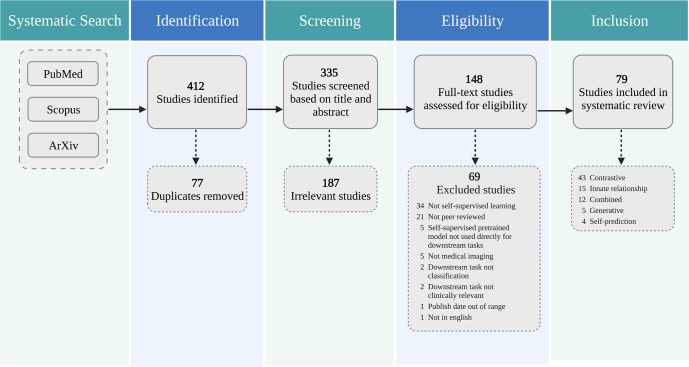
“We screened a total of 412 relevant studies and included 79 papers for data extraction and analysis.”
- Also stated in: § Results · plain
“A total of 79 studies fulfilled our eligibility criteria and were included for systematic review and data extraction.”
- Also stated in: § Results · plain
“Out of 412 studies identified from PubMed, Scopus, and ArXiv, 79 studies were included in the systematic review.”
§ Self-supervised learning for medical image classification: a systematic review and implementation guidelines > Abstract
plain- Asserted: passes — The authors put it forward as true.
- Checkable: passes — It can be checked against evidence.
- Load-bearing: passes — The paper’s conclusions depend on it.
- Based: passes — The paper gives a reason why it holds.
- Also stated in: § Results · plain
None of the sources cited for this claim have been checked yet.
In the paper
“Nine of these studies designed their innate relationship pre-text task based on different image transformations, including rotation prediction44–47, horizontal flip prediction48, reordering shuffled slices49, and patch order prediction46,50–52.”
§ Self-supervised learning for medical image classification: a systematic review and implementation guidelines > Results > Innate relationship
What the sources say
- Not checked yetcites [44] Vats, A., Pedersen, M. & Mohammed, A. A Preliminary Analysis of Self-Supervision for Wireless Capsule Endoscopy. In 2021 9th European Workshop on Visual Information Processing (EUVIP) 1–6 (2021). source
- Not checked yetcites [45] Ewen, N. & Khan, N. Online Unsupervised Learning For Domain Shift In Covid-19 CT Scan Datasets. In 2021 IEEE International Conference on Autonomous Systems (ICAS) 1–5 (2021). source
- Not checked yetcites [46] Zhu, Y. Self-supervised Learning for Small Shot COVID-19 Classification. In 2021 3rd International Conference on Information Technology and Computer Communications 36–40 (2021). source
- Not checked yetcites [47] Long, Y. Pneumonia Identification with Self-supervised Learning and Transfer Learning. In Application of Intelligent Systems in Multi-modal Information Analytics 627–635 (2021). source
- Not checked yetcites [48] Ewen, N. & Khan, N. Targeted Self Supervision For Classification On A Small Covid-19 Ct Scan Dataset. In 2021 IEEE 18th International Symposium on Biomedical Imaging (ISBI) 1481–1485 (2021). source
- Not checked yetcites [49] Jiao, J., Droste, R., Drukker, L., Papageorghiou, A. T. & Alison Noble, J. Self-supervised Representation Learning for Ultrasound Video. In 2020 IEEE 17th International Symposium on Biomedical Imaging (ISBI) (2020). source
plain- Asserted: passes — The authors put it forward as true.
- Checkable: passes — It can be checked against evidence.
- Load-bearing: unclear — It is unclear whether the paper’s conclusions depend on it.
- Based: passes — The paper gives a reason why it holds.
A result the paper reports from its own data — it cites no other source for it, so there is none to check. The quote shows it is in the paper.
In the paper
“The remaining six studies designed clinically relevant pre-text tasks by exploiting the unique properties of medical images.”
§ Self-supervised learning for medical image classification: a systematic review and implementation guidelines > Results > Innate relationship
plain- Asserted: passes — The authors put it forward as true.
- Checkable: passes — It can be checked against evidence.
- Load-bearing: unclear — It is unclear whether the paper’s conclusions depend on it.
- Based: passes — The paper gives a reason why it holds.
A result the paper reports from its own data — it cites no other source for it, so there is none to check. The quote shows it is in the paper.
In the paper
“Innate relationship was used in 15 out of 79 studies (Table 1).”
§ Self-supervised learning for medical image classification: a systematic review and implementation guidelines > Results > Innate relationship
plain- Asserted: passes — The authors put it forward as true.
- Checkable: passes — It can be checked against evidence.
- Load-bearing: unclear — It is unclear whether the paper’s conclusions depend on it.
- Based: passes — The paper gives a reason why it holds.
A result the paper reports from its own data — it cites no other source for it, so there is none to check. The quote shows it is in the paper.
In the paper
“We screened a total of 412 relevant studies and included 79 papers for data extraction and analysis.”
- Also stated in: § Results · plain
“A total of 412 unique studies were identified through our systematic search.”
- Also stated in: § Results · plain
“Out of 412 studies identified from PubMed, Scopus, and ArXiv, 79 studies were included in the systematic review.”
§ Self-supervised learning for medical image classification: a systematic review and implementation guidelines > Abstract
plain- Asserted: passes — The authors put it forward as true.
- Checkable: passes — It can be checked against evidence.
- Load-bearing: unclear — It is unclear whether the paper’s conclusions depend on it.
- Based: passes — The paper gives a reason why it holds.
- Also stated in: § Results · plain
A result the paper reports from its own data — it cites no other source for it, so there is none to check. The quote shows it is in the paper.
In the paper
“After removing duplicates and excluding studies based on title and abstract using our study selection criteria (see Methods), 148 studies remained for full-text screening.”
§ Self-supervised learning for medical image classification: a systematic review and implementation guidelines > Results
plain- Asserted: passes — The authors put it forward as true.
- Checkable: passes — It can be checked against evidence.
- Load-bearing: unclear — It is unclear whether the paper’s conclusions depend on it.
- Based: passes — The paper gives a reason why it holds.
A result the paper reports from its own data — it cites no other source for it, so there is none to check. The quote shows it is in the paper.
In the paper
“On average, clinically relevant pre-text tasks achieved greater improvements in performance over transformation-based pre-text tasks, when compared to purely supervised methods (13.7% vs. 5.03%).”
§ Self-supervised learning for medical image classification: a systematic review and implementation guidelines > Results > Innate relationship
plaindirect- Asserted: passes — The authors put it forward as true.
- Checkable: passes — It can be checked against evidence.
- Load-bearing: passes — The paper’s conclusions depend on it.
- Based: passes — The paper gives a reason why it holds.
A result the paper reports from its own data — it cites no other source for it, so there is none to check. The quote shows it is in the paper.
In the paper
“Generative SSL was used in 3 out of 79 studies (Table 1).”
§ Self-supervised learning for medical image classification: a systematic review and implementation guidelines > Results > Generative
plain- Asserted: passes — The authors put it forward as true.
- Checkable: passes — It can be checked against evidence.
- Load-bearing: unclear — It is unclear whether the paper’s conclusions depend on it.
- Based: passes — The paper gives a reason why it holds.
- Probably not a substantial claim. 21
- It may state two separate claims as one. 28
The paper states this without a source or data behind it here, so there is nothing to check it against. The quote shows it is in the paper.
In the paper
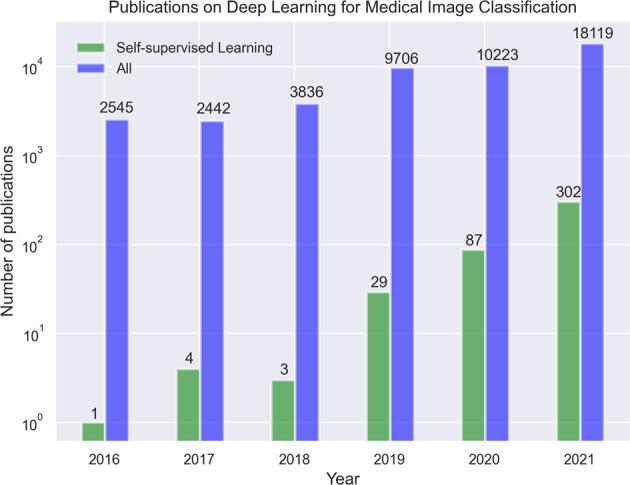
“While there is already a growing trend in recent medical imaging AI literature to leverage SSL (Fig. 1)”
§ Self-supervised learning for medical image classification: a systematic review and implementation guidelines > Introduction
plain- Asserted: passes — The authors put it forward as true.
- Checkable: passes — It can be checked against evidence.
- Load-bearing: fails — The paper’s conclusions may not depend on it.
- Based: fails — The paper may give no reason why it holds.
Probably not a substantial claim. The paper’s conclusions may not depend on it. The paper may give no reason why it holds.
None of the sources cited for this claim have been checked yet.
In the paper
“Of the three studies, two reported comparisons with purely supervised models and showed relative improvements of 16.6%58 and 24.5%56 with self-supervised learning.”
§ Self-supervised learning for medical image classification: a systematic review and implementation guidelines > Results > Generative
What the sources say
- Not checked yetcites [58] Zhao, Q., Liu, Z., Adeli, E. & Pohl, K. M. Longitudinal Self-Supervised Learning. Med. Image Anal. 71, (2021). source
- Not checked yetcites [56] Gamper, J. & Rajpoot, N. Multiple Instance Captioning: Learning Representations from Histopathology Textbooks and Articles. In 2021 IEEE/CVF Conference on Computer Vision and Pattern Recognition (CVPR) 16544–16554 (2021). source
plaindirect- Asserted: passes — The authors put it forward as true.
- Checkable: passes — It can be checked against evidence.
- Load-bearing: unclear — It is unclear whether the paper’s conclusions depend on it.
- Based: passes — The paper gives a reason why it holds.
It may state two separate claims as one.
A result the paper reports from its own data — it cites no other source for it, so there is none to check. The quote shows it is in the paper.
In the paper
“Out of all innate relationship based studies, ten compared performance to those of supervised pre-trained models and eight of them showed improvement in performance.”
§ Self-supervised learning for medical image classification: a systematic review and implementation guidelines > Results > Innate relationship
plain- Asserted: passes — The authors put it forward as true.
- Checkable: passes — It can be checked against evidence.
- Load-bearing: unclear — It is unclear whether the paper’s conclusions depend on it.
- Based: passes — The paper gives a reason why it holds.
It may state two separate claims as one.
None of the sources cited for this claim have been checked yet.
In the paper
“The tasks were focused on histopathological classification, where the majority focused on colorectal cancer classification68,84–87.”
§ Self-supervised learning for medical image classification: a systematic review and implementation guidelines > Discussion
What the sources say
- Not checked yetcites [68] Ke, J., Shen, Y., Liang, X. & Shen, D. Contrastive Learning Based Stain Normalization Across Multiple Tumor in Histopathology. In Medical Image Computing and Computer Assisted Intervention – MICCAI 2021 571–580 (Springer International Publishing, 2021). source
- Not checked yetcites [84] Yang, P., Hong, Z., Yin, X., Zhu, C. & Jiang, R. Self-supervised Visual Representation Learning for Histopathological Images. In Medical Image Computing and Computer Assisted Intervention – MICCAI 2021 47–57 (Springer International Publishing, 2021). source
- Not checked yetcites [85] Ciga, O., Xu, T. & Martel, A. L. Self supervised contrastive learning for digital histopathology. Machine Learning with Applications 7, (2022). source
- Not checked yetcites [86] Li, J., Lin, T. & Xu, Y. SSLP: Spatial Guided Self-supervised Learning on Pathological Images. In Medical Image Computing and Computer Assisted Intervention – MICCAI 2021 3–12 (2021). source
- Not checked yetcites [87] Srinidhi, C. L., Kim, S. W., Chen, F.-D. & Martel, A. L. Self-supervised driven consistency training for annotation efficient histopathology image analysis. Med. Image Anal. 75, (2021). source
plain- Asserted: passes — The authors put it forward as true.
- Checkable: passes — It can be checked against evidence.
- Load-bearing: unclear — It is unclear whether the paper’s conclusions depend on it.
- Based: passes — The paper gives a reason why it holds.
It may state two separate claims as one.
The paper states this without a source or data behind it here, so there is nothing to check it against. The quote shows it is in the paper.
In the paper
“However, it is important to note that combined strategies are typically the proposed method in the manuscripts, and thus publication bias might have resulted in this trend.”
§ Self-supervised learning for medical image classification: a systematic review and implementation guidelines > Discussion
plain- Asserted: passes — The authors put it forward as true.
- Checkable: passes — It can be checked against evidence.
- Load-bearing: fails — The paper’s conclusions may not depend on it.
- Based: passes — The paper gives a reason why it holds.
Probably not a substantial claim. The paper’s conclusions may not depend on it.
A result the paper reports from its own data — it cites no other source for it, so there is none to check. The quote shows it is in the paper.
In the paper
“Thirty-six studies compared contrastive SSL pre-training to supervised pre-training and reported an average improvement in performance of 6.35%.”
§ Self-supervised learning for medical image classification: a systematic review and implementation guidelines > Results > Contrastive
plaindirect- Asserted: passes — The authors put it forward as true.
- Checkable: passes — It can be checked against evidence.
- Load-bearing: passes — The paper’s conclusions depend on it.
- Based: passes — The paper gives a reason why it holds.
It may state two separate claims as one.
The paper states this without a source or data behind it here, so there is nothing to check it against. The quote shows it is in the paper.
In the paper
“Similar to radiology, this field is centered around medical imaging in the form of whole slide images.”
§ Self-supervised learning for medical image classification: a systematic review and implementation guidelines > Discussion
plain- Asserted: passes — The authors put it forward as true.
- Checkable: passes — It can be checked against evidence.
- Load-bearing: fails — The paper’s conclusions may not depend on it.
- Based: passes — The paper gives a reason why it holds.
Probably not a substantial claim. The paper’s conclusions may not depend on it.
A result the paper reports from its own data — it cites no other source for it, so there is none to check. The quote shows it is in the paper.
In the paper
“Among the SSL baselines, SimCLR was most frequently compared (16/26), followed by autoencoders (11/26) and MoCo (9/26).”
§ Self-supervised learning for medical image classification: a systematic review and implementation guidelines > Discussion
plain- Asserted: passes — The authors put it forward as true.
- Checkable: passes — It can be checked against evidence.
- Load-bearing: unclear — It is unclear whether the paper’s conclusions depend on it.
- Based: passes — The paper gives a reason why it holds.
It may state two separate claims as one.
None of the sources cited for this claim have been checked yet.
In the paper
“Two of the five studies compared their approach to models without self-supervised pre-training and reported slight relative improvements in performance of 1.12%67 and 0.690%63.”
§ Self-supervised learning for medical image classification: a systematic review and implementation guidelines > Results > Self-prediction
What the sources say
- Not checked yetcites [67] Park, J., Kwak, I.-Y. & Lim, C. A Deep Learning Model with Self-Supervised Learning and Attention Mechanism for COVID-19 Diagnosis Using Chest X-ray Images. Electronics 10, 1996 (2021). source
- Not checked yetcites [63] Liu, C. et al. TN-USMA Net: Triple normalization-based gastrointestinal stromal tumors classification on multicenter EUS images with ultrasound-specific pre-training and meta attention. Med. Phys. 48, 7199–7214 (2021). source
plaindirect- Asserted: passes — The authors put it forward as true.
- Checkable: passes — It can be checked against evidence.
- Load-bearing: unclear — It is unclear whether the paper’s conclusions depend on it.
- Based: passes — The paper gives a reason why it holds.
It may state two separate claims as one.
A result the paper reports from its own data — it cites no other source for it, so there is none to check. The quote shows it is in the paper.
In the paper
“Furthermore, even though self-supervised learning strategies generate label-efficient representations, the learning process typically requires a relatively large amount of unlabeled data.”
§ Self-supervised learning for medical image classification: a systematic review and implementation guidelines > Discussion > Implementation guidelines
plaindirect- Asserted: passes — The authors put it forward as true.
- Checkable: passes — It can be checked against evidence.
- Load-bearing: unclear — It is unclear whether the paper’s conclusions depend on it.
- Based: passes — The paper gives a reason why it holds.
It may state two separate claims as one.
None of the sources cited for this claim have been checked yet.
In the paper
“The remaining studies explored multiple other tasks and many focused on classification of malignant disorders such as breast cancer56,61,88, skin cancer89, and lung cancer59.”
§ Self-supervised learning for medical image classification: a systematic review and implementation guidelines > Discussion
What the sources say
- Not checked yetcites [56] Gamper, J. & Rajpoot, N. Multiple Instance Captioning: Learning Representations from Histopathology Textbooks and Articles. In 2021 IEEE/CVF Conference on Computer Vision and Pattern Recognition (CVPR) 16544–16554 (2021). source
- Not checked yetcites [61] Wang, X. et al. TransPath: Transformer-Based Self-supervised Learning for Histopathological Image Classification. In Medical Image Computing and Computer Assisted Intervention – MICCAI 2021 186–195 (2021). source
- Not checked yetcites [88] Dehaene, O., Camara, A., Moindrot, O., de Lavergne, A. & Courtiol, P. Self-Supervision Closes the Gap Between Weak and Strong Supervision in Histology. in ML4H 2020 NeurIPS workshop (2020).
- Not checked yetcites [89] Liu, Q. et al. SimTriplet: Simple Triplet Representation Learning with a Single GPU. In Medical Image Computing and Computer Assisted Intervention–MICCAI 2021. Part II 24, 102–112 (2021). source
- Not checked yetcites [59] Li, B., Li, Y. & Eliceiri, K. W. Dual-stream Multiple Instance Learning Network for Whole Slide Image Classification with Self-supervised Contrastive Learning. In Proceedings of the IEEE/CVF conference on computer vision and pattern recognition. (2021). source
plain- Asserted: passes — The authors put it forward as true.
- Checkable: passes — It can be checked against evidence.
- Load-bearing: unclear — It is unclear whether the paper’s conclusions depend on it.
- Based: passes — The paper gives a reason why it holds.
It may state two separate claims as one.
None of the sources cited for this claim have been checked yet.
In the paper
“A particularly interesting medical task that was explored was classification of psychiatric diseases or psychiatric traits using fMRI57,62,90.”
§ Self-supervised learning for medical image classification: a systematic review and implementation guidelines > Discussion
What the sources say
- Not checked yetcites [57] Osin, J. et al. Learning Personal Representations from fMRI by Predicting Neurofeedback Performance. In Medical Image Computing and Computer Assisted Intervention – MICCAI 2020 469–478 (2020). source
- Not checked yetcites [62] Dufumier, B. et al. Contrastive Learning with Continuous Proxy Meta-data for 3D MRI Classification. In Medical Image Computing and Computer Assisted Intervention – MICCAI 2021 58–68 (2021). source
- Not checked yetcites [90] Hashimoto, Y., Ogata, Y., Honda, M. & Yamashita, Y. Deep Feature Extraction for Resting-State Functional MRI by Self-Supervised Learning and Application to Schizophrenia Diagnosis. Front. Neurosci. 15, 696853 (2021). source
plain- Asserted: passes — The authors put it forward as true.
- Checkable: passes — It can be checked against evidence.
- Load-bearing: fails — The paper’s conclusions may not depend on it.
- Based: passes — The paper gives a reason why it holds.
Probably not a substantial claim. The paper’s conclusions may not depend on it.
A result the paper reports from its own data — it cites no other source for it, so there is none to check. The quote shows it is in the paper.
In the paper
“Eight of the studies that combined different strategies compared self-supervised pre-training with purely supervised approaches, all of which reported performance improvement (0.140–8.29%).”
§ Self-supervised learning for medical image classification: a systematic review and implementation guidelines > Results > Combined approaches
plaindirect- Asserted: passes — The authors put it forward as true.
- Checkable: passes — It can be checked against evidence.
- Load-bearing: passes — The paper’s conclusions depend on it.
- Based: passes — The paper gives a reason why it holds.
It may state two separate claims as one.
A result the paper reports from its own data — it cites no other source for it, so there is none to check. The quote shows it is in the paper.
In the paper
“SimCLR, MoCo and BYOL were the three most used frameworks, applied in 13, 8, and 3 papers, respectively.”
§ Self-supervised learning for medical image classification: a systematic review and implementation guidelines > Results > Contrastive
plain- Asserted: passes — The authors put it forward as true.
- Checkable: passes — It can be checked against evidence.
- Load-bearing: unclear — It is unclear whether the paper’s conclusions depend on it.
- Based: passes — The paper gives a reason why it holds.
It may state two separate claims as one.
The paper states this without a source or data behind it here, so there is nothing to check it against. The quote shows it is in the paper.
In the paper
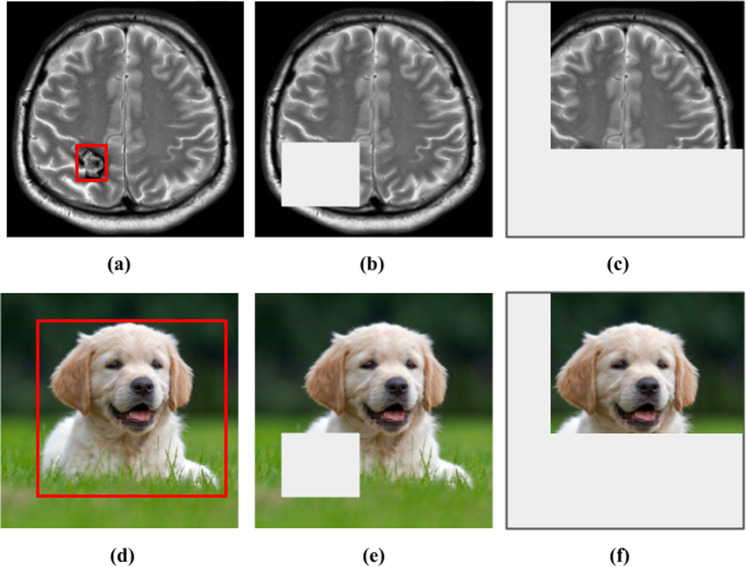
“b and c Masking and cropping operations can obscure the cavernoma and alter the semantic meaning of the image, as the MRI-scan no longer exhibits any abnormality.”
§ Self-supervised learning for medical image classification: a systematic review and implementation guidelines > Discussion > Implementation guidelines
plaindirectSingle case- Asserted: passes — The authors put it forward as true.
- Checkable: passes — It can be checked against evidence.
- Load-bearing: passes — The paper’s conclusions depend on it.
- Based: passes — The paper gives a reason why it holds.
It may state two separate claims as one.
A result the paper reports from its own data — it cites no other source for it, so there is none to check. The quote shows it is in the paper.
In the paper
“Furthermore, we are unable to aggregate or statistically compare the effects of each self-supervised learning strategy on performance gain, since the included studies use different imaging modalities, report different performance metrics, and investigate different objectives.”
§ Self-supervised learning for medical image classification: a systematic review and implementation guidelines > Discussion > Limitations
plain- Asserted: passes — The authors put it forward as true.
- Checkable: passes — It can be checked against evidence.
- Load-bearing: passes — The paper’s conclusions depend on it.
- Based: passes — The paper gives a reason why it holds.
It may state two separate claims as one.
The paper states this without a source or data behind it here, so there is nothing to check it against. The quote shows it is in the paper.
In the paper
“d Image of a dog (bounded in red), (e) and (f) Masking and cropping operations do not obscure the dog nor alter the semantic meaning of the image.”
§ Self-supervised learning for medical image classification: a systematic review and implementation guidelines > Discussion > Implementation guidelines
plainSingle case- Asserted: passes — The authors put it forward as true.
- Checkable: passes — It can be checked against evidence.
- Load-bearing: fails — The paper’s conclusions may not depend on it.
- Based: passes — The paper gives a reason why it holds.
Probably not a substantial claim. The paper’s conclusions may not depend on it. It may state two separate claims as one.
None of the sources cited for this claim have been checked yet.
In the paper
“With such an immense cognitive burden placed on radiologists, delays in diagnosis and diagnostic errors are unavoidable6,7.”
§ Self-supervised learning for medical image classification: a systematic review and implementation guidelines > Introduction
What the sources say
- Not checked yetcites [6] Alonso-Martínez, J. L., Sánchez, F. J. A. & Echezarreta, M. A. U. Delay and misdiagnosis in sub-massive and non-massive acute pulmonary embolism. Eur. J. Intern. Med. 21, 278–282 (2010). source
- Not checked yetcites [7] Hendriksen, J. M. T. et al. Clinical characteristics associated with diagnostic delay of pulmonary embolism in primary care: a retrospective observational study. BMJ Open 7, e012789 (2017). source
plaindirect- Asserted: passes — The authors put it forward as true.
- Checkable: passes — It can be checked against evidence.
- Load-bearing: passes — The paper’s conclusions depend on it.
- Based: passes — The paper gives a reason why it holds.
It may state two separate claims as one.
None of the sources cited for this claim have been checked yet.
In the paper
“These pre-trained large language models18,19 are capable of achieving state-of-the-art results for a wide range of NLP tasks, and have shown the ability to perform well on new tasks with only a fraction of the labeled data that traditional supervised learning techniques require.”
§ Self-supervised learning for medical image classification: a systematic review and implementation guidelines > Introduction
What the sources say
- Not checked yetcites [18] Devlin, J., Chang, M.-W., Lee, K. & Toutanova, K. BERT: Pre-training of Deep Bidirectional Transformers for Language Understanding. Preprint at https://arxiv.org/abs/1810.04805 (2018).
- Not checked yetcites [19] Brown, T., Mann, B. & Ryder, N. Language models are few-shot learners. Adv. Neural Inf. Process. Syst. (2020).
plaindirect- Asserted: passes — The authors put it forward as true.
- Checkable: passes — It can be checked against evidence.
- Load-bearing: fails — The paper’s conclusions may not depend on it.
- Based: passes — The paper gives a reason why it holds.
Probably not a substantial claim. The paper’s conclusions may not depend on it. It may state two separate claims as one.
A conclusion the paper draws from its own results — it cites no other source for it, so there is none to check. The quote shows it is in the paper.
In the paper
“Reducing the number of manual annotations required to train medical imaging models will significantly reduce both the cost and time required for model development, making automated systems more accessible to different specialties and hospitals, thereby reducing workload for radiologists and potentially improving patient care.”
§ Self-supervised learning for medical image classification: a systematic review and implementation guidelines > Introduction
boosteddirect- Asserted: passes — The authors put it forward as true.
- Checkable: passes — It can be checked against evidence.
- Load-bearing: passes — The paper’s conclusions depend on it.
- Based: fails — The paper may give no reason why it holds.
Probably not a substantial claim. The paper may give no reason why it holds. It may state two separate claims as one.
- Rests on an assumption: Annotating medical imaging datasets requires domain expertize, making large-scale annotations cost-prohibitive and time-consuming.
- Rests on an assumption: The current success of deep learning has been largely dominated by supervised learning frameworks, which typically require large-scale labeled datasets to achieve high performance.
- Rests on an assumption: The inability to generalize can be largely due to the process of supervised learning, which encourages the model to mainly learn features heavily correlated with specific labels rather than general features representative of the whole data distribution.
- Rests on an assumption: In a healthcare system where a myriad of opportunities and possibilities for automation exist, it is practically impossible to curate labeled datasets for all tasks, modalities, and outcomes for training supervised models.
What the paper did — it cites no source for this, so there is none to check. The quote shows it is in the paper.
In the paper
“The authors independently screened all records for eligibility.”
§ Self-supervised learning for medical image classification: a systematic review and implementation guidelines > Results
plain- Asserted: passes — The authors put it forward as true.
- Checkable: passes — It can be checked against evidence.
- Load-bearing: fails — The paper’s conclusions may not depend on it.
- Based: passes — The paper gives a reason why it holds.
Probably not a substantial claim. The paper’s conclusions may not depend on it.
None of the sources cited for this claim have been checked yet.
In the paper
“Examples of augmentations and transformations that alter the semantic meaning of medical images144 but not natural images145.”
§ Self-supervised learning for medical image classification: a systematic review and implementation guidelines > Discussion > Implementation guidelines
What the sources say
- Not checked yetcites [144] Hellerhoff. File:Kavernom rechts parietal 59M - MR - 001.jpg. Wikimedia https://commons.wikimedia.org/wiki/File:Kavernom_rechts_parietal_59M_-_MR_-_001.jpg (2022).
- Not checked yetcites [145] Matio, H. File:Dog Breeds.jpg. Wikimedia Commons https://commons.wikimedia.org/wiki/File:Dog_Breeds.jpg (2019).
plaindirect- Asserted: passes — The authors put it forward as true.
- Checkable: passes — It can be checked against evidence.
- Load-bearing: passes — The paper’s conclusions depend on it.
- Based: passes — The paper gives a reason why it holds.
It may state two separate claims as one.
In the paper
“Nevertheless, using federated learning, Yan et al. have demonstrated the possibility of training self-supervised models with data from multiple healthcare centers without the need for explicitly sharing data, and have shown improvement in robustness and performance over models trained using data from only one institution97.”
§ Self-supervised learning for medical image classification: a systematic review and implementation guidelines > Discussion > Implementation guidelines
What the sources say
- Not checked yetcites [97] Yan, R. et al. Label-Efficient Self-Supervised Federated Learning for Tackling Data Heterogeneity in Medical Imaging. IEEE Transactions on Medical Imaging (2023). source
boosteddirect- Asserted: passes — The authors put it forward as true.
- Checkable: passes — It can be checked against evidence.
- Load-bearing: unclear — It is unclear whether the paper’s conclusions depend on it.
- Based: passes — The paper gives a reason why it holds.
It may state two separate claims as one.
- Rests on an assumption: Curating large-scale medical image datasets from multiple institutions is often challenged by the difficulty of sharing patient data while preserving patient privacy.
In the paper
“For instance, for natural image datasets, MoCo outperforms MAE by training a linear model on extracted features (linear probing), while MAE achieves better performance than MoCo as the number of fine-tune layers increases41.”
§ Self-supervised learning for medical image classification: a systematic review and implementation guidelines > Discussion > Implementation guidelines
What the sources say
- Not checked yetcites [41] He, K. et al. Masked Autoencoders Are Scalable Vision Learners. Proc. IEEE/CVF Conf. Comput. Vis. Pattern Recognit. (CVPR) 2022, 16000–16009 (2022).
plaindirect- Asserted: passes — The authors put it forward as true.
- Checkable: passes — It can be checked against evidence.
- Load-bearing: unclear — It is unclear whether the paper’s conclusions depend on it.
- Based: passes — The paper gives a reason why it holds.
It may state two separate claims as one.
A conclusion the paper draws from its own results — it cites no other source for it, so there is none to check. The quote shows it is in the paper.
In the paper
“It is worth noting that representations learned using certain SSL strategies can be relatively more linearly separable, while representations from other strategies can achieve better performance when more layers or the entire model are fine-tuned.”
§ Self-supervised learning for medical image classification: a systematic review and implementation guidelines > Discussion > Implementation guidelines
plainconditional- Asserted: passes — The authors put it forward as true.
- Checkable: passes — It can be checked against evidence.
- Load-bearing: unclear — It is unclear whether the paper’s conclusions depend on it.
- Based: passes — The paper gives a reason why it holds.
It may state two separate claims as one.
A conclusion the paper draws from its own results — it cites no other source for it, so there is none to check. The quote shows it is in the paper.
In the paper
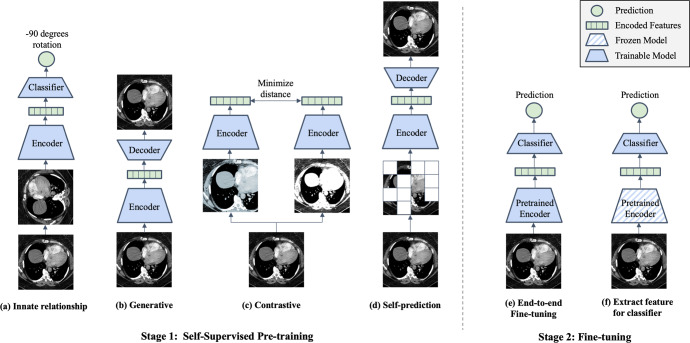
“The random masking operation often utilized by self-prediction self-supervised learning methods may also alter a medical image’s semantic meaning by removing image regions with diseases or abnormalities (Fig. 5b).”
§ Self-supervised learning for medical image classification: a systematic review and implementation guidelines > Discussion > Implementation guidelines
hedgedconditional- Asserted: passes — The authors put it forward as true.
- Checkable: passes — It can be checked against evidence.
- Load-bearing: fails — The paper’s conclusions may not depend on it.
- Based: passes — The paper gives a reason why it holds.
Probably not a substantial claim. The paper’s conclusions may not depend on it.
A conclusion the paper draws from its own results — it cites no other source for it, so there is none to check. The quote shows it is in the paper.
In the paper
“Factors such as the degree of domain shift between SSL pre-training data and downstream task data could also affect the linear separability of the representations.”
§ Self-supervised learning for medical image classification: a systematic review and implementation guidelines > Discussion > Implementation guidelines
hedgedconditional- Asserted: passes — The authors put it forward as true.
- Checkable: passes — It can be checked against evidence.
- Load-bearing: fails — The paper’s conclusions may not depend on it.
- Based: fails — The paper may give no reason why it holds.
Probably not a substantial claim. The paper’s conclusions may not depend on it. The paper may give no reason why it holds.
The paper states this without a source or data behind it here, so there is nothing to check it against. The quote shows it is in the paper.
In the paper
“Therefore, these methods typically apply strong transformations to the original image and encourage the model to learn similar global representations for images with similar semantic meanings.”
§ Self-supervised learning for medical image classification: a systematic review and implementation guidelines > Discussion > Implementation guidelines
plaindirect- Asserted: passes — The authors put it forward as true.
- Checkable: passes — It can be checked against evidence.
- Load-bearing: passes — The paper’s conclusions depend on it.
- Based: passes — The paper gives a reason why it holds.
It may state two separate claims as one.
A conclusion the paper draws from its own results — it cites no other source for it, so there is none to check. The quote shows it is in the paper.
In the paper
“The unique attributes of medical images can also be utilized for creating relevant pre-text tasks.”
§ Self-supervised learning for medical image classification: a systematic review and implementation guidelines > Discussion > Implementation guidelines
plainconditional- Asserted: passes — The authors put it forward as true.
- Checkable: passes — It can be checked against evidence.
- Load-bearing: fails — The paper’s conclusions may not depend on it.
- Based: passes — The paper gives a reason why it holds.
Probably not a substantial claim. The paper’s conclusions may not depend on it.
What the paper did — it cites no source for this, so there is none to check. The quote shows it is in the paper.
In the paper
“In cases where consensus could not be achieved a fourth arbitrating researcher was consulted (A.S.C.).”
§ Self-supervised learning for medical image classification: a systematic review and implementation guidelines > Methods > Study selection
plain- Asserted: passes — The authors put it forward as true.
- Checkable: passes — It can be checked against evidence.
- Load-bearing: fails — The paper’s conclusions may not depend on it.
- Based: passes — The paper gives a reason why it holds.
Probably not a substantial claim. The paper’s conclusions may not depend on it.
In the paper
“We also limited our search to only consider papers published after 2012, which excluded papers that applied self-supervised learning prior to the era of deep learning for computer vision108.”
§ Self-supervised learning for medical image classification: a systematic review and implementation guidelines > Discussion > Limitations
What the sources say
- Not checked yetcites [108] Russakovsky, O. et al. ImageNet Large Scale Visual Recognition Challenge. Int. J. Comput. Vis. 115, 211–252 (2015). source
plaindirect- Asserted: passes — The authors put it forward as true.
- Checkable: passes — It can be checked against evidence.
- Load-bearing: passes — The paper’s conclusions depend on it.
- Based: passes — The paper gives a reason why it holds.
It may state two separate claims as one.
In the paper
“Rivail et al. proposed a self-supervised approach to model disease progression by estimating the time interval between pairs of optical coherence tomography (OCT) scans from the same patient104.”
§ Self-supervised learning for medical image classification: a systematic review and implementation guidelines > Discussion > Implementation guidelines
What the sources say
- Not checked yetcites [104] Rivail, A. et al. Modeling Disease Progression in Retinal OCTs with Longitudinal Self-supervised Learning. in Predictive Intelligence in Medicine 44–52 (2019). source
plain- Asserted: passes — The authors put it forward as true.
- Checkable: passes — It can be checked against evidence.
- Load-bearing: fails — The paper’s conclusions may not depend on it.
- Based: passes — The paper gives a reason why it holds.
Probably not a substantial claim. The paper’s conclusions may not depend on it.
A conclusion the paper draws from its own results — it cites no other source for it, so there is none to check. The quote shows it is in the paper.
In the paper
“For this review paper, publication bias can be a considerable limitation due to disproportionately reported positive results in the literature, which can lead to overestimation of the benefits of self-supervised learning.”
§ Self-supervised learning for medical image classification: a systematic review and implementation guidelines > Discussion > Limitations
plaindirect- Asserted: passes — The authors put it forward as true.
- Checkable: passes — It can be checked against evidence.
- Load-bearing: fails — The paper’s conclusions may not depend on it.
- Based: fails — The paper may give no reason why it holds.
Probably not a substantial claim. The paper’s conclusions may not depend on it. The paper may give no reason why it holds. It may state two separate claims as one.
A conclusion the paper draws from its own results — it cites no other source for it, so there is none to check. The quote shows it is in the paper.
In the paper
“Lastly, our study selection criteria only included literature for the task of medical image classification, which limits the scope of this review paper, since we recognize that self-supervised pre-trained models can also be fine-tuned for other important medical tasks, including segmentation, regression, and registration.”
§ Self-supervised learning for medical image classification: a systematic review and implementation guidelines > Discussion > Limitations
plainconditional- Asserted: passes — The authors put it forward as true.
- Checkable: passes — It can be checked against evidence.
- Load-bearing: fails — The paper’s conclusions may not depend on it.
- Based: fails — The paper may give no reason why it holds.
Probably not a substantial claim. The paper’s conclusions may not depend on it. The paper may give no reason why it holds.
In the paper
“This systematic review was conducted based on the PRISMA guidelines109.”
§ Self-supervised learning for medical image classification: a systematic review and implementation guidelines > Methods
What the sources say
- Not checked yetcites [109] Page, M. J. et al. “The PRISMA 2020 statement: an updated guideline for reporting systematic reviews.” International journal of surgery. 88 (2021).
plain- Asserted: passes — The authors put it forward as true.
- Checkable: passes — It can be checked against evidence.
- Load-bearing: fails — The paper’s conclusions may not depend on it.
- Based: passes — The paper gives a reason why it holds.
Probably not a substantial claim. The paper’s conclusions may not depend on it.
What the paper did — it cites no source for this, so there is none to check. The quote shows it is in the paper.
In the paper
“Study selection was performed by three independent researchers (S.-C.H., A.P., and M.J.), and disagreements were resolved through discussion.”
§ Self-supervised learning for medical image classification: a systematic review and implementation guidelines > Methods > Study selection
plain- Asserted: passes — The authors put it forward as true.
- Checkable: passes — It can be checked against evidence.
- Load-bearing: passes — The paper’s conclusions depend on it.
- Based: passes — The paper gives a reason why it holds.
Probably not a substantial claim. It may state two separate claims as one.
In the paper
“Jiao et al. cleverly leveraged the correlation between fetal ultrasonography and the narrative speech of the sonographer to create a pre-text task for self-supervision, and subsequently used the learned representations for downstream standard plane classification on sonograms53.”
§ Self-supervised learning for medical image classification: a systematic review and implementation guidelines > Discussion > Implementation guidelines
What the sources say
- Not checked yetcites [53] Jiao, J. et al. Self-Supervised Contrastive Video-Speech Representation Learning for Ultrasound. In Medical Image Computing and Computer Assisted Intervention – MICCAI 2020 534–543 (2020). source
plaindirect- Asserted: passes — The authors put it forward as true.
- Checkable: passes — It can be checked against evidence.
- Load-bearing: unclear — It is unclear whether the paper’s conclusions depend on it.
- Based: passes — The paper gives a reason why it holds.
It may state two separate claims as one.
In the paper
“For example, Taleb et al. proposed a multimodal contrastive learning strategy between retinal fundus images and genetics data and showed improvement in performance over single modality pre-training105.”
§ Self-supervised learning for medical image classification: a systematic review and implementation guidelines > Discussion > Implementation guidelines
What the sources say
- Not checked yetcites [105] Taleb A., Kirchler M. & Monti R. ContIG: Self-supervised Multimodal Contrastive Learning for Medical Imaging with Genetics. In Proceedings of the IEEE/CVF Conference on Computer Vision and Pattern Recognition. 20908–20921 (2022). source
plaindirect- Asserted: passes — The authors put it forward as true.
- Checkable: passes — It can be checked against evidence.
- Load-bearing: unclear — It is unclear whether the paper’s conclusions depend on it.
- Based: passes — The paper gives a reason why it holds.
It may state two separate claims as one.
What the paper did — it cites no source for this, so there is none to check. The quote shows it is in the paper.
In the paper
“In addition, subjectivity may have been introduced when categorizing the self-supervised learning strategy in each paper, especially for studies that implemented novel, unconventional, or a mixture of methods.”
§ Self-supervised learning for medical image classification: a systematic review and implementation guidelines > Discussion > Limitations
hedgedconditional- Asserted: passes — The authors put it forward as true.
- Checkable: passes — It can be checked against evidence.
- Load-bearing: fails — The paper’s conclusions may not depend on it.
- Based: passes — The paper gives a reason why it holds.
Probably not a substantial claim. The paper’s conclusions may not depend on it.
What the paper did — it cites no source for this, so there is none to check. The quote shows it is in the paper.
In the paper
“The search encompassed papers published between January 2012 and May 2021.”
§ Self-supervised learning for medical image classification: a systematic review and implementation guidelines > Methods > Search strategy
plain- Asserted: passes — The authors put it forward as true.
- Checkable: passes — It can be checked against evidence.
- Load-bearing: passes — The paper’s conclusions depend on it.
- Based: passes — The paper gives a reason why it holds.
Probably not a substantial claim.
None of the sources cited for this claim have been checked yet.
In the paper
“Several studies have utilized these medical reports to provide supervision signals during self-supervised learning and shown label efficiency for downstream tasks60,106.”
§ Self-supervised learning for medical image classification: a systematic review and implementation guidelines > Discussion > Implementation guidelines
What the sources say
- Not checked yetcites [60] Ji, Z. et al. Improving Joint Learning of Chest X-Ray and Radiology Report by Word Region Alignment. In Machine Learning in Medical Imaging 110–119 (2021). source
- Not checked yetcites [106] Zhang, Y., Jiang, H., Miura, Y., Manning, C. D. & Langlotz, C. P. Contrastive Learning of Medical Visual Representations from Paired Images and Text. Preprint at https://arxiv.org/abs/2010.00747 (2020).
plaindirect- Asserted: passes — The authors put it forward as true.
- Checkable: passes — It can be checked against evidence.
- Load-bearing: unclear — It is unclear whether the paper’s conclusions depend on it.
- Based: passes — The paper gives a reason why it holds.
It may state two separate claims as one.
- Rests on an assumption: Many medical imaging modalities have corresponding radiology reports that contain detailed descriptions of the medical conditions observed by radiologists.
In the paper
“By leveraging radiology reports, Huang et al. demonstrated the model’s ability to localize chest abnormalities on chest x-rays without segmentation labels and revealed the possibility of zero-shot learning by converting the classification classes into textual captions and framing the image classification task as measuring the image-text similarity107.”
§ Self-supervised learning for medical image classification: a systematic review and implementation guidelines > Discussion > Implementation guidelines
What the sources say
- Not checked yetcites [107] Huang, S.-C., Shen, L., Lungren, M. P. & Yeung, S. GLoRIA: A multimodal global-local representation learning framework for label-efficient medical image recognition. In 2021 IEEE/CVF International Conference on Computer Vision (ICCV) (2021). source
boosteddirect- Asserted: passes — The authors put it forward as true.
- Checkable: passes — It can be checked against evidence.
- Load-bearing: unclear — It is unclear whether the paper’s conclusions depend on it.
- Based: passes — The paper gives a reason why it holds.
It may state two separate claims as one.
- Rests on an assumption: Many medical imaging modalities have corresponding radiology reports that contain detailed descriptions of the medical conditions observed by radiologists.
What the paper did — it cites no source for this, so there is none to check. The quote shows it is in the paper.
In the paper
“A systematic literature search was implemented in three literature databases: PubMed, Scopus and ArXiv.”
§ Self-supervised learning for medical image classification: a systematic review and implementation guidelines > Methods > Search strategy
plain- Asserted: passes — The authors put it forward as true.
- Checkable: passes — It can be checked against evidence.
- Load-bearing: passes — The paper’s conclusions depend on it.
- Based: passes — The paper gives a reason why it holds.
Probably not a substantial claim.
A conclusion the paper draws from its own results — it cites no other source for it, so there is none to check. The quote shows it is in the paper.
In the paper
“Overall, the flexibility in creating self-supervised methods as well as the adaptability and transferability to multiple medical domains highlights the importance and utility of self-supervised techniques in clinical applications.”
§ Self-supervised learning for medical image classification: a systematic review and implementation guidelines > Discussion > Implementation guidelines
plaindirect- Asserted: passes — The authors put it forward as true.
- Checkable: fails — It may be too vague to check against evidence.
- Load-bearing: passes — The paper’s conclusions depend on it.
- Based: fails — The paper may give no reason why it holds.
Probably not a substantial claim. It may be too vague to check against evidence. The paper may give no reason why it holds.
The paper relies on this without support.
Annotating medical imaging datasets requires domain expertize, making large-scale annotations cost-prohibitive and time-consuming.
“However, the prevailing paradigm of training deep learning models requires large quantities of labeled training data, which is both time-consuming and cost-prohibitive to curate for medical images.”
“However, annotating medical imaging datasets requires domain expertize, making large-scale annotations cost-prohibitive and time-consuming, which fundamentally limits building effective medical imaging models across varying clinical use cases.”
The paper relies on this without support.
The current success of deep learning has been largely dominated by supervised learning frameworks, which typically require large-scale labeled datasets to achieve high performance.
“While deep learning provides promising solutions for improving medical image interpretation, the current success has been largely dominated by supervised learning frameworks, which typically require large-scale labeled datasets to achieve high performance.”
The paper relies on this without support.
The inability to generalize can be largely due to the process of supervised learning, which encourages the model to mainly learn features heavily correlated with specific labels rather than general features representative of the whole data distribution.
“The inability to generalize can be largely due to the process of supervised learning, which encourages the model to mainly learn features heavily correlated with specific labels rather than general features representative of the whole data distribution.”
The paper relies on this without support.
In a healthcare system where a myriad of opportunities and possibilities for automation exist, it is practically impossible to curate labeled datasets for all tasks, modalities, and outcomes for training supervised models.
“In a healthcare system where a myriad of opportunities and possibilities for automation exist, it is practically impossible to curate labeled datasets for all tasks, modalities, and outcomes for training supervised models.”
The paper relies on this without support.
SSL can create generalist models that can be fine-tuned for many downstream tasks without large-scale labeled datasets.
“Unlike supervised learning, SSL can create generalist models that can be fine-tuned for many downstream tasks without large-scale labeled datasets.”
The paper relies on this without support.
The most suitable strategies and best practices for medical images have not been sufficiently investigated.
“the most suitable strategies and best practices for medical images have not been sufficiently investigated.”
The paper relies on this without support.
Many clinical tasks are based on classification.
“We focus on medical image classification tasks because many clinical tasks are based on classification, and thus our research may be directly applicable to deep learning models for clinical workflows.”
The paper relies on this without support.
SSL is task agnostic, and the same SSL pre-trained model can be fine-tuned for different types of downstream tasks, including classification, segmentation, and object detection.
“It is worth emphasizing that SSL is task agnostic, and the same SSL pre-trained model can be fine-tuned for different types of downstream tasks, including classification, segmentation, and object detection.”
The paper relies on this without support.
Current limited knowledge and understanding of possible imaging features arising in psychiatric diseases constitutes a major clinical challenge to making local annotations such as bounding boxes or segmentations on brain scans.
“Current limited knowledge and understanding of possible imaging features arising in psychiatric diseases constitutes a major clinical challenge to making local annotations such as bounding boxes or segmentations on brain scans.”
The paper relies on this without support.
Curating large-scale medical image datasets from multiple institutions is often challenged by the difficulty of sharing patient data while preserving patient privacy.
“Curating large-scale medical image datasets from multiple institutions is often challenged by the difficulty of sharing patient data while preserving patient privacy.”
The paper relies on this without support.
Many medical imaging modalities have corresponding radiology reports that contain detailed descriptions of the medical conditions observed by radiologists.
“Furthermore, many medical imaging modalities have corresponding radiology reports that contain detailed descriptions of the medical conditions observed by radiologists.”
The paper relies on this without support.
Currently there are very few publicly available medical image datasets with corresponding radiology reports, largely due to the difficulties in preserving patient privacy.
“However, currently there are very few publicly available medical image datasets with corresponding radiology reports, largely due to the difficulties in preserving patient privacy.”
The paper relies on this without support.
Many models pre-trained in a self-supervised manner on large-scale natural image datasets are publicly available.
“Although self-supervised pre-training can be computationally demanding, many models pre-trained in a self-supervised manner on large-scale natural image datasets are publicly available and should be utilized.”
Claims other papers make about this one
Each is checked against this paper’s own text: does it say what the citing paper says it does?
In the citing paper
“The expanding literature on SSL in medical imaging13 focuses primarily on two-dimensional (2D) images (X-ray, whole slide images, dermatology images, fundus images and so on) for diagnostic applications.”
From Foundation Model for Cancer Imaging Biomarkers (2024) · cites this paper as [13]
Self-check
Percentages, sums and reported differences re-computed from the paper’s own numbers.
Each contradiction between two passages listed here was confirmed by an independent check.
Rated major: it would touch a result — a value a result rests on, reported and recomputed p-values on opposite sides of the significance level, two passages that conflict with no sign which is right, or a cited work retracted before this paper was published.
In the paper
§ Self-supervised learning for medical image classification: a systematic review and implementation guidelines > Abstract
“papers published between 2012 and 2022 on PubMed, Scopus, and ArXiv”
§ Self-supervised learning for medical image classification: a systematic review and implementation guidelines > Methods > Search strategy
“The search encompassed papers published between January 2012 and May 2021.”
Rated minor: it would not touch a result — a value no result rests on, a p-value that stays on the same side of the significance level, or a conflict that is clerical, resolved elsewhere in the paper, or outside its own findings.
In the paper
§ Self-supervised learning for medical image classification: a systematic review and implementation guidelines > Discussion > Implementation guidelines
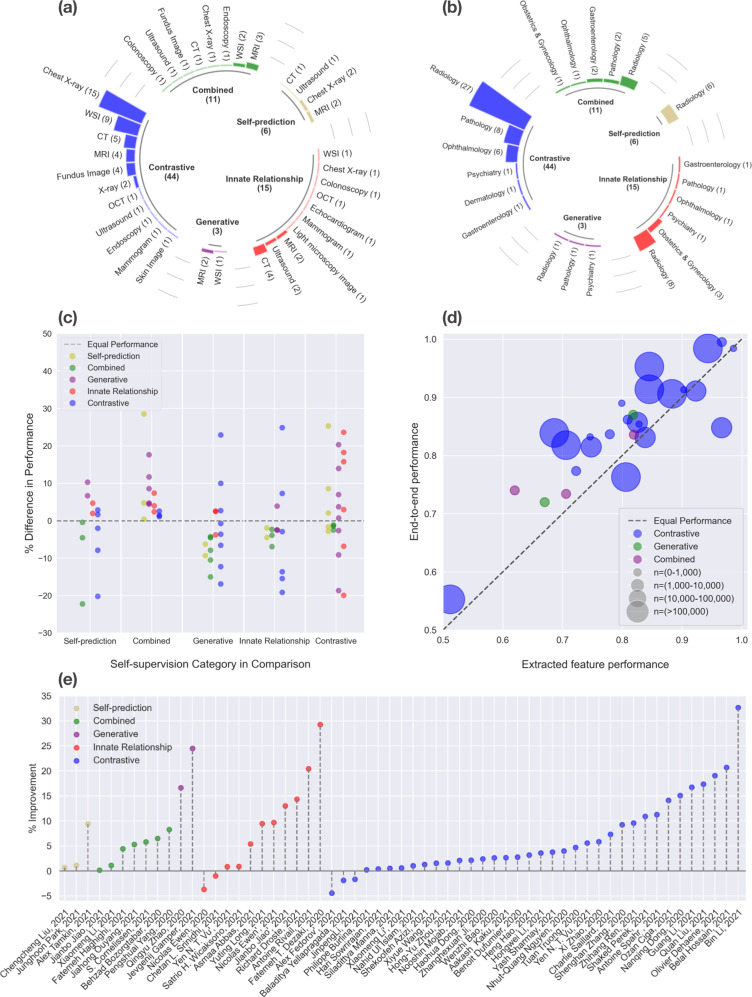
“Based on our aggregated results, we found that end-to-end fine-tuning generally leads to better performance for medical images (Fig. 4c).”
§ Self-supervised learning for medical image classification: a systematic review and implementation guidelines > Results
“c Relative performance difference between different types of self-supervised learning strategies on the same task. d Performance comparison between end-to-end fine-tuning vs. training a classifier using extracted features from pre-trained self-supervised models.”
Rated minor: it would not touch a result — a value no result rests on, a p-value that stays on the same side of the significance level, or a conflict that is clerical, resolved elsewhere in the paper, or outside its own findings.
In the paper
§ Self-supervised learning for medical image classification: a systematic review and implementation guidelines > Results > Self-prediction
“Two of the five studies compared their approach to models without self-supervised pre-training and reported slight relative improvements in performance of 1.12%67 and 0.690%63.”
§ Self-supervised learning for medical image classification: a systematic review and implementation guidelines > Results
“| Self-prediction | 2021 | Alex Tamkin143 | Chest X-ray | Radiology | Chest abnormality | – | SHED | Extract features from encoder -> Linear classifier | Accuracy | 0.745 | 0.681 | 0.094 |”
Citations
Cites
The PRISMA 2020 statement: An updated guideline for reporting systematic reviews
Page, M. J., McKenzie, J. E., Bossuyt, P. M., Boutron, I., Hoffmann, T. C., Mulrow, C. D., Shamseer, L., Tetzlaff, J. M., Akl, E. A., Brennan, S. E., et al. (2021) · BMJ · doi:10.1136/bmj.n71 · Cited by 108,283
BERT: Pre-training of Deep Bidirectional Transformers for Language Understanding
Devlin, J., Chang, M.-W., Lee, K., & Toutanova, K. (2018) · arXiv · doi:10.48550/arxiv.1810.04805 · Cited by 73,173
ImageNet Large Scale Visual Recognition Challenge
Russakovsky, O., Deng, J., Su, H., Krause, J., Satheesh, S., Ma, S., Huang, Z., Karpathy, A., Khosla, A., Bernstein, M., et al. (2015) · International Journal of Computer Vision · doi:10.1007/s11263-015-0816-y · Cited by 39,380 · cited 1×
“We also limited our search to only consider papers published after 2012, which excluded papers that applied self-supervised learning prior to the era of deep learning for computer vision 108 .”
BackgroundAuto-Encoding Variational Bayes
Kingma, D. P., & Welling, M. (2013) · arXiv · doi:10.48550/arxiv.1312.6114 · Cited by 20,067
Deep learning in neural networks: an overview
Schmidhuber, J. (2015) · Neural Networks · doi:10.1016/j.neunet.2014.09.003 · Cited by 18,570 · cited 1×
“Generative models, popularized through the advent of traditional autoencoders 27 , variational autoencoders 28 and generative adversarial networks (GANs) 29 , are able to learn the distribution of training data, and thereby reconstruct the original input or create new synthetic data instances.”
BackgroundDermatologist-level classification of skin cancer with deep neural networks
Esteva, A., Kuprel, B., Novoa, R. A., Ko, J., Swetter, S. M., Blau, H. M., & Thrun, S. (2017) · Nature · doi:10.1038/nature21056 · Cited by 14,362
Momentum Contrast for Unsupervised Visual Representation Learning
He, K., Fan, H., Wu, Y., Xie, S., & Girshick, R. (2020) · 2020 IEEE/CVF Conference on Computer Vision and Pattern Recognition (CVPR) · doi:10.1109/cvpr42600.2020.00975 · Cited by 13,347 · cited 1×
“To reduce the large batch size required by SimCLR to ensure enough informative negative samples, Momentum Contrast (MoCo) introduced a momentum encoded queue to keep negative samples 33 .”
MethodThe PRISMA 2020 Statement: An Updated Guideline for Reporting Systematic Reviews
Page, M. J., McKenzie, J. E., Bossuyt, P. M., Boutron, I., Hoffmann, T. C., Mulrow, C. D., Shamseer, L., Tetzlaff, J. M., Akl, E. A., Brennan, S. E., et al. (2021) · International Journal of Surgery · doi:10.1016/j.ijsu.2021.105906 · Cited by 11,748
Extracting and composing robust features with denoising autoencoders
Vincent, P., Larochelle, H., Bengio, Y., & Manzagol, P.-A. (2008) · Proceedings of the 25th international conference on Machine learning - ICML '08 · doi:10.1145/1390156.1390294 · Cited by 7,436 · cited 1×
“Early work that leverages generative models for self-supervised learning rely on autoencoders, where an encoder converts inputs into latent representations and a decoder reconstructs the representation back to the original image 30 .”
BackgroundEmerging Properties in Self-Supervised Vision Transformers
Caron, M., Touvron, H., Misra, I., Jegou, H., Mairal, J., Bojanowski, P., & Joulin, A. (2021) · 2021 IEEE/CVF International Conference on Computer Vision (ICCV) · doi:10.1109/iccv48922.2021.00951 · Cited by 5,638 · cited 1×
“More recently, a subtype of contrastive self-supervised learning called instance discrimination, which includes methods such as DINO 34 , BYOL 35 and SimSiam 36 , further eliminates the need for negative samples.”
Background
Research works printed but not linked: 21
- Brown, T., Mann, B. & Ryder, N. Language models are few-shot learners. Adv. Neural Inf. Process. Syst. (2020).
- Chen, T., Kornblith, S., Norouzi, M. & Hinton, G. A Simple Framework for Contrastive Learning of Visual Representations. Proc. 37th Int. Conf. Mach. Learn., PMLR 119, 1597–1607 (2020).
- Lilian Weng, J. W. K. Self-Supervised Learning: Self-Prediction and Contrastive Learning. Adv. Neural Inf. Proc. Syst. (2021).
- Goodfello w, I. J. et al. Generative Adversarial Networks. Preprint at https://community.unix.com/uploads/short-url/oXsmq2VZ9hc2X6hwPRXZRMGbV20.pdf (2014).
- Donahue J. & Simonyan K. Large scale adversarial representation learning. Adv. Neural Inf. Process. Syst. (2019).
- Grill J. B., Strub F., Altché F. & Tallec C. Bootstrap your own latent-a new approach to self-supervised learning. Adv. Neural Inf. Proc. Syst. 33, (2020).
- Chen, X. & He, K. Exploring Simple Siamese Representation Learning. Proc. IEEE/CVF Conf. Comput. Vis. Pattern Recognit. (CVPR), 2021, 15750–15758 (2021).
- Pathak, D., Krahenbuhl, P., Donahue, J., Darrell, T. & Efros, A. A. Context Encoders: Feature Learning by Inpainting. Proc. IEEE Conf. Comput. Vis. Pattern Recognit. (CVPR) 2016, 2536–2544 (2016).
- He, K. et al. Masked Autoencoders Are Scalable Vision Learners. Proc. IEEE/CVF Conf. Comput. Vis. Pattern Recognit. (CVPR) 2022, 16000–16009 (2022).
- Vu, Y. N. T., Tsue, T., Su, J. & Singh, S. An improved mammography malignancy model with self-supervised learning. Med. Imaging 2021: Comput-Aided Diagn. 11597, 210–216 (2021).
- Hao, H., Didari, S., Woo, J. O., Moon, H. & Bangert, P. Highly Efficient Representation and Active Learning Framework for Imbalanced Data and its Application to COVID-19 X-Ray Classification. Conference on Neural Information Processing Systems (NeurIPS 2021) (2021).
- Dehaene, O., Camara, A., Moindrot, O., de Lavergne, A. & Courtiol, P. Self-Supervision Closes the Gap Between Weak and Strong Supervision in Histology. in ML4H 2020 NeurIPS workshop (2020).
- Kotar, K., Ilharco, G. & Schmidt, L. Contrasting contrastive self-supervised representation learning pipelines. Proc. Estonian Acad. Sci. Biol. Ecol.
- Cole, E., Yang, X., Wilber, K., Aodha, O. M. & Belongie, S. When Does Contrastive Visual Representation Learning Work? Proc. IEEE/CVF Conf. Comput. Vis. Pattern Recognit. (CVPR) 2022, 14755–14764 (2022).
- Azizi, S., Mustafa, B., Ryan, F. & Beaver, Z. Big self-supervised models advance medical image classification. Proc. Estonian Acad. Sci. Biol. Ecol.
- Shi, Y., Siddharth, N., Torr, P. H. S. & Kosiorek, A. R. Adversarial Masking for Self-Supervised Learning. In International Conference on Machine Learning, 20026–20040. (2022).
- Van Gansbeke, X. & Vandenhende, S. Revisiting contrastive methods for unsupervised learning of visual representations. Adv. Neural Inf. Process. Syst. 34, 16238–16250 (2021).
- Sowrirajan, H., Yang, J., Ng, A. Y. & Rajpurkar, P. MoCo-CXR: MoCo Pre-training Improves Representation and Transferability of Chest X-ray Models. Proc. Mach. Learn. Res. 143, 727–743 (2021).
- Bao, W., Jin, Y., Huang, C. & Peng, W. CT Image Classification of Invasive Depth of Gastric Cancer based on 3D-DPN Structure. In The 11th International Workshop on Computer Science and Engineering (WCSE 2021) 115–121 (2021).
- Kaku, A., Upadhya, S. & Razavian, N. Intermediate layers matter in momentum contrastive self supervised learning. In 35th Conference on Neural Information Processing Systems (NeurIPS 2021). (2021).
- Liu, Q. et al. SimTriplet: Simple Triplet Representation Learning with a Single GPU. In Medical Image Computing and Computer Assisted Intervention – MICCAI 2021 102–112 (2021). · DOI · Paper page
Cited by
Sorted by citations
Items 101–200 of 470
Domain shift, domain adaptation, and generalization
Richiardi, J., Ravano, V., Molchanova, N., Gordaliza, P. M., Kober, T., & Cuadra, M. B. (2025) · Elsevier eBooks · doi:10.1016/b978-0-44-323761-4.00015-8 · Cited by 8
Abdallah, A., Kasem, M. S., Abdelhalim, I., Alghamdi, N. S., & El-Baz, A. S. (2025) · IEEE Access · doi:10.1109/access.2025.3581582 · Cited by 11
Mitigating Data Bias in Healthcare AI With Self-Supervised Standardization
Lan, G., Zhu, Y. T., Xiao, S., Iqbal, M., & Yang, J. (2025) · IEEE Journal of Biomedical and Health Informatics · doi:10.1109/jbhi.2025.3588196 · Cited by 9
Foundation Models for Quantitative Biomarker Discovery in Cancer ImagingPreprint
Pai, S., Bontempi, D., Hadžić, I., Prudente, V., Sokač, M., Chaunzwa, T. L., Bernatz, S., Hosny, A., Mak, R. H., Birkbak, N. J., et al. (2023) · medRxiv · doi:10.1101/2023.09.04.23294952 · Cited by 9
Progress and Thinking on Self-Supervised Learning Methods in Computer Vision: A Review
Chen, Z., Hu, B., Chen, Z., & Zhang, J. (2024) · IEEE Sensors Journal · doi:10.1109/jsen.2024.3443885 · Cited by 11
Zou, L., Li, J., Chen, H., Liang, M., Jia, K., Zhong, Y., & Chen, J. (2025) · Expert Systems with Applications · doi:10.1016/j.eswa.2025.126660 · Cited by 7
Enhancing Medical Vision-Language Contrastive Learning via Inter-Matching Relation Modeling
Li, M., Meng, M., FULHAM, M. J., Feng, D. D., Bi, L., & Kim, J. (2025) · IEEE Transactions on Medical Imaging · doi:10.1109/tmi.2025.3534436 · Cited by 9
Automated Fast Prediction of Bone Mineral Density From Low-dose Computed Tomography
Zhou, K., Xin, E., Yang, S., Luo, X., Zhu, Y., Zeng, Y., Fu, J., Ruan, Z., Wang, R., Geng, D., et al. (2025) · Academic Radiology · doi:10.1016/j.acra.2025.02.041 · Cited by 7
Clinical Application of Artificial Intelligence in Digital Breast Tomosynthesis
Chang, J. M., Lee, W., & Bahl, M. (2025) · Journal of the Korean Society of Radiology · doi:10.3348/jksr.2025.0011 · Cited by 7
Khan, K., & Katarya, R. (2025) · Engineering Analysis with Boundary Elements · doi:10.1016/j.enganabound.2025.106382 · Cited by 7
RetractedOurang, S. A., Sohrabniya, F., Sadr, S., Lee, J., Ramzy, N., Law, A., Lam, E. W. N., Khan, A. A., & Nosrat, A. (2025) · International Endodontic Journal · doi:10.1111/iej.70065 · Cited by 8
Multimodal artificial intelligence in medicine: a task-oriented framework for clinical translation
Zhang, R., Chen, Y., Yue, W., Zhang, Y., Li, X., Feng, S., Yuan, F., & Luo, M. (2026) · Frontiers in Medicine · doi:10.3389/fmed.2025.1736272 · Cited by 15
3D foundation model for generalizable disease detection in head computed tomography
Zhu, W., Huang, H., Tang, H., Musthyala, R., Yu, B., Chen, L., Vega, E., O’Donnell, T., Hayek, R., Kuohn, L. R., et al. (2026) · Nature Biomedical Engineering · doi:10.1038/s41551-026-01668-w · Cited by 22
Pinetsuksai, N., Kittichai, V., Jomtarak, R., et al. (2023) · doi:10.1109/icitee59582.2023.10317719 · Cited by 7
Rumberger, J. L., Franzen, J., Hirsch, P., Albrecht, J.-P., & Kainmueller, D. (2023) · IEEE International Conference on Computer Vision Workshops · doi:10.1109/iccvw60793.2023.00410 · Cited by 8
Imagawa, K., & Shiomoto, K. (2024) · Journal of Imaging Informatics in Medicine · doi:10.1007/s10278-024-00975-5 · Cited by 10
Dornaika, F., Hajjar, S. E., & Charafeddine, J. (2024) · Engineering Applications of Artificial Intelligence · doi:10.1016/j.engappai.2024.108336 · Cited by 7
Machine learning for medical image classification
Husain, G., Mayer, J., Bekbolatova, M., Vathappallil, P., Matalia, M., & Toma, M. (2024) · Academia Medicine · doi:10.20935/acadmed7444 · Cited by 11
Sugawara, K., Takaya, E., Inamori, R., Konaka, Y., Sato, J., Shiratori, Y., Hario, F., Kobayashi, T., Ueda, T., & Okamoto, Y. (2025) · Radiological Physics and Technology · doi:10.1007/s12194-024-00874-y · Cited by 8
Wang, W., Jin, Z., Liu, X., & Chen, X. (2025) · Computerized Medical Imaging and Graphics · doi:10.1016/j.compmedimag.2025.102524 · Cited by 7
Federated Learning-assisted Self-supervised CNN for Monkeypox Diagnosis
Jahan, N., Bajwa, G., & Akilan, T. (2023) · IEEE Western New York Image and Signal Processing Workshop (WNYISPW) · doi:10.1109/wnyispw60588.2023.10349384 · Cited by 7
Liao, W., Luo, X., Li, L., Xu, J., He, Y., Huang, H. L., & Zhang, S. (2025) · Scientific Reports · doi:10.1038/s41598-024-84804-3 · Cited by 7
Multi-Modal Graph Neural Networks for Colposcopy Data Classification and Visualization
Chatterjee, P., Siddiqui, S., Kareem, R. S. A., & Rao, S. R. (2025) · Cancers · doi:10.3390/cancers17091521 · Cited by 6
Turki, A., Alshabrawy, O. S., & Woo, W. L. (2025) · Cancers · doi:10.3390/cancers17132115 · Cited by 7
Maturity Framework for Operationalizing Machine Learning Applications in Health Care: Scoping Review
Li, Y., Tian, J., Xu, A., Greiner, R., Hayward, J., Greenshaw, A. J., & Cao, B. (2025) · Journal of Medical Internet Research · doi:10.2196/66559 · Cited by 10
Fang, Z., Johnston, A., Cheuy, L. Y., Na, H. S., Paschali, M., González, C., Armstrong, B. A., Koirala, A., Laurel, D., Campion, A., et al. (2025) · npj Digital Medicine · doi:10.1038/s41746-025-02007-0 · Cited by 11
Self-citationZhang, J., Xiao, F., Zou, H., Feng, R. E., & He, J. (2024) · iScience · doi:10.1016/j.isci.2024.110566 · Cited by 7
Effective automatic classification methods via deep learning for myopic maculopathy
Zhang, Z., Gao, Q., Dong, F., Mijit, A., Lü, C., Li, W., & Wei, Y. (2024) · Frontiers in Medicine · doi:10.3389/fmed.2024.1492808 · Cited by 7
Atitallah, S. B., Rabah, C. B., Driss, M., Boulila, W., & Koubâa, A. (2025) · Computers in Biology and Medicine · doi:10.1016/j.compbiomed.2025.109874 · Cited by 6
Chyrmang, G., Barua, B., Bora, K., et al. (2025) · Pathology - Research and Practice · doi:10.1016/j.prp.2025.155961 · Cited by 6
Robust and explainable framework to address data scarcity in diagnostic imaging
Zhao, Z., Alzubaidi, L., Zhang, J., Duan, Y., Naseem, U., & Gu, Y. (2025) · Computers in Biology and Medicine · doi:10.1016/j.compbiomed.2025.111052 · Cited by 10
Almansi, A. A., Sugarova, S., Alsanosi, A. A., et al. (2024) · Computers in Biology and Medicine · doi:10.1016/j.compbiomed.2024.108168 · Cited by 6
Biomedical Image Classification using Deep Reinforcement Learning
Parihar, S., Kukker, A., Dhar, S., et al. (2024) · International Conference on Advances in Electrical, Computing, Communication and Sustainable Technologies (ICAECT) · doi:10.1109/icaect60202.2024.10468733 · Cited by 6
Wrist fracture detection using self-supervised learning methodology
Thorat, S. R., Jha, D. G., Sharma, A. K., & Katkar, D. V. (2024) · Journal of Musculoskeletal Surgery and Research · doi:10.25259/jmsr_260_2023 · Cited by 5
Tailored self-supervised pretraining improves brain MRI diagnostic models
Huang, X., Wang, Z. W., Zhou, W., Yang, K., Wen, K., Liu, H., Huang, S., & Lyu, M. (2025) · Computerized Medical Imaging and Graphics · doi:10.1016/j.compmedimag.2025.102560 · Cited by 8
Self-citationA Survey of Large-Scale Deep Learning Models in Medicine and Healthcare
Chen, Z., Liu, R., Huang, S., Guo, Y., & Ren, Y. (2025) · Computer Modeling in Engineering & Sciences · doi:10.32604/cmes.2025.067809 · Cited by 6
Self-citationA Review of Unlabeled and Imbalanced Data Challenges in Machine Learning: Strategies and Solutions
S, N. M., & S, V. C. S. (2025) · Wiley Interdisciplinary Reviews Data Mining and Knowledge Discovery · doi:10.1002/widm.70043 · Cited by 7
Fine art image classification and design methods integrating lightweight deep learning
Ma, K., Lee, S.-W., Ma, X., & Chen, H. (2025) · Scientific Reports · doi:10.1038/s41598-025-18420-0 · Cited by 6
Kim, J., Na, I., Chung, J., Song, H.-N., Kim, K., Ju, S., Eun, M., Seo, W., & Park, H. (2025) · Computerized Medical Imaging and Graphics · doi:10.1016/j.compmedimag.2025.102651 · Cited by 5
Self-supervised learning for breast cancer detection: A review
Figueiras, H., Domingues, J., Matela, N., & Garcia, N. C. (2025) · Computers in Biology and Medicine · doi:10.1016/j.compbiomed.2025.111245 · Cited by 5
Self-supervised learning for data augmentation in histopathology image segmentation
Almubarak, H. A. (2025) · Scientific Reports · doi:10.1038/s41598-025-23280-9 · Cited by 8
Telçeken, M. (2025) · Biomedical Signal Processing and Control · doi:10.1016/j.bspc.2025.109381 · Cited by 5
GCNet-Mamba: Leveraging state space models and CNN for medical image classification
Zhou, Y., Sun, L., Xiong, X., Ti, G., & Yang, S. (2025) · Expert Systems with Applications · doi:10.1016/j.eswa.2025.130733 · Cited by 7
Foundation models in radiology: a primer for pediatric radiologists
Gupta, A., Fanni, S. C., Veiga-Canuto, D., & Guarnera, A. (2026) · Pediatric Radiology · doi:10.1007/s00247-026-06544-y · Cited by 5
Trustworthy AI in digital health: a comprehensive review of robustness and explainability
Mamun, A., Soumma, S. B., & Ghasemzadeh, H. G. (2026) · Progress in Biomedical Engineering · doi:10.1088/2516-1091/ae4e74 · Cited by 10
Wolf, D., Payer, T., Lisson, C. S., Lisson, C. G., Beer, M., GOETZ, M. A., & Ropinski, T. (2024) · Computers in Biology and Medicine · doi:10.1016/j.compbiomed.2024.109242 · Cited by 5
Lenskjold, A., Brejnebøl, M. W., Rose, M. H., et al. (2024) · Scientific Reports · doi:10.1038/s41598-024-75752-z · Cited by 5
Self-citationArtificial Intelligence in the Diagnosis and Prognostication of the Musculoskeletal Patient
Girod-Hoffman, M. M., Saniei, S., Ulrich, M. N., Bukowiec, L. G., Mulford, K. L., Taunton, M. J., & Wyles, C. C. (2025) · HSS Journal® The Musculoskeletal Journal of Hospital for Special Surgery · doi:10.1177/15563316251339660 · Cited by 6
Domain and label efficient approach for diabetic retinopathy severity detection
Ohri, K., & Kumar, M. (2023) · Multimedia Tools and Applications · doi:10.1007/s11042-023-16908-3 · Cited by 6
CLRiuS: Contrastive Learning for intrinsically unordered Steel Scrap
Schäfer, M., Faltings, U., & Glaser, B. (2024) · Machine Learning with Applications · doi:10.1016/j.mlwa.2024.100573 · Cited by 5
Huang, Y., Chen, M., Chen, J., et al. (2025) · Expert Systems with Applications · doi:10.1016/j.eswa.2025.129062 · Cited by 4
Neural heterogeneity as a unifying mechanism for efficient learning in spiking neural networks
Zhang, F., & Cui, J. (2025) · Frontiers in Computational Neuroscience · doi:10.3389/fncom.2025.1661070 · Cited by 4
Automatic rib fracture detection on postmortem CT data using deep learning
Lopez-Melia, M., Magnin, V., Schranz, S., et al. (2025) · International Journal of Legal Medicine · doi:10.1007/s00414-025-03669-x · Cited by 4
Agrawal, L., Agrawal, P. K., Agrawal, S. S., Sonune, M. S., Kadu, R. K., Kulkarni, M. B., & Bhaiyya, M. L. (2026) · Graefe s Archive for Clinical and Experimental Ophthalmology · doi:10.1007/s00417-026-07273-6 · Cited by 7
Wang, Z., Kulpanowski, A. M., Copen, W. A., et al. (2025) · Resuscitation · doi:10.1016/j.resuscitation.2025.110652 · Cited by 4
Artificial intelligence-driven techniques for interventional cardiology: A current appraisal
Dash, D., Dash, U., & Abu-Dakka, B. (2025) · Cardiovascular revascularization medicine · doi:10.1016/j.carrev.2025.06.016 · Cited by 5
UltraScanNet: A Mamba-Inspired Hybrid Backbone for Breast Ultrasound Classification
Laicu-Hausberger, A.-G., & Popa, C.-A. (2025) · Electronics · doi:10.3390/electronics14183633 · Cited by 4
Chen, L., & Zhang, Z. (2023) · Medical Physics · doi:10.1002/mp.16736 · Cited by 5
Feng, R., Deb, B., Ganesan, P., Tjong, F. V. Y., Rogers, A. J., Ruipérez-Campillo, S., Somani, S. S., Clopton, P., Baykaner, T., Rodrigo, M., et al. (2023) · Frontiers in Cardiovascular Medicine · doi:10.3389/fcvm.2023.1189293 · Cited by 4
A Study on Self-Supervised Pretraining for Vision Problems in Gastrointestinal Endoscopy
Sanderson, E., & Matuszewski, B. J. (2024) · IEEE Access · doi:10.1109/access.2024.3381517 · Cited by 7
Carter, D., Bykhovsky, D., Hasky, A., Mamistvalov, I., Zimmer, Y., Ram, E., & Hoffer, O. (2024) · Techniques in Coloproctology · doi:10.1007/s10151-024-02917-3 · Cited by 4
Worldwide research landscape of artificial intelligence in lung disease: A scientometric study
Zeng, M., Wang, X., & Chen, W. (2024) · Heliyon · doi:10.1016/j.heliyon.2024.e31129 · Cited by 4
Automated cell profiling in imaging flow cytometry with annotation-efficient learning
Hong, T., Peng, M., Kim, Y., Schellhorn, H. E., & Fang, Q. (2024) · Optics & Laser Technology · doi:10.1016/j.optlastec.2024.111992 · Cited by 7
Nguyen, M. T. P., Tran, M., Nakano, T., Tran, T. H., & Nguyen, Q. D. N. (2024) · Sensors · doi:10.3390/s25010163 · Cited by 4
Gao, R., Peng, A., Duan, Y., Chen, M., Zheng, T., Zhang, M., Chen, L., & Sun, H. (2025) · Journal of Magnetic Resonance Imaging · doi:10.1002/jmri.29734 · Cited by 4
Nguyen, P. D., Dao, M. B., & Nguyen, T. Q. (2025) · 3D Printing and Additive Manufacturing · doi:10.1089/3dp.2024.0211 · Cited by 4
All-in-One Multi-Organ Segmentation in 3D CT Images via Self-Supervised and Cross-Dataset Learning
Huang, J., Chen, S., Liang, X., et al. (2025) · IEEE International Symposium on Biomedical Imaging (ISBI) · doi:10.1109/isbi60581.2025.10980981 · Cited by 4
Zhang, Y., Pan, L., Yang, Q., Li, T., & Chen, Z. (2024) · IEEE Journal of Biomedical and Health Informatics · doi:10.1109/jbhi.2024.3384407 · Cited by 6
Automated radiography assessment of ankle joint instability using deep learning
Noh, S., Lee, M. S., & Lee, B.-D. (2025) · Scientific Reports · doi:10.1038/s41598-025-99620-6 · Cited by 4
Bellal, M., Fkihi, S. E., Cengiz, K., & Ivković, N. (2025) · IEEE Access · doi:10.1109/access.2025.3566627 · Cited by 3
Zhang, S., Wang, Q., Wei, M., Zhong, J., Zhang, Y., Song, Z., Li, C., Zhang, X., Han, Y., Li, Y., et al. (2025) · IEEE Journal of Biomedical and Health Informatics · doi:10.1109/jbhi.2025.3552638 · Cited by 3
Mohammed, A. A. Q., Geng, X., Wang, J., Fateh, A. A., Hassan, M. A., & Ali, Z. (2025) · Biomedical Signal Processing and Control · doi:10.1016/j.bspc.2025.108539 · Cited by 3
Improving Coronary Artery Disease Diagnosis in Cardiac MRI with Self-Supervised Learning
Khalid, U., Kaya, M., & Alhajj, R. (2025) · Diagnostics · doi:10.3390/diagnostics15202618 · Cited by 3
Huang, B., Liu, Y., Tang, B., & Fang, G. (2026) · Neural Processing Letters · doi:10.1007/s11063-025-11823-0 · Cited by 5
Self-supervised contrastive learning enables robust electrocardiogram-based cardiac classification
Dade, D. R., Bergquist, J., MacLeod, R., Steinberg, B. A., & Taşdizen, T. (2026) · Heart Rhythm O2 · doi:10.1016/j.hroo.2026.01.016 · Cited by 4
A survey on design choices for self-supervised learning in computer vision
Wittscher, L. (2026) · Artificial Intelligence Review · doi:10.1007/s10462-026-11506-9 · Cited by 4
Raghaw, C. S., Parwal, A., Dar, S. S., Darade, P., & Kumar, N. (2026) · Expert Systems with Applications · doi:10.1016/j.eswa.2026.132279 · Cited by 4
A deep representation learning model to predict response to vagus nerve stimulation
Suresh, H., Mithani, K., Li, V., Latypov, T. H., Warsi, N. M., Wong, S. M., Erdman, L., Kang, J., Germann, J., Gouveia, F. V., et al. (2026) · Nature Communications · doi:10.1038/s41467-026-71555-0 · Cited by 4
Ocular biomarkers: useful incidental findings by deep learning algorithms in fundus photographs
Martin, E., Cook, A. G., Frost, S. M., Turner, A. W., Chen, F. K., McAllister, I. L., Nolde, J. M., & Schlaich, M. P. (2024) · Eye · doi:10.1038/s41433-024-03085-2 · Cited by 4
Corponi, F., Li, B. M., Anmella, G., Valenzuela‐Pascual, C., Mas, A., Pacchiarotti, I., Valentí, M., Grande, I., Benabarre, A., Garriga, M., et al. (2024) · JMIR mhealth and uhealth · doi:10.2196/55094 · Cited by 3
A puzzle questions form training for self-supervised skeleton-based action recognition
Moutik, O., Sekkat, H., Tchakoucht, T. A., Kari, B. E., & Alaoui, A. E. H. (2024) · Image and Vision Computing · doi:10.1016/j.imavis.2024.105137 · Cited by 3
Chikhaoui, K., & Alfarraj, M. (2024) · Proceedings - International Conference on Image Processing · doi:10.1109/icip51287.2024.10647414 · Cited by 3
Enhancing Fan Base Engagement through Explainable Self-Learning Sentiment Analysis
Lye, M. H., & Wijesinghe, N. (2024) · Moratuwa Engineering Research Conference (MERCon) · doi:10.1109/mercon63886.2024.10688963 · Cited by 3
Robust Myocardial Perfusion MRI Quantification With DeepFermi
Brahma, S., Kofler, A., Zimmermann, F. F., et al. (2024) · IEEE Transactions on Biomedical Engineering · doi:10.1109/tbme.2024.3485233 · Cited by 3
Busayakanon, S., Kaewthamasorn, M., Pinetsuksai, N., et al. (2024) · Veterinary World · doi:10.14202/vetworld.2024.2619-2634 · Cited by 3
Moving Healthcare AI Support Systems for Visually Detectable Diseases to Constrained Devices
Watt, T., Chrysoulas, C., Barclay, P. J., Boudani, B. E., & Kalliatakis, G. (2024) · Applied Sciences · doi:10.3390/app142411474 · Cited by 3
HFGL-Net: High-frequency guided multi-scale non-local network for remote sensing object detection
Dan, Z., Fu, Q., Huang, L., Hu, D., Li, X., & Sun, H. (2025) · Digital Signal Processing · doi:10.1016/j.dsp.2025.105230 · Cited by 4
Qiu, Z., Rivaz, H. J., & Xiao, Y. (2025) · Medical Physics · doi:10.1002/mp.17977 · Cited by 3
OpenFungi: A Machine Learning Dataset for Fungal Image Recognition Tasks
Cighir, A., Bolboacă, R., & Lenard, T. (2025) · Life · doi:10.3390/life15071132 · Cited by 4
Abbas, T., Linjawi, M., Iqbal, I., Alghushairy, O., Alsini, R. A. I., & Daud, A. Y. (2025) · Biomedical Signal Processing and Control · doi:10.1016/j.bspc.2025.108391 · Cited by 3
Advancing Spine Fracture Detection: The Role of Artificial Intelligence in Clinical Practice
Jeong, S., & Lee, B. (2025) · Korean Journal of Neurotrauma · doi:10.13004/kjnt.2025.21.e22 · Cited by 3
Zhang, K., Chen, W., Liu, W. K., Brinson, L. C., & Apley, D. W. (2025) · Acta Materialia · doi:10.1016/j.actamat.2025.121588 · Cited by 4
Organoids Segmentation using Self-Supervised Learning: How Complex Should the Pretext Task Be?
Haja, A., Woude, B. V. D., & Schomaker, L. (2023) · International Conference on Biomedical and Bioinformatics Engineering (ICBBE) · doi:10.1145/3637732.3637772 · Cited by 3
Cleaned Meta Pseudo Labels-Based Pet Behavior Recognition Using Time-Series Sensor Data
Go, J., & Moon, N. (2024) · Sensors · doi:10.3390/s24113391 · Cited by 3
CoBooM: Codebook Guided Bootstrapping for Medical Image Representation Learning
Singh, A., & Mishra, D. (2024) · Lecture notes in computer science · doi:10.1007/978-3-031-72390-2_3 · Cited by 3
Chen, C., Hsieh, K.-Y., Huang, K.-E., & Cheng, E.-T. (2025) · Cureus · doi:10.7759/cureus.77391 · Cited by 3
Mugambi, L., Maina, C. W., & Zuhlke, L. J. (2025) · Journal of Imaging · doi:10.3390/jimaging11040097 · Cited by 3
Lai, W., Liu, D., Yang, J., et al. (2025) · Biomedical Signal Processing and Control · doi:10.1016/j.bspc.2025.107909 · Cited by 3
Kazeminasab, S., Sekimitsu, S., Fazli, M. S., Eslami, M., Shi, M. Y., Tian, Y., Luo, Y., Wang, M., Elze, T., & Zebardast, N. (2025) · Journal of Imaging Informatics in Medicine · doi:10.1007/s10278-025-01539-x · Cited by 2
Li, Z., Shi, J., Wu, X., Cui, Z., Liu, B., & Liu, Y. (2025) · Pathology - Research and Practice · doi:10.1016/j.prp.2025.156071 · Cited by 3
Metadata
- Authors
- Huang, S.-C., Pareek, A., Jensen, M., Lungren, M. P., Yeung, S., & Chaudhari, A. S.
- Affiliations
- Stanford University (US)
- Stanford Medicine (US)
- Corresponding author
- Huang, Shih-Cheng
- Venue
- npj Digital Medicine
- Published
- 2023-04-26
- Volume
- 6
- Issue
- 1
- Pages
- 74-74
- ISSN
- 2398-6352 (ISSN-L)
- PMC
- PMC10131505
- OpenAlex
- W4367055910
- Cited by
- 479
- References
- 130
- Citations by year
- 2026: 145 · 2025: 208 · 2024: 102 · 2023: 24
- FWCI
- 10.03
- Type
- journal article
- Language
- en
- Open access
- gold
- doi.org
- Locations
- npj Digital Medicine (publishedVersion, cc-by)
- PubMed Central (publishedVersion, cc-by)
- PubMed (publishedVersion)
- DOAJ (DOAJ: Directory of Open Access Journals) (submittedVersion, cc-by-sa)
- Funders
- National Institutes of Health (75N92020C00021, 75N92020C00008, AR077604, EB002524)
- National Heart, Lung, and Blood Institute (75N92020C00008, 75N92020C00021, R01HL155410)
- National Institute of Arthritis and Musculoskeletal and Skin Diseases (R01AR077604, R01AR079431)
- National Institute of Biomedical Imaging and Bioengineering (P41EB027060, R01EB002524)
- U.S. National Library of Medicine (R01LM012966)
- Topics
- Physical Sciences › Computer Science › Artificial Intelligence › Domain Adaptation and Few-Shot Learning
- Health Sciences › Medicine › Health Informatics › Artificial Intelligence in Healthcare and Education
- Physical Sciences › Computer Science › Computer Vision and Pattern Recognition › Medical Image Segmentation Techniques
- Keywords
- self-supervised learning, medical image classification, diagnostic imaging, unlabeled data, implementation guidelines, deep learning, limited labeled data
About these checks
Registry, retraction, Cites and statistics results are computed, not judged, with one exception: a printed reference that no index lists is read once by a model before it counts as a citation error. Claims are extracted by a model and kept only when their quote appears verbatim in the text; each cited source is then checked, with a model’s help, for whether it says what the claim relies on. Those verdicts can be wrong — read the claim’s quote and the cited source before relying on one.
A language model drew the claims from the paper on 2026-10-07, under version 3 of the claim definition (model deepseek-v4.1-flash, prompt extract-v3).
A second model labelled each claim on 2026-10-07 (model jev-1.13-20260917, definition revision gold-guideline-v0.2).
Cited sources are checked with a language model’s help (gpt-6-sol).
Statistics and arithmetic are recomputed, not judged.
Confidence bands are shown only for fields calibrated on our annotated test set. None is calibrated yet, so no band is shown.
What counts as a claim ›How we measure confidence ›How we check this ›
Are you an author, or do you see a problem with this page? Request a review
