

A study of generative large language model for medical research and healthcare
Open accessThe DOI matches its Crossref record; 52 of the 52 references it cites were found in a registry or an index.
Abstract
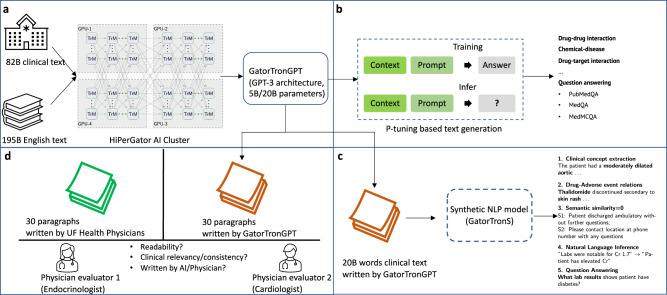
There are enormous enthusiasm and concerns in applying large language models (LLMs) to healthcare. Yet current assumptions are based on general-purpose LLMs such as ChatGPT, which are not developed for medical use. This study develops a generative clinical LLM, GatorTronGPT, using 277 billion words of text including (1) 82 billion words of clinical text from 126 clinical departments and approximately 2 million patients at the University of Florida Health and (2) 195 billion words of diverse general English text. We train GatorTronGPT using a GPT-3 architecture with up to 20 billion parameters and evaluate its utility for biomedical natural language processing (NLP) and healthcare text generation. GatorTronGPT improves biomedical natural language processing. We apply GatorTronGPT to generate 20 billion words of synthetic text. Synthetic NLP models trained using synthetic text generated by GatorTronGPT outperform models trained using real-world clinical text. Physicians’ Turing test using 1 (worst) to 9 (best) scale shows that there are no significant differences in linguistic readability (p = 0.22; 6.57 of GatorTronGPT compared with 6.93 of human) and clinical relevance (p = 0.91; 7.0 of GatorTronGPT compared with 6.97 of human) and that physicians cannot differentiate them (p < 0.001). This study provides insights into the opportunities and challenges of LLMs for medical research and healthcare.
Overview
The claims and statistics of this paper haven’t been checked yet.
Free: it reads the open-access text and checks the first 5 claims that cite a source we can check. Create a free account to check every claim.
Integrity signals
Registry
Cites
Statistics
Figures
Verification
Claims the paper makes
The claims and statistics of this paper haven’t been checked yet.
Free: it reads the open-access text and checks the first 5 claims that cite a source we can check. Create a free account to check every claim.
Claims other papers make about this one
Each is checked against this paper’s own text: does it say what the citing paper says it does?
The source backs part of the claim, not all of it — or backs it for a different population, condition or comparison.
In the citing paper
“As shown in Figure 2A, AI agents possess the capacity to process extensive patient data, including medical histories, diagnostic test results, and imaging, thereby aiding healthcare professionals in making more informed and precise diagnostic decisions.62,63,64,65,66,67,68,69”
From A foundational architecture for AI agents in healthcare (2025) · cites this paper as [62]
Experimental — accuracy not yet measuredThe source backs part of the claim, not all of it — or backs it for a different population, condition or comparison.
In the citing paper
“Large Language Models (LLMs) have attained human-level accuracy on medical question-answer (QA) benchmarks.”
From Limitations of large language models in clinical problem-solving arising from inflexible reasoning (2025) · cites this paper as [5]
Experimental — accuracy not yet measuredThe source backs part of the claim, not all of it — or backs it for a different population, condition or comparison.
In the citing paper
“GatorTronGPT is a domain-adapted clinical generative LLM built on a GPT-3 decoder-only architecture and pretrained on large-scale biomedical and de-identified clinical corpora, making it specifically optimized for healthcare language tasks and was accessed locally via institutional computing infrastructure.”
From A Curated Dataset for Question Answering on Laboratory Test Reference Ranges and Interpretation (2026) · cites this paper as [58]
Experimental — accuracy not yet measuredThe source backs part of the claim, not all of it — or backs it for a different population, condition or comparison.
In the citing paper
“Most LLM studies have depended on human lead semi-quantitative assessment of coherence, comprehensiveness, harmfulness and factual inconsistencies as well as comparing LLM with human based summaries [5, 13, 14].”
From A pilot feasibility study comparing large language models in extracting key information from ICU patient text records from an Irish population (2024) · cites this paper as [14]
Experimental — accuracy not yet measuredThe source backs part of the claim, not all of it — or backs it for a different population, condition or comparison.
In the citing paper
“Most studies applying LLM on clinical notes have been conducted in the US without individual consent, using de-identified data, with only one study from France utilising retrospective MRI reports without identifiable data [5, 6, 13, 14, 17–20].”
From A pilot feasibility study comparing large language models in extracting key information from ICU patient text records from an Irish population (2024) · cites this paper as [14]
Experimental — accuracy not yet measured
1 more claim about this paper
Create a free account to see every claim other papers make about this one.
Self-check
Percentages, sums and reported differences re-computed from the paper’s own numbers.
The self-check needs the paper’s full text.
Citations
Cites
BERT: Pre-training of Deep Bidirectional Transformers for Language Understanding
Devlin, J., Chang, M.-W., Lee, K., & Toutanova, K. (2019) · Proceedings of the 2019 Conference of the North American Chapter of the Association for Computational Linguistics: Human Language Technologies, Volume 1 (Long and Short Papers) · doi:10.18653/v1/n19-1423 · Cited by 54,325
MIMIC-III, a freely accessible critical care database
Johnson, A. E. W., Pollard, T. J., Shen, L., Lehman, L.-W. H., Feng, M., Ghassemi, M., Moody, B., Szolovits, P., Anthony Celi, L., & Mark, R. G. (2016) · Scientific Data · doi:10.1038/sdata.2016.35 · Cited by 8,141 · cited 1×
“We sampled the beginning 15 tokens from all sections of the de-identi fi ed notes from the MIMIC III database 22 and generated approximately 8 million prompts.”
Liu, P., Yuan, W., Fu, J., Jiang, Z., Hayashi, H., & Neubig, G. (2023) · ACM Computing Surveys · doi:10.1145/3560815 · Cited by 4,361 · cited 1×
“Speci fi cally, we adopted a fi xed-LLM prompt-tuning strategy 42 to attach a continuous embedding (i.e., virtue tokens) to the input sequence [ virtual tokens; x; y ] as a soft prompt to control the text generation; the LLM was not changed during training.”
Liu, P., Yuan, W., Fu, J., Jiang, Z., Hayashi, H., & Neubig, G. (2021) · arXiv · doi:10.48550/arxiv.2107.13586 · Cited by 4,352 · cited 1×
“Speci fi cally, we adopted a fi xed-LLM prompt-tuning strategy 42 to attach a continuous embedding (i.e., virtue tokens) to the input sequence [ virtual tokens; x; y ] as a soft prompt to control the text generation; the LLM was not changed during training.”
Training language models to follow instructions with human feedback
Ouyang, L., Wu, J., Jiang, X., Almeida, D., Wainwright, C. L., Mishkin, P., Zhang, C., Agarwal, S., Slama, K., Ray, A., et al. (2022) · arXiv · doi:10.48550/arxiv.2203.02155 · Cited by 4,208 · cited 2×
“Researchers are exploring solutions such as reinforcement learning from human feedback (RLHF) 34 to reduce hallucinations, but it is still a not yet solved limitation of current LLMs. Future studies should explore strategies to better control the hallucinations at a minimal level to ensure the safety of using LLMs in…”
Large language models encode clinical knowledge
Singhal, K., Azizi, S., Tu, T., Mahdavi, S. S., Wei, J., Chung, H. W., Scales, N., Tanwani, A., Cole-Lewis, H., Pfohl, S., et al. (2023) · Nature · doi:10.1038/s41586-023-06291-2 · Cited by 4,083 · cited 5×
“…47 — a biomedical question answering dataset collected from PubMed abstracts, which requires answering questions with ‘ yes/no/maybe ’ ; MedMCQA 48 — a large-scale multi-choice question answering dataset designed to address real world medical entrance exam questions covering 2400 healthcare…”
InfluentialSemantics derived automatically from language corpora contain human-like biases
Caliskan, A., Bryson, J. J., & Narayanan, A. (2017) · Science · doi:10.1126/science.aal4230 · Cited by 2,887 · cited 1×
“Bias inherited from the original training data may be imitated and sometimes even ampli fi ed by AI models, which may cause systematic bias to speci fi c patient groups 36 .”
On the Opportunities and Risks of Foundation Models
Bommasani, R., Hudson, D. A., Adeli, E., Altman, R., Arora, S., von Arx, S., Bernstein, M. S., Bohg, J., Bosselut, A., Brunskill, E., et al. (2021) · arXiv · doi:10.48550/arxiv.2108.07258 · Cited by 2,676 · cited 1×
“It might be still early to judge if LLMs will become the one and only foundation model 12 for NLP, but it looks like we are closer than ever.”
Self-citationGPT-3: Its Nature, Scope, Limits, and Consequences
Floridi, L., & Chiriatti, M. (2020) · Minds and Machines · doi:10.1007/s11023-020-09548-1 · Cited by 2,519 · cited 5×
“We inherited the GPT-3 architecture implemented in the MegaTron-LM 40 and trained GatorTronGPT models from scratch with the default GPT-3 loss function 13 .”
InfluentialPrefix-Tuning: Optimizing Continuous Prompts for Generation
Li, X. L., & Liang, P. (2021) · Proceedings of the 59th Annual Meeting of the Association for Computational Linguistics and the 11th International Joint Conference on Natural Language Processing (Volume 1: Long Papers) · doi:10.18653/v1/2021.acl-long.353 · Cited by 2,473 · cited 1×
“Following previous studies 18,41 , we approached the two tasks using a uni fi ed prompt-based text generation architecture.”
Research works printed but not linked: 3
- Brown T Mann B Ryder N Language models are few-shot learners Adv. Neural Inf. Process. Syst. 2020 33 1877 1901
- Levine, Y., Wies, N., Sharir, O., Bata, H. & Shashua, A. The depth-to-width interplay in self-attention. arXiv [cs.LG] (2020).
- Holtzman, A., Buys, J., Du, L., Forbes, M. & Choi, Y. The curious case of neural text degeneration. arXiv preprintarXiv:1904.09751 (2019).
Cited by
Items 301–400 of 479
HEAL-Summ: a lightweight and ethical framework for accessible summarization of health information
Fisher, A., Srinivasan, K. K., Hillier, S. A., & Mago, V. (2025) · Frontiers in Public Health · doi:10.3389/fpubh.2025.1619274 · Cited by 2
“Automated summarization of health-related news offers a promising intervention to improve clarity, reduce cognitive burden, and promote informed decision-making (4).”
Quality assessment of patient-facing urologic telesurgery content using validated tools
Davuluri, T. S., Gabriel, P., Wainstein, M. D., & Ekwenna, O. (2025) · Journal of Robotic Surgery · doi:10.1007/s11701-025-02871-8 · Cited by 2
“The strengths of this model are in its ability to answer clinical questions and generate synthetic clinical text [32].”
Mapping scientific literature with large language models and topic modeling
Smetana, M., & Khazanovich, L. (2026) · Scientometrics · doi:10.1007/s11192-026-05643-9 · Cited by 3
“A conjunction of such techniques makes it possible to systematically extract, classify, and synthesize complex scientific knowledge [42, 43], representing a significant but still underexploited opportunity to advance research understanding.”
LCM-Net: LLM-Driven Cross-Modality MoE Feature Fusion Network for Cancer Survival Analysis
Yang, S., Zhou, H., Yang, Y., Wang, W., Chen, S., Yang, G., Fu, H., & Zhu, L. (2026) · IEEE Transactions on Medical Imaging · doi:10.1109/tmi.2026.3657518 · Cited by 4
“Question-Answering [37], [38], clinical decision-making [39], and other healthcare tasks [40].”
Cheema, M. N., Nazir, A., Harmanci, A. O., Harmancı, A. S., Cheema, Y., Masood, S., & Khokhar, F. A. (2026) · The Visual Computer · doi:10.1007/s00371-026-04385-2 · Cited by 2
“GatorTronGPT [103] similarly, it is used for clinical question answering and text generation from large-scale pre-training to improve clinical response quality.”
Document Haystack: A Long Context Multimodal Image/Document Understanding Vision LLM Benchmark
Huybrechts, G., Ronanki, S., Jayanthi, S. M., FitzGerald, J., & Veeravanallur, S. (2025) · IEEE International Conference on Computer Vision Workshops · doi:10.1109/iccvw69036.2025.00428 · Cited by 5
“This field is crucial across numerous domains, with particular importance in legal [13, 14], medical [15, 16], and financial sectors [17, 18], where accurate document interpretation directly impacts decision-making and regulatory compliance.”
Agarwal, S., & Peta, S. B. (2025) · International Conference on Artificial Intelligence and Speech Technology (AIST) · doi:10.1109/aist68591.2025.11441565 · Cited by 3
“LLMs facilitate the generation of diverse datasets required for training as well as upgrading AI algorithms in a wide range of applications, including business management [59], healthcare [60], and education [61].”
Fatawi, I., Bilad, M. R., & Asy’ari, M. (2026) · IAES International Journal of Artificial Intelligence · doi:10.11591/ijai.v15.i2.pp1071-1086 · Cited by 2
“For instance, an LLM tasked with summarizing biomedical research might incorrectly interpret data or cite fictional studies, potentially leading researchers astray [6], [48], [54].”
Mohammed, S. I., Abdulameer, K. A., salih, M., & Al-Hussaniy, H. A. (2026) · Journal of Umm Al-Qura University for Medical Sciences · doi:10.1007/s44361-026-00045-1 · Cited by 2
A roadmap for medical large language models: a review of foundations, applications, and challenges
Sha, Y.-Y., Yu, L., Lin, Z.-H., Kaur, A., Lou, Y., Gornale, S. S., Zhang, T., Wong, L. S., Wang, Z., Yan, Y., et al. (2026) · Military Medical Research · doi:10.1016/j.mmr.2026.100050 · Cited by 4
Transforming Healthcare with AI: Multimodal VQA Systems and LLMs
Vengatachalam, S. S., & Thamilselvan, R. (2025) · doi:10.1109/icsc64553.2025.10968734 · Cited by 3
“Because these models have been pre-trained on big text corpora, they are quite good at understanding and generating human-like answers in natural language[5].”
Evaluating Large Language Models on Aerospace Medicine Principles
Anderson, K. D., Davis, C. A., Pickett, S. M., & Pohlen, M. (2025) · Wilderness and Environmental Medicine · doi:10.1177/10806032251330628 · Cited by 2
“24 To address this, methods such as prompt chaining and fact checking are being explored to improve the accuracy of information provided by LLMs.”
Communication experiment with moral-based chatbot: toward solution of divisions in democracy
Miwa, K., Yamakawa, M., Nakahara, A., & Shimada, A. (2025) · AI & Society · doi:10.1007/s00146-025-02377-9 · Cited by 2
“For example, it was shown through what the authors refer to as the Turing test that texts generated by the LLM are indistinguishable from texts generated by human doctors (Peng et al. 2023).”
Generalizability of Choice Architecture InterventionsPreprint
Szászi, B., Goldstein, D. G., Soman, D., & Michie, S. (2024) · PsyArXiv (OSF Preprints) · doi:10.31234/osf.io/8p4vq · Cited by 2
PATENTWRITER: A Benchmarking Study for Patent Drafting with LLMsPreprint
Shomee, H. H., Maity, S. K., & Medya, S. (2025) · arXiv (Cornell University) · doi:10.48550/arxiv.2507.22387 · Cited by 6
ASQ-PHI: An adversarial synthetic data benchmark for clinical de-identification and search utility
Weatherhead, J., Golovko, G., & McCaffrey, P. (2026) · Data in Brief · doi:10.1016/j.dib.2026.112586 · Cited by 4
“LLM-generated synthetic datasets have been used for NLP benchmarking [ 11 ], and synthetic clinical corpora have been described as substitutes for restricted real clinical data [ 12 , 13 ].”
Ou, J., & Holve, E. (2025) · JAMIA Open · doi:10.1093/jamiaopen/ooaf081 · Cited by 1
“26 As 1 example, Wu et al. 25 developed and disseminated clinical LLMs such as GatorTron 27 and GatorTronGPT 28 to address limitations of traditional rule-based machine learning methods, which often lack scalability and transportability across data networks.”
Online Scheduling for LLM Inference with KV Cache Constraints
Jaillet, P., Jiang, J., Mellou, K., Molinaro, M., Podimata, C., & Zhou, Z. (2025) · arXiv · doi:10.48550/arxiv.2502.07115 · Cited by 1
“Perplexity, 2022, You.com, 2020], code assistants [Amazon, 2023, GitHub, 2021, Replit, 2018], and healthcare services [Cascella et al., 2023, Peng et al., 2023, Sallam, 2023].”
T-Agent: A Term-Aware Agent for Medical Dialogue Generation
Hu, Z., Zhao, H., Zhao, Y., Xu, S., & Xu, B. (2024) · International Joint Conference on Neural Networks (IJCNN) · doi:10.1109/ijcnn60899.2024.10650649 · Cited by 5
“Currently, the majority of models in the medical field are derived from general LLMs, fine-tuning them on medical text, including MedAlpaca [7], BenTsao [8], PMC-LLaMA [6], Med-PaLM 2 [25], GatorTronGPT [26], and ClinicalGPT [27].”
BackgroundBelle: Large Language Model-Based Conversational Recommender Systems for Beauty Products
Wulandari, E., & Baizal, Z. K. A. (2025) · International Conference on Advancement in Data Science, E-learning and Information System (ICADEIS) · doi:10.1109/icadeis65852.2025.10933248 · Cited by 2
“LLM has been applied in recommender systems across various fields such as finance [11] and healthcare [12][13].”
Fu, Z.-X., & Lee, C.-H. (2024) · International Conference on Natural Language Processing and Information Retrieval (NLPIR) · doi:10.1145/3711542.3711561 · Cited by 1
Paredes, D., Talankar, S., Cheng, P., Balian, P., Lewis, M., Yan, S., Tsai, W.-B., Chang, C., Wilson, D. L., Lo-Ciganic, W.-H., et al. (2025) · Europe PMC (PubMed Central) · Cited by 3
Self-citationLLM-Powered Diagnostic Decision Support System Integrated with Electronic Health Records
Khan, F. A., & Hajiarbabi, M. (2025) · International Conference on Data Intelligence and Cognitive Informatics (ICDICI) · doi:10.1109/icdici66477.2025.11135130 · Cited by 1
“LLMs can streamline documentation, improve diagnostic accuracy, and support clinical tasks [19][21].”
DualAlign: Generating Clinically Grounded Synthetic Data
Li, R., Wang, X., & Yu, H. Q. (2026) · Findings of the Association for Computational Linguistics: ACL (Findings of ACL) · doi:10.18653/v1/2026.findings-acl.1405 · Cited by 1
Cache Your Prompt When It's Green - Carbon-aware Caching for Large Language Model Serving
Tian, Y., Sun, D., Ding, Y., & Liu, S. (2026) · ACM SIGMETRICS Performance Evaluation Review · doi:10.1145/3820171.3806850 · Cited by 3
SHALE: A Scalable Benchmark for Fine-grained Hallucination Evaluation in LVLMs
Yan, B., Chen, Z., Min, Y., Zhang, J., Wang, J., Wang, X., & Shan, S. (2025) · ACM International Conference on Multimedia (ACM MM) · doi:10.1145/3746027.3758308 · Cited by 4
“Halluci-nations not only adversely affect model performance in specific tasks but can also lead to harmful consequences in real-world applications [21, 25, 33], particularly when users lacking adequate domain knowledge place excessive trust in these models.”
Closed Domain Semantic Question Answering System as a Use Case of Transformer-Based BERT Models
Bhattacharya, D., Sambyo, K., & Majumdar, R. (2025) · Journal of Visualized Experiments · doi:10.3791/69424 · Cited by 1
Alamery, M. M., Alatawi, H. O. E., Alruwaili, I. D., Alanazi, H. D. S., Alsumairy, S. S. M., Gharawi, A. A. Y., .Aldossary, A. N. A., Alwayni, H. M. Y., Thiyabi, S. S. S. A., & alinazy, A. E. (2024) · Saudi Journal of Medicine and Public Health · doi:10.64483/202412443 · Cited by 2
“[ 72,73]EHRs have become the essential means of improving healthcare in the modern world.”
Allam, A., Ahmed, S., Hamdi, A., & Shaban, K. (2025) · IEEE/ACS International Conference on Computer Systems and Applications (AICCSA) · doi:10.1109/aiccsa66935.2025.11315338 · Cited by 1
“[6], [7], [15].”
Hierarchical agent reflection for aligning LLM reasoning with clinical diagnostic processes
Wang, X., Li, X., Zhao, D., Feng, K., Liang, L., Zhang, Z., Ding, K., Chen, H., Wan, B., & Zhang, Q. (2026) · Health Information Science and Systems · doi:10.1007/s13755-025-00410-1 · Cited by 2
“For instance, models like BioMedLM [30], OphGLM [31], and Gator-TronGPT [32] absorb extensive medical knowledge during pre-training, enabling strong performance across a range of medical tasks.”
Garg, M., Liu, X., Jeon, E., Biernacka, J. M., Frye, M. A., Geda, Y. E., & Sohn, S. (2026) · Frontiers in Psychiatry · doi:10.3389/fpsyt.2025.1726100 · Cited by 4
Machine learning-assisted abstract screening on learning analytics: a step-by-step tutorial
Xu, Z., Ma, S., Zhuang, X., Adeyemi, A. E., & Kogut, A. (2026) · Systematic Reviews · doi:10.1186/s13643-026-03111-2 · Cited by 1
“LLMs are widely employed for a variety of tasks in diverse fields, including material science (e.g., [23]), finance (e.g., [41]), medicine (e.g., [28, 36]), education (e.g., [20]), and psychology (e.g., [10]).”
Fan, M., Lipowski, M., WANG, X., & Liu, T. (2026) · Journal of Mechanics in Medicine and Biology · doi:10.1142/s0219519426400452 · Cited by 1
Ren, S., Zheng, X., Zhao, J., Du, J., Zhang, Y., Bi, C., Song, J., Zhang, J., Lang, H., Zhang, F., et al. (2026) · JMIR Medical Informatics · doi:10.2196/78519 · Cited by 1
Self-citationCache Your Prompt When It's Green — Carbon-Aware Caching for Large Language Model Serving
Tian, Y., Sun, D., Ding, Y., & Liu, S. (2026) · Proceedings of the ACM on Measurement and Analysis of Computing Systems · doi:10.1145/3788087 · Cited by 6
Virtual medicine: medical AI in human health and diseases
Zhang, C., Wang, F.-X., Tang, X., Li, J.-L., Ding, N., Hong, Y., Song, P., Bai, L., & Su, J. (2026) · Military Medical Research · doi:10.1016/j.mmr.2026.100012 · Cited by 5
“At present, more and more LLMs in specific fields have been launched (Table 1) [133,137-150], such as organoids-GPT (O-GPT), a vertical large model focusing on organoid research.”
Large Language Models for Clinical Narrative Processing: Methods, Applications, and Challenges
Livieratos, A., Lin, J., Chasani, P., Gaga, M., Fousekis, F. S., Gogos, C. A., Akinosoglou, K., Katsanos, K. H., & Gamalo, M. (2026) · Methods and Protocols · doi:10.3390/mps9030069 · Cited by 2
“Recently, research has shifted to large language models (LLMs) as a possible solution, suggesting that their broad knowledge and contextual understanding might enhance their ability to adapt across domains for tasks such as note section classification [1,14].”
Fang, M., Dai, Y., Zha, Y., Shao, M., & Wang, Y. (2026) · Medical & Biological Engineering & Computing · doi:10.1007/s11517-026-03588-y · Cited by 1
“…representations, the resulting text often lacks fluency and natural expression, thereby limiting the effective exploitation of the rich prior semantic knowledge embedded within PLMs. Generative Large Language Models (LLMs) have emerged as a transformative paradigm in the field of NLP [19, 20].”
Al-Garadi, M. A., Davis, S. E., Matheny, M. E., Westerman, D. M., Conger, A. K., Richmond, B. W., Lasko, T. A., Ricket, I. M., Paulin, L. M., Brown, J. R., et al. (2026) · JMIR Medical Informatics · doi:10.2196/84326 · Cited by 1
Putra, F. P., Mahendra, I. G. A. P., Tedyyana, A., & Noor, M. (2026) · Jurnal Testing dan Implementasi Sistem Informasi · doi:10.55583/jtisi.v4i1.2176 · Cited by 1
“In contrast, dense retrieval is better at handling paraphrases and semantic similarity, but it can sometimes retrieve conceptually related yet intentually incorrect answers (Peng et al., 2023).”
He, Y., Wei, Y., Zhi, J., Huang, C. J., Han, L., Liu, S., & Wang, L. (2026) · GigaScience · doi:10.1093/gigascience/giag075 · Cited by 1
MV-MoE: A multi-view mixture-of-expert tuning method for medical LLMs
Zhang, W., Yan, Y., Wang, J., Wu, X., Yuan, C., & Ruan, T. (2026) · Expert Systems with Applications · doi:10.1016/j.eswa.2026.133593 · Cited by 1
Xiao, Y., Chen, Z., & Zhang, J. M. (2026) · Philosophical Transactions of the Royal Society A Mathematical Physical and Engineering Sciences · doi:10.1098/rsta.2025.0125 · Cited by 2
Rearchitecting the Datacenter Lifecycle for AI
Stojkovic, J., Zhang, C., Goiri, Í., & Bianchini, R. (2026) · Proceedings - International Symposium on Computer Architecture/Proceedings · doi:10.1109/isca66397.2026.00029 · Cited by 1
“Generative LLMs are reshaping industries, from education [9] and healthcare [95] to software development [28] and scientific research [122].”
Davis, T., Guevel, B., Logishetty, K., Dick, A., & Hutt, J. R. B. (2026) · Annals of The Royal College of Surgeons of England · doi:10.1308/rcsann.2026.0056 · Cited by 1
Balaji, S., Campbell, K. S., Chen, R. C., Smith, D., Reyna, M. A., Sarker, A., Wallach, J. D., Parikh, R. B., & Bozkurt, S. (2026) · JMIR Cancer · doi:10.2196/99573 · Cited by 2
Foundation Models for Generative AI in Time-Series Forecasting
Beltramin, D., & Cédric Bousquet, B. (2025) · Journal of Medical Internet Research · doi:10.2196/76964 · Cited by 2
“For example, GatorTron [3], which is cited in the article, is a masked language model, but it has a generative AI version, GatorTronGPT [4].”
Azade, R. S., & Sazzed, S. (2025) · IEEE International Conference on Big Data (BigData) · doi:10.1109/bigdata66926.2025.11400765 · Cited by 1
“In recent years, large language models (LLMs) have emerged as promising solutions to address various challenges in health research [13], [14], [15].”
LongBoX: Evaluating Transformers on Long-Sequence Clinical TasksPreprint
Parmar, M., Naik, A., Gupta, H., Agrawal, D., & Baral, C. R. (2023) · arXiv · doi:10.48550/arxiv.2311.09564 · Cited by 4
“Over the years, many large language models (LLMs) have been developed in these domains such as BioGPT (Luo et al., 2022), BioMedLM (Venigalla et al., 2022), GatorTRONGPT (Peng et al., 2023) and MedPaLM (Singhal et al., 2022).”
BackgroundBian, J., Peng, Y., Mendonça, E. A., Banerjee, I., Xu, H., Sun, H. F., Ye, Y., Taylor, C. O., Lourenço, A. M. G., Rodríguez‐González, A., et al. (2024) · Journal of Biomedical Informatics · doi:10.1016/j.jbi.2024.104703 · Cited by 1
Self-citationEvaluating large language models for quality control in research ethics review
Maghsoudlou, P., Fennelly-Barnwell, J., Abraham, A., Kapacee, Z., Allen, C., Totenhofer, A., Mamtora, S., Keane, P. A., Denniston, A. K., Liu, X., et al. (2026) · Scientific Reports · doi:10.21203/rs.3.rs-6417944/v1 · Cited by 2
Park, H., Rees, M., Kruger, N., Fuse, K., Castro, V. M., Gainer, V. S., Wattanasin, N., Benoit, B., Wagholikar, K. B., & Murphy, S. N. (2025) · medRxiv · doi:10.1101/2025.04.29.25326696 · Cited by 2
ModernBERT + ColBERT: Enhancing biomedical RAG through an advanced re-ranking retrieverPreprint
Rivera, E. M., & Menolascina, F. (2025) · arXiv (Cornell University) · doi:10.48550/arxiv.2510.04757 · Cited by 2
“…of LLMs is highly susceptible to performance degradation due to distribution shift, a common phenomenon in medicine resulting from factors such as emerging pathogens, new thera-1 peutic guidelines, and evolving standards of care (Peng et al. (2023), Ng et al. (2025), Tian et al. (2023)).”
On the Performance of an Explainable Language Model on PubMedQAPreprint
Srinivasan, V., Jatav, V., Chandrababu, A., & Sharma, G. (2025) · arXiv (Cornell University) · doi:10.48550/arxiv.2504.05074 · Cited by 3
Federated Large Language Models in Healthcare: A Systematic Review, Opportunities and ChallengesPreprint
Nascimento, L. D. F., Awaysheh, F. M., Alawadi, S., Zomaya, A. Y., & Guizani, M. (2025) · Research Square · doi:10.21203/rs.3.rs-7841356/v1 · Cited by 4
Large Language Models Readability Classification: A Variability Analysis of Sources and MetricsPreprint
de Matos, H. G. C., Wasmann, J.-W. A., Morata, T. C., Alvarenga, K. D. F., & JACOB, L. C. B. (2026) · medRxiv · doi:10.64898/2026.02.20.26346638 · Cited by 1
Bian, J., Peng, Y., Mendonça, E. A., Banerjee, I., & Xu, H. (2026) · Journal of Biomedical Informatics · doi:10.1016/j.jbi.2026.105023 · Cited by 1
Self-citationA Hybrid Retrieval and Reranking Framework for Evidence-Grounded Retrieval-Augmented Generation
Irany, F. A., & Akwafuo, S. (2026) · Cureus Journal of Computer Science. · doi:10.48550/arxiv.2605.01664 · Cited by 2
“More recent large-scale clinical language models, such as GatorTron and GatorTronGPT, further demonstrate that scaling language models on clinical and biomedical text can improve clinical NLP and healthcare text generation tasks [22], [23].”
Afroogh, S., Pouresmaeil, Y., Xu, Y., Chen, K., Murali, A., & Jiao, J. (2026) · arXiv (Cornell University) · doi:10.48550/arxiv.2606.08723 · Cited by 1
“These inaccuracies pose risks in clinical applications where precision is paramount [58].”
Science Edge Evaluation: SEE the Missing Step Toward Real Scientific DiscoveryPreprint
Han, T., Zhang, Y., Wang, J., Wu, Y., Chiu, W. Y., Li, Z., Zhang, Y., Wang, J., Zhou, Y., Zhao, C., et al. (2026) · arXiv (Cornell University) · doi:10.48550/arxiv.2608.06931 · Cited by 1
“Representative examples include general scientific and biomedical models such as Galactica [23], BioGPT [24], BioMedLM [25], GatorTronGPT [26], Med-PaLM [27], and Meditron [28]; chemistry, molecule, and materials-oriented models or instruction resources such as ChemLLM [29], ChemDFM [30],…”
Self-citationMitigating Context Interference for Reliable and Efficient Search Agents
Xue, B., Wu, B., Qiao, S., Wang, S., Wang, R., Du, Y., Wang, H., Pan, J. Z., Yilmaz, E., Wong, K.-F., et al. (2026) · Proceedings of the 64th Annual Meeting of the Association for Computational Linguistics (Volume 1: Long Papers) · doi:10.18653/v1/2026.acl-long.160
A Curated Dataset for Question Answering on Laboratory Test Reference Ranges and Interpretation
Bhasuran, B., Jin, Q., Deville, A., Wu, Y., Hanna, K., Lu, Z., & He, Z. (2026) · Scientific Data · doi:10.1038/s41597-026-07554-z
Self-citationXu, S., Chen, S., & Chen, M. (2024) · Communications in computer and information science · doi:10.1007/978-981-97-1280-9_9
SerenePulse: A Web App Pipeline for Real-time Physiological Monitoring Using rPPG and OpenAI LLMs
Gopi, S., & Dehbozorgi, N. (2024) · ASEE Annual Conference & Exposition · doi:10.18260/1-2--47963
Weissenbacher, D., Dutcher, L. S., Boustany, M., Cressman, L., O’Connor, K., Hamilton, K. W., Gerber, J. S., Grundmeier, R. W., & Gonzalez‐Hernandez, G. (2024) · medRxiv · doi:10.1101/2024.08.09.24311714
“35 We acknowledge that a sample size of 50 notes is relatively small for evaluating our generative model.”
BackgroundTang, Y. (2024) · Research Square · doi:10.21203/rs.3.rs-4785726/v1
Me-LLaMA: Medical Foundation Large Language Models for Comprehensive Text Analysis and BeyondPreprint
Xie, Q., Chen, Q., Chen, A., Cheng, P., Hu, Y., Lin, F., Peng, X., Huang, J., Zhang, J., Keloth, V. K., et al. (2024) · SSRN Electronic Journal · doi:10.2139/ssrn.4943761 · Cited by 8
Self-citationMusunuri, R. L., & Bhatt, A. (2024) · Advances in healthcare information systems and administration book series · doi:10.4018/979-8-3693-8552-4.ch003
Wang, B., Xiao, X., Guan, C., Xia, Z., Gao, Y., Xu, M., & Dong, L. (2024) · IEEE International Conference on Energy and Electrical Engineering (EEE) · doi:10.1109/eee59956.2024.10709393
“These large models have been widely applied in fields such as natural language processing [9], computer vision [10, 11], and speech recognition [12], and they continue to expand into new areas, such as autonomous driving [13] and healthcare [14, 15].”
MethodSupekar, N., Peddada, S., & Reid, J. (2024) · Abu Dhabi International Petroleum Exhibition & Conference (ADIPEC) · doi:10.2118/221999-ms
Evaluating Large Language Models for Healthcare: Insights from MCQ Evaluation
Lin, S., Osop, H., Zhang, M., & Huang, X. (2024) · Lecture notes in computer science · doi:10.1007/978-981-96-0865-2_22
Wang, D., Wang, L., Tang, K., & Bo, Q. (2024) · IEEE Access · doi:10.1109/access.2024.3512553
“Peng et al. [14] developed a generative model specifically designed for the medical field, showing excellent performance in biomedical relationship extraction and question and answer tasks.”
Empowering Comprehensive Biomedical Information Analysis with Large Language Models
Zhao, Y., Chen, J., Wu, N., & Wang, W. (2024) · Lecture notes in computer science · doi:10.1007/978-981-96-0840-9_17
Chen, J., Dai, Z., Yin, S., et al. (2025) · Hydrology and earth system sciences · doi:10.5194/hess-2024-315-rc1
Chen, J. (2025) · Hydrology and earth system sciences · doi:10.5194/hess-2024-315-ac1
Chen, J. (2025) · Hydrology and earth system sciences · doi:10.5194/hess-2024-315-ac2
Xu, H., Lou, K., & Chan, S. (2024) · Conference proceedings/Conference proceedings - IEEE International Conference on Systems, Man, and Cybernetics · doi:10.1109/smc54092.2024.10831350 · Cited by 1
“Relation extraction also facilitates establishing connections between various entities in patients’ medical histories, providing support for personalized medical rehabilitation plan formulation[2, 3].”
AllergoAssist 2.0: a Specialized Artificial Intelligence for Pediatric Allergology
Mondillo, G., Colosimo, S., Perrotta, A., Frattolillo, V., Indolfi, C., Decimo, F., & del Giudice, M. M. (2024) · Rivista di immunologia ed allergologia pediatrica. · doi:10.53151/2531-3916/2024-561
Compression Strategies for Massive Natural Language Generation Models
Dayal, A., Angara, J., Gupta, S., & Saripalle, R. S. (2025) · Lecture notes of the Institute for Computer Sciences, Social Informatics and Telecommunications Engineering · doi:10.1007/978-3-031-77081-4_7
Hao, M., Yao, K., Huang, Y., Yang, L., Peng, S., Wang, Z., & Zhu, Y. (2025) · Communications in computer and information science · doi:10.1007/978-981-96-4298-4_1 · Cited by 1
From Text to Treatment: Large Language Models in Clinical Practice and Medical Research
Singh, H., Bajetha, I., Bharti, Pandey, A., Singh, S., & Singh, S. (2024) · International Conference on Progressive Innovations in Intelligent Systems and Data Science (ICPIDS) · doi:10.1109/icpids65698.2024.00069 · Cited by 1
“Performance metrics to evaluate the system accuracy, system relevance, completenss of responses and user satisfaction [14] Furthermore, we carried out an interaction experiment with real users being healthcare professionals over a two months period.”
Yang, Y., Zhu, T., Chen, H., Zhang, Y., Zhang, C., Liu, D., Mao, Y., Wu, J., & Xiong, T. (2026) · Frontiers in Public Health · doi:10.3389/fpubh.2026.1646475
“Large language models (LLMs), with their convenience and robust interactive capabilities, are becoming essential tools for public access to medical information (4).”
Self-citationSoylu, T., Topçu, İ., Karaman, M. İ., Tuzcu, E. M., Kınık, A. H., Güneren, M. S., Salman, Z., Demir, P., & KAÇ, B. (2025) · Anadolu Kliniği Tıp Bilimleri Dergisi · doi:10.21673/anadoluklin.1653335
Tariciotti, L., Zohdy, Y. M., Riva, M., Levi, R., Pessina, F., & Pradilla, G. (2025) · Springer eBooks · doi:10.1007/978-3-031-81850-9_21
Murali, S., Kamath, S. S., & Sugumaran, V. (2025) · Lecture notes in computer science · doi:10.1007/978-3-031-97141-9_16
Rubinstein, B., & Matos, S. (2025) · Lecture notes in computer science · doi:10.1007/978-3-032-05176-9_24
“LLMs have surpassed previous NLP systems in medical question answering, summarization, text generation, and clinical decision support [9]; yet, an area where research is lagging behind is supporting physician-to-physician discussions of patient cases.”
Generative AI in healthcare: Introduction, concept, applications, and challenges
Gaur, L., & Abraham, A. (2025) · Elsevier eBooks · doi:10.1016/b978-0-443-33124-4.00013-8
A Novel Low-Resource Graph Convolutional Neural Network Approach for Entity Recognition
Zhao, Z., & Li, X. (2025) · IEEE Transactions on Computational Biology and Bioinformatics · doi:10.1109/tcbbio.2025.3614139
“3billion,andGatorTronGPT [6]usesaGPT-3architecturewithupto20billionparametersfor training.”
Tıbbi Akıl Yürütme için Gemma 3 Modellerinin CoT Destekli SFT ve GRPO ile İncelenmesi
İşeri, İ., Yıldırım, A., Öztorun, A., Tuna, T., & Turan, A. (2025) · Çukurova Üniversitesi Mühendislik Fakültesi Dergisi · doi:10.21605/cukurovaumfd.1755684
AI-supported extraction of functional tissue unit properties for Human Reference Atlas construction
Kong, Y., & Börner, K. (2026) · Communications Biology · doi:10.1038/s42003-026-10850-4
Automatic Annotation of Clinicaltrials.gov Entities Using Large Language Models
Nahed, P., Farivar, S., & Taghva, K. (2025) · Lecture notes in networks and systems · doi:10.1007/978-981-96-6929-5_35
Foundation Models in Medicine, Gastroenterology, and Endoscopy: The Next Frontier?
Sevyeri, L. R., & Renteln, D. A. V. (2025) · Gastroenterology · doi:10.1053/j.gastro.2025.10.001
Digital Technology in the Management and Prevention of Diabetes, volume II
Shen, Y., Zou, X., & Hu, G. (2025) · Frontiers research topics · doi:10.3389/978-2-8325-7053-1
Efficient Fine-Tuning of Large Language Models for Medical Chatbot Applications
Srinivas, S., Akshatha, Y., Rakshitha, K., Kalister, P. J., Keshav, R. S., & Bhavana, A. (2025) · International Conference on New Frontiers in Communication, Automation, Management and Security (ICCAMS) · doi:10.1109/iccams65118.2025.11234627
“Yet current LLMs 2025 2nd International Conference on New Frontiers in Communication, Automation, Management and Security (ICCAMS) 979-8-3315-9610-1/25/$31.00 ©2025 IEEE such as ChatGPT are focused on general purpose usage, they are not solely developed for medical purposes [2].”
InfluentialA Keyword-Guided Training Approach to Large Language Models for Judicial Document Generation
peng, Y. T., & Lei, C. (2025) · Computer Modeling in Engineering & Sciences · doi:10.32604/cmes.2025.073258
The Role of Domain-Specific Models for Synthetic Data Generation with Iterative Prompt Optimization
Freise, N., Heitlinger, M., Nuredini, R., & Meixner, G. (2025) · Annual International Conference of the IEEE Engineering in Medicine and Biology Society (EMBC) · doi:10.1109/embc58623.2025.11252935
“We conducted a Turing test based on the methodology described by Peng et al. [43].”
Promises and Pitfalls of Large Language Models use to interpret Healthcare Guidelines
Awasthi, R., Mishra, S., Atreja, A., Subramanian, C. R., Aurón, M., Singh, N., Cywiński, J. B., Papay, F., Maheshwari, K. K., Khanna, A. K., et al. (2025) · ACM International Conference on Bioinformatics, Computational Biology, and Health Informatics (ACM-BCB) · doi:10.1145/3768322.3769017
Extracting Patient History from Clinical Text: A Comparative Study of Clinical Large Language ModelsPreprint
Nghiem, H., Le, T.-D., Chen, S., Thieu, T., Gin, A., Nguyen, E. P., Delen, D., Thomas, J., Lamichhane, J., & Miao, Z. (2025) · arXiv (Cornell University) · doi:10.48550/arxiv.2503.23281
Plaza, B. C., Godoy, L. C., Martínez, M. C., Ganderat, R. C., & Ruiz, F. C. (2025) · Editora Artemis eBooks · doi:10.37572/edart_09122574115
Metadata
- Authors
- Peng, C., Yang, X., Chen, A., Smith, K. E., PourNejatian, N., Costa, A. B., Martin, C., Flores, M. G., Zhang, Y., Magoc, T., Lipori, G., Mitchell, D. A., Ospina, N. S., Ahmed, M. M., Hogan, W. R., Shenkman, E. A., Guo, Y., Bian, J., & Wu, Y.
- Affiliations
- University of Florida (US)
- Nvidia (United States) (US)
- University of Florida Health (US)
- Corresponding author
- Wu, Yonghui
- ORCID
- Venue
- npj Digital Medicine
- Published
- 2023-11-16
- Volume
- 6
- Issue
- 1
- Pages
- 210-210
- ISSN
- 2398-6352 (ISSN-L)
- PMC
- PMC10654385
- OpenAlex
- W4388725043
- Semantic Scholar
- e154dd91de91558f9d671370754eace62a54c911
- Cited by
- 408
- References
- 37
- Citations by year
- 2026: 95 · 2025: 182 · 2024: 124 · 2023: 7
- FWCI
- 16.25
- Type
- journal article
- Language
- en
- Open access
- gold
- doi.org
- Licence
- cc-by
- creativecommons.org/licenses/by/4.0 (tdm)
- creativecommons.org/licenses/by/4.0 (vor)
- Locations
- npj Digital Medicine (publishedVersion, cc-by)
- PubMed Central (publishedVersion, cc-by)
- PubMed (publishedVersion)
- arXiv (Cornell University) (submittedVersion)
- DOAJ (DOAJ: Directory of Open Access Journals) (submittedVersion, cc-by-sa)
- arXiv (Cornell University)
- Funders
- Patient-Centered Outcomes Research Institute (ME-2018C3-14754)
- U.S. Department of Health & Human Services | NIH | National Cancer Institute (R56AG069880, 1R01CA246418)
- Topics
- Health Sciences › Medicine › Health Informatics › Artificial Intelligence in Healthcare and Education
- Physical Sciences › Computer Science › Artificial Intelligence › Topic Modeling
- Physical Sciences › Computer Science › Artificial Intelligence › Machine Learning in Healthcare
- Keywords
- generative large language models, clinical language models, biomedical natural language processing, GPT-3, medical research applications
About these checks
Registry, retraction, Cites and statistics results are computed, not judged, with one exception: a printed reference that no index lists is read once by a model before it counts as a citation error. Claims are extracted by a model and kept only when their quote appears verbatim in the text; each cited source is then checked, with a model’s help, for whether it says what the claim relies on. Those verdicts can be wrong — read the claim’s quote and the cited source before relying on one.
Statistics and arithmetic are recomputed, not judged.
Confidence bands are shown only for fields calibrated on our annotated test set. None is calibrated yet, so no band is shown.
What counts as a claim ›How we measure confidence ›How we check this ›
Are you an author, or do you see a problem with this page? Request a review
Data sources
Bibliographic data: Semantic Scholar, OpenAlex, Crossref.
Contains information from the Semantic Scholar Academic Graph Datasets, made available under the ODC Attribution License (ODC-BY 1.0).
Semantic Scholar’s data is described in: Kinney, R., et al. (2023). The Semantic Scholar Open Data Platform. arXiv:2301.10140.
