

A study of generative large language model for medical research and healthcare
Open accessThe DOI matches its Crossref record; 51 of the 51 references it cites were found in a registry or an index.
Abstract
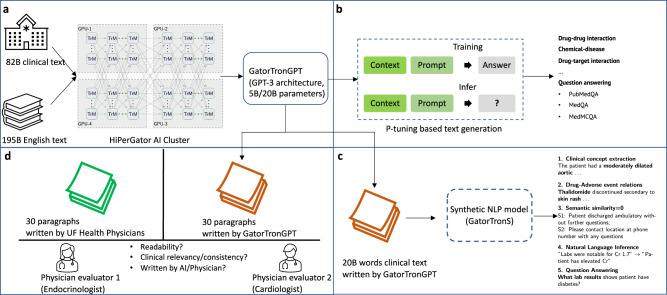
There are enormous enthusiasm and concerns in applying large language models (LLMs) to healthcare. Yet current assumptions are based on general-purpose LLMs such as ChatGPT, which are not developed for medical use. This study develops a generative clinical LLM, GatorTronGPT, using 277 billion words of text including (1) 82 billion words of clinical text from 126 clinical departments and approximately 2 million patients at the University of Florida Health and (2) 195 billion words of diverse general English text. We train GatorTronGPT using a GPT-3 architecture with up to 20 billion parameters and evaluate its utility for biomedical natural language processing (NLP) and healthcare text generation. GatorTronGPT improves biomedical natural language processing. We apply GatorTronGPT to generate 20 billion words of synthetic text. Synthetic NLP models trained using synthetic text generated by GatorTronGPT outperform models trained using real-world clinical text. Physicians’ Turing test using 1 (worst) to 9 (best) scale shows that there are no significant differences in linguistic readability (p = 0.22; 6.57 of GatorTronGPT compared with 6.93 of human) and clinical relevance (p = 0.91; 7.0 of GatorTronGPT compared with 6.97 of human) and that physicians cannot differentiate them (p < 0.001). This study provides insights into the opportunities and challenges of LLMs for medical research and healthcare.
Overview
The claims and statistics of this paper haven’t been checked yet.
Free: it reads the open-access text and checks the first 5 claims that cite a source we can check. Create a free account to check every claim.
Integrity signals
Registry
Cites
Statistics
Figures
Verification
Claims the paper makes
The claims and statistics of this paper haven’t been checked yet.
Free: it reads the open-access text and checks the first 5 claims that cite a source we can check. Create a free account to check every claim.
Claims other papers make about this one
Each is checked against this paper’s own text: does it say what the citing paper says it does?
The source backs part of the claim, not all of it — or backs it for a different population, condition or comparison.
In the citing paper
“As shown in Figure 2A, AI agents possess the capacity to process extensive patient data, including medical histories, diagnostic test results, and imaging, thereby aiding healthcare professionals in making more informed and precise diagnostic decisions.62,63,64,65,66,67,68,69”
From A foundational architecture for AI agents in healthcare (2025) · cites this paper as [62]
Experimental — accuracy not yet measuredThe source backs part of the claim, not all of it — or backs it for a different population, condition or comparison.
In the citing paper
“Large Language Models (LLMs) have attained human-level accuracy on medical question-answer (QA) benchmarks.”
From Limitations of large language models in clinical problem-solving arising from inflexible reasoning (2025) · cites this paper as [5]
Experimental — accuracy not yet measuredThe source backs part of the claim, not all of it — or backs it for a different population, condition or comparison.
In the citing paper
“GatorTronGPT is a domain-adapted clinical generative LLM built on a GPT-3 decoder-only architecture and pretrained on large-scale biomedical and de-identified clinical corpora, making it specifically optimized for healthcare language tasks and was accessed locally via institutional computing infrastructure.”
From A Curated Dataset for Question Answering on Laboratory Test Reference Ranges and Interpretation (2026) · cites this paper as [58]
Experimental — accuracy not yet measuredThe source backs part of the claim, not all of it — or backs it for a different population, condition or comparison.
In the citing paper
“Most LLM studies have depended on human lead semi-quantitative assessment of coherence, comprehensiveness, harmfulness and factual inconsistencies as well as comparing LLM with human based summaries [5, 13, 14].”
From A pilot feasibility study comparing large language models in extracting key information from ICU patient text records from an Irish population (2024) · cites this paper as [14]
Experimental — accuracy not yet measuredThe source backs part of the claim, not all of it — or backs it for a different population, condition or comparison.
In the citing paper
“Most studies applying LLM on clinical notes have been conducted in the US without individual consent, using de-identified data, with only one study from France utilising retrospective MRI reports without identifiable data [5, 6, 13, 14, 17–20].”
From A pilot feasibility study comparing large language models in extracting key information from ICU patient text records from an Irish population (2024) · cites this paper as [14]
Experimental — accuracy not yet measured
1 more claim about this paper
Create a free account to see every claim other papers make about this one.
Self-check
Percentages, sums and reported differences re-computed from the paper’s own numbers.
The self-check needs the paper’s full text.
Citations
Cites
BERT: Pre-training of Deep Bidirectional Transformers for Language Understanding
Devlin, J., Chang, M.-W., Lee, K., & Toutanova, K. (2019) · Proceedings of the 2019 Conference of the North American Chapter of the Association for Computational Linguistics: Human Language Technologies, Volume 1 (Long and Short Papers) · doi:10.18653/v1/n19-1423 · Cited by 54,325
MIMIC-III, a freely accessible critical care database
Johnson, A. E. W., Pollard, T. J., Shen, L., Lehman, L.-W. H., Feng, M., Ghassemi, M., Moody, B., Szolovits, P., Anthony Celi, L., & Mark, R. G. (2016) · Scientific Data · doi:10.1038/sdata.2016.35 · Cited by 8,141 · cited 1×
“We sampled the beginning 15 tokens from all sections of the de-identi fi ed notes from the MIMIC III database 22 and generated approximately 8 million prompts.”
Liu, P., Yuan, W., Fu, J., Jiang, Z., Hayashi, H., & Neubig, G. (2023) · ACM Computing Surveys · doi:10.1145/3560815 · Cited by 4,361 · cited 1×
“Speci fi cally, we adopted a fi xed-LLM prompt-tuning strategy 42 to attach a continuous embedding (i.e., virtue tokens) to the input sequence [ virtual tokens; x; y ] as a soft prompt to control the text generation; the LLM was not changed during training.”
Liu, P., Yuan, W., Fu, J., Jiang, Z., Hayashi, H., & Neubig, G. (2021) · arXiv · doi:10.48550/arxiv.2107.13586 · Cited by 4,352 · cited 1×
“Speci fi cally, we adopted a fi xed-LLM prompt-tuning strategy 42 to attach a continuous embedding (i.e., virtue tokens) to the input sequence [ virtual tokens; x; y ] as a soft prompt to control the text generation; the LLM was not changed during training.”
Training language models to follow instructions with human feedback
Ouyang, L., Wu, J., Jiang, X., Almeida, D., Wainwright, C. L., Mishkin, P., Zhang, C., Agarwal, S., Slama, K., Ray, A., et al. (2022) · arXiv · doi:10.48550/arxiv.2203.02155 · Cited by 4,208 · cited 2×
“Researchers are exploring solutions such as reinforcement learning from human feedback (RLHF) 34 to reduce hallucinations, but it is still a not yet solved limitation of current LLMs. Future studies should explore strategies to better control the hallucinations at a minimal level to ensure the safety of using LLMs in…”
Large language models encode clinical knowledge
Singhal, K., Azizi, S., Tu, T., Mahdavi, S. S., Wei, J., Chung, H. W., Scales, N., Tanwani, A., Cole-Lewis, H., Pfohl, S., et al. (2023) · Nature · doi:10.1038/s41586-023-06291-2 · Cited by 4,083 · cited 5×
“…47 — a biomedical question answering dataset collected from PubMed abstracts, which requires answering questions with ‘ yes/no/maybe ’ ; MedMCQA 48 — a large-scale multi-choice question answering dataset designed to address real world medical entrance exam questions covering 2400 healthcare…”
InfluentialSemantics derived automatically from language corpora contain human-like biases
Caliskan, A., Bryson, J. J., & Narayanan, A. (2017) · Science · doi:10.1126/science.aal4230 · Cited by 2,887 · cited 1×
“Bias inherited from the original training data may be imitated and sometimes even ampli fi ed by AI models, which may cause systematic bias to speci fi c patient groups 36 .”
On the Opportunities and Risks of Foundation Models
Bommasani, R., Hudson, D. A., Adeli, E., Altman, R., Arora, S., von Arx, S., Bernstein, M. S., Bohg, J., Bosselut, A., Brunskill, E., et al. (2021) · arXiv · doi:10.48550/arxiv.2108.07258 · Cited by 2,676 · cited 1×
“It might be still early to judge if LLMs will become the one and only foundation model 12 for NLP, but it looks like we are closer than ever.”
Self-citationGPT-3: Its Nature, Scope, Limits, and Consequences
Floridi, L., & Chiriatti, M. (2020) · Minds and Machines · doi:10.1007/s11023-020-09548-1 · Cited by 2,519 · cited 5×
“We inherited the GPT-3 architecture implemented in the MegaTron-LM 40 and trained GatorTronGPT models from scratch with the default GPT-3 loss function 13 .”
InfluentialPrefix-Tuning: Optimizing Continuous Prompts for Generation
Li, X. L., & Liang, P. (2021) · Proceedings of the 59th Annual Meeting of the Association for Computational Linguistics and the 11th International Joint Conference on Natural Language Processing (Volume 1: Long Papers) · doi:10.18653/v1/2021.acl-long.353 · Cited by 2,473 · cited 1×
“Following previous studies 18,41 , we approached the two tasks using a uni fi ed prompt-based text generation architecture.”
Research works printed but not linked: 3
- Brown T Mann B Ryder N Language models are few-shot learners Adv. Neural Inf. Process. Syst. 2020 33 1877 1901
- Levine, Y., Wies, N., Sharir, O., Bata, H. & Shashua, A. The depth-to-width interplay in self-attention. arXiv [cs.LG] (2020).
- Holtzman, A., Buys, J., Du, L., Forbes, M. & Choi, Y. The curious case of neural text degeneration. arXiv preprintarXiv:1904.09751 (2019).
Cited by
Items 101–200 of 479
Excoffier, J.-B., Röhr, T., Figueroa, A., Papaioannou, J.-M., Bressem, K. K., & Ortala, M. (2024) · arXiv (Cornell University) · doi:10.48550/arxiv.2401.01943 · Cited by 30
Alamoodi, A. H., Zughoul, O., David, D., Garfan, S., Pamucar, D., Albahri, O. S., Albahri, A. S., Yussof, S., & Sharaf, I. M. (2024) · Journal of Medical Systems · doi:10.1007/s10916-024-02090-y · Cited by 22
“First of all, according to work proposed by Peng, et al. [20], different versions of GatorTronGPT, including (1) GatorTron, 90B ( A 1 ) , (2) GatorTronS 1B ( A 2 ) , (3) GatorTronS, 5B ( A 3 ), (4) Gator-TronS, 10B ( A 4 ), and (5) GatorTronS 20B ( A 5 ), which all were medically developed LLMs…”
InfluentialLiu, F., Zhou, H., Wang, K., Yu, Y., Gao, Y., Sun, Z., Liu, S., Sun, S., Zou, Z., Li, Z., et al. (2025) · Cell Reports Medicine · doi:10.1016/j.xcrm.2025.102056 · Cited by 22
“To address this gap, recent advancements have focused on domain-specific models such as PMC-LLaMA, 14 BiomedGPT, 15 and GatorTronGPT, 16 which leverage medical da-tasetslikePubMedarticles,EHRs,andtextbooks toenhancetheir domain knowledge.”
Aspect-Based Sentiment Analysis of Patient Feedback Using Large Language Models
Alkhnbashi, O. S., Nassr, R. M., & Hammoudeh, M. A. A. (2024) · Big Data and Cognitive Computing · doi:10.3390/bdcc8120167 · Cited by 25
Eisinger, F., Holderried, F., Mahling, M., Stegemann–Philipps, C., Herrmann‐Werner, A., Nazarenus, E., Sonanini, A., Guthoff, M., Eickhoff, C., & Holderried, M. (2025) · Journal of Medical Internet Research · doi:10.2196/67143 · Cited by 25
“In the long term—especially with the increasing availability of additional LLMs [38,39]—fine-tuning (both general and domain-specific) and the potential application of specialized LLMs should be considered for the creation of patient-centered letters.”
Adverse reactions to the use of large language models in social interactions
Dvorak, F., Stumpf, R., Fehrler, S., & Fischbacher, U. (2025) · PNAS Nexus · doi:10.1093/pnasnexus/pgaf112 · Cited by 32
Xu, T., Chen, L., Hu, Z., & Li, B. (2025) · Expert Systems with Applications · doi:10.1016/j.eswa.2025.127582 · Cited by 30
LlamaF: An Efficient Llama2 Architecture Accelerator on Embedded FPGAs
Xu, H., Li, Y., & Ji, S. (2024) · IEEE World Forum on Internet of Things (WF-IoT) · doi:10.1109/wf-iot62078.2024.10811385 · Cited by 28
“These models, capable of generating human-like interactions, are poised to transform a myriad of industries, including healthcare [1] biomedical [2], entertainment [3], robotics [4] and music [5].”
BackgroundWang, Y., Zhu, T., Zhou, T., Wu, B., Tan, W., Ma, K., Yao, Z., Wang, J., Li, S., Qin, F., et al. (2025) · Journal of Medical Systems · doi:10.1007/s10916-025-02176-1 · Cited by 27
“By assisting clinicians in mobile health management, LLMs reduce clinical workload and lower the accessibility cost of personalized medical interventions, thereby enhancing the feasibility of their broader implementation in clinical settings [20–24].”
Awasthi, R., Bhattad, A., Ramachandran, S. P., Mishra, S. V., Khanna, A. K., Cywiński, J. B., Maheshwari, K. K., Mahapatra, D., DiRosa, I., Cohen, A., et al. (2025) · npj Health Systems · doi:10.1038/s44401-025-00043-2 · Cited by 32
Challenges and applications in generative AI for clinical tabular data in physiology
Umesh, C., Mahendra, M., Bej, S., Wolkenhauer, O., & Wolfien, M. (2024) · Pflügers Archiv - European Journal of Physiology · doi:10.1007/s00424-024-03024-w · Cited by 22
“The work of Peng et al. under-scores LLMs’ potential in medical research [44].”
Applications and Future Prospects of Medical LLMs: A Survey Based on the M-KAT Conceptual Framework
Chang, Y., Yin, J., Li, J., Liu, C., Cao, L., & Lin, S. (2024) · Journal of Medical Systems · doi:10.1007/s10916-024-02132-5 · Cited by 23
Large language models in traditional Chinese medicine: a systematic review
Chen, Z., Wang, H., Li, C., Liu, C., Yang, F., Zhang, D., Fauci, A. J., & Zhang, J. (2025) · Acupuncture and Herbal Medicine · doi:10.1097/hm9.0000000000000143 · Cited by 26
“Complementary exploration of LLMs is necessary to be compatible with user acceptance and feedback systems, forming a cooperative approach between humans and AI for clinical diagnostics and treatment assistance decision-making [35] .”
AI for Biomedicine in the Era of Large Language ModelsPreprint
Bi, Z., Dip, S. A., Hajialigol, D., Kommu, S., Liu, H., Meng, L., & Wang, X. (2024) · arXiv (Cornell University) · doi:10.48550/arxiv.2403.15673 · Cited by 25
A Generative Artificial Intelligence Copilot for Biomedical Nanoengineering
Wang, Y., Song, H., Teng, Y., Huang, G., Qian, J., Wang, H., Dong, S., Ha, J., Ma, Y., Chang, M., et al. (2025) · ACS Nano · doi:10.1021/acsnano.5c03454 · Cited by 22
Self-citationHealthcare: A Growing Role for Large Language Models and Generative AI
Pahune, S. A., & Rewatkar, N. (2023) · International Journal for Research in Applied Science and Engineering Technology · doi:10.22214/ijraset.2023.55573 · Cited by 24
Meduri, K., Gonaygunta, H., Nadella, G. S., Pawar, P. P., & Kumar, D. (2024) · IJARCCE · doi:10.17148/ijarcce.2024.13114 · Cited by 22
Li, J., Yang, Y., Mao, C., Pang, P. C., Zhu, Q., Xu, D., & Wang, Y. (2025) · Journal of Medical Internet Research · doi:10.2196/66344 · Cited by 26
“Several studies have pointed out that LLMs show strong performance in medical [12], financial [13], and education [14] fields, especially in the medical field, where ChatGPT shows reliable accuracy in questioning dialogues [15], diagnosing illnesses [16], suggesting treatments [17], and predicting…”
Urquhart, E., Ryan, J., Hartigan, S., Nita, C., Hanley, C., Moran, P., Bates, J., Jooste, R., Judge, C., Laffey, J. G., et al. (2024) · Intensive Care Medicine Experimental · doi:10.1186/s40635-024-00656-1 · Cited by 18
Engineering material failure analysis report generation based on QWen and Llama2
Chang, S., Wan, M., Wang, J., Du, H. Y., Zhang, P., & Shi, P. (2025) · Results in Engineering · doi:10.1016/j.rineng.2025.104532 · Cited by 21
Lafourcade, C., Kérourédan, O., Ballester, B., & Richert, R. (2025) · Journal of Dentistry · doi:10.1016/j.jdent.2025.105764 · Cited by 20
MedKA: A knowledge graph-augmented approach to improve factuality in medical Large Language Models
Deng, Y., Zhao, S., Miao, Y., Zhu, J., & Li, J. (2025) · Journal of Biomedical Informatics · doi:10.1016/j.jbi.2025.104871 · Cited by 24
Huo, B., Collins, G. S., Cacciamani, G. E., & Guyatt, G. H. (2025) · npj Digital Medicine · doi:10.1038/s41746-025-02113-z · Cited by 24
Yu, G., Yiu, T. W., Shen, X., & Tam, V. W. Y. (2026) · Engineering Construction & Architectural Management · doi:10.1108/ecam-10-2025-1668 · Cited by 27
Based on Medicine, The Now and Future of Large Language Models
Su, Z., Tang, G., Huang, R., Yang, Q. W., Zhang, Z., & Dai, X. (2024) · Cellular and Molecular Bioengineering · doi:10.1007/s12195-024-00820-3 · Cited by 20
“This model surpasses many existing models in extracting relationships such as drug-drug interactions, chemical-disease relationships, and drug-target interactions [43].”
Beyond Accuracy: Investigating Error Types in GPT-4 Responses to USMLE Questions
Roy, S., Khatua, A., Ghoochani, F., Hadler, U., Nejdl, W., & Ganguly, N. (2024) · Proceedings of the 47th International ACM SIGIR Conference on Research and Development in Information Retrieval · doi:10.1145/3626772.3657882 · Cited by 17
Cheng, M., Zhang, Q., Liang, H., Wang, Y., Qin, J., Gong, L., Wang, S., Li, L., & Xiao, X. (2025) · Frontiers in Endocrinology · doi:10.3389/fendo.2025.1559265 · Cited by 17
“In clinical decision support and intelligent question-and-answer systems, AI applications have signi fi cantly improved healthcare ef fi ciency, contributing to overall improvements in healthcare service quality (15).”
Evaluating large language models in medical applications: a surveyPreprint
Chen, X., Xiang, J., Lu, S., Liu, Y., He, M., & Shi, D. (2024) · arXiv (Cornell University) · doi:10.48550/arxiv.2405.07468 · Cited by 30
Accuracy of large language models in answering ophthalmology board-style questions: A meta-analysis
Wu, J.-H., Nishida, T., & Liu, T. Y. A. (2024) · Asia-Pacific Journal of Ophthalmology · doi:10.1016/j.apjo.2024.100106 · Cited by 16
Large Language Model Architectures in Health Care: Scoping Review of Research Perspectives
Leiser, F., Guse, R., & Sunyaev, A. (2025) · Journal of Medical Internet Research · doi:10.2196/70315 · Cited by 17
“The 3 models include chain-of-thought-reasoning into the inference step of LLMs [47], incorporate physician behavior to teach ChatGPT to reply in a doctor-specific manner [38], or retrain GPT-3 on biomedical datasets containing clinical texts by question-answer challenges [48].”
Vakili, T., Henriksson, A., & Dalianis, H. (2024) · BMC Medical Informatics and Decision Making · doi:10.1186/s12911-024-02546-8 · Cited by 24
“However, the example of GatorTronS [40] shows that this approach is indeed possible and that models pre-trained on synthetic text can perform well.”
BackgroundThe Development Landscape of Large Language Models for Biomedical Applications
Cao, Z., Keloth, V. K., Xie, Q., Qian, L., Liu, Y., Wang, Y., Shi, R., Zhou, W., Yang, G. F., Zhang, J., et al. (2025) · Annual Review of Biomedical Data Science · doi:10.1146/annurev-biodatasci-102224-074736 · Cited by 21
Fabijan, A., Zawadzka-Fabijan, A., Fabijan, R., Zakrzewski, K. M., Nowosławska, E., & Polis, B. (2024) · Diagnostics · doi:10.3390/diagnostics14070773 · Cited by 17
Xiao, C., & Yang, Z. (2025) · Proceedings of the ACM on Human-Computer Interaction · doi:10.1145/3748634 · Cited by 17
“Given these promising applications, we are interested in understanding whether similar capabilities can be observed in the gaming domain.”
Chameleon: Adaptive Caching and Scheduling for Many-Adapter LLM Inference Environments
Iliakopoulou, N., Stojkovic, J., Alverti, C., Xu, T., Franke, H., & Torrellas, J. (2025) · IEEE/ACM International Symposium on Microarchitecture (MICRO) · doi:10.1145/3725843.3756083 · Cited by 28
“They have become integral to numerous technological advancements and applications of different domains, e.g. healthcare [40], coding [12], data analytics [55], or education [3].”
LLMs in medicine: The need for advanced evaluation systems for disruptive technologies
Tang, Y.-D., Dong, E., & Gao, W. (2024) · The Innovation · doi:10.1016/j.xinn.2024.100622 · Cited by 33
MEDITRON: Open Medical Foundation Models Adapted for Clinical PracticePreprint
Chen, Z., Romanou, A., Bonnet, A., Hernández-Cano, A., AlKhamissi, B., Matoba, K., Salvi, F., Pagliardini, M., Fan, S., Köpf, A., et al. (2024) · Research Square · doi:10.21203/rs.3.rs-4139743/v1 · Cited by 31
GPT-Neo with LoRA for Better Medical Knowledge Performance on MultiMedQA DatasetPreprint
Blanco, J., Lambert, C., & Thompson, O. (2024) · OSF Preprints (OSF Preprints) · doi:10.31219/osf.io/njupy · Cited by 60
Cheng, P., Zhang, K., Lyu, M., Liu, H., Sun, L., & Wu, Y. (2025) · Journal of Biomedical Informatics · doi:10.1016/j.jbi.2025.104946 · Cited by 20
Self-citationNatural language generation in healthcare: A review of methods and applications
Lyu, M., Li, X., Chen, Z., Pan, J., Peng, C., Talankar, S., & Wu, Y. (2026) · Journal of Biomedical Informatics · doi:10.1016/j.jbi.2026.104997 · Cited by 19
Self-citationBioMamba: Domain-Adaptive Biomedical Language Models
Yue, L., Zhu, M., Xing, S., Cao, Y., Wang, Y., Chenthamarakshan, V., Pan, S., Das, P., & Fu, T. (2026) · Health Data Science · doi:10.34133/hds.0454 · Cited by 16
Richter-Pechanski, P., Wiesenbach, P., Schwab, D. M., Kiriakou, C., Geis, N. A., Dieterich, C., & Frank, A. (2024) · Natural language processing. · doi:10.1017/nlp.2024.52 · Cited by 18
“…with billions of parameters deliver impressive results in various general (Brown et al., 2020; Chowdhery et al., 2022; Work-shop et al., 2023; Touvron et al., 2023) and biomedical and clinical NLP tasks (Singhal et al., 2023; Thirunavukarasu et al., 2023; Clusmann et al., 2023; Peng et al., 2023).”
Can people with epilepsy trust AI chatbots for information on physical exercise?
Silva, R. R., de Lima, B. E., Costa, T. G., Morais, N. S., José, G., Cordeiro, D. F., de Almeida, A. A., Lopim, G. M., Viana, R. B., Sousa, B. S., et al. (2024) · Epilepsy & Behavior · doi:10.1016/j.yebeh.2024.110193 · Cited by 17
“Research on chatbots in healthcare has expanded, offering new opportunities for sharing medical information and supporting patients [26 – 31].”
Chuang, Y.-S., Sarkar, A. R., Hsu, Y.-C., Mohammed, N., & Jiang, X. (2025) · Journal of the American Medical Informatics Association · doi:10.1093/jamia/ocaf037 · Cited by 14
DualSG: A Dual-Stream Explicit Semantic-Guided Multivariate Time Series Forecasting Framework
Ding, K., Fan, F., Wang, Y., Jian, R., Wang, X., Gong, L., Jiang, Y., Luo, C., & Zhan, J. (2025) · ACM International Conference on Multimedia (ACM MM) · doi:10.1145/3746027.3755458 · Cited by 14
Explainable AI-Driven Analysis of Radiology Reports Using Text and Image Data: Experimental Study
Zamir, M. T., Khan, S. U., Gelbukh, A. F., Riverón, E. M. F., & Gelbukh, I. (2025) · JMIR Formative Research · doi:10.2196/77482 · Cited by 20
“The advent of transformer-based models, such as Clinical-BERT (Bidirectional Encoder Representations from Transformers) and Bio-BERT, further enhanced text understanding by leveraging pretraining on biomedical corpora [19,20].”
Wafaie, K., Basyouni, M. E., Bhattacharjee, T., Prasad, S., Daraqel, B., & Mohammed, H. (2025) · BMC Oral Health · doi:10.1186/s12903-025-06960-w · Cited by 15
“These include assisting with diagnosis [9], structuring data from health records [10–12], answering questions [13], improving crisis response times [14], summarizing evidence [15, 16], facilitating research [17], and data extraction [18].”
Dahlberg, A., Käenniemi, T., Winther-Jensen, T., Tapiola, O., Luisto, R., Puranen, T., Gordon, M., Sanmark, E., & Vartiainen, V. A. (2026) · Artificial Intelligence in Medicine · doi:10.1016/j.artmed.2026.103421 · Cited by 15
de Oliveira, A. C., Bessa, R. F., & Teles, A. S. (2024) · Cadernos de Saúde Pública · doi:10.1590/0102-311xen028824 · Cited by 15
“In the evolution of LMs towards LLMs, another alternative LMs application has been opened in the healthcare domain to respond to free-text queries with specific professional knowledge 10,11 .”
Reviewing clinical knowledge in medical large language models: Training and beyond
Li, Q. Y., Liu, H., Guo, C., Gao, C., Chen, D., Wang, M., Gao, F., van Harmelen, F., & Gu, J. (2025) · Knowledge-Based Systems · doi:10.1016/j.knosys.2025.114215 · Cited by 20
Rao, H., Liu, W., Wang, H., Huang, I.-C., He, Z., & Huang, X. (2026) · Journal of Healthcare Informatics Research · doi:10.1007/s41666-026-00229-9 · Cited by 16
Li, L., Dinh, L., Hu, S., & Hemphill, L. (2024) · Research Square · doi:10.21203/rs.3.rs-4887385/v1 · Cited by 14
Kornblith, A. E., Singh, C., Innes, J. C., Chang, T. P., Adelgais, K., Holsti, M., Kim, J., McClain, B., Nishijima, D. K., Rodgers, S., et al. (2025) · Scientific Reports · doi:10.1038/s41598-025-89996-w · Cited by 16
“Recently, LLMs have been applied in healthcare, enhancing tools such as diagnostics, decision-making support, and predictive analytics 4 .”
Fleurence, R., Wang, X., Bian, J., Higashi, M. K., Ayer, T., Xu, H., Dawoud, D., & Chhatwal, J. (2025) · Value in Health · doi:10.1016/j.jval.2025.04.2167 · Cited by 22
Self-citationThe Aloe Family recipe for open and specialized healthcare LLMs
García-Gasulla, D., Bayarri-Planas, J., Gururajan, A. K., Lopez-Cuena, E., Tormos, A., Hinjos, D., Bernabeu-Pérez, P., Arias-Duart, A., Martin-Torres, P. A., Mallo, M. G., et al. (2026) · npj Digital Medicine · doi:10.1038/s41746-026-02637-y · Cited by 16
Sometimes Painful but Promising: Feasibility and Trade-Offs of On-Device Language Model Inference
Abstreiter, M., Tarkoma, S., & Morabito, R. (2026) · ACM Transactions on Embedded Computing Systems · doi:10.1145/3788870 · Cited by 17
“Beyond their role in conversational AI and virtual assistants, these models are driving substantial transformations across multiple industries, including healthcare, education, entertainment, and software development [6, 46, 54, 61].”
Application of GenAI in Clinical Administration Support
Taheri, A., Farhadi, A., & Zamanifar, A. (2025) · Springer eBooks · doi:10.1007/978-3-031-82963-5_4 · Cited by 15
What can artificial intelligence do for EUS?
Mahajan, S., Siyu, S., & Bhutani, M. S. (2025) · Endoscopic Ultrasound · doi:10.1097/eus.0000000000000102 · Cited by 12
Liu, Z., Hu, L., Zhou, T., Tang, Y., & Cai, Z. (2025) · IEEE Symposium on Security and Privacy (S&P) · doi:10.1109/sp61157.2025.00092 · Cited by 22
“(2) Unpredictable Generative Risks : The information generated by LLMs is not always accurate or reliable, facing challenges of decision-making opacity and susceptibility to model poisoning [16], [20]–[22].”
Qin, S., Wang, Y., Cui, T., Ma, J., Zhou, X., Guo, X., Zhang, C., Zhou, C., Guo, R., & Li, H. (2025) · Pharmacological Research · doi:10.1016/j.phrs.2025.107883 · Cited by 12
Generalizability of choice architecture interventions
Szászi, B., Goldstein, D. G., Soman, D., & Michie, S. (2025) · Nature Reviews Psychology · doi:10.1038/s44159-025-00471-9 · Cited by 22
“These biases could lead to the perpetuation of existing generalizability problems 157,158 and worsen existing inequalities and biases in the literature 159 .”
Exploring healthcare in the 6G and AI era: Opportunities and challenges
Taleb, H., Andrieux, G., Khalife, D., Ajami, A., & Nasser, A. (2025) · Internet of Things · doi:10.1016/j.iot.2025.101744 · Cited by 14
AI and immunology as a new research paradigm
Gururaj, A. E., Scheuermann, R. H., & Lin, D. (2024) · Nature Immunology · doi:10.1038/s41590-024-01974-y · Cited by 11
Survey of Large Language Models for Answering Questions Across Various Fields
Shailendra, P., Ghosh, R. C., Kumar, R., & Sharma, N. (2024) · International Conference on Advanced Computing and Communication Systems (ICACCS) · doi:10.1109/icaccs60874.2024.10717078 · Cited by 24
“Peng et al. [30] introduced the GatorTronGPT model, a clinical generative Large Language Model (LLM) based on the GPT-3 [31] 20B architecture.”
MethodLarge Language Models in Neurosurgery
Ieva, A. D., Stewart, C., & Molina, E. S. (2024) · Advances in experimental medicine and biology · doi:10.1007/978-3-031-64892-2_11 · Cited by 12
RJUA-QA: A Comprehensive QA Dataset for UrologyPreprint
Lyu, S., Chi, C., Cai, H., Shi, L., Xiaoyan, Y., Liu, L., Chen, X., Zhao, D., Zhang, Z., Lyu, X., et al. (2023) · arXiv (Cornell University) · doi:10.48550/arxiv.2312.09785 · Cited by 20
“For one clinical session of a medical consul-tation, the query of a patient generally contains complicated personal context information, which requires LLMs to recognize and understand the important medical-specific information (Peng et al., 2023), e.g. , the patient’s basic information and needs.”
BackgroundLow responsiveness of machine learning models to critical or deteriorating health conditions
Pias, T. S., Afrose, S., Tuli, M. D., Trisha, I. H., Deng, X., Nemeroff, C. B., & Yao, D. D. (2025) · Communications Medicine · doi:10.1038/s43856-025-00775-0 · Cited by 10
Kopitar, L., Štiglic, G., Bedrač, L., & Bian, J. (2024) · IEEE International Conference on Healthcare Informatics (ICHI) · doi:10.1109/ichi61247.2024.00049 · Cited by 12
“…model (MealGM), and (2) the meal plan image generation model (MealImageGM), which both utilized through prompt refinement strategies, leveraging GatorTronGPT—a clinical LLM [5] and GPT-4 with DALL-E (via GPT-4 API)—a general domain LLM with imaging generation capability through DALL-E [8].”
MethodSelf-citationAI-driven report-generation tools in mental healthcare: A review of commercial tools
Bouguettaya, A., Victoria Team, Stuart, E. M., & Aboujaoude, E. N. (2025) · General Hospital Psychiatry · doi:10.1016/j.genhosppsych.2025.02.018 · Cited by 14
Emails by LLMs: A Comparison of Language in AI-Generated and Human-Written Emails
Li, W., Lai, Y., Soni, S., & Saha, K. (2025) · ACM Web Science Conference (WebSci) · doi:10.1145/3717867.3717872 · Cited by 19
Pandita, A., Keniston, A., & Madhuripan, N. (2025) · npj Digital Medicine · doi:10.1038/s41746-025-01658-3 · Cited by 14
“Syntheticorsemi-syntheticdatasetscanbeharnessed to solve this 14,15 but the approach is yet to be adopted at scale in healthcare 16 – 19 .”
Liu, B., Nie, Y., Song, H., Lin, Y., Li, J., Weng, X., Su, Z., Suo, Y., Lv, T., Zhao, X., et al. (2025) · Information Fusion · doi:10.1016/j.inffus.2025.103557 · Cited by 12
Fuchs, S., Werth, A., Méndez, C., & Butcher, J. T. (2025) · Journal of Engineering Education · doi:10.1002/jee.70033 · Cited by 10
“…downstream NLP tasks such as basic text classification (Chung et al., 2023; Kumar et al., 2020; Sahu et al., 2022), improving business management (Rane, 2023), and generating clinical data that outperformed real-world data while addressing patient data-sharing challenges (Peng et al., 2023).”
Preparing Allergists to Practice in 2050 Using Artificial Intelligence
Khoury, P., Oppenheimer, J., Bunyavanich, S., Ciaccio, C. E., & Portnoy, J. M. (2025) · The Journal of Allergy and Clinical Immunology In Practice · doi:10.1016/j.jaip.2025.09.012 · Cited by 13
MIRA: A Novel Framework for Fusing Modalities in Medical RAG
Wang, J., Ashraf, T., Han, Z., Laaksonen, J. T., & Anwer, R. M. (2025) · ACM International Conference on Multimedia (ACM MM) · doi:10.1145/3746027.3755760 · Cited by 15
When to use large language models for digital manufacturing in supply chains?
Tan, B. Q., Kang, K., & Zhong, R. Y. (2026) · International Journal of Production Economics · doi:10.1016/j.ijpe.2026.109932 · Cited by 11
Yu, C.-H., & Masum, M. (2026) · Bioengineering · doi:10.3390/bioengineering13010120 · Cited by 11
“Meanwhile, progress in biomedical generative models, including BioGPT [31], MedAlpaca [32], Meditron [33], ClinicalCamel [34], and hybrid architectures such as BioMedGPT [35] and GatorTronGPT [36], underscores the potential of language-based reasoning to augment numerical sensing.”
Cattaneo, A., Vitali, A., Regazzoni, D., & Rizzi, C. (2024) · Studies in health technology and informatics · doi:10.3233/shti240014 · Cited by 12
PALLM: Evaluating and Enhancing Palliative Care Conversations with Large Language Models
Wang, Z., Yuan, F., LeBaron, V. T., Flickinger, T., & Barnes, L. E. (2026) · ACM Transactions on Computing for Healthcare · doi:10.1145/3712300 · Cited by 16
“Using standard prompting, we asked the LLMs to explain their reasoning after evaluating the segments to better understand their justifications.”
Chen, C., Hu, Y., Cai, W., Pan, H., Shen, M., Zhai, Y., Wu, S. X., Zhou, Q., & Guo, Y. (2025) · International Journal of Medical Informatics · doi:10.1016/j.ijmedinf.2025.106029 · Cited by 10
Self-citationEjas, F., Khan, S. A., Mujahid, A., AlJoker, F., Mautong, H., Alvarado-Villa, G., Kashyap, A., Yasir, M. U., Woubshet, K., Jain, N., et al. (2025) · Journal of Medical Education and Curricular Development · doi:10.1177/23821205251331124 · Cited by 11
“…the accuracy of such datasets is seemingly limited to models designed for medical usage as compared to general chatbots available for public use 16 discovered that a synthetic generative LLM was able to outperform NLP models trained using real-world clinical text, and also found that…”
Maurya, R., Rajput, N., Diviit, M. G., Mahapatra, S., & Ojha, M. K. (2025) · Scientific Reports · doi:10.1038/s41598-025-05012-1 · Cited by 13
Proceeding artificial intelligence technology towards vaccine designs
Zhao, F., & Zai, X. (2025) · The Innovation Life · doi:10.59717/j.xinn-life.2025.100162 · Cited by 9
AutoGraph-R1: End-to-End Reinforcement Learning for Knowledge Graph Construction
Tsang, H. T., Bai, J., Huang, H. K., Xiao, Q., Zheng, T., Xu, B., Liu, S., & Song, Y. (2026) · Proceedings of the conference - Association for Computational Linguistics. Meeting · doi:10.18653/v1/2026.acl-long.1070 · Cited by 15
Salehin, I., Sajib, M. T. A., Badhon, N. H., Rifat, M. S. H., Amin, N., & Moon, N. N. (2025) · Engineering Reports · doi:10.1002/eng2.70365 · Cited by 13
Artificial Intelligence–Assisted Cancer Status Detection in Radiology Reports
Arya, A., Niederhausern, A., Bahadur, N. S., Shah, N. J., Nichols, C., Chatterjee, A., & Philip, J. (2024) · Cancer Research Communications · doi:10.1158/2767-9764.crc-24-0064 · Cited by 11
“Successful application of LLMs in medical notes have achieved comparable performance as human labelers (26, 27).”
BackgroundHe, X., Wei, R., Huang, Y., Chen, Z., Lyu, T., Bost, S. J., Tong, J., Li, L., Zhou, Y., Li, Z., et al. (2024) · Alzheimer s & Dementia Diagnosis Assessment & Disease Monitoring · doi:10.1002/dad2.12613 · Cited by 13
Self-citationChatGPT and Large Language Models in Healthcare; a Bibliometrics Analysis and Review
Mosavi, A. H., Imre, F., & Hùng, V. T. (2024) · IEEE International Conference on Computational Cybernetics (ICCC) · doi:10.1109/iccc62278.2024.10582937 · Cited by 11
Loftus, T. J., Haider, A. H., & Upchurch, G. R. (2025) · JAMA Surgery · doi:10.1001/jamasurg.2024.6025 · Cited by 9
Giuffrè, M., You, K., Pang, Z., Kresevic, S., Chung, S., Chen, R., Ko, Y., Chan, C., Saarinen, T., Ajčević, M., et al. (2025) · npj Digital Medicine · doi:10.1038/s41746-025-01589-z · Cited by 16
Me LLaMA: Foundation Large Language Models for Medical Applications
Xie, Q., Chen, Q., Chen, A., Peng, C., Hu, Y., Lin, F., Peng, X., Huang, J., Zhang, J., Keloth, V., et al. (2024) · arXiv · doi:10.48550/arxiv.2402.12749 · Cited by 8
Self-citationSurgery scheduling based on large language models
Wan, F. J., Wang, T., Wang, K., Si, Y., Fondrevelle, J., Du, S., & Duclos, A. (2025) · Artificial Intelligence in Medicine · doi:10.1016/j.artmed.2025.103151 · Cited by 9
Liu, Y., Zhang, Z., Mi, J., Pan, S., Chen, T., Guo, Y. M., He, X., & Bian, J. (2024) · Journal of Biomedical Informatics · doi:10.1016/j.jbi.2025.104851 · Cited by 11
Self-citationThe Performance of ChatGPT-4.0 and ChatGPT-4omni on Answering Thyroid Question: A Multicenter Study
Guo, S., Li, G., Gou, J., Gong, Y., Zhao, W., Li, Z., Yang, X., Liu, Z., Li, Z., & Lei, J. (2025) · Journal of Surgical Research · doi:10.1016/j.jss.2025.06.066 · Cited by 9
Self-citationSiepmann, R. M., Schneider, C. V., von der Stück, M. S., Amygdalos, I., Große, K., Schneider, K. M., Pollmanns, M. R., Murad, M., Joy, J., Kabak, E., et al. (2025) · Liver International · doi:10.1111/liv.70324 · Cited by 10
Leveraging ChatGPT and explainable AI for enhancing clinical decision support
Shawi, R. E., & Jamel, L. (2025) · Scientific Reports · doi:10.1038/s41598-025-22784-8 · Cited by 13
“LLMs and generative AI have significant potential across diverse domains, including finance 28,29 , healthcare 30,31 , agriculture 32 , and recommender systems 33 .”
Arik, A. O., Parlayandemir, G., & Çelik, S. (2026) · Egyptian Informatics Journal · doi:10.1016/j.eij.2026.100886 · Cited by 11
Lyu, M., Cheng, P., Li, X., Balian, P., Bian, J., & Wu, Y. (2024) · Europe PMC (PubMed Central) · doi:10.48550/arxiv.2403.13089 · Cited by 13
“Previously, we have developed clinical LLMs including GatorTron 18 and GatorTronGPT 19 , and have explored soft prompting for multiple clinical NLP tasks and demonstrated good performance in clinical concept extraction, clinical relation extraction, clinical abbreviation disambiguation, natural…”
MethodSelf-citationEnhancing Chinese Medical Diagnostic Chatbot through Supervised Fine-Tuning of Large Language Models
Ihnaini, B., Huang, Y., Li, L., Wei, J., & Qi, S. (2024) · International Conference on Internet of Things, Automation and Artificial Intelligence (IoTAAI) · doi:10.1109/iotaai62601.2024.10692873 · Cited by 8
“For example, the GatorTronGPT model based on GPT-3 can generate realistic clinical text to supplement medical records that are left blank due to patient privacy issues [15].”
MethodMa, Z., Bi, L., Collins, P., Leary, O. P., Imami, M. R., Zhong, Z., Lu, S., Baird, G. L., Tapinos, N., Çetintemel, U., et al. (2025) · Meta-Radiology · doi:10.1016/j.metrad.2025.100150 · Cited by 8
Metadata
- Authors
- Peng, C., Yang, X., Chen, A., Smith, K. E., PourNejatian, N., Costa, A. B., Martin, C., Flores, M. G., Zhang, Y., Magoc, T., Lipori, G., Mitchell, D. A., Ospina, N. S., Ahmed, M. M., Hogan, W. R., Shenkman, E. A., Guo, Y., Bian, J., & Wu, Y.
- Affiliations
- University of Florida (US)
- Nvidia (United States) (US)
- University of Florida Health (US)
- Corresponding author
- Wu, Yonghui
- ORCID
- Venue
- npj Digital Medicine
- Published
- 2023-11-16
- Volume
- 6
- Issue
- 1
- Pages
- 210-210
- ISSN
- 2398-6352 (ISSN-L)
- PMC
- PMC10654385
- OpenAlex
- W4388725043
- Semantic Scholar
- e154dd91de91558f9d671370754eace62a54c911
- Cited by
- 408
- References
- 37
- Citations by year
- 2026: 95 · 2025: 182 · 2024: 124 · 2023: 7
- FWCI
- 16.25
- Type
- journal article
- Language
- en
- Open access
- gold
- doi.org
- Licence
- cc-by
- creativecommons.org/licenses/by/4.0 (tdm)
- creativecommons.org/licenses/by/4.0 (vor)
- Locations
- npj Digital Medicine (publishedVersion, cc-by)
- PubMed Central (publishedVersion, cc-by)
- PubMed (publishedVersion)
- arXiv (Cornell University) (submittedVersion)
- DOAJ (DOAJ: Directory of Open Access Journals) (submittedVersion, cc-by-sa)
- arXiv (Cornell University)
- Funders
- Patient-Centered Outcomes Research Institute (ME-2018C3-14754)
- U.S. Department of Health & Human Services | NIH | National Cancer Institute (R56AG069880, 1R01CA246418)
- Topics
- Health Sciences › Medicine › Health Informatics › Artificial Intelligence in Healthcare and Education
- Physical Sciences › Computer Science › Artificial Intelligence › Topic Modeling
- Physical Sciences › Computer Science › Artificial Intelligence › Machine Learning in Healthcare
- Keywords
- generative large language models, clinical language models, biomedical natural language processing, GPT-3, medical research applications
About these checks
Registry, retraction, Cites and statistics results are computed, not judged, with one exception: a printed reference that no index lists is read once by a model before it counts as a citation error. Claims are extracted by a model and kept only when their quote appears verbatim in the text; each cited source is then checked, with a model’s help, for whether it says what the claim relies on. Those verdicts can be wrong — read the claim’s quote and the cited source before relying on one.
Statistics and arithmetic are recomputed, not judged.
Confidence bands are shown only for fields calibrated on our annotated test set. None is calibrated yet, so no band is shown.
What counts as a claim ›How we measure confidence ›How we check this ›
Are you an author, or do you see a problem with this page? Request a review
Data sources
Bibliographic data: Semantic Scholar, OpenAlex, Crossref.
Contains information from the Semantic Scholar Academic Graph Datasets, made available under the ODC Attribution License (ODC-BY 1.0).
Semantic Scholar’s data is described in: Kinney, R., et al. (2023). The Semantic Scholar Open Data Platform. arXiv:2301.10140.
