

A study of generative large language model for medical research and healthcare
Open accessThe DOI matches its Crossref record; 52 of the 52 references it cites were found in a registry or an index.
Abstract
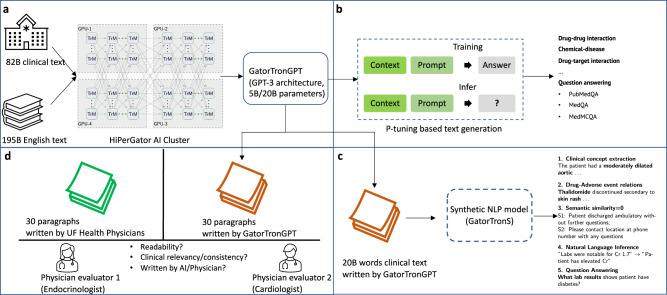
There are enormous enthusiasm and concerns in applying large language models (LLMs) to healthcare. Yet current assumptions are based on general-purpose LLMs such as ChatGPT, which are not developed for medical use. This study develops a generative clinical LLM, GatorTronGPT, using 277 billion words of text including (1) 82 billion words of clinical text from 126 clinical departments and approximately 2 million patients at the University of Florida Health and (2) 195 billion words of diverse general English text. We train GatorTronGPT using a GPT-3 architecture with up to 20 billion parameters and evaluate its utility for biomedical natural language processing (NLP) and healthcare text generation. GatorTronGPT improves biomedical natural language processing. We apply GatorTronGPT to generate 20 billion words of synthetic text. Synthetic NLP models trained using synthetic text generated by GatorTronGPT outperform models trained using real-world clinical text. Physicians’ Turing test using 1 (worst) to 9 (best) scale shows that there are no significant differences in linguistic readability (p = 0.22; 6.57 of GatorTronGPT compared with 6.93 of human) and clinical relevance (p = 0.91; 7.0 of GatorTronGPT compared with 6.97 of human) and that physicians cannot differentiate them (p < 0.001). This study provides insights into the opportunities and challenges of LLMs for medical research and healthcare.
Overview
The claims and statistics of this paper haven’t been checked yet.
Free: it reads the open-access text and checks the first 5 claims that cite a source we can check. Create a free account to check every claim.
Integrity signals
Registry
Cites
Statistics
Figures
Verification
Claims the paper makes
The claims and statistics of this paper haven’t been checked yet.
Free: it reads the open-access text and checks the first 5 claims that cite a source we can check. Create a free account to check every claim.
Claims other papers make about this one
Each is checked against this paper’s own text: does it say what the citing paper says it does?
The source backs part of the claim, not all of it — or backs it for a different population, condition or comparison.
In the citing paper
“As shown in Figure 2A, AI agents possess the capacity to process extensive patient data, including medical histories, diagnostic test results, and imaging, thereby aiding healthcare professionals in making more informed and precise diagnostic decisions.62,63,64,65,66,67,68,69”
From A foundational architecture for AI agents in healthcare (2025) · cites this paper as [62]
Experimental — accuracy not yet measuredThe source backs part of the claim, not all of it — or backs it for a different population, condition or comparison.
In the citing paper
“Large Language Models (LLMs) have attained human-level accuracy on medical question-answer (QA) benchmarks.”
From Limitations of large language models in clinical problem-solving arising from inflexible reasoning (2025) · cites this paper as [5]
Experimental — accuracy not yet measuredThe source backs part of the claim, not all of it — or backs it for a different population, condition or comparison.
In the citing paper
“GatorTronGPT is a domain-adapted clinical generative LLM built on a GPT-3 decoder-only architecture and pretrained on large-scale biomedical and de-identified clinical corpora, making it specifically optimized for healthcare language tasks and was accessed locally via institutional computing infrastructure.”
From A Curated Dataset for Question Answering on Laboratory Test Reference Ranges and Interpretation (2026) · cites this paper as [58]
Experimental — accuracy not yet measuredThe source backs part of the claim, not all of it — or backs it for a different population, condition or comparison.
In the citing paper
“Most LLM studies have depended on human lead semi-quantitative assessment of coherence, comprehensiveness, harmfulness and factual inconsistencies as well as comparing LLM with human based summaries [5, 13, 14].”
From A pilot feasibility study comparing large language models in extracting key information from ICU patient text records from an Irish population (2024) · cites this paper as [14]
Experimental — accuracy not yet measuredThe source backs part of the claim, not all of it — or backs it for a different population, condition or comparison.
In the citing paper
“Most studies applying LLM on clinical notes have been conducted in the US without individual consent, using de-identified data, with only one study from France utilising retrospective MRI reports without identifiable data [5, 6, 13, 14, 17–20].”
From A pilot feasibility study comparing large language models in extracting key information from ICU patient text records from an Irish population (2024) · cites this paper as [14]
Experimental — accuracy not yet measured
1 more claim about this paper
Create a free account to see every claim other papers make about this one.
Self-check
Percentages, sums and reported differences re-computed from the paper’s own numbers.
The self-check needs the paper’s full text.
Citations
Cites
BERT: Pre-training of Deep Bidirectional Transformers for Language Understanding
Devlin, J., Chang, M.-W., Lee, K., & Toutanova, K. (2019) · Proceedings of the 2019 Conference of the North American Chapter of the Association for Computational Linguistics: Human Language Technologies, Volume 1 (Long and Short Papers) · doi:10.18653/v1/n19-1423 · Cited by 54,325
MIMIC-III, a freely accessible critical care database
Johnson, A. E. W., Pollard, T. J., Shen, L., Lehman, L.-W. H., Feng, M., Ghassemi, M., Moody, B., Szolovits, P., Anthony Celi, L., & Mark, R. G. (2016) · Scientific Data · doi:10.1038/sdata.2016.35 · Cited by 8,141 · cited 1×
“We sampled the beginning 15 tokens from all sections of the de-identi fi ed notes from the MIMIC III database 22 and generated approximately 8 million prompts.”
Liu, P., Yuan, W., Fu, J., Jiang, Z., Hayashi, H., & Neubig, G. (2023) · ACM Computing Surveys · doi:10.1145/3560815 · Cited by 4,361 · cited 1×
“Speci fi cally, we adopted a fi xed-LLM prompt-tuning strategy 42 to attach a continuous embedding (i.e., virtue tokens) to the input sequence [ virtual tokens; x; y ] as a soft prompt to control the text generation; the LLM was not changed during training.”
Liu, P., Yuan, W., Fu, J., Jiang, Z., Hayashi, H., & Neubig, G. (2021) · arXiv · doi:10.48550/arxiv.2107.13586 · Cited by 4,352 · cited 1×
“Speci fi cally, we adopted a fi xed-LLM prompt-tuning strategy 42 to attach a continuous embedding (i.e., virtue tokens) to the input sequence [ virtual tokens; x; y ] as a soft prompt to control the text generation; the LLM was not changed during training.”
Training language models to follow instructions with human feedback
Ouyang, L., Wu, J., Jiang, X., Almeida, D., Wainwright, C. L., Mishkin, P., Zhang, C., Agarwal, S., Slama, K., Ray, A., et al. (2022) · arXiv · doi:10.48550/arxiv.2203.02155 · Cited by 4,208 · cited 2×
“Researchers are exploring solutions such as reinforcement learning from human feedback (RLHF) 34 to reduce hallucinations, but it is still a not yet solved limitation of current LLMs. Future studies should explore strategies to better control the hallucinations at a minimal level to ensure the safety of using LLMs in…”
Large language models encode clinical knowledge
Singhal, K., Azizi, S., Tu, T., Mahdavi, S. S., Wei, J., Chung, H. W., Scales, N., Tanwani, A., Cole-Lewis, H., Pfohl, S., et al. (2023) · Nature · doi:10.1038/s41586-023-06291-2 · Cited by 4,083 · cited 5×
“…47 — a biomedical question answering dataset collected from PubMed abstracts, which requires answering questions with ‘ yes/no/maybe ’ ; MedMCQA 48 — a large-scale multi-choice question answering dataset designed to address real world medical entrance exam questions covering 2400 healthcare…”
InfluentialSemantics derived automatically from language corpora contain human-like biases
Caliskan, A., Bryson, J. J., & Narayanan, A. (2017) · Science · doi:10.1126/science.aal4230 · Cited by 2,887 · cited 1×
“Bias inherited from the original training data may be imitated and sometimes even ampli fi ed by AI models, which may cause systematic bias to speci fi c patient groups 36 .”
On the Opportunities and Risks of Foundation Models
Bommasani, R., Hudson, D. A., Adeli, E., Altman, R., Arora, S., von Arx, S., Bernstein, M. S., Bohg, J., Bosselut, A., Brunskill, E., et al. (2021) · arXiv · doi:10.48550/arxiv.2108.07258 · Cited by 2,676 · cited 1×
“It might be still early to judge if LLMs will become the one and only foundation model 12 for NLP, but it looks like we are closer than ever.”
Self-citationGPT-3: Its Nature, Scope, Limits, and Consequences
Floridi, L., & Chiriatti, M. (2020) · Minds and Machines · doi:10.1007/s11023-020-09548-1 · Cited by 2,519 · cited 5×
“We inherited the GPT-3 architecture implemented in the MegaTron-LM 40 and trained GatorTronGPT models from scratch with the default GPT-3 loss function 13 .”
InfluentialPrefix-Tuning: Optimizing Continuous Prompts for Generation
Li, X. L., & Liang, P. (2021) · Proceedings of the 59th Annual Meeting of the Association for Computational Linguistics and the 11th International Joint Conference on Natural Language Processing (Volume 1: Long Papers) · doi:10.18653/v1/2021.acl-long.353 · Cited by 2,473 · cited 1×
“Following previous studies 18,41 , we approached the two tasks using a uni fi ed prompt-based text generation architecture.”
Research works printed but not linked: 3
- Brown T Mann B Ryder N Language models are few-shot learners Adv. Neural Inf. Process. Syst. 2020 33 1877 1901
- Levine, Y., Wies, N., Sharir, O., Bata, H. & Shashua, A. The depth-to-width interplay in self-attention. arXiv [cs.LG] (2020).
- Holtzman, A., Buys, J., Du, L., Forbes, M. & Choi, Y. The curious case of neural text degeneration. arXiv preprintarXiv:1904.09751 (2019).
Cited by
Items 401–479 of 479
Multimorbidity measurement strategies for predicting hospital visits
Neves, B. D., Moreira, J. M., Gonçalves, S., Cerejo, J., Mota, I., Silva, N. A., Leite, F., & Silva, M. J. (2025) · BMC Health Services Research · doi:10.1186/s12913-025-13817-z
Dias, E., Pilastri, A. L., Ferreira, A. R., Lemos, B., & Cortez, P. C. (2025) · IEEE International Conference on Tools with Artificial Intelligence (ICTAI) · doi:10.1109/ictai66417.2025.00109
“Models such as Me-Llama [8], GatorTronGPT [9], and Med-754 Gemini [10] leverage specialized training on medical corpora including clinical notes, biomedical literature, and medical textbooks.”
Urquhart, E., Ryan, J., Hartigan, S. D., Niță, C., Hanley, C., Moran, P., Bates, J. J., Jooste, R., Judge, C. S., Laffey, J. G., et al. (2024) · Figshare · doi:10.6084/m9.figshare.26777725
Montealegre, D. P. D., Fulton, A., Ghahfarokhi, M. H., Uthamacumaran, A., & Zenil, H. (2025) · arXiv (Cornell University) · doi:10.48550/arxiv.2511.14817
“Combining knowledge graphs with CI and generative AI could enable dynamic, interpretable, and context-aware reasoning in clinical settings (Peng et al., 2023).”
Mahbub, I. (2025) · LUTPub (LUT University)
Generating Synthetic Clinical Data in European Portuguese Using an Open-Source Large Language Model
Félix, D. F. S. (2025) · Portuguese National Funding Agency for Science, Research and Technology (RCAAP Project by FCT)
Zhi, Q. (2025) · DiVA (Stockholm University)
Padovano, M., Longo, F., Padovano, A., Frascio, M., & Nardo, B. (2025) · Procedia Computer Science · doi:10.1016/j.procs.2025.12.117 · Cited by 1
FireNarrator: Multimodal LLM-Based Fire Incident Reporting with Decision Logic
Ingle, P. Y., & Kim, Y. (2025) · IEEE Intl Conf on Dependable, Autonomic and Secure Computing, Intl Conf on Pervasive Intelligence and Computing, Intl Conf on Cloud and Big Data Computing, Intl Conf on Cyber Science and Technology Congress (DASC/PiCom/CBDCom/CyberSciTech) · doi:10.1109/dasc68382.2025.00016 · Cited by 1
“In parallel, LLMs have demonstrated remarkable success in generating human-readable narratives from structured inputs across domains such as medicine [6], robotics [7], and environmental monitoring [8].”
Lee, M.-H., Huang, T.-Y., Yang, P.-Y., Chang, Y., & Hsu, M. (2026) · Health Information Science and Systems · doi:10.1007/s13755-026-00431-4
“The deep learning models included BioBERT [20], BioClinicalBERT [17], Biomed-BERT [22], Bioformer [23] and GatorTronS[21], each offering unique strengths in biomedical text processing.”
NM-LLaVA: A Novel Large Language Model Assistant for Nuclear Medicine Imaging Analysis and Reporting
Wang, W., Yun, C., Miao, H., Feng, A., & Zhao, X. (2025) · IEEE International Conference on Bioinformatics and Biomedicine (BIBM) · doi:10.1109/bibm66473.2025.11357214
“Large language models (LLMs), a type of novel and advanced artificial intelligence model based on deep learning technology, learn patterns, grammar, and semantics through training on vast text data, enabling them to handle diverse natural language tasks [11, 12].”
MedEvalarena: A Self-Generated, Peer-Judged Benchmark for Medical ReasoningPreprint
Prem, P., Shidara, K., Kuppa, V., Wheeler, E., Liu, F., Alaa, A. M., & Bernardo, D. (2026) · medRxiv · doi:10.64898/2026.01.27.26344905 · Cited by 4
Feng, X., Kang, Y., Yin, K., Zhang, T., & Wang, P. (2026) · International Journal of Human-Computer Interaction · doi:10.1080/10447318.2026.2623224
“…massive parameters and complex computational structures (Kalota, 2024), Generative AI deeply integrates technologies such as large language models (Peng et al., 2023; Soltani et al., 2025), natural language understanding (Du et al., 2024; Koenigstein, 2025), and neural networks (Rajalakshmi et…”
Interpretable Biomedical QA: Customizing Models for PubMedQA with Knowledge Distillation and XAI
Malik, S., & Singhal, N. (2025) · International Conference on Electronics and Computing, Communication Networking Automation Technologies (ICEC2NT) · doi:10.1109/icec2nt65402.2025.11380163
“Cheng Peng et al. [10] developed GatorTronGPT, which is a clinical language model that is trained on 277 billion words of mixed clinical and general English text using GPT-3 architecture.”
Sazzed, S., Azade, R. S., Dehan, F. N., & Pial, M. E. R. (2025) · IEEE International Conference on Big Data (BigData) · doi:10.1109/bigdata66926.2025.11400847
“Recent advances in large language models (LLMs) have highlighted their potential to tackle a broad range of challenges in health informatics [13], [14], [15].”
Xue, C., Bai, J., Zhang, W. G., Wang, Y., Guo, Y., Yu, J., & Zhu, J. (2026) · Rheumatology & autoimmunity · doi:10.1002/rai2.70041
Self-citationAkbar, A., Wales-McGrath, S., Levya, A., Gokhale, L., Singh, R., Chen, W., Parwani, A. V., & Niazi, M. K. K. (2026) · Research Square · doi:10.21203/rs.3.rs-9076912/v1
Addobea, A. A., Siameh, T., Obiri, I. A., Hassan, J. N. A., & Miao, Z. (2025) · IEEE International Conference on Artificial Intelligence, Computer Science and Information Processing (AICSIP) · doi:10.1109/aicsip65423.2025.11427302
Nizam, S., Lee, K. H., & Khowala, A. (2026) · International Conference on Consumer Electronics · doi:10.1109/icce67443.2026.11449694
“The BERT model [17] established the foundation for contextual language understanding, while GPT-based models have shown remarkable capability in medical text understanding and generation tasks [18].”
Ethical Considerations of Large Language Models: Challenges and Best Practices
Velmovitsky, P. E., Arbuckle, L., & Papadopoulou, P. (2026) · Frontiers research topics · doi:10.3389/978-2-8325-7702-8
Wiese, T. L. (2026) · Informatics for Health and Social Care · doi:10.1080/17538157.2026.2650681
“13 Machine learning (ML) algorithms are increasingly employed for predictive tasks in healthcare, including cost and charge prediction.”
Njunge, M., Huang, Y., Li, R., Karunairajah, A., Burns, N., Falkner, N. M., & Porter, G. (2026) · Journal of Medical Imaging and Radiation Oncology · doi:10.1111/1754-9485.70092 · Cited by 1
Multi-criteria optimization for the management of intensive care beds in an epidemic context
Wan, F. (2024) · theses.fr (ABES) · doi:10.70675/79f4d0a6zc6ddz4374z92abz7adf6bc278e6
Ni, M., Jiang, Y., Li, M., & Zhou, Y. (2026) · Informatics for Health and Social Care · doi:10.1080/17538157.2026.2655820
AIGC-driven virtual patients for diabetes: a systematic review
Tang, Y., Wen, G., & Wu, H. (2026) · Diabetes Research and Clinical Practice · doi:10.1016/j.diabres.2026.113261
Liu, Y., Chen, Z., Suman, P., Cho, H., Prosperi, M., & Wu, Y. (2026) · IEEE International Conference on Healthcare Informatics (ICHI) · doi:10.1109/ichi69079.2026.00031
“Building on this architecture, our team developed GatorTron [22, 23], an encoder-based LLM with up to 8.9 billion parameters trained on 90 billion words of medical text.”
InfluentialSelf-citationDai, A. X. (2026) · International Journal of Human-Computer Interaction · doi:10.1080/10447318.2026.2667475
He, K., Xiao, Q., Chen, W., Jing, L., Wang, Y., Li, S., Yang, D., Xu, H., Pang, K., Xiao, R., et al. (2026) · Journal of Medical Internet Research · doi:10.2196/92852
Clinical text embeddings: A systematic review of methods, applications, and future directions
Jo, H., Kim, S., Son, H., & Kim, J. (2026) · International Journal of Medical Informatics · doi:10.1016/j.ijmedinf.2026.106505 · Cited by 1
Domain-Specific NLP for Personalized Radiation Treatment Pathways with LLM Fine-Tuning
Biswas, A., Patwary, M. O., Momo, M., Tasnim, S., Sultan, T., & Bhowmik, A. (2025) · IEEE International Women in Engineering (WIE) Conference on Electrical and Computer Engineering (WIECON-ECE) · doi:10.1109/wiecon-ece69386.2025.11526388
USE CASES FOR LARGE LANGUAGE MODEL AI IN HEALTHCARE DATA ANALYTICS
Ротар, О. (2026) · Наука і техніка сьогодні · doi:10.52058/2786-6025-2026-4(58)-2593-2604
Dehkordi, M. K. H., Chen, S., Zaidenberg, A., Elhanan, G., Deek, F. P., & Perl, Y. (2026) · Big Data and Cognitive Computing · doi:10.3390/bdcc10060189
Evaluating teacher-supervised small medical language models for institution-constrained clinical QA
Du, G., Dimitriadis, D., & Li, X. (2026) · Journal of Biomedical Informatics · doi:10.1016/j.jbi.2026.105095
He, Z., Bhasuran, B., Lustria, M. L. A., Hanna, K., Killian, M., Shavor, C., Dailey, M., Manikandan, S. S., & Luo, X. (2026) · Journal of Medical Internet Research · doi:10.2196/87280 · Cited by 1
“Although clinician evaluations compared GPT-4o and LLaMA 3.2 in round 3, the patient-facing survey scenarios were based on questions generated for patients 2, 5, and 6, whereas LLaMA 3.2 was applied only to patients 7, 8, and 9.”
InfluentialYang, L., WANG, L. C., Ma, Y., Liu, J., & Zhao, S. (2026) · Knowledge-Based Systems · doi:10.1016/j.knosys.2026.116480
Wang, B., & Hua, X. (2026) · Cluster Computing · doi:10.1007/s10586-026-06141-6
Collaboration Between Two Large Language Models for Design Concept Generation
Xiao, S., Zhang, G., & McAdams, D. A. (2026) · Journal of Mechanical Design · doi:10.1115/1.4072235
Charoensuk, J., Silabumrungrad, N., Lordee, N., & Chootong, C. (2026) · Communications in computer and information science · doi:10.1007/978-981-95-9843-4_29
Inteligência Artificial Generativa na Saúde Mental
Figueiredo, F. D. C. (2026) · Portuguese National Funding Agency for Science, Research and Technology (RCAAP Project by FCT)
Benchmarking large language models for de-identification of electronic health record notes
Panchal, O., Chang, N., Zhao, Z., Nadar, D. R., Dai, H.-J., & Jonnagaddala, J. (2026) · BMJ Health & Care Informatics · doi:10.1136/bmjhci-2025-101894 · Cited by 10
Abayakoon, I., Altiary, M., & Hussain, F. K. (2026) · Knowledge-Based Systems · doi:10.1016/j.knosys.2026.116692
Kang, S., Lee, S. Y., Kim, J., Shin, K., & Chang, B. (2026) · ACM Conference on Recommender Systems (RecSys) · doi:10.1145/3773078.3831753
“Recently, LLMs have shown promise in synthesizing medical data [3, 28, 38]. a l Data For example, GatorTronGPT [47] is fine-tuned to generate clinical notes, leading to improved performance in clinical NLP tasks [32].”
Fariha, T. N., & Raisa, J. F. (2026) · Journal of FST · doi:10.64494/jfst/v4i1/tf/2026/06/109-124
Rajpoot, A. K., Virdee, B., & Khanna, A. (2026) · Lecture notes in networks and systems · doi:10.1007/978-3-032-23317-2_12
Yin, Z., Lam, H.-P., & Jin, N. (2026) · SSRN Electronic Journal · doi:10.2139/ssrn.7229660
AI-based multimodal integration of genomics and electronic health records
Venkatesh, R., & Ritchie, M. D. (2026) · Nature Reviews Genetics · doi:10.1038/s41576-026-00992-w
Emati, J. H. M., Mboussam, H. P., Djam-Doudou, M., & Tchendji, V. K. (2026) · Lecture notes of the Institute for Computer Sciences, Social Informatics and Telecommunications Engineering · doi:10.1007/978-3-032-33957-7_35
Peng, J., Tuo, Y., Wang, G., 韩瑞琴, Wang, Q., Wang, Y., Hu, Z., & Hu, X. (2026) · Visual Computing for Industry Biomedicine and Art · doi:10.1186/s42492-026-00228-y
Liu, Z., Ouyang, H., Liu, X., Mao, H., Dai, W., & Kang, Y. (2026) · Bioengineering · doi:10.3390/bioengineering13080945
“…the proposed framework standardizes heterogeneous literature into semantically normalized entities and typed, literature-weighted relations, enabling knowledge that was previously fragmented across modality-specific studies to be integrated into a unified, computable, and queryable network [42].”
Lupon, E. L., Gérard, A. O., Destère, A., Lombardi, R., Maurice-Szamburski, A., & Micicoi, G. (2026) · Advances in Medical Education and Practice · doi:10.2147/amep.s623640
Hasei, J., Toda, Y., Nishimura, Y., IKEZAKI, T., Matsuoka, H., Takeuchi, K., Nakahara, R., & Ozaki, T. (2026) · Frontiers in Digital Health · doi:10.2196/preprints.109786
Sun, Q., Yang, F., Zhang, P., Zhang, T., Qi, J., & Sun, L. (2026) · Digital Health · doi:10.1177/20552076261483318
“34,35 Compared with general-purpose counterparts trained largely on open-web corpora, medical models face constrained data sharing, strict privacy constraints, and pronounced long-tail distributions.”
Zhou, S.-M., Zhang, M.-J., Zhang, S.-L., Chen, T., Wei, Z., Dong, H.-B., Cui, Q., Li, M., Wang, D., Wang, H.-C., et al. (2027) · World Journal of Gastroenterology · doi:10.3748/wjg.123087
Aftiss, A., Lamsiyah, S., Schommer, C., & Alaoui, S. O. E. (2026) · IEEE Access · doi:10.1109/access.2026.3729844
“Peng et al. [64] introduced GatorTronGPT, trained on large-scale clinical and general text, showing strong results across multiple biomedical tasks and demonstrating the utility of synthetic text generation.”
Transforming large language models into medical specialists via knowledge injection
Kim, K., Song, J., Kim, D. Y., Nam, Y., Park, S., Shin, K., Jo, W., & Kim, N. (2026) · Cell Reports Medicine · doi:10.1016/j.xcrm.2026.103020
Jones-Whiting, L., Campbell, D., Hayes, A., Lee, R. W., & Smith, M. J. (2026) · SSRN Electronic Journal · doi:10.2139/ssrn.7396499
Large Language Models in Clinical Contexts: Infrastructure, Oversight, and Risk Dynamics
Müller, A., Weber, S., Hoffmann, J., Schneider, L., & Klein, T. (2025) · Journal of Artificial Intelligence for Healthcare Systems · doi:10.68159/j510298368
Costa, G., Mendes, R., Teixeira, B., & Ribeiro, L. (2026) · Journal of Artificial Intelligence for Healthcare Systems · doi:10.68159/f858630908
Beem, V. R. (2026) · International Journal of Artificial Intelligence and Machine Learning · doi:10.51483/ijaiml.6.9s.2026.848-855
Rader, B. M., Rai, D. K., Stewart, M. L., Lejfer, S., Chennuri, S., Hartwell, J., Moyano, V., Witwer, M. H., Laussen, P. C., Nelson, H. L., et al. (2026) · PLOS Digital Health · doi:10.1371/journal.pdig.0001684
Tarek, M. F. B., Carroll, R. M., Flores, C., Henderer, J. D., & Beheshti, R. (2026) · Ophthalmology Science · doi:10.1016/j.xops.2026.101417
Jones-Whiting, L., Campbell, D., Hayes, A., Lee, R. W., & Smith, M. J. F. (2026) · SSRN Electronic Journal · doi:10.2139/ssrn.7499015
Saccomanno, S., Ederli, L. S., Ciocia, C., Calò, F., Rizzo, A., Inchingolo, F., Jubani, J., Russo, F., Scarano, R., Grazia, M., et al. (2026) · Frontiers in Dental Medicine · doi:10.3389/fdmed.2026.1959672
Gül, İ., Çolak, R., Çolak, M. K., & Çiçek, O. (2026) · Diagnostics · doi:10.3390/diagnostics16193158
Artificial Intelligence in European Healthcare
Cole-Hunter, T., Abboud, L., Knottnerus, J. A., Martí-Bonmatí, L., Barua, I., Boman, M., Fialová, E., Mihalaş, G., Komadina, R., Korja, M., et al. (2026) · doi:10.1553/easac-feam_report_ai-in-healthcare_2026
Gonçalves, A. R., Liu, V. X., & Ray, P. (2026) · arXiv (Cornell University) · doi:10.48550/arxiv.2609.34007
“…from BERT-style models such as BEHRT, Med-BERT, and CEHR-BERT (Li et al., 2020; Rasmy et al., 2021; Pang et al., 2021) to large-scale foundation models including CLMBR, TransformEHR, MOTOR, and Curiosity (Steinberg et al., 2021; Yang et al., 2023; Steinberg et al., 2024; Waxler et al., 2025).”
Pradana, B. I., Irawan, M. C., Zhorif, K. Y. M., Haz, A. L., Fajrianti, E. D., Sukaridhoto, S., Wibowo, A., & Mufid, M. R. (2026) · International Electronics Symposium (IES) · doi:10.1109/ies71033.2026.11702720
Yu, S., Gu, X., Gao, Y., Zhao, F., & Zhang, J. (2026) · Integrated Diagnostics · doi:10.1016/j.intdia.2026.100006
Chowdhury, A., Joti, T. J., Afikuzzaman, M., Bithi, A. N., Hafiz, M. F. B., & Khan, N. A. (2026) · International Journal of Information Security · doi:10.1007/s10207-026-01339-6
“GatorTronGPT, a 20B-parameter model trained on 277B tokens including 82B clinical tokens, achieves strong biomedical NLP results and can generate synthetic clinical text that improves smaller synthetic models such as GatorTronS [69].”
Application of Large Language Models (LLMs) in the Field of Healthcare
Aymen, J., Ridha, H., & Mohamed, N. (2024) · International Journal of Advanced Natural Sciences and Engineering Researches
Prescher, T., & Kernebeck, S. (2025) · German Journal of Paramedic Science
ARTEMIS enables reusable analytical context generation from scientific literature
Li, D., Gong, B., Tong, W., & Xu, J. (2026) · Discover Artificial Intelligence · doi:10.1007/s44163-026-02485-5
“Large Language Models (LLMs) are increasingly being explored as tools for scientific literature analysis because they can summarize, organize, and synthesize large amounts of information [1, 2].”
Yu, C.-H., & Masum, M. (2026) · Machine Learning with Applications · doi:10.1016/j.mlwa.2026.101051
Medical Reasoning in Large Language Models: Development and Evaluation of the MedEvalArena Benchmark
Prem, P., Kuppa, V., Shidara, K., Wheeler, E., Chang, G., Liu, F., Alaa, A. M., & Bernardo, D. (2026) · Journal of Medical Internet Research · doi:10.2196/96885
Ara, L., Miled, Z. B., Boustani, M. A., & Mohanty, S. (2026) · JAMIA Open · doi:10.1093/jamiaopen/ooag206
Shafiq, S. I., Sanín, C., & Szczerbicki, E. (2026) · Procedia Computer Science · doi:10.1016/j.procs.2026.10.288
Wen, Z., Fu, B., Qin, Y., Gao, Z., & 朱艳 (2026) · Frontiers in Public Health · doi:10.3389/fpubh.2026.1855398
Odewole, O. O., & Başaran, S. (2026) · Sustainability · doi:10.3390/su182111245
Large Language Models for Generating Patient Education Materials: Scoping Review
Li, C., Li, J., Liu, X., Gao, Z., Xu, Y., Xu, X., Liu, X., Zhao, T., Cheng, Y., & Li, M. (2026) · Journal of Medical Internet Research · doi:10.2196/98084
Metadata
- Authors
- Peng, C., Yang, X., Chen, A., Smith, K. E., PourNejatian, N., Costa, A. B., Martin, C., Flores, M. G., Zhang, Y., Magoc, T., Lipori, G., Mitchell, D. A., Ospina, N. S., Ahmed, M. M., Hogan, W. R., Shenkman, E. A., Guo, Y., Bian, J., & Wu, Y.
- Affiliations
- University of Florida (US)
- Nvidia (United States) (US)
- University of Florida Health (US)
- Corresponding author
- Wu, Yonghui
- ORCID
- Venue
- npj Digital Medicine
- Published
- 2023-11-16
- Volume
- 6
- Issue
- 1
- Pages
- 210-210
- ISSN
- 2398-6352 (ISSN-L)
- PMC
- PMC10654385
- OpenAlex
- W4388725043
- Semantic Scholar
- e154dd91de91558f9d671370754eace62a54c911
- Cited by
- 408
- References
- 37
- Citations by year
- 2026: 95 · 2025: 182 · 2024: 124 · 2023: 7
- FWCI
- 16.25
- Type
- journal article
- Language
- en
- Open access
- gold
- doi.org
- Licence
- cc-by
- creativecommons.org/licenses/by/4.0 (tdm)
- creativecommons.org/licenses/by/4.0 (vor)
- Locations
- npj Digital Medicine (publishedVersion, cc-by)
- PubMed Central (publishedVersion, cc-by)
- PubMed (publishedVersion)
- arXiv (Cornell University) (submittedVersion)
- DOAJ (DOAJ: Directory of Open Access Journals) (submittedVersion, cc-by-sa)
- arXiv (Cornell University)
- Funders
- Patient-Centered Outcomes Research Institute (ME-2018C3-14754)
- U.S. Department of Health & Human Services | NIH | National Cancer Institute (R56AG069880, 1R01CA246418)
- Topics
- Health Sciences › Medicine › Health Informatics › Artificial Intelligence in Healthcare and Education
- Physical Sciences › Computer Science › Artificial Intelligence › Topic Modeling
- Physical Sciences › Computer Science › Artificial Intelligence › Machine Learning in Healthcare
- Keywords
- generative large language models, clinical language models, biomedical natural language processing, GPT-3, medical research applications
About these checks
Registry, retraction, Cites and statistics results are computed, not judged, with one exception: a printed reference that no index lists is read once by a model before it counts as a citation error. Claims are extracted by a model and kept only when their quote appears verbatim in the text; each cited source is then checked, with a model’s help, for whether it says what the claim relies on. Those verdicts can be wrong — read the claim’s quote and the cited source before relying on one.
Statistics and arithmetic are recomputed, not judged.
Confidence bands are shown only for fields calibrated on our annotated test set. None is calibrated yet, so no band is shown.
What counts as a claim ›How we measure confidence ›How we check this ›
Are you an author, or do you see a problem with this page? Request a review
Data sources
Bibliographic data: Semantic Scholar, OpenAlex, Crossref.
Contains information from the Semantic Scholar Academic Graph Datasets, made available under the ODC Attribution License (ODC-BY 1.0).
Semantic Scholar’s data is described in: Kinney, R., et al. (2023). The Semantic Scholar Open Data Platform. arXiv:2301.10140.
