

A study of generative large language model for medical research and healthcare
Open accessThe DOI matches its Crossref record; 52 of the 52 references it cites were found in a registry or an index.
Abstract
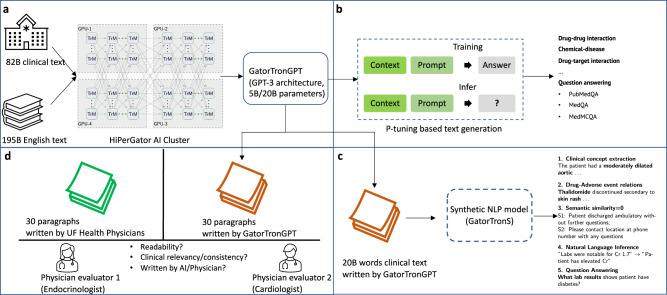
There are enormous enthusiasm and concerns in applying large language models (LLMs) to healthcare. Yet current assumptions are based on general-purpose LLMs such as ChatGPT, which are not developed for medical use. This study develops a generative clinical LLM, GatorTronGPT, using 277 billion words of text including (1) 82 billion words of clinical text from 126 clinical departments and approximately 2 million patients at the University of Florida Health and (2) 195 billion words of diverse general English text. We train GatorTronGPT using a GPT-3 architecture with up to 20 billion parameters and evaluate its utility for biomedical natural language processing (NLP) and healthcare text generation. GatorTronGPT improves biomedical natural language processing. We apply GatorTronGPT to generate 20 billion words of synthetic text. Synthetic NLP models trained using synthetic text generated by GatorTronGPT outperform models trained using real-world clinical text. Physicians’ Turing test using 1 (worst) to 9 (best) scale shows that there are no significant differences in linguistic readability (p = 0.22; 6.57 of GatorTronGPT compared with 6.93 of human) and clinical relevance (p = 0.91; 7.0 of GatorTronGPT compared with 6.97 of human) and that physicians cannot differentiate them (p < 0.001). This study provides insights into the opportunities and challenges of LLMs for medical research and healthcare.
Overview
The claims and statistics of this paper haven’t been checked yet.
Free: it reads the open-access text and checks the first 5 claims that cite a source we can check. Create a free account to check every claim.
Integrity signals
Registry
Cites
Statistics
Figures
Verification
Claims the paper makes
The claims and statistics of this paper haven’t been checked yet.
Free: it reads the open-access text and checks the first 5 claims that cite a source we can check. Create a free account to check every claim.
Claims other papers make about this one
Each is checked against this paper’s own text: does it say what the citing paper says it does?
The source backs part of the claim, not all of it — or backs it for a different population, condition or comparison.
In the citing paper
“As shown in Figure 2A, AI agents possess the capacity to process extensive patient data, including medical histories, diagnostic test results, and imaging, thereby aiding healthcare professionals in making more informed and precise diagnostic decisions.62,63,64,65,66,67,68,69”
From A foundational architecture for AI agents in healthcare (2025) · cites this paper as [62]
Experimental — accuracy not yet measuredThe source backs part of the claim, not all of it — or backs it for a different population, condition or comparison.
In the citing paper
“Large Language Models (LLMs) have attained human-level accuracy on medical question-answer (QA) benchmarks.”
From Limitations of large language models in clinical problem-solving arising from inflexible reasoning (2025) · cites this paper as [5]
Experimental — accuracy not yet measuredThe source backs part of the claim, not all of it — or backs it for a different population, condition or comparison.
In the citing paper
“GatorTronGPT is a domain-adapted clinical generative LLM built on a GPT-3 decoder-only architecture and pretrained on large-scale biomedical and de-identified clinical corpora, making it specifically optimized for healthcare language tasks and was accessed locally via institutional computing infrastructure.”
From A Curated Dataset for Question Answering on Laboratory Test Reference Ranges and Interpretation (2026) · cites this paper as [58]
Experimental — accuracy not yet measuredThe source backs part of the claim, not all of it — or backs it for a different population, condition or comparison.
In the citing paper
“Most LLM studies have depended on human lead semi-quantitative assessment of coherence, comprehensiveness, harmfulness and factual inconsistencies as well as comparing LLM with human based summaries [5, 13, 14].”
From A pilot feasibility study comparing large language models in extracting key information from ICU patient text records from an Irish population (2024) · cites this paper as [14]
Experimental — accuracy not yet measuredThe source backs part of the claim, not all of it — or backs it for a different population, condition or comparison.
In the citing paper
“Most studies applying LLM on clinical notes have been conducted in the US without individual consent, using de-identified data, with only one study from France utilising retrospective MRI reports without identifiable data [5, 6, 13, 14, 17–20].”
From A pilot feasibility study comparing large language models in extracting key information from ICU patient text records from an Irish population (2024) · cites this paper as [14]
Experimental — accuracy not yet measured
1 more claim about this paper
Create a free account to see every claim other papers make about this one.
Self-check
Percentages, sums and reported differences re-computed from the paper’s own numbers.
The self-check needs the paper’s full text.
Citations
Cites
BERT: Pre-training of Deep Bidirectional Transformers for Language Understanding
Devlin, J., Chang, M.-W., Lee, K., & Toutanova, K. (2019) · Proceedings of the 2019 Conference of the North American Chapter of the Association for Computational Linguistics: Human Language Technologies, Volume 1 (Long and Short Papers) · doi:10.18653/v1/n19-1423 · Cited by 54,325
MIMIC-III, a freely accessible critical care database
Johnson, A. E. W., Pollard, T. J., Shen, L., Lehman, L.-W. H., Feng, M., Ghassemi, M., Moody, B., Szolovits, P., Anthony Celi, L., & Mark, R. G. (2016) · Scientific Data · doi:10.1038/sdata.2016.35 · Cited by 8,141 · cited 1×
“We sampled the beginning 15 tokens from all sections of the de-identi fi ed notes from the MIMIC III database 22 and generated approximately 8 million prompts.”
Liu, P., Yuan, W., Fu, J., Jiang, Z., Hayashi, H., & Neubig, G. (2023) · ACM Computing Surveys · doi:10.1145/3560815 · Cited by 4,361 · cited 1×
“Speci fi cally, we adopted a fi xed-LLM prompt-tuning strategy 42 to attach a continuous embedding (i.e., virtue tokens) to the input sequence [ virtual tokens; x; y ] as a soft prompt to control the text generation; the LLM was not changed during training.”
Liu, P., Yuan, W., Fu, J., Jiang, Z., Hayashi, H., & Neubig, G. (2021) · arXiv · doi:10.48550/arxiv.2107.13586 · Cited by 4,352 · cited 1×
“Speci fi cally, we adopted a fi xed-LLM prompt-tuning strategy 42 to attach a continuous embedding (i.e., virtue tokens) to the input sequence [ virtual tokens; x; y ] as a soft prompt to control the text generation; the LLM was not changed during training.”
Training language models to follow instructions with human feedback
Ouyang, L., Wu, J., Jiang, X., Almeida, D., Wainwright, C. L., Mishkin, P., Zhang, C., Agarwal, S., Slama, K., Ray, A., et al. (2022) · arXiv · doi:10.48550/arxiv.2203.02155 · Cited by 4,208 · cited 2×
“Researchers are exploring solutions such as reinforcement learning from human feedback (RLHF) 34 to reduce hallucinations, but it is still a not yet solved limitation of current LLMs. Future studies should explore strategies to better control the hallucinations at a minimal level to ensure the safety of using LLMs in…”
Large language models encode clinical knowledge
Singhal, K., Azizi, S., Tu, T., Mahdavi, S. S., Wei, J., Chung, H. W., Scales, N., Tanwani, A., Cole-Lewis, H., Pfohl, S., et al. (2023) · Nature · doi:10.1038/s41586-023-06291-2 · Cited by 4,083 · cited 5×
“…47 — a biomedical question answering dataset collected from PubMed abstracts, which requires answering questions with ‘ yes/no/maybe ’ ; MedMCQA 48 — a large-scale multi-choice question answering dataset designed to address real world medical entrance exam questions covering 2400 healthcare…”
InfluentialSemantics derived automatically from language corpora contain human-like biases
Caliskan, A., Bryson, J. J., & Narayanan, A. (2017) · Science · doi:10.1126/science.aal4230 · Cited by 2,887 · cited 1×
“Bias inherited from the original training data may be imitated and sometimes even ampli fi ed by AI models, which may cause systematic bias to speci fi c patient groups 36 .”
On the Opportunities and Risks of Foundation Models
Bommasani, R., Hudson, D. A., Adeli, E., Altman, R., Arora, S., von Arx, S., Bernstein, M. S., Bohg, J., Bosselut, A., Brunskill, E., et al. (2021) · arXiv · doi:10.48550/arxiv.2108.07258 · Cited by 2,676 · cited 1×
“It might be still early to judge if LLMs will become the one and only foundation model 12 for NLP, but it looks like we are closer than ever.”
Self-citationGPT-3: Its Nature, Scope, Limits, and Consequences
Floridi, L., & Chiriatti, M. (2020) · Minds and Machines · doi:10.1007/s11023-020-09548-1 · Cited by 2,519 · cited 5×
“We inherited the GPT-3 architecture implemented in the MegaTron-LM 40 and trained GatorTronGPT models from scratch with the default GPT-3 loss function 13 .”
InfluentialPrefix-Tuning: Optimizing Continuous Prompts for Generation
Li, X. L., & Liang, P. (2021) · Proceedings of the 59th Annual Meeting of the Association for Computational Linguistics and the 11th International Joint Conference on Natural Language Processing (Volume 1: Long Papers) · doi:10.18653/v1/2021.acl-long.353 · Cited by 2,473 · cited 1×
“Following previous studies 18,41 , we approached the two tasks using a uni fi ed prompt-based text generation architecture.”
Research works printed but not linked: 3
- Brown T Mann B Ryder N Language models are few-shot learners Adv. Neural Inf. Process. Syst. 2020 33 1877 1901
- Levine, Y., Wies, N., Sharir, O., Bata, H. & Shashua, A. The depth-to-width interplay in self-attention. arXiv [cs.LG] (2020).
- Holtzman, A., Buys, J., Du, L., Forbes, M. & Choi, Y. The curious case of neural text degeneration. arXiv preprintarXiv:1904.09751 (2019).
Cited by
Items 201–300 of 479
A survey for wearable sensors empowering smart healthcare in the era of large language models
Liu, Y., Li, J., Lian, C., Zhang, X., Gong, J., Wang, Y., & Zhao, Y. (2025) · Information Fusion · doi:10.1016/j.inffus.2025.103409 · Cited by 13
Yang, E., Garcia, T., Williams, H., Kumar, B., Ramé, M., Rivera, E., Ma, Y., Amar, J., Catalani, C., & Jia, Y. (2025) · JMIR Formative Research · doi:10.2196/75421 · Cited by 13
AI and the next medical revolution: deep learning’s uncharted healthcare promise
Krithika, L. B., Vishnu, S., Kotei, E., Gadde, A., Kothamasu, G. A., Nallabantu, S. C., & Jayabalasamy, G. (2024) · Engineering Research Express · doi:10.1088/2631-8695/ad56fc · Cited by 9
Mudrik, A., Tsur, A., Nadkarni, G. N., Efros, O., Glicksberg, B. S., Soffer, S., & Klang, E. (2024) · medRxiv · doi:10.1101/2024.08.08.24311699 · Cited by 11
“26 27 LLMs can also aid in medical research by identifying hidden patterns, potentially leading to new discoveries.”
BackgroundMarey, A., Serdysnki, K. C., Killeen, B. D., Unberath, M., & Umair, M. (2024) · BJR|Artificial Intelligence · doi:10.1093/bjrai/ubae008 · Cited by 7
Ce‐LLMs: Status and trends of education‐specific large language models developed in China
Xie, T., Zhou, Y., & Yu, J. (2025) · Future in Educational Research · doi:10.1002/fer3.70008 · Cited by 8
C-PATH: Conversational Patient Assistance and Triage in Healthcare System
Shi, Q. F., Han, Q., & Soares, C. (2025) · IEEE International Conference on Digital Health (ICDH) · doi:10.1109/icdh67620.2025.00016 · Cited by 7
“To enhance the efficacy of generalist LLMs for medical applications, researchers have recognized the importance of training and/or fine-tuning these models on large, in-domain datasets [24].”
A Generative AI–Driven Clinical Decision Support Framework Using Large Language Models
Kachhia, J. A. (2024) · Journal of Computer Science and Technology Studies · doi:10.32996/jcsts.2024.6.5.31 · Cited by 7
Grounding large language models in clinical diagnostics
Chen, X., Zhou, H., Yi, H., You, M., Liu, W., Li, W., Qin, Z., Li, H., Zhang, X., Guo, Y., et al. (2026) · Nature Communications · doi:10.1038/s41467-026-70274-w · Cited by 21
“This approach was motivated by: (1) The substantial volume of data required for training; (3) Prior success in similar approaches, where LLMs were used to structure or simulate medical training data for downstream applications 24,74 – 77 .”
Self-citationGanapathy, A., & Kaushal, P. (2025) · Medical Science Educator · doi:10.1007/s40670-025-02303-0 · Cited by 10
“…still under development, and the potential of these platforms is being investigated in various fields, including medicine by exploring their knowledge, capacity to analyse clinical data, support diagnosis, provide therapeutic advice and assist in continuous training of healthcare professionals [4].”
Albahri, O. S., Alsalem, M. A., Albahri, A. S., Mahmoud, M. A., Alzubaidi, L., Alamoodi, A. H., & Sharaf, I. M. (2025) · International Journal of Intelligent Systems · doi:10.1155/int/2376097 · Cited by 7
“Evaluating and comparing LLMs is crucial [41].”
Devi, A., Uttrani, S., Singla, A., Jha, S., Dasgupta, N., Natarajan, S., Punekar, R. S., Pickett, L. A., & Dutt, V. (2024) · International Conference on PErvasive Technologies Related to Assistive Environments (PETRA) · doi:10.1145/3652037.3663922 · Cited by 10
“AI models may inadvertently replicate and exacerbate biases in their training data, leading to systematic biases against certain patient demographics [15].”
BackgroundReal-World Performance of Large Language Models in Emergency Department Chest Pain TriagePreprint
Meng, X., Ji, J., Yan, X., Xu, H., Gao, J., Wang, J., Wang, J., Wang, X., Wang, Y.-G.-S., Wang, W., et al. (2024) · medRxiv · doi:10.1101/2024.04.24.24306264 · Cited by 7
Large Language Models for Medical Forecasting -- Foresight 2Preprint
Kraljević, Ž., Yeung, J. A., Bean, D. M., Teo, J., & Dobson, R. (2024) · arXiv (Cornell University) · doi:10.48550/arxiv.2412.10848 · Cited by 13
“Similarly, Peng et al. [2023] train an LLM with up to 20B parameters on 82B words of clinical text and 195B words of general English text.”
Zhu, X., Dai, W., Evans, R. D., Geng, X., Mu, A., & Liu, Z. (2025) · JMIR Medical Informatics · doi:10.2196/76636 · Cited by 7
“gLLMs represent a novel addition to digital health [14,61,62], creating new avenues for neurological care [17] and offering significant potential to improve stroke prevention and bridge gaps in care access.”
From task-specific to foundation models: A paradigm shift in medical vision-language analysis
Ali, M. U., Zafar, A., Kim, S., Kim, K. S., & Lee, S. W. (2025) · Computer Science Review · doi:10.1016/j.cosrev.2025.100831 · Cited by 10
Generation of synthetic clinical text: a systematic review
Alshaikhdeeb, B., Lorant, A., Hemedan, A. A., Ghosh, S., Balaur, I., & Satagopam, V. (2026) · npj Digital Medicine · doi:10.1038/s41746-026-03438-z · Cited by 8
Maslinski, J., Grasfield, R. H., Awasthi, R., Mishra, S. V., Mahapatra, D., & Mathur, P. (2025) · Cureus · doi:10.7759/cureus.82397 · Cited by 9
“Over the last couple of years, there has been a rapid growth in not only generic LLMs, but also in numerous healthcare-specific LLMs trained on healthcare data, including electronic health record data (Figure 1 ) [8].”
Lee, J., Oh, S. E., Schwendicke, F., Chaurasia, A., & Kim, Y. (2025) · Journal of Periodontal & Implant Science · doi:10.5051/jpis.2402220111 · Cited by 8
“More recently, large language models (LLMs) have demonstrated the ability to generate accurate responses to diverse medical queries [18,19].”
Liu, R., Li, J., Zivkovic, M., & Abbasi, A. (2025) · MIS Quarterly · doi:10.25300/misq/2024/18573 · Cited by 10
“…et al., 2019); [2] (Van Engelen & Hoos, 2020); [3] (Y. Wang et al., 2020); [4] (Lee et al., 2020); [5] (Brown et al., 2020; Luo et al., 2022; Peng et al., 2023); [6] (Miyato et al., 2017); [7] (Snell et al., 2017); [8] (Xiao & Carenini, 2019); [9] (Beltagy et al., 2019); [10] (Hochreiter &…”
A Survey of Large-Scale Deep Learning Models in Medicine and Healthcare
Chen, Z., Liu, R., Huang, S., Guo, Y., & Ren, Y. (2025) · Computer Modeling in Engineering & Sciences · doi:10.32604/cmes.2025.067809 · Cited by 11
Self-citationGiuffrè, M., Pugliese, N., Kresevic, S., Ajčević, M., Negro, F., Puoti, M., Forns, X., Pawlotsky, J., Shung, D. L., & Aghemo, A. (2025) · Liver International · doi:10.1111/liv.70349 · Cited by 7
AlMuhaideb, S., bin Shawyah, A., Alhamid, M. F., Alabbad, A., Alabbad, M., Alsergani, H., & Alswailem, O. (2024) · Healthcare · doi:10.3390/healthcare12111110 · Cited by 6
“Generative AI has recently emerged as a disruptive technology revolutionizing many application domains [39–41].”
BackgroundMethodManoj, R., & Nandhini, G. (2024) · IEEE Region Humanitarian Technology Conference · doi:10.1109/r10-htc59322.2024.10778845 · Cited by 8
“GenAI [26] has developed a concept of synthetic medical data generation to address these issues.”
Lee, J. J., Zepeda, A., Arbour, G., Isaac, K. V., Ng, R. T., & Nichol, A. (2024) · JCO Clinical Cancer Informatics · doi:10.1200/cci.24.00107 · Cited by 7
Synthetic data production for biomedical research
Lee, Y. G., Kwak, M.-S., Kim, J. E., Kim, M. S., No, D. U., & Chai, H.-Y. (2025) · Osong Public Health and Research Perspectives · doi:10.24171/j.phrp.2024.0335 · Cited by 7
“Gene expression profiles can be examined to identify transcriptional signatures specific to cancer subtypes or chronic disease conditions, thereby facilitating the discovery of potential therapeutic targets [2].”
Ayesha, N., Mujahid, M., Mirdad, A. R., Alamri, F. S., & Khan, A. R. (2025) · Computers, materials & continua/Computers, materials & continua (Print) · doi:10.32604/cmc.2025.063560 · Cited by 6
Rizzo, M. (2025) · Annals of Neurology · doi:10.1002/ana.27229 · Cited by 7
Arabic Large Language Models for Medical Text Generation
Allam, A., Ahmed, S., Hamdi, A., & Mohammed, A. (2025) · International Conference on Computer Technologies (ICCTech) · doi:10.1109/icctech66294.2025.00010 · Cited by 6
“By using advanced libraries, fine-tuning techniques, and dynamic training setups, the design aimed to optimize models for both performance and efficiency [5].”
InfluentialKadhim, A. Z., Green, Z., Nazari, I., Baker, J., George, M. R., Heinson, A., Vadgama, B., Stammers, M., Kipps, C., Beattie, R. M., et al. (2025) · Med · doi:10.1016/j.medj.2025.100895 · Cited by 9
Silva, R. R., de Lima, B. E., José, G., Cordeiro, D. F., Viana, R. B., Andrade, M. S., Vancini, R. L., Rosemann, T. J., Weiss, K., Knechtle, B., et al. (2024) · Epilepsy & Behavior Reports · doi:10.1016/j.ebr.2024.100692 · Cited by 9
“LLMs have a greater capacity for text generation that allows them to engage in complex in-depth dialogs, from which they continuously learn [16].”
BackgroundStawicki, S. P., Martinez-Baladejo, M. T., & Ng-Pellegrino, A. (2023) · International Journal of Academic Medicine · doi:10.4103/ijam.ijam_63_23 · Cited by 6
AI-generated data contamination erodes pathological variability and diagnostic reliabilityPreprint
He, H., Xiang, S., Zhang, Y., Zhu, Y., Zhang, J., Lu, Y., Deng, H., Alsentzer, E., Liu, Y., Chen, Q., et al. (2026) · medRxiv · doi:10.64898/2026.01.19.26344383 · Cited by 9
“Importantly, this synthetic content does not remain confined to documentation: it is incorporated into the datasets used to train subsequent generations of medical AI systems 9–11 .”
Self-citationPham, M.-K., Ho, T.-L. N., Dao, T. T. P., Mai, T. T., Tran, M.-T., Ward, M. E., Geary, Ú., Brennan, R., McDonald, N., Crane, M., et al. (2026) · Research Square · doi:10.21203/rs.3.rs-9085469/v1 · Cited by 6
“Models such as TabNet (Arik & Pfister, 2021) and TabTransformer (Huang et al., 2020) introduced attention-based feature selection and contextualized embeddings, while more recent approaches, including ResNet-style architectures (Gorishniy et al., 2023b), TabM (Gorishniy et al., 2025), ExcelFormer (Chen et al., 2024),…”
InfluentialDeveloping Resource-Efficient Clinical LLMs for Brazilian Portuguese
Pinto, J. G. D. S., de Freitas, A. R., Martins, A. R. D. C., Sawazaki, C. M. R., Vidal, C., & Oliveira, L. E. S. E. (2025) · Lecture notes in computer science · doi:10.1007/978-3-031-79038-6_4 · Cited by 6
Adopción de la inteligencia artificial y tecnologías digitales en la educación superior, Volumen 1
California, U. A. D. B. (2025) · Qartuppi eBooks · doi:10.29410/qtp.25.05 · Cited by 5
Bechar, A., Elmir, Y., Himeur, Y., Medjoudj, R., & Amira, A. (2024) · IEEE/ACM International Conference on Big Data Computing, Applications and Technologies (BDCAT) · doi:10.1109/bdcat63179.2024.00062 · Cited by 7
Song, E. S., Kim, G. H., & Lee, S. (2025) · Journal of Dental Sciences · doi:10.1016/j.jds.2025.07.020 · Cited by 7
Evaluating Large Language Models for Radiology Systematic Review Title and Abstract Screening
Dogra, S., Arabshahi, S., Wei, J., Hu, E., Saidenberg, L., Sharma, S., Gu, Z., Siriruchatanon, M., & Kang, S. K. (2025) · Academic Radiology · doi:10.1016/j.acra.2025.08.014 · Cited by 5
Reimagining clinical AI: from clickstreams to clinical insights with EHR use metadata
Yan, C., Zhang, X., Kannampallil, T., Adler‐Milstein, J., & Chen, Y. (2025) · npj Health Systems · doi:10.1038/s44401-025-00040-5 · Cited by 7
“Developing clinical foundation models from large-scale patient health records has recently gained considerable interest 77 – 81 .”
Mudumbai, S. C., Chung, P., Chen, J., Litake, O., Regala, S., Madhok, J., Krause, M., Pearl, R. G., Boateng, A., & Gabriel, R. A. (2025) · A&A Practice · doi:10.1213/xaa.0000000000002057 · Cited by 6
Nazih, W., Abuhmed, T., Alharbi, M., & El–Sappagh, S. (2025) · PLoS ONE · doi:10.1371/journal.pone.0332134 · Cited by 8
“[70] introduced Gatortron-Base, developed collaboratively by the University of Florida and NVIDIA.”
Asif, S., Hadi, F., Ain, Q. U., Yan, Y., Wang, V. Y., & Xu, D. (2025) · Computer Science Review · doi:10.1016/j.cosrev.2025.100847 · Cited by 6
Cronin, A., Kelly, A., Wrona, M., O'Donnell, P., Hassan, A. A., Myles, T., Fallon, T., & MacFarlane, A. E. (2025) · BJGP Open · doi:10.3399/bjgpo.2025.0107 · Cited by 5
Nuccetelli, F., Gabellone, V., Marsano, F., Giovanetti, F., Dri, P., Valetto, M. R., & Prato, R. (2025) · European Journal of Public Health · doi:10.1093/eurpub/ckaf189 · Cited by 8
Akuze, J., Otieno, G. P., Amare, S. Y., Ngatia, B., Wanduru, P., Kirakoya‐Samadoulougou, F., Kananura, R. M., Amouzou, A., Estifanos, A. S., & Ohuma, E. O. (2025) · BMC Public Health · doi:10.1186/s12889-025-25430-0 · Cited by 8
“…for addressing MNCH and broader healthcare challenges, although it should be noted that current LLMs, such as ChatGPT, are not specifically designed for medical applications and therefore bring performance and safety considerations that require careful adaptation and oversight in healthcare [139].”
Li, Y., Liu, S., Zeng, A., Wu, J. J., Zhang, J., Zhang, W., & Li, S. (2024) · Systems · doi:10.3390/systems12040113 · Cited by 5
MOSS-MED: A Family of Multimodal Models Serving Medical Image Analysis
Dai, J., Zhu, Q., Zhan, J., Wang, B., & Qiu, X. (2025) · ACM Transactions on Management Information Systems · doi:10.1145/3688005 · Cited by 8
“Recent studies [3, 12, 24, 35] have focused on developing language models tailored for the medical domain.”
Chen, R., Zeng, D., Li, Y., Huang, R., Sun, D., & Li, T. (2024) · International Journal of Gynecology & Obstetrics · doi:10.1002/ijgo.15959 · Cited by 7
“4,6,7 Compared to its predecessor, GPT-3.”
Gatsinga, R., Lau, R. S.-E., Lim, B. J. H., Fong, K. Y., Yeong, M. Z. G., Ng, L. G., Ng, L. G., Aslim, E. J., Gan, V. H. L., & Lim, E. J. (2025) · Transplantation Proceedings · doi:10.1016/j.transproceed.2025.02.027 · Cited by 5
Fine-Tuning LLaMA2 for Summarizing Discharge Notes: Evaluating the Role of Highlighted Information
Dehkordi, M. K. H., Perl, Y., Deek, F. P., & Liu, H. (2025) · Big Data and Cognitive Computing · doi:10.3390/bdcc10010004 · Cited by 6
Adversarial Text Purification: A Large Language Model Approach for Defense
Moraffah, R., Khandelwal, S., Bhattacharjee, A., & Liu, H. (2024) · Lecture notes in computer science · doi:10.1007/978-981-97-2262-4_6 · Cited by 8
LLMs in the Heart of Differential Testing: A Case Study on a Medical Rule Engine
Isaku, E., Laaber, C., Sartaj, H., Ali, S., Schwitalla, T., & Nygård, J. F. (2025) · IEEE International Conference on Software Testing, Verification and Validation (ICST) · doi:10.1109/icst62969.2025.10989025 · Cited by 7
“9 Step 3: Double check the use of original variable names as properties, and maintain only one value for each variable.”
Advances in Wearable Electronics, M-IoT, and Artificial Intelligence for Medical and Healthcare
Abadi, A. S. S., Koguciuk, A., Jangas, M., Korycki, P., Tylicka, K., & Targos, P. (2025) · Journal of Electronic & Information Systems · doi:10.30564/jeis.v7i1.9352 · Cited by 4
“After six days of training, the model became a tool for synthetic clinical text generation [97] .”
Foundation Model for Medical Imaging: A Comprehensive Review
Jiao, L., Yang, J., Li, R., Liu, F., Liu, X., Chen, P., Guo, Y., Li, L., Shang, R., & Ma, W. (2025) · IEEE Transactions on Artificial Intelligence · doi:10.1109/tai.2025.3618796 · Cited by 11
“In this stage, the importance of data centrality is emphasized, and representative methods include DoctorGLM [77], MedAlpaca [78], BianQue [79], HuatuoGPT [80], Med-PaLM2 [81], GatorTronGPT [82], and SoulChat [83].”
Self-citationUppuluri, P. C., & Yang, C. W. (2025) · Academic Radiology · doi:10.1016/j.acra.2025.10.063 · Cited by 5
Mora-Delgado, J., Ramos-Ruperto, L., Pardilla, M. J., Sicilia, M., Rodríguez‐González, A., Sempere, J. M., & Puchades, R. (2025) · Revista Clínica Española (English Edition) · doi:10.1016/j.rceng.2025.502413 · Cited by 7
Chen, B., & Taipalus, T. (2025) · ACM Conference on Research in Adaptive and Convergent Systems (RACS) · doi:10.1145/3769002.3769952 · Cited by 7
Promises and challenges of applying large language models in the healthcare domain
Wang, Q., Gong, Z., Lai, Z., Bu, L., Dahlweid, F.-M., & Sun, H. (2026) · Frontiers in Digital Health · doi:10.3389/fdgth.2026.1772274 · Cited by 4
Kebede, R., Oetsch, J., Johansson, P., & Moscati, A. (2026) · Procedia Computer Science · doi:10.1016/j.procs.2026.02.372 · Cited by 4
Artificial Intelligence–Generated Editorials in Radiology: Can Expert Editors Detect Them?
Ozkara, B. B., Boutet, A., Comstock, B. A., Goethem, J. W. V., Huisman, T. A. G. M., Ross, J. S., Saba, L., Shah, L. M., Wintermark, M., & Castillo, M. (2024) · American Journal of Neuroradiology · doi:10.3174/ajnr.a8505 · Cited by 5
InfectA-Chat, an Arabic Large Language Model for Infectious Diseases: Comparative Analysis
Selcuk, Y., Kim, E., & Ahn, I. (2025) · JMIR Medical Informatics · doi:10.2196/63881 · Cited by 5
Yang, S., Jing, M., Wang, S., Huang, Z., Wang, J., Kou, J., Shi, M., Xia, Z., Wei, Q., Xing, W., et al. (2025) · Artificial Intelligence in Medicine · doi:10.1016/j.artmed.2025.103310 · Cited by 5
Zhu, S., Xie, Y., Tang, Y., Zhou, Y., Zhao, R., & Dong, X. (2025) · European Journal of Pediatrics · doi:10.1007/s00431-025-06602-x · Cited by 4
Mora-Delgado, J., Ramos-Ruperto, L., Pardilla, M. J., Sicilia, M. L. M., Rodríguez‐González, A., Sempere, J. M., & Puchades, R. (2025) · Revista Clínica Española · doi:10.1016/j.rce.2025.502413 · Cited by 8
Pangenome-Informed Language Models for Synthetic Genome Sequence Generation
Huang, P., Charton, F., Schmelzle, J.-N., Darnell, S. S., Prins, P., Garrison, E. P., & Suh, G. E. (2025) · IEEE International Conference on Bioinformatics and Biomedicine (BIBM) · doi:10.1109/bibm66473.2025.11356310 · Cited by 4
“The generated language text can be used to train other models [20]–[22], including those in the medical domain [23], [24].”
Tessler, I., Yamin, T., Peeri, H., Alon, E. E., Zimlichman, E., Glicksberg, B. S., & Klang, E. (2024) · Future Medicine AI · doi:10.2217/fmai-2024-0001 · Cited by 4
Generating Synthetic Medical Dataset Using Generative AI: A Case Study
Ray, P. P. (2025) · Wiley eBooks · doi:10.1002/9781394280735.ch13 · Cited by 4
Towards Adapting Open-Source Large Language Models for Expert-Level Clinical Note Generation
Wang, H., Gao, C., Liu, B., Xu, Q., Hussein, G., Labban, M. E., Iheasirim, K., Korsapati, H. R., Outcalt, C., & Sun, J. (2025) · Findings of the Association for Computational Linguistics: ACL (Findings of ACL) · doi:10.18653/v1/2025.findings-acl.626 · Cited by 11
“Notably, GatorTronGPT (Peng et al., 2023), the only LLM trained from scratch us-ing EMR data from real patients to date, performed lower in both MedQA and PubMedQA compared to other clinical LLMs (Chen et al., 2023; Wu et al., 2023a; Kweon et al., 2023).”
Zhang, H., Wang, A., He, C., Qiu, S., & An, Z. (2026) · Journal of the American Pharmacists Association · doi:10.1016/j.japh.2026.103077 · Cited by 3
Lee, S., Kim, S., Koh, G., & Ahn, H. (2024) · Journal of Personalized Medicine · doi:10.3390/jpm14080812 · Cited by 3
Stengel, F. C., Motov, S., Zoia, C., Aldea, C. C., Bartek, J. J., Bauer, M., Belo, D., Drosos, E., Kaprovoy, S., Lepić, M., et al. (2025) · Brain and Spine · doi:10.1016/j.bas.2025.104375 · Cited by 3
Xin, W., Yi, H., Song, J., Tian, Z., Chen, H., & Tan, S. (2025) · Asian Journal of Psychiatry · doi:10.1016/j.ajp.2025.104707 · Cited by 4
Odisho, A. Y., Liu, A. W., Pace, W. A., Carlisle, M., Krumm, R., Cowan, J. E., Carroll, P. R., & Cooperberg, M. R. (2026) · JCO Clinical Cancer Informatics · doi:10.1200/cci-24-00334 · Cited by 3
Generative AI empowered digital twins for advancing precision medicine
Akbarialiabad, H., Safaee, E., Letafati, M., Gong, J., Leachman, S. A., Grada, A. A., Pasdar, A., Janatifar, M., Shakil, F., Bunick, C. G., et al. (2026) · Discover Artificial Intelligence · doi:10.1007/s44163-026-01034-4 · Cited by 3
Cheng, P., Dong, X., Lyu, M., Paredes, D., Zhang, Y., & Wu, Y. (2026) · Journal of Biomedical Informatics · doi:10.1016/j.jbi.2026.105034 · Cited by 8
Self-citationOleas, D., Rodas, J. A., & Alarcon, D. (2026) · Frontiers in Digital Health · doi:10.3389/fdgth.2026.1882677 · Cited by 5
“These platforms can synthesize evidence, structure reasoning, and solve demanding tasks in real time, thereby altering the ways students access, organize, and process academic information (4, 5).”
Shakeri, E., & Far, B. H. (2026) · Intelligence-Based Medicine · doi:10.1016/j.ibmed.2026.100442 · Cited by 3
Farmer, H., Kreiner, K., Schuetz, T., Pölzl, G., Puelacher, C., & Schreier, G. (2024) · Studies in health technology and informatics · doi:10.3233/shti240042 · Cited by 5
PROMISE: A Framework for Model-Driven Stateful Prompt Orchestration
Wu, W., Heierli, J., Meisterhans, M., Moser, A., Färber, A., Dolata, M., Gavagnin, E., de Spindler, A., & Schwabe, G. (2024) · Lecture notes in business information processing · doi:10.1007/978-3-031-61000-4_18 · Cited by 8
Deep Learning-Based Postural Asymmetry Detection Through Pressure Mat
Azurmendi, I., González, M., García, G., Zulueta, E., & García‐Martín, E. (2024) · Applied Sciences · doi:10.3390/app142412050 · Cited by 4
MedicalGLM: A Pediatric Medical Question Answering Model with a quality evaluation mechanism
Wang, X., Sun, Z., Wang, P., & Wei, B. (2025) · Journal of Biomedical Informatics · doi:10.1016/j.jbi.2025.104793 · Cited by 5
ANALISIS PERFORMA CHATGPT DALAM KASUS PROBLEM BASED LEARNING
Baharuddin, B., Sukarno, D. A., & Prawitasari, D. S. (2023) · Prosiding Sains Nasional dan Teknologi · doi:10.36499/psnst.v13i1.9591 · Cited by 6
“Bahkan Peng dan Timnya berhasil membuktikan kemampuan menjawab permasalahan klinis (Peng et al., 2023).”
BackgroundThe Transformative Role of Large Language Models in Post-Acute and Long-Term Care
Eltaybani, S. (2024) · Journal of the American Medical Directors Association · doi:10.1016/j.jamda.2024.03.002 · Cited by 3
PLRTE: Progressive learning for biomedical relation triplet extraction using large language models
Zheng, Y.-K., Zeng, B., Feng, Y., Zhou, L., & Li, Y. (2024) · Journal of Biomedical Informatics · doi:10.1016/j.jbi.2024.104738 · Cited by 3
Harnessing the Power of Language Models for Intelligent Digital Health Services
Garima, S., Morandé, S., & Shashank, S. (2024) · ITU Kaleidoscope Academic Conference (ITU K) · doi:10.23919/ituk62727.2024.10772761 · Cited by 3
Carfin: Car Recommender System Based on Conversational Recommender System Using Large Language Model
Wirawan, A. W., & Baizal, Z. K. A. (2025) · International Conference on Advancement in Data Science, E-learning and Information System (ICADEIS) · doi:10.1109/icadeis65852.2025.10933065 · Cited by 3
“GatorTronGPT has been shown to enhance biomedical natural language processing and generate high-quality synthetic text [11].”
Cheng, P., Yu, Z., Smith, K. E., Lo‐Ciganic, W., Bian, J., & Wu, Y. (2024) · Europe PMC (PubMed Central) · doi:10.48550/arxiv.2403.12374 · Cited by 7
Self-citationLarge Language Models Diagnose Facial DeformityPreprint
Lee, J., Xu, X., Kim, D., Deng, H., Kuang, T., Lampen, N., Fang, X. F., Gateño, J., & Yan, P. (2024) · medRxiv · doi:10.1101/2024.07.11.24310274 · Cited by 3
“One remarkable feature of these models is their capacity for in-context learning (ICL) [20], allowing them to adapt to new tasks and data types, including diverse medical datasets [21].”
BackgroundThe Geometry of Queries: Query-Based Innovations in Retrieval-Augmented Generation for Healthcare QAPreprint
Yang, E., Amar, J., Lee, J. H., Kumar, B., & Jia, Y. (2024) · arXiv (Cornell University) · doi:10.48550/arxiv.2407.18044 · Cited by 5
“…developing conversational AI systems that can answer patient questions, offer personalized health advice, and improve access to care, particularly for underserved populations (Clusmann et al., 2023; Peng et al., 2023; Alowais et al., 2023; Nori et al., 2023; Singhal et al., 2023; Tu et al., 2024).”
Numviyumukiza, E., Niyonsenga, J., Niyibizi, J. B., & Jansen, S. (2024) · Research Square · doi:10.21203/rs.3.rs-5150455/v1 · Cited by 4
Yang, E., Garcia, T., Williams, H., Kumar, B., Ramé, M., Rivera, E., Ma, Y., Amar, J., Catalani, C., & Jia, Y. (2024) · arXiv (Cornell University) · doi:10.48550/arxiv.2410.14041 · Cited by 3
“Notably, their conversational ability allows LLMs to clarify user intent, answer nutrition-related questions with contextual nuance, provide tailored recommendations that align with individual preferences and needs, and adapt their approach based on user feedback [29, 21, 23].”
BackgroundPham, M.-K., Mai, T. T., Dao, T. T. P., Tran, M., Crane, M., & Bezbradica, M. (2025) · doi:10.36227/techrxiv.175021755.55836808/v1 · Cited by 3
From Medical LLMs to Versatile Medical Agents: A Comprehensive SurveyPreprint
Zhou, Y., Zheng, H., Chen, D., Yang, H., Han, W., & Shen, J. (2026) · Authorea · doi:10.22541/au.177437366.61663600/v1 · Cited by 8
Generative Large Language Models in Clinical, Legal and Financial Domains
Garg, G., & Bhatt, S. (2025) · Springer eBooks · doi:10.1007/978-3-031-88988-2_9 · Cited by 2
Sarkar, A., Ghosh, E., & Bhattacharjee, S. (2026) · Frontiers in Dental Medicine · doi:10.3389/fdmed.2026.1778372 · Cited by 2
“Using deep learning techniques, ChatGPT is trained on extensive datasets comprising 175 billion parameters to generate responses that resemble human conversation based on user input (2, 3).”
SPSleepNet: enhancing EEG-based sleep staging for OSA patients via sleep position integration
Zhang, Y., Qiu, X., Ma, G., Yang, L., Jing, T., & Huang, J. (2025) · Complex & Intelligent Systems · doi:10.1007/s40747-025-02030-4 · Cited by 2
“They can leverage medical corpora during pretraining to emulate medical professionals, extending medical resources, providing preliminary screening services, reducingphysicians’workload,andacceleratingthediagnos-tic process [25, 26].”
Self-citationFrydman-Gani, C., Arias, A., Vallejo, M. P., Martínez, J. D. L., Valencia‐Echeverry, J., Castano, M., Bui, A. A. T., Freimer, N. B., López‐Jaramillo, C., & Loohuis, L. M. O. (2026) · Journal of Medical Internet Research · doi:10.2196/93328 · Cited by 3
MediFusion AI: An Integrated System for Multimodal Disease Diagnosis and Patient-Doctor Interaction
Nassir, H. A., Hassan, S. Z., Vinoy, A. C., Saktheeswaran, D., & Konikkara, D. (2025) · International Conference on Advances in Computing, Communication, Embedded and Secure Systems (ACCESS) · doi:10.1109/access65134.2025.11135715 · Cited by 2
“Additionally, research by Tang et al. [11] and Peng et al. [12] evaluated LLMs in medical evidence summarization, reinforcing the role of AI in synthesizing medical knowledge.”
Arabic Symptom Classification and Diagnosis Using Transformer Models and LLM-Based Augmentation
Ahmed, S., Allam, A., Hamdi, A., & Mohammed, A. (2025) · Intelligent Methods, Systems, and Applications (IMSA) · doi:10.1109/imsa65733.2025.11167759 · Cited by 2
Metadata
- Authors
- Peng, C., Yang, X., Chen, A., Smith, K. E., PourNejatian, N., Costa, A. B., Martin, C., Flores, M. G., Zhang, Y., Magoc, T., Lipori, G., Mitchell, D. A., Ospina, N. S., Ahmed, M. M., Hogan, W. R., Shenkman, E. A., Guo, Y., Bian, J., & Wu, Y.
- Affiliations
- University of Florida (US)
- Nvidia (United States) (US)
- University of Florida Health (US)
- Corresponding author
- Wu, Yonghui
- ORCID
- Venue
- npj Digital Medicine
- Published
- 2023-11-16
- Volume
- 6
- Issue
- 1
- Pages
- 210-210
- ISSN
- 2398-6352 (ISSN-L)
- PMC
- PMC10654385
- OpenAlex
- W4388725043
- Semantic Scholar
- e154dd91de91558f9d671370754eace62a54c911
- Cited by
- 408
- References
- 37
- Citations by year
- 2026: 95 · 2025: 182 · 2024: 124 · 2023: 7
- FWCI
- 16.25
- Type
- journal article
- Language
- en
- Open access
- gold
- doi.org
- Licence
- cc-by
- creativecommons.org/licenses/by/4.0 (tdm)
- creativecommons.org/licenses/by/4.0 (vor)
- Locations
- npj Digital Medicine (publishedVersion, cc-by)
- PubMed Central (publishedVersion, cc-by)
- PubMed (publishedVersion)
- arXiv (Cornell University) (submittedVersion)
- DOAJ (DOAJ: Directory of Open Access Journals) (submittedVersion, cc-by-sa)
- arXiv (Cornell University)
- Funders
- Patient-Centered Outcomes Research Institute (ME-2018C3-14754)
- U.S. Department of Health & Human Services | NIH | National Cancer Institute (R56AG069880, 1R01CA246418)
- Topics
- Health Sciences › Medicine › Health Informatics › Artificial Intelligence in Healthcare and Education
- Physical Sciences › Computer Science › Artificial Intelligence › Topic Modeling
- Physical Sciences › Computer Science › Artificial Intelligence › Machine Learning in Healthcare
- Keywords
- generative large language models, clinical language models, biomedical natural language processing, GPT-3, medical research applications
About these checks
Registry, retraction, Cites and statistics results are computed, not judged, with one exception: a printed reference that no index lists is read once by a model before it counts as a citation error. Claims are extracted by a model and kept only when their quote appears verbatim in the text; each cited source is then checked, with a model’s help, for whether it says what the claim relies on. Those verdicts can be wrong — read the claim’s quote and the cited source before relying on one.
Statistics and arithmetic are recomputed, not judged.
Confidence bands are shown only for fields calibrated on our annotated test set. None is calibrated yet, so no band is shown.
What counts as a claim ›How we measure confidence ›How we check this ›
Are you an author, or do you see a problem with this page? Request a review
Data sources
Bibliographic data: Semantic Scholar, OpenAlex, Crossref.
Contains information from the Semantic Scholar Academic Graph Datasets, made available under the ODC Attribution License (ODC-BY 1.0).
Semantic Scholar’s data is described in: Kinney, R., et al. (2023). The Semantic Scholar Open Data Platform. arXiv:2301.10140.
