

Adopting and expanding ethical principles for generative artificial intelligence from military to healthcare
Open accessThe DOI matches its Crossref record; 90 of the 91 references it cites were found in a registry or an index; 6 of the 31 sources its claims cite were checked for support.
Abstract
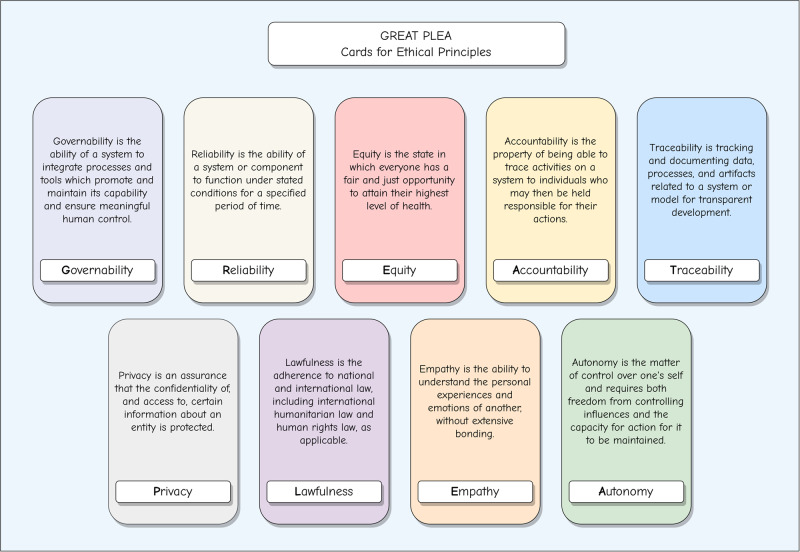
In 2020, the U.S. Department of Defense officially disclosed a set of ethical principles to guide the use of Artificial Intelligence (AI) technologies on future battlefields. Despite stark differences, there are core similarities between the military and medical service. Warriors on battlefields often face life-altering circumstances that require quick decision-making. Medical providers experience similar challenges in a rapidly changing healthcare environment, such as in the emergency department or during surgery treating a life-threatening condition. Generative AI, an emerging technology designed to efficiently generate valuable information, holds great promise. As computing power becomes more accessible and the abundance of health data, such as electronic health records, electrocardiograms, and medical images, increases, it is inevitable that healthcare will be revolutionized by this technology. Recently, generative AI has garnered a lot of attention in the medical research community, leading to debates about its application in the healthcare sector, mainly due to concerns about transparency and related issues. Meanwhile, questions around the potential exacerbation of health disparities due to modeling biases have raised notable ethical concerns regarding the use of this technology in healthcare. However, the ethical principles for generative AI in healthcare have been understudied. As a result, there are no clear solutions to address ethical concerns, and decision-makers often neglect to consider the significance of ethical principles before implementing generative AI in clinical practice. In an attempt to address these issues, we explore ethical principles from the military perspective and propose the “GREAT PLEA” ethical principles, namely Governability, Reliability, Equity, Accountability, Traceability, Privacy, Lawfulness, Empathy, and Autonomy for generative AI in healthcare. Furthermore, we introduce a framework for adopting and expanding these ethical principles in a practical way that has been useful in the military and can be applied to healthcare for generative AI, based on contrasting their ethical concerns and risks. Ultimately, we aim to proactively address the ethical dilemmas and challenges posed by the integration of generative AI into healthcare practice.
Overview
CoChat Summary
TL;DR
This perspective proposes “GREAT PLEA” ethical principles for generative AI in healthcare by adapting and expanding military AI ethics from the U.S. Department of Defense and NATO. It argues that shared military–healthcare concerns support adopting governability, reliability, equity, accountability, traceability, privacy, lawfulness, empathy, and autonomy.
Key findings
- The paper proposes nine “GREAT PLEA” principles for generative AI in healthcare: Governability, Reliability, Equity, Accountability, Traceability, Privacy, Lawfulness, Empathy, and Autonomy.
- It maps these principles to DOD, NATO, and WHO guidelines, noting that all except privacy, empathy, and autonomy directly align with either DOD or NATO guidelines; privacy, empathy, and autonomy align directly or indirectly with WHO guidelines.
- It identifies generative AI risks in healthcare including algorithmic bias, hallucination, poor commonsense reasoning, lack of generally agreed model evaluation metrics, PHI leakage, and lack of empathy.
- It cites the DOD’s 2020 disclosure of five core AI ethical principles and reports ChatGPT had an estimated 100 million monthly active users in January 2023.
Methods
- Conceptual/perspective analysis comparing ethical concerns and risks of generative AI in military versus healthcare settings.
- Draws on existing ethical frameworks and reports, including DOD, NATO, WHO, AMA, CHAI, OSTP, and a RAND Corporation study on military AI.
- Proposes a framework for adopting shared principles and expanding healthcare-specific principles, summarized in a mapping table and principle cards.
Limitations
- The paper states that enforcement of the proposed ethical principles is out of scope and acknowledges “the lack of detailed enforcement procedures as the limitation of the work.”
- Evident from the text: the work is conceptual and does not empirically validate the GREAT PLEA principles or test their implementation in clinical settings.
- Evident from the text: the framework relies on qualitative comparison and existing guideline alignment rather than measured outcomes, patient data, or clinician data.
Model-written summary. Check it against the paper before relying on it.
Integrity signals
Registry
Cites
Statistics
Figures
Verification
Claims the paper makes
5 Valid · 3 Not valid · 18 Not checked · 19 Own results and interpretations
The cited sources support only part of this claim — read each source’s verdict below.
In the paper
“Without this consideration, generative AI systems could erroneously recommend treatments for different patients99.”
§ Adopting and expanding ethical principles for generative artificial intelligence from military to healthcare > GREAT PLEA ethical principles for generative AI in healthcare > Equity
What the sources say
- Partly supportedcites [99] Hoffman KM Trawalter S Axt JR Oliver MN Racial bias in pain assessment and treatment recommendations, and false beliefs about biological differences between blacks and whites Proc. Natl Acad. Sci. 2016 113 4296 4301 10.1073/pnas.1516047113 27044069 PMC4843483 sourceExperimental — accuracy not yet measured
The Study 2 passage reports that medical trainees who endorsed false beliefs about racial differences made less accurate treatment recommendations for Black patients. That supports the concern about biased recommendations, but the paper studies people, not generative AI systems, and does not test whether accounting for existing health disparities changes AI recommendations. (LLM, conf=0.82)
hedgedstates a possible cause- Asserted: passes — The authors put it forward as true.
- Checkable: passes — It can be checked against evidence.
- Load-bearing: passes — The paper’s conclusions depend on it.
- Based: passes — The paper gives a reason why it holds.
- Rests on an assumption not shown here.
- Partly supported
Every source the paper cites for this claim was checked and supports it.
In the paper
“This high-level understanding will help optimize trust, as operators will be aware of the capabilities and limitations of the AI systems they work with and know the appropriate settings for use104.”
§ Adopting and expanding ethical principles for generative artificial intelligence from military to healthcare > GREAT PLEA ethical principles for generative AI in healthcare > Traceability
What the sources say
- Supportedcites [104] Li, B. et al. Trustworthy ai: From principles to practices. ACM Comput. Surv. 5510.1145/3555803 (2023). source
Appendix A.2.1 (p. 43) says operators should know a system’s working conditions and limitations to avoid exceptional use cases. Section 4.1 (p. 28) says appropriate information disclosure improves trust, while warning that poorly chosen explanations can encourage overreliance. Together, these support the claim that understanding when a system should be used helps calibrate trust. (LLM, conf=0.86)
plainstates a cause- Asserted: passes — The authors put it forward as true.
- Checkable: passes — It can be checked against evidence.
- Load-bearing: passes — The paper’s conclusions depend on it.
- Based: passes — The paper gives a reason why it holds.
- Supported
The cited sources support only part of this claim — read each source’s verdict below.
In the paper
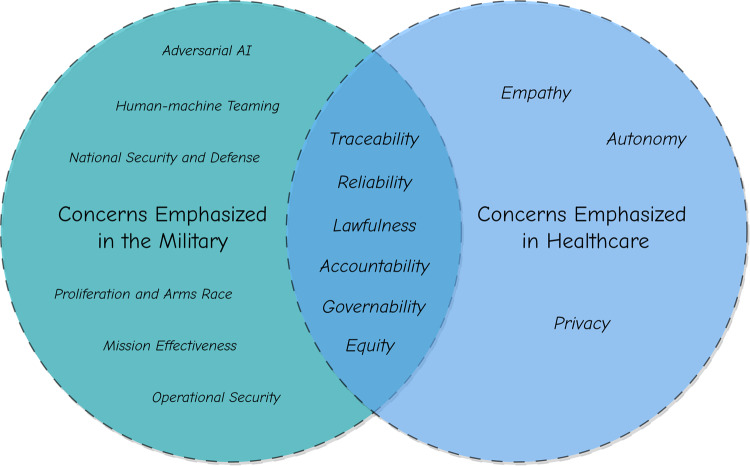
“There are many concerns specific to the military that are unsuitable for forming ethical principles in healthcare, such as national security and defense, mission effectiveness, operational security, adversarial AI94, human-machine teaming, rules of engagement, rapid deployment and adaptation, and proliferation and arms race.”
§ Adopting and expanding ethical principles for generative artificial intelligence from military to healthcare > GREAT PLEA ethical principles for generative AI in healthcare
What the sources say
- Partly supportedcites [94] Rosenberg, I., Shabtai, A., Elovici, Y. & Rokach, L. Adversarial machine learning attacks and defense methods in the cyber security domain. ACM Comput. Surv. 5410.1145/3453158 (2021). sourceExperimental — accuracy not yet measured
The Introduction and Conclusions discuss adversarial attacks on machine-learning systems as a cybersecurity concern, supporting the cited example of adversarial AI. They do not characterize it as specific to the military or say it is unsuitable as a basis for healthcare ethics principles. The citation is attached to “adversarial AI,” not to the other examples in the list. (LLM, conf=0.85)
plain- Asserted: passes — The authors put it forward as true.
- Checkable: passes — It can be checked against evidence.
- Load-bearing: passes — The paper’s conclusions depend on it.
- Based: passes — The paper gives a reason why it holds.
- Partly supported
Every source the paper cites for this claim was checked and supports it.
In the paper
“This assurance of accountability is crucial when a clinician is using generative AI to help treat a patient, as without proper measures for human accountability, the patient may feel that the clinician is not invested in the care they are delivering102.”
§ Adopting and expanding ethical principles for generative artificial intelligence from military to healthcare > GREAT PLEA ethical principles for generative AI in healthcare > Accountability
What the sources say
- Supportedcites [102] Habli I Lawton T Porter Z Artificial intelligence in health care: accountability and safety Bull. World Health Org. 2020 98 251 – 256 10.2471/BLT.19.237487 32284648 PMC7133468 source
The 'Clinician and patient perspectives' section states that moral accountability 'underpins the patient's trust in the clinician providing care' and that 'patients tend to believe that the clinician is acting towards them with goodwill', adding that accountability 'helps to avoid professional complacency' — i.e. where human accountability is not secured, the patient's sense that the clinician is acting in their interest is undermined, which is what the hedged claim attributes. The source is here discussing AI-assisted care generally (its AI Clinician/sepsis example) rather than generative AI specifically, but the accountability-to-patient-trust point it makes carries the claim, and the source states it with at least as much confidence as the citing 'may feel'. (LLM, conf=0.82)
hedgedstates a possible cause- Asserted: passes — The authors put it forward as true.
- Checkable: passes — It can be checked against evidence.
- Load-bearing: passes — The paper’s conclusions depend on it.
- Based: passes — The paper gives a reason why it holds.
- Supported
The cited sources that could be checked couldn’t confirm or dispute this claim.
In the paper
“However, no set of principles encompasses all ethical concerns that healthcare providers or patients may have92.”
§ Adopting and expanding ethical principles for generative artificial intelligence from military to healthcare > GREAT PLEA ethical principles for generative AI in healthcare
What the sources say
- Could not verifycites [92] Naik, N. et al. Legal and ethical consideration in artificial intelligence in healthcare: Who takes responsibility?Front. Surg.9 (2022). PMC8963864 35360424 sourceExperimental — accuracy not yet measured
The Ethical Challenges section identifies four major issues in healthcare AI, and the Abstract says well-defined regulations are lacking. Neither says that no set of principles can encompass all concerns of healthcare providers or patients; searches for that statement and a paraphrase found no supporting passage. (LLM, conf=0.72)
plain- Asserted: passes — The authors put it forward as true.
- Checkable: passes — It can be checked against evidence.
- Load-bearing: passes — The paper’s conclusions depend on it.
- Based: passes — The paper gives a reason why it holds.
- Could not verify
15 more claims
Create a free account to see all 45 claims and to verify the 25 references still open.
- It may state two separate claims as one. 11
- Probably not a substantial claim. 20
Claims other papers make about this one
Each is checked against this paper’s own text: does it say what the citing paper says it does?
The cited source says what the claim attributes to it.
In the citing paper
“The development of these guidelines should also address biases, promote fairness in AI-generated content, and consider data privacy and security, especially as AI tools often require access to large datasets, potentially containing sensitive information.24”
From Balancing innovation and integrity: the role of AI in research and scientific writing (2023) · cites this paper as [24]
The cited source says what the claim attributes to it.
In the citing paper
“AI algorithms may be harmful when prematurely deployed without adequate control [9, 15–17].”
From Implementing Artificial Intelligence in Critical Care Medicine: a consensus of 22. (2025) · cites this paper as [17]
Citations
Cites
Vaswani, A., Shazeer, N., Parmar, N., Uszkoreit, J., Jones, L., Gomez, A. N., Kaiser, L., & Polosukhin, I. (2017) · arXiv · doi:10.48550/arxiv.1706.03762 · Cited by 120,404 · cited 2×
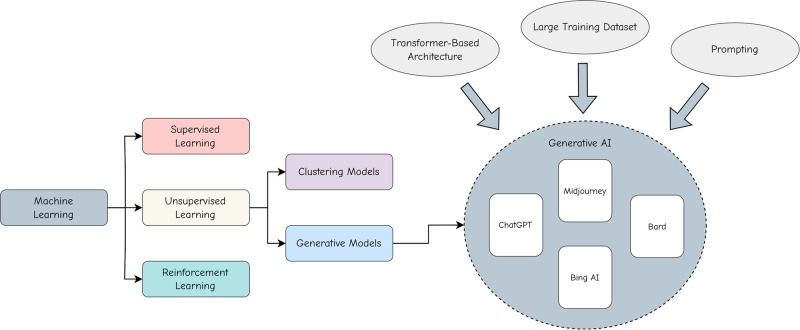
“Many state-of-the-art generative AI models, also known as Large Language Models (LLMs), share a similar transformer-based architecture 32 .”
BackgroundLanguage Models are Few-Shot Learners
Brown, T. B., Mann, B., Ryder, N., Subbiah, M., Kaplan, J., Dhariwal, P., Neelakantan, A., Shyam, P., Sastry, G., Askell, A., et al. (2020) · arXiv · doi:10.48550/arxiv.2005.14165 · Cited by 23,372 · cited 2×
“The model architectures for ChatGPT, previously known as GPT-3.”
BackgroundHigh-Resolution Image Synthesis with Latent Diffusion Models
Rombach, R., Blattmann, A., Lorenz, D., Esser, P., & Ommer, B. (2022) · 2022 IEEE/CVF Conference on Computer Vision and Pattern Recognition (CVPR) · doi:10.1109/cvpr52688.2022.01042 · Cited by 20,302 · cited 1×
“The well-known generative AI models used for image generation from text prompts, such as Stable Diffusion 33 and DALL-E 2 34 , employ a combination of the diffusion process 35 and a transformer-based architecture similar to the one used in GPT models.”
MethodDissecting racial bias in an algorithm used to manage the health of populations
Obermeyer, Z., Powers, B., Vogeli, C., & Mullainathan, S. (2019) · Science · doi:10.1126/science.aax2342 · Cited by 7,137 · cited 1×
“In healthcare settings, biased algorithms or biased practices can lead to certain patient groups receiving lower levels of care 83 .”
BackgroundSurvey of Hallucination in Natural Language Generation
Ji, Z., Lee, N., Frieske, R., Yu, T., Su, D., Xu, Y., Ishii, E., Bang, Y. J., Madotto, A., & Fung, P. (2023) · ACM Computing Surveys · doi:10.1145/3571730 · Cited by 5,025 · cited 3×
“The proximity of generative AI to patient well-being necessitates standards for reliability to minimize potential errors that could lead to accidents 43 .”
BackgroundInfluentialSurvey of Hallucination in Natural Language Generation
Ji, Z., Lee, N., Frieske, R., Yu, T., Su, D., Xu, Y., Ishii, E., Bang, Y., Chen, D., Dai, W., et al. (2022) · arXiv · doi:10.48550/arxiv.2202.03629 · Cited by 4,981
Chain-Of-Thought Prompting Elicits Reasoning in Large Language Models
Wei, J., Wang, X., Schuurmans, D., Bosma, M., Ichter, B., Xia, F., Chi, E., Le, Q. V., & Zhou, D. (2022) · Advances in Neural Information Processing Systems 35 · doi:10.52202/068431-1800 · Cited by 4,505
Liu, P., Yuan, W., Fu, J., Jiang, Z., Hayashi, H., & Neubig, G. (2023) · ACM Computing Surveys · doi:10.1145/3560815 · Cited by 4,361 · cited 1×
“Most of these generative AI models also rely on a method called prompting 37 , which lets users input a natural language description of a task and uses it as a context to generate useful information.”
MethodLiu, P., Yuan, W., Fu, J., Jiang, Z., Hayashi, H., & Neubig, G. (2021) · arXiv · doi:10.48550/arxiv.2107.13586 · Cited by 4,352 · cited 1×
“Most of these generative AI models also rely on a method called prompting 37 , which lets users input a natural language description of a task and uses it as a context to generate useful information.”
MethodChain-of-Thought Prompting Elicits Reasoning in Large Language Models
Wei, J., Wang, X., Schuurmans, D., Bosma, M., Ichter, B., Xia, F., Chi, E., Le, Q., & Zhou, D. (2022) · arXiv · doi:10.48550/arxiv.2201.11903 · Cited by 4,263 · cited 1×
“…algorithmic bias may result in the mistreatment of patients 48 , hallucination may carry misinformation 49 , poor commonsense reasoning can result in confusing interactions 50 , and lack of general and domain-speci fi c metrics can make it dif fi cult to validate the robustness of the AI system 51 .”
BackgroundLarge language models encode clinical knowledge
Singhal, K., Azizi, S., Tu, T., Mahdavi, S. S., Wei, J., Chung, H. W., Scales, N., Tanwani, A., Cole-Lewis, H., Pfohl, S., et al. (2023) · Nature · doi:10.1038/s41586-023-06291-2 · Cited by 4,083 · cited 1×
“The use and impact of AI in clinical Natural Language Processing (NLP) in the context of Electronic Health Records (EHRs) have been profound 10 – 13 .”
BackgroundLarge Language Models Encode Clinical Knowledge
Singhal, K., Azizi, S., Tu, T., Mahdavi, S. S., Wei, J., Chung, H. W., Scales, N., Tanwani, A., Cole-Lewis, H., Pfohl, S., et al. (2022) · arXiv · doi:10.48550/arxiv.2212.13138 · Cited by 4,083 · cited 1×
“The use and impact of AI in clinical Natural Language Processing (NLP) in the context of Electronic Health Records (EHRs) have been profound 10 – 13 .”
BackgroundAyers, J. W., Poliak, A., Dredze, M., Leas, E. C., Zhu, Z., Kelley, J. B., Faix, D. J., Goodman, A. M., Longhurst, C. A., Hogarth, M., et al. (2023) · JAMA Internal Medicine · doi:10.1001/jamainternmed.2023.1838 · Cited by 2,613
Hierarchical Text-Conditional Image Generation with CLIP Latents
Ramesh, A., Dhariwal, P., Nichol, A., Chu, C., & Chen, M. (2022) · arXiv · doi:10.48550/arxiv.2204.06125 · Cited by 2,511 · cited 1×
“The well-known generative AI models used for image generation from text prompts, such as Stable Diffusion 33 and DALL-E 2 34 , employ a combination of the diffusion process 35 and a transformer-based architecture similar to the one used in GPT models.”
MethodHoffman, K. M., Trawalter, S., Axt, J. R., & Oliver, M. N. (2016) · Proceedings of the National Academy of Sciences · doi:10.1073/pnas.1516047113 · Cited by 2,486 · cited 1×
“Without this consideration, generative AI systems could erroneously recommend treatments for different patients 99 .”
BackgroundA Survey of Large Language Models
Zhao, W. X., Zhou, K., Li, J., Tang, T., Dong, Z., Hou, Y., Zhang, B., Min, Y., Zhang, J., Liu, P., et al. (2026) · Frontiers of Computer Science · doi:10.1007/s11704-026-60308-3 · Cited by 2,093 · cited 2×
“All of the models are characterized by unsupervised training on very large datasets 36 .”
BackgroundMethodA Survey of Large Language Models
Zhao, W. X., Zhou, K., Li, J., Tang, T., Wang, X., Hou, Y., Min, Y., Zhang, B., Zhang, J., Dong, Z., et al. (2023) · arXiv · doi:10.48550/arxiv.2303.18223 · Cited by 2,090 · cited 2×
“All of the models are characterized by unsupervised training on very large datasets 36 .”
BackgroundMethodImplementing Machine Learning in Health Care — Addressing Ethical Challenges
Char, D. S., Shah, N. H., & Magnus, D. (2018) · New England Journal of Medicine · doi:10.1056/nejmp1714229 · Cited by 1,857 · cited 1×
“The issue of human autonomy when developing generative AI is especially pertinent in healthcare, as both patient and clinician autonomy must be respected 85 .”
BackgroundThe rise of artificial intelligence in healthcare applications
Bohr, A., & Memarzadeh, K. (2020) · Artificial Intelligence in Healthcare · doi:10.1016/b978-0-12-818438-7.00002-2 · Cited by 1,636
Legal and Ethical Consideration in Artificial Intelligence in Healthcare: Who Takes Responsibility?
Naik, N., Hameed, B. M. Z., Shetty, D. K., Swain, D., Shah, M., Paul, R., Aggarwal, K., Ibrahim, S., Patil, V., Smriti, K., et al. (2022) · Frontiers in Surgery · doi:10.3389/fsurg.2022.862322 · Cited by 931
A large language model for electronic health records
Yang, X., Chen, A., PourNejatian, N., Shin, H. C., Smith, K. E., Parisien, C., Compas, C., Martin, C., Costa, A. B., Flores, M. G., et al. (2022) · npj Digital Medicine · doi:10.1038/s41746-022-00742-2 · Cited by 847 · cited 1×
“The use and impact of AI in clinical Natural Language Processing (NLP) in the context of Electronic Health Records (EHRs) have been profound 10 – 13 .”
BackgroundArtificial Intelligence and Human Trust in Healthcare: Focus on Clinicians
Asan, O., Bayrak, A. E., & Choudhury, A. (2020) · Journal of Medical Internet Research · doi:10.2196/15154 · Cited by 825
LaMDA: Language Models for Dialog Applications
Thoppilan, R., De Freitas, D., Hall, J., Shazeer, N., Kulshreshtha, A., Cheng, H.-T., Jin, A., Bos, T., Baker, L., Du, Y., et al. (2022) · arXiv · doi:10.48550/arxiv.2201.08239 · Cited by 778 · cited 2×
“…including: ● Algorithmic bias 41,42 ● Hallucination 43,44 ● Poor commonsense reasoning 44,45 ● Lack of generally agreed model evaluation metrics 46,47 All of these issues are common for generative AI in general, but more so in the healthcare domain, where algorithmic bias may result in the…”
BackgroundHigh-Resolution Image Synthesis with Latent Diffusion Models
Rombach, R., Blattmann, A., Lorenz, D., Esser, P., & Ommer, B. (2021) · arXiv · doi:10.48550/arxiv.2112.10752 · Cited by 737 · cited 1×
“The well-known generative AI models used for image generation from text prompts, such as Stable Diffusion 33 and DALL-E 2 34 , employ a combination of the diffusion process 35 and a transformer-based architecture similar to the one used in GPT models.”
MethodBang, Y., Cahyawijaya, S., Lee, N., Dai, W., Su, D., Wilie, B., Lovenia, H., Ji, Z., Yu, T., Chung, W., et al. (2023) · Proceedings of the 13th International Joint Conference on Natural Language Processing and the 3rd Conference of the Asia-Pacific Chapter of the Association for Computational Linguistics (Volume 1: Long Papers) · doi:10.18653/v1/2023.ijcnlp-main.45 · Cited by 682 · cited 2×
“…outcomes in healthcare can arise from a number of issues, including: ● Algorithmic bias 41,42 ● Hallucination 43,44 ● Poor commonsense reasoning 44,45 ● Lack of generally agreed model evaluation metrics 46,47 All of these issues are common for generative AI in general, but more so in the…”
BackgroundThe Role of Empathy in Health and Social Care Professionals
Moudatsou, M., Stavropoulou, A., Philalithis, A., & Koukouli, S. (2020) · Healthcare · doi:10.3390/healthcare8010026 · Cited by 645 · cited 2×
“Empathy is the ability to understand the personal experiences and emotions of another, without extensive bonding 111 .”
BackgroundTrustworthy AI: From Principles to Practices
Li, B., Qi, P., Liu, B., Di, S., Liu, J., Pei, J., Yi, J., & Zhou, B. (2023) · ACM Computing Surveys · doi:10.1145/3555803 · Cited by 612 · cited 1×
“This high-level understanding will help optimize trust, as operators will be aware of the capabilities and limitations of the AI systems they work with and know the appropriate settings for use 104 .”
BackgroundChatGPT for (Finance) research: The Bananarama Conjecture
Dowling, M., & Lucey, B. (2023) · Finance Research Letters · doi:10.1016/j.frl.2023.103662 · Cited by 591
Holm, S. (2002) · Journal of Medical Ethics · doi:10.1136/jme.28.5.332-a · Cited by 470
Role of artificial intelligence in patient safety outcomes: systematic literature review
Choudhury, A., & Asan, O. (2020) · JMIR Medical Informatics · doi:10.2196/18599 · Cited by 440
Patient apprehensions about the use of artificial intelligence in healthcare
Richardson, J. P., Smith, C., Curtis, S., Watson, S., Zhu, X., Barry, B., & Sharp, R. R. (2021) · npj Digital Medicine · doi:10.1038/s41746-021-00509-1 · Cited by 424
NORTH ATLANTIC TREATY ORGANIZATION
IGNARSKI, J. S. (1983) · Regional Cooperation, Organizations and Problems · doi:10.1016/b978-0-444-86237-2.50079-2 · Cited by 422
A study of generative large language model for medical research and healthcare
Peng, C., Yang, X., Chen, A., Smith, K. E., PourNejatian, N., Costa, A. B., Martin, C., Flores, M. G., Zhang, Y., Magoc, T., et al. (2023) · npj Digital Medicine · doi:10.1038/s41746-023-00958-w · Cited by 408 · cited 2×
“…but more so in the healthcare domain, where algorithmic bias may result in the mistreatment of patients 48 , hallucination may carry misinformation 49 , poor commonsense reasoning can result in confusing interactions 50 , and lack of general and domain-speci fi c metrics can make it dif fi cult to…”
BackgroundArtificial intelligence in health care: accountability and safety
Habli, I., Lawton, T., & Porter, Z. (2020) · Bulletin of the World Health Organization · doi:10.2471/blt.19.237487 · Cited by 357 · cited 1×
“This assurance of accountability is crucial when a clinician is using generative AI to help treat a patient, as without proper measures for human accountability, the patient may feel that the clinician is not invested in the care they are delivering 102 .”
BackgroundLee, M., Liang, P., & Yang, Q. (2022) · CHI Conference on Human Factors in Computing Systems · doi:10.1145/3491102.3502030 · Cited by 345
Bang, Y., Cahyawijaya, S., Lee, N., Dai, W., Su, D., Wilie, B., Lovenia, H., Ji, Z., Yu, T., Chung, W., et al. (2023) · arXiv · doi:10.48550/arxiv.2302.04023 · Cited by 337 · cited 2×
“…outcomes in healthcare can arise from a number of issues, including: ● Algorithmic bias 41,42 ● Hallucination 43,44 ● Poor commonsense reasoning 44,45 ● Lack of generally agreed model evaluation metrics 46,47 All of these issues are common for generative AI in general, but more so in the…”
BackgroundAdversarial Machine Learning Attacks and Defense Methods in the Cyber Security Domain
Rosenberg, I., Shabtai, A., Elovici, Y., & Rokach, L. (2022) · ACM Computing Surveys · doi:10.1145/3453158 · Cited by 295 · cited 1×
“…fi c to the military that are unsuitable for forming ethical principles in healthcare, such as national security and defense, mission effectiveness, operational security, adversarial AI 94 , human-machine teaming, rules of engagement, rapid deployment and adaptation, and proliferation and arms race.”
BackgroundShould ChatGPT be biased? Challenges and risks of bias in large language models
Ferrara, E. (2023) · First Monday · doi:10.5210/fm.v28i11.13346 · Cited by 282 · cited 1×
“While generative AI shows promising results, dangerous outcomes in healthcare can arise from a number of issues, including: ● Algorithmic bias 41,42 ● Hallucination 43,44 ● Poor commonsense reasoning 44,45 ● Lack of generally agreed model evaluation metrics 46,47 All of these issues are common for…”
BackgroundThe Role of Trust in Human-Robot Interaction
Lewis, M., Sycara, K., & Walker, P. (2018) · Studies in Systems, Decision and Control · doi:10.1007/978-3-319-64816-3_8 · Cited by 281 · cited 1×
“In both situations, the root cause is operators not knowing the capabilities and limitations of the systems they interact with 77 .”
BackgroundWill Artificial Intelligence Replace Radiologists?
Langlotz, C. P. (2019) · Radiology: Artificial Intelligence · doi:10.1148/ryai.2019190058 · Cited by 244
A Complete Survey on Generative AI (AIGC): Is ChatGPT from GPT-4 to GPT-5 All You Need?Preprint
Zhang, C.-N., Zhang, C.-S., Zheng, S., Qiao, Y., Li, C.-H., Zhang, M.-C., Dam, S. K., Thwal, C. M., Tun, Y. L., Huy, L. L., et al. (2023) · arXiv.org · doi:10.48550/arxiv.2303.11717 · Cited by 228
Regulation of predictive analytics in medicine
Parikh, R. B., Obermeyer, Z., & Navathe, A. S. (2019) · Science · doi:10.1126/science.aaw0029 · Cited by 223 · cited 1×
“Misuse can lead to non-typical errors, such as fratricide in the military or patient harm in a hospital 78,79 .”
BackgroundNot just autonomy--the principles of American biomedical ethics.
Holm, S. (1995) · Journal of Medical Ethics · doi:10.1136/jme.21.6.332 · Cited by 211
Bahl, M., Barzilay, R., Yedidia, A. B., Locascio, N. J., Yu, L., & Lehman, C. D. (2018) · Radiology · doi:10.1148/radiol.2017170549 · Cited by 180
The Self-Perception and Political Biases of ChatGPT
Rutinowski, J., Franke, S., Endendyk, J., Dormuth, I., & Pauly, M. (2023) · arXiv · doi:10.48550/arxiv.2304.07333 · Cited by 178
Developing cyber-resilient systems: a systems security engineering approach
Ross, R., Pillitteri, V., Graubart, R., Bodeau, D., & McQuaid, R. (2021) · doi:10.6028/nist.sp.800-160v2r1 · Cited by 162
Evaluating GPT4 on Impressions Generation in Radiology Reports
Sun, Z., Ong, H., Kennedy, P., Tang, L., Chen, S., Elias, J., Lucas, E., Shih, G., & Peng, Y. (2023) · Radiology · doi:10.1148/radiol.231259 · Cited by 159 · cited 1×
“Generative AI has also become an active area of research in the healthcare domain 19,20 , with applications such as clinical documentation 21 and evidence-based medicine summarization 22 .”
BackgroundSelf-citationDiverse patients’ attitudes towards Artificial Intelligence (AI) in diagnosis
Robertson, C., Woods, A., Bergstrand, K., Findley, J., Balser, C., & Slepian, M. J. (2023) · PLOS Digital Health · doi:10.1371/journal.pdig.0000237 · Cited by 158
A Comparison of Artificial Intelligence and Human Doctors for the Purpose of Triage and Diagnosis
Baker, A., Perov, Y., Middleton, K., Baxter, J., Mullarkey, D., Sangar, D., Butt, M., DoRosario, A., & Johri, S. (2020) · Frontiers in Artificial Intelligence · doi:10.3389/frai.2020.543405 · Cited by 157
Applications of Artificial Intelligence to Electronic Health Record Data in Ophthalmology
Lin, W.-C., Chen, J., Chiang, M. F., & Hribar, M. R. (2020) · Translational Vision Science & Technology · doi:10.1167/tvst.9.2.13 · Cited by 155
Human-centricity in AI governance: A systemic approach
Sigfrids, A., Leikas, J., Salo-Pöntinen, H., & Koskimies, E. (2023) · Frontiers in Artificial Intelligence · doi:10.3389/frai.2023.976887 · Cited by 155 · cited 1×
“Governability is the ability of a system to integrate processes and tools which promote and maintain its capability and ensure meaningful human control 95 .”
BackgroundHuman–Human Reliance in the Context of Automation
Lyons, J. B., & Stokes, C. K. (2012) · Human Factors: The Journal of the Human Factors and Ergonomics Society · doi:10.1177/0018720811427034 · Cited by 137 · cited 1×
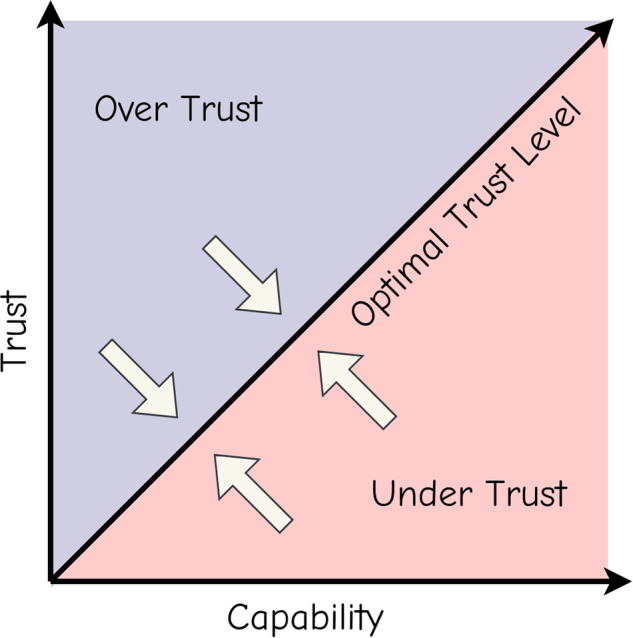
“Too much trust in AI systems can lead to overuse of the AI when it is not in the best interest of patients or operators 75 , and too little trust can lead to underuse of the system when it would be better to use it 76 .”
BackgroundShould ChatGPT Be Biased? Challenges and Risks of Bias in Large Language Models
Ferrara, E. (2023) · doi:10.2139/ssrn.4627814 · Cited by 133
Metrics for Deep Generative ModelsPreprint
Chen, N., Klushyn, A., Kurle, R., Jiang, X., Bayer, J., & van der Smagt, P. (2017) · arXiv (Cornell University) · doi:10.48550/arxiv.1711.01204 · Cited by 130 · cited 1×
“…including: ● Algorithmic bias 41,42 ● Hallucination 43,44 ● Poor commonsense reasoning 44,45 ● Lack of generally agreed model evaluation metrics 46,47 All of these issues are common for generative AI in general, but more so in the healthcare domain, where algorithmic bias may result in the…”
BackgroundMedically Aware GPT-3 as a Data Generator for Medical Dialogue Summarization
Chintagunta, B., Katariya, N., Amatriain, X., & Kannan, A. (2021) · Proceedings of the Second Workshop on Natural Language Processing for Medical Conversations · doi:10.18653/v1/2021.nlpmc-1.9 · Cited by 122
The Forgotten Margins of AI Ethics
Birhane, A., Ruane, E., Laurent, T., S. Brown, M., Flowers, J., Ventresque, A., & L. Dancy, C. (2022) · 2022 ACM Conference on Fairness Accountability and Transparency · doi:10.1145/3531146.3533157 · Cited by 122 · cited 1×
“Despite many successful and promising AI applications, ethics has been one of the more controversial subjects of discussion in the AI community, with diverging views and a plethora of opinions 23,24 .”
BackgroundDifferentiate ChatGPT-generated and Human-written Medical Texts
Liao, W., Liu, Z., Dai, H., Xu, S., Wu, Z., Zhang, Y., Huang, X., Zhu, D., Cai, H., Liu, T., et al. (2023) · arXiv · doi:10.48550/arxiv.2304.11567 · Cited by 119
Differentiating ChatGPT-Generated and Human-Written Medical Texts: Quantitative Study
Liao, W., Liu, Z., Dai, H., Xu, S., Wu, Z., Zhang, Y., Huang, X., Zhu, D., Cai, H., Li, Q., et al. (2023) · JMIR Medical Education · doi:10.2196/48904 · Cited by 116
Ignore Previous Prompt: Attack Techniques For Language Models
Perez, F., & Ribeiro, I. (2022) · arXiv · doi:10.48550/arxiv.2211.09527 · Cited by 110 · cited 1×
“For example, the utilization of generative AI models presents potential privacy breach risks, including prompt injection 107 , where malicious actions could be conducted by overriding an original prompt, and jailbreak 108 , where training data could be divulged by eliciting generated content.”
BackgroundUnderstanding Diffusion Models: A Unified Perspective
Luo, C. (2022) · arXiv (Cornell University) · doi:10.48550/arxiv.2208.11970 · Cited by 105
Will machine learning end the viability of radiology as a thriving medical specialty?
Chan, S., & Siegel, E. L. (2018) · British Journal of Radiology · doi:10.1259/bjr.20180416 · Cited by 97
Traceability for Trustworthy AI: A Review of Models and Tools
Mora-Cantallops, M., Sánchez-Alonso, S., García-Barriocanal, E., & Sicilia, M.-A. (2021) · Big Data and Cognitive Computing · doi:10.3390/bdcc5020020 · Cited by 91 · cited 1×
“Traceability is tracking and documenting data, processes, and artifacts related to a system or model for transparent development 103 .”
BackgroundGenerating Fake Cyber Threat Intelligence Using Transformer-Based Models
Ranade, P., Piplai, A., Mittal, S., Joshi, A., & Finin, T. (2021) · 2021 International Joint Conference on Neural Networks (IJCNN) · doi:10.1109/ijcnn52387.2021.9534192 · Cited by 82
Text-to-image Diffusion Models in Generative AI: A Survey
Zhang, C., Zhang, C., Zhang, M., Kweon, I. S., & Kim, J. (2023) · arXiv (Cornell University) · doi:10.48550/arxiv.2303.07909 · Cited by 82 · cited 1×
“This description also aligns harmoniously with existing research and studies 38 – 40 .”
ResultAI-generated text may have a role in evidence-based medicine
Peng, Y., Rousseau, J. F., Shortliffe, E. H., & Weng, C. (2023) · Nature Medicine · doi:10.1038/s41591-023-02366-9 · Cited by 64 · cited 1×
“Generative AI has also become an active area of research in the healthcare domain 19,20 , with applications such as clinical documentation 21 and evidence-based medicine summarization 22 .”
BackgroundSelf-citationAquino, Y. S. J., Carter, S. M., Houssami, N., Braunack-Mayer, A., Win, K. T., Degeling, C., Wang, L., & Rogers, W. A. (2025) · Journal of Medical Ethics · doi:10.1136/jme-2022-108850 · Cited by 62
Dalal, A. K., Fuller, T., Garabedian, P., Ergai, A., Balint, C., Bates, D. W., & Benneyan, J. (2019) · Journal of the American Medical Informatics Association · doi:10.1093/jamia/ocz002 · Cited by 58 · cited 1×
“Just as military uses of AI can save lives on the battle fi eld, AI can help save lives by assisting clinicians in diagnosing diseases and reducing risks to patient safety 57 – 59 .”
BackgroundMedical domain knowledge in domain-agnostic generative AI
Kather, J. N., Ghaffari Laleh, N., Foersch, S., & Truhn, D. (2022) · npj Digital Medicine · doi:10.1038/s41746-022-00634-5 · Cited by 57 · cited 1×
“This description also aligns harmoniously with existing research and studies 38 – 40 .”
ResultBajgain, B., Lorenzetti, D., Lee, J., & Sauro, K. (2023) · BMJ Open · doi:10.1136/bmjopen-2022-068373 · Cited by 57
Priyanshu, A., Vijay, S., Ayush Kumar, A., Naidu, R., & Mireshghallah, F. (2023) · arXiv (Cornell University) · doi:10.48550/arxiv.2305.15008 · Cited by 55 · cited 2×
“Furthermore, in the context of healthcare, there are concerns about leaking Protected Health Information (PHI) 52 as well as lacking empathy to patients 53 .”
BackgroundNew technologies and mixed-use convergence: How humans and algorithms are adapting to each other
Applin, S. A., & Fischer, M. D. (2015) · 2015 IEEE International Symposium on Technology and Society (ISTAS) · doi:10.1109/istas.2015.7439436 · Cited by 51 · cited 1×
“If autonomy in decision-making is not patient-focused, the potential for adverse events and poor clinical outcomes will surely follow 116 .”
BackgroundSedig, L. K. (2016) · The AMA Journal of Ethic · doi:10.1001/journalofethics.2016.18.1.ecas2-1601 · Cited by 50
Impact of artificial intelligence on pathologists’ decisions: an experiment
Meyer, J. M., Khademi, A., Têtu, B., Han, W., Nippak, P. M. D., & Remisch, D. (2022) · Journal of the American Medical Informatics Association · doi:10.1093/jamia/ocac103 · Cited by 47
Is Artificial Intelligence Replacing Our Radiology Stars? Not Yet!
Cacciamani, G. E., Sanford, D. I., Chu, T. N., Kaneko, M., De Castro Abreu, A. L., Duddalwar, V., & Gill, I. S. (2023) · European Urology Open Science · doi:10.1016/j.euros.2022.09.024 · Cited by 43
Towards Explainable Evaluation Metrics for Natural Language GenerationPreprint
Leiter, C., Lertvittayakumjorn, P., Fomicheva, M., Zhao, W., Gao, Y., & Eger, S. (2022) · arXiv (Cornell University) · doi:10.48550/arxiv.2203.11131 · Cited by 42 · cited 1×
“…algorithmic bias may result in the mistreatment of patients 48 , hallucination may carry misinformation 49 , poor commonsense reasoning can result in confusing interactions 50 , and lack of general and domain-speci fi c metrics can make it dif fi cult to validate the robustness of the AI system 51 .”
BackgroundCognitive Informatics for Biomedicine: Human Computer Interaction in Healthcare
(2015) · Health informatics · doi:10.1007/978-3-319-17272-9 · Cited by 41
AI weapons: Russia’s war in Ukraine shows why the world must enact a ban
Russell, S. (2023) · Nature · doi:10.1038/d41586-023-00511-5 · Cited by 39
Military Applications of Artificial Intelligence: Ethical Concerns in an Uncertain World
Morgan, F., Boudreaux, B., Lohn, A., Ashby, M., Curriden, C., Klima, K., & Grossman, D. (2020) · doi:10.7249/rr3139 · Cited by 37 · cited 3×
“A RAND Corporation study raised various concerns about the use of AI in warfare, shown in Figure 2.3 of the research report 67 .”
BackgroundMethodInfluentialApproximating Online Human Evaluation of Social Chatbots with Prompting
Svikhnushina, E., & Pu, P. (2023) · Annual Meeting of the Special Interest Group on Discourse and Dialogue · doi:10.18653/v1/2023.sigdial-1.25 · Cited by 27 · cited 1×
“We note that the enforcement of the proposed ethical principles, be it via evaluation approaches (e.g., Likert scale, prompting, or semantic similarity-based approaches for empathy 53,118,119 ) or through other means, is out of the scope of this effort.”
BackgroundLeveraging Medical Literature for Section Prediction in Electronic Health Records
Rosenthal, S., Barker, K., & Liang, Z. (2019) · Conference on Empirical Methods in Natural Language Processing (EMNLP) · doi:10.18653/v1/d19-1492 · Cited by 24
Toward Artificial Empathy for Human-Centered Design: A Framework
Zhu, Q., & Luo, J. (2023) · Volume 3B: 49th Design Automation Conference (DAC) · doi:10.1115/detc2023-117266 · Cited by 23
Sedig, L. K. (2016) · The AMA Journal of Ethic · doi:10.1001/journalofethics.2017.18.1.ecas2-1601 · Cited by 21
Understanding Emails and Drafting Responses -- An Approach Using GPT-3
Thiergart, J., Huber, S., & Übellacker, T. (2021) · arXiv · doi:10.48550/arxiv.2102.03062 · Cited by 14 · cited 1×
“The rate of development of generative AI has been staggering, with many industries and researchers fi nding its use in fi elds such as fi nance 15 , collaborative writing 16 , email communication 17 , and cyber threat intelligence 18 .”
BackgroundBeyond Bias and Compliance: Towards Individual Agency and Plurality of Ethics in AIPreprint
Gilbert, T. K., Brozek, M. W., & Brozek, A. (2023) · arXiv (Cornell University) · doi:10.48550/arxiv.2302.12149 · Cited by 13 · cited 1×
“Despite many successful and promising AI applications, ethics has been one of the more controversial subjects of discussion in the AI community, with diverging views and a plethora of opinions 23,24 .”
BackgroundDevelopment and modeling of intelligent control system of cruise missile based on fuzzy logic
Utegen, A. S., Moldamurat, K., Mukhanbetkaliyeva, A., Talgat, A., Ануар, Г. А., & Brimzhanova, S. S. (2021) · International Conference on Electronics, Computer and Computation · doi:10.1109/icecco53203.2021.9663808 · Cited by 10 · cited 1×
“AIhas been seamlessly woven into the military ’ s technology fabric for several decades, serving as the backbone for various advancements ranging from autonomous drone weapons to intelligent cruise missiles 64,65 .”
BackgroundBias Impact Analysis of AI in Consumer Mobile Health Technologies: Legal, Technical, and PolicyPreprint
Gloria, K., Rastogi, N., & DeGroff, S. (2022) · arXiv (Cornell University) · doi:10.48550/arxiv.2209.05440 · Cited by 5 · cited 1×
“…are common for generative AI in general, but more so in the healthcare domain, where algorithmic bias may result in the mistreatment of patients 48 , hallucination may carry misinformation 49 , poor commonsense reasoning can result in confusing interactions 50 , and lack of general and…”
BackgroundToward Artificial Empathy for Human-Centered Design: A FrameworkPreprint
Zhu, Q., & Luo, J. (2023) · arXiv (Cornell University) · doi:10.48550/arxiv.2303.10583 · Cited by 2
OpenAI, Achiam, J., Adler, S., Agarwal, S., Ahmad, L., Akkaya, I., Aleman, F. L., Almeida, D., Altenschmidt, J., Altman, S., et al. (2023) · arXiv · doi:10.48550/arxiv.2303.08774
Jailbreaking ChatGPT via prompt engineering: an empirical study
Liu, Y., Deng, G., Xu, Z., Li, Y., Zheng, Y., Zhang, Y., Zhao, L., Zhang, T., Wang, K., & Liu, Y. (2023) · arXiv · doi:10.48550/arxiv.2305.13860 · cited 1×
“For example, the utilization of generative AI models presents potential privacy breach risks, including prompt injection 107 , where malicious actions could be conducted by overriding an original prompt, and jailbreak 108 , where training data could be divulged by eliciting generated content.”
BackgroundBian, N., Han, X., Sun, L., Lin, H., Lu, Y., He, B., Jiang, S., & Dong, B. (2023) · arXiv · doi:10.48550/arxiv.2303.16421 · cited 1×
“…outcomes in healthcare can arise from a number of issues, including: ● Algorithmic bias 41,42 ● Hallucination 43,44 ● Poor commonsense reasoning 44,45 ● Lack of generally agreed model evaluation metrics 46,47 All of these issues are common for generative AI in general, but more so in the…”
BackgroundArtificial Intelligence and Human Trust in Healthcare: Focus on Clinicians (Preprint)
Asan, O., Bayrak, A. E., & Choudhury, A. (2019) · doi:10.2196/preprints.15154
Research works printed but not linked: 4
- Journal, H. Hipaa, healthcare data, and artificial intelligence. HIPAA J. https://www.hipaajournal.com/hipaa-healthcare-data-and-artificial-intelligence/ (2023).
- Augmented intelligence in Health Care*1 - American Medical Association https://www.ama-assn.org/system/files/2019-01/augmented-intelligence-policy-report.pdf.
- Habli I Lawton T Porter Z Artificial intelligence in health care: accountability and safety Bull. World Health Org. 2020 98 251 – 256 10.2471/BLT.19.237487 32284648 PMC7133468 · DOI · Paper page
- Raamkumar, A. S. & Yang, Y. Empathetic conversational systems: a review of current advances, gaps, and opportunities (2022). Preprint at https://arxiv.org/abs/2206.05017. · arXiv
Cited by
Bekbolatova, M., Mayer, J., Ong, C. W., & Toma, M. (2024) · Healthcare · doi:10.3390/healthcare12020125 · Cited by 404
“Integrating ethical and accountable AI solutions into organizational planning is crucial for responsible AI [125].”
BackgroundA Comprehensive Review on Generative AI for Education
Mittal, U., Sai, S., Chamola, V., & Sangwan, D. (2024) · IEEE Access · doi:10.1109/access.2024.3468368 · Cited by 383
“GAI also contributes to navigating ethical challenges and professional obstacles in medicine, preparing students for the complexities they may encounter in their careers [75].”
BackgroundMoulaei, K., Yadegari, A., Baharestani, M., Farzanbakhsh, S., Sabet, B., & Reza Afrash, M. (2024) · International Journal of Medical Informatics · doi:10.1016/j.ijmedinf.2024.105474 · Cited by 244
Ning, Y., Teixayavong, S., Shang, Y., Savulescu, J., Nagaraj, V., Miao, D., Mertens, M., Ting, D. S. W., Ong, J. C. L., Liu, M., et al. (2024) · The Lancet Digital Health · doi:10.1016/s2589-7500(24)00143-2 · Cited by 212
“26,39,63,64 Similar discussions are extending to GenAI, 16,25,30 possibly by adopting and expanding ethical frameworks from other domains to health care, 65 but they are not easily translated into improved research practice.”
BackgroundSingh, K., Chatterjee, S., & Mariani, M. (2024) · Technovation · doi:10.1016/j.technovation.2024.103021 · Cited by 178
Metadata
- Authors
- Oniani, D., Hilsman, J., Peng, Y., Poropatich, R. K., Pamplin, J. C., Legault, G. L., & Wang, Y.
- Affiliations
- University of Pittsburgh (US)
- Weill Cornell Medicine (US)
- Telemedicine & Advanced Technology Research Center (US)
- Brooke Army Medical Center (US)
- Corresponding author
- Wang, Yanshan
- Venue
- npj Digital Medicine
- Published
- 2023-12-02
- Volume
- 6
- Issue
- 1
- Pages
- 225-225
- ISSN
- 2398-6352 (ISSN-L)
- PMC
- PMC10693640
- OpenAlex
- W4389274881
- Semantic Scholar
- 1d8cb727f1b03b2434cce774e0826c19831add08
- Cited by
- 143
- References
- 62
- Citations by year
- 2026: 35 · 2025: 48 · 2024: 56 · 2023: 4
- FWCI
- 1.68
- Type
- journal article
- Language
- en
- Open access
- gold
- doi.org
- Licence
- cc-by
- creativecommons.org/licenses/by/4.0 (tdm)
- creativecommons.org/licenses/by/4.0 (vor)
- Locations
- npj Digital Medicine (publishedVersion, cc-by)
- PubMed Central (publishedVersion, cc-by)
- PubMed (publishedVersion)
- DOAJ (DOAJ: Directory of Open Access Journals) (submittedVersion, cc-by-sa)
- Funders
- Pitt | School of Health and Rehabilitation Sciences, University of Pittsburgh
- U.S. Department of Health & Human Services | National Institutes of Health (R01LM014306, 4R00LM013001)
- U.S. Department of Health & Human Services | NIH | National Center for Advancing Translational Sciences (U24TR004111)
- National Science Foundation (2145640)
- Topics
- Health Sciences › Medicine › Health Informatics › Artificial Intelligence in Healthcare and Education
- Physical Sciences › Computer Science › Artificial Intelligence › Ethics and Social Impacts of AI
- Health Sciences › Medicine › Public Health, Environmental and Occupational Health › Ethics and bioethics in healthcare
- Keywords
- generative AI, AI ethics, ethical principles, artificial intelligence in healthcare, algorithmic bias, health disparities, transparency, accountability, privacy, clinical decision-making
About these checks
Registry, retraction, Cites and statistics results are computed, not judged, with one exception: a printed reference that no index lists is read once by a model before it counts as a citation error. Claims are extracted by a model and kept only when their quote appears verbatim in the text; each cited source is then checked, with a model’s help, for whether it says what the claim relies on. Those verdicts can be wrong — read the claim’s quote and the cited source before relying on one.
The claim verdicts this report counts are experimental: their accuracy is not yet measured.
A language model drew the claims from the paper on 2026-10-08, under version 3 of the claim definition (model deepseek-v4.1-flash, prompt extract-v3).
A second model labelled each claim on 2026-10-08 (model jev-1.13-20260917, definition revision gold-guideline-v0.2).
Cited sources are checked with a language model’s help (gpt-6-sol and qwen3.8-omni-flash).
Statistics and arithmetic are recomputed, not judged.
Confidence bands are shown only for fields calibrated on our annotated test set. None is calibrated yet, so no band is shown.
What counts as a claim ›How we measure confidence ›How we check this ›
Are you an author, or do you see a problem with this page? Request a review
Data sources
Bibliographic data: Semantic Scholar, OpenAlex, Crossref.
Contains information from the Semantic Scholar Academic Graph Datasets, made available under the ODC Attribution License (ODC-BY 1.0).
Semantic Scholar’s data is described in: Kinney, R., et al. (2023). The Semantic Scholar Open Data Platform. arXiv:2301.10140.
