

Systematic review and meta-analysis of AI-based conversational agents for promoting mental health and well-being
Open accessThe DOI matches its Crossref record; 73 of the 74 references it cites were found in a registry or an index.
Abstract
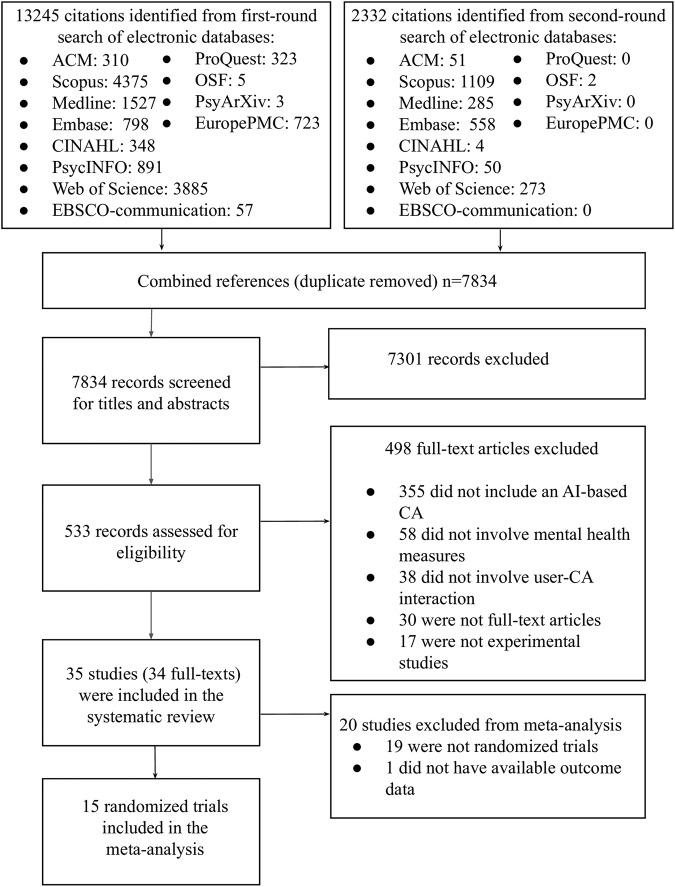
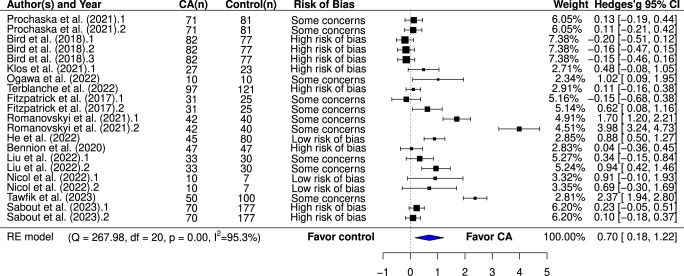
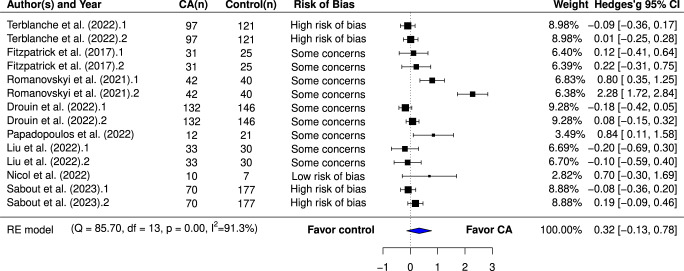
Conversational artificial intelligence (AI), particularly AI-based conversational agents (CAs), is gaining traction in mental health care. Despite their growing usage, there is a scarcity of comprehensive evaluations of their impact on mental health and well-being. This systematic review and meta-analysis aims to fill this gap by synthesizing evidence on the effectiveness of AI-based CAs in improving mental health and factors influencing their effectiveness and user experience. Twelve databases were searched for experimental studies of AI-based CAs’ effects on mental illnesses and psychological well-being published before May 26, 2023. Out of 7834 records, 35 eligible studies were identified for systematic review, out of which 15 randomized controlled trials were included for meta-analysis. The meta-analysis revealed that AI-based CAs significantly reduce symptoms of depression (Hedge’s g 0.64 [95% CI 0.17–1.12]) and distress (Hedge’s g 0.7 [95% CI 0.18–1.22]). These effects were more pronounced in CAs that are multimodal, generative AI-based, integrated with mobile/instant messaging apps, and targeting clinical/subclinical and elderly populations. However, CA-based interventions showed no significant improvement in overall psychological well-being (Hedge’s g 0.32 [95% CI –0.13 to 0.78]). User experience with AI-based CAs was largely shaped by the quality of human-AI therapeutic relationships, content engagement, and effective communication. These findings underscore the potential of AI-based CAs in addressing mental health issues. Future research should investigate the underlying mechanisms of their effectiveness, assess long-term effects across various mental health outcomes, and evaluate the safe integration of large language models (LLMs) in mental health care.
Overview
The claims and statistics of this paper haven’t been checked yet.
Free: it reads the open-access text and checks the first 5 claims that cite a source we can check. Create a free account to check every claim.
Integrity signals
Registry
Cites
Statistics
Figures
Verification
Claims the paper makes
The claims and statistics of this paper haven’t been checked yet.
Free: it reads the open-access text and checks the first 5 claims that cite a source we can check. Create a free account to check every claim.
Claims other papers make about this one
Each is checked against this paper’s own text: does it say what the citing paper says it does?
The source backs part of the claim, not all of it — or backs it for a different population, condition or comparison.
In the citing paper
“The rapid adoption of generative LLMs (e.g., GPT‐4) reflects broader AI trends, but introduces unique risks in mental health contexts 185 .”
From Charting the evolution of artificial intelligence mental health chatbots from rule‐based systems to large language models: a systematic review (2025) · cites this paper as [185]
Experimental — accuracy not yet measuredThe source backs part of the claim, not all of it — or backs it for a different population, condition or comparison.
In the citing paper
“Although reviews and meta-analyses of LLM-CBs for mental health exist13,14,29,30, as well as scoping reviews on the implementation of LLM-CBs in mental health31,32, their focus is narrowed to applications of LLM-CBs as clinical intervention tools.”
From A scoping review on the mental health harms of LLM-based chatbots (2026) · cites this paper as [14]
Experimental — accuracy not yet measuredThe source backs part of the claim, not all of it — or backs it for a different population, condition or comparison.
In the citing paper
“the first systematic reviews and meta-analyses demonstrate the potential of LLM-CBs as clinical tools for mental health13,14.”
From A scoping review on the mental health harms of LLM-based chatbots (2026) · cites this paper as [14]
Experimental — accuracy not yet measuredThe source backs part of the claim, not all of it — or backs it for a different population, condition or comparison.
In the citing paper
“LLM-CBs find increasing use as mental health support tools, both for the general public8–12 and for patients in clinical interventions13,14.”
From A scoping review on the mental health harms of LLM-based chatbots (2026) · cites this paper as [14]
Experimental — accuracy not yet measuredThe source backs part of the claim, not all of it — or backs it for a different population, condition or comparison.
In the citing paper
“A recent meta-analysis shows that GenAI chatbots outperform rule-based and retrieval-based chatbots in reducing depressive symptoms [13].”
From Generative AI Mental Health Chatbots as Therapeutic Tools: Systematic Review and Meta-Analysis of Their Role in Reducing Mental Health Issues (2025) · cites this paper as [13]
Experimental — accuracy not yet measured
6 more claims about this paper
Create a free account to see every claim other papers make about this one.
Self-check
Percentages, sums and reported differences re-computed from the paper’s own numbers.
The self-check needs the paper’s full text.
Citations
Cites
The Cochrane Collaboration's tool for assessing risk of bias in randomised trials
Higgins, J. P. T., Altman, D. G., Gotzsche, P. C., Juni, P., Moher, D., Oxman, A. D., Savovic, J., Schulz, K. F., Weeks, L., Sterne, J. A. C., et al. (2011) · BMJ · doi:10.1136/bmj.d5928 · Cited by 33,817
Dermyshi, E., Wang, Y., Yan, C., Hong, W., Qiu, G., Gong, X., & Zhang, T. (2017) · Neonatology · doi:10.1159/000454668 · Cited by 24,451
GRADE: an emerging consensus on rating quality of evidence and strength of recommendations
Guyatt, G. H., Oxman, A. D., Vist, G. E., Kunz, R., Falck-Ytter, Y., Alonso-Coello, P., & Schünemann, H. J. (2008) · BMJ · doi:10.1136/bmj.39489.470347.ad · Cited by 23,305
Interrater reliability: The kappa statistic
McHugh, M. L. (2012) · Biochemia Medica · doi:10.11613/bm.2012.031 · Cited by 19,877 · cited 1×
“Inter-rater reliability, assessed using Cohen ’ s Kappa 63 , indicated near-perfect agreement for title/abstract screening (0.9) and full-text review (0.83).”
MethodInfluentialCochrane Handbook for Systematic Reviews of Interventions
(2019) · doi:10.1002/9781119536604 · Cited by 14,828
Preferred reporting items for systematic reviews and meta-analyses: The PRISMA statement
Moher, D., Liberati, A., Tetzlaff, J., & Altman, D. G. (2010) · International Journal of Surgery · doi:10.1016/j.ijsu.2010.02.007 · Cited by 12,156 · cited 1×
“The study protocol was registered in PROSPERO, CRD 42023392187, and adhered to the Preferred Reporting Items for Systematic reviews and Meta-Analyses 74 (Supplementary Table 9).”
MethodCohen, J. (1992) · Psychological Bulletin · doi:10.1037//0033-2909.112.1.155 · Cited by 8,771
Fitzpatrick, K. K., Darcy, A., & Vierhile, M. (2017) · JMIR Mental Health · doi:10.2196/mental.7785 · Cited by 2,730 · cited 4×
“…Empathic communication 17,26,28,29,37 ( n = 5) (cid:129) Non-judgmental 33,49 ( n = 2) (cid:129) Accountability (e.g., regular check-ins) 21,26 ( n = 2) (cid:129) Human-like personality 26,49 ( n = 2) (cid:129) Tailored feedback 28 ( n = 1) (cid:129) Relationship 28 ( n = 1) Content ( n =…”
BackgroundInfluentialHow important are the common factors in psychotherapy? An update
Wampold, B. E. (2015) · World Psychiatry · doi:10.1002/wps.20238 · Cited by 1,728 · cited 1×
“…were key determinants of user experience, which corresponds to previous psychotherapy research that identi fi es these common elements (e.g., therapeutic alliance, empathy, and therapist effect) as active ingredients contributing to therapeutic changes across various therapeutic frameworks 61 .”
Charlson, F., van Ommeren, M., Flaxman, A., Cornett, J., Whiteford, H., & Saxena, S. (2019) · The Lancet · doi:10.1016/s0140-6736(19)30934-1 · Cited by 1,702 · cited 1×
“We fi ne-tuned our search strategy based on previous systematic reviews 3,51,62 to locate sources related to AI-based CAs for addressing mental health problems or promoting mental well-being.”
Method
Research works printed but not linked: 2
- Romanovskyi, O., Pidbutska, N. & Knysh, A. Elomia Chatbot: The effectiveness of Artificial Intelligence in the fight for mental health. In COLINs 5th International Conference on Computational Linguistics and Intelligent Systems, 1215–1224 (2021).
- Terblanche N Molyn J De Haan E Nilsson VO Coaching at scale: Investigating the efficacy of Artificial Intelligence coaching Int. J. Evid. Based Coach. Mentor 2022 20 20 36
Cited by
Items 301–400 of 606
Li, H., Abhulimen, P. O., Yu, Q., Cheng, W., & Njunge, L. W. (2026) · Ageing Research Reviews · doi:10.1016/j.arr.2026.103205 · Cited by 2
Self-citationMental health app crisis support assessment framework: development and pilot testing
Knysh, A., & Pohrebniak, T. (2026) · Frontiers in Digital Health · doi:10.3389/fdgth.2026.1814547 · Cited by 1
“Li et al. (13), in a systematic review and meta-analysis of AI-based conversational agents for mental health, noted that evidence for their efficacy was preliminary and that safety evaluation – including crisis response capability – remained a critical gap in the literature.”
Huang, G., Matera, M., & Spitale, M. (2026) · International Conference on Automatic Face and Gesture Recognition · doi:10.1109/fg67764.2026.11556952 · Cited by 1
“Artificial agents that support human group interactions hold great promise, particularly in sensitive contexts such as well-being promotion [24], [12] and therapeutic interventions [7].”
Artificial Intelligence in Couple and Family Therapy: Systemic Ethical Principles
Hertlein, K. M., Springer, P. R., & Rajaei, A. (2026) · International Journal of Systemic Therapy · doi:10.1080/2692398x.2026.2691467 · Cited by 1
From promise to practice: artificial intelligence in mental health care in the MENA region
Hajj, S. E., Nsouli, A., Wehbe, M., Saad, G. A., & Maalouf, F. T. (2026) · Frontiers in Psychiatry · doi:10.3389/fpsyt.2026.1878052 · Cited by 3
“A meta-analysis of 35 studies reported moderate reductions in depression and distress, with user satisfaction driven by empathic, non-judg-mental communication, while poor understanding and imperson-ality reduced engagement (22).”
Srivastava, A., & Bita, M. (2026) · Asian Journal of Psychiatry · doi:10.1016/j.ajp.2026.105087 · Cited by 4
Mokhtar, D., Wang, H. D., Garland, E. C., Shakya, D., Occhino-Moede, L., Liu, E., & Frank, A. C. (2026) · Journal of Participatory Medicine · doi:10.2196/98822 · Cited by 2
“AI-driven conversational agents and chatbots have been used to augment psychotherapy by delivering components of cognitive behavioral therapy, providing psychoeducation, and offering real-time coping support [12].”
Lastretti, M., Manchia, M., Fraschini, M., Faa, A., Coghe, F., Paribello, P., Pinna, M., Tiwari, E., Suri, J. S., Saba, L., et al. (2026) · Psychiatry International · doi:10.3390/psychiatryint7050194 · Cited by 2
“The algorithm is programmed to be kind, attentive, and to maintain a non-judgmental tone [30].”
Clinicians’ Attitudes and Perceptions on the Adoption of AI in Mental Health Care: Scoping Review
Hudson, C., Phan, T. L., & Randall, M. (2026) · Journal of Medical Internet Research · doi:10.2196/92370 · Cited by 2
“Reviews of conversational agents have similarly concentrated on their effectiveness in improving mental health outcomes and the factors influencing user experience [14,15].”
Mansell, W. (2026) · Digital Health · doi:10.1177/20552076261490707 · Cited by 1
On, Y., Kim, T., & Kim, N. (2024) · 신경정신의학 · doi:10.4306/jknpa.2024.63.3.151 · Cited by 1
TECNOLOGIAS AVANÇADAS NO CONTEXTO DA AVALIAÇÃO PSICOLÓGICA: A inteligência artificial
Comassetto, M. E., de Campos, C. B., & Feijó, L. P. (2025) · Psicologia e Saúde em Debate · doi:10.22289/2446-922x.v11a1a59 · Cited by 3
Chung, P., Cong, R., Yao, L., & Jin, Q. (2025) · Applied Sciences · doi:10.3390/app152011209 · Cited by 3
Güngör, İ., Sarman, A., & Tuncay, S. (2025) · PLoS ONE · doi:10.1371/journal.pone.0338701 · Cited by 3
“In contrast, AI approaches can provide consistent, data-driven analysis to support individualized therapeutic interventions [11].”
RetractedZhang, R., Li, H. Z., Afonso, Liu, Z., & Lee, Y. (2024) · doi:10.31219/osf.io/qw7gx · Cited by 1
Self-citationSundaram, S., Adarsh, R., & Thapa, S. (2025) · medRxiv · doi:10.1101/2025.06.27.25330316 · Cited by 2
Villarreal‐Zegarra, D., Paredes-Gonzales, Y., Dámaso-Román, A., Quiñones-Inga, J., Centeno-Terrazas, G., & Lozada, Y. P. A.-M. (2025) · medRxiv · doi:10.1101/2025.09.22.25336411 · Cited by 1
Mlakar, I., Šafran, V., Plohl, N., Kumperščak, H. G., Močnik, S., Smogavc, Ž., & Smrke, U. (2025) · medRxiv · doi:10.1101/2025.10.13.25337952 · Cited by 1
Shimgekar, S. R., Rodriguez, V. J., Bloom, P. A., Yoo, D. W., & Saha, K. (2025) · doi:10.2196/preprints.86265 · Cited by 1
Artificial Intelligence Can’t Replicate Human Presence in Psychotherapy
Irfan, B., Soni, A., & Boyd, J. W. (2026) · The American Journal of Bioethics · doi:10.1080/15265161.2025.2608621 · Cited by 1
“AI guided interventions can produce modest short-term reductions in anxiety and depressive symptoms in selected populations, although their long term effects and overall real world effectiveness remains uncertain (Feng, et al. 2025; Li et al. 2023; Zhong, Luo, and Zhang 2024).”
Yi, X., Chen, Y. H., Loh, S. C., Siaw, Y.-L., Hao, L. J., & Abuhassna, H. (2026) · Research Square · doi:10.21203/rs.3.rs-7486943/v1 · Cited by 1
Risk Governance for Generative AI Mental Health Support: A Multi-Turn Safety ArchitecturePreprint
Areias, A. C., Botelho, C., Farinhas, A., Vassilopoulos, A., Janela, D., Tong, X., Guerreiro, N. M., D'Eon, M., Costa, F., & Rei, R. (2026) · Research Square · doi:10.21203/rs.3.rs-10279940/v1 · Cited by 3
Lukas, C. (2025) · arXiv · doi:10.48550/arxiv.2502.00005 · Cited by 1
Caring Without Feeling: Affective Dynamics as the Control Layer of Human-AI Agent Collaboration
Xu, J., Wu, X., Zhang, Z., Xu, Y., Yang, Y., Zhu, J., Xiao, L., Wu, W., & He, L. (2026) · arXiv · doi:10.48550/arxiv.2606.18259
“Mental-health chatbots can provide scalable, non-judgmental support [76].”
Social Smarts with Tech Sparks: Harnessing LLMs for Youth Socioemotional Growth
Vo, K. (2024) · Proceedings of the AAAI Symposium Series · doi:10.1609/aaaiss.v3i1.31253 · Cited by 2
Ambient Intelligence and Active Aging
Armstrong, D., & Zeng, M. (2024) · ACM SIGCPR Conference on Computer Personnel Research (SIGCPR) · doi:10.1145/3632634.3655887
Ou, X., Bao, X., Xu, X., Luo, H., Hu, W., & Huang, Q. (2024) · Advances in Social Science, Education and Humanities Research/Advances in social science, education and humanities research · doi:10.2991/978-2-38476-271-2_57
Doumanis, I., & Economou, D. (2024) · Communications in computer and information science · doi:10.1007/978-3-031-73990-3_6
Artificial Intelligence (Not) Replacing Coaches: A Thematic Literature ReviewPreprint
Ezhikov, A. I. (2024) · doi:10.61726/9807.2024.81.43.001
Innovations in Continuous Patient Monitoring
Siddiqui, S., Khan, A. A., Khan, M. A., & Sosan, R. (2025) · Springer eBooks · doi:10.1007/978-3-031-81433-4_3 · Cited by 1
Current Treatments for Anxiety and Trauma-Related Disorders
Szuhany, K. L., Feldman, B. H., Malgaroli, M., & Simon, N. M. (2025) · Oxford University Press eBooks · doi:10.1093/med/9780197640654.003.0042
AI-Driven Mental Health Solutions for Healthcare Worker Burnout: A Strategic Approach (Preprint)Preprint
Heydari, K., Carlo, B. A., Rao, A. S., & Succi, M. D. (2024) · doi:10.2196/preprints.70579 · Cited by 1
Li, Y., Wang, J., Li, S., Zhang, Y., Lv, J. G., Liu, Z., Wang, Z., Peng, Y., Liu, C., Yu, X., et al. (2025) · doi:10.2196/preprints.73521
Demographic Gaps and Digital Innovations in Therapy Trends—Reply
Olfson, M. (2025) · JAMA Psychiatry · doi:10.1001/jamapsychiatry.2025.0108
Demographic Gaps and Digital Innovations in Therapy Trends
Xie, Q. (2025) · JAMA Psychiatry · doi:10.1001/jamapsychiatry.2025.0105
Yun, B., Kim, B., Lee, J. H., Ko, H., Kim, J., Kim, W., Kim, B. R., Park, S. Y., Kim, J., & Kim, G. H. (2025) · doi:10.2196/preprints.75308
Gamified Self-Regulation and AI Risk Detection in Student Mental Health: Pilot Study ResultsPreprint
Narayan, A. P., Wong, V. W., & Shah, N. R. (2025) · SSRN Electronic Journal · doi:10.2139/ssrn.5226738
Huang, Y., Chen, J., Han, F., Riad, A., & Chlebcová, V. (2025) · SSRN Electronic Journal · doi:10.2139/ssrn.5265642
Zhi-qi, Z., Shuaina, C., Tao, W., Zhao, E., Gao, K., & Runhan, Y. (2025) · Social Sciences · doi:10.11648/j.ss.20251403.12
Trust, Support, and Adoption Intentions Towards Generative AI are Context Dependent
Liew, K., Wu, X., & Zhang, Z. (2025) · IEEE Conference on Artificial Intelligence (CAI) · doi:10.1109/cai64502.2025.00051
“One explanation could be that support for others using AI for mental health comes from a perspective of support for the wellbeing of others [29].”
AI-Facilitated Cognitive Reappraisal via Socrates 2.0: A Mixed Methods Feasibility Study (Preprint)Preprint
Held, P., Pridgen, S., Szoke, D. R., Chen, Y., Akhtar, Z., & Amin, D. (2025) · doi:10.2196/preprints.80461
The future of narcolepsy treatment: what role will artificial intelligence play?
Maghsoudi, A., Ramezani, A., Razjouyan, J., & Sharafkhaneh, A. (2025) · Elsevier eBooks · doi:10.1016/b978-0-443-30004-2.00050-x · Cited by 1
Predictive Analytics in Mental Health: AI for Identifying Risk Factors and Preventing Crises
Zim, M. K. I., & Hanif, M. A. (2025) · International Conference on Recent Advances in Information Technology · doi:10.1109/rait65068.2025.11088892
Maslej, M. M., Ortiz, A., Andrews, P. W., & Mulsant, B. H. (2025) · PLOS mental health. · doi:10.1371/journal.pmen.0000245 · Cited by 1
Societal Changes and Their Impact on Our Well-Being at Work
Dharani, B. (2025) · Springer eBooks · doi:10.1007/978-3-031-91493-5_3
Third-Order Cybernetics: Systemic Practices Go Digital
Borcsa, M., & Pomini, V. (2025) · European Family Therapy Association series · doi:10.1007/978-3-031-92225-1_1
Quispe, E. P. T., Galarza, N. D. V., Aracayo, D. L. M., Lopez, M. P., & Huamaní, A. P. (2025) · Educational Regent Multidisciplinary Journal · doi:10.63969/ec113346 · Cited by 1
Kutá, B., Novák, L., Žídková, R., Fürstová, J., Maliňáková, K., de Winter, A. F., & Hušek, V. (2025) · doi:10.2196/preprints.82642
Emotion Regulation in Human-Robot Interaction: Insights from Video and Game Simulations
Jia, L., Ayoub, J., Tian, D., Song, M., Moradi‐Pari, E., & Du, N. (2025) · Proceedings of the Human Factors and Ergonomics Society Annual Meeting · doi:10.1177/10711813251368825
Introduction to AI in Psychotherapy
Bandyopadhyay, B., & Jain, N. (2025) · Advances in computational intelligence and robotics book series · doi:10.4018/979-8-3373-0467-0.ch001
Yang, Y., Fan, L., Wang, T., & Yan, R. (2025) · SSRN Electronic Journal · doi:10.2139/ssrn.5472396
Ufniarski, T., Ufniarska, M., Piech, A., Pasierb, K., Poplicha, K., Grodzińska, M., Siuzdak, B., Moszkowicz, J., Sobkiewicz, P., Kardasz, P., et al. (2025) · International Journal of Innovative Technologies in Social Science · doi:10.31435/ijitss.3(47).2025.3809
“…systems can provide conversational psychoeducation and on-demand triage, fostering mental health awareness and accelerating referral to formal care (H. Li et al., 2023; Rollwage et al., 2023) The recent emergence of large language models (LLMs) has significantly enhanced chatbot capabilities and,…”
Lack, C. W., & Haws, J. K. (2025) · Psychiatric Clinics of North America · doi:10.1016/j.psc.2025.08.018
Amalakanti, S., Avula, V. C. R., & Jillella, J. P. (2025) · Archives of Mental Health · doi:10.4103/amh.amh_35_25
Lu, X., Guha, S., Pfafman, R., Pater, J. A., Washington, C. L., & Nova, F. F. (2025) · doi:10.2196/preprints.85152
Bektaş, S. A., & Bumın, G. (2025) · Applied Neuropsychology Child · doi:10.1080/21622965.2025.2578634 · Cited by 1
Comparing agent-based VR stress therapy: Single vs. Group interventions
Islam, M., & Takeuchi, Y. (2025) · IEEE RO-MAN · doi:10.1109/ro-man63969.2025.11217815 · Cited by 1
“A meta-analysis found that Multimodal and generative AI based Conver-sational Agent significantly reduces depression (Hedge’s g = 0.64) and psychological distress (Hedge’s g = 0.7) than normal CA[19].”
InfluentialFoundations of holistic mental health
Reddy, K. J. (2025) · Elsevier eBooks · doi:10.1016/b978-0-443-43908-7.00007-0
de Vries, M., Begeman, M., Derksen, M. E., Goudriaan, A. E., & Blankers, M. (2026) · JMIR Human Factors · doi:10.2196/86752
“The finding that accessibility, neutrality, and broad knowledge are seen as major advantages aligns with prior digital mental health research [20,21].”
EmpowerMind: Accessible Mental Health Support App for Adolescents and PwDs
Saravanan, S., Murugan, D., Bhuyan, A., Somvanshi, B., & Akash, P. (2025) · International Conference on New Frontiers in Communication, Automation, Management and Security (ICCAMS) · doi:10.1109/iccams65118.2025.11234602
Vromman, F. V., Kerckhove, C. V., Gagnon, J., Pelletier, C., Dufresne, Y., & Coulombe, S. (2025) · doi:10.2196/preprints.88750
Takizawa, Y. (2025) · AI & Society · doi:10.1007/s00146-025-02776-y
“…on AI chatbots designed specifically for mental health interventions have consistently demonstrated their effectiveness in fostering positive therapeutic relationships and improving mental health outcomes, such as reducing depression and anxiety (He et al. 2022; Li et al. 2023; Sabour et al. 2023).”
AI Applications for General Well-Being
Majumder, S., & Dey, N. (2025) · Studies in computational intelligence · doi:10.1007/978-3-032-15735-5_5 · Cited by 1
Gładysz, D., Barwacz, J., Adamik, M., Settaf-Cherif, L., Malinowska, K., & Settaf-Cherif, E. (2025) · International Journal of Innovative Technologies in Social Science · doi:10.31435/ijitss.4(48).2025.4197
Editorial: Mental health in the age of artificial intelligence
Noble, J. M., Ha, K., & Greenshaw, A. (2026) · Frontiers in Psychiatry · doi:10.3389/fpsyt.2025.1750256
“” (19).”
Zeng, Z., Zhang, Y.-Z., & Zhu, F. (2025) · International Conference on Artificial Intelligence, Virtual Reality and Interaction Design · doi:10.1145/3777730.3777737 · Cited by 1
Haba, D., Miyashita, R., Kondo, T., TATSUKAWA, K., Oohashi, F., Kitamura, A., Konya, C., Sanada, H., & Matsumoto, M. (2025) · doi:10.2196/preprints.89166
Shen, J., & Shen, Z. (2025) · International Symposium on Artificial Intelligence for Medicine Sciences (ISAIMS) · doi:10.1145/3777577.3777705
Precision Approaches for Scalable Digital and Clinic-Based Interventions in Mental Health
Bohnert, A. S. B., Fritsche, L., & Sen, S. (2026) · Biological Psychiatry Cognitive Neuroscience and Neuroimaging · doi:10.1016/j.bpsc.2026.01.004 · Cited by 1
Stratton, E., & Glozier, N. (2026) · Disability and Rehabilitation · doi:10.1080/09638288.2026.2618928
“Digital interventions—especially those using AI-based conversational agents (CAs) like LeapForward—are increasingly addressing access barriers in psychosocial care [43].”
NeuroSphere: Optimizing Mental Wellness Through Reinforcement Learning
Pradhyumna, S., Udupa, P., Satwik, N. G., Bn, R., & Jayaram, R. (2025) · International Conference on Software, Systems and Information Technology (SSITCON) · doi:10.1109/ssitcon66133.2025.11342145
“H. Li, R.Zhang, Y. Lee, R.E.Kraut, and J.D.Mohr conducted systematic review of AI-based conversational agents, revealing potential while identifying gaps in personalization and long-term effectiveness [12].”
Exploring the Role of Generative AI in Supporting Physical and Mental Health Among Students
Xu, C., & Qiu, K. (2026) · Lecture notes in computer science · doi:10.1007/978-3-032-13022-8_29
Predictive Analytics with Multimodal Inputs for Mental Health Assessment
Zim, M. K. I., & Singh, A. (2025) · IEEE International Conference on Intelligent Signal Processing and Effective Communication Technologies (INSPECT) · doi:10.1109/inspect67393.2025.11350419
“Han Li et al. A systematic review and meta-analysis by Birnbaum et al (2017) [ 15 ] examined the effectiveness of AI-based conversational agents (CAs) on improvement in mental health and well-being.”
Advanced robot interfaces are unnecessary for effective psychological health interventions
Huang, I. S., & Hoorn, J. F. (2026) · Computers in Human Behavior Reports · doi:10.1016/j.chbr.2026.100955
Orzeł, J., & Strzałek, J. (2026) · Psychiatria i Psychologia Kliniczna · doi:10.15557/pipk.2025.0028
Silent Signals, Loud Consequences: Chemo-Communication, Ethics, and Digital Therapeutics
Brasi, C., & Seccomandi, B. (2026) · Lecture notes in networks and systems · doi:10.1007/978-3-032-14160-6_3
AI Chatbots in Mental Health Support: Are They Effective
Mohammed, O., Alan, U., & Banjoko, B. (2026) · London journal of interdisciplinary sciences. · doi:10.31039/ljis.2025.5.355
Yun, B. H., Kim, B., Ko, H., Kim, J., Kim, B. R., Kim, W., Park, S., Kim, J., Lee, J. H., & Kim, G. H. (2026) · JMIR mhealth and uhealth · doi:10.2196/75308
“These agents show promise to advance patient-centered care by supporting users in managing their own health [24,25].”
Liu, X., & Lee, K. C. (2025) · International Journal of Modern Education · doi:10.35631/ijmoe.728015
Kokilavani, T., Rajalakshmi, J., Samantha, S., Rekha, R., Nithya, V., & M, N. A. (2025) · International Conference on Emerging Research in Electronics, Computer Science and Technology (ICERECT) · doi:10.1109/icerect65215.2025.11376236
Castillo, M. L. G., de Luna, R. G., Tubola, O. D., Torres, A. A., Oldan, B. R. M., Gorom, J. N. A., Javier, N. T., Arias, G. E., & Villanueva, C. P. C. (2025) · International Workshop on Artificial Intelligence and Education (WAIE) · doi:10.1109/waie67422.2025.11381172
“Research has explored AI’s role in mental health, including systematic reviews on its effectiveness [22], AI-driven diagnostics [23], and patient monitoring [24].”
Developing a Service Quality Index System for AI Health Care Chatbots: Mixed Methods Study
Gu, Y., & Wang, X. (2026) · Journal of Medical Internet Research · doi:10.2196/83051
“Unlike earlier rule-based chatbots that relied on scripted replies, AI chatbots leverage advanced technologies, such as large language models (LLMs), to deliver personalized and context-aware interactions [2].”
AI-powered conversational framework for mental health diagnosis
Diwakar, D., Raj, D., Prasad, A., Ali, G., & ELAffendi, M. A. (2026) · PeerJ Computer Science · doi:10.7717/peerj-cs.3602
So, M., Sobolev, M., & Menvielle, G. (2026) · JMIR Formative Research · doi:10.2196/87054
“Conversational platforms, especially those powered by large language models, introduce new opportunities for naturalistic data capture [43-46].”
UX-Oriented Design as a Tool for Improving Labor Productivity in Corporate SaaS Solutions
Orlova, K. (2024) · Universal library of engineering technology. · doi:10.70315/uloap.ulete.2024.0102013
Explainable AI for Well-Being Prediction From Lifestyle Data: 2-Study Design
Vromman, F. V., Kerckhove, C. V., Gagnon, J., Pelletier, C., Dufresne, Y., & Coulombe, S. (2026) · JMIR Mental Health · doi:10.2196/88750
“While well-being–related AI predictive models hold great promise for raising awareness and supporting self-reflection [22,23], their practical value depends on more than just statistical accuracy [20].”
Privacy at Scale in Networked Healthcare
Rahimian, M. A., Panny, B., & Joshi, J. B. D. (2025) · IEEE International Conference on Trust, Privacy and Security in Intelligent Systems and Applications (TPS-ISA) · doi:10.1109/tps-isa67132.2025.00067
“…all fields of health sciences and medicine, from digital contact tracing [3], [4] and the promotion of mental health and psychological well-being [5] to medical image analysis [6], cancer diagnosis [7], [8], identifying diabetic retinopathy [9], arrhythmia detection [10], surgery [11], and…”
He, K., Fang, Y., Frank, E., Li, C., Bohnert, A. S. B., Sen, S., & Wang, M. (2026) · medRxiv · doi:10.64898/2026.03.03.26347299
“LLM-based AI agents have recently been applied in digital mental health care, supporting tasks such as mood monitoring, reflective dialogue, cognitive-behavioral guidance, and personalized behavioral coaching 20–24 .”
Nadeeshani, M., Johnstone, J., Ellis, K., & Ananthanarayan, S. (2026) · International Journal of Human-Computer Interaction · doi:10.1080/10447318.2026.2634975
Lin, T., Wu, J. C., So, W. W. Y., Liang, S. X., Shum, D., & Hsu, C. L. (2026) · doi:10.2196/preprints.94707
a review of longitudinal studies
de Sousa, R. D., Zagalo, D. M., Sousa, R., Costa, T., de Almeida, J. M. C., Canhão, H. M., Rodrigues, A., Jm, C.-D.-A., & Rodrigues, A. M. (2025) · Portuguese National Funding Agency for Science, Research and Technology (RCAAP Project by FCT)
Enhancing Student Well-being Through Generative AI: A Design Science Approach to Creative Learning
Suroso, J. S., & Suroso, M. F. H. (2025) · International Conference on Orange Technology (ICOT) · doi:10.1109/icot68409.2025.11425427
Artificial intelligence, patient education, and the work of caring in cardiovascular disease
Ghisi, G. L. D. M. (2026) · Patient Education and Counseling · doi:10.1016/j.pec.2026.109587
Kimeu, J. M., Irudayaraj, G., Adekanbi, J., Obuobi-Donkor, G., Adu, M. K., Eboreime, E., Ataguba, G., Orji, R., & Oyebode, O. (2026) · Lecture notes in computer science · doi:10.1007/978-3-032-19687-3_10
Subbulakshmi, M. M., Jayaraman, M., & Jeyaraman, J. (2026) · Expert Review of Medical Devices · doi:10.1080/17434440.2026.2649559
Ai Based Virtual Medical Assistant
Verma, A., Chauhan, H., Khatri, S. R., Kumar, T., & Pal, N. (2025) · International Conference on Advances in Computation, Communication and Information Technology (ICAICCIT) · doi:10.1109/icaiccit68829.2025.11434047
Metadata
- Authors
- Li, H., Zhang, R., Lee, Y.-C., Kraut, R. E., & Mohr, D. C.
- Affiliations
- National University of Singapore (SG)
- Carnegie Mellon University (US)
- Northwestern University (US)
- Corresponding author
- Zhang, Renwen
- Venue
- npj Digital Medicine
- Published
- 2023-12-19
- Volume
- 6
- Issue
- 1
- Pages
- 236-236
- ISSN
- 2398-6352 (ISSN-L)
- PMC
- PMC10730549
- OpenAlex
- W4389934892
- Semantic Scholar
- 69a4cb1a3d84e924ab79848910507ee34e80150a
- Cited by
- 598
- References
- 74
- Citations by year
- 2026: 322 · 2025: 212 · 2024: 64
- FWCI
- 20.31
- Type
- journal article
- Language
- en
- Open access
- gold
- doi.org
- Licence
- cc-by
- creativecommons.org/licenses/by/4.0 (tdm)
- creativecommons.org/licenses/by/4.0 (vor)
- Locations
- npj Digital Medicine (publishedVersion, cc-by)
- PubMed Central (publishedVersion, cc-by)
- PubMed (publishedVersion)
- DOAJ (DOAJ: Directory of Open Access Journals) (submittedVersion, cc-by-sa)
- Funders
- National University of Singapore (A-8000936-01-00)
- National Institute of Mental Health (P50MH119029)
- Topics
- Social Sciences › Psychology › Applied Psychology › Digital Mental Health Interventions
- Social Sciences › Psychology › Social Psychology › Social Robot Interaction and HRI
- Health Sciences › Medicine › Health Informatics › Artificial Intelligence in Healthcare and Education
- Keywords
- chatbots, artificial intelligence, mental health, depression, psychological distress, psychological well-being, generative AI, multimodal AI, mobile health apps, older adults, large language models, user experience
About these checks
Registry, retraction, Cites and statistics results are computed, not judged, with one exception: a printed reference that no index lists is read once by a model before it counts as a citation error. Claims are extracted by a model and kept only when their quote appears verbatim in the text; each cited source is then checked, with a model’s help, for whether it says what the claim relies on. Those verdicts can be wrong — read the claim’s quote and the cited source before relying on one.
Statistics and arithmetic are recomputed, not judged.
Confidence bands are shown only for fields calibrated on our annotated test set. None is calibrated yet, so no band is shown.
What counts as a claim ›How we measure confidence ›How we check this ›
Are you an author, or do you see a problem with this page? Request a review
Data sources
Bibliographic data: Semantic Scholar, OpenAlex, Crossref.
Contains information from the Semantic Scholar Academic Graph Datasets, made available under the ODC Attribution License (ODC-BY 1.0).
Semantic Scholar’s data is described in: Kinney, R., et al. (2023). The Semantic Scholar Open Data Platform. arXiv:2301.10140.
