

Wearable microfluidic biosensors with haptic feedback for continuous monitoring of hydration biomarkers in workers
Open accessThe DOI matches its Crossref record; 48 of the 48 references it cites were found in a registry or an index.
Abstract
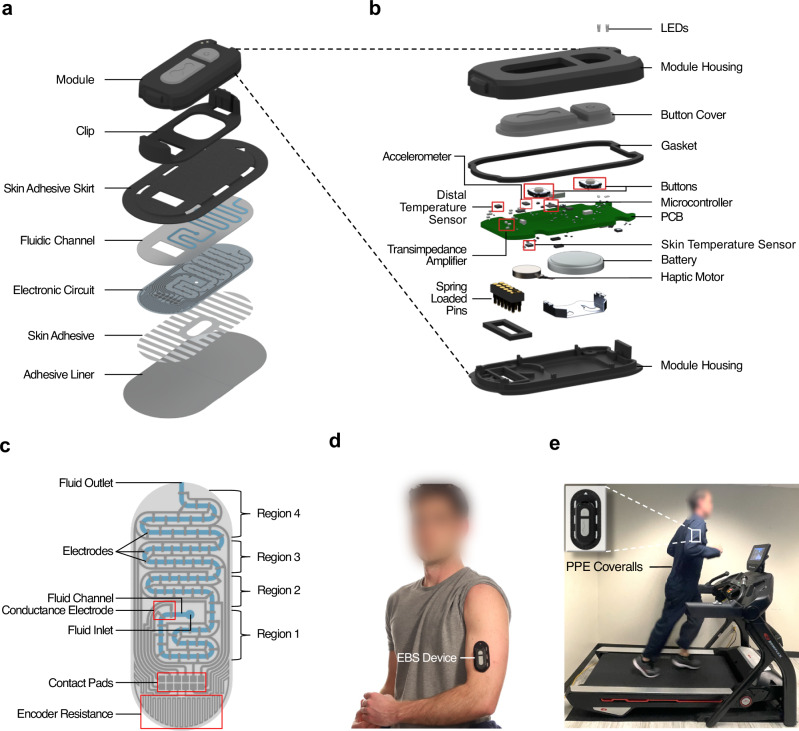
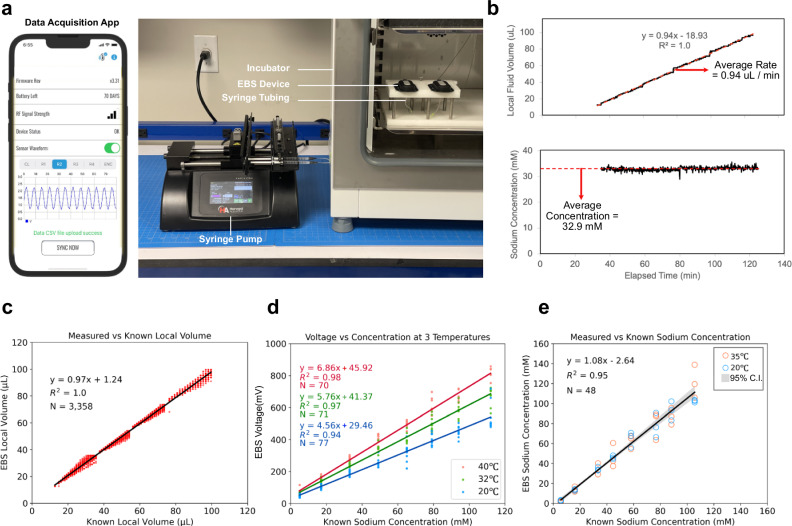
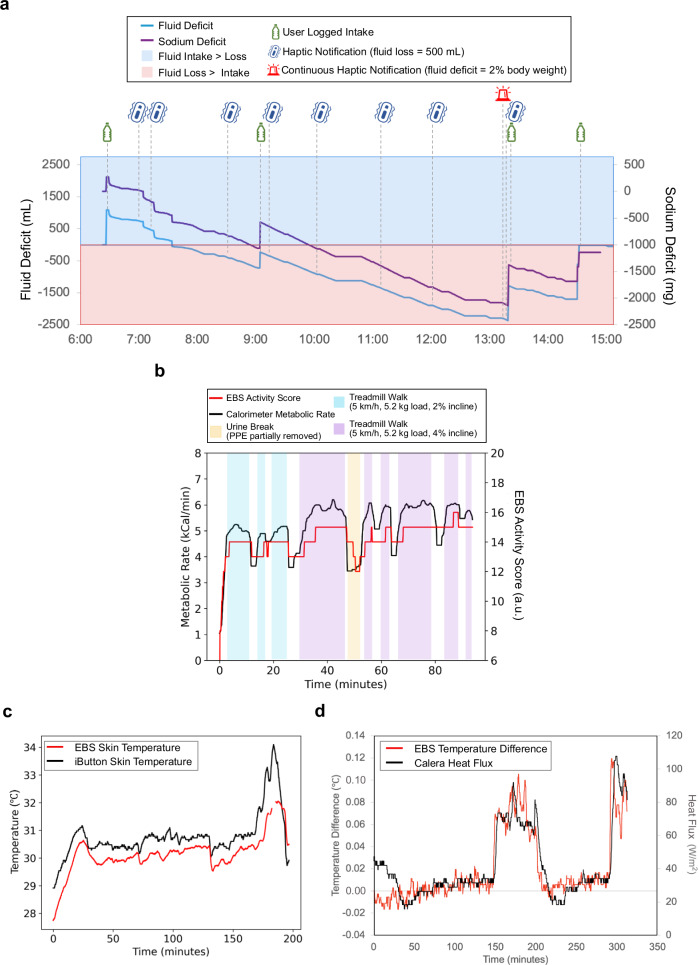
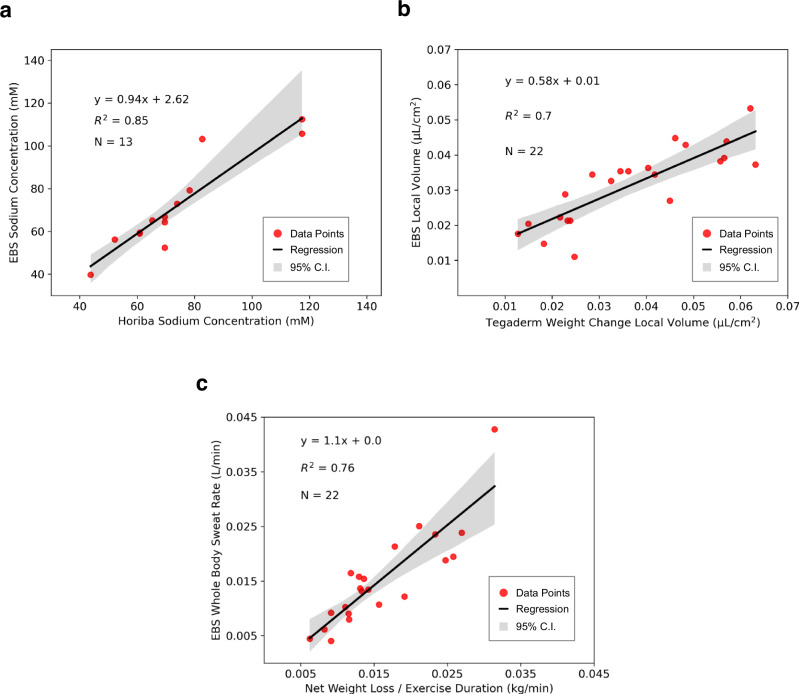
Real-time monitoring of hydration biomarkers in tandem with biophysical markers can offer valuable physiological insights about heat stress and related thermoregulatory response. These metrics have been challenging to achieve with wearable sensors. Here we present a closed-loop electrochemical/biophysical wearable sensing device and algorithms that directly measure whole-body sweat loss, sweating rate, sodium concentration, and sodium loss with electrode arrays embedded in a microfluidic channel. The device contains two temperature sensors for skin temperature and thermal flux recordings, and an accelerometer for real-time monitoring of activity level. An onboard haptic module enables vibratory feedback cues to the wearer once critical sweat loss thresholds are reached. Data is stored onboard in memory and autonomously transmitted via Bluetooth to a smartphone and cloud portal. Field studies conducted in physically demanding activities demonstrate the key capabilities of this platform to inform hydration interventions in highly challenging real-world settings.
Overview
The claims and statistics of this paper haven’t been checked yet.
Free: it reads the open-access text and checks the first 5 claims that cite a source we can check. Create a free account to check every claim.
Integrity signals
Registry
Cites
Statistics
Figures
Verification
Claims the paper makes
The claims and statistics of this paper haven’t been checked yet.
Free: it reads the open-access text and checks the first 5 claims that cite a source we can check. Create a free account to check every claim.
Self-check
Percentages, sums and reported differences re-computed from the paper’s own numbers.
The self-check needs the paper’s full text.
Citations
Cites
Sontrop, J. M., Dixon, S. N., Garg, A. X., Buendia-Jimenez, I., Dohein, O., Huang, S.-H. S., & Clark, W. F. (2013) · American Journal of Nephrology · doi:10.1159/000350377 · Cited by 5,871
A formula to estimate the approximate surface area if height and weight be known. 1916.
Bois, D. D., & Bois, E. F. D. (1989) · PubMed · Cited by 5,706
Fully integrated wearable sensor arrays for multiplexed in situ perspiration analysis
Gao, W., Emaminejad, S., Nyein, H. Y. Y., Challa, S., Chen, K., Peck, A., Fahad, H. M., Ota, H., Shiraki, H., Kiriya, D., et al. (2016) · Nature · doi:10.1038/nature16521 · Cited by 5,087
Hot weather and heat extremes: health risks
Ebi, K. L., Capon, A., Berry, P., Broderick, C., de Dear, R., Havenith, G., Honda, Y., Kovats, R. S., Ma, W., Malik, A., et al. (2021) · The Lancet · doi:10.1016/s0140-6736(21)01208-3 · Cited by 2,172
Chronic kidney disease and the global public health agenda: an international consensus
Francis, A., Harhay, M. N., Ong, A. C. M., Tummalapalli, S. L., Ortiz, A., Fogo, A. B., Fliser, D., Roy-Chaudhury, P., Fontana, M., Nangaku, M., et al. (2024) · Nature Reviews Nephrology · doi:10.1038/s41581-024-00820-6 · Cited by 1,374
Bio-Integrated Wearable Systems: A Comprehensive Review
Ray, T. R., Choi, J., Bandodkar, A. J., Krishnan, S., Gutruf, P., Tian, L., Ghaffari, R., & Rogers, J. A. (2019) · Chemical Reviews · doi:10.1021/acs.chemrev.8b00573 · Cited by 1,350
Self-citationA soft, wearable microfluidic device for the capture, storage, and colorimetric sensing of sweat
Koh, A., Kang, D., Xue, Y., Lee, S., Pielak, R. M., Kim, J., Hwang, T., Min, S., Banks, A., Bastien, P., et al. (2016) · Science Translational Medicine · doi:10.1126/scitranslmed.aaf2593 · Cited by 1,308
Self-citationExtreme Weather and Climate Change: Population Health and Health System Implications
Ebi, K. L., Vanos, J., Baldwin, J. W., Bell, J. E., Hondula, D. M., Errett, N. A., Hayes, K., Reid, C. E., Saha, S., Spector, J., et al. (2021) · Annual Review of Public Health · doi:10.1146/annurev-publhealth-012420-105026 · Cited by 1,213
A wearable electrochemical biosensor for the monitoring of metabolites and nutrients
Wang, M., Yang, Y., Min, J., Song, Y., Tu, J., Mukasa, D., Ye, C., Xu, C., Heflin, N., McCune, J. S., et al. (2022) · Nature Biomedical Engineering · doi:10.1038/s41551-022-00916-z · Cited by 896
Bandodkar, A. J., Gutruf, P., Choi, J., Lee, K., Sekine, Y., Reeder, J. T., Jeang, W. J., Aranyosi, A. J., Lee, S. P., Model, J. B., et al. (2019) · Science Advances · doi:10.1126/sciadv.aav3294 · Cited by 761
Self-citation
Research works printed but not linked: 1
- Stone, J. et al. Report of the Small Business Advocacy Review Panel on OSHA's Potential Standard for Heat Injury and Illness Prevention in Outdoor and Indoor Work Settings (U.S. Department of Labor, Occupational Safety and Health Administration Website, 2023).
Cited by
Metabolic reprogramming in ischemic stroke: when glycolytic overdrive meets lipid storm
Wang, Y., Ge, M., Wang, J., Xu, Y., Wang, N., & Xu, S. (2025) · Cell Death and Disease · doi:10.1038/s41419-025-08114-w · Cited by 97
“An international MRIS consortium integrating metabolomics, chronobiology, and digital health is urgently needed to develop biomarker-validated, chrono-optimized interventions grounded in systems-level pathophysiology [289].”
Microfluidic technologies for wearable and implantable biomedical devices
Wang, Z., Shah, A., Lee, H., & Lee, C. H. (2025) · Lab on a Chip · doi:10.1039/d5lc00499c · Cited by 68
AI-Powered Wearable Sensors for Health Monitoring and Clinical Decision Making
Soumma, S. B., Mamun, A., & Ghasemzadeh, H. G. (2025) · Current Opinion in Biomedical Engineering · doi:10.1016/j.cobme.2025.100628 · Cited by 31
Lenar, N., & Paczosa‐Bator, B. (2025) · International Journal of Molecular Sciences · doi:10.3390/ijms26115001 · Cited by 23
“The choice between wearable and implantable nanosensors depends on the specific health-care application, the required monitoring precision, and considerations of user comfort and safety [89].”
Peng, M., Ning, Y., Zhang, J. W., He, Y., Xu, Z., Li, D., Yang, Y., & Ren, T.-L. (2026) · Biosensors · doi:10.3390/bios16010046 · Cited by 23
“…such hybrid modeling frameworks—which integrate mechanistic priors with data-driven learning—are expected to perform most preprocessing and risk assessment locally on wearable devices [110], thereby achieving an optimal trade-off among energy consumption, bandwidth, privacy, and intelligence.”
InfluentialYang, D. S., Zhou, M., Li, S., Cho, S., Wu, Y., Sekine, Y., Kanatzidis, E. E., Lv, Z., Yamagishi, K., Kim, J., et al. (2025) · Advanced Functional Materials · doi:10.1002/adfm.202509169 · Cited by 16
Self-citationRabost-Garcia, G., Sánchez-Molas, D., Nacher-Castellet, V., Fajardo-Garcia, A., Ymbern, O., Muñoz-Pascual, X., Alvarez, A., Punter-Villagrasa, J., Casals‐Terré, J., Heredia, R., et al. (2025) · Frontiers in Lab on a Chip Technologies · doi:10.3389/frlct.2025.1688689 · Cited by 8
Next-gen cellulose therapeutics: fusing in vivo/in vitro data for precision healthcare
Song, Y., Zhou, J., Hao, S., Shao, C., Yu, W., Yu, Y., Wang, F., Li, Z., Fu, P., Yang, J. H., et al. (2026) · Progress in Materials Science · doi:10.1016/j.pmatsci.2026.101700 · Cited by 10
Advances and Challenges in Wearable Sensors for Health Monitoring
Brazaca, L. C., Lozano, A. M., Mayol, B., Scheidt, D. T., Fazio, D. D., Kim, E., Maroli, G., Rosati, G., Ates, H. C., Wang, H., et al. (2026) · ACS Applied Materials & Interfaces · doi:10.1021/acsami.6c04520 · Cited by 13
Self-citationDavis, N., Mehta, P., Kang, A., Gillan, L., Hiltunen, J. A., & Javey, A. (2025) · Lab on a Chip · doi:10.1039/d5lc00586h · Cited by 7
Davis, N., Kang, A., Hakola, E., Gillan, L., Zhan, Y., Hiltunen, J. A., & Javey, A. (2025) · Advanced Materials Technologies · doi:10.1002/admt.202500477 · Cited by 10
The valley of death in translation: Challenges and pathways for wearable microfluidic sweat sensors
Yan, H., Fu, S., & Guo, Z. (2025) · Chemical Engineering Journal · doi:10.1016/j.cej.2025.170306 · Cited by 6
Wireless arm-worn bioimpedance sensor for continuous assessment of whole-body hydration
Jankovic, M., Kang, S.-M., Bhattacharya, S., Kashanchi, J., Wang, J., Deoli, K., Huang, T., Johnson, A., Ambani, K., Kim, S., et al. (2025) · Proceedings of the National Academy of Sciences · doi:10.1073/pnas.2504278122 · Cited by 6
Jalali, P., & Sanati‐Nezhad, A. (2026) · Lab on a Chip · doi:10.1039/d5lc01172h · Cited by 5
Wearable electrochemical biosensors for remote hydration and health management
Lee, S. P., Aranyosi, A. J., & Ghaffari, R. (2025) · Nature Reviews Electrical Engineering · doi:10.1038/s44287-025-00184-4 · Cited by 5
“Heat negatively impacts psychomotor and cognitive performance, leading to a 1% increase in injuries per 1 °C increase in temperature 8,10 .”
InfluentialSelf-citationWen, H., Dong, K., Huang, F., Gao, Z., An, Z., Sun, R., Li, X., Ye, Q., & Liu, Q. (2026) · Lab on a Chip · doi:10.1039/d5lc00755k · Cited by 2
Highly linear bionic strain decoupling sensor mediated by curved surface stress
Zhang, X., Zhang, J., Wu, J., Chen, Y., Li, X., Yu, W. W., Meng, X., Li, G., Ju, L., Li, B., et al. (2026) · Chemical Engineering Journal · doi:10.1016/j.cej.2026.173458 · Cited by 2
Hu, Y., Zhou, X., & Yang, Z. (2026) · Microchemical Journal · doi:10.1016/j.microc.2026.117414 · Cited by 2
Advances in Wearable Biosensors for Non-Invasive Biofluid Monitoring
Mondal, R., & Saikia, M. J. (2026) · Biosensors · doi:10.3390/bios16060336 · Cited by 4
“Unlike blood sampling, which is invasive and often painful, sweat can be collected directly from the skin surface with minimal discomfort and without the need for trained personnel [60].”
Barreto, F. C., dos Santos, G. T. V., Barberis, M. E., Mounienguet, N. K., Silva, M. K. L., He, Q., & Cesarino, I. (2025) · Talanta Open · doi:10.1016/j.talo.2025.100548 · Cited by 1
Application of Intelligent Systems in Biomedicine
Badnjević, A., & Spahić, L. (2026) · Series in bioengineering · doi:10.1007/978-3-032-14785-1_2 · Cited by 3
Tonello, S., Berti, N., Guidolin, M., Sardini, E., & Lopomo, N. F. (2026) · IEEE Access · doi:10.1109/access.2026.3659998 · Cited by 2
“In contrast, for dynamic tests targeting physical states - such as fatigue and stress [22], [23], [24], [27], [28], [29], [30], [31], [32], [61], [79], [82] - special attention was given to protocol design.”
Thanapaul, R. J. R. S., Govindarajulu, M., Pundkar, C. Y., & Arun, P. (2026) · Military Medical Research · doi:10.1016/j.mmr.2026.100014 · Cited by 4
“In addition, physiologic signals, such as heart-rate variability, perfusion indices, and skin temperature, often presage clinical deterioration and can serve as early-warning markers when integrated with continuous monitoring systems [252-255].”
Umapathi, K. (2026) · Analytical Methods · doi:10.1039/d6ay00459h · Cited by 2
Wu, R., Liu, X., Zhang, T., & Hua, Q. (2026) · Nano Energy · doi:10.1016/j.nanoen.2026.112284 · Cited by 2
Wearable Electrochemical Sensors for On-Body Diagnostics
Jeerapan, I. (2025) · Springer series on chemical sensors and biosensors · doi:10.1007/5346_2025_38 · Cited by 1
Emerging wearable sweat sensors for monitoring sports health
Wen, H., Huang, F., Gao, Z., Cao, Y., Liu, F., Li, A., Cai, W., Pan, T., & Liu, Q. (2026) · TrAC Trends in Analytical Chemistry · doi:10.1016/j.trac.2026.118977
Pediatric and adolescent nutritional and metabolic assessment in the precision era
Jurado‐Castro, J. M., Pastor‐Villaescusa, B., Llorente‐Cantarero, F. J., & Gil‐Campos, M. (2026) · Current Opinion in Clinical Nutrition & Metabolic Care · doi:10.1097/mco.0000000000001244
Cai, H., He, Y. F., Wang, C., Zhao, Y., & Yang, C. (2026) · Frontiers in Bioengineering and Biotechnology · doi:10.3389/fbioe.2026.1885022 · Cited by 2
“…that interpretation depends on multimodal physiological information, circadian timing, sweat availability or sweat loss, exercise state, and subject-specific context rather than on concentration alone (Torrente-Rodríguez et al., 2020; Ghaffari et al., 2021; Lin et al., 2024; Spinelli et al., 2025).”
Uzunoğlu, B. E., Ojuade, O. A., Hepler, K. A., Aleem, M., Rajaram, K., Kathpalia, K., Su, K., Şahin, B., Misra, V., Dhong, C., et al. (2026) · Device · doi:10.1016/j.device.2026.101245 · Cited by 1
Smart wearable biosensors: a transformative synergy between diagnosis and treatment of disease
Mishra, Y., Jena, R., Shukla, A., Telange, D. R., Aljabali, A. A. A., & Mishra, V. K. (2026) · RSC Advances · doi:10.1039/d6ra02749k
Construction Methods for Hybrid Polycarbonate-Silicon Microfluidic Devices
Higgins, N. C., Kading, J. C., Blauvelt, D. G., & Roy, S. (2026) · Journal of Visualized Experiments · doi:10.3791/69640
Wearable Iontophoretic Biosensing: From Active Sampling Principles to Analytical Validation
Ahmed, F., Song, J., Kim, S., Masud, & Kim, J. (2026) · Analytical Chemistry · doi:10.1021/acs.analchem.6c01565
Roy, N., Powers, M., Gonzalez, M., & Cucullo, L. (2026) · Biosensors · doi:10.3390/bios16090477 · Cited by 1
“A wearable electrochemical/biophysical platform measured sweat volume and sodium concentration during demanding field use and coupled the data to haptic feedback, with on-body comparisons against reference measurements [61].”
Agostinelli, P. J., Ozga, M., Murphy, C., Isaacs, Z., Chavez, P. J. D. D., Brown, L. R., Annarelli, A., & Davis, J.-K. (2026) · Frontiers in Public Health · doi:10.3389/fpubh.2026.1903472
“This system has shown strong agreement (R 2 ≥ 0.70) with reference methods for regional sweat collection (26) while allowing for continuous monitoring throughout the full duration of the participant’s shift.”
InfluentialWang, P., Foo, N., Su, C., Leung, N. Y. T., Song, S. W., Seres, G., Sapanel, Y., Hooi, L., Wong, A., Ong, Y. H., et al. (2026) · PLoS ONE · doi:10.1371/journal.pone.0354234 · Cited by 2
Kızılkurtlu, A. A., & Akpek, A. (2026) · Biosensors · doi:10.3390/bios16080448 · Cited by 1
Microfluidic valves for wearable sweat analysis: a review
Tang, H., Yang, M., & Wang, X. (2026) · Analytical Sciences · doi:10.1007/s44211-026-00964-4
“By providing control points along the flow path, valves can hold sweat, release it after a trigger, direct it to a selected chamber, separate older sweat from newly arriving sweat, isolate reagents, or replace older sweat at the sensor [ 22–25].”
Feng, J., Yin, T., Wei, Z., Zhong, H., Zhang, B., Zhang, H., Yin, J., Wan, Y., Lv, J., Yang, X., et al. (2026) · Chemical Communications · doi:10.1039/d6cc04420d
Chan, J. F., Zhang, J., Shiu, M. Y., Bouak, F., Shea, K., Saary, J., Vartanian, O. A., & Rhind, S. G. (2026) · Frontiers in Physiology · doi:10.3389/fphys.2026.1920799
“…gaze, blink, pupil, and oculo-motor dynamics (Compierchio et al., 2023); and epidermal, micro fl uidic, or microneedle platforms can sample sweat or inter- stitial-fl uid markers relevant to stress and metabolism (Sim et al., 2022; Spinelli et al., 2025; Wu et al., 2024; Gulgosteren et al., 2025).”
Qi, Q., Duan, J., Lei, Y., Zhou, S., Liu, Q. S., Wang, Q., Gao, N., Sun, W., Zhan, Z., & Wu, Y. (2026) · Biosensors · doi:10.3390/bios16090523
Krishnamoorthy, U., Mohanraj, R., Mariprasath, T., Anand Babu, R., Saranya, P., Chan, C. K., Bulakhe, R. N., Jaber, M. M., Kamalrudin, M., Dixit, S., et al. (2026) · Scientific Reports · doi:10.1038/s41598-026-69813-8 · Cited by 1
Xu, W., Guo, X., Wu, L., Jia, H., Pan, P., Li, J., & Zhang, J. (2026) · Chemical Engineering Journal · doi:10.1016/j.cej.2026.182682
Zhao, X., Chen, K., Wang, B., Ma, J., Wang, Z., Gao, C., Zhang, T., Zang, F., Hu, B., & Chen, H. (2026) · Frontiers in Bioengineering and Biotechnology · doi:10.3389/fbioe.2026.1964470
“Morphologically, such interfaces are no longer simple arrays of metallic contacts but flexible composites integrating physical and biochemical sensors, capable of synchronously decoding mechanical motion and metabolic microenvironments (Wang et al., 2022; Spinelli et al., 2025).”
Metadata
- Authors
- Spinelli, J. C., Suleski, B. J., Wright, D. E., Grow, J. L., Fagans, G. R., Buckley, M. J., Yang, D. S., Yang, K., Beil, S. M., Wallace, J. C., DiZoglio, T. S., Model, J. B., Love, S., Macintosh, D. E., Scarth, A. P., Marrapode, M. T., Serviente, C., Avila, R., Alahmad, B. K., Busa, M. A., Wright, J. A., Li, W., Casa, D. J., Rogers, J. A., Lee, S. P., Ghaffari, R., & Aranyosi, A. J.
- Affiliations
- Northwestern University (US)
- University of Massachusetts Amherst (US)
- Rice University (US)
- Harvard University (US)
- University of Connecticut (US)
- Corresponding author
- Rogers, John A.
- Lee, Stephen P.
- Ghaffari, Roozbeh
- Aranyosi, Alexander J.
- ORCID
- Venue
- npj Digital Medicine
- Published
- 2025-02-01
- Volume
- 8
- Issue
- 1
- Pages
- 76-76
- ISSN
- 2398-6352 (ISSN-L)
- PMC
- PMC11787291
- OpenAlex
- W4407058372
- Cited by
- 44
- References
- 48
- Citations by year
- 2026: 31 · 2025: 13
- FWCI
- 10.70
- Type
- journal article
- Language
- en
- Open access
- gold
- doi.org
- Licence
- cc-by-nc-nd
- creativecommons.org/licenses/by-nc-nd/4.0 (tdm)
- creativecommons.org/licenses/by-nc-nd/4.0 (vor)
- Locations
- npj Digital Medicine (publishedVersion, cc-by-nc-nd)
- PubMed Central (publishedVersion, cc-by-nc-nd)
- PubMed (publishedVersion)
- DOAJ (DOAJ: Directory of Open Access Journals) (submittedVersion)
- Funders
- Northwestern University
- University of Massachusetts Amherst
- Topics
- Physical Sciences › Engineering › Biomedical Engineering › Advanced Sensor and Energy Harvesting Materials
- Health Sciences › Medicine › Physiology (medical) › Thermoregulation and physiological responses
- Physical Sciences › Engineering › Biomedical Engineering › Non-Invasive Vital Sign Monitoring
- Keywords
- wearable sensors, microfluidic biosensor, haptic feedback, hydration biomarkers, sweat loss, sweat rate, sweat sodium concentration, sodium loss, heat stress, thermoregulation, skin temperature, heat flux, accelerometer, closed-loop monitoring, occupational workers, Bluetooth data transmission
About these checks
Registry, retraction, Cites and statistics results are computed, not judged, with one exception: a printed reference that no index lists is read once by a model before it counts as a citation error. Claims are extracted by a model and kept only when their quote appears verbatim in the text; each cited source is then checked, with a model’s help, for whether it says what the claim relies on. Those verdicts can be wrong — read the claim’s quote and the cited source before relying on one.
Statistics and arithmetic are recomputed, not judged.
Confidence bands are shown only for fields calibrated on our annotated test set. None is calibrated yet, so no band is shown.
What counts as a claim ›How we measure confidence ›How we check this ›
Are you an author, or do you see a problem with this page? Request a review
Data sources
Bibliographic data: Semantic Scholar, OpenAlex, Crossref.
Contains information from the Semantic Scholar Academic Graph Datasets, made available under the ODC Attribution License (ODC-BY 1.0).
Semantic Scholar’s data is described in: Kinney, R., et al. (2023). The Semantic Scholar Open Data Platform. arXiv:2301.10140.
