

Three types of incremental learning
Open accessThe DOI matches its Crossref record; 59 of the 59 references it cites were found in a registry or an index.
Abstract
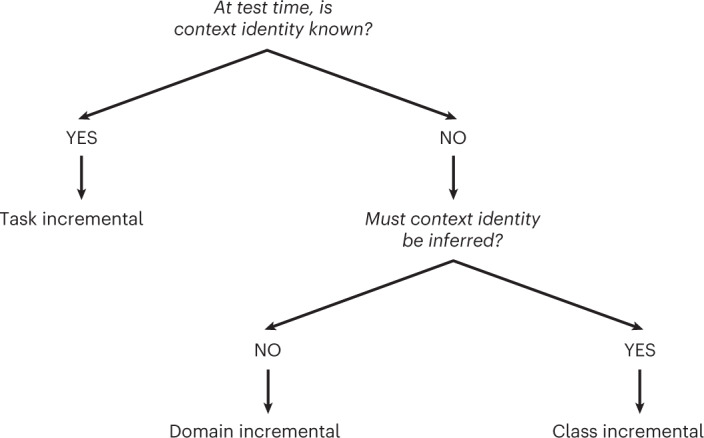
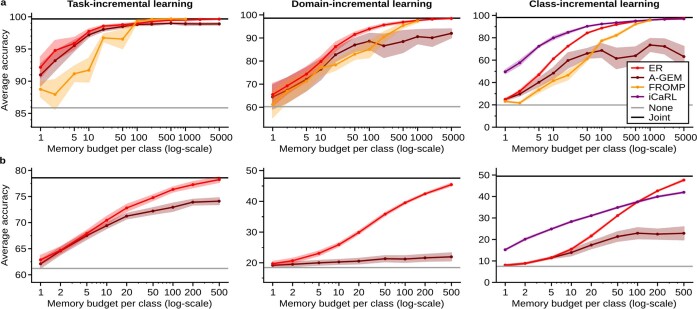
Incrementally learning new information from a non-stationary stream of data, referred to as ‘continual learning’, is a key feature of natural intelligence, but a challenging problem for deep neural networks. In recent years, numerous deep learning methods for continual learning have been proposed, but comparing their performances is difficult due to the lack of a common framework. To help address this, we describe three fundamental types, or ‘scenarios’, of continual learning: task-incremental, domain-incremental and class-incremental learning. Each of these scenarios has its own set of challenges. To illustrate this, we provide a comprehensive empirical comparison of currently used continual learning strategies, by performing the Split MNIST and Split CIFAR-100 protocols according to each scenario. We demonstrate substantial differences between the three scenarios in terms of difficulty and in terms of the effectiveness of different strategies. The proposed categorization aims to structure the continual learning field, by forming a key foundation for clearly defining benchmark problems.
Overview
The claims and statistics of this paper haven’t been checked yet.
Free: it reads the open-access text and checks the first 5 claims that cite a source we can check. Create a free account to check every claim.
Integrity signals
Registry
Cites
Statistics
Figures

Verification
Claims the paper makes
The claims and statistics of this paper haven’t been checked yet.
Free: it reads the open-access text and checks the first 5 claims that cite a source we can check. Create a free account to check every claim.
Claims other papers make about this one
Each is checked against this paper’s own text: does it say what the citing paper says it does?
The cited source says what the claim attributes to it.
In the citing paper
“To avert catastrophic forgetting, various algorithms[11, 48, 49] employ task-specific components or design separate networks for each task.”
From Few-Shot Class-Incremental Learning for Classification and Object Detection: A Survey (2025) · cites this paper as [11]
The cited source says what the claim attributes to it.
In the citing paper
“DIL is an ML problem designed to continuously adapt to data distribution from different domains while the structure of the problem is always the same [11].”
From Few-Shot Class-Incremental Learning for Classification and Object Detection: A Survey (2025) · cites this paper as [11]
The cited source says what the claim attributes to it.
In the citing paper
“TIL's primary challenge lies in identifying shared features across tasks to balance performance and computational complexity, using knowledge from one task to enhance performance in others [11].”
From Few-Shot Class-Incremental Learning for Classification and Object Detection: A Survey (2025) · cites this paper as [11]
Self-check
Percentages, sums and reported differences re-computed from the paper’s own numbers.
The self-check needs the paper’s full text.
Citations
Cites
Adam: A Method for Stochastic Optimization
Kingma, D. P., & Ba, J. (2014) · arXiv · doi:10.48550/arxiv.1412.6980 · Cited by 98,946
Gradient-based learning applied to document recognition
Lecun, Y., Bottou, L., Bengio, Y., & Haffner, P. (1998) · Proceedings of the IEEE · doi:10.1109/5.726791 · Cited by 58,805 · cited 1×
“For the Split MNIST protocol, the MNIST dataset 66 was split into five contexts, such that each context contained two digits.”
Auto-Encoding Variational Bayes
Kingma, D. P., & Welling, M. (2013) · arXiv · doi:10.48550/arxiv.1312.6114 · Cited by 20,067
Distilling the Knowledge in a Neural Network
Hinton, G., Vinyals, O., & Dean, J. (2015) · arXiv · doi:10.48550/arxiv.1503.02531 · Cited by 14,204
(2017) · Cited by 11,625
Overcoming catastrophic forgetting in neural networks
Kirkpatrick, J., Pascanu, R., Rabinowitz, N., Veness, J., Desjardins, G., Rusu, A. A., Milan, K., Quan, J., Ramalho, T., Grabska-Barwinska, A., et al. (2017) · Proceedings of the National Academy of Sciences · doi:10.1073/pnas.1611835114 · Cited by 7,899 · cited 9×
“A few years ago this scenario was regularly studied with Permuted MNIST 31,49,61 , but this protocol is not often used any-more as it is considered too artificial.”
InfluentialLi, Z., & Hoiem, D. (2018) · IEEE Transactions on Pattern Analysis and Machine Intelligence · doi:10.1109/tpami.2017.2773081 · Cited by 4,202
iCaRL: Incremental Classifier and Representation Learning
Rebuffi, S.-A., Kolesnikov, A., Sperl, G., & Lampert, C. H. (2017) · 2017 IEEE Conference on Computer Vision and Pattern Recognition (CVPR) · doi:10.1109/cvpr.2017.587 · Cited by 3,988
Catastrophic Interference in Connectionist Networks: The Sequential Learning Problem
McCloskey, M., & Cohen, N. J. (1989) · Psychology of Learning and Motivation · doi:10.1016/s0079-7421(08)60536-8 · Cited by 3,770
Catastrophic forgetting in connectionist networks
French, R. (1999) · Trends in Cognitive Sciences · doi:10.1016/s1364-6613(99)01294-2 · Cited by 2,311 · cited 16×
“During training on context K , the regularization term of FROMP was given by: with τ a hyperparameter controlling the regularization strength (which was set based on a grid search, see Supplementary Note 8) and ̂ θ ∗ the parameter vector with values as they were at the end of training on context K − 1.”
InfluentialContinual Learning Through Synaptic Intelligence
Zenke, F., Poole, B., & Ganguli, S. (2017) · arXiv · doi:10.48550/arxiv.1703.04200 · Cited by 1,784
Adaptive deconvolutional networks for mid and high level feature learning
Zeiler, M. D., Taylor, G. W., & Fergus, R. (2011) · 2011 International Conference on Computer Vision · doi:10.1109/iccv.2011.6126474 · Cited by 1,217
An Empirical Investigation of Catastrophic Forgetting in Gradient-Based Neural Networks
Goodfellow, I. J., Mirza, M., Xiao, D., Courville, A., & Bengio, Y. (2013) · arXiv · doi:10.48550/arxiv.1312.6211 · Cited by 1,089 · cited 1×
“Instead, here we follow the more general framework described by equation (1) in the main text, which states that the ith observation of experience t is drawn from context c with probability p c .”
Efficient Lifelong Learning with A-GEM
Chaudhry, A., Ranzato, M., Rohrbach, M., & Elhoseiny, M. (2018) · arXiv · doi:10.48550/arxiv.1812.00420 · Cited by 852 · cited 2×
“…stored samples in the ‘standard way’ (that is, loss on replayed data added to loss on current data); and averaged gradient episodic memory (A-GEM 54 ), which replays the same stored samples but using the loss on replayed data as inequality constraint (that is, loss on current data optimized…”
Class-Incremental Learning: Survey and Performance Evaluation on Image Classification
Masana, M., Liu, X., Twardowski, B., Menta, M., Bagdanov, A. D., & van de Weijer, J. (2023) · IEEE Transactions on Pattern Analysis and Machine Intelligence · doi:10.1109/tpami.2022.3213473 · Cited by 740 · cited 1×
“An important challenge in this scenario is learning to discriminate between classes that are not observed together, which has turned out to be very challenging for deep neural networks, especially when storing examples of previously seen classes is not allowed 29,30 .”
Expert Gate: Lifelong Learning with a Network of Experts
Aljundi, R., Chakravarty, P., & Tuytelaars, T. (2017) · 2017 IEEE Conference on Computer Vision and Pattern Recognition (CVPR) · doi:10.1109/cvpr.2017.753 · Cited by 619 · cited 1×
“Using task-specific components in this scenario is, however, only possible if an algorithm first identifies the task 18–23 , but that is not necessarily the most efficient strategy.”
Self-citationThree scenarios for continual learning
van de Ven, G. M., & Tolias, A. S. (2019) · Lirias · doi:10.48550/arxiv.1904.07734 · Cited by 523 · cited 1×
“At least in part because of two preprints of this article 58,59 , the terms ‘task-incremental learning’, ‘domain-incremental learning’ and ‘class-incremental learning’ are sometimes being used in the recent literature in a way that restricts them to this academic setting.”
Self-citationFew-Shot Class-Incremental Learning
Tao, X., Hong, X., Chang, X., Dong, S., Wei, X., & Gong, Y. (2020) · 2020 IEEE/CVF Conference on Computer Vision and Pattern Recognition (CVPR) · doi:10.1109/cvpr42600.2020.01220 · Cited by 499
Brain-inspired replay for continual learning with artificial neural networks
van de Ven, G. M., Siegelmann, H. T., & Tolias, A. S. (2020) · Nature Communications · doi:10.1038/s41467-020-17866-2 · Cited by 474 · cited 9×
“…replay methods were deep generative replay (DGR 27 ), which replays generated representations at the input level; brain-inspired replay (BI-R 28 ), which replays generated representations at the latent feature level; experience replay (ER 52,53 ), which replays stored samples in the…”
InfluentialSelf-citationEmbracing Change: Continual Learning in Deep Neural Networks
Hadsell, R., Rao, D., Rusu, A. A., & Pascanu, R. (2020) · Trends in Cognitive Sciences · doi:10.1016/j.tics.2020.09.004 · Cited by 467 · cited 1×
“An important open problem in deep learning is enabling neural networks to incrementally learn from non-stationary streams of data 1,2 .”
Online continual learning in image classification: An empirical survey
Mai, Z., Li, R., Jeong, J., Quispe, D., Kim, H., & Sanner, S. (2022) · Neurocomputing · doi:10.1016/j.neucom.2021.10.021 · Cited by 410
Aljundi, R., Kelchtermans, K., & Tuytelaars, T. (2019) · 2019 IEEE/CVF Conference on Computer Vision and Pattern Recognition (CVPR) · doi:10.1109/cvpr.2019.01151 · Cited by 324 · cited 1×
“From here on, we will use the term task only to refer to a context when it is always clear to the learning algorithm when a sample belongs to that context (as is the case with task-incremental learning).”
Self-citationContinuous learning in single-incremental-task scenarios
Maltoni, D., & Lomonaco, V. (2019) · Neural Networks · doi:10.1016/j.neunet.2019.03.010 · Cited by 309
Continual learning of context-dependent processing in neural networks
Zeng, G., Chen, Y., Cui, B., & Yu, S. (2019) · Nature Machine Intelligence · doi:10.1038/s42256-019-0080-x · Cited by 309 · cited 1×
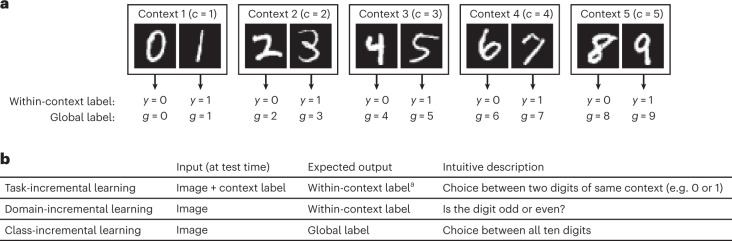
“2 shows how Split MNIST, which is a popular toy problem for continual learning 27,28,31,32 , can be performed according to each of the three scenarios.”
On Tiny Episodic Memories in Continual Learning
Chaudhry, A., Rohrbach, M., Elhoseiny, M., Ajanthan, T., Dokania, P. K., Torr, P. H. S., & Ranzato, M. (2019) · arXiv (Cornell University) · doi:10.48550/arxiv.1902.10486 · Cited by 298
Alleviating catastrophic forgetting using context-dependent gating and synaptic stabilization
Masse, N. Y., Grant, G. D., & Freedman, D. J. (2018) · Proceedings of the National Academy of Sciences · doi:10.1073/pnas.1803839115 · Cited by 255
Clinical applications of continual learning machine learning
Lee, C. S., & Lee, A. Y. (2020) · The Lancet Digital Health · doi:10.1016/s2589-7500(20)30102-3 · Cited by 254
Contextual inference underlies the learning of sensorimotor repertoires
Heald, J. B., Lengyel, M., & Wolpert, D. M. (2021) · Nature · doi:10.1038/s41586-021-04129-3 · Cited by 238 · cited 1×
“Using task-specific components in this scenario is, however, only possible if an algorithm first identifies the task 18–23 , but that is not necessarily the most efficient strategy.”
Biological underpinnings for lifelong learning machines
Kudithipudi, D., Aguilar-Simon, M., Babb, J., Bazhenov, M., Blackiston, D., Bongard, J., Brna, A. P., Chakravarthi Raja, S., Cheney, N., Clune, J., et al. (2022) · Nature Machine Intelligence · doi:10.1038/s42256-022-00452-0 · Cited by 236 · cited 18×
“During training on context K , the regularization term of FROMP was given by: with τ a hyperparameter controlling the regularization strength (which was set based on a grid search, see Supplementary Note 8) and ̂ θ ∗ the parameter vector with values as they were at the end of training on context K − 1.”
InfluentialSelf-citationA Comprehensive Study of Class Incremental Learning Algorithms for Visual Tasks
Belouadah, E., Popescu, A., & Kanellos, I. (2020) · arXiv · doi:10.48550/arxiv.2011.01844 · Cited by 235 · cited 1×
“An important challenge in this scenario is learning to discriminate between classes that are not observed together, which has turned out to be very challenging for deep neural networks, especially when storing examples of previously seen classes is not allowed 29,30 .”
Continual Learning for Real-World Autonomous Systems: Algorithms, Challenges and Frameworks
Shaheen, K., Hanif, M. A., Hasan, O., & Shafique, M. (2022) · Journal of Intelligent & Robotic Systems · doi:10.1007/s10846-022-01603-6 · Cited by 202 · cited 1×
“In recent years, this area of machine learning research has been rapidly expanding, fuelled by the potential utility of deploying continual learning algorithms for applications such as medical diagnosis 6 , autonomous driving 7 or predicting financial markets 8 .”
Continual Prototype Evolution: Learning Online from Non-Stationary Data Streams
De Lange, M., & Tuytelaars, T. (2021) · 2021 IEEE/CVF International Conference on Computer Vision (ICCV) · doi:10.1109/iccv48922.2021.00814 · Cited by 194
Self-citationTask-Agnostic Continual Learning Using Online Variational Bayes with Fixed-Point Updates
Zeno, C., Golan, I., Hoffer, E., & Soudry, D. (2021) · Neural Computation · doi:10.1162/neco_a_01430 · Cited by 179
Towards Robust Evaluations of Continual Learning
Farquhar, S., & Gal, Y. (2018) · arXiv (Cornell University) · doi:10.48550/arxiv.1805.09733 · Cited by 169 · cited 1×
“Task-incremental learning is sometimes considered ‘easy’, and it has been argued that the continual-learning community should move away from the assumption that context identities (or task labels, as they are often called) are provided at test time 60 .”
Generative replay with feedback connections as a general strategy for continual learning
van de Ven, G. M., & Tolias, A. S. (2018) · Lirias · doi:10.48550/arxiv.1809.10635 · Cited by 161 · cited 1×
“At least in part because of two preprints of this article 58,59 , the terms ‘task-incremental learning’, ‘domain-incremental learning’ and ‘class-incremental learning’ are sometimes being used in the recent literature in a way that restricts them to this academic setting.”
Self-citationLifelong Machine Learning with Deep Streaming Linear Discriminant Analysis
Hayes, T. L., & Kanan, C. (2019) · arXiv · doi:10.48550/arxiv.1909.01520 · Cited by 150
Lifelong Machine Learning with Deep Streaming Linear Discriminant Analysis
Hayes, T. L., & Kanan, C. (2020) · 2020 IEEE/CVF Conference on Computer Vision and Pattern Recognition Workshops (CVPRW) · doi:10.1109/cvprw50498.2020.00118 · Cited by 145
Wortsman, M., Ramanujan, V., Liu, R., Kembhavi, A., Rastegari, M., Yosinski, J., & Farhadi, A. (2020) · arXiv · doi:10.48550/arxiv.2006.14769 · Cited by 144
CORe50: a New Dataset and Benchmark for Continuous Object Recognition
Lomonaco, V., & Maltoni, D. (2017) · arXiv · doi:10.48550/arxiv.1705.03550 · Cited by 135
Generative Models from the perspective of Continual Learning
Lesort, T., Caselles-Dupre, H., Garcia-Ortiz, M., Stoian, A., & Filliat, D. (2019) · 2019 International Joint Conference on Neural Networks (IJCNN) · doi:10.1109/ijcnn.2019.8851986 · Cited by 127
Avalanche: an End-to-End Library for Continual Learning
Lomonaco, V., Pellegrini, L., Cossu, A., Carta, A., Graffieti, G., Hayes, T. L., De Lange, M., Masana, M., Pomponi, J., van de Ven, G. M., et al. (2021) · 2021 IEEE/CVF Conference on Computer Vision and Pattern Recognition Workshops (CVPRW) · doi:10.1109/cvprw53098.2021.00399 · Cited by 120 · cited 2×
“These experiences are the incremental steps of a continual learning problem, in the sense that at each step, the algorithm has free access to the data of the current experience, but not to the data from past or future experiences (see also ref.”
Self-citationPosterior Meta-Replay for Continual LearningPreprint
Henning, C., Cervera, M. R., D'Angelo, F., von Oswald, J., Traber, R., Ehret, B., Kobayashi, S., Grewe, B. F., & Sacramento, J. (2021) · arXiv (Cornell University) · doi:10.48550/arxiv.2103.01133 · Cited by 86 · cited 1×
“Because all output units should always be active for the Bayesian interpretation of the parameter regularization methods 21 , we decided to use that approach in this study.”
Continual Unsupervised Representation Learning
Rao, D., Visin, F., Rusu, A., Teh, Y. W., Pascanu, R., & Hadsell, R. T. (2019) · arXiv (Cornell University) · doi:10.48550/arxiv.1910.14481 · Cited by 78
Understanding Continual Learning Settings with Data Distribution Drift AnalysisPreprint
Lesort, T., Caccia, M., & Rish, I. (2021) · arXiv (Cornell University) · doi:10.48550/arxiv.2104.01678 · Cited by 72 · cited 2×
“However, this setting does not reflect well the arbitrary non-stationarity that can be observed in the real world 33–40 .”
CLASSIC: Continual and Contrastive Learning of Aspect Sentiment Classification Tasks
Ke, Z., Liu, B., Xu, H., & Shu, L. (2021) · Conference on Empirical Methods in Natural Language Processing (EMNLP) · doi:10.18653/v1/2021.emnlp-main.550 · Cited by 70 · cited 1×
“16,17 ).”
European Symposium on Artificial Neural Networks ESANN '95
Campbell, I. C. G., & Vicente, C. (1995) · Cited by 68
Efficient Feature Transformations for Discriminative and Generative Continual Learning
Verma, V. K., Liang, K. J., Mehta, N., Rai, P., & Carin, L. (2021) · 2021 IEEE/CVF Conference on Computer Vision and Pattern Recognition (CVPR) · doi:10.1109/cvpr46437.2021.01365 · Cited by 62
Continual Deep Learning by Functional Regularisation of Memorable Past
Pan, P., Swaroop, S., Immer, A., Eschenhagen, R., Turner, R. E., & Khan, M. E. (2020) · arXiv (Cornell University) · doi:10.48550/arxiv.2004.14070 · Cited by 53 · cited 1×
“For functional regularization, compared were learning without forgetting (LwF 50 ), which uses the inputs from the current context as anchor points; and functional regularization of the memorable past (FROMP 51 ), which uses stored examples from past contexts as anchor points.”
Class-Incremental Learning with Generative Classifiers
van de Ven, G. M., Li, Z., & Tolias, A. S. (2021) · 2021 IEEE/CVF Conference on Computer Vision and Pattern Recognition Workshops (CVPRW) · doi:10.1109/cvprw53098.2021.00400 · Cited by 53 · cited 2×
“55 , which uses class-specific generative models as templates.”
Self-citationIs Class-Incremental Enough for Continual Learning?
Cossu, A., Graffieti, G., Pellegrini, L., Maltoni, D., Bacciu, D., Carta, A., & Lomonaco, V. (2022) · Frontiers in Artificial Intelligence · doi:10.3389/frai.2022.829842 · Cited by 48 · cited 1×
“An advantage of distinguishing between the context set and the data stream is that it makes it possible to describe continual learning problems with gradual transitions between contexts 34,37,40,42 or whereby contexts are revisited 43–45 .”
Incremental Object Learning From Contiguous Views
Stojanov, S., Mishra, S., Thai, N. A., Dhanda, N., Humayun, A., Yu, C., Smith, L. B., & Rehg, J. M. (2019) · IEEE Computer Society Conference on Computer Vision and Pattern Recognition/Proceedings - IEEE Computer Society Conference on Computer Vision and Pattern Recognition/Proceedings · doi:10.1109/cvpr.2019.00898 · Cited by 46
Continuum: Simple Management of Complex Continual Learning ScenariosPreprint
Douillard, A., & Lesort, T. (2021) · arXiv (Cornell University) · doi:10.48550/arxiv.2102.06253 · Cited by 36 · cited 1×
“However, in recent years, several resources have been created that provide—or enable the generation of—more realistic context sets well suited for domain-incremental learning 24,41,62–64 .”
Energy-Based Models for Continual Learning
Li, S., Du, Y., van de Ven, G. M., & Mordatch, I. (2020) · Lirias (KU Leuven) · doi:10.48550/arxiv.2011.12216 · Cited by 36 · cited 1×
“An advantage of distinguishing between the context set and the data stream is that it makes it possible to describe continual learning problems with gradual transitions between contexts 34,37,40,42 or whereby contexts are revisited 43–45 .”
Encoders and Ensembles for Task-Free Continual LearningPreprint
Shanahan, M., Kaplanis, C., & Mitrovic, J. (2021) · arXiv (Cornell University) · doi:10.48550/arxiv.2105.13327 · Cited by 31 · cited 1×
“From here on, we will use the term task only to refer to a context when it is always clear to the learning algorithm when a sample belongs to that context (as is the case with task-incremental learning).”
Sequoia: A Software Framework to Unify Continual Learning ResearchPreprint
Normandin, F., Golemo, F., Ostapenko, O., Rodríguez, P., Riemer, M., Hurtado, J., Khetarpal, K., Lindeborg, R., Cecchi, L., Lesort, T., et al. (2021) · arXiv (Cornell University) · doi:10.48550/arxiv.2108.01005 · Cited by 31
Simple Lifelong Learning Machines
Vogelstein, J. T., Dey, J. K., Helm, H. S., LeVine, W., Mehta, R., Tomita, T. M., Xu, H., Geisa, A., Wang, Q., van de Ven, G. M., et al. (2025) · IEEE Transactions on Pattern Analysis and Machine Intelligence · doi:10.1109/tpami.2025.3595364 · Cited by 29
Continual Learning Augmented Investment DecisionsPreprint
Philps, D., Weyde, T., Garcez, A. D., & Batchelor, R. (2018) · RePEc: Research Papers in Economics · doi:10.48550/arxiv.1812.02340 · Cited by 21 · cited 3×
“With XdG 12 , the base neural network was used and for each context a different, randomly selected subset of X % of the units in each hidden layer was fully gated (that is, their activations were set to zero), with X a hyper-parameter whose value was set by a grid search (Supplementary Note 8).”
Simple Lifelong Learning MachinesPreprint
Dey, J. K., Vogelstein, J. T., Helm, H. S., et al. (2020) · arXiv (Cornell University) · doi:10.48550/arxiv.2004.12908 · Cited by 4
GMvandeVen/continual-learning: v1.0.0
GMvandeVen (2022) · Zenodo (CERN European Organization for Nuclear Research) · doi:10.5281/zenodo.7189377 · Cited by 1
Research works printed but not linked: 16
- Chen Z Liu B Lifelong machine learning Synth. Lect. Artif. Intell. Mach. Learn. 2018 12 1 207
- Mundt, M., Lang, S., Delfosse, Q. & Kersting, K. CLEVA-compass: A continual learning evaluation assessment compass to promote research transparency and comparability. In International Conference on Learning Representations (2022).
- Ruvolo, P. & Eaton, E. ELLA: An efficient lifelong learning algorithm. In International Conference on Machine Learning 507–515 (PMLR, 2013).
- Ramesh, R. & Chaudhari, P. Model Zoo: A growing brain that learns continually. In International Conference on Learning Representations (2022).
- Lopez-Paz, D. & Ranzato, M. Gradient episodic memory for continual learning. In Advances in Neural Information Processing Systems Vol. 30, 6470–6479 (2017).
- Mirza, M. J., Masana, M., Possegger, H. & Bischof, H. An efficient domain-incremental learning approach to drive in all weather conditions. In Proceedings of the IEEE/CVF Conference on Computer Vision and Pattern Recognition (CVPR) Workshops 3001–3011 (2022).
- von Oswald, J., Henning, C., Sacramento, J. & Grewe, B. F. Continual learning with hypernetworks. In International Conference on Learning Representations (2020).
- Shin, H., Lee, J. K., Kim, J. & Kim, J. Continual learning with deep generative replay. In Advances in Neural Information Processing Systems Vol. 30, 2994–3003 (2017).
- Caccia, L., Belilovsky, E., Caccia, M. & Pineau, J. Online learned continual compression with adaptive quantization modules. In International Conference on Machine Learning 1240–1250 (PMLR, 2020).
- Lee, S., Ha, J., Zhang, D. & Kim, G.A neural dirichlet process mixture model for task-free continual learning. In International Conference on Learning Representations (2020).
- Jin, X., Sadhu, A., Du, J. & Ren, X. Gradient-based editing of memory examples for online task-free continual learning. In Advances in Neural Information Processing Systems Vol. 34, 29193–29205 (2021).
- Rolnick, D., Ahuja, A., Schwarz, J., Lillicrap, T. & Wayne, G. Experience replay for continual learning. In Advances in Neural Information Processing Systems Vol. 32 (2019).
- Aljundi, R. et al. Online continual learning with maximally interfered retrieval. In Advances in Neural Information Processing Systems Vol. 32 (2019). · DOI · Paper page
- Hess, T., Mundt, M., Pliushch, I. & Ramesh, V. A procedural world generation framework for systematic evaluation of continual learning. In Thirty-fifth Conference on Neural Information Processing Systems, Datasets and Benchmarks Track (2021).
- Ioffe, S. & Szegedy, C. Batch normalization: Accelerating deep network training by reducing internal covariate shift. In International Conference on Machine Learning 448–456 (PMLR, 2015).
- Rezende, D. & Mohamed, S. Variational inference with normalizing flows. In International Conference on Machine Learning 1530–1538 (PMLR, 2015).
Cited by
Class-Incremental Learning: A Survey
Zhou, D.-W., Wang, Q.-W., Qi, Z.-H., Ye, H.-J., Zhan, D.-C., & Liu, Z. (2024) · IEEE Transactions on Pattern Analysis and Machine Intelligence · doi:10.1109/tpami.2024.3429383 · Cited by 376
“Hence, although these works achieve competitive results in task-incremental learning, many works [8] find that parameter regularization-based methods perform poorly in the class-incremental learning scenario.”
BackgroundInfluentialAdvances and Challenges in Meta-Learning: A Technical Review
Vettoruzzo, A., Bouguelia, M.-R., Vanschoren, J., Rögnvaldsson, T., & Santosh, K. (2024) · IEEE Transactions on Pattern Analysis and Machine Intelligence · doi:10.1109/tpami.2024.3357847 · Cited by 314
“Continual learning scenarios can be divided into task-incremental learning, domain-incremental learning, and class-incremental learning, depending on whether task identity is provided at test time or must be inferred by the algorithm [170].”
Continual Learning of Large Language Models: A Comprehensive Survey
Shi, H., Xu, Z., Wang, H., Qin, W., Wang, W., Wang, Y., Wang, Z., Ebrahimi, S., & Wang, H. (2025) · ACM Computing Surveys · doi:10.1145/3735633 · Cited by 443
“Institutions, regardless of size, often possess significant amounts of unlabeled, domain-specific data.”
A Comprehensive Survey on Test-Time Adaptation Under Distribution Shifts
Liang, J., He, R., & Tan, T. (2025) · International Journal of Computer Vision · doi:10.1007/s11263-024-02181-w · Cited by 271
“There are three fundamental scenarios of CL [64]: task-incremental, domain-incremental, and class-”
Challenges in data-driven geospatial modeling for environmental research and practice
Koldasbayeva, D., Tregubova, P., Gasanov, M., Zaytsev, A., Petrovskaia, A., & Burnaev, E. (2024) · Nature Communications · doi:10.1038/s41467-024-55240-8 · Cited by 184
Metadata
- Authors
- van de Ven, G. M., Tuytelaars, T., & Tolias, A. S.
- Affiliations
- Baylor College of Medicine (US)
- KU Leuven (BE)
- Corresponding author
- van de Ven, Gido M.
- Venue
- Nature Machine Intelligence
- Published
- 2022-12-05
- Volume
- 4
- Issue
- 12
- Pages
- 1185-1197
- ISSN
- 2522-5839 (ISSN-L)
- PMC
- PMC9771807
- OpenAlex
- W4312210066
- Cited by
- 665
- References
- 43
- Citations by year
- 2026: 173 · 2025: 258 · 2024: 172 · 2023: 60 · 2022: 2
- FWCI
- 40.48
- Type
- journal article
- Language
- en
- Open access
- hybrid
- doi.org
- Licence
- cc-by
- creativecommons.org/licenses/by/4.0 (tdm)
- creativecommons.org/licenses/by/4.0 (vor)
- Locations
- Nature Machine Intelligence (publishedVersion, cc-by)
- PubMed Central (publishedVersion, cc-by)
- PubMed (publishedVersion)
- Lirias (KU Leuven) (submittedVersion, cc-by)
- Rice Research Repository (Rice University) (submittedVersion, cc-by)
- Apollo (University of Cambridge) (submittedVersion, cc-by)
- Apollo
- Funders
- International Brain Research Organization
- National Institutes of Health
- Defense Advanced Research Projects Agency (HR0011, HR0011-18-2-0025)
- Advanced Research Projects Agency
- Intelligence Advanced Research Projects Activity (D16PC00003)
- Interior Business Center
- National Institute of Mental Health (R01MH109556)
- National Eye Institute (P30EY002520)
- H2020 European Research Council (101021347)
- Topics
- Physical Sciences › Computer Science › Artificial Intelligence › Domain Adaptation and Few-Shot Learning
- Physical Sciences › Computer Science › Artificial Intelligence › Data Stream Mining Techniques
- Physical Sciences › Computer Science › Computer Vision and Pattern Recognition › Advanced Neural Network Applications
- Keywords
- continual learning, incremental learning, task-incremental learning, domain-incremental learning, class-incremental learning, catastrophic forgetting, non-stationary data streams, deep neural network
About these checks
Registry, retraction, Cites and statistics results are computed, not judged, with one exception: a printed reference that no index lists is read once by a model before it counts as a citation error. Claims are extracted by a model and kept only when their quote appears verbatim in the text; each cited source is then checked, with a model’s help, for whether it says what the claim relies on. Those verdicts can be wrong — read the claim’s quote and the cited source before relying on one.
Statistics and arithmetic are recomputed, not judged.
Confidence bands are shown only for fields calibrated on our annotated test set. None is calibrated yet, so no band is shown.
What counts as a claim ›How we measure confidence ›How we check this ›
Are you an author, or do you see a problem with this page? Request a review
Data sources
Bibliographic data: Semantic Scholar, OpenAlex, Crossref.
Contains information from the Semantic Scholar Academic Graph Datasets, made available under the ODC Attribution License (ODC-BY 1.0).
Semantic Scholar’s data is described in: Kinney, R., et al. (2023). The Semantic Scholar Open Data Platform. arXiv:2301.10140.
