

Three types of incremental learning
Open accessThe DOI matches its Crossref record; 59 of the 59 references it cites were found in a registry or an index.
Abstract
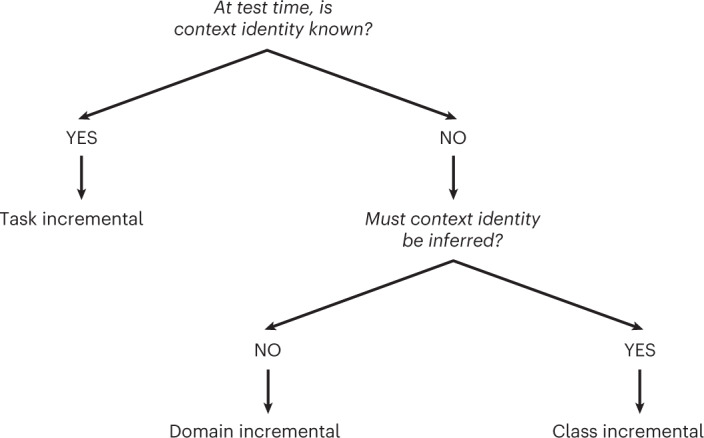
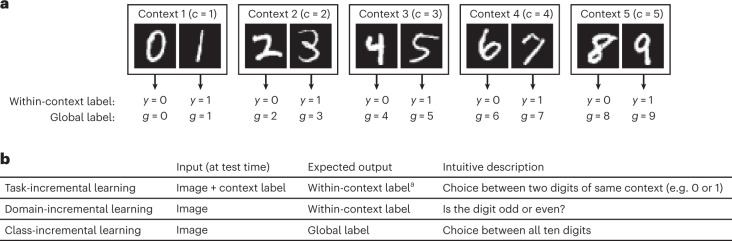
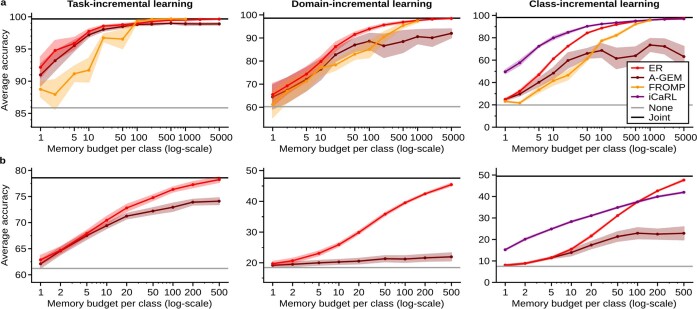
Incrementally learning new information from a non-stationary stream of data, referred to as ‘continual learning’, is a key feature of natural intelligence, but a challenging problem for deep neural networks. In recent years, numerous deep learning methods for continual learning have been proposed, but comparing their performances is difficult due to the lack of a common framework. To help address this, we describe three fundamental types, or ‘scenarios’, of continual learning: task-incremental, domain-incremental and class-incremental learning. Each of these scenarios has its own set of challenges. To illustrate this, we provide a comprehensive empirical comparison of currently used continual learning strategies, by performing the Split MNIST and Split CIFAR-100 protocols according to each scenario. We demonstrate substantial differences between the three scenarios in terms of difficulty and in terms of the effectiveness of different strategies. The proposed categorization aims to structure the continual learning field, by forming a key foundation for clearly defining benchmark problems.
Overview
The claims and statistics of this paper haven’t been checked yet.
Free: it reads the open-access text and checks the first 5 claims that cite a source we can check. Create a free account to check every claim.
Integrity signals
Registry
Cites
Statistics
Figures

Verification
Claims the paper makes
The claims and statistics of this paper haven’t been checked yet.
Free: it reads the open-access text and checks the first 5 claims that cite a source we can check. Create a free account to check every claim.
Claims other papers make about this one
Each is checked against this paper’s own text: does it say what the citing paper says it does?
The cited source says what the claim attributes to it.
In the citing paper
“To avert catastrophic forgetting, various algorithms[11, 48, 49] employ task-specific components or design separate networks for each task.”
From Few-Shot Class-Incremental Learning for Classification and Object Detection: A Survey (2025) · cites this paper as [11]
The cited source says what the claim attributes to it.
In the citing paper
“DIL is an ML problem designed to continuously adapt to data distribution from different domains while the structure of the problem is always the same [11].”
From Few-Shot Class-Incremental Learning for Classification and Object Detection: A Survey (2025) · cites this paper as [11]
The cited source says what the claim attributes to it.
In the citing paper
“TIL's primary challenge lies in identifying shared features across tasks to balance performance and computational complexity, using knowledge from one task to enhance performance in others [11].”
From Few-Shot Class-Incremental Learning for Classification and Object Detection: A Survey (2025) · cites this paper as [11]
Self-check
Percentages, sums and reported differences re-computed from the paper’s own numbers.
The self-check needs the paper’s full text.
Citations
Cites
Adam: A Method for Stochastic Optimization
Kingma, D. P., & Ba, J. (2014) · arXiv · doi:10.48550/arxiv.1412.6980 · Cited by 98,946
Gradient-based learning applied to document recognition
Lecun, Y., Bottou, L., Bengio, Y., & Haffner, P. (1998) · Proceedings of the IEEE · doi:10.1109/5.726791 · Cited by 58,805 · cited 1×
“For the Split MNIST protocol, the MNIST dataset 66 was split into five contexts, such that each context contained two digits.”
Auto-Encoding Variational Bayes
Kingma, D. P., & Welling, M. (2013) · arXiv · doi:10.48550/arxiv.1312.6114 · Cited by 20,067
Distilling the Knowledge in a Neural Network
Hinton, G., Vinyals, O., & Dean, J. (2015) · arXiv · doi:10.48550/arxiv.1503.02531 · Cited by 14,204
(2017) · Cited by 11,625
Overcoming catastrophic forgetting in neural networks
Kirkpatrick, J., Pascanu, R., Rabinowitz, N., Veness, J., Desjardins, G., Rusu, A. A., Milan, K., Quan, J., Ramalho, T., Grabska-Barwinska, A., et al. (2017) · Proceedings of the National Academy of Sciences · doi:10.1073/pnas.1611835114 · Cited by 7,899 · cited 9×
“A few years ago this scenario was regularly studied with Permuted MNIST 31,49,61 , but this protocol is not often used any-more as it is considered too artificial.”
InfluentialLi, Z., & Hoiem, D. (2018) · IEEE Transactions on Pattern Analysis and Machine Intelligence · doi:10.1109/tpami.2017.2773081 · Cited by 4,202
iCaRL: Incremental Classifier and Representation Learning
Rebuffi, S.-A., Kolesnikov, A., Sperl, G., & Lampert, C. H. (2017) · 2017 IEEE Conference on Computer Vision and Pattern Recognition (CVPR) · doi:10.1109/cvpr.2017.587 · Cited by 3,988
Catastrophic Interference in Connectionist Networks: The Sequential Learning Problem
McCloskey, M., & Cohen, N. J. (1989) · Psychology of Learning and Motivation · doi:10.1016/s0079-7421(08)60536-8 · Cited by 3,770
Catastrophic forgetting in connectionist networks
French, R. (1999) · Trends in Cognitive Sciences · doi:10.1016/s1364-6613(99)01294-2 · Cited by 2,311 · cited 16×
“During training on context K , the regularization term of FROMP was given by: with τ a hyperparameter controlling the regularization strength (which was set based on a grid search, see Supplementary Note 8) and ̂ θ ∗ the parameter vector with values as they were at the end of training on context K − 1.”
Influential
Research works printed but not linked: 16
- Chen Z Liu B Lifelong machine learning Synth. Lect. Artif. Intell. Mach. Learn. 2018 12 1 207
- Mundt, M., Lang, S., Delfosse, Q. & Kersting, K. CLEVA-compass: A continual learning evaluation assessment compass to promote research transparency and comparability. In International Conference on Learning Representations (2022).
- Ruvolo, P. & Eaton, E. ELLA: An efficient lifelong learning algorithm. In International Conference on Machine Learning 507–515 (PMLR, 2013).
- Ramesh, R. & Chaudhari, P. Model Zoo: A growing brain that learns continually. In International Conference on Learning Representations (2022).
- Lopez-Paz, D. & Ranzato, M. Gradient episodic memory for continual learning. In Advances in Neural Information Processing Systems Vol. 30, 6470–6479 (2017).
- Mirza, M. J., Masana, M., Possegger, H. & Bischof, H. An efficient domain-incremental learning approach to drive in all weather conditions. In Proceedings of the IEEE/CVF Conference on Computer Vision and Pattern Recognition (CVPR) Workshops 3001–3011 (2022).
- von Oswald, J., Henning, C., Sacramento, J. & Grewe, B. F. Continual learning with hypernetworks. In International Conference on Learning Representations (2020).
- Shin, H., Lee, J. K., Kim, J. & Kim, J. Continual learning with deep generative replay. In Advances in Neural Information Processing Systems Vol. 30, 2994–3003 (2017).
- Caccia, L., Belilovsky, E., Caccia, M. & Pineau, J. Online learned continual compression with adaptive quantization modules. In International Conference on Machine Learning 1240–1250 (PMLR, 2020).
- Lee, S., Ha, J., Zhang, D. & Kim, G.A neural dirichlet process mixture model for task-free continual learning. In International Conference on Learning Representations (2020).
- Jin, X., Sadhu, A., Du, J. & Ren, X. Gradient-based editing of memory examples for online task-free continual learning. In Advances in Neural Information Processing Systems Vol. 34, 29193–29205 (2021).
- Rolnick, D., Ahuja, A., Schwarz, J., Lillicrap, T. & Wayne, G. Experience replay for continual learning. In Advances in Neural Information Processing Systems Vol. 32 (2019).
- Aljundi, R. et al. Online continual learning with maximally interfered retrieval. In Advances in Neural Information Processing Systems Vol. 32 (2019). · DOI · Paper page
- Hess, T., Mundt, M., Pliushch, I. & Ramesh, V. A procedural world generation framework for systematic evaluation of continual learning. In Thirty-fifth Conference on Neural Information Processing Systems, Datasets and Benchmarks Track (2021).
- Ioffe, S. & Szegedy, C. Batch normalization: Accelerating deep network training by reducing internal covariate shift. In International Conference on Machine Learning 448–456 (PMLR, 2015).
- Rezende, D. & Mohamed, S. Variational inference with normalizing flows. In International Conference on Machine Learning 1530–1538 (PMLR, 2015).
Cited by
Class-Incremental Learning: A Survey
Zhou, D.-W., Wang, Q.-W., Qi, Z.-H., Ye, H.-J., Zhan, D.-C., & Liu, Z. (2024) · IEEE Transactions on Pattern Analysis and Machine Intelligence · doi:10.1109/tpami.2024.3429383 · Cited by 376
“Hence, although these works achieve competitive results in task-incremental learning, many works [8] find that parameter regularization-based methods perform poorly in the class-incremental learning scenario.”
BackgroundInfluentialAdvances and Challenges in Meta-Learning: A Technical Review
Vettoruzzo, A., Bouguelia, M.-R., Vanschoren, J., Rögnvaldsson, T., & Santosh, K. (2024) · IEEE Transactions on Pattern Analysis and Machine Intelligence · doi:10.1109/tpami.2024.3357847 · Cited by 314
“Continual learning scenarios can be divided into task-incremental learning, domain-incremental learning, and class-incremental learning, depending on whether task identity is provided at test time or must be inferred by the algorithm [170].”
Continual Learning of Large Language Models: A Comprehensive Survey
Shi, H., Xu, Z., Wang, H., Qin, W., Wang, W., Wang, Y., Wang, Z., Ebrahimi, S., & Wang, H. (2025) · ACM Computing Surveys · doi:10.1145/3735633 · Cited by 443
“Institutions, regardless of size, often possess significant amounts of unlabeled, domain-specific data.”
A Comprehensive Survey on Test-Time Adaptation Under Distribution Shifts
Liang, J., He, R., & Tan, T. (2025) · International Journal of Computer Vision · doi:10.1007/s11263-024-02181-w · Cited by 271
“There are three fundamental scenarios of CL [64]: task-incremental, domain-incremental, and class-”
Challenges in data-driven geospatial modeling for environmental research and practice
Koldasbayeva, D., Tregubova, P., Gasanov, M., Zaytsev, A., Petrovskaia, A., & Burnaev, E. (2024) · Nature Communications · doi:10.1038/s41467-024-55240-8 · Cited by 184
Applications of artificial intelligence/machine learning to high-performance composites
Wang, Y., Wang, K., & Zhang, C. (2024) · Composites Part B: Engineering · doi:10.1016/j.compositesb.2024.111740 · Cited by 159
Loss of plasticity in deep continual learning
Dohare, S., Hernandez-Garcia, J. F., Lan, Q., Rahman, P., Mahmood, A. R., & Sutton, R. S. (2024) · Nature · doi:10.1038/s41586-024-07711-7 · Cited by 172
“We use it here because it is the standard practice in deep continual learning for this type of problem in which the learning system has to learn a sequence of independent tasks 52 .”
Continual learning and catastrophic forgetting
van de Ven, G. M., Soures, N., & Kudithipudi, D. (2024) · Elsevier eBooks · doi:10.1016/b978-0-443-15754-7.00073-0 · Cited by 211
“Following van de Ven et al. (2022), the above descriptions of task-based and task-free continual learning can be formalized by letting T be the set of underlying tasks and defining the data stream as a sequence of experiences: { e 1 , e 2 , ..., e N } .”
BackgroundContinual Learning of Large Language Models: A Comprehensive Survey
Shi, H., Xu, Z., Wang, H., Qin, W., Wang, W., Wang, Y., Wang, Z., Ebrahimi, S., & Wang, H. (2024) · arXiv · doi:10.48550/arxiv.2404.16789 · Cited by 135
“Institutions, regardless of size, often possess significant amounts of unlabeled, domain-specific data.”
A Comprehensive Survey of Forgetting in Deep Learning Beyond Continual Learning
Wang, Z., Yang, E., Shen, L., & Huang, H. (2024) · IEEE Transactions on Pattern Analysis and Machine Intelligence · doi:10.1109/tpami.2024.3498346 · Cited by 183
“Itisimportant to note that the terms CL and incremental learning (IL) are often used interchangeably when addressing learning from non-stationary data distributions, as described in [3].”
InfluentialText Classification: How Machine Learning Is Revolutionizing Text Categorization
Allam, H., Makubvure, L., Gyamfi, B. K., Kwadwo, G., & Akinwolere, K. (2025) · Information · doi:10.3390/info16020130 · Cited by 138
An overview of large AI models and their applications
Tu, X., He, Z., Huang, Y., Zhang, Z., Yang, M., & Zhao, J. C. (2024) · Visual Intelligence · doi:10.1007/s44267-024-00065-8 · Cited by 134
“With the successful applications of large AI models in different fields and tasks, continuous learning [188] and incremental learning [189] will become important directions for development.”
Li, J., Wang, Z., Zhang, S., Lin, Y., Jiang, L., & Tan, J. (2023) · Robotics and Computer-Integrated Manufacturing · doi:10.1016/j.rcim.2023.102647 · Cited by 98
Incorporating neuro-inspired adaptability for continual learning in artificial intelligence
Wang, L., Zhang, X., Li, Q., Zhang, M., Su, H., Zhu, J., & Zhong, Y. (2023) · Nature Machine Intelligence · doi:10.1038/s42256-023-00747-w · Cited by 91
“Finally, we evaluate CAF under the setting of task-incremental learning 52 and compare it with a range of representative methods 7–9 , 53– 56 .”
The Computational and Neural Bases of Context-Dependent Learning
Heald, J. B., Wolpert, D. M., & Lengyel, M. (2023) · Annual Review of Neuroscience · doi:10.1146/annurev-neuro-092322-100402 · Cited by 103
Perera, M., de Hoog, J., Bandara, K., Senanayake, D., & Halgamuge, S. K. (2024) · Applied Energy · doi:10.1016/j.apenergy.2024.122971 · Cited by 93
“Therefore, investigating how HTCNNs can be adapted without retraining from scratch (e.g., continual or incremental learning of networks [70, 71]) would be an important direction for future work.”
BackgroundFew-Shot Class-Incremental Learning for Classification and Object Detection: A Survey
Zhang, J., Liu, L., Silvén, O., Pietikäinen, M., & Hu, D. (2025) · IEEE Transactions on Pattern Analysis and Machine Intelligence · doi:10.1109/tpami.2025.3529038 · Cited by 84
“To avert catastrophic forgetting, various algorithms [11], [48], [49] employ task-specific components or design separate networks for each task.”
InfluentialMosaic integration and knowledge transfer of single-cell multimodal data with MIDAS
He, Z., Hu, S., Chen, Y., An, S., Zhou, J., Liu, R., Shi, J., Wang, J., Dong, G., Shi, J., et al. (2024) · Nature Biotechnology · doi:10.1038/s41587-023-02040-y · Cited by 84
“Thus, using incremental learning 56 is an inevitable trend to achieve continuous mosaic integration without model retraining.”
Vos, G., Trinh, K., Sarnyai, Z., & Azghadi, M. R. (2023) · Journal of Biomedical Informatics · doi:10.1016/j.jbi.2023.104556 · Cited by 88
Representation Learning for Tabular Data: A Comprehensive Survey
Jiang, J., Liu, S.-Y., Cai, H.-R., Zhou, Q.-L., & Ye, H.-J. (2026) · IEEE Transactions on Pattern Analysis and Machine Intelligence · doi:10.1109/tpami.2026.3657217 · Cited by 117
“It regularizes neuron attributions to encourage neurons to specialize and become orthogonal to one another.”
Towards retraining-free RNA modification prediction with incremental learning
Qiao, J., Jin, J., Yu, H., & Wei, L. (2024) · Information Sciences · doi:10.1016/j.ins.2024.120105 · Cited by 73
A data-to-forecast machine learning system for global weather
Sun, X., Zhong, X., Xu, X., Huang, Y., Li, H., Neelin, J. D., Chen, D., Feng, J., Han, W., Wu, L., et al. (2025) · Nature Communications · doi:10.1038/s41467-025-62024-1 · Cited by 89
Exploring the Potential of Distributed Computing Continuum Systems
Donta, P. K., Murturi, I., Pujol, V. C., Sedlak, B., & Dustdar, S. (2023) · Computers · doi:10.3390/computers12100198 · Cited by 84
“Adopting incremental learning features can improve the performance of learned models with limited data availability as well as learned models from historical data [133,134].”
BackgroundBuilding compositional tasks with shared neural subspaces
Tafazoli, S., Bouchacourt, F., Ardalan, A., Markov, N. T., Uchimura, M., Mattar, M. G., Daw, N. D., & Buschman, T. J. (2025) · Nature · doi:10.1038/s41586-025-09805-2 · Cited by 75
“4 and 5; a form of class-incremental continual learning 16 ).”
Recent Advances of Foundation Language Models-based Continual Learning: A Survey
Yang, Y., Zhou, J., Ding, X., Huai, T., Liu, S., Chen, Q., Xie, Y., & He, L. (2025) · ACM Computing Surveys · doi:10.1145/3705725 · Cited by 112
A Survey on Continual Semantic Segmentation: Theory, Challenge, Method and Application
Yuan, B., & Zhao, D. (2024) · IEEE Transactions on Pattern Analysis and Machine Intelligence · doi:10.1109/tpami.2024.3446949 · Cited by 81
“In spite of the presentation of an explicit summary of three IL types by [70], CSS also encounters various types of tasks.”
BackgroundRecent Advances of Multimodal Continual Learning: A Comprehensive Survey
Yu, D., Zhang, X., Chen, Y., Liu, A., Zhang, Y., Yu, P. S., & King, I. (2026) · IEEE Transactions on Neural Networks and Learning Systems · doi:10.1109/tnnls.2026.3658485 · Cited by 64
ExoMDN: Rapid characterization of exoplanet interior structures with mixture density networks
Baumeister, P., & Tosi, N. (2023) · Astronomy and Astrophysics · doi:10.1051/0004-6361/202346216 · Cited by 53
Wardana, A. A., Kołaczek, G., Warzyński, A., & Sukarno, P. (2024) · Scientific Reports · doi:10.1038/s41598-024-54438-6 · Cited by 56
“The essence of incremental learning lies in its adaptability and the ability to build upon existing knowledge, making it a valuable paradigm for scenarios where systems need to evolve and incorporate new insights without discarding the wisdom gained from prior experiences 25 .”
BackgroundZhang, Y., Shen, C., Shi, J., Li, C., Lin, X., Zhu, Z., & Wang, D. (2024) · Knowledge-Based Systems · doi:10.1016/j.knosys.2024.111679 · Cited by 53
A collective AI via lifelong learning and sharing at the edge
Soltoggio, A., Ben-Iwhiwhu, E., Braverman, V., Eaton, E., Epstein, B., Ge, Y., Halperin, L., How, J., Itti, L., Jacobs, M. A., et al. (2024) · Nature Machine Intelligence · doi:10.1038/s42256-024-00800-2 · Cited by 51
Ma, Y., Zheng, S., Yang, Z., Zheng, P., Leng, J., & Hong, J. (2025) · Journal of Manufacturing Systems · doi:10.1016/j.jmsy.2025.07.019 · Cited by 56
Chen, H., Wang, Z., Yang, S., Luo, X., He, D., & Chan, S. (2024) · Alexandria Engineering Journal · doi:10.1016/j.aej.2024.10.014 · Cited by 59
“Incremental learning involves acquiring new information from a non-stationary data stream, often referred to as ‘‘continuous learning’’ or ‘‘lifelong learn-ing’’ [25].”
An efficient quantum proactive incremental learning algorithm
Li, L., Li, J., Song, Y., Qin, S., Wen, Q., & Gao, F. (2024) · Science China Physics Mechanics and Astronomy · doi:10.1007/s11433-024-2501-4 · Cited by 55
Multimodal fusion techniques: Review, data representation, information fusion, and application areas
Hangloo, S., & Arora, B. (2025) · Neurocomputing · doi:10.1016/j.neucom.2025.130827 · Cited by 59
Liu, M., Bian, S., Zhou, B., & Lukowicz, P. (2024) · ACM International Symposium on Wearable Computers (ISWC) · doi:10.1145/3675095.3676618 · Cited by 56
ATRNet-STAR: A Large Dataset and Benchmark Toward Remote Sensing Object Recognition in the Wild
Liu, Y., Li, W., Liu, L., Zhou, J., Peng, B., Song, Y., Xiong, X., Yang, W., Liu, T., Liu, Z., et al. (2026) · IEEE Transactions on Pattern Analysis and Machine Intelligence · doi:10.1109/tpami.2026.3658649 · Cited by 72
“The diversity of our dataset supports investigations into domain incremental learning and class incremental learning [113].”
Du, R., Chen, J., Xiang, Y., Zhang, Z., Yang, N., Yang, X., Tang, Z., Wang, H., Wang, X., Shi, H., et al. (2023) · Computers and Electronics in Agriculture · doi:10.1016/j.compag.2023.108356 · Cited by 44
Steering Prototypes with Prompt-tuning for Rehearsal-free Continual Learning
Li, Z., Zhao, L., Zhang, Z., Zhang, H., Liu, D., Liu, T., & Metaxas, D. (2024) · IEEE Winter Conference on Applications of Computer Vision · doi:10.1109/wacv57701.2024.00251 · Cited by 59
“Prevalent algorithms can typically be categorized into three primary branches [41, 54, 19].”
BackgroundMultimodal Parameter-Efficient Few-Shot Class Incremental Learning
D’Alessandro, M., Alonso, A., Calabrés, E., & Galar, M. (2023) · 2023 IEEE/CVF International Conference on Computer Vision Workshops (ICCVW) · doi:10.1109/iccvw60793.2023.00364 · Cited by 40
“Incremental learning deals with the problem of learning new information from non-stationary data streams [46, 28, 35].”
BackgroundA robust and interpretable ensemble machine learning model for predicting healthcare insurance fraud
Wang, Z., Chen, X., Wu, Y., Jiang, L., Lin, S., & Qiu, G. (2025) · Scientific Reports · doi:10.1038/s41598-024-82062-x · Cited by 39
MetaTransformer: deep metagenomic sequencing read classification using self-attention models
Wichmann, A., Buschong, E., Müller, A., Jünger, D., Hildebrandt, A., Hankeln, T., & Schmidt, B. (2023) · NAR Genomics and Bioinformatics · doi:10.1093/nargab/lqad082 · Cited by 40
MAGMAX: Leveraging Model Merging for Seamless Continual Learning
Marczak, D., Twardowski, B., Trzcinski, T. P., & Cygert, S. (2024) · Lecture notes in computer science · doi:10.1007/978-3-031-73013-9_22 · Cited by 91
Unleashing the Power of Continual Learning on Non-Centralized Devices: A Survey
Li, Y., Wang, H., Xu, W., Xiao, T., Liu, H., Tu, M., Wang, Y., Yang, X., Zhang, R., Yu, S., et al. (2025) · IEEE Communications Surveys & Tutorials · doi:10.1109/comst.2025.3568279 · Cited by 56
“For example, the authors in [33], [34] discuss strategies for alleviating catastrophic forgetting and systematically summarize the latest advances in continual learning.”
Class Incremental Learning with Multi-Teacher Distillation
Wen, H., Pan, L., Dai, Y., Qiu, H., Wang, L., Wu, Q., & Li, H. (2024) · IEEE Computer Society Conference on Computer Vision and Pattern Recognition/Proceedings - IEEE Computer Society Conference on Computer Vision and Pattern Recognition/Proceedings · doi:10.1109/cvpr52733.2024.02687 · Cited by 57
“Distillation strategies are essentially functional regularization methods [16, 46], which encourage the input-output mapping of the model to be invariant and are the most direct approaches to incremental learning.”
MethodShan, S., & Li, Y. (2024) · International Journal of Human-Computer Interaction · doi:10.1080/10447318.2024.2423335 · Cited by 38
“The rapid incremental training strategy introduces incremental corpora to train the model incrementally, enabling the model to achieve continual learning (Van de Ven et al., 2022).”
Towards Incremental Learning in Large Language Models: A Critical Review
Jovanovic, M., & Voss, P. (2025) · Expert Systems · doi:10.1111/exsy.70127 · Cited by 41
“However, the existing work focuses on learning plasticity and inter-task generalizability [20, 22, 23, 25].”
A Review of Continual Learning in Edge AI
Wu, B., Ding, Z., & Huang, J. (2026) · IEEE Transactions on Network Science and Engineering · doi:10.1109/tnse.2026.3657652 · Cited by 36
“This created a synchronization dependency that proved untenable in real world federated scenarios where clients operated independently with uncorrelated data arrival patterns and computational capabilities [89].”
AI-based diagnosis of acute aortic syndrome from noncontrast CT
Hu, Y., Xiang, Y., Zhou, Y.-J., He, Y., Lang, D., Yang, S., Du, X., Den, C., Xu, Y., Wang, G., et al. (2025) · Nature Medicine · doi:10.1038/s41591-025-03916-z · Cited by 45
Su, H., Gao, H., Wang, X., Fang, X., Liu, Q., Huang, G.-B., Li, X., & Cao, Q. P. (2024) · IEEE Transactions on Instrumentation and Measurement · doi:10.1109/tim.2024.3472860 · Cited by 44
“Incremental learning can be categorized into three primary scenarios: task incremental learning (Task-IL), Domain-IL, and class incremental learning (Class-IL) [31].”
BackgroundWhat is Wrong with Continual Learning in Medical Image Segmentation?
González, C., Lemke, N., Ranem, A., Sakas, G., & Mukhopadhyay, A. (2025) · doi:10.1145/3746259.3760435 · Cited by 38
Wang, Z., Fang, Y., Liu, Z., Hao, N., Zhang, H. H., Sun, X., Que, J., & Ding, H. (2024) · Nature Communications · doi:10.1038/s41467-024-51639-5 · Cited by 35
Sayed, A. N., Himeur, Y., Varlamis, I., & Bensaali, F. (2025) · Applied Energy · doi:10.1016/j.apenergy.2025.125458 · Cited by 33
Tang, H., Li, J., Wang, B., Zu, X., Feng, W., Chen, P., Xue, H., & Qing-An, L. (2025) · Engineering Applications of Artificial Intelligence · doi:10.1016/j.engappai.2025.110763 · Cited by 33
Shi, M., Ding, C., Shen, C., Huang, W., & Zhu, Z. (2024) · Advanced Engineering Informatics · doi:10.1016/j.aei.2024.102832 · Cited by 30
Cai, Z., He, M., Li, C., Qi, H., Bai, R., Yang, J., & Zhang, C. (2023) · Computers and Electronics in Agriculture · doi:10.1016/j.compag.2023.108371 · Cited by 30
A Novel Domain Incremental Learning Method for Bearing Fault Diagnosis Based on F&K
Sun, M., Xiao, X., Chen, T., He, Q., Long, Z., & Li, L. (2024) · IEEE Transactions on Industrial Informatics · doi:10.1109/tii.2024.3470908 · Cited by 37
Monday, C. U., Zaghloul, M. S., Krishnamurthy, D., & Achari, G. (2024) · Journal of Water Process Engineering · doi:10.1016/j.jwpe.2024.106600 · Cited by 29
Continual Learning in Medical Imaging: A Survey and Practical Analysis
Qazi, M. A., Hashmi, A. U. R., Sanjeev, S., Almakky, I., Saeed, N., González, C., & Yaqub, M. K. (2025) · ACM Computing Surveys · doi:10.1145/3785663 · Cited by 35
Nguyen-Le, H.-H., Tran, V.-T., Nguyen, D.-T., & Le-Khac, N.-A. (2026) · Artificial Intelligence Review · doi:10.1007/s10462-026-11608-4 · Cited by 28
Naikar, N., Brady, A., Moy, G., & Kwok, H.-W. (2023) · Ergonomics · doi:10.1080/00140139.2023.2281898 · Cited by 35
“For instance, the ability of deep learning systems to learn from raw data introduces the possibility of automated systems that can learn independently, or without significant human involvement, to respond to new or unexpected situations (van de Ven, Tuytelaars, and Tolias 2022).”
BackgroundAdvances in Continual Graph Learning for Anti‐Money Laundering Systems: A Comprehensive Review
Deprez, B., Wei, W., Verbeke, W., Baesens, B., Mets, K., & Verdonck, T. (2025) · Wiley Interdisciplinary Reviews Computational Statistics · doi:10.1002/wics.70040 · Cited by 32
“This limits their adoption in practice. van de Ven et al. [58] mention the use of entirely separate output layers or networks to learn each task.”
InfluentialStewart, C. A., Diao, L., Xi, Y., Wang, R., Ramkumar, K., Serrano, A. G., Tanimoto, A., Rodriguez, B. L., Morris, B. B., Shen, L., et al. (2024) · Clinical Cancer Research · doi:10.1158/1078-0432.ccr-24-0361 · Cited by 28
Continual Learning in Medicine: A Systematic Literature Review
Bruno, P., Quarta, A., & Calimeri, F. (2025) · Neural Processing Letters · doi:10.1007/s11063-024-11709-7 · Cited by 31
Continual Learning with Deep Neural Networks in Physiological Signal Data: A Survey
Li, A., Li, H., & Yuan, G. (2024) · Healthcare · doi:10.3390/healthcare12020155 · Cited by 35
Adaptable, incremental, and explainable network intrusion detection systems for internet of things
Cerasuolo, F., Bovenzi, G., Ciuonzo, D., & Pescapè, A. (2025) · Engineering Applications of Artificial Intelligence · doi:10.1016/j.engappai.2025.110143 · Cited by 30
Incremental Learning-Enabled Fault Diagnosis of Dynamic Systems: A Comprehensive Review
Liu, Z., He, X. Y., Huang, B., & Zhou, D. (2025) · IEEE Transactions on Cybernetics · doi:10.1109/tcyb.2025.3586643 · Cited by 29
“For more information, please refer to [30], [31], [32], [33], and [34].”
Simple Lifelong Learning Machines
Vogelstein, J. T., Dey, J. K., Helm, H. S., LeVine, W., Mehta, R., Tomita, T. M., Xu, H., Geisa, A., Wang, Q., van de Ven, G. M., et al. (2025) · IEEE Transactions on Pattern Analysis and Machine Intelligence · doi:10.1109/tpami.2025.3595364 · Cited by 29
“For example, Learn++ [19] boosts ensembles of weak learners learned over different data sequences in class incremental lifelong learning settings [20].”
Machine Learning in Next-Generation Polymer Composites: Recent Advances and Perspectives
Olhan, S., Antil, B., & Maimí, P. (2026) · Applied Composite Materials · doi:10.1007/s10443-025-10437-y · Cited by 26
“Various ML-based concepts, such as active learning [73], DL [73–75], physics-informed machine learning (PIML) [76], meta-learning [77], and incremental learning [78], were introduced and developed to enhance learning capabilities and address real-world engineering challenges.”
Continual Learning With Neuromorphic Computing: Foundations, Methods, and Emerging Applications
Minhas, M. F., Putra, R. V. W., Awwad, F. R., Hasan, O., & Shafique, M. (2025) · IEEE Access · doi:10.1109/access.2025.3588665 · Cited by 33
Keloth, V. K., Selek, S., Chen, Q., Gilman, C., Fu, S., Dang, Y., Chen, X., Hu, X., Zhou, Y., He, H., et al. (2025) · npj Digital Medicine · doi:10.1038/s41746-025-01645-8 · Cited by 24
“Other approachessuchasacombinationofDomain-incrementallearningand Class-incrementallearning 62 can also be applied to sequentially update a single model with new domains and new sets of classes.”
Wang, Z., & You, F. (2025) · Nature Computational Science · doi:10.1038/s43588-025-00797-7 · Cited by 26
“Considering the cost of training models, incremental learning can be employed 55,56 , where the model is continuously or periodically trained with new data without needing to retrain from scratch.”
Dual Consolidation for Pre-Trained Model-Based Domain-Incremental Learning
Zhou, D., Cai, Z.-W., Ye, H.-J., Zhang, L., & Zhan, D. (2025) · IEEE Computer Society Conference on Computer Vision and Pattern Recognition/Proceedings - IEEE Computer Society Conference on Computer Vision and Pattern Recognition/Proceedings · doi:10.1109/cvpr52734.2025.01913 · Cited by 49
“After that, we keep the merged backbone frozen and retrain the classification layer to align it with the consolidated representation.”
Boonpalit, K., Kinchagawat, J., Prommin, C., Nutanong, S. Y., & Namuangruk, S. (2023) · Physical Chemistry Chemical Physics · doi:10.1039/d3cp03667g · Cited by 24
Clustering-based Domain-Incremental Learning
Lamers, C., Vidal, R., Belbachir, N., van Stein, B., Bäck, T., & Giampouras, P. V. (2023) · IEEE International Conference on Computer Vision Workshops · doi:10.1109/iccvw60793.2023.00363 · Cited by 38
“This approach successfully counteracts forgetting in the setting of domain-incremental learning, a setting for which this problem was previously unsolved [35].”
BackgroundMethodInfluentialA Life-long Learning Intrusion Detection System for 6G-Enabled IoV
Korba, A. A., Sebaa, S., Mabrouki, M., Ghamri-Doudane, Y. M., & Benatchba, K. (2024) · International Wireless Communications and Mobile Computing Conference (IWCMC) · doi:10.1109/iwcmc61514.2024.10592500 · Cited by 30
“Predominantly, these recent AI-driven IDS rely on deep learning techniques [3], [5], however an inherent limitation of DL: the challenge of incremental learning from continuously evolving data streams, often described as catastrophic forgetting [6].”
BackgroundInfluentialAslam, S., Rasool, A., Li, X., & Wu, H. (2025) · Interdisciplinary Sciences: Computational Life Sciences · doi:10.1007/s12539-024-00675-2 · Cited by 23
“However, most existing approaches are typically designed for Task-IL or Class-IL within the context of classification problems [9].”
Fullington, D., Yangue, E., Bappy, M. M., Liu, C., & Tian, W. (2024) · Journal of Manufacturing Systems · doi:10.1016/j.jmsy.2024.04.021 · Cited by 27
Online continual learning for human activity recognition
Schiemer, M., Fang, L., Dobson, S., & Ye, J. (2023) · Pervasive and Mobile Computing · doi:10.1016/j.pmcj.2023.101817 · Cited by 33
Generative appearance replay for continual unsupervised domain adaptation
Chen, B., Thandiackal, K., Pati, P., & Göksel, O. (2023) · Medical Image Analysis · doi:10.1016/j.media.2023.102924 · Cited by 27
Qiu, J., Zhong, Y., Shao, Y., Zhang, G., Yang, J., Li, Z., & Cheng, Y. (2024) · Chemical Engineering Journal · doi:10.1016/j.cej.2024.155987 · Cited by 23
CP-Prompt: Composition-Based Cross-modal Prompting for Domain-Incremental Continual Learning
Feng, Y., Tian, Z., Zhu, Y., Han, Z., Luo, H., Zhang, G., & Song, M. (2024) · ACM International Conference on Multimedia (ACM MM) · doi:10.1145/3664647.3681481 · Cited by 41
Mind the Gap: Preserving and Compensating for the Modality Gap in CLIP-Based Continual Learning
Huang, L., Cao, X., Lu, H., Meng, Y., Yang, F., & Liu, X. (2025) · IEEE/CVF International Conference on Computer Vision (ICCV) · doi:10.1109/iccv51701.2025.00360 · Cited by 47
“The goal of continual learning is to enable models to continuously acquire new knowledge and adapt to the ever-changing real world [22, 31].”
Active Learning for Data Quality Control: A Survey
Li, N., Qi, Y., Li, C., & Zhao, Z. (2024) · Journal of Data and Information Quality · doi:10.1145/3663369 · Cited by 26
Morales-García, J., Bueno-Crespo, A., Martínez‐España, R., García, F. J., Ros, S., Fernández-Pedauyé, J., & Cecilia, J. M. (2022) · Internet of Things · doi:10.1016/j.iot.2023.100734 · Cited by 21
Guo, M., Yao, M., Gao, J., Liu, W.-L., & Lin, S. (2023) · International Journal of Electrical Power & Energy Systems · doi:10.1016/j.ijepes.2023.109705 · Cited by 21
Zhan, Z., Wan, S., Li, X., & Fang, B. (2025) · Engineering Applications of Artificial Intelligence · doi:10.1016/j.engappai.2025.110199 · Cited by 21
Online Class-Incremental Learning For Real-World Food Image Classification
Raghavan, S., He, J., & Zhu, F. M. (2024) · IEEE Winter Conference on Applications of Computer Vision · doi:10.1109/wacv57701.2024.00801 · Cited by 33
Deep learning for intelligent irrigation decision-making: A review
Yu, J., Qu, Q., Peng, S., Wei, X., Li, Y., & Sun, C. (2025) · Agricultural Water Management · doi:10.1016/j.agwat.2025.109836 · Cited by 20
Multi-view class incremental learning
Li, D., Wang, T., Chen, J., Kawaguchi, K., Lian, C., & Zeng, Z. (2023) · Information Fusion · doi:10.1016/j.inffus.2023.102021 · Cited by 25
“There are three incremental learning scenarios, depending on how the aspect of the data that changes over time relates to the function or mapping [23, 38].”
BackgroundMethodFu, Y., Yang, R., Liu, Z., & Ng, M. K. (2025) · IEEE Transactions on Circuits and Systems for Video Technology · doi:10.1109/tcsvt.2025.3598274 · Cited by 24
“Incremental learning [7], [8] is proposed to continuously acquire new knowledge from a sequence of tasks while preventing catastrophic forgetting [9] with e ffi cient resource usage.”
A Systematic Comparison of Large Language Models Performance for Intrusion Detection
Bui, M.-T., Boffa, M., Valentim, R. V., Navarro, J. M., Chen, F., Bao, X., Houidi, Z. B., & Rossi, D. (2024) · Proceedings of the ACM on Networking · doi:10.1145/3696379 · Cited by 19
Continual Learning for Intrusion Detection Under Evolving Network Threats
Guo, C., Li, X., Cheng, J., Yang, S., & Gong, H. (2025) · Future Internet · doi:10.3390/fi17100456 · Cited by 23
Enhancing Mathematical Education Through Mobile Learning: A Problem-Based Approach
Martínez-Gómez, J., & Nicolalde, J. F. (2025) · Education Sciences · doi:10.3390/educsci15040462 · Cited by 19
Kabir, R., Watanobe, Y., Ding, D., Islam, M. R., & Naruse, K. (2025) · IEEE Access · doi:10.1109/access.2025.3619776 · Cited by 24
Class-Incremental Learning for Recognition of Complex-Valued Signals
Fan, Z., Tu, Y., Lin, Y., & Shi, Q. (2023) · IEEE Transactions on Cognitive Communications and Networking · doi:10.1109/tccn.2023.3331296 · Cited by 18
“IL aims to enable artificial intelligence systems to leverage previous knowledge and adapt to new situations throughout the task [31], [32], [33].”
BackgroundAn Open-Set Few-Shot Class Incremental Learning Framework for Specific Emitter Identification
Zhang, T., Shen, X., Shang, Z., Ding, G., Wu, H., & Qiao, X. (2025) · IEEE Transactions on Cognitive Communications and Networking · doi:10.1109/tccn.2025.3565589 · Cited by 20
“Traditional DL methods often require retraining on the entire dataset [19], [20], while Class Incremental Learning (CIL) enables the model to progressively assimilate new classes while preserving knowledge of previously learned classes, thus saving time and computational resources [21].”
PASS++: A Dual Bias Reduction Framework for Non-Exemplar Class-Incremental Learning
Zhu, F., Zhang, X.-Y., Cheng, Z., & Liu, C. (2025) · IEEE Transactions on Pattern Analysis and Machine Intelligence · doi:10.1109/tpami.2025.3568886 · Cited by 24
“However, they show poor performance in CIL scenario [33].”
BackgroundKnowledge transfer in lifelong machine learning: a systematic literature review
Khodaee, P., Viktor, H. L., & Michalowski, W. (2024) · Artificial Intelligence Review · doi:10.1007/s10462-024-10853-9 · Cited by 22
Personalized Federated Domain-Incremental Learning Based on Adaptive Knowledge Matching
Li, Y., Xu, W., Wang, H., Qi, Y., Guo, J., & Li, R. (2024) · Lecture notes in computer science · doi:10.1007/978-3-031-72952-2_8 · Cited by 37
Metadata
- Authors
- van de Ven, G. M., Tuytelaars, T., & Tolias, A. S.
- Affiliations
- Baylor College of Medicine (US)
- KU Leuven (BE)
- Corresponding author
- van de Ven, Gido M.
- Venue
- Nature Machine Intelligence
- Published
- 2022-12-05
- Volume
- 4
- Issue
- 12
- Pages
- 1185-1197
- ISSN
- 2522-5839 (ISSN-L)
- PMC
- PMC9771807
- OpenAlex
- W4312210066
- Cited by
- 665
- References
- 43
- Citations by year
- 2026: 173 · 2025: 258 · 2024: 172 · 2023: 60 · 2022: 2
- FWCI
- 40.48
- Type
- journal article
- Language
- en
- Open access
- hybrid
- doi.org
- Licence
- cc-by
- creativecommons.org/licenses/by/4.0 (tdm)
- creativecommons.org/licenses/by/4.0 (vor)
- Locations
- Nature Machine Intelligence (publishedVersion, cc-by)
- PubMed Central (publishedVersion, cc-by)
- PubMed (publishedVersion)
- Lirias (KU Leuven) (submittedVersion, cc-by)
- Rice Research Repository (Rice University) (submittedVersion, cc-by)
- Apollo (University of Cambridge) (submittedVersion, cc-by)
- Apollo
- Funders
- International Brain Research Organization
- National Institutes of Health
- Defense Advanced Research Projects Agency (HR0011, HR0011-18-2-0025)
- Advanced Research Projects Agency
- Intelligence Advanced Research Projects Activity (D16PC00003)
- Interior Business Center
- National Institute of Mental Health (R01MH109556)
- National Eye Institute (P30EY002520)
- H2020 European Research Council (101021347)
- Topics
- Physical Sciences › Computer Science › Artificial Intelligence › Domain Adaptation and Few-Shot Learning
- Physical Sciences › Computer Science › Artificial Intelligence › Data Stream Mining Techniques
- Physical Sciences › Computer Science › Computer Vision and Pattern Recognition › Advanced Neural Network Applications
- Keywords
- continual learning, incremental learning, task-incremental learning, domain-incremental learning, class-incremental learning, catastrophic forgetting, non-stationary data streams, deep neural network
About these checks
Registry, retraction, Cites and statistics results are computed, not judged, with one exception: a printed reference that no index lists is read once by a model before it counts as a citation error. Claims are extracted by a model and kept only when their quote appears verbatim in the text; each cited source is then checked, with a model’s help, for whether it says what the claim relies on. Those verdicts can be wrong — read the claim’s quote and the cited source before relying on one.
Statistics and arithmetic are recomputed, not judged.
Confidence bands are shown only for fields calibrated on our annotated test set. None is calibrated yet, so no band is shown.
What counts as a claim ›How we measure confidence ›How we check this ›
Are you an author, or do you see a problem with this page? Request a review
Data sources
Bibliographic data: Semantic Scholar, OpenAlex, Crossref.
Contains information from the Semantic Scholar Academic Graph Datasets, made available under the ODC Attribution License (ODC-BY 1.0).
Semantic Scholar’s data is described in: Kinney, R., et al. (2023). The Semantic Scholar Open Data Platform. arXiv:2301.10140.
