

Leveraging large language models for predictive chemistry
Open accessPublished version of a preprint
The DOI matches its Crossref record; 83 of the 83 references it cites were found in a registry or an index.
Abstract
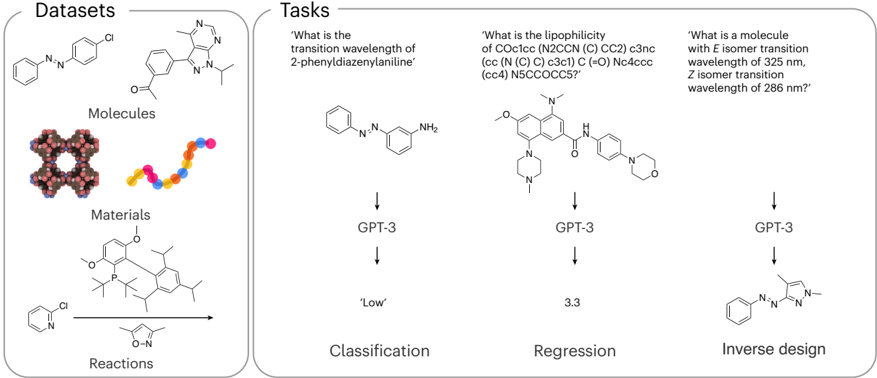
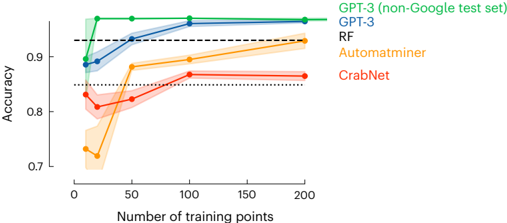
Machine learning has transformed many fields and has recently found applications in chemistry and materials science. The small datasets commonly found in chemistry sparked the development of sophisticated machine learning approaches that incorporate chemical knowledge for each application and, therefore, require specialized expertise to develop. Here we show that GPT-3, a large language model trained on vast amounts of text extracted from the Internet, can easily be adapted to solve various tasks in chemistry and materials science by fine-tuning it to answer chemical questions in natural language with the correct answer. We compared this approach with dedicated machine learning models for many applications spanning the properties of molecules and materials to the yield of chemical reactions. Surprisingly, our fine-tuned version of GPT-3 can perform comparably to or even outperform conventional machine learning techniques, in particular in the low-data limit. In addition, we can perform inverse design by simply inverting the questions. The ease of use and high performance, especially for small datasets, can impact the fundamental approach to using machine learning in the chemical and material sciences. In addition to a literature search, querying a pre-trained large language model might become a routine way to bootstrap a project by leveraging the collective knowledge encoded in these foundation models, or to provide a baseline for predictive tasks.
Overview
The claims and statistics of this paper haven’t been checked yet.
Free: it reads the open-access text and checks the first 5 claims that cite a source we can check. Create a free account to check every claim.
Integrity signals
Registry
Cites
Statistics
Figures
Verification
Claims the paper makes
The claims and statistics of this paper haven’t been checked yet.
Free: it reads the open-access text and checks the first 5 claims that cite a source we can check. Create a free account to check every claim.
Claims other papers make about this one
Each is checked against this paper’s own text: does it say what the citing paper says it does?
The source backs part of the claim, not all of it — or backs it for a different population, condition or comparison.
In the citing paper
“In parallel, chemistry-oriented reviews have shown that large language models can move beyond text generation toward tool use, retrieval, planning, code execution, and multi-agent coordination [5-10].”
From From Scientific Copilots to Tool-Grounded Autonomy: AI Agents in Simulation-Driven Materials Discovery (2026) · cites this paper as [9]
Experimental — accuracy not yet measuredThe source backs part of the claim, not all of it — or backs it for a different population, condition or comparison.
In the citing paper
“The central challenge is not only to predict a property, but to manage the sequence of reasoning and action that connects a scientific objective to executable computational or experimental steps [2-10].”
From From Scientific Copilots to Tool-Grounded Autonomy: AI Agents in Simulation-Driven Materials Discovery (2026) · cites this paper as [9]
Experimental — accuracy not yet measuredThe check wasn’t confident either way, so it gives no verdict — never disputed.
In the citing paper
“The broader literature on autonomous scientific systems has already argued for more rigorous evaluation protocols and transparent tool interfaces [3,5,7-12].”
From From Scientific Copilots to Tool-Grounded Autonomy: AI Agents in Simulation-Driven Materials Discovery (2026) · cites this paper as [9]
Experimental — accuracy not yet measuredThe check wasn’t confident either way, so it gives no verdict — never disputed.
In the citing paper
“To the best of our knowledge, no prior review has isolated simulation-driven, toolorchestrating AI agent workflows for materials discovery as a distinct evidence base with study-level extraction of autonomy, validation, and reproducibility [3-14].”
From From Scientific Copilots to Tool-Grounded Autonomy: AI Agents in Simulation-Driven Materials Discovery (2026) · cites this paper as [9]
Experimental — accuracy not yet measured
Self-check
Percentages, sums and reported differences re-computed from the paper’s own numbers.
The self-check needs the paper’s full text.
Citations
Cites
Vaswani, A., Shazeer, N., Parmar, N., Uszkoreit, J., Jones, L., Gomez, A. N., Kaiser, L., & Polosukhin, I. (2017) · arXiv · doi:10.48550/arxiv.1706.03762 · Cited by 120,404
XGBoost: A Scalable Tree Boosting System
Chen, T., & Guestrin, C. (2016) · Proceedings of the 22nd ACM SIGKDD International Conference on Knowledge Discovery and Data Mining · doi:10.1145/2939672.2939785 · Cited by 54,569
Exploring the Limits of Transfer Learning with a Unified Text-to-Text Transformer
Raffel, C., Shazeer, N., Roberts, A., Lee, K., Narang, S., Matena, M., Zhou, Y., Li, W., & Liu, P. J. (2019) · arXiv · doi:10.48550/arxiv.1910.10683 · Cited by 31,859
Language Models are Few-Shot Learners
Brown, T. B., Mann, B., Ryder, N., Subbiah, M., Kaplan, J., Dhariwal, P., Neelakantan, A., Shyam, P., Sastry, G., Askell, A., et al. (2020) · arXiv · doi:10.48550/arxiv.2005.14165 · Cited by 23,372 · cited 3×
“However, as these models were not explicitly trained on these tasks, it is a remarkable result 5 .”
Weininger, D. (1988) · Journal of Chemical Information and Computer Sciences · doi:10.1021/ci00057a005 · Cited by 7,436 · cited 8×
“For machine learning applications, there has been a lot of effort to represent a chemical with unique line encodings (for example, simplified molecular-input line-entry system (SMILES) 30 or self-referencing embedded strings (SELFIES) 31,32 ).”
InfluentialBannwarth, C., Ehlert, S., & Grimme, S. (2019) · Journal of Chemical Theory and Computation · doi:10.1021/acs.jctc.8b01176 · Cited by 4,399 · cited 1×
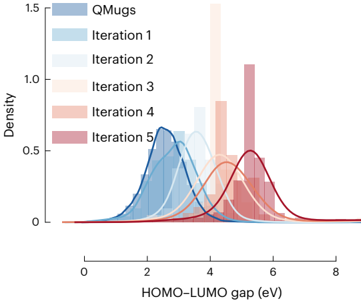
“This HOMO–LUMO gap can be predicted accurately using semi-empirical quantum mechanics (GFN2-xTB 46 ), which is computationally affordable enough for us to compute for all generated molecules (Supplementary Note 77).”
ChEMBL: a large-scale bioactivity database for drug discovery
Gaulton, A., Bellis, L. J., Bento, A. P., Chambers, J., Davies, M., Hersey, A., Light, Y., McGlinchey, S., Michalovich, D., Al-Lazikani, B., et al. (2012) · Nucleic Acids Research · doi:10.1093/nar/gkr777 · Cited by 4,382
Universal Language Model Fine-tuning for Text Classification
Howard, J., & Ruder, S. (2018) · Proceedings of the 56th Annual Meeting of the Association for Computational Linguistics (Volume 1: Long Papers) · doi:10.18653/v1/p18-1031 · Cited by 4,100 · cited 1×
“Before discussing the different applications in detail, let us first discuss how we fine-tune 23 the GPT-3 model in practice for a simple but highly non-trivial example.”
Automatic Chemical Design Using a Data-Driven Continuous Representation of Molecules
Gómez-Bombarelli, R., Wei, J. N., Duvenaud, D., Hernández-Lobato, J. M., Sánchez-Lengeling, B., Sheberla, D., Aguilera-Iparraguirre, J., Hirzel, T. D., Adams, R. P., & Aspuru-Guzik, A. (2018) · ACS Central Science · doi:10.1021/acscentsci.7b00572 · Cited by 3,106 · cited 1×
“If we have large datasets, we can train generative models such as variational autoencoders 34,35 or generative adversarial neural networks 36,37 .”
On the Opportunities and Risks of Foundation Models
Bommasani, R., Hudson, D. A., Adeli, E., Altman, R., Arora, S., von Arx, S., Bernstein, M. S., Bohg, J., Bosselut, A., Brunskill, E., et al. (2021) · arXiv · doi:10.48550/arxiv.2108.07258 · Cited by 2,676 · cited 1×
“One of the fascinating advances in machine learning has been the development of large language models (LLMs), so-called foundation models 1–6 .”
Research works printed but not linked: 7
- Goldblum, M., Finzi, M., Rowan, K. & Wilson, A. The no free lunch theorem, Kolmogorov complexity, and the role of inductive biases in machine learning. ICLR 2024 Conference, OpenReview https://openreview.net/forum?id=X7nz6ljg9Y (2023).
- Dettmers, T., Lewis, M., Belkada, Y. & Zettlemoyer, L. GPT3.int8(): 8-bit matrix multiplication for transformers at scale. Adv. Neural Inf. Process. Syst. 35, 30318-30332 (2022).
- Dettmers, T., Lewis, M., Shleifer, S. & Zettlemoyer, L. 8-bit optimizers via block-wise quantization. in The Tenth International Conference on Learning Representations (2022).
- Hu, E. J. et al. LoRA: low-rank adaptation of large language models. in International Conference On Learning Representations (2021).
- Griffiths, R.-R. et al. Gauche: a library for Gaussian processes in chemistry. in ICML 2022 2nd AI for Science Workshop https:// openreview.net/forum?id=i9MKI7zrWal (2022)
- Radford, A. et al. Language models are unsupervised multitask learners. OpenAI blog 1, 9 (2019).
- Kawazoe, Y., Yu, J.-Z., Tsai, A.-P. & Masumoto, T. (eds) Nonequilibrium Phase Diagrams of Ternary Amorphous Alloys Landolt-Börnstein: Numerical Data and Functional Relationships in Science and Technology-New Series (Springer, 2006).
Cited by
Items 201–300 of 382
Fluorine-Free Ion Exchange Membranes for (Photo)electrochemical Applications
Zukova, D., Hager, M. D., Schacher, F. H., van de Krol, R., Schubert, U. S., & Favaro, M. (2025) · ACS Polymers Au · doi:10.1021/acspolymersau.5c00089 · Cited by 4
“181,182 Recent studies have demonstrated the efficacy of ML algorithms in designing fluorine-free copolymers for anion exchange membranes (AEMs), achieving high hydroxide ion conductivity alongside desirable mechanical properties and chemical stability.”
Mohan, M., Guggilam, S., Bhowmik, D., Kidder, M. K., & Smith, J. C. (2025) · ACS Sustainable Chemistry & Engineering · doi:10.1021/acssuschemeng.5c08057 · Cited by 4
Guo, Z., Yang, G., & Wu, W. (2025) · Technological Forecasting and Social Change · doi:10.1016/j.techfore.2025.124370 · Cited by 8
Perez, R. M., Shimogawa, M., Chang, Y., Li, X., Phan, H. A. T., Marmorstein, J. G., Yanagawa, E. S. K., & Petersson, E. J. (2026) · Computers and Education Artificial Intelligence · doi:10.1016/j.caeai.2026.100546 · Cited by 11
Pagel, S., Jirásek, M., & Cronin, L. (2026) · Communications Chemistry · doi:10.1038/s42004-026-01993-w · Cited by 27
Jafari, P., Zhu, G., Zhu, Z., Lynch, M., Cai, T., Huo, S., Ren, J., Huang, G., & Song, P. (2026) · Polymer Degradation and Stability · doi:10.1016/j.polymdegradstab.2026.112138 · Cited by 4
Large Language Models are In-Context Molecule Learners
Li, J., Liu, W., Ding, Z., Fan, W., Li, Y., & Li, Q. (2025) · IEEE Transactions on Knowledge and Data Engineering · doi:10.1109/tkde.2025.3557697 · Cited by 35
“Specifically, Mol2Cap involves generating a textual description that elucidates the features of the given molecule, while Cap2Mol focuses on predicting the exact molecule based on the textual caption.”
Ottomano, F., Goulermas, J. Y., Gusev, V. V., Savani, R., Gaultois, M. W., Manning, T. D., Lin, H., Manzanera, T. P., Poole, E., Dyer, M. S., et al. (2025) · Digital Discovery · doi:10.1039/d5dd00010f · Cited by 7
Inconsistency of LLMs in molecular representations
Yan, B., Chen, A., & Cho, K. (2025) · Digital Discovery · doi:10.1039/d5dd00176e · Cited by 7
Jalali, M., Wonanke, A. D. D., Friederich, P., & Wöll, C. (2025) · Journal of Chemical Information and Modeling · doi:10.1021/acs.jcim.5c01518 · Cited by 5
Bizzarri, C., & Tsotsalas, M. M. (2024) · Advanced Energy and Sustainability Research · doi:10.1002/aesr.202400325 · Cited by 5
Molecular dynamics and machine learning unlock possibilities in beauty design—A perspective
Xu, Y., Ni, H., Zhao, F., Gao, Q., Zhao, Z., Chang, C.-H., Huo, Y., Hu, S., Zhang, Y., Grovu, R. C., et al. (2025) · AIP Advances · doi:10.1063/5.0245365 · Cited by 7
ChemLit-QA: a human evaluated dataset for chemistry RAG tasks
Wellawatte, G. P., Guo, H., Lederbauer, M., Borisova, A., Hart, M., Brucka, M., & Schwaller, P. (2025) · Machine Learning Science and Technology · doi:10.1088/2632-2153/adc2d6 · Cited by 18
“In addition to RAG, other common approaches to improve an LLM’s performance for generating factually correct text are through fine-tuning [3, 14, 15], in-context learning [16, 17] and, using Language-Interfaced Fine-Tuning (LIFT) [18, 19].”
Self-citationAn unsupervised machine learning based approach to identify efficient spin-orbit torque materials
Sayed, S., Kleidermacher, H. C., Hashemi-Asasi, G., Hsu, C., & Salahuddin, S. (2025) · npj Computational Materials · doi:10.1038/s41524-025-01626-1 · Cited by 3
“…on using LLMs in scienti fi c research, with or without fi ne-tuning, which showed promising results in property prediction 28 , inverse designs 28 , molecule-caption translation 29 , harvesting from low-fi delity calculations 30 , protein structure prediction 31 , biomedical text generation 32…”
He, L., Cui, X., Dai, B., Chen, J., Su, P., Su, Z., Hu, H., Jiang, Y., & Wang, C. (2025) · ACS Central Science · doi:10.1021/acscentsci.5c00561 · Cited by 6
“Recent studies 18 have demonstrated that GPT-3 12 and GPT-4 19 can correlate molecular SMILES with chemical properties through fine-tuning and in-context learning, making them promising tools for feature extraction and small-data prediction tasks.”
Exploring lightweight language models for materials informatics with AlchemBERT
Wang, Y., Liu, X., Chen, H., Yang, T., Liu, X., & Wen, X. (2025) · Cell Reports Physical Science · doi:10.1016/j.xcrp.2025.102724 · Cited by 7
A multi-agent-driven robotic AI chemist enabling autonomous chemical research on demandPreprint
Song, T., Luo, M., Chen, L., Huang, Y. H., Zhu, Q., Liu, D., Zhang, B., Zou, G., Zhang, F., Shang, W., et al. (2024) · ChemRxiv · doi:10.26434/chemrxiv-2024-w953h · Cited by 10
Large language model driven multiple operating conditions identification and predictive control
Zhang, Z., Mao, M., Huang, K., Wu, D., & Yang, C. (2025) · Applied Soft Computing · doi:10.1016/j.asoc.2025.113674 · Cited by 6
Situ, Y., Chen, Y., Li, W., Qiao, Z., Ding, L., & Yang, Q. (2025) · Chemical Engineering Journal · doi:10.1016/j.cej.2025.169314 · Cited by 4
Empowering scientific discovery with explainable small domain-specific and large language models
Yu, H., Wang, Y., Cheng, T., Yan, Y., Dawson, K. A., Li, S. F. Y., Zheng, Y., & Jin, Y. (2025) · Artificial Intelligence Review · doi:10.1007/s10462-025-11365-w · Cited by 5
“Besides, fine-tuning GPT-3 enabled it to effectively tackle a range of chemical and materials science tasks, outperforming conventional machine learning models, particularly in low-data scenarios, and offering a powerful tool for both predictive tasks and inverse design (Jablonka et al. 2024 ).”
Meyer, P., Duigou, T., Gricourt, G., & Faulon, J. (2025) · Journal of Cheminformatics · doi:10.1186/s13321-025-01074-5 · Cited by 7
OptiChat: Bridging Optimization Models and Practitioners with Large Language Models
Chen, H., Constante‐Flores, G. E., Mantri, K. S. I., Kompalli, S. M., Ahluwalia, A. S., & Li, C. (2025) · INFORMS Journal on Data Science · doi:10.1287/ijds.2025.0074 · Cited by 18
Prompt2Poly: ask, specify, create – a dialogue-based large language model for targeted TSMPs design
Das, B., Peters, A. J., Li, G., & Hei, X. (2025) · Polymer Chemistry · doi:10.1039/d5py00921a · Cited by 3
Stephenson, A. P., Sumabat, J., Kawabe, H., Lakshmanan, S., Kim, H. J., Li, Y., Marchand, J. A., & Nivala, J. (2025) · Nucleic Acids Research · doi:10.1093/nar/gkaf1389 · Cited by 3
“Although originally designed for language tasks, LLMs are increasingly applied to molecular property prediction [ 48 ], raising the possibility that they could transfer knowledge across novel nucleotide chemistries.”
Zhang, Z., Shang, Y., Li, X., & Cheng, Z. (2026) · Energy storage materials · doi:10.1016/j.ensm.2026.104892 · Cited by 3
Wu, X., Quan, L. I. U., Zheng, R., & Jiang, J. (2026) · Chemical Engineering Journal · doi:10.1016/j.cej.2026.176943 · Cited by 4
GNN-SKAN: Advancing Molecular Representation Learning with SwallowKAN
Li, R., Li, M., Liu, W., & Chen, H. (2025) · ACM SIGKDD Conference on Knowledge Discovery and Data Mining (KDD) · doi:10.1145/3711896.3736984 · Cited by 5
“Precisely predicting the physicochemical properties of molecules [29, 32], drug activities [11, 38], and material characteristics [22, 35] is essential for advancing drug discovery and material science.”
Leveraging large language models to address data scarcity in machine learning for graphene synthesis
Biswajeet, D. D., & Kadkhodaei, S. (2026) · Diamond and Related Materials · doi:10.1016/j.diamond.2026.113915 · Cited by 5
Chen, H., Yoshimori, A., & Bajorath, J. (2024) · RSC Medicinal Chemistry · doi:10.1039/d4md00423j · Cited by 3
Solving Advanced Task-Specific Problems in Measurement Sciences with Generative AI
Wahab, M. F., Handlovic, T. T., Roy, S., Burk, R. J., & Armstrong, D. W. (2024) · Analytical Chemistry · doi:10.1021/acs.analchem.4c01734 · Cited by 7
Chen, H., & Bajorath, J. (2024) · Journal of Chemical Information and Modeling · doi:10.1021/acs.jcim.4c01781 · Cited by 5
Zhang, P., Nde, J., Eliaz, Y., Jennings, N., Cieplak, P., & Cheung, M. S. (2025) · Protein Science · doi:10.1002/pro.70023 · Cited by 3
LLMs can Design Sustainable Concrete – a Systematic BenchmarkPreprint
Völker, C., Rug, T., Jablonka, K. M., & Kruschwitz, S. (2024) · Research Square · doi:10.21203/rs.3.rs-3913272/v1 · Cited by 6
Self-citationKalmer, T. L., Ancajas, C. M. F., Cheng, Z., Oyedele, A. S., Davis, H. L., & Walker, A. S. (2024) · bioRxiv (Cold Spring Harbor Laboratory) · doi:10.1101/2024.08.01.606186 · Cited by 3
“39 Beyond applications in automated data extraction, ChatGPT and other LLMs have also found use in various chemistry applications including answering questions about molecular properties or reaction yields, 40 and even planning and performing experiments.”
MethodSirisha, U., Kumar, C. K., Durgam, R., Eswaraiah, P., & Nagamani, G. M. (2025) · Computers, materials & continua/Computers, materials & continua (Print) · doi:10.32604/cmc.2025.063721 · Cited by 7
Coevolution of large language models with physical models boosts advanced battery research
Li, J.-H., Hu, Y., Xia, G., Mo, W., Li, B., Jia, Y., Gao, Y., Xuan, F., Liu, H., & Lian, C. (2025) · Cell Reports Physical Science · doi:10.1016/j.xcrp.2025.102553 · Cited by 2
Interpretable machine learning-assisted development of catalytic science theory
Hu, J., Yang, J., Hu, S., Liu, J., & Li, W. (2025) · Scientia Sinica Chimica · doi:10.1360/ssc-2025-0066 · Cited by 2
Applications of machine learning in quantitative structure-activity relationships (QSAR)
Walters, W. P. (2025) · Elsevier eBooks · doi:10.1016/b978-0-443-29808-0.00032-7 · Cited by 2
Zhang, L., Song, X., Li, P., Yuan, Y., Wan, K., Huang, F., Guo, Y., & Zhang, H. (2025) · Arabian Journal of Chemistry · doi:10.25259/ajc_33_2025 · Cited by 2
Pan, Z., Zhao, Y., Wang, Z., & Huang, H.-Z. (2025) · Langmuir · doi:10.1021/acs.langmuir.5c02763 · Cited by 3
Exocortex Network for AI-Augmented Human-Led Scientific Expedition
Tsai, E. H. R., & Yager, K. G. (2025) · Photon Science · doi:10.1021/photonsci.5c00009 · Cited by 5
Wang, X., Li, J., & Yang, C. (2025) · Israel Journal of Chemistry · doi:10.1002/ijch.70002 · Cited by 2
What Do Large Language Models Know About Materials?
Ehrenhofer, A., Wallmersperger, T., & Cuniberti, G. (2025) · Advanced Engineering Materials · doi:10.1002/adem.202501876 · Cited by 2
MOFReasoner: think like a scientist—a reasoning large language model via knowledge distillation
Bai, X., Zheng, Z., Zhang, X., Wang, H.-T., Yang, R., & Li, J. (2026) · Digital Discovery · doi:10.1039/d5dd00429b · Cited by 3
Carou‐Senra, P., Rodríguez‐Pombo, L., Alvarez‐Lorenzo, C., & Goyanes, Á. (2026) · International Journal of Pharmaceutics · doi:10.1016/j.ijpharm.2026.126587 · Cited by 3
Synergizing Chemical and AI Communities for Advancing Laboratories of the Future
Oh, S., Fang, X., Lin, I.-H., Dee, P., Dunham, C. S., Copp, S. M., Doyle, A. G., de Alaniz, J. R., & Gu, M. (2026) · ACS Central Science · doi:10.1021/acscentsci.5c01994 · Cited by 7
Radaković, J., Batalović, K., & Novaković, N. (2026) · Journal of Cheminformatics · doi:10.1186/s13321-025-01149-3 · Cited by 2
New tech, old demons: generative artificial intelligence could inherit the flaws of machine learning
Nzobonimpa, S. (2026) · Journal of Responsible Technology · doi:10.1016/j.jrt.2026.100160 · Cited by 4
Chauhan, R. S., Mottafegh, A., Rana, A., & Singh, A. K. (2026) · Chemical Engineering Journal · doi:10.1016/j.cej.2026.174829 · Cited by 2
GrapheneChat: A Large Language Model for Enhancing Graphene Research
Yang, D., Lu, C., Feng, Y., Mao, W., Wang, K., Sun, L., Wang, Y., Hu, B., Tan, J., Liu, Z., et al. (2026) · ACS Nano · doi:10.1021/acsnano.5c21335 · Cited by 2
Busch, M., Tacke, M., Lamaka, S. V., Zheludkevich, M. L., Cyron, C. J., Feiler, C., & Aydin, R. C. (2026) · Journal of Chemical Information and Modeling · doi:10.1021/acs.jcim.6c00961 · Cited by 9
From Chatbots to Chemists: Autonomous Agents for Heterogeneous Catalysis
Jin, M., Liao, C., Xu, Z., Song, Y., He, R., Zhang, Y., Hu, X., & Shen, Z. (2026) · ACS Catalysis · doi:10.1021/acscatal.6c02268 · Cited by 4
Yang, S., Liu, J., Jin, F., & Lu, Y. (2024) · Chinese Science Bulletin (Chinese Version) · doi:10.1360/tb-2024-0404 · Cited by 5
Shao, Z., Zhang, Z., Kuang, Y., Xiong, C., Yang, J., Wu, W., Liu, Y., Xiong, L., Duan, X., & Liu, C. (2025) · Small · doi:10.1002/smll.202411788 · Cited by 4
Leveraging LLMs to identify patent-free glass materials
Urata, S., Miya, N., Hashimoto, R., Konishi, T., Fujii, K., Murakami, Y., & Kanehara, K. (2025) · Computational Materials Science · doi:10.1016/j.commatsci.2025.114022 · Cited by 4
Perspective on utilizing foundation models for laboratory automation in materials research
Hatakeyama‐Sato, K., Nishida, T., Kitamura, K., Ushiku, Y., TAKAHASHI, K., Nabae, Y., & Hayakawa, T. (2025) · Science and Technology of Advanced Materials Methods · doi:10.1080/27660400.2025.2582379 · Cited by 8
“These foundation models and generative AI have begun to influence chemistry and materials science [11], giving rise to diverse applications including molecular and materials design [12–14], reaction pathway exploration [15], catalyst design [16], and even autonomous planning of chemical experiments…”
An automated evaluation agent for Q&A pairs and reticular synthesis conditions
Rampal, N., Fu, D. J., Zhao, C., Murayshid, H. S., Abaalkhail, A. A., Alhazmi, N. E., Alawad, M. O., Borgs, C., Chayes, J., & Yaghi, O. M. (2025) · Digital Discovery · doi:10.1039/d5dd00413f · Cited by 6
AI chatbot shows surprising talent for predicting chemical properties and reactions
Castelvecchi, D. (2024) · Nature · doi:10.1038/d41586-024-00347-7 · Cited by 2
Can Large Language Models Predict Antimicrobial Peptide Activity and Toxicity?Preprint
Orsi, M., & Reymond, J. (2024) · ChemRxiv · doi:10.26434/chemrxiv-2023-74041-v2 · Cited by 1
Application of Self-Evolving AI Agents in Chemical Research: A Novel Intelligent Assistance SystemPreprint
Ma, K. (2024) · ChemRxiv · doi:10.26434/chemrxiv-2024-6tv8c · Cited by 1
Xu, Q., Liu, X., Jiang, X., & Kim, Y. (2024) · medRxiv · doi:10.1101/2024.12.10.24318800 · Cited by 3
Liu, A., Kim, G., & Song, H. (2026) · Chemical Engineering Journal · doi:10.1016/j.cej.2026.175701 · Cited by 1
Miao, Q., & Wang, F.-Y. (2024) · SpringerBriefs in service science · doi:10.1007/978-3-031-67419-8_6 · Cited by 1
AI-driven materials design: paradigm shift from small data to big data
Chen, X., Song, Z., Lu, S., Wu, Y., Ju, M., Zhou, Q., & Wang, J. (2025) · Scientia Sinica Chimica · doi:10.1360/ssc-2025-0048 · Cited by 2
Song, X., Chen, X.-Y., Li, Y., & Zhu, L.-J. (2025) · Powder Technology · doi:10.1016/j.powtec.2025.121252 · Cited by 1
L’IA générative : une révolution technologique entre promesses et défis
Moulines, É. (2025) · Annales des Mines - Réalités industrielles · doi:10.3917/rindu1.252.0007 · Cited by 1
Enhancing deep chemical reaction prediction with advanced chirality and fragment representation
Mastrolorito, F., Ciriaco, F., Nicolotti, O., & Grisoni, F. (2025) · Chemical Communications · doi:10.1039/d5cc02641e · Cited by 3
Torres–Martínez, S. (2025) · Language and Semiotic Studies · doi:10.1515/lass-2024-0072 · Cited by 3
“This phenomenon occurs through users ’ enhanced attribution of precision and accuracy to AI technologies, which they perceive as tools for precision optimization and human outperformance (Jablonka et al. 2023).”
Song, Z., Lu, S., Zhou, Q., & Wang, J. (2025) · Acta Physico-Chimica Sinica · doi:10.1016/j.actphy.2025.100213 · Cited by 5
Real-time critical transition discoveries with large language models
Ma, G., Wang, Z., Wang, Y., Zhang, Y., Song, H., Ding, H., & Yuan, Y. (2025) · National Science Open · doi:10.1360/nso/20250060 · Cited by 1
Artificial Intelligence in De Novo Drug Design
Cerchia, C., Delre, P., Falbo, E., & Lavecchia, A. (2026) · Springer eBooks · doi:10.1007/978-3-031-98022-0_6 · Cited by 2
Evaluating In‐Context Learning in Large Language Models for Molecular Property Regression
Joe, C. Y., Song, K., & Chang, R. (2026) · Journal of Computational Chemistry · doi:10.1002/jcc.70308 · Cited by 4
Spectroscopy and Artificial Intelligence-driven coal quality detection: a review
Zhou, S., Bai, X., Li, S., Cui, J., Wu, J., Huang, G., Deng, J., Cao, Y., Huangfu, Z., Li, J., et al. (2026) · International Journal of Coal Preparation and Utilization · doi:10.1080/19392699.2026.2616231 · Cited by 1
Artificial intelligence in polymer chemistry: opportunities and challenges
Seyidova, C. M., Shikhverdiyeva, N., Aslanova, H. F., Rahimli, N. T., Zeynalov, N. A., Tagiyev, D. B., Amiraslanova, F. C., & Shikhverdiyev, I. V. (2026) · Chemical Papers · doi:10.1007/s11696-025-04509-3 · Cited by 1
Jiang, H., Jin, H., Zhang, M., Li, X., Lyu, K., Deng, W., & Wang, D. (2026) · Chinese Chemical Letters · doi:10.1016/j.cclet.2026.112632 · Cited by 1
Chen, Z., Du, M., Qian, C., & Yu, H. (2026) · Journal of Hazardous Materials · doi:10.1016/j.jhazmat.2026.141820 · Cited by 3
Wu, Y., Liu, L., Deng, W., Jiang, H., Li, R., Hu, M., Peng, B., & Wang, D. (2026) · Acta Physico-Chimica Sinica · doi:10.1016/j.actphy.2026.100291 · Cited by 2
Ahmad, M., Rahman, T. A., Kasera, N., & Ahmed, S. (2026) · International Journal of Intelligent Systems · doi:10.1155/int/2260439 · Cited by 1
DMAPLM: A multimodal pretrained framework for computational drug repositioning
Chen, H., & Li, Z. (2026) · PLoS Computational Biology · doi:10.1371/journal.pcbi.1014192 · Cited by 1
“Pretrained models, such as BioBERT [15], ChemBERTa [16], and ESM-2 [17], have shown strong feature representation capabilities by learning from large-scale corpora, and successfully applied to tasks such as molecular property prediction [18] and protein design [19].”
Usability and extensibility: imperatives for next-generation LLM agents in chemistry
Bai, X., Zhang, X., Wang, H., Zheng, Z., & Li, J.-R. (2026) · Science China Chemistry · doi:10.1007/s11426-025-3262-6 · Cited by 1
Hosny, S., Alomoush, Q. K., Abbass, L. M., Qaderi, M. A., Saeed, M., & Mohamed, L. Z. (2026) · Arabian Journal for Science and Engineering · doi:10.1007/s13369-026-11316-9 · Cited by 1
“Data on the synthesis and propertiesofcoordinationcompoundsarefarlessprevalentin publicly available databases compared to organic molecules [167].”
Sevryugina, Y. V., Collins‐Thompson, K., & Walter, N. G. (2026) · AI in Education · doi:10.3390/aieduc2020014 · Cited by 2
“Tools such as IBM’s RXN for Chemistry (Schwaller et al., 2019) and OpenAI’s GPT-based adaptations (Jablonka et al., 2024) demonstrate how such models are increasingly used to assist in tasks ranging from reaction planning to interactive learning in synthetic chemistry.”
AI for battery-accelerated discovery of high-voltage electrolytes for advanced lithium batteries
Zhan, Y. Z., Chen, N., Li, L., Wu, F., & Chen, R. (2026) · Chemical Society Reviews · doi:10.1039/d4cs01250j · Cited by 1
The ballad of LLM agents: philosophical reasoning for chemistry
Harb, H., Sun, Y. P., Unal, M., Chia, N., Yang, Z., Ingram, B. J., & Assary, R. S. (2026) · Machine Learning Science and Technology · doi:10.1088/2632-2153/ae792d · Cited by 3
A 50,688-Reaction Data Set Reveals General Ligands and Mechanistic Diversity in C–N Couplings
Das, J., Zhang, X., Tan, Y., Abdelalim, M., Lu, T., Mauro, C., Regan, C. J., & Cernak, T. (2026) · Journal of the American Chemical Society · doi:10.1021/jacs.6c05959 · Cited by 6
Gangwal, A., & Lavecchia, A. (2026) · Medicinal Research Reviews · doi:10.1002/med.70074 · Cited by 4
Liu, C., Behdad, S., Pagilla, P. R., Liang, X., & Zheng, M. (2026) · Robotics and Computer-Integrated Manufacturing · doi:10.1016/j.rcim.2026.103361 · Cited by 3
“LLMs have been applied in various domains, such as finance [40], medicine [41], chemistry [42], and industry [43].”
Bhati, N., Dyson, P. J., Nazeeruddin, M. K., & Marechal, F. M. A. (2026) · Cell Reports Physical Science · doi:10.1016/j.xcrp.2026.103428 · Cited by 2
Autonomous laboratories for sustainable nanomaterials discovery
Jathar, A., Nawghare, B. R., & Ganure, K. A. (2026) · Next Materials · doi:10.1016/j.nxmate.2026.102883 · Cited by 2
Świt, P., Hammerle, F. J., & Ganzera, M. (2026) · Analytical Chemistry · doi:10.1021/acs.analchem.6c02529 · Cited by 2
Enhancing Power Grid Model Generation With Large Language Models via Progressive Fine-Tuning
Deng, K., Zhou, Y., Yang, Y., Yang, X., Dong, W., & Guo, Q. (2026) · IEEE Transactions on Power Systems · doi:10.1109/tpwrs.2026.3723876 · Cited by 1
“LLMs have demonstrated remarkable versatility across diverse domains, including functional protein sequence generation [12], chemical knowledge question answering [13], and mathematical problem solving [14].”
Explainable Synthesizability Prediction of Inorganic Crystal Polymorphs Using Large Language Models
Kim, S.-M., Schrier, J., & Jung, Y. (2025) · Angewandte Chemie · doi:10.1002/ange.202423950 · Cited by 3
Instruction Tuning for Developing Large Language Models Specialized in Chemical Domain
Lee, J., Kim, H. Y., Lee, S., Kim, Y., Lee, K. S., & Kim, S.-B. (2025) · Journal of Korean Institute of Industrial Engineers · doi:10.7232/jkiie.2025.51.2.150 · Cited by 1
Artificial intelligence-driven drug delivery: innovations and challenges
Wu, Y., Wang, N., Xiong, P., Wang, R., Deng, J., & Ouyang, D. (2025) · Scientia Sinica Chimica · doi:10.1360/ssc-2025-0040 · Cited by 1
Zhao, F., Li, Y., Liu, Z., Chen, P., Wang, C., Liu, J., Li, H., & Wang, Y. (2025) · Machine Learning Science and Technology · doi:10.1088/2632-2153/ae0c56 · Cited by 5
“In the chemical domain, fine-tuned LLMs were used to streamline material property prediction and accelerate chemical discovery [27].”
Kevlishvili, I., Michel, R. G. S., Garrison, A. G., Toney, J., Adamji, H., Jia, H., & Kulik, H. J. (2024) · ChemRxiv · doi:10.26434/chemrxiv-2024-vx95v · Cited by 1
New Tech, Old Demons: Generative Artificial Intelligence Could Inherit Flaws of Machine LearningPreprint
Nzobonimpa, S. (2025) · SSRN Electronic Journal · doi:10.2139/ssrn.5118289 · Cited by 1
The Dual-use Dilemma in LLMs: Do Empowering Ethical Capacities Make a Degraded Utility?Preprint
Zhang, Y., Chen, X., Chen, K., Du, Y., Dang, X., & Heng, P. (2025) · Qeios · doi:10.32388/cw5qru · Cited by 3
Fung, S.-H., Zhang, Z., Wang, R., Miao, C., Wong, B. S., Li, K. Y., Hong, C., Zhou, J., Yip, K. Y.-L., Tsui, S. K., et al. (2025) · bioRxiv (Cold Spring Harbor Laboratory) · doi:10.1101/2025.02.11.637772 · Cited by 1
Large language model research: Knowledge structure, thematic evolution, and future research agendaPreprint
Cao, X., Yang, B., Yang, X., Wang, Q., & Cao, N. (2026) · Research Square · doi:10.21203/rs.3.rs-8876513/v1 · Cited by 1
Metadata
- Authors
- Jablonka, K. M., Schwaller, P., Ortega-Guerrero, A., & Smit, B.
- Affiliations
- Helmholtz Institute Jena (DE)
- École Polytechnique Fédérale de Lausanne (CH)
- Corresponding author
- Smit, Berend
- Venue
- Nature Machine Intelligence
- Published
- 2024-02-06
- Volume
- 6
- Issue
- 2
- Pages
- 161-169
- ISSN
- 2522-5839 (ISSN-L)
- OpenAlex
- W4391561379
- Semantic Scholar
- cba71f24d5fd25ade9e60ef38df282aa91de5b80
- Cited by
- 378
- References
- 75
- Citations by year
- 2026: 121 · 2025: 178 · 2024: 77
- FWCI
- 36.62
- Type
- journal article
- Language
- en
- Open access
- hybrid
- doi.org
- Licence
- cc-by
- creativecommons.org/licenses/by/4.0 (tdm)
- creativecommons.org/licenses/by/4.0 (vor)
- Locations
- Nature Machine Intelligence (publishedVersion, cc-by)
- ChemRxiv (acceptedVersion, cc-by)
- HZB Repository (Helmholtz-Zentrum Berlin für Materialien und Energie GmbH (HZB)) (submittedVersion, other-oa)
- Infoscience (Ecole Polytechnique Fédérale de Lausanne) (submittedVersion, cc-by-nc-nd)
- Funders
- National Science Foundation
- Carl-Zeiss-Stiftung
- Grantham Foundation for the Protection of the Environment
- École Polytechnique Fédérale de Lausanne
- Schweizerischer Nationalfonds zur Förderung der Wissenschaftlichen Forschung (180544, 51NF40, 182892, (51NF40-182892).)
- NCCR Catalysis
- Topics
- Physical Sciences › Materials Science › Materials Chemistry › Machine Learning in Materials Science
- Life Sciences › Pharmacology, Toxicology and Pharmaceutics › Drug Discovery › Computational Drug Discovery Methods
- Social Sciences › Arts and Humanities › History and Philosophy of Science › History and advancements in chemistry
- Keywords
- large language models, GPT-3, fine-tuning, inverse design, molecular property prediction, reaction yield prediction, foundation models, literature searching
About these checks
Registry, retraction, Cites and statistics results are computed, not judged, with one exception: a printed reference that no index lists is read once by a model before it counts as a citation error. Claims are extracted by a model and kept only when their quote appears verbatim in the text; each cited source is then checked, with a model’s help, for whether it says what the claim relies on. Those verdicts can be wrong — read the claim’s quote and the cited source before relying on one.
Statistics and arithmetic are recomputed, not judged.
Confidence bands are shown only for fields calibrated on our annotated test set. None is calibrated yet, so no band is shown.
What counts as a claim ›How we measure confidence ›How we check this ›
Are you an author, or do you see a problem with this page? Request a review
Data sources
Bibliographic data: Semantic Scholar, OpenAlex, Crossref.
Contains information from the Semantic Scholar Academic Graph Datasets, made available under the ODC Attribution License (ODC-BY 1.0).
Semantic Scholar’s data is described in: Kinney, R., et al. (2023). The Semantic Scholar Open Data Platform. arXiv:2301.10140.
