

Leveraging large language models for predictive chemistry
Open accessPublished version of a preprint
The DOI matches its Crossref record; 83 of the 83 references it cites were found in a registry or an index.
Abstract
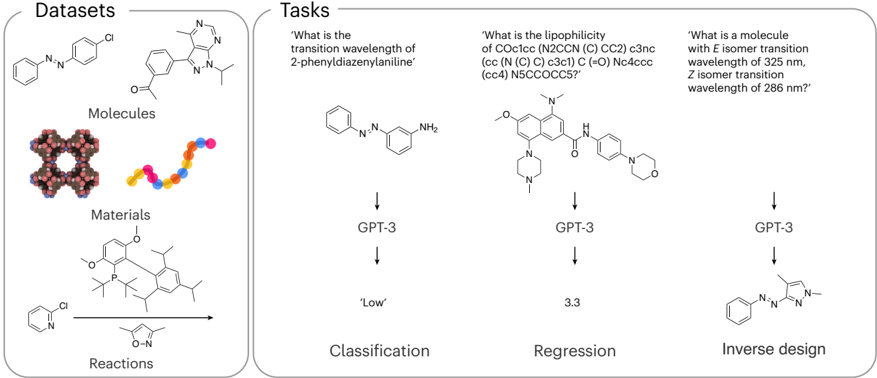
Machine learning has transformed many fields and has recently found applications in chemistry and materials science. The small datasets commonly found in chemistry sparked the development of sophisticated machine learning approaches that incorporate chemical knowledge for each application and, therefore, require specialized expertise to develop. Here we show that GPT-3, a large language model trained on vast amounts of text extracted from the Internet, can easily be adapted to solve various tasks in chemistry and materials science by fine-tuning it to answer chemical questions in natural language with the correct answer. We compared this approach with dedicated machine learning models for many applications spanning the properties of molecules and materials to the yield of chemical reactions. Surprisingly, our fine-tuned version of GPT-3 can perform comparably to or even outperform conventional machine learning techniques, in particular in the low-data limit. In addition, we can perform inverse design by simply inverting the questions. The ease of use and high performance, especially for small datasets, can impact the fundamental approach to using machine learning in the chemical and material sciences. In addition to a literature search, querying a pre-trained large language model might become a routine way to bootstrap a project by leveraging the collective knowledge encoded in these foundation models, or to provide a baseline for predictive tasks.
Overview
The claims and statistics of this paper haven’t been checked yet.
Free: it reads the open-access text and checks the first 5 claims that cite a source we can check. Create a free account to check every claim.
Integrity signals
Registry
Cites
Statistics
Figures
Verification
Claims the paper makes
The claims and statistics of this paper haven’t been checked yet.
Free: it reads the open-access text and checks the first 5 claims that cite a source we can check. Create a free account to check every claim.
Claims other papers make about this one
Each is checked against this paper’s own text: does it say what the citing paper says it does?
The source backs part of the claim, not all of it — or backs it for a different population, condition or comparison.
In the citing paper
“In parallel, chemistry-oriented reviews have shown that large language models can move beyond text generation toward tool use, retrieval, planning, code execution, and multi-agent coordination [5-10].”
From From Scientific Copilots to Tool-Grounded Autonomy: AI Agents in Simulation-Driven Materials Discovery (2026) · cites this paper as [9]
Experimental — accuracy not yet measuredThe source backs part of the claim, not all of it — or backs it for a different population, condition or comparison.
In the citing paper
“The central challenge is not only to predict a property, but to manage the sequence of reasoning and action that connects a scientific objective to executable computational or experimental steps [2-10].”
From From Scientific Copilots to Tool-Grounded Autonomy: AI Agents in Simulation-Driven Materials Discovery (2026) · cites this paper as [9]
Experimental — accuracy not yet measuredThe check wasn’t confident either way, so it gives no verdict — never disputed.
In the citing paper
“The broader literature on autonomous scientific systems has already argued for more rigorous evaluation protocols and transparent tool interfaces [3,5,7-12].”
From From Scientific Copilots to Tool-Grounded Autonomy: AI Agents in Simulation-Driven Materials Discovery (2026) · cites this paper as [9]
Experimental — accuracy not yet measuredThe check wasn’t confident either way, so it gives no verdict — never disputed.
In the citing paper
“To the best of our knowledge, no prior review has isolated simulation-driven, toolorchestrating AI agent workflows for materials discovery as a distinct evidence base with study-level extraction of autonomy, validation, and reproducibility [3-14].”
From From Scientific Copilots to Tool-Grounded Autonomy: AI Agents in Simulation-Driven Materials Discovery (2026) · cites this paper as [9]
Experimental — accuracy not yet measured
Self-check
Percentages, sums and reported differences re-computed from the paper’s own numbers.
The self-check needs the paper’s full text.
Citations
Cites
Vaswani, A., Shazeer, N., Parmar, N., Uszkoreit, J., Jones, L., Gomez, A. N., Kaiser, L., & Polosukhin, I. (2017) · arXiv · doi:10.48550/arxiv.1706.03762 · Cited by 120,404
XGBoost: A Scalable Tree Boosting System
Chen, T., & Guestrin, C. (2016) · Proceedings of the 22nd ACM SIGKDD International Conference on Knowledge Discovery and Data Mining · doi:10.1145/2939672.2939785 · Cited by 54,569
Exploring the Limits of Transfer Learning with a Unified Text-to-Text Transformer
Raffel, C., Shazeer, N., Roberts, A., Lee, K., Narang, S., Matena, M., Zhou, Y., Li, W., & Liu, P. J. (2019) · arXiv · doi:10.48550/arxiv.1910.10683 · Cited by 31,859
Language Models are Few-Shot Learners
Brown, T. B., Mann, B., Ryder, N., Subbiah, M., Kaplan, J., Dhariwal, P., Neelakantan, A., Shyam, P., Sastry, G., Askell, A., et al. (2020) · arXiv · doi:10.48550/arxiv.2005.14165 · Cited by 23,372 · cited 3×
“However, as these models were not explicitly trained on these tasks, it is a remarkable result 5 .”
Weininger, D. (1988) · Journal of Chemical Information and Computer Sciences · doi:10.1021/ci00057a005 · Cited by 7,436 · cited 8×
“For machine learning applications, there has been a lot of effort to represent a chemical with unique line encodings (for example, simplified molecular-input line-entry system (SMILES) 30 or self-referencing embedded strings (SELFIES) 31,32 ).”
InfluentialBannwarth, C., Ehlert, S., & Grimme, S. (2019) · Journal of Chemical Theory and Computation · doi:10.1021/acs.jctc.8b01176 · Cited by 4,399 · cited 1×
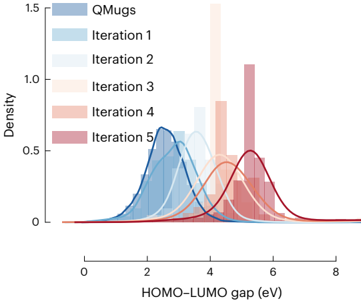
“This HOMO–LUMO gap can be predicted accurately using semi-empirical quantum mechanics (GFN2-xTB 46 ), which is computationally affordable enough for us to compute for all generated molecules (Supplementary Note 77).”
ChEMBL: a large-scale bioactivity database for drug discovery
Gaulton, A., Bellis, L. J., Bento, A. P., Chambers, J., Davies, M., Hersey, A., Light, Y., McGlinchey, S., Michalovich, D., Al-Lazikani, B., et al. (2012) · Nucleic Acids Research · doi:10.1093/nar/gkr777 · Cited by 4,382
Universal Language Model Fine-tuning for Text Classification
Howard, J., & Ruder, S. (2018) · Proceedings of the 56th Annual Meeting of the Association for Computational Linguistics (Volume 1: Long Papers) · doi:10.18653/v1/p18-1031 · Cited by 4,100 · cited 1×
“Before discussing the different applications in detail, let us first discuss how we fine-tune 23 the GPT-3 model in practice for a simple but highly non-trivial example.”
Automatic Chemical Design Using a Data-Driven Continuous Representation of Molecules
Gómez-Bombarelli, R., Wei, J. N., Duvenaud, D., Hernández-Lobato, J. M., Sánchez-Lengeling, B., Sheberla, D., Aguilera-Iparraguirre, J., Hirzel, T. D., Adams, R. P., & Aspuru-Guzik, A. (2018) · ACS Central Science · doi:10.1021/acscentsci.7b00572 · Cited by 3,106 · cited 1×
“If we have large datasets, we can train generative models such as variational autoencoders 34,35 or generative adversarial neural networks 36,37 .”
On the Opportunities and Risks of Foundation Models
Bommasani, R., Hudson, D. A., Adeli, E., Altman, R., Arora, S., von Arx, S., Bernstein, M. S., Bohg, J., Bosselut, A., Brunskill, E., et al. (2021) · arXiv · doi:10.48550/arxiv.2108.07258 · Cited by 2,676 · cited 1×
“One of the fascinating advances in machine learning has been the development of large language models (LLMs), so-called foundation models 1–6 .”
Research works printed but not linked: 7
- Goldblum, M., Finzi, M., Rowan, K. & Wilson, A. The no free lunch theorem, Kolmogorov complexity, and the role of inductive biases in machine learning. ICLR 2024 Conference, OpenReview https://openreview.net/forum?id=X7nz6ljg9Y (2023).
- Dettmers, T., Lewis, M., Belkada, Y. & Zettlemoyer, L. GPT3.int8(): 8-bit matrix multiplication for transformers at scale. Adv. Neural Inf. Process. Syst. 35, 30318-30332 (2022).
- Dettmers, T., Lewis, M., Shleifer, S. & Zettlemoyer, L. 8-bit optimizers via block-wise quantization. in The Tenth International Conference on Learning Representations (2022).
- Hu, E. J. et al. LoRA: low-rank adaptation of large language models. in International Conference On Learning Representations (2021).
- Griffiths, R.-R. et al. Gauche: a library for Gaussian processes in chemistry. in ICML 2022 2nd AI for Science Workshop https:// openreview.net/forum?id=i9MKI7zrWal (2022)
- Radford, A. et al. Language models are unsupervised multitask learners. OpenAI blog 1, 9 (2019).
- Kawazoe, Y., Yu, J.-Z., Tsai, A.-P. & Masumoto, T. (eds) Nonequilibrium Phase Diagrams of Ternary Amorphous Alloys Landolt-Börnstein: Numerical Data and Functional Relationships in Science and Technology-New Series (Springer, 2006).
Cited by
Items 101–200 of 382
Zimmermann, Y., Bazgir, A., Al‐Feghali, A., Ansari, M., Bocarsly, J. D., Brinson, L. C., Chiang, Y., Çırcı, D., Chiu, M., Daelman, N., et al. (2025) · Machine Learning Science and Technology · doi:10.1088/2632-2153/ae011a · Cited by 63
Self-citationWang, H., Chen, J., Liu, W., Wang, D., Song, Y., Hong, H., Wang, T., Anastas, P. T., & Zimmerman, J. B. (2026) · Chemical Reviews · doi:10.1021/acs.chemrev.5c00828 · Cited by 20
Shokri, B. J., Mirzaghorbanali, A., McDougall, K., Karunasena, W., Nourizadeh, H., Entezam, S., Hosseini, S., & Aziz, N. (2024) · Applied Sciences · doi:10.3390/app14219925 · Cited by 22
Chiang, Y., Hsieh, E., Chou, C.-H., & Riebesell, J. (2024) · arXiv · doi:10.48550/arxiv.2401.17244 · Cited by 19
“Jablonka et al. [13] demonstrated GPT-3 fine-tuned against online corpora could outperform purpose-trained models on classification, regression, and inverse design of high-entropy alloys and molecules.”
MethodLv, S., Peng, L., Wu, W., Yao, Y., Jiao, S., & Hu, W. (2025) · Materials Genome Engineering Advances · doi:10.1002/mgea.70013 · Cited by 18
Wysocka, M., Wysocki, O., Delmas, M., Mutel, V., & Freitas, A. (2024) · Journal of Biomedical Informatics · doi:10.1016/j.jbi.2024.104724 · Cited by 45
“…of antibiotic discovery through high-throughput drug screening, with a particular emphasis on the identification of novel antibiotic compounds Jablonka et al. [2024], Guo et al. [2023], Torres and de la Fuente-Nunez [2019], Lluka and Stokes [2023], Ruiz Puentes et al. [2022], David et al.…”
BackgroundKhoo, T. L., Lee, T. S., Bee, S., Ma, C., & Zhang, Y.-Y. (2025) · Processes · doi:10.3390/pr13092680 · Cited by 23
Huang, P., Liu, W., Sun, C., Li, Z., Wang, Y., & Chen, Y. (2025) · Materials Genome Engineering Advances · doi:10.1002/mgea.70036 · Cited by 23
Schmid, S. P., Schlosser, L., Glorius, F., & Jorner, K. (2024) · Beilstein Journal of Organic Chemistry · doi:10.3762/bjoc.20.196 · Cited by 23
LAB-Bench: Measuring Capabilities of Language Models for Biology Research
Laurent, J. M., Janizek, J. D., Ruzo, M., Hinks, M. M., Hammerling, M. J., Narayanan, S., Ponnapati, M., White, A. D., & Rodriques, S. G. (2024) · arXiv · doi:10.48550/arxiv.2407.10362 · Cited by 21
“…there has been a growing effort to leverage LLMs and LLM-augmented agents to perform scientific research workflows in domains like chemistry [5, 17, 31, 35, 57], biology [21, 36, 53], materials science [32, 51], as well as more general science tasks [52], though the dream of a fully autonomous…”
BackgroundPark, T., Mondal, S., & Cai, W. (2025) · Laser & Photonics Review · doi:10.1002/lpor.202401520 · Cited by 23
Polymer Solubility Prediction Using Large Language Models
Agarwal, S., Mahmood, A. U., & Ramprasad, R. (2025) · ACS Materials Letters · doi:10.1021/acsmaterialslett.5c00054 · Cited by 22
Zhang, D., Liu, M., Yu, Z., Xu, H., Pfister, S., Menichetti, G., Kou, X., Zhu, J., Fan, D., & Rao, P. (2025) · Trends in Food Science & Technology · doi:10.1016/j.tifs.2025.105272 · Cited by 18
Improved decision making with similarity based machine learning: applications in chemistry
Lemm, D., von Rudorff, G. F., & von Lilienfeld, O. A. (2023) · Machine Learning Science and Technology · doi:10.1088/2632-2153/ad0fa3 · Cited by 28
Generative artificial intelligence performs rudimentary structural biology modeling
Ille, A. M., Markosian, C., Burley, S. K., Mathews, M. B., Pasqualini, R., & Arap, W. (2024) · Scientific Reports · doi:10.1038/s41598-024-69021-2 · Cited by 16
Sharma, P. S., Thomas, S., Nair, M., & Rajan, A. G. (2024) · Journal of the American Chemical Society · doi:10.1021/jacs.4c08282 · Cited by 17
Evaluating the performance and robustness of LLMs in materials science Q&A and property predictions
Wang, H., Li, K., Ramsay, S., Fehlis, Y., Kim, E., & Hattrick-Simpers, J. R. (2025) · Digital Discovery · doi:10.1039/d5dd00090d · Cited by 40
“Recent work has demonstrated that LLMs are capable of domain-specific Q&A [12–14], materials property predictions [15–17], and information extraction from complex datasets [4, 18].”
Kim, Y.-H., Doo, H., Shin, D., Lee, S. Y., Roh, Y., Park, S., Song, H., Jung, Y., Yoo, H. J., Han, S. S., et al. (2025) · Computers & Chemical Engineering · doi:10.1016/j.compchemeng.2025.109266 · Cited by 25
Madani, S. S., Shabeer, Y., Fowler, M. W., Panchal, S., Ziebert, C., Chaoui, H., & Allard, F. (2025) · World Electric Vehicle Journal · doi:10.3390/wevj17010002 · Cited by 16
“…benchmarked sequential neural models against state-of-the-art gradient-boosting frameworks (e.g., XGBoost, Light-GBM, CatBoost), even though such regressors have demonstrated exceptional performance in nonlinear regression and tabular learning tasks across diverse engineering domains [38].”
Liu, S., Wen, T., Ye, B., Li, Z., Liu, H., Ren, Y., & Srolovitz, D. J. (2025) · Digital Discovery · doi:10.1039/d5dd00061k · Cited by 28
Large Language Models (LLMs) for Materials Design
Zhang, L., Liu, Z., Ni, B., & Wang, Q. (2025) · Advanced Functional Materials · doi:10.1002/adfm.202525897 · Cited by 36
Leveraging large language models for word sense disambiguation
Yae, J. H., Skelly, N. C., Ranly, N. C., & LaCasse, P. M. (2024) · Neural Computing and Applications · doi:10.1007/s00521-024-10747-5 · Cited by 42
Choudhary, K. K. (2025) · The Journal of Physical Chemistry Letters · doi:10.1021/acs.jpclett.4c03137 · Cited by 25
Learning Electromagnetic Metamaterial Physics With ChatGPT
Lu, D., Deng, Y., Malof, J. M., & Padilla, W. J. (2025) · IEEE Access · doi:10.1109/access.2025.3552418 · Cited by 26
“This adaptability of LLMs has already been demonstrated in chemistry [33], [34], optics [35], and mechanics [36], signaling their versatility across various scientific fields.”
Jin, Z., Gu, D., Li, P., Ye, G., Zhu, H., Wei, K., Li, C., Zhong, W., Du, W., & Zhu, Q. J. (2025) · Sustainable Chemistry for Energy Materials · doi:10.1016/j.scenem.2025.100010 · Cited by 26
Rethinking chemical research in the age of large language models
MacKnight, R., Boiko, D. A., Regio, J. E., Gallegos, L. C., Neukomm, T. A., & Gomes, G. (2025) · Nature Computational Science · doi:10.1038/s43588-025-00811-y · Cited by 32
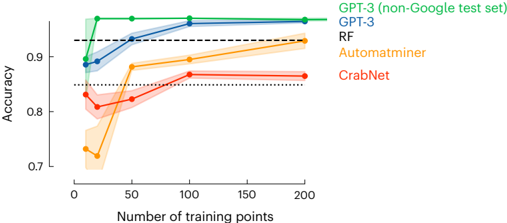
“Jablonka and colleagues 81 found that, in the small-data regime, LLMs are often more accurate than conventional ML models (for example, Automatminer) 82 ; this superior performance can be attributed to the transfer of learned representations from language to chemical space, enabled by the model’s…”
Chained LLM-human interactive framework for electrolyte design in four-electron Zn-I2 batteries
Chen, Z., Zhang, J., Zhao, G., Wang, Q., Yang, C., & Guo, Y. (2025) · Science China Chemistry · doi:10.1007/s11426-025-2789-5 · Cited by 17
Automation and AI-Powered Prediction in Chromatographic Separation
Liu, C., & Mo, F. (2025) · Accounts of Chemical Research · doi:10.1021/acs.accounts.5c00677 · Cited by 21
Чэн, Б., Li, H., Huang, R., Tang, Y., & Li, F. (2024) · Nature Communications · doi:10.1038/s41467-024-52805-5 · Cited by 19
From lab to fab: A large language model for chemical engineering
Zhou, J., Xu, F., Chang, Z., Liu, D., Li, L., Cui, J., Li, Y., Li, X., Qian, L., Zhang, Z., et al. (2025) · CHINESE JOURNAL OF CATALYSIS (CHINESE VERSION) · doi:10.1016/s1872-2067(25)64725-5 · Cited by 17
Can large language models predict antimicrobial peptide activity and toxicity?
Orsi, M., & Reymond, J. (2024) · RSC Medicinal Chemistry · doi:10.1039/d4md00159a · Cited by 24
“26 33 However, to the best of our knowledge LLMs have not been implemented to predict the bioactivity of peptides yet.”
AI agents in chemical research: GVIM – an intelligent research assistant system
Ma, K. (2025) · Digital Discovery · doi:10.1039/d4dd00398e · Cited by 26
Chat-microreactor: A large-language-model-based assistant for designing continuous flow systems
Pan, Y., Xiao, Q., Zhao, F., Li, Z., Liu, J., Ullah, S., Lim, K. H., Huang, T., Yu, Z., Li, C., et al. (2025) · Chemical Engineering Science · doi:10.1016/j.ces.2025.121567 · Cited by 17
DynaMate: Leveraging AI-agents for customized research workflows
Mendible-Barreto, O. A., Díaz-Maldonado, M., Carmona Esteva, F. J., Torres, J. E., Córdova-Figueroa, U. M., & Colón, Y. J. (2025) · Molecular Systems Design & Engineering · doi:10.1039/d5me00062a · Cited by 12
Text mining in MOF research: from manual curation to large language model-based automation
Bae, S., Jeon, M., & Moon, H. R. (2025) · Chemical Communications · doi:10.1039/d5cc02511g · Cited by 16
Large Language Models for Heterogeneous Catalysis
Yao, Y., Zhu, J., Liu, Y., Ren, G., Li, X., & Ou, P. (2025) · Wiley Interdisciplinary Reviews Computational Molecular Science · doi:10.1002/wcms.70046 · Cited by 16
Synthesis-Aware Materials Redesign via Large Language Models
Choi, J., Kim, S.-M., & Jung, Y. (2025) · Journal of the American Chemical Society · doi:10.1021/jacs.5c07743 · Cited by 25
Extracting and reconstructing knowledge in materials science literature using large language models
Li, S., Wei, S., Huang, C., Zhang, Y., Zhang, G., & Sun, S. (2026) · Communications Materials · doi:10.1038/s43246-025-01043-3 · Cited by 24
“In recent years, natural language processing (NLP) techniques have been successfully applied to extract scienti fi c literature data in the fi elds of chemistry 23,24 , medicine, biology 25 , and materials science 26 , mining a large amountofexcellentdata.”
Connecting molecular properties with plain language
Hocky, G. M. (2024) · Nature Machine Intelligence · doi:10.1038/s42256-024-00812-y · Cited by 14
Unveiling the power of language models in chemical research question answering
Chen, X., Wang, T., Guo, T., Guo, K., Zhou, J., Li, H., Song, Z., Gao, X., & Zhang, X. (2025) · Communications Chemistry · doi:10.1038/s42004-024-01394-x · Cited by 36
“A number of domain-speci fi c QA datasets are proposed in the biomedical domain 16 – 18 .”
Torres–Martínez, S. (2025) · AI & Society · doi:10.1007/s00146-024-02165-x · Cited by 20
Xie, L., Jin, Y.-D., Xu, L., Chang, S., & Xu, X. (2025) · Journal of Chemical Theory and Computation · doi:10.1021/acs.jctc.5c00605 · Cited by 17
Qiu, Y. L., Wang, L. Y., Liu, C., Zhang, X., Tian, Y., & Zhou, Z. P. (2025) · Materials Today · doi:10.1016/j.mattod.2025.10.017 · Cited by 14
Zhao, Y., Hansen, A., Dahlhaus, A., Brandt, N., Selzer, M. A., Koeppe, A., Nestler, B., Knapp, M., & Ehrenberg, H. (2025) · Materials Today Communications · doi:10.1016/j.mtcomm.2025.112380 · Cited by 16
Benchmarking large language models for materials synthesis: The case of atomic layer deposition
Yanguas-Gil, Á., Dearing, M. T., Elam, J. W., Jones, J. C., Kim, S., Mohammad, A., Nguyen, C. T., & Sengupta, B. (2025) · Journal of Vacuum Science & Technology A Vacuum Surfaces and Films · doi:10.1116/6.0004319 · Cited by 19
Large Language Model in Materials Science: Roles, Challenges, and Strategic Outlook
Zhang, J., Chen, X., Ye, X., Yang, Y., & Ai, B. (2025) · Advanced Intelligent Discovery · doi:10.1002/aidi.202500085 · Cited by 23
Wang, T., & Yin, L.-F. (2025) · Advanced Engineering Informatics · doi:10.1016/j.aei.2025.103706 · Cited by 12
Kevlishvili, I., Michel, R. G. S., Garrison, A. G., Toney, J., Adamji, H., Jia, H., Román‐Leshkov, Y., & Kulik, H. J. (2025) · Faraday Discussions · doi:10.1039/d4fd00087k · Cited by 21
Maity, A., Maidantchik, V. D., Weidenfeld, K., Larisch, S., Barkan, D., & Haick, H. (2025) · Advanced Materials · doi:10.1002/adma.202413017 · Cited by 11
Natural language access point to digital metal–organic polyhedra chemistry in The World Avatar
Rihm, S. D., Tran, D. N., Kondinski, A., Pascazio, L., Saluz, F., Deng, X., Mosbach, S., Akroyd, J., & Kraft, M. (2025) · Data-Centric Engineering · doi:10.1017/dce.2025.12 · Cited by 12
“In the realm of chemistry, LLMs are increasingly utilized for a variety of tasks, including data processing, engineering, inference, and augmentation, in conjunction with various computational tools (Guo et al., 2023; Jablonka et al., 2024; M. Bran A et al., 2024).”
Enhancing molecular structure elucidation with reasoning-capable LLMs
Priessner, M., Lewis, R. J., Johansson, M. J., Goodman, J. M., Janet, J. P., & Tomberg, A. (2026) · Digital Discovery · doi:10.1039/d5dd00359h · Cited by 14
Busch, M., Tacke, M., Lamaka, S. V., Zheludkevich, M. L., Linka, K., Cyron, C. J., Feiler, C., & Aydin, R. C. (2025) · Corrosion Science · doi:10.1016/j.corsci.2025.113080 · Cited by 18
Large Language Models are Catalyzing Chemistry EducationPreprint
Du, Y., Duan, C., Bran, A. M., Sotnikova, A., Qu, Y., Kulik, H. J., Bosselut, A., Xu, J., & Schwaller, P. (2024) · ChemRxiv · doi:10.26434/chemrxiv-2024-h722v · Cited by 14
Self-citationThe rise of data repositories in materials chemistry
Stracke, K., & Evans, J. D. (2024) · Communications Chemistry · doi:10.1038/s42004-024-01143-0 · Cited by 12
Pinto, R. V., Pinto, M. L., & Serre, C. (2025) · Advanced Healthcare Materials · doi:10.1002/adhm.202404553 · Cited by 15
Can large language models predict the hydrophobicity of metal–organic frameworks?
Wu, X., & Jiang, J. (2025) · Journal of Materials Chemistry A · doi:10.1039/d5ta01139f · Cited by 11
Mathur, S., van der Vleuten, N., Yager, K. G., & Tsai, E. H. R. (2025) · Machine Learning Science and Technology · doi:10.1088/2632-2153/add9e4 · Cited by 33
“Rapid development in large language models (LLMs) has led to growing interests in leveraging LLMs for accelerating physical science, including in biomedical research [22–24], material synthesis [25], inverse design of materials with specific properties [26–31] or targeted morphologies [32].”
Mao, J., Sui, T., Cho, K., No, K. T., Wang, J., & Shan, D. (2025) · Molecular Diversity · doi:10.1007/s11030-025-11280-w · Cited by 16
Proceeding artificial intelligence technology towards vaccine designs
Zhao, F., & Zai, X. (2025) · The Innovation Life · doi:10.59717/j.xinn-life.2025.100162 · Cited by 9
Machine-learning for capacitive energy storage polymer dielectrics: opportunities and challenges
Yang, M., Wan, C., Liu, R., Zhang, J., Shen, Z., Nan, C., & Shen, Y. (2026) · Progress in Materials Science · doi:10.1016/j.pmatsci.2026.101678 · Cited by 11
Fonseca Parra, E. P., Oumerri, J., Arteni, A. A., Six, J.-L., Armes, S. P., & Ferji, K. (2025) · Macromolecules · doi:10.1021/acs.macromol.4c01772 · Cited by 8
Hatakeyama‐Sato, K., Ishikawa, H., Takaishi, S., Igarashi, Y., Nabae, Y., & Hayakawa, T. (2024) · Polymer Journal · doi:10.1038/s41428-024-00930-9 · Cited by 8
Umer, M. S., Nabeel, M., Athar, U., Lynch, I., Afantitis, A., Ullah, S., & Fraz, M. M. (2025) · Archives of Computational Methods in Engineering · doi:10.1007/s11831-025-10437-y · Cited by 15
“Large models in cheminformatics have improved efficiency in low-data regimes, with fine-tuned models like GPT-3 achieving state-of-the-art molecular property prediction [293].”
LUMIR: an LLM-driven unified agent framework for multi-task infrared spectroscopy reasoning
Xie, Z., Chen, Z., Liang, J., Yu, X., & Yu, Z. (2025) · Analytica Chimica Acta · doi:10.1016/j.aca.2025.344857 · Cited by 12
General-Purpose Models for the Chemical Sciences: LLMs and Beyond
Alampara, N., Aneesh, A., Ríos-García, M., Mirza, A., Schilling-Wilhelmi, M., Aghajani, A. A., Sun, M., Prastalo, G., & Jablonka, K. M. (2026) · Chemical Reviews · doi:10.1021/acs.chemrev.5c00583 · Cited by 37
Self-citationZeng, D., Xu, X., Zhu, T., Li, Y., & Li, Q. (2026) · Frontiers in Psychology · doi:10.3389/fpsyg.2026.1743722 · Cited by 7
LLM-Driven Synthesis Planning for Quantum Dot Materials Development
Choi, S. E., Jang, M., Yoon, S., Yoo, S., Ahn, J., Kim, M., Kim, H.-G., Jung, Y., Park, S. S., Kim, Y. C., et al. (2025) · Journal of Chemical Information and Modeling · doi:10.1021/acs.jcim.4c01529 · Cited by 12
Jin, S., Fu, Z., Song, G., Pei, J., Gong, H., Ma, L., & Zhang, D. (2025) · Corrosion Science · doi:10.1016/j.corsci.2025.113217 · Cited by 10
Large language model guided automated reaction pathway exploration
Chen, R., Liu, Y., Chen, Z., Li, Y., Yang, F., Lin, J., & Ke, Z. (2025) · Communications Chemistry · doi:10.1038/s42004-025-01630-y · Cited by 15
“ThestudybyJablonkaetal.indicatedthat fi ne-tuned LLMs can excel in chemical and materials science tasks, including predicting molecular properties and chemical reaction yields, especially with limited data 21 22 .”
Advancing battery research through large language models: A review
Chen, J., Wang, Y., Guo, D., Liu, Z., Wang, Y. D., Li, S., Xu, W., Qian, L., Shen, Y., Sun, T., et al. (2025) · The Innovation · doi:10.1016/j.xinn.2025.101091 · Cited by 20
Data‐Driven Polyoxometalate Chemistry
Kondinski, A., Gumerova, N. I., Rompel, A., Falcaro, P., & Schreck, T. (2025) · Chemistry - A European Journal · doi:10.1002/chem.202501528 · Cited by 7
Multi agent large language models for biomedical hypothesis generation in drug combination discovery
Xu, Q., Soto, C. A., Shahnawaz, M., Liu, X., Jiang, X., & Kim, Y. (2025) · iScience · doi:10.1016/j.isci.2025.113984 · Cited by 14
Large language models for porous materials: from text mining to autonomous laboratory
Han, S., Bae, T., Kim, J., Kim, Y., & Kim, J. (2026) · Digital Discovery · doi:10.1039/d5dd00578g · Cited by 8
Artificial Intelligence for Materials Science: Transforming Research Paradigms
Li, Y., Wang, S., Wang, J., Liu, Q., & Zhang, J. (2026) · Chemical Reviews · doi:10.1021/acs.chemrev.6c00012 · Cited by 14
Kinase Drug Discovery: Impact of Open Science and Artificial Intelligence
Miljković, F. N., & Bajorath, J. (2024) · Molecular Pharmaceutics · doi:10.1021/acs.molpharmaceut.4c00659 · Cited by 8
Wu, J., Yan, D., Du, X., Wu, C., Lin, X., Xu, B., Xu, Y. C., Ye, J., & Shen, Y. (2025) · Acta Pharmaceutica Sinica B · doi:10.1016/j.apsb.2025.06.010 · Cited by 9
RetractedA multi-agent-driven robotic AI chemist enabling autonomous chemical research on demandPreprint
Song, T., Luo, M., Chen, L., Huang, Y. H., Zhu, Q. J., Liu, D., Zhang, B., Zou, G., Zhang, F., Shang, W., et al. (2024) · ChemRxiv · doi:10.26434/chemrxiv-2024-w953h-v2 · Cited by 10
Data Analytics for Catalysis Predictions: Are We Ready Yet?
Zhang, D., Smith, B. A., Wu, H., Nguyen, M., Rousseau, R. J., & Glezakou, V. (2024) · ACS Catalysis · doi:10.1021/acscatal.3c05285 · Cited by 7
Fu, L., Zhou, Q., Jin, M., & Wu, W. (2025) · Environmental chemistry and safety · doi:10.26599/ecs.2025.9600002 · Cited by 7
Du, W., & Yang, S. (2025) · Frontiers of Chemical Science and Engineering · doi:10.1007/s11705-025-2587-5 · Cited by 12
Nguyen, D.-N., Tong, R. K., & Dinh, N. (2025) · Digital Discovery · doi:10.1039/d5dd00306g · Cited by 12
Stereochemistry-aware string-based molecular generation
Tom, G., Yu, E., Yoshikawa, N., Jorner, K., & Aspuru‐Guzik, A. (2025) · PNAS Nexus · doi:10.1093/pnasnexus/pgaf329 · Cited by 16
“…a diverse array of approaches in this domain, including but not limited to variational autoencoders (VAEs) ( 2, 15 – 19), generative adversarial networks (GANs) (4, 20, 21), reinforcement learning (RL) (22 – 27), genetic algorithms (GAs) (28 – 31), and transformer-based architectures (32 – 35).”
Machine Learning for Green Solvents: Assessment, Selection and Substitution
Datta, R., Nistane, J., Sose, A. T., Sahu, H., & Ramprasad, R. (2025) · Advanced Science · doi:10.1002/advs.202516851 · Cited by 8
Wang, S., Bao, Q., & Yu, J. (2026) · The Asia-Pacific Education Researcher · doi:10.1007/s40299-026-01092-3 · Cited by 12
“…leveraging metacognitive strat - egies and LLM-derived self-efficacy during cross-linguistic learning establishes a mediating pathway whereby L1E-acquired self-efficacy initiates adaptive processes, thereby establishing foundational benchmarks for L2E self-efficacy (Jablonka et al., 2024).”
Fine-tuning Large Language Models with Limited Data: A Survey and Practical Guide
Szep, M., Rueckert, D., von Eisenhart‐Rothe, R., & Hinterwimmer, F. (2026) · Transactions of the Association for Computational Linguistics · doi:10.1162/tacl.a.627 · Cited by 35
“…require large-scale data and computational resources, often unavailable in real-world scenarios, particularly in low-resource languages or specialized domains such as medicine (Crema et al., 2023), law (Noguti et al., 2023), chemistry (Jablonka et al., 2024), or finance (Zhao et al., 2021).”
Language Models for Predicting Organic Synthesis Procedures
Vaškevičius, M., & Kapočiūtė-Dzikienė, J. (2024) · Applied Sciences · doi:10.3390/app142411526 · Cited by 11
AstroMLab 2: AstroLLaMA-2-70B Model and Benchmarking Specialised LLMs for Astronomy
Pan, R., Nguyen, T. D., Arora, H., Accomazzi, A., Ghosal, T., & Ting, Y.-S. (2024) · International Conference for High Performance Computing, Networking, Storage and Analysis (SC) · doi:10.1109/scw63240.2024.00019 · Cited by 20
Considering the ethics of large machine learning models in the chemical sciences
Spotte-Smith, E. W. C. (2025) · Machine Learning: Science and Technology · doi:10.1088/2632-2153/adec3c · Cited by 6
“It appears that LLMs are able to compete and in some cases even exceed small, single-purpose ML models when available data are scarce [114].”
Post-Pretraining Large Language Model Enabled Reverse Design of MOFs for Hydrogen StoragePreprint
Liu, Z. Y., Su, Y., Guo, Y., Lin, J. C., Wang, S., Song, Z., Xi, Z., Gao, H., Shi, L., & Wang, G. (2024) · ChemRxiv · doi:10.26434/chemrxiv-2024-xz77q · Cited by 5
Valo, P., Antoine, T., Baranton, E., Hervé, H., Freyssinet, E., & Hana, V. (2025) · Digital Health · doi:10.1177/20552076251374233 · Cited by 10
Artificial intelligence in atomic layer deposition
Navabi, P., Ramachandran, R. A., Bhatia, H., Jaberi‐Douraki, M., Diwekar, U. M., Sukotjo, C., & Takoudis, C. G. (2025) · Journal of Vacuum Science & Technology A Vacuum Surfaces and Films · doi:10.1116/6.0004881 · Cited by 6
Tong, C., Liu, Q., Wang, H., & Yao, M. (2026) · Environmental Science Nano · doi:10.1039/d5en00610d · Cited by 6
Machine learning toward electrochemical energy storage materials and devices: A review
Ma, C., Yao, C., Xu, J., & Xie, Y. (2026) · Sustainable materials and technologies · doi:10.1016/j.susmat.2026.e01990 · Cited by 6
Attention to training set partitioning in machine learning for solid-state hydrogen storage alloys
Li, J., Zhang, C., Li, M., Luo, S., Lu, X., Zhu, Y., Gao, Z., & Yang, W. (2026) · Journal of Alloys and Compounds · doi:10.1016/j.jallcom.2026.187957 · Cited by 10
Modern Automation in Organic Synthesis Laboratories
Miéville, P., & de Nanteuil, F. (2024) · Elsevier eBooks · doi:10.1016/b978-0-323-96025-0.00047-8 · Cited by 6
Seaweed-Based Bioplastics: Data Mining Ingredient–Property Relations from the Scientific Literature
Véliz, F., Bikku, T., Ibarra-Pérez, D., Hernández-Muñoz, V., Garmulewicz, A., & Herrera, F. (2025) · Data · doi:10.3390/data10020020 · Cited by 4
Co-intelligent Design of Catalysis Research with Large Language Models: Hype or Reality?
Balcells, D. (2025) · ACS Catalysis · doi:10.1021/acscatal.5c04238 · Cited by 7
Su, H., Lei, S., Chen, Y., Lv, Y., & Zhang, Q. (2025) · ACS Applied Materials & Interfaces · doi:10.1021/acsami.5c16158 · Cited by 4
Extraction of chemical synthesis information using the World Avatar
Rihm, S. D., Saluz, F., Kondinski, A., Bai, J., Butler, P. W. V., Mosbach, S., Akroyd, J., & Kraft, M. (2025) · Digital Discovery · doi:10.1039/d5dd00183h · Cited by 14
Atifi, A. (2025) · ACS electrochemistry. · doi:10.1021/acselectrochem.5c00355 · Cited by 4
Metadata
- Authors
- Jablonka, K. M., Schwaller, P., Ortega-Guerrero, A., & Smit, B.
- Affiliations
- Helmholtz Institute Jena (DE)
- École Polytechnique Fédérale de Lausanne (CH)
- Corresponding author
- Smit, Berend
- Venue
- Nature Machine Intelligence
- Published
- 2024-02-06
- Volume
- 6
- Issue
- 2
- Pages
- 161-169
- ISSN
- 2522-5839 (ISSN-L)
- OpenAlex
- W4391561379
- Semantic Scholar
- cba71f24d5fd25ade9e60ef38df282aa91de5b80
- Cited by
- 378
- References
- 75
- Citations by year
- 2026: 121 · 2025: 178 · 2024: 77
- FWCI
- 36.62
- Type
- journal article
- Language
- en
- Open access
- hybrid
- doi.org
- Licence
- cc-by
- creativecommons.org/licenses/by/4.0 (tdm)
- creativecommons.org/licenses/by/4.0 (vor)
- Locations
- Nature Machine Intelligence (publishedVersion, cc-by)
- ChemRxiv (acceptedVersion, cc-by)
- HZB Repository (Helmholtz-Zentrum Berlin für Materialien und Energie GmbH (HZB)) (submittedVersion, other-oa)
- Infoscience (Ecole Polytechnique Fédérale de Lausanne) (submittedVersion, cc-by-nc-nd)
- Funders
- National Science Foundation
- Carl-Zeiss-Stiftung
- Grantham Foundation for the Protection of the Environment
- École Polytechnique Fédérale de Lausanne
- Schweizerischer Nationalfonds zur Förderung der Wissenschaftlichen Forschung (180544, 51NF40, 182892, (51NF40-182892).)
- NCCR Catalysis
- Topics
- Physical Sciences › Materials Science › Materials Chemistry › Machine Learning in Materials Science
- Life Sciences › Pharmacology, Toxicology and Pharmaceutics › Drug Discovery › Computational Drug Discovery Methods
- Social Sciences › Arts and Humanities › History and Philosophy of Science › History and advancements in chemistry
- Keywords
- large language models, GPT-3, fine-tuning, inverse design, molecular property prediction, reaction yield prediction, foundation models, literature searching
About these checks
Registry, retraction, Cites and statistics results are computed, not judged, with one exception: a printed reference that no index lists is read once by a model before it counts as a citation error. Claims are extracted by a model and kept only when their quote appears verbatim in the text; each cited source is then checked, with a model’s help, for whether it says what the claim relies on. Those verdicts can be wrong — read the claim’s quote and the cited source before relying on one.
Statistics and arithmetic are recomputed, not judged.
Confidence bands are shown only for fields calibrated on our annotated test set. None is calibrated yet, so no band is shown.
What counts as a claim ›How we measure confidence ›How we check this ›
Are you an author, or do you see a problem with this page? Request a review
Data sources
Bibliographic data: Semantic Scholar, OpenAlex, Crossref.
Contains information from the Semantic Scholar Academic Graph Datasets, made available under the ODC Attribution License (ODC-BY 1.0).
Semantic Scholar’s data is described in: Kinney, R., et al. (2023). The Semantic Scholar Open Data Platform. arXiv:2301.10140.
