

Leveraging large language models for predictive chemistry
Open accessPublished version of a preprint
The DOI matches its Crossref record; 83 of the 83 references it cites were found in a registry or an index.
Abstract
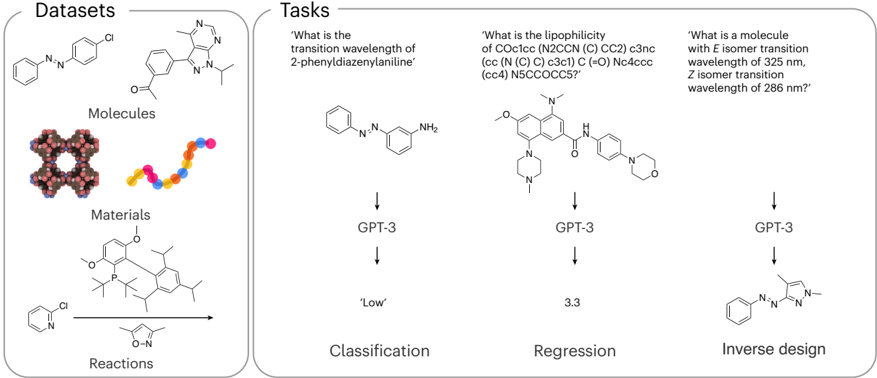
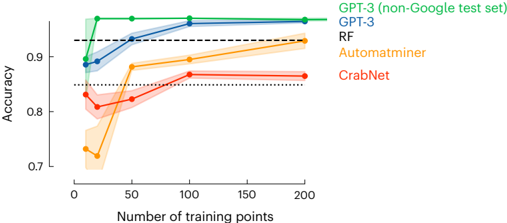
Machine learning has transformed many fields and has recently found applications in chemistry and materials science. The small datasets commonly found in chemistry sparked the development of sophisticated machine learning approaches that incorporate chemical knowledge for each application and, therefore, require specialized expertise to develop. Here we show that GPT-3, a large language model trained on vast amounts of text extracted from the Internet, can easily be adapted to solve various tasks in chemistry and materials science by fine-tuning it to answer chemical questions in natural language with the correct answer. We compared this approach with dedicated machine learning models for many applications spanning the properties of molecules and materials to the yield of chemical reactions. Surprisingly, our fine-tuned version of GPT-3 can perform comparably to or even outperform conventional machine learning techniques, in particular in the low-data limit. In addition, we can perform inverse design by simply inverting the questions. The ease of use and high performance, especially for small datasets, can impact the fundamental approach to using machine learning in the chemical and material sciences. In addition to a literature search, querying a pre-trained large language model might become a routine way to bootstrap a project by leveraging the collective knowledge encoded in these foundation models, or to provide a baseline for predictive tasks.
Overview
The claims and statistics of this paper haven’t been checked yet.
Free: it reads the open-access text and checks the first 5 claims that cite a source we can check. Create a free account to check every claim.
Integrity signals
Registry
Cites
Statistics
Figures
Verification
Claims the paper makes
The claims and statistics of this paper haven’t been checked yet.
Free: it reads the open-access text and checks the first 5 claims that cite a source we can check. Create a free account to check every claim.
Claims other papers make about this one
Each is checked against this paper’s own text: does it say what the citing paper says it does?
The source backs part of the claim, not all of it — or backs it for a different population, condition or comparison.
In the citing paper
“In parallel, chemistry-oriented reviews have shown that large language models can move beyond text generation toward tool use, retrieval, planning, code execution, and multi-agent coordination [5-10].”
From From Scientific Copilots to Tool-Grounded Autonomy: AI Agents in Simulation-Driven Materials Discovery (2026) · cites this paper as [9]
Experimental — accuracy not yet measuredThe source backs part of the claim, not all of it — or backs it for a different population, condition or comparison.
In the citing paper
“The central challenge is not only to predict a property, but to manage the sequence of reasoning and action that connects a scientific objective to executable computational or experimental steps [2-10].”
From From Scientific Copilots to Tool-Grounded Autonomy: AI Agents in Simulation-Driven Materials Discovery (2026) · cites this paper as [9]
Experimental — accuracy not yet measuredThe check wasn’t confident either way, so it gives no verdict — never disputed.
In the citing paper
“The broader literature on autonomous scientific systems has already argued for more rigorous evaluation protocols and transparent tool interfaces [3,5,7-12].”
From From Scientific Copilots to Tool-Grounded Autonomy: AI Agents in Simulation-Driven Materials Discovery (2026) · cites this paper as [9]
Experimental — accuracy not yet measuredThe check wasn’t confident either way, so it gives no verdict — never disputed.
In the citing paper
“To the best of our knowledge, no prior review has isolated simulation-driven, toolorchestrating AI agent workflows for materials discovery as a distinct evidence base with study-level extraction of autonomy, validation, and reproducibility [3-14].”
From From Scientific Copilots to Tool-Grounded Autonomy: AI Agents in Simulation-Driven Materials Discovery (2026) · cites this paper as [9]
Experimental — accuracy not yet measured
Self-check
Percentages, sums and reported differences re-computed from the paper’s own numbers.
The self-check needs the paper’s full text.
Citations
Cites
Vaswani, A., Shazeer, N., Parmar, N., Uszkoreit, J., Jones, L., Gomez, A. N., Kaiser, L., & Polosukhin, I. (2017) · arXiv · doi:10.48550/arxiv.1706.03762 · Cited by 120,404
XGBoost: A Scalable Tree Boosting System
Chen, T., & Guestrin, C. (2016) · Proceedings of the 22nd ACM SIGKDD International Conference on Knowledge Discovery and Data Mining · doi:10.1145/2939672.2939785 · Cited by 54,569
Exploring the Limits of Transfer Learning with a Unified Text-to-Text Transformer
Raffel, C., Shazeer, N., Roberts, A., Lee, K., Narang, S., Matena, M., Zhou, Y., Li, W., & Liu, P. J. (2019) · arXiv · doi:10.48550/arxiv.1910.10683 · Cited by 31,859
Language Models are Few-Shot Learners
Brown, T. B., Mann, B., Ryder, N., Subbiah, M., Kaplan, J., Dhariwal, P., Neelakantan, A., Shyam, P., Sastry, G., Askell, A., et al. (2020) · arXiv · doi:10.48550/arxiv.2005.14165 · Cited by 23,372 · cited 3×
“However, as these models were not explicitly trained on these tasks, it is a remarkable result 5 .”
Weininger, D. (1988) · Journal of Chemical Information and Computer Sciences · doi:10.1021/ci00057a005 · Cited by 7,436 · cited 8×
“For machine learning applications, there has been a lot of effort to represent a chemical with unique line encodings (for example, simplified molecular-input line-entry system (SMILES) 30 or self-referencing embedded strings (SELFIES) 31,32 ).”
InfluentialBannwarth, C., Ehlert, S., & Grimme, S. (2019) · Journal of Chemical Theory and Computation · doi:10.1021/acs.jctc.8b01176 · Cited by 4,399 · cited 1×
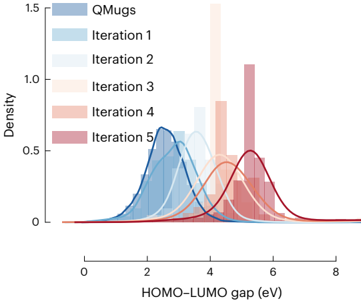
“This HOMO–LUMO gap can be predicted accurately using semi-empirical quantum mechanics (GFN2-xTB 46 ), which is computationally affordable enough for us to compute for all generated molecules (Supplementary Note 77).”
ChEMBL: a large-scale bioactivity database for drug discovery
Gaulton, A., Bellis, L. J., Bento, A. P., Chambers, J., Davies, M., Hersey, A., Light, Y., McGlinchey, S., Michalovich, D., Al-Lazikani, B., et al. (2012) · Nucleic Acids Research · doi:10.1093/nar/gkr777 · Cited by 4,382
Universal Language Model Fine-tuning for Text Classification
Howard, J., & Ruder, S. (2018) · Proceedings of the 56th Annual Meeting of the Association for Computational Linguistics (Volume 1: Long Papers) · doi:10.18653/v1/p18-1031 · Cited by 4,100 · cited 1×
“Before discussing the different applications in detail, let us first discuss how we fine-tune 23 the GPT-3 model in practice for a simple but highly non-trivial example.”
Automatic Chemical Design Using a Data-Driven Continuous Representation of Molecules
Gómez-Bombarelli, R., Wei, J. N., Duvenaud, D., Hernández-Lobato, J. M., Sánchez-Lengeling, B., Sheberla, D., Aguilera-Iparraguirre, J., Hirzel, T. D., Adams, R. P., & Aspuru-Guzik, A. (2018) · ACS Central Science · doi:10.1021/acscentsci.7b00572 · Cited by 3,106 · cited 1×
“If we have large datasets, we can train generative models such as variational autoencoders 34,35 or generative adversarial neural networks 36,37 .”
On the Opportunities and Risks of Foundation Models
Bommasani, R., Hudson, D. A., Adeli, E., Altman, R., Arora, S., von Arx, S., Bernstein, M. S., Bohg, J., Bosselut, A., Brunskill, E., et al. (2021) · arXiv · doi:10.48550/arxiv.2108.07258 · Cited by 2,676 · cited 1×
“One of the fascinating advances in machine learning has been the development of large language models (LLMs), so-called foundation models 1–6 .”
Research works printed but not linked: 7
- Goldblum, M., Finzi, M., Rowan, K. & Wilson, A. The no free lunch theorem, Kolmogorov complexity, and the role of inductive biases in machine learning. ICLR 2024 Conference, OpenReview https://openreview.net/forum?id=X7nz6ljg9Y (2023).
- Dettmers, T., Lewis, M., Belkada, Y. & Zettlemoyer, L. GPT3.int8(): 8-bit matrix multiplication for transformers at scale. Adv. Neural Inf. Process. Syst. 35, 30318-30332 (2022).
- Dettmers, T., Lewis, M., Shleifer, S. & Zettlemoyer, L. 8-bit optimizers via block-wise quantization. in The Tenth International Conference on Learning Representations (2022).
- Hu, E. J. et al. LoRA: low-rank adaptation of large language models. in International Conference On Learning Representations (2021).
- Griffiths, R.-R. et al. Gauche: a library for Gaussian processes in chemistry. in ICML 2022 2nd AI for Science Workshop https:// openreview.net/forum?id=i9MKI7zrWal (2022)
- Radford, A. et al. Language models are unsupervised multitask learners. OpenAI blog 1, 9 (2019).
- Kawazoe, Y., Yu, J.-Z., Tsai, A.-P. & Masumoto, T. (eds) Nonequilibrium Phase Diagrams of Ternary Amorphous Alloys Landolt-Börnstein: Numerical Data and Functional Relationships in Science and Technology-New Series (Springer, 2006).
Cited by
Items 301–382 of 382
Alviz-Meza, A., Valencia-Arias, A., Rojas-Flores, S., & Diaz, F. (2026) · Data · doi:10.3390/data11070180
Introduction to Machine Learning for Materials Property Modeling
Gini, G. C. (2025) · Challenges and advances in computational chemistry and physics · doi:10.1007/978-3-031-78728-7_2
Construction and Evaluation System of Machine Learning Language Model for Digital Network Resources
Liu, J., & Meng, L. (2025) · International Conference on Integrated Circuits and Communication Systems (ICICACS) · doi:10.1109/icicacs65178.2025.10967766
Risks of Large Language Models Misalignment: Multi-Stakeholder Obligations and Governance
Wu, L., Zou, W., Li, J., & Qi, J. (2025) · Communications in computer and information science · doi:10.1007/978-981-95-0880-8_22 · Cited by 1
ELLMO at LLMs4OL 2025 Tasks A and D: LLM-Based Term, Type, and Relationship Extraction
Roche, R., Gray, R., Murdock, J., & Crowder, D. C. (2025) · Open Conference Proceedings · doi:10.52825/ocp.v6i.2897 · Cited by 3
“In fact, more recent developments have allowed LLMs to perform logical reasoning [5], which opens up new opportunities for using LLMs as research assistants and co-pilots [6].”
Shateri, A., Yang, Z., Xing, L., Yan, Y., Wu, Z., & Xie, J. (2025) · Research Square · doi:10.21203/rs.3.rs-7800991/v1
Sayeed, S., Pial, S. M. R., & Iqbal, A. (2025) · Biannual Conference of the Italian SIGCHI Chapter (CHItaly) · doi:10.1145/3750069.3750094
“The performance improvements achieved through fine-tuning are substantial across various domains including Mathematics [43, 54], Physics [63], Chemistry [32, 68], Biology [16], Programming [44] and even Poetry and Creative Writing [56].”
Cognitive Predictive Coding Network: Rethinking the Generalization in Raven's Progressive Matrices
Zhang, X., Zhang, L., Wu, Y., Huang, M., & Liu, J. (2025) · ACM International Conference on Multimedia (ACM MM) · doi:10.1145/3746027.3755313 · Cited by 3
“This principle posits that intelligent systems function by minimizing free energy, which represents the balance between prediction accuracy and model complexity [15, 27].”
Simulating Tandem Mass Spectra for Small Molecules using a General-Purpose Large-Language ModelPreprint
Nguyen, T., & Barupal, D. K. (2025) · bioRxiv (Cold Spring Harbor Laboratory) · doi:10.1101/2025.11.10.687298
Exploring materials data through collaboration: 2024 KRICT ChemDX Hackathon
Yoo, S., Low, A. K. Y., Recatala‐Gomez, J., Sahu, H., Kim, C., Joung, J. F., Chun, H., Christofidou, K. A., Berry, J., Minotakis, M., et al. (2025) · Journal of Materials Informatics · doi:10.20517/jmi.2025.65 · Cited by 1
Generative AI as chemist’s virtual assistant: a case study with the chemistry of SmI2
Das, A., Behera, S., Haldar, R., Dawar, P., Maity, S., & De, S. (2025) · Discover Applied Sciences · doi:10.1007/s42452-025-07913-2
“As , for example, in chemistry, AI has aided in the prediction of molecular properties, data recover [11], the optimization of reactions, metal–organic framework (MOF) synthesis [12] and the development of environmentally friendly chemical processes [13, 14].”
Instructing a Chatbot to Design Nucleic Acid Probes for Diagnostics
Chen, H., & Chan, W. C. W. (2025) · ACS Nano Medicine · doi:10.1021/acsnanomed.5c00062
Large Language Models for Forward and Inverse Design of Metamaterials
Lu, D., Deng, Y. H., Malof, J. M., & Padilla, W. J. (2025) · Digest - IEEE Antennas and Propagation Society. International Symposium · doi:10.1109/ap-s/cnc-usnc-ursi55537.2025.11266555
“We note that for fine-tuning LLMs, better performance can be obtained by limiting the dataset to a few significant values (i.e. 3 digits), since LLMs struggle with processing long numeric data [23].”
Islam, S., Rogers, W. S., Hu, C., Song, M., Bao, X., Sayed, S., & Incorvia, J. A. C. (2025) · Advanced Materials · doi:10.1002/adma.202518241
Bai, Q., Liu, M., & Xu, T. (2025) · Elsevier eBooks · doi:10.1016/b978-0-44-332908-1.00020-9
Lv, X., Cheng, L., Qi, L., Li, Q., Liu, Y., & Tang, L. (2026) · International Journal of Reliability Quality and Safety Engineering · doi:10.1142/s0218539325500639
Le, D.-K., Ha, M.-Q., Nguyen, T.-D., Nguyen, V.-H., & Dam, H. (2026) · Molecular Physics · doi:10.1080/00268976.2025.2610374 · Cited by 1
Large Language Models in Drug Discovery
Gangwal, A., & Lavecchia, A. (2026) · Springer eBooks · doi:10.1007/978-3-031-98022-0_14
Correia, C., Ung, C. Y., Grenko, C. M., Zhu, S., Billadeau, D. D., & Li, H. (2026) · Challenges and advances in computational chemistry and physics · doi:10.1007/978-3-032-07880-3_1
ChemAU: A collaborative framework for chemical reasoning via adaptive uncertainty estimation
Liu, X., Li, Y., Yang, W., Song, J., Ma, L., & Fei, B. (2026) · Expert Systems with Applications · doi:10.1016/j.eswa.2026.131399 · Cited by 3
Xie, Z., Liang, J., Yu, X., & Yu, Z. (2025) · SSRN Electronic Journal · doi:10.2139/ssrn.5391577 · Cited by 1
The Role of AI in Enhancing Knowledge Management Processes
Fahmy, T., Minda, R., & Pak, S. (2026) · Emerald Group Publishing Limited eBooks · doi:10.1108/978-1-80592-391-620261002 · Cited by 1
Use of Machine Learning and Large Language Models in Chemical Information Extraction
Chen, Y., Zhang, Y., Zhou, H., Leung, C. T., & Gao, H. (2026) · Annual Review of Chemical and Biomolecular Engineering · doi:10.1146/annurev-chembioeng-100724-080433 · Cited by 4
Large language models for automated drug target discovery and literature mining
Shah, S. N. A., Aalam, J., & Parveen, R. (2026) · Elsevier eBooks · doi:10.1016/b978-0-443-44430-2.00016-5 · Cited by 1
Domain-adapted discovery of PET depolymerisation routes using in-house curated scientific literature
Sivan, D., Zafar, S., Satheeshkumar, K., Kumar, T. K. M., Moorthy, K., Misnon, I. I., Yang, C.-C., & Jose, R. (2026) · Chemical Communications · doi:10.1039/d6cc00581k
Xu, Q., Zhao, Y., Liu, Y., & Li, Y. (2026) · Journal of Chemical Education · doi:10.1021/acs.jchemed.5c00678
An Automated Extraction System for Material Chemistry Experimental Protocols
Yang, F., Xu, F., Liang, H., Fan, X., Chen, L., Zhang, K., Li, X., Wu, L., & Wang, S. (2026) · Lecture notes in computer science · doi:10.1007/978-981-95-7144-4_14
Online learning with real-time improving predictions
Wu, M., Yin, Y., & Lynch, J. P. (2026) · Artificial Intelligence for Transportation · doi:10.1016/j.ait.2026.100054
Du, H., Tian, Y., Wang, W., Wei, B., Mei, T., Zhu, H., Yang, Z., & He, X. (2026) · Health Information Science and Systems · doi:10.1007/s13755-026-00441-2
Do humans and large language models agree on the quality of synthesis plans?
Voinarovska, V., Mercado, R., Kabeshov, M., & Genheden, S. (2026) · Digital Discovery · doi:10.1039/d6dd00266h · Cited by 1
How AI is revolutionizing the chemical engineering landscape
Chen, G., Song, Z., & Qi, Z. (2026) · ENGINEERING Chemical Engineering · doi:10.1007/s11705-026-2666-2
Dou, Y., & Fu, Q. (2026) · SSRN Electronic Journal · doi:10.2139/ssrn.6484841 · Cited by 3
AI-Assisted design and DFT screening prioritize Y-SCN thiocyanating reagentsPreprint
Teng, C., Zhu, H., & Chen, F.-X. (2026) · SSRN Electronic Journal · doi:10.2139/ssrn.6569705
Moch, E. (2026) · Journal of Entrepreneurship and Global Business Strategy · doi:10.66705/zakg0c54
Gordon, C. K., Browne, L. D., Sweet, T. G., Zemke-Smith, C., Blaauw-Smith, F. J., Chan, S. V., Waterland, M., & Davis, N. J. L. K. (2026) · Discover Education · doi:10.1007/s44217-026-01479-w
CGAgentX: Agentic AI Framework to Develop Transferable Coarse-Grained ModelsPreprint
Seth, S., & Deshmukh, S. A. (2026) · bioRxiv (Cold Spring Harbor Laboratory) · doi:10.64898/2026.04.17.719081
“Recent studies have demonstrated the ability of LLMs to assist with molecular design 23 , property prediction 24 , and scientific reasoning tasks 25 .”
Tang, Z., Wu, S., Zhao, X., Wang, Y., & Gong, X. (2026) · Journal of Chromatography A · doi:10.1016/j.chroma.2026.467096 · Cited by 1
Large language models unlock knowledge flow networks across battery chemistries
Hu, X., & Zhou, Z. (2026) · Science China Chemistry · doi:10.1007/s11426-026-3431-x
Naser, M. Z., & Rangaraju, P. R. (2026) · Materials Research Bulletin · doi:10.1016/j.materresbull.2026.114251
Cheng, L., Shao, P., Zhao, S., Zhang, B., & Xing, G. (2026) · Chinese Chemical Letters · doi:10.1016/j.cclet.2026.113075
Chen, X., Liang, X., Wang, X., Xue, W., Zhang, S., Zhao, Y., & 梁桂兆 (2026) · Critical Reviews in Food Science and Nutrition · doi:10.1080/10408398.2026.2691234
“…trends, Transformer-based chemical language models and large models, via the pretraining-fine-tuning paradigm, demonstrate stronger generalization in small-sample tasks and can extract priors from text and structural knowledge for screening and mechanism construction (Jablonka et al. 2024).”
Enabling knowledge discovery from data
Rajan, K. (2026) · Elsevier eBooks · doi:10.1016/b978-0-443-22256-6.00003-8
Deep learning-assisted structural color inverse design: a perspective
Ma, T., & Guo, L. J. (2026) · Chemical Science · doi:10.1039/d6sc01773h
Materials informatics across the length scales
Nasir, J. A., Kavak, H., Der, O., Erçetin, A., Akagić, A., Friis, J., Bleken, F. L., Lorenzoni, A., Mercuri, F., Woodley, S. M., et al. (2026) · Machine Learning Engineering · doi:10.1088/3049-4761/ae850a · Cited by 1
“However, these ‘foundation’ models can often be ‘fine-tuned’ to perform much more accurately on specific tasks [147].”
Challenges and strategies for harnessing large language models in plant protection
Li, X. Y., Shangguan, W., Cao, L., Yuan, H., & Yan, X. (2026) · Frontiers in Plant Science · doi:10.3389/fpls.2026.1801548 · Cited by 1
“The high-throughput rapid screening process improves the identi fi cation of novel pesticide active ingredients, boosts the biosynthesis ef fi ciency of highly active compounds, and shortens the R&D cycle (Jablonka et al., 2024).”
Sun, Y., Ravichandran, A., Harb, H., Assary, R. S., Ingram, B. J., & Yang, Z. (2026) · Digital Discovery · doi:10.1039/d6dd00466k · Cited by 1
Leveraging Large Language Models for Understanding Fundamental Principles of Catalysis
Michtavy, S. S., Perera, S. M. H. D., & Porosoff, M. D. (2026) · The Journal of Physical Chemistry C · doi:10.1021/acs.jpcc.6c02607 · Cited by 1
Uncertainty-aware prediction of thermal expansion in complex oxides via LLM-curated literature data
Marshall, J., Alexander, M., García, V. J., Safin, J., Sanchez, S. L., Foadian, E., Rawn, C. J., Page, K. L., Kalinin, S. V., & Ahmadi, M. (2026) · APL Machine Learning · doi:10.1063/5.0333166
Catalyst Design for Sustainable Reactions: A Primer toward Knowledge-Driven Innovation
Mendes, P. S. F., Costa, D. P., Lauwaert, J., & Thybaut, J. W. (2026) · Chemical Reviews · doi:10.1021/acs.chemrev.5c01041 · Cited by 1
Artificial Intelligence for Chemistry
He, X. D., Wei, G., & Merz, K. M. (2026) · Journal of Chemical Information and Modeling · doi:10.1021/acs.jcim.6c02047 · Cited by 2
Yi, Z., Wang, J., Bai, N., Zhang, S., Guo, J., Wang, Y., Mao, Y., Liu, H., Li, L., Li, J., et al. (2026) · Energy Materials and Devices · doi:10.26599/emd.2026.9370104 · Cited by 2
Dartsi, O., Walters, L. N., Trewartha, A., Torrisi, S. B., Volk, A. A., Joyce, L., Ceder, G., & Jain, A. (2026) · Advanced Science · doi:10.1002/advs.76450 · Cited by 2
Agumba, J. O., & Okumu, F. O. (2026) · Applied Physics A · doi:10.1007/s00339-026-10091-6
“These oxidation–reduction reactions depend on precursor con - centration, phytochemical composition, pH, temperature, and reaction pathways [14–18, 48, 49 ].”
Agentic design of compositional descriptors via autoresearch for materials science applications
Cobelli, M., & Sanvito, S. (2026) · Digital Discovery · doi:10.1039/d6dd00313c · Cited by 1
APPLICATION OF MACHINE LEARNING METHODS IN EARLY DRUG DEVELOPMENT
Maksimov, A. S., & Дергачёва, Ж. М. (2026) · Vestnik Farmacii · doi:10.52540/2074-9457.2026.1.72
Tian, Y., Wei, C., Mu, W., Yin, Y., Wang, Z., & Mu, T. (2026) · ChemSusChem · doi:10.1002/cssc.70982 · Cited by 1
A Hybrid Intelligence Framework for Personalized Career Guidance via LLMs and Reinforcement Learning
Li, G., Zhang, X., & Zhou, Y. (2026) · International Journal of Information Technologies and Systems Approach · doi:10.4018/ijitsa.420186
Yu, Z., Liang, J., Xie, Z., & He, J. (2026) · Analytica Chimica Acta · doi:10.1016/j.aca.2026.346160
A review of tandem matching for chemical reactor design
Zhu, L., Li, G., Chen, X., Ruan, S., Wu, M., & Luo, Z.-H. (2026) · Chemical Engineering Science · doi:10.1016/j.ces.2026.125044
Fang, Y., Xiong, D., Zhao, G., Yang, Y., Wang, H., & Sun, M. (2026) · Aerospace · doi:10.3390/aerospace13090790
Gao, S., Qi, G., Chen, X., Hou, W., Wang, X., Xu, S., Yan, J., Yang, H., Cheng, G., Zhang, X., et al. (2026) · SSRN Electronic Journal · doi:10.2139/ssrn.7403161
TMC-LewisGen: Automated Generation of Lewis-like Structures for Transition–Metal Complexes
Reecy-Z, Zhu, J., Tong, S. H., Xiao, L., & Lin, Z. (2026) · Journal of Chemical Information and Modeling · doi:10.1021/acs.jcim.6c02278
Lan, D.-Y., Zhang, J., Gao, Y.-C., Chen, X., Niu, Y., Zhang, R., Ling, C., & Zhang, Q. (2026) · Cell Press Blue · doi:10.1016/j.cpblue.2026.100123
Tao, C., Liu, C., Li, C., & Yang, B. (2026) · ENGINEERING Energy · doi:10.1007/s11708-026-1076-y
Zhao, Y., Song, T., Chen, L., Huang, Y., Sun, K., Han, W., Shen, M., Mao, C., Lan, P., Zhou, M. R., et al. (2026) · Journal of the American Chemical Society · doi:10.1021/jacs.6c13252
Liu, P., Yang, C., Zhu, Y., Zheng, W., Pu, X., Liu, Q., Du, J., & Zhang, L. (2026) · Chinese Journal of Chemical Engineering · doi:10.1016/j.cjche.2026.09.006
Busch, M., Tacke, M., Lamaka, S. V., Zheludkevich, M. L., Cyron, C. J., Aydin, R. C., & Feiler, C. (2026) · Corrosion Science · doi:10.1016/j.corsci.2026.114276
Advances in the Use of Artificial Intelligence in the Pharmaceutical Industry
Montaña, A. F., Mora, J. A., Martínez, J. J., Pulido, D. F., & Brijaldo, M. H. (2026) · BioMedInformatics · doi:10.3390/biomedinformatics6050083
“These limitations make it difficult for regulatory agencies to assess algorithmic confidentiality and ensure patient safety [100].”
InfluentialTang, D., Li, R., Lei, Z., Mao, Q., Das, R., Zhu, B., Gao, Y., & Qi, R. (2026) · Journal of Materials Informatics · doi:10.20517/jmi.2026.63
Xie, H., Yan, Z., Luo, D., Chen, L., Yu, K., Hui, J., Lookman, T., Rao, Z., Ren, Y., & Zeng, X. (2026) · Progress in Materials Science · doi:10.1016/j.pmatsci.2026.101849
Alghamdi, A. D. (2026) · Natural Language Processing Journal · doi:10.1016/j.nlp.2026.100236
Selective gas adsorption in microporous materials
Yang, L., Lu, X., Wang, Q., Cui, J., Yang, Z., Wu, T., Zhou, D., Qiao, W., Zhang, Y., Wang, Z., et al. (2026) · Nature Reviews Methods Primers · doi:10.1038/s43586-026-00526-y · Cited by 2
“…extracting adsorption data from literature, stand-ardizing material names and experimental conditions, generating simulation or analysis workflows, assisting in hypothesis generation and integrating fragmented knowledge about adsorbent structures, gas properties and separation scenarios 131,132 .”
Causal QSAR Requires Separation of Molecular Association from Mechanistic Explanation
Idrissi, F. E., Bennani, S., Benali, Y., & Ali, A. B. (2026) · International Journal Of Pharmaceutical Research And Allied Sciences · doi:10.51847/pzu1leayjy
Ehiro, T., & Yamashita, R. (2026) · Discover Chemistry. · doi:10.1007/s44371-026-01015-7
“These findings are consistent with Jablonka et al. [41], where IUPAC names yielded higher predictive performance than SMILES or SELFIES [42] for molecular property prediction tasks using LLMs, and suggest that the observed performance advantage of name-containing prompts reflects the richer…”
Tacke, M., Busch, M., Linka, K., Aydin, R. C., & Cyron, C. J. (2026) · GAMM-Mitteilungen · doi:10.1002/gamm.70016
Sang, J., Hong, Z., Yi, Z., Xu, W., Lin, S., Wan, X., Xu, W., & Zhao, H. (2026) · World Electric Vehicle Journal · doi:10.3390/wevj17100548
Agentic AI systems for scientific discovery
Feng, B., Walther, P., Zhang, L., Coyle, R. A., Kim, S., Mandal, A., Zhang, Z., Papidocha, S. M., Kelmanson, A., Segura, D. M., et al. (2026) · Nature Reviews Methods Primers · doi:10.1038/s43586-026-00534-y · Cited by 9
Self-citationxu, C., Guo, G., & Guo, G. (2026) · Journal of Materials Chemistry A · doi:10.1039/d6ta06877d
Cheng, Y., Yi, Y., Diao, K., Wang, X., Liu, X., & Ding, Z. (2026) · Chemical Engineering Science · doi:10.1016/j.ces.2026.125441
Motmans, B., Ghogare, D., van Wijk, T. G. I., Herck, J. V., Heidarian, S., Meyer, P. D., Smit, B., Hardy, A., & Vanpoucke, D. E. P. (2026) · Chemistry of Materials · doi:10.1021/acs.chemmater.6c01699 · Cited by 2
Self-citationHu, Y., Liang, Z., Cao, J., Zha, Y., Jia, D., Jiang, Y., & Xing, M. (2026) · Future Molecular Science · doi:10.68642/ftms.202600003
Metadata
- Authors
- Jablonka, K. M., Schwaller, P., Ortega-Guerrero, A., & Smit, B.
- Affiliations
- Helmholtz Institute Jena (DE)
- École Polytechnique Fédérale de Lausanne (CH)
- Corresponding author
- Smit, Berend
- Venue
- Nature Machine Intelligence
- Published
- 2024-02-06
- Volume
- 6
- Issue
- 2
- Pages
- 161-169
- ISSN
- 2522-5839 (ISSN-L)
- OpenAlex
- W4391561379
- Semantic Scholar
- cba71f24d5fd25ade9e60ef38df282aa91de5b80
- Cited by
- 378
- References
- 75
- Citations by year
- 2026: 121 · 2025: 178 · 2024: 77
- FWCI
- 36.62
- Type
- journal article
- Language
- en
- Open access
- hybrid
- doi.org
- Licence
- cc-by
- creativecommons.org/licenses/by/4.0 (tdm)
- creativecommons.org/licenses/by/4.0 (vor)
- Locations
- Nature Machine Intelligence (publishedVersion, cc-by)
- ChemRxiv (acceptedVersion, cc-by)
- HZB Repository (Helmholtz-Zentrum Berlin für Materialien und Energie GmbH (HZB)) (submittedVersion, other-oa)
- Infoscience (Ecole Polytechnique Fédérale de Lausanne) (submittedVersion, cc-by-nc-nd)
- Funders
- National Science Foundation
- Carl-Zeiss-Stiftung
- Grantham Foundation for the Protection of the Environment
- École Polytechnique Fédérale de Lausanne
- Schweizerischer Nationalfonds zur Förderung der Wissenschaftlichen Forschung (180544, 51NF40, 182892, (51NF40-182892).)
- NCCR Catalysis
- Topics
- Physical Sciences › Materials Science › Materials Chemistry › Machine Learning in Materials Science
- Life Sciences › Pharmacology, Toxicology and Pharmaceutics › Drug Discovery › Computational Drug Discovery Methods
- Social Sciences › Arts and Humanities › History and Philosophy of Science › History and advancements in chemistry
- Keywords
- large language models, GPT-3, fine-tuning, inverse design, molecular property prediction, reaction yield prediction, foundation models, literature searching
About these checks
Registry, retraction, Cites and statistics results are computed, not judged, with one exception: a printed reference that no index lists is read once by a model before it counts as a citation error. Claims are extracted by a model and kept only when their quote appears verbatim in the text; each cited source is then checked, with a model’s help, for whether it says what the claim relies on. Those verdicts can be wrong — read the claim’s quote and the cited source before relying on one.
Statistics and arithmetic are recomputed, not judged.
Confidence bands are shown only for fields calibrated on our annotated test set. None is calibrated yet, so no band is shown.
What counts as a claim ›How we measure confidence ›How we check this ›
Are you an author, or do you see a problem with this page? Request a review
Data sources
Bibliographic data: Semantic Scholar, OpenAlex, Crossref.
Contains information from the Semantic Scholar Academic Graph Datasets, made available under the ODC Attribution License (ODC-BY 1.0).
Semantic Scholar’s data is described in: Kinney, R., et al. (2023). The Semantic Scholar Open Data Platform. arXiv:2301.10140.
