

Leveraging large language models for predictive chemistry
Open accessPublished version of a preprint
The DOI matches its Crossref record; 83 of the 83 references it cites were found in a registry or an index.
Abstract
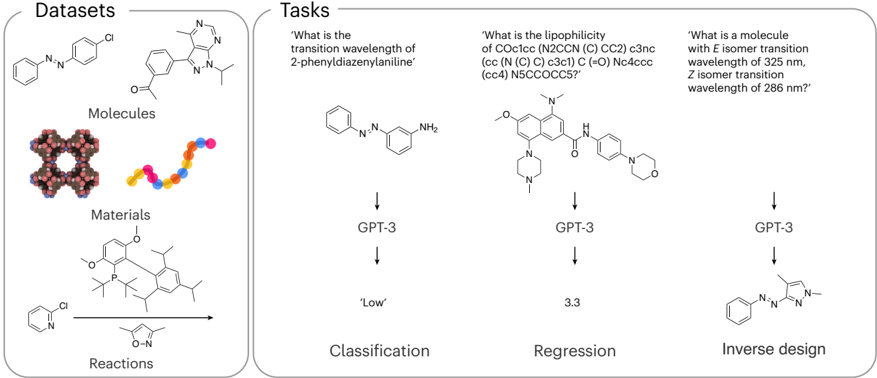
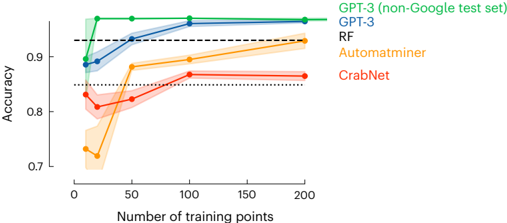
Machine learning has transformed many fields and has recently found applications in chemistry and materials science. The small datasets commonly found in chemistry sparked the development of sophisticated machine learning approaches that incorporate chemical knowledge for each application and, therefore, require specialized expertise to develop. Here we show that GPT-3, a large language model trained on vast amounts of text extracted from the Internet, can easily be adapted to solve various tasks in chemistry and materials science by fine-tuning it to answer chemical questions in natural language with the correct answer. We compared this approach with dedicated machine learning models for many applications spanning the properties of molecules and materials to the yield of chemical reactions. Surprisingly, our fine-tuned version of GPT-3 can perform comparably to or even outperform conventional machine learning techniques, in particular in the low-data limit. In addition, we can perform inverse design by simply inverting the questions. The ease of use and high performance, especially for small datasets, can impact the fundamental approach to using machine learning in the chemical and material sciences. In addition to a literature search, querying a pre-trained large language model might become a routine way to bootstrap a project by leveraging the collective knowledge encoded in these foundation models, or to provide a baseline for predictive tasks.
Overview
The claims and statistics of this paper haven’t been checked yet.
Free: it reads the open-access text and checks the first 5 claims that cite a source we can check. Create a free account to check every claim.
Integrity signals
Registry
Cites
Statistics
Figures
Verification
Claims the paper makes
The claims and statistics of this paper haven’t been checked yet.
Free: it reads the open-access text and checks the first 5 claims that cite a source we can check. Create a free account to check every claim.
Claims other papers make about this one
Each is checked against this paper’s own text: does it say what the citing paper says it does?
The source backs part of the claim, not all of it — or backs it for a different population, condition or comparison.
In the citing paper
“In parallel, chemistry-oriented reviews have shown that large language models can move beyond text generation toward tool use, retrieval, planning, code execution, and multi-agent coordination [5-10].”
From From Scientific Copilots to Tool-Grounded Autonomy: AI Agents in Simulation-Driven Materials Discovery (2026) · cites this paper as [9]
Experimental — accuracy not yet measuredThe source backs part of the claim, not all of it — or backs it for a different population, condition or comparison.
In the citing paper
“The central challenge is not only to predict a property, but to manage the sequence of reasoning and action that connects a scientific objective to executable computational or experimental steps [2-10].”
From From Scientific Copilots to Tool-Grounded Autonomy: AI Agents in Simulation-Driven Materials Discovery (2026) · cites this paper as [9]
Experimental — accuracy not yet measuredThe check wasn’t confident either way, so it gives no verdict — never disputed.
In the citing paper
“The broader literature on autonomous scientific systems has already argued for more rigorous evaluation protocols and transparent tool interfaces [3,5,7-12].”
From From Scientific Copilots to Tool-Grounded Autonomy: AI Agents in Simulation-Driven Materials Discovery (2026) · cites this paper as [9]
Experimental — accuracy not yet measuredThe check wasn’t confident either way, so it gives no verdict — never disputed.
In the citing paper
“To the best of our knowledge, no prior review has isolated simulation-driven, toolorchestrating AI agent workflows for materials discovery as a distinct evidence base with study-level extraction of autonomy, validation, and reproducibility [3-14].”
From From Scientific Copilots to Tool-Grounded Autonomy: AI Agents in Simulation-Driven Materials Discovery (2026) · cites this paper as [9]
Experimental — accuracy not yet measured
Self-check
Percentages, sums and reported differences re-computed from the paper’s own numbers.
The self-check needs the paper’s full text.
Citations
Cites
Vaswani, A., Shazeer, N., Parmar, N., Uszkoreit, J., Jones, L., Gomez, A. N., Kaiser, L., & Polosukhin, I. (2017) · arXiv · doi:10.48550/arxiv.1706.03762 · Cited by 120,404
XGBoost: A Scalable Tree Boosting System
Chen, T., & Guestrin, C. (2016) · Proceedings of the 22nd ACM SIGKDD International Conference on Knowledge Discovery and Data Mining · doi:10.1145/2939672.2939785 · Cited by 54,569
Language Models are Few-Shot Learners
Brown, T. B., Mann, B., Ryder, N., Subbiah, M., Kaplan, J., Dhariwal, P., Neelakantan, A., Shyam, P., Sastry, G., Askell, A., et al. (2020) · arXiv · doi:10.48550/arxiv.2005.14165 · Cited by 23,372 · cited 3×
“However, as these models were not explicitly trained on these tasks, it is a remarkable result 5 .”
Exploring the Limits of Transfer Learning with a Unified Text-to-Text Transformer
Raffel, C., Shazeer, N., Roberts, A., Lee, K., Narang, S., Matena, M., Zhou, Y., Li, W., & Liu, P. J. (2019) · arXiv · doi:10.48550/arxiv.1910.10683 · Cited by 10,929
Weininger, D. (1988) · Journal of Chemical Information and Computer Sciences · doi:10.1021/ci00057a005 · Cited by 7,436 · cited 8×
“For machine learning applications, there has been a lot of effort to represent a chemical with unique line encodings (for example, simplified molecular-input line-entry system (SMILES) 30 or self-referencing embedded strings (SELFIES) 31,32 ).”
InfluentialBannwarth, C., Ehlert, S., & Grimme, S. (2019) · Journal of Chemical Theory and Computation · doi:10.1021/acs.jctc.8b01176 · Cited by 4,399 · cited 1×
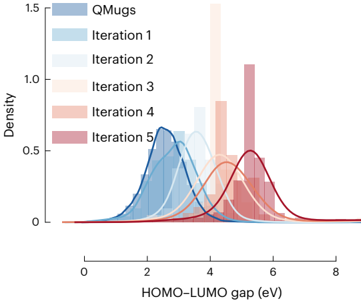
“This HOMO–LUMO gap can be predicted accurately using semi-empirical quantum mechanics (GFN2-xTB 46 ), which is computationally affordable enough for us to compute for all generated molecules (Supplementary Note 77).”
ChEMBL: a large-scale bioactivity database for drug discovery
Gaulton, A., Bellis, L. J., Bento, A. P., Chambers, J., Davies, M., Hersey, A., Light, Y., McGlinchey, S., Michalovich, D., Al-Lazikani, B., et al. (2012) · Nucleic Acids Research · doi:10.1093/nar/gkr777 · Cited by 4,382
Universal Language Model Fine-tuning for Text Classification
Howard, J., & Ruder, S. (2018) · Proceedings of the 56th Annual Meeting of the Association for Computational Linguistics (Volume 1: Long Papers) · doi:10.18653/v1/p18-1031 · Cited by 4,100 · cited 1×
“Before discussing the different applications in detail, let us first discuss how we fine-tune 23 the GPT-3 model in practice for a simple but highly non-trivial example.”
Automatic Chemical Design Using a Data-Driven Continuous Representation of Molecules
Gómez-Bombarelli, R., Wei, J. N., Duvenaud, D., Hernández-Lobato, J. M., Sánchez-Lengeling, B., Sheberla, D., Aguilera-Iparraguirre, J., Hirzel, T. D., Adams, R. P., & Aspuru-Guzik, A. (2018) · ACS Central Science · doi:10.1021/acscentsci.7b00572 · Cited by 3,106 · cited 1×
“If we have large datasets, we can train generative models such as variational autoencoders 34,35 or generative adversarial neural networks 36,37 .”
On the Opportunities and Risks of Foundation Models
Bommasani, R., Hudson, D. A., Adeli, E., Altman, R., Arora, S., von Arx, S., Bernstein, M. S., Bohg, J., Bosselut, A., Brunskill, E., et al. (2021) · arXiv · doi:10.48550/arxiv.2108.07258 · Cited by 2,676 · cited 1×
“One of the fascinating advances in machine learning has been the development of large language models (LLMs), so-called foundation models 1–6 .”
Research works printed but not linked: 7
- Goldblum, M., Finzi, M., Rowan, K. & Wilson, A. The no free lunch theorem, Kolmogorov complexity, and the role of inductive biases in machine learning. ICLR 2024 Conference, OpenReview https://openreview.net/forum?id=X7nz6ljg9Y (2023).
- Dettmers, T., Lewis, M., Belkada, Y. & Zettlemoyer, L. GPT3.int8(): 8-bit matrix multiplication for transformers at scale. Adv. Neural Inf. Process. Syst. 35, 30318-30332 (2022).
- Dettmers, T., Lewis, M., Shleifer, S. & Zettlemoyer, L. 8-bit optimizers via block-wise quantization. in The Tenth International Conference on Learning Representations (2022).
- Hu, E. J. et al. LoRA: low-rank adaptation of large language models. in International Conference On Learning Representations (2021).
- Griffiths, R.-R. et al. Gauche: a library for Gaussian processes in chemistry. in ICML 2022 2nd AI for Science Workshop https:// openreview.net/forum?id=i9MKI7zrWal (2022)
- Radford, A. et al. Language models are unsupervised multitask learners. OpenAI blog 1, 9 (2019).
- Kawazoe, Y., Yu, J.-Z., Tsai, A.-P. & Masumoto, T. (eds) Nonequilibrium Phase Diagrams of Ternary Amorphous Alloys Landolt-Börnstein: Numerical Data and Functional Relationships in Science and Technology-New Series (Springer, 2006).
Cited by
Autonomous chemical research with large language models
Boiko, D. A., MacKnight, R., Kline, B., & Gomes, G. (2023) · Nature · doi:10.1038/s41586-023-06792-0 · Cited by 1,050
“These models have been successfully applied to various domains, including natural language 1–5 , biological 6,7 and chemical research 8–10 as well as code generation 11,12 .”
Augmenting large language models with chemistry tools
M. Bran, A., Cox, S., Schilter, O., Baldassari, C., White, A. D., & Schwaller, P. (2024) · Nature Machine Intelligence · doi:10.1038/s42256-024-00832-8 · Cited by 794
“Although most tools are developed by the open-source community or made accessible through application programming interfaces (API), their integration and interoperability pose considerable challenges for experimental chemists, mainly due to their lack of computational skill set and the diversity of…”
BackgroundMethodSelf-citationArtificial intelligence in drug development
Zhang, K., Yang, X., Wang, Y., Yu, Y., Huang, N., Li, G., Li, X., Wu, J. C., & Yang, S. (2025) · Nature Medicine · doi:10.1038/s41591-024-03434-4 · Cited by 498
A Comprehensive Survey on Deep Graph Representation Learning
Ju, W., Fang, Z., Gu, Y., Liu, Z., Long, Q., Qiao, Z., Qin, Y., Shen, J., Sun, F., Xiao, Z., et al. (2024) · Neural Networks · doi:10.1016/j.neunet.2024.106207 · Cited by 341
Empowering biomedical discovery with AI agents
Gao, S., Fang, A., Huang, Y., Giunchiglia, V., Noori, A., Schwarz, J. R., Ektefaie, Y., Kondic, J., & Zitnik, M. (2024) · Cell · doi:10.1016/j.cell.2024.09.022 · Cited by 315
A review of large language models and autonomous agents in chemistry
Ramos, M. C., Collison, C. J., & White, A. D. (2025) · Chemical Science · doi:10.1039/d4sc03921a · Cited by 274
Machine learning in preclinical drug discovery
Catacutan, D. B., Alexander, J., Arnold, A., & Stokes, J. M. (2024) · Nature Chemical Biology · doi:10.1038/s41589-024-01679-1 · Cited by 204
“Transformer-based large language models (LLMs) are also being increasingly applied for generative chemistry 57,58 .”
Recent Advances in Machine Learning‐Assisted Multiscale Design of Energy Materials
Mortazavi, B. (2025) · Advanced Energy Materials · doi:10.1002/aenm.202403876 · Cited by 188
A Multiagent-Driven Robotic AI Chemist Enabling Autonomous Chemical Research On Demand
Song, T., Luo, M., Zhang, X., Chen, L., Huang, Y., Cao, J., Zhu, Q., Liu, D., Zhang, B., Zou, G., et al. (2025) · Journal of the American Chemical Society · doi:10.1021/jacs.4c17738 · Cited by 171
Crystal structure generation with autoregressive large language modeling
Antunes, L. M., Butler, K. T., & Grau-Crespo, R. (2024) · Nature Communications · doi:10.1038/s41467-024-54639-7 · Cited by 157
From text to insight: large language models for chemical data extraction
Schilling-Wilhelmi, M., Ríos-García, M., Shabih, S., Gil, M. V., Miret, S., Koch, C. T., Márquez, J. A., & Jablonka, K. M. (2025) · Chemical Society Reviews · doi:10.1039/d4cs00913d · Cited by 142
Self-citationAccelerated end-to-end chemical synthesis development with large language models
Ruan, Y., Lu, C., Xu, N., Zhang, J., Xuan, J., Pan, J., Fang, Q., Gao, H., Shen, X., Ye, N., et al. (2024) · doi:10.26434/chemrxiv-2024-6wmg4 · Cited by 140
Large language models for reticular chemistry
Zheng, Z., Rampal, N., Inizan, T. J., Borgs, C., Chayes, J. T., & Yaghi, O. M. (2025) · Nature Reviews Materials · doi:10.1038/s41578-025-00772-8 · Cited by 134
“…an LLM involves retraining a base model on a specific data set (for example, scientific papers, synthesis condition data sets, chemical representations, structural information, material design principles and material properties) to tailor its performance to particular tasks or domains 41,58–63 .”
An automatic end-to-end chemical synthesis development platform powered by large language models
Ruan, Y., Lu, C., Xu, N., He, Y., Chen, Y., Zhang, J., Xuan, J., Pan, J., Fang, Q., Gao, H., et al. (2024) · Nature Communications · doi:10.1038/s41467-024-54457-x · Cited by 116
“Recent studies have shown that incorporating domain-speci fi c chemicalknowledgeinto LLMs, typically through fi ne-tuning methods, signi fi cantly enhances their performance on chemistry-related tasks 38,72 – 77 .”
Automation and machine learning augmented by large language models in a catalysis study
Su, Y., Wang, X., Ye, Y., Xie, Y., Xu, Y., Jiang, Y., & Wang, C. (2024) · Chemical Science · doi:10.1039/d3sc07012c · Cited by 107
“156,158 In BO and AL, a machine learning model (or a surrogate model) is necessary to approximate a mapping.”
BackgroundFoundation models for materials discovery – current state and future directions
Pyzer‐Knapp, E. O., Manica, M., Staar, P., Morin, L., Ruch, P., Laino, T., Smith, J. R., & Curioni, A. (2025) · npj Computational Materials · doi:10.1038/s41524-025-01538-0 · Cited by 187
“3 shows that other base architectures such as GPT 56 – 59 are becoming more prevalent.”
Jain, A. (2024) · Current Opinion in Solid State and Materials Science · doi:10.1016/j.cossms.2024.101189 · Cited by 123
Autonomous chemistry: Navigating self-driving labs in chemical and material sciences
Bayley, O. M., Savino, E., Slattery, A., & Noël, T. (2024) · Matter · doi:10.1016/j.matt.2024.06.003 · Cited by 111
Has generative artificial intelligence solved inverse materials design?
Park, H., Li, Z., & Walsh, A. (2024) · Matter · doi:10.1016/j.matt.2024.05.017 · Cited by 137
Mirza, A., Alampara, N., Kunchapu, S., Ríos-García, M., Emoekabu, B., Krishnan, A., Gupta, T., Schilling-Wilhelmi, M., Okereke, M., Aneesh, A., et al. (2025) · Nature Chemistry · doi:10.1038/s41557-025-01815-x · Cited by 380
“Owing to the lack of widely accepted standard benchmarks, the developers of chemical language models 16,44–47 frequently utilize language-interfaced 48 tabular datasets such as the ones reported in MoleculeNet 49,50 , Therapeutic Data Commons 51 , safety databases 52 or MatBench 53 .”
Self-citationReticular Materials for Photocatalysis
Sun, K., Qian, Y., Li, D., & Jiang, H. (2024) · Advanced Materials · doi:10.1002/adma.202411118 · Cited by 99
Large Language Models for Inorganic Synthesis Predictions
Kim, S., Jung, Y., & Schrier, J. (2024) · Journal of the American Chemical Society · doi:10.1021/jacs.4c05840 · Cited by 73
Automating alloy design and discovery with physics-aware multimodal multiagent AI
Ghafarollahi, A., & Buehler, M. J. (2025) · Proceedings of the National Academy of Sciences · doi:10.1073/pnas.2414074122 · Cited by 72
AtomGPT: Atomistic Generative Pretrained Transformer for Forward and Inverse Materials Design
Choudhary, K. (2024) · The Journal of Physical Chemistry Letters · doi:10.1021/acs.jpclett.4c01126 · Cited by 72
Application of Transformers in Cheminformatics
Luong, K.-D., & Singh, A. K. (2024) · Journal of Chemical Information and Modeling · doi:10.1021/acs.jcim.3c02070 · Cited by 87
Winkler, D. A., Hughes, A. E., Özkan, C., Mol, J. M. C., Würger, T., Feiler, C., Zhang, D., & Lamaka, S. V. (2024) · Progress in Materials Science · doi:10.1016/j.pmatsci.2024.101392 · Cited by 81
The Road Ahead for Metal–Organic Frameworks: Current Landscape, Challenges and Future Prospects
Barsoum, M. L., Fahy, K. M., Morris, W., Dravid, V. P., Hernández, B., & Farha, O. K. (2025) · ACS Nano · doi:10.1021/acsnano.4c14744 · Cited by 71
Synthetic Aspects and Characterization Needs in MOF Chemistry – from Discovery to Applications
Achenbach, B., Yurduşen, A., Stock, N., Maurin, G., & Serre, C. (2025) · Advanced Materials · doi:10.1002/adma.202411359 · Cited by 73
Machine learning for CO 2 capture and conversion: A review
Jerng, S. E., Park, Y. J., & Li, J. (2024) · Energy and AI · doi:10.1016/j.egyai.2024.100361 · Cited by 80
Sun, D., Guo, D., Lu, Y., Chen, J., Lu, Y., Han, X., Feng, X., Lu, L., Wang, H., & Ouyang, M. (2024) · Energy & Environmental Science · doi:10.1039/d4ee03063j · Cited by 65
A Perspective on Foundation Models in Chemistry
Choi, J., Nam, G., Choi, J., & Jung, Y. (2025) · JACS Au · doi:10.1021/jacsau.4c01160 · Cited by 107
33 Unresolved Questions in Nanoscience and Nanotechnology
Mirkin, C. A., Petrosko, S. H., Artzi, N., Aydın, K., Biaggne, A., Brinker, C. J., Bujold, K. E., Cao, Y. C., Chan, R. R., Chen, C., et al. (2025) · ACS Nano · doi:10.1021/acsnano.5c12854 · Cited by 69
Herck, J. V., Gil, M. V., Jablonka, K. M., Abrudan, A., Anker, A. S., Asgari, M., Blaiszik, B. J., Buffo, A., Choudhury, L., Corminbœuf, C., et al. (2025) · Chemical Science · doi:10.1039/d4sc04401k · Cited by 84
“7 However, this increase in accuracy does not compensate for the fact that with open-source models, anybody can reproduce our results.”
Self-citationArtificial Intelligence Paradigms for Next-Generation Metal–Organic Framework Research
Özcan, A., Coudert, F., Rogge, S. M. J., Heydenrych, G., Fan, D., Sarikas, A. P., Keskın, S., Maurin, G., Froudakis, G. E., Wuttke, S., et al. (2025) · Journal of the American Chemical Society · doi:10.1021/jacs.5c08214 · Cited by 73
Testing AI on language comprehension tasks reveals insensitivity to underlying meaning
Dentella, V., Günther, F., Murphy, E., Marcus, G., & Leivada, E. (2024) · Scientific Reports · doi:10.1038/s41598-024-79531-8 · Cited by 54
“Yet , good performance in tasks that require memorizing specialized knowledge is not necessarily grounded in a solid understanding of language, such that LLMs may fail at comparatively easier tasks ( Moravecs paradox 6–8 ).”
Cross-disciplinary perspectives on the potential for artificial intelligence across chemistry
Mroz, A. M., Basford, A. R., Hastedt, F., Jayasekera, I. S., Mosquera‐Lois, I., Sedgwick, R., Ballester, P. J., Bocarsly, J. D., del Rio‐Chanona, E. A., Evans, M. L., et al. (2025) · Chemical Society Reviews · doi:10.1039/d5cs00146c · Cited by 73
Large language models for drug discovery and development
Zheng, Y., Koh, H. Y., Ju, J., Yang, M., May, L. T., Webb, G. I., Li, L., Pan, S., & Church, G. M. (2025) · Patterns · doi:10.1016/j.patter.2025.101346 · Cited by 134
Large‐Language‐Model‐Based AI Agent for Organic Semiconductor Device Research
Zhang, Q., Hu, Y., Yan, J., Zhang, H., Xie, X., Zhu, J., Li, H., Niu, X., Li, L., Sun, Y., et al. (2024) · Advanced Materials · doi:10.1002/adma.202405163 · Cited by 72
A Large language model-based multi-agent manufacturing system for intelligent shopfloors
Zhao, Z. M., Tang, D., Liu, C., Wang, L., Zhang, Z., Zhu, H., Chen, K., Nie, Q., & Ji, Y. (2025) · Advanced Engineering Informatics · doi:10.1016/j.aei.2025.103888 · Cited by 107
“In biology, researchers have achieved immense progress building upon the use of LLMs. Boiko et al. [24] introduced Coscientist, an AI system powered by GPT-4.”
Fu, Z., Huang, P., Wang, X., Liu, W., Kong, L., Chen, K., Li, J., & Chen, Y. (2025) · Advanced Energy Materials · doi:10.1002/aenm.202500744 · Cited by 62
Large language models to accelerate organic chemistry synthesis
Zhang, Y., Han, Y., Chen, S., Yu, R., Zhao, X. Z., Liu, X., Zeng, K., Yu, M., Tian, J., Zhu, F., et al. (2025) · Nature Machine Intelligence · doi:10.1038/s42256-025-01066-y · Cited by 105
“Jablonka et al. fine-tuned GPT-3 for inverse design and reaction classification tasks in organic chemistry 6 .”
Leveraging language representation for materials exploration and discovery
Qu, J., Xie, Y. R., Ciesielski, K., Porter, C. E., Toberer, E. S., & Ertekin, E. (2024) · npj Computational Materials · doi:10.1038/s41524-024-01231-8 · Cited by 66
“Even so, models show promise for certain chemistry applications in the small data limit 69 .”
Artificial Intelligence‐Driven Approaches in Semiconductor Research
Zheng, Y., Xu, H., Li, Z., Li, L., Yu, Y., Jiang, P., Shi, Y., Zhang, J., Huang, Y., Luo, Q., et al. (2025) · Advanced Materials · doi:10.1002/adma.202504378 · Cited by 66
Large language model-based evolutionary optimizer: Reasoning with elitism
Brahmachary, S., Joshi, S. M., Panda, A., Koneripalli, K., Sagotra, A. K., Patel, H., Sharma, A., Jagtap, A. D., & Kalyanaraman, K. (2024) · Neurocomputing · doi:10.1016/j.neucom.2024.129272 · Cited by 95
Lu, G., Farrukh, S., & Fan, X. (2025) · Fuel · doi:10.1016/j.fuel.2025.134740 · Cited by 53
Comparing SMILES and SELFIES tokenization for enhanced chemical language modeling
Leon, M., Perezhohin, Y., Peres, F., Popovič, A., & Castelli, M. (2024) · Scientific Reports · doi:10.1038/s41598-024-76440-8 · Cited by 62
“An overview of some NLP models applied to chemistry, developed in a hackathon by Jablonka et al. 16 .”
BackgroundGenerative AI for design of nanoporous materials: review and future prospects
Xie, E., Wang, X., Siepmann, J. I., Chen, H., & Snurr, R. Q. (2025) · Digital Discovery · doi:10.1039/d5dd00221d · Cited by 53
Recent Advances and Prospects in High‐Performance Bio‐Based Phthalonitrile Resins
Bulgakov, B. A., & Schubert, U. S. (2024) · Advanced Functional Materials · doi:10.1002/adfm.202410071 · Cited by 41
Chakraborty, C., Bhattacharya, M., Pal, S., Chatterjee, S., Das, A., & Lee, S. (2025) · Journal of Advanced Research · doi:10.1016/j.jare.2025.02.011 · Cited by 60
Zhao, Y., Zhao, Y., Wang, J., & Wang, Z. (2025) · Industrial & Engineering Chemistry Research · doi:10.1021/acs.iecr.4c04636 · Cited by 50
A Deep Generative Model for the Inverse Design of Transition Metal Ligands and Complexes
Strandgaard, M., Linjordet, T., Kneiding, H., Burnage, A. L., Nova, A., Jensen, J. H., & Balcells, D. (2025) · JACS Au · doi:10.1021/jacsau.5c00242 · Cited by 54
Open Science at the generative AI turn: An exploratory analysis of challenges and opportunities
Hosseini, M., Horbach, S. P. J. M., Holmes, K., & Ross-Hellauer, T. (2025) · Quantitative Science Studies · doi:10.1162/qss_a_00337 · Cited by 40
“Using GenAI for data analysis has already been investigated, for example, in archival analysis (Hosseini, Hong et al., 2024), hydrology (Irvine, Halloran, & Brunner, 2023), chemistry (Jablonka, Schwaller et al., 2024), pharmacology (Shin & Ramanathan, 2024), and many more contexts.”
Probing the limitations of multimodal language models for chemistry and materials research
Alampara, N., Schilling-Wilhelmi, M., Ríos-García, M., Mandal, I., Khetarpal, P., Grover, H. S., Krishnan, N. M. A., & Jablonka, K. M. (2025) · Nature Computational Science · doi:10.1038/s43588-025-00836-3 · Cited by 124
Self-citationBayesian Optimization of Catalysis with In-Context Learning
Ramos, M. C., Michtavy, S. S., White, A. D., & Porosoff, M. D. (2026) · ACS Central Science · doi:10.1021/acscentsci.5c02418 · Cited by 37
“39,40 However, using GPT models as surrogates for BO introduces additional challenges, such as the requirement of substantially more training compute.”
Lin, J., Zhao, D., Lu, S., Li, R., Xu, X., Wang, Z., Li, W., Ji, Y., Zhang, C., Shi, L., et al. (2025) · ACS Nano · doi:10.1021/acsnano.5c04880 · Cited by 36
Large Language Model (LLM)-Enabled Graphs in Dynamic Networking
Sun, G., Wang, Y., Niyato, D. T., Wang, J., Wang, X., Poor, H. V., & Letaief, K. B. (2024) · IEEE Network · doi:10.1109/mnet.2024.3511662 · Cited by 36
“For instance, the authors in [8] fine-tuned LLMs (GPT-3) to answer chemical questions in natural language with the correct answer.”
BackgroundExploration of crystal chemical space using text-guided generative artificial intelligence
Park, H., Onwuli, A., & Walsh, A. (2025) · Nature Communications · doi:10.1038/s41467-025-59636-y · Cited by 104
“Already, AI techniques are being tailored to identify patterns in chemical datasets 1 , predict reaction outcomes 2 , and accelerate discovery and optimisation cycles 3 .”
Design and Application of Electrocatalyst Based on Machine Learning
Gu, Y., Zhang, H., Xu, Z., Ren, R., Kong, X., Wang, Y., Zhu, H., Xue, D., Zhang, Y., Ma, Y., et al. (2025) · Interdisciplinary materials · doi:10.1002/idm2.12249 · Cited by 61
“For instance, researchers have employed large language models (e.g., GPT, ChemBERTa) to extract structural and catalytic activity information from relevant literature, summarize novel catalyst design principles, and guide experimental work [151, 152].”
Enabling GPTs for Expert-Level Environmental Engineering Question Answering
Zhu, J., Yang, M., Jiang, J., Bai, Y., Chen, D., & Ren, Z. J. (2024) · Environmental Science & Technology Letters · doi:10.1021/acs.estlett.4c00665 · Cited by 38
Song, Z., Lu, S., Ju, M., Zhou, Q., & Wang, J. (2025) · Nature Communications · doi:10.1038/s41467-025-61778-y · Cited by 72
“Such domain adaptation has been widely reported to yield substantial performance boosts for LLMs even when only relatively small datasets are available 39,50 .”
Design of circularly polarized phosphorescence materials guided by transfer learning
Liu, X., Zhang, Y., Xie, Y., Wang, L., Gan, L., Li, J., Li, J., Zhang, H., Chen, L., Shang, W., et al. (2025) · Nature Communications · doi:10.1038/s41467-025-60310-6 · Cited by 44
AI‐Guided Inverse Design and Discovery of Recyclable Vitrimeric Polymers
Zheng, Y., Thakolkaran, P., Biswal, A. K., Smith, J. A., Lu, Z., Zheng, S., Nguyen, B. H., Kumar, S., & Vashisth, A. (2024) · Advanced Science · doi:10.1002/advs.202411385 · Cited by 46
Large language models for batteries
Zuo, W., Zheng, H., He, T., Vishwanath, V., Chan, M. K. Y., Stevens, R. L., Amine, K., & Xu, G. (2025) · Joule · doi:10.1016/j.joule.2025.102037 · Cited by 40
Bioinformatics and biomedical informatics with ChatGPT: Year one review
Wang, J., Cheng, Z., Yao, Q., Liu, L., Xu, D. H., & Hu, G. (2024) · Quantitative Biology · doi:10.1002/qub2.67 · Cited by 41
“Task ‐ tuning GPT ‐ 3 has demonstrated notable advantages over traditional machine learning approaches, particularly in tasks where training data is small [62].”
Wellawatte, G. P., & Schwaller, P. (2025) · Communications Chemistry · doi:10.1038/s42004-024-01393-y · Cited by 76
“To circumvent such challenges at the intersection of chemistry and LLMs, Jablonka et al. 32 demonstrated that fi netuning LLMs could provide a solu-tiontothis.”
Self-citationFine-tuning a large language model for automating computational fluid dynamics simulations
Dong, Z., Zhen Hua, L. U., & Yue, Y. (2025) · Theoretical and Applied Mechanics Letters · doi:10.1016/j.taml.2025.100594 · Cited by 49
“They have aided scientific discovery [12] in fields like mathematics [13] and chemistry [14].”
Empowering Generalist Material Intelligence with Large Language Models
Yuan, W., Chen, G., Wang, Z., & You, F. (2025) · Advanced Materials · doi:10.1002/adma.202502771 · Cited by 55
Machine Learning Assisted Material Discovery: A Small Data Approach
Zhou, Q., Chen, X., & Wang, J. (2025) · Accounts of Materials Research · doi:10.1021/accountsmr.1c00236 · Cited by 39
Physics-Based Solubility Prediction for Organic Molecules
Fowles, D. J., Connaughton, B. J., Carter, J. W., Mitchell, J. B. O., & Palmer, D. S. (2025) · Chemical Reviews · doi:10.1021/acs.chemrev.4c00855 · Cited by 40
Language models for materials discovery and sustainability: Progress, challenges, and opportunities
Pei, Z., Yin, J., & Zhang, J. (2025) · Progress in Materials Science · doi:10.1016/j.pmatsci.2025.101495 · Cited by 30
Machine learning for structure-guided materials and process design
Morand, L., Iraki, T., Dornheim, J., Sandfeld, S., Link, N., & Helm, D. (2024) · Materials & Design · doi:10.1016/j.matdes.2024.113453 · Cited by 29
Machine Learning in Small-Molecule Mass Spectrometry
Hong, Y., Ye, Y., & Tang, H. (2025) · Annual Review of Analytical Chemistry · doi:10.1146/annurev-anchem-071224-082157 · Cited by 35
Leveraging Prompt Engineering in Large Language Models for Accelerating Chemical Research
Luo, F., Zhang, J., Wang, Q., & Yang, C. (2025) · ACS Central Science · doi:10.1021/acscentsci.4c01935 · Cited by 49
Artificial intelligence for drug delivery: Yesterday, today and tomorrow
Wu, Y.-Y., Wang, N., Xiong, P., Wang, R., Deng, J.-Y., & Ouyang, D.-F. (2025) · Acta Pharmaceutica Sinica B · doi:10.1016/j.apsb.2025.09.022 · Cited by 37
“These LLM-based systems have demonstrated effectiveness in several key applications, including molecular property prediction 161 , understanding protein structures 162 , drug repurposing 163 , and automated screening of the literature 164 .”
Transformers and Large Language Models for Chemistry and Drug Discovery
Bran, A. M., & Schwaller, P. (2024) · Springer eBooks · doi:10.1007/978-981-97-4828-0_8 · Cited by 55
Self-citationColaço, M. C., Glitz, V. A., Jacobs, A. K., Port, V. C., & Caramori, G. F. (2024) · European Journal of Organic Chemistry · doi:10.1002/ejoc.202400367 · Cited by 30
Explainable Synthesizability Prediction of Inorganic Crystal Polymorphs Using Large Language Models
Kim, S.-M., Schrier, J., & Jung, Y. (2025) · Angewandte Chemie International Edition · doi:10.1002/anie.202423950 · Cited by 47
The AI Act, gender equality and non-discrimination: what role for the AI office?
Lütz, F. (2024) · ERA Forum · doi:10.1007/s12027-024-00785-w · Cited by 48
“LLMs are used in many different fields, from general applications such as Chat-GPT, GPT-4, to recruitment tools or chemistry, Jablonka et al. [25].”
Qiu, Y., Mintenig, S. M., Barchiesi, M., & Koelmans, A. A. (2025) · Environment International · doi:10.1016/j.envint.2025.109341 · Cited by 32
Overview on Building Blocks and Applications of Efficient and Robust Extended Tight Binding
Katbashev, A., Stahn, M., Rose, T., Alizadeh, V., Friede, M., Plett, C., Steinbach, P., & Ehlert, S. (2025) · The Journal of Physical Chemistry A · doi:10.1021/acs.jpca.4c08263 · Cited by 32
Through-space interactions of optoelectronic materials
Zhang, J., Xiong, Z., Liu, X., Xu, Q., Lam, J. W. Y., Sun, J. Z., Zhang, H., & Tang, B. Z. (2026) · Chemical Society Reviews · doi:10.1039/d3cs00996c · Cited by 32
Toward Automated Simulation Research Workflow through LLM Prompt Engineering Design
Liu, Z., Chai, Y., & Li, J. (2025) · Journal of Chemical Information and Modeling · doi:10.1021/acs.jcim.4c01653 · Cited by 24
Smith, N. S. S., Yuan, X., Melissinos, C., & Moghe, G. D. (2024) · Bioinformatics · doi:10.1093/bioinformatics/btae756 · Cited by 24
“One study demonstrated that an older model, GPT-3, could perform similarly or outperform dedicated models on a variety of evaluations including questions on molecule properties and chemical reaction yields (Jablonka et al. 2024).”
Lü, J., Song, Z., Zhao, Q., Du, Y., Cao, Y., Jia, H., & Duan, C. (2025) · Journal of the American Chemical Society · doi:10.1021/jacs.5c02097 · Cited by 48
Wang, H., Zhu, Y., Li, J., Liu, X., Ma, Y., Yao, Y., Zhang, J., & Pan, L. (2025) · Journal of Materials Chemistry A · doi:10.1039/d5ta00922g · Cited by 22
The rise of generative AI for metal-organic framework design and synthesis
Duan, C., Nandy, A., Pal, S. C., Yang, X., Gao, W., Du, Y., Kraß, H., Kang, Y., Bernales, V., Ye, Z., et al. (2026) · Matter · doi:10.1016/j.matt.2026.102748 · Cited by 37
“79 Similarly, language models fine-tuned on SMILES string and IUPAC names of existing reported MOF linkers demonstrate the ability to propose new and valid organic linkers based on human instruction.”
Self-citationCollective intelligence for AI-assisted chemical synthesis
Li, H., Sarkar, S., Lu, W., Loftus, P. O., Qiu, T., Shee, Y., Cuomo, A. E., Webster, J.-P., Kelly, H. R., Manee, V., et al. (2026) · Nature · doi:10.1038/s41586-026-10131-4 · Cited by 43
PatCID: an open-access dataset of chemical structures in patent documents
Morin, L., Weber, V., Meijer, G. I., Yu, F., & Staar, P. (2024) · Nature Communications · doi:10.1038/s41467-024-50779-y · Cited by 26
“Learning-based molecular generation methods can bene fi t from Pat-CID, as a large corpus of 13.8Munique chemicalstructures can be used for training models 37 – 39 .”
Zhang, Z., Zhu, Y., Zhang, Q., Cui, N., & Shang, Y. (2024) · Energy · doi:10.1016/j.energy.2024.133993 · Cited by 39
Evaluating the World Model Implicit in a Generative Model
Vafa, K., Chen, J., Rambachan, A., Kleinberg, J., & Mullainathan, S. (2024) · Advances in Neural Information Processing Systems 37 · doi:10.52202/079017-0846 · Cited by 22
Kumar, A., Nazemi, F., Kodamana, H., Ramteke, M., & Bakshi, B. R. (2025) · Environmental Science & Technology · doi:10.1021/acs.est.5c05955 · Cited by 24
Large Language Models in Genomics—A Perspective on Personalized Medicine
Ali, S. M., Qadri, Y. A., Ahmad, K., Lin, Z., Leung, M.-F., Kim, S. W., Vasilakos, A. V., & Zhou, T. (2025) · Bioengineering · doi:10.3390/bioengineering12050440 · Cited by 30
“LLMs can support biomedical research and drug development by analyzing the massive tranche of academic literature available on this topic [18,19].”
Combined usage of ligand- and structure-based virtual screening in the artificial intelligence era
Dai, J., Zhou, Z., Zhao, Y., Kong, F., Zhai, Z., Zhu, Z., Cai, J., Huang, S., Xu, Y., & Sun, T. (2024) · European Journal of Medicinal Chemistry · doi:10.1016/j.ejmech.2024.117162 · Cited by 24
Chemical space as a unifying theme for chemistry
Reymond, J. (2025) · Journal of Cheminformatics · doi:10.1186/s13321-025-00954-0 · Cited by 24
Molecular analysis and design using generative artificial intelligence via multi-agent modeling
Stewart, I., & Buehler, M. J. (2025) · Molecular Systems Design & Engineering · doi:10.1039/d4me00174e · Cited by 29
PiNN: Equivariant Neural Network Suite for Modeling Electrochemical Systems
Li, J., Knijff, L., Zhang, Z., Andersson, L., & Zhang, C. (2025) · Journal of Chemical Theory and Computation · doi:10.1021/acs.jctc.4c01570 · Cited by 25
An open-source family of large encoder-decoder foundation models for chemistry
Soares, E. A., Brazil, E. V., Shirasuna, V. Y., Zubarev, D. Y., Cerqueira, R., & Schmidt, K. (2025) · Communications Chemistry · doi:10.1038/s42004-025-01585-0 · Cited by 51
“Traditional methods rely on labor-intensive trial-and-error experiments, which are both costly and time-consuming 2 .”
Cheng, A., Ser, C. T., Skreta, M., Guzmán-Cordero, A., Thiede, L., Burger, A., Aldossary, A., Leong, S. X., Pablo‐García, S., Strieth‐Kalthoff, F., et al. (2025) · Faraday Discussions · doi:10.1039/d4fd00153b · Cited by 29
Wang, Y., Guo, M., Chen, X., & Ai, D. (2025) · Scientific Reports · doi:10.1038/s41598-025-86840-z · Cited by 24
BatGPT-Chem: A Foundation Large Model for Chemical Engineering
Yang, Y., Shi, R., Li, Z., Jiang, S., Lu, B., Zhao, Q., Yang, Y., & Zhao, H. (2025) · Research · doi:10.34133/research.0827 · Cited by 34
Metadata
- Authors
- Jablonka, K. M., Schwaller, P., Ortega-Guerrero, A., & Smit, B.
- Affiliations
- Helmholtz Institute Jena (DE)
- École Polytechnique Fédérale de Lausanne (CH)
- Corresponding author
- Smit, Berend
- Venue
- Nature Machine Intelligence
- Published
- 2024-02-06
- Volume
- 6
- Issue
- 2
- Pages
- 161-169
- ISSN
- 2522-5839 (ISSN-L)
- OpenAlex
- W4391561379
- Cited by
- 378
- References
- 75
- Citations by year
- 2026: 121 · 2025: 178 · 2024: 77
- FWCI
- 36.62
- Type
- journal article
- Language
- en
- Open access
- hybrid
- doi.org
- Licence
- cc-by
- creativecommons.org/licenses/by/4.0 (tdm)
- creativecommons.org/licenses/by/4.0 (vor)
- Locations
- Nature Machine Intelligence (publishedVersion, cc-by)
- ChemRxiv (acceptedVersion, cc-by)
- HZB Repository (Helmholtz-Zentrum Berlin für Materialien und Energie GmbH (HZB)) (submittedVersion, other-oa)
- Infoscience (Ecole Polytechnique Fédérale de Lausanne) (submittedVersion, cc-by-nc-nd)
- Funders
- National Science Foundation
- Carl-Zeiss-Stiftung
- Grantham Foundation for the Protection of the Environment
- École Polytechnique Fédérale de Lausanne
- Schweizerischer Nationalfonds zur Förderung der Wissenschaftlichen Forschung (180544, 51NF40, 182892, (51NF40-182892).)
- NCCR Catalysis
- Topics
- Physical Sciences › Materials Science › Materials Chemistry › Machine Learning in Materials Science
- Life Sciences › Pharmacology, Toxicology and Pharmaceutics › Drug Discovery › Computational Drug Discovery Methods
- Social Sciences › Arts and Humanities › History and Philosophy of Science › History and advancements in chemistry
- Keywords
- large language models, GPT-3, fine-tuning, inverse design, molecular property prediction, reaction yield prediction, foundation models, literature searching
About these checks
Registry, retraction, Cites and statistics results are computed, not judged, with one exception: a printed reference that no index lists is read once by a model before it counts as a citation error. Claims are extracted by a model and kept only when their quote appears verbatim in the text; each cited source is then checked, with a model’s help, for whether it says what the claim relies on. Those verdicts can be wrong — read the claim’s quote and the cited source before relying on one.
Statistics and arithmetic are recomputed, not judged.
Confidence bands are shown only for fields calibrated on our annotated test set. None is calibrated yet, so no band is shown.
What counts as a claim ›How we measure confidence ›How we check this ›
Are you an author, or do you see a problem with this page? Request a review
Data sources
Bibliographic data: Semantic Scholar, OpenAlex, Crossref.
Contains information from the Semantic Scholar Academic Graph Datasets, made available under the ODC Attribution License (ODC-BY 1.0).
Semantic Scholar’s data is described in: Kinney, R., et al. (2023). The Semantic Scholar Open Data Platform. arXiv:2301.10140.
