

Complexities of the global plastics supply chain revealed in a trade-linked material flow analysis
Open accessThe DOI matches its Crossref record; 66 of the 67 references it cites were found in a registry or an index; 12 of the 23 sources its claims cite were checked for support.
Abstract
Abstract Plastic has become an integral part of our lives. Addressing the global environmental concerns of plastics requires a comprehensive analysis along the whole supply chain. Here, we provide a global trade-linked material flow analysis of plastics for the year 2022. Globally, 436.66 million tonnes (Mt) of plastics were traded in 2022, with final products alone accounting for 111 Mt. Our findings suggest that plastics are subject to geographical concentration, with feedstocks concentrated in oil-resource rich countries and processing in countries with large manufacturing capacity. Furthermore, there is a significant shift in waste disposal: incineration is emerging as a prominent waste disposal method (34%), landfill is decreasing substantially (40%), while the global recycling rate remained stagnant (9%). Income disparities among countries diminish in the context of plastic waste imports, reshaping the global plastics trade patterns. Uncovering the complex plastic supply chain is crucial for reducing pollution and promoting sustainable plastic management.
Overview
CoChat Summary
TL;DR
This paper presents a global trade-linked material flow analysis of plastics for 2022, covering feedstocks, production, manufacturing, use, trade, and waste management. It finds geographically concentrated production and trade, with waste management still dominated by landfill (40%) while incineration reaches 34% and recycling remains stagnant at 9%.
Key findings
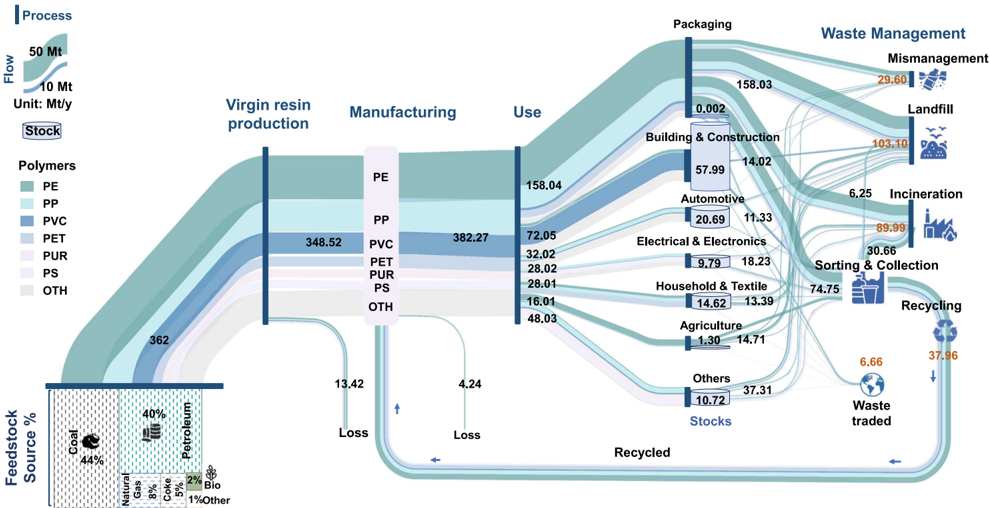
- Global plastics production in 2022 was 400 Mt: 362 Mt virgin resin and 38 Mt secondary plastics. About 98% of virgin plastics came from fossil-fuel feedstocks (44% coal, 40% petroleum, 8% natural gas, 5% coke, 1% other), while only 2% came from bio sources.
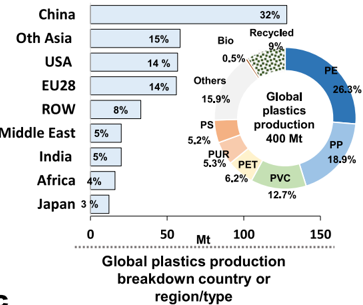
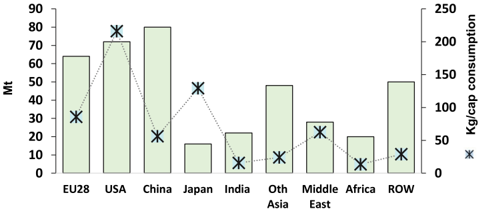
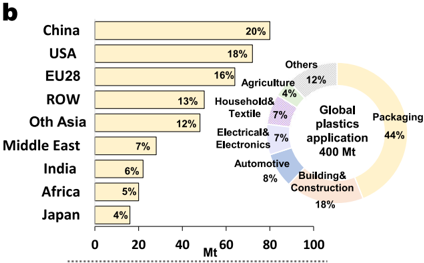
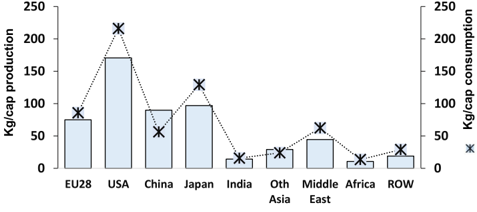
- A total of 436.66 Mt of plastics were traded in 2022, with final products alone accounting for 111 Mt. China was the largest producer (32%) and consumer (20%) of plastics and accounted for 40% of global output of final plastic products.
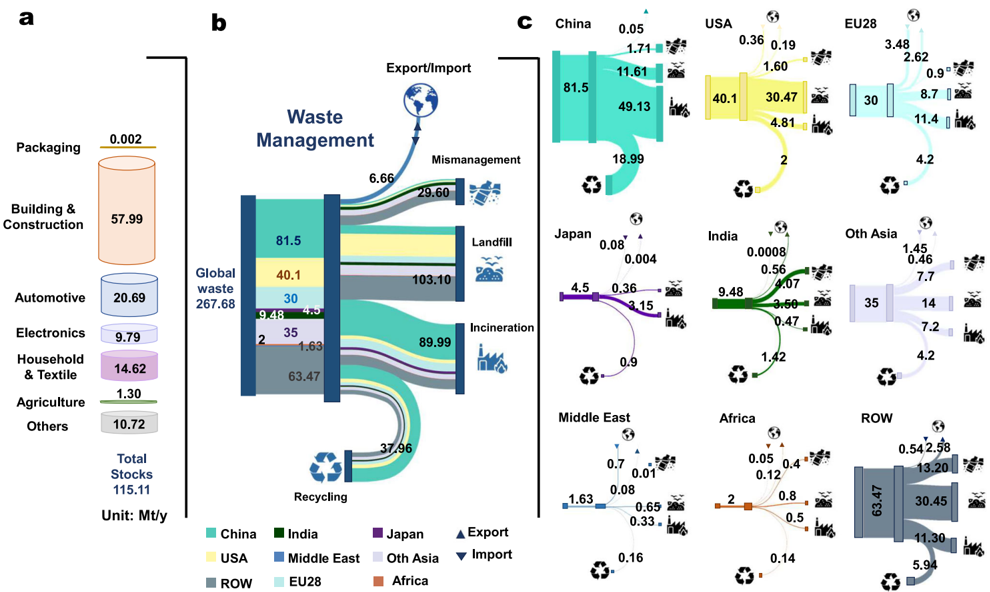
- Global plastic waste generated in 2022 was 267.68 Mt. Landfill remained the main destination at 103.37 Mt (40%), incineration accounted for 34%, and the global recycling rate remained stagnant at 9% (38 Mt); mismanaged waste was 29.60 Mt.
- EU28 emerged as a net importer of plastic waste, accounting for 52% of global plastic waste imports, while China was the largest regional waste generator at 81.5 Mt (30%). China’s incineration rate was 60% (49.13 Mt), and the USA landfilled 76% (30.47 Mt) of its plastic waste with a 5% recycling rate.
Methods
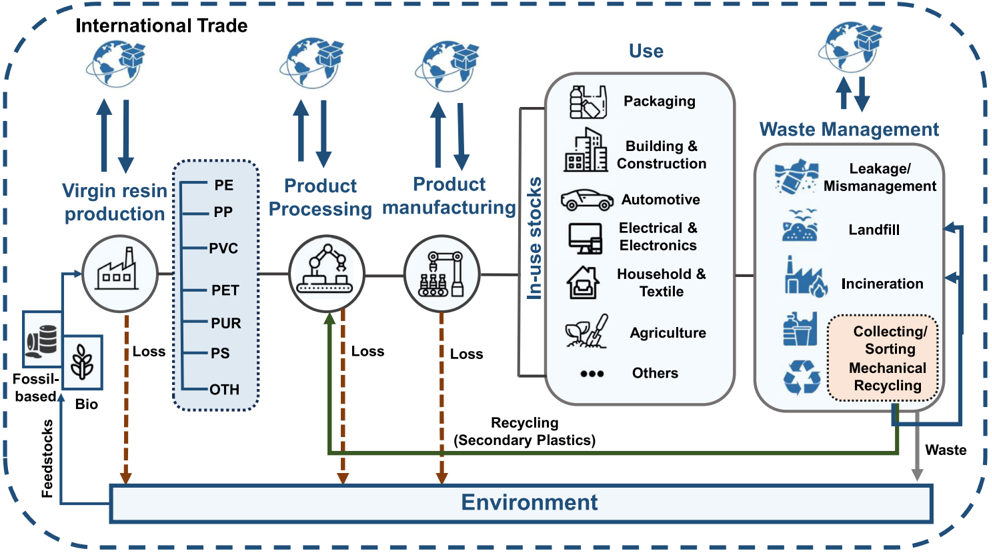
- The study uses a global trade-linked material flow analysis for 2022, covering virgin resin production, processing and manufacturing, use, and waste management. It includes polymers PE, PP, PVC, PET, PUR, PS, and others, and use sectors packaging, building and construction, automotive, electrical and electronics, household and textile, agriculture, and others.
- Data were collected from national statistics, industry reports, and international databases including UN Comtrade, using 566 HS codes across feedstocks, additives, primary plastics, intermediate plastics, final plastics, and waste. The analysis applies mass balance principles, a delay model for use-stage outflows, and sensitivity analysis varying production by ±10% and ±20%, consumption by ±5% and ±10%, waste generation by ±5 and ±10 kg per capita, and product plastic content by ±2% and ±10%.
- Plastics stocks and waste generation were calculated using mass balance equations, and trade data were cross-checked with regional trade reports and industry publications.
Limitations
- The paper states that variations in data collection practices across regions may introduce inaccuracies; that the global accounting is complex and limited in analyzing specific additives, focusing mainly on commonly used and traded additives; and that informal recycling systems are not accounted for, which may mean the global recycling rate is underestimated.
- The text also makes evident that losses are quantified as entering the environment but their specific aquatic or terrestrial pathways and ultimate destinations are not modeled, and the analysis is limited to the year 2022 without including cumulative waste from previous years.
Model-written summary. Check it against the paper before relying on it.
Integrity signals
Registry
Cites
Statistics
Figures
Verification
Claims the paper makes
9 Valid · 3 Not valid · 10 Not checked · 104 Own results and interpretations
At least one cited source doesn’t support this claim or points to a different paper, and none confirmed it — see the verdicts below.
In the paper
“while the global recycling rate remained stagnant (9%)”
- Also stated in: § The global shift of plastic trade patterns · plain
“The global recycling rate remain stagnant showing little progress from previous estimates 1 , accounting of 9% of primary production.”
§ Complexities of the global plastics supply chain revealed in a trade-linked material flow analysis Check for updates > Abstract
What the sources say
- Disputedcites [1] 1. Geyer, R., Jambeck, J. R. & Law, K. L. Production, use, and fate of all plastics ever made. Science 3, e1700782 (2017). sourceExperimental — accuracy not yet measured
Results and Discussion reports that global recycling of nonfiber plastic waste increased to 18% in 2014; the 9% rate that remained steady since 2012 applies to the United States, not the world. The paper’s other global 9% figure is the cumulative share of plastic waste recycled between 1950 and 2015, not a stagnant rate or a share of primary production. (LLM, conf=0.90)
Checked by a reasoning model — may be wrong.
plain- Asserted: passes — The authors put it forward as true.
- Checkable: passes — It can be checked against evidence.
- Load-bearing: passes — The paper’s conclusions depend on it.
- Based: passes — The paper gives a reason why it holds.
- Also stated in: § The global shift of plastic trade patterns · plain
Every source the paper cites for this claim was checked and supports it.
In the paper
“Yet, a large number of additives and monomers produced and traded in the global market have been identified as substances of potential concern for their toxicity based on the European Union criteria 48 .”
§ Complexities of the global plastics supply chain revealed in a trade-linked material flow analysis Check for updates > The global shift of plastic trade patterns
What the sources say
- Supportedcites [48] 48. Wiesinger, H., Wang, Z. & Hellweg, S. Deep dive into plastic monomers, additives, and processing aids. Environ. Sci. Technol. 55, 9339-9351 (2021). source
The Abstract says the study examined plastic monomers, additives, and processing aids on the global market and identified over 2,400 substances of potential concern under European Union criteria. Section 3.3 gives the more precise figure of 2,486, including 2,368 with toxicity of concern. (LLM, conf=0.94)
plain- Asserted: passes — The authors put it forward as true.
- Checkable: passes — It can be checked against evidence.
- Load-bearing: unclear — It is unclear whether the paper’s conclusions depend on it.
- Based: passes — The paper gives a reason why it holds.
- Supported
The cited sources support only part of this claim — read each source’s verdict below.
In the paper
“This amount shows improvement from the historical accumulated waste in landfill estimated by Geyer et al. 1 (79% of the total waste).”
§ Complexities of the global plastics supply chain revealed in a trade-linked material flow analysis Check for updates > Global and regional plastics waste management
What the sources say
- Partly supportedcites [1] 1. Geyer, R., Jambeck, J. R. & Law, K. L. Production, use, and fate of all plastics ever made. Science 3, e1700782 (2017). sourceExperimental — accuracy not yet measured
The Results and Discussion estimate that, of plastic waste generated from 1950 to 2015, 12% was incinerated and 9% recycled, leaving roughly 79% discarded. But the paper says discarded waste accumulated in landfills or the natural environment; it does not estimate that 79% went to landfills alone. (LLM, conf=0.88)
plainstates a cause- Asserted: passes — The authors put it forward as true.
- Checkable: passes — It can be checked against evidence.
- Load-bearing: unclear — It is unclear whether the paper’s conclusions depend on it.
- Based: passes — The paper gives a reason why it holds.
- Partly supported
A result the paper states — it cites no source for it, so there is none to check. The quote shows it is in the paper.
In the paper
“A total of 348.52 Mt of virgin plastics were processed, and the total amount of plastics manufactured in 2022 was around 386.41 Mt (comprising the recycled plastic diverted in the manufacturing stage).”
§ Complexities of the global plastics supply chain revealed in a trade-linked material flow analysis Check for updates > Global trade-linked plastics material flow analysis
plain- Asserted: passes — The authors put it forward as true.
- Checkable: passes — It can be checked against evidence.
- Load-bearing: unclear — It is unclear whether the paper’s conclusions depend on it.
- Based: passes — The paper gives a reason why it holds.
A result the paper reports from its own data — it cites no other source for it, so there is none to check. The quote shows it is in the paper.
In the paper
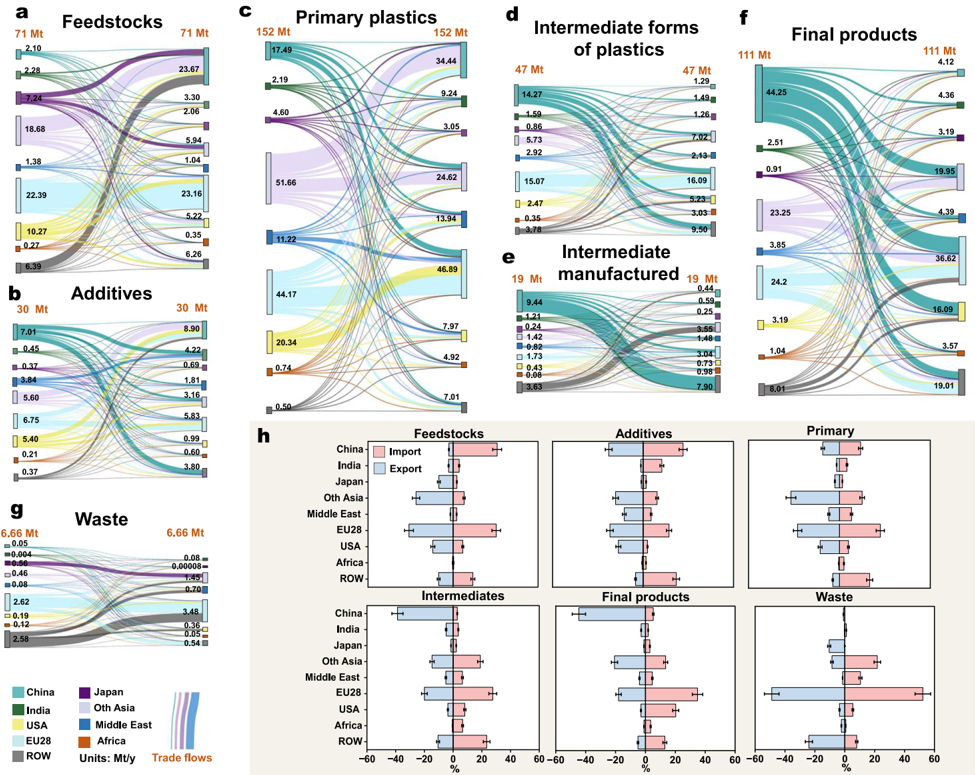
“with final products alone accounting for 111 Mt”
- Also stated in: § Global trade-linked plastics material flow analysis · plain
“Final plastics products accounted for the largest trade share along the whole supply chain of plastics with a total of 111 Mt (Fig. 2f).”
§ Complexities of the global plastics supply chain revealed in a trade-linked material flow analysis Check for updates > Abstract
plain- Asserted: passes — The authors put it forward as true.
- Checkable: passes — It can be checked against evidence.
- Load-bearing: passes — The paper’s conclusions depend on it.
- Based: passes — The paper gives a reason why it holds.
- Also stated in: § Global trade-linked plastics material flow analysis · plain
42 more claims
Create a free account to see all 126 claims and to verify the 1 reference still open.
- Probably not a substantial claim. 29
- It may state two separate claims as one. 63
Claims other papers make about this one
Each is checked against this paper’s own text: does it say what the citing paper says it does?
The source backs part of the claim, not all of it — or backs it for a different population, condition or comparison.
In the citing paper
“According to Houssini et al. [11] , the five leading plastics by global production share are polyethylene (PE, 26.3%), polypropylene (PP, 18.9%), polyvinyl chloride (PVC, 12.7%), polyethylene terephthalate (PET, 6.2%), and polystyrene (PS, 5.2%).”
From Functional carbon materials from waste plastics: synthesis and applications (2025) · cites this paper as [11]
Experimental — accuracy not yet measuredThe cited source says what the claim attributes to it.
In the citing paper
“Although about 34% of plastic waste is processed this way, the method has clear limitations [11] .”
From Functional carbon materials from waste plastics: synthesis and applications (2025) · cites this paper as [11]
The cited source says what the claim attributes to it.
In the citing paper
“Landfilling [11] , currently the most widely used disposal method (≈40% of total), offers advantages such as low cost, operational simplicity, and large processing capacity.”
From Functional carbon materials from waste plastics: synthesis and applications (2025) · cites this paper as [11]
Self-check
Percentages, sums and reported differences re-computed from the paper’s own numbers.
Each contradiction between two passages listed here was confirmed by an independent check.
Rated major: it would touch a result — a value a result rests on, reported and recomputed p-values on opposite sides of the significance level, two passages that conflict with no sign which is right, or a cited work retracted before this paper was published.
In the paper
§ Complexities of the global plastics supply chain revealed in a trade-linked material flow analysis Check for updates > Global trade-linked plastics material flow analysis
“The total amount of plastics stocks amounted to ~115 Mt”
§ Complexities of the global plastics supply chain revealed in a trade-linked material flow analysis Check for updates > The global shift of plastic trade patterns
“our analysis account for plastics stock (141.58Mt) that are not included in the waste stream for 2022”
Rated minor: it would not touch a result — a value no result rests on, a p-value that stays on the same side of the significance level, or a conflict that is clerical, resolved elsewhere in the paper, or outside its own findings.
In the paper
§ Complexities of the global plastics supply chain revealed in a trade-linked material flow analysis Check for updates > Global trade-linked plastics material flow analysis
“China is the largest exporter of intermediate forms of plastics (14.21 Mt)”
§ Complexities of the global plastics supply chain revealed in a trade-linked material flow analysis Check for updates > Global trade-linked plastics material flow analysis
“EU28 was responsible for 15.07 Mt of intermediate forms of plastics”
Rated minor: it would not touch a result — a value no result rests on, a p-value that stays on the same side of the significance level, or a conflict that is clerical, resolved elsewhere in the paper, or outside its own findings.
In the paper
“Final plastics products accounted for the largest trade share along the whole supply chain of plastics with a total of 111 Mt (Fig. 2f).China, as one the countries with the largest manufacturing capacity exported a total of 44.25 Mt (45%)”
§ Complexities of the global plastics supply chain revealed in a trade-linked material flow analysis Check for updates > Global trade-linked plastics material flow analysis
Reported 45 · recomputed 39.864865
Rated minor: it would not touch a result — a value no result rests on, a p-value that stays on the same side of the significance level, or a conflict that is clerical, resolved elsewhere in the paper, or outside its own findings.
In the paper
“The global plastic waste traded in 2022 accounted to 6.66 Mt (Fig. 2g).EU28 exported 49% and imported more than 52% of the global plastic waste.”
§ Complexities of the global plastics supply chain revealed in a trade-linked material flow analysis Check for updates > Global trade-linked plastics material flow analysis
Reported 49 · recomputed 39.339339
Rated minor: it would not touch a result — a value no result rests on, a p-value that stays on the same side of the significance level, or a conflict that is clerical, resolved elsewhere in the paper, or outside its own findings.
In the paper
“Around 152 Mt of plastics were exported as primary plastics (Fig. 2c).Oth Asia region dominates as the largest exporters of primary plastics accounting with 51.55 Mt (32%)”
§ Complexities of the global plastics supply chain revealed in a trade-linked material flow analysis Check for updates > Global trade-linked plastics material flow analysis
Reported 32 · recomputed 33.914474
Citations
Cites
Production, use, and fate of all plastics ever made
Geyer, R., Jambeck, J. R., & Law, K. L. (2017) · Science Advances · doi:10.1126/sciadv.1700782 · Cited by 18,606 · cited 4×
“Theglobalrecyclingrateremainstagnantshowinglittleprogressfrom previous estimates 1 , accounting of 9% of primary production.”
InfluentialAnomalous collapses of Nares Strait ice arches leads to enhanced export of Arctic sea ice
Moore, G. W. K., Howell, S. E. L., Brady, M., Xu, X., & McNeil, K. (2021) · Nature Communications · doi:10.1038/s41467-020-20314-w · Cited by 5,155
International Labour Organization
(2022) · Permanent Missions to the United Nations · doi:10.18356/9789210018289c229 · Cited by 4,331
Hahladakis, J. N., Velis, C. A., Weber, R., Iacovidou, E., & Purnell, P. (2018) · Journal of Hazardous Materials · doi:10.1016/j.jhazmat.2017.10.014 · Cited by 3,873
Future Scenarios of Global Plastic Waste Generation and Disposal
Lebreton, L., & Andrady, A. (2019) · Palgrave Communications · doi:10.1057/s41599-018-0212-7 · Cited by 2,327
Waste Mismanagement in Developing Countries: A Review of Global Issues
Ferronato, N., & Torretta, V. (2019) · International Journal of Environmental Research and Public Health · doi:10.3390/ijerph16061060 · Cited by 2,293
Classify plastic waste as hazardous
Rochman, C. M., Browne, M. A., Halpern, B. S., Hentschel, B. T., Hoh, E., Karapanagioti, H. K., Rios-Mendoza, L. M., Takada, H., Teh, S., & Thompson, R. C. (2013) · Nature · doi:10.1038/494169a · Cited by 1,752 · cited 1×
“Theglobaldemandforplastics hasquadrupledoverthepastdecades 1 anditisprojectedtodoubleby2050 2 , resulting in severe impacts on the environment and human health 3,4 .”
Law, K. L., & Thompson, R. C. (2014) · Science · doi:10.1126/science.1254065 · Cited by 1,471
Principles for a sustainable circular economy
Velenturf, A. P. M., & Purnell, P. (2021) · Sustainable Production and Consumption · doi:10.1016/j.spc.2021.02.018 · Cited by 1,350
The world of plastic waste: A review
Nayanathara Thathsarani Pilapitiya, P. G. C., & Ratnayake, A. S. (2024) · Cleaner Materials · doi:10.1016/j.clema.2024.100220 · Cited by 1,034
Research works printed but not linked: 2
- 6. UNEP. Historic day in the campaign to beat plastic pollution: Nations commit to develop a legally binding agreement https://www.unep. org/news-and-stories/press-release/historic-day-campaign-beat- plastic-pollution-nations-commit-develop (2022).
- Ministry of Environment. Plastic Resource Circulation Strategy https://www.env.go.jp/press/106866.html (2019).
Cited by
Yassin, L. K., Skrabulyte-Barbulescu, J., Alshamsi, S. H., Saeed, S., Alkuwaiti, S. H., Almazrouei, S., Alnuaimi, A., BaniYas, S., Aldhaheri, D., Alderei, M., et al. (2025) · Frontiers in Aging Neuroscience · doi:10.3389/fnagi.2025.1667448 · Cited by 53
Alabi, O. O., Akande, T. O., Gbadeyan, O. J., & Deenadayalu, N. (2025) · RSC Advances · doi:10.1039/d5ra06715d · Cited by 62
Mäder, G., Rüegg, N., Tschichold, T., & Yildirim, S. (2025) · Sustainable Food Technology · doi:10.1039/d5fb00187k · Cited by 24
Sustainable Polypropylene Blends: Balancing Recycled Content with Processability and Performance
Zhiltsova, T., & Oliveira, M. S. A. (2025) · Polymers · doi:10.3390/polym17111556 · Cited by 29
Valasara, V., Ahn, B., Goel, S., Han, S.-M., Woo, N.-S., Yu, B.-Y., & Won, W. (2025) · ACS Sustainable Chemistry & Engineering · doi:10.1021/acssuschemeng.5c05581 · Cited by 22
Improving waste systems in the global south to tackle international environmental impacts
Anshassi, M., & Townsend, T. G. (2025) · Nature Sustainability · doi:10.1038/s41893-025-01607-8 · Cited by 26
Valorization of plastic waste into drop-in fuels: Economic and environmental perspectives
Ahn, B., Kwon, T., Ro, I., & Won, W. (2025) · Chemical Engineering Journal · doi:10.1016/j.cej.2025.171143 · Cited by 21
Advances in PLA/PBAT-based blend film in food packaging applications: A review
Patil, S., Chawla, R., de Souza, C. K., Ezati, P., Kalita, P., & Roy, S. (2026) · Food Packaging and Shelf Life · doi:10.1016/j.fpsl.2026.101715 · Cited by 19
Naja Hasoon, K. T., & Panicker, U. G. (2026) · RSC Advances · doi:10.1039/d5ra08379f · Cited by 23
An Exploratory Review of Microplastic Pollution, Associated Microbiomes and Pathogens in Water
Cholewińska, P., Wojnarowski, K., Moniuszko, H., Pokorny, P., & Palić, D. (2025) · Applied Sciences · doi:10.3390/app15158128 · Cited by 19
Mazzon, M., Edo, C., Guerrini, S., Gioacchini, P., Cupi, J., Malena, P., Rosal, R., & Marzadori, C. (2026) · Journal of Environmental Management · doi:10.1016/j.jenvman.2026.128594 · Cited by 13
Mishra, R., Shu, C., Gollakota, A. R. K., & Pan, S.-Y. (2026) · Energy · doi:10.1016/j.energy.2026.140072 · Cited by 18
Deng, Z., Sumbal, Li, L., & Khaskheli, M. B. (2026) · Sustainability · doi:10.3390/su18052523 · Cited by 13
Wu, X., Jusli, E. A., Anggraini, V., Jaya, R. P., & Zhang, X. (2025) · Cleaner Materials · doi:10.1016/j.clema.2025.100357 · Cited by 31
Moloi, M. S., Carratta, G., & Kühnel, D. (2026) · Environmental Sciences Europe · doi:10.1186/s12302-026-01336-5 · Cited by 13
Microplastics as emerging stressors in plants: biochemical and metabolic responses
Pal, S., Gupta, S. K., GUHA, P. S., & Saha, N. (2025) · Environmental Geochemistry and Health · doi:10.1007/s10653-025-02839-5 · Cited by 15
Zhang, D., Luo, J., Li, X., Wu, D., Xie, Y., Zeng, H., Deng, H., Chen, Q., Ge, C., & Zhang, Y. (2025) · Water Research · doi:10.1016/j.watres.2025.125139 · Cited by 10
Rasool, A., Brožová, K., Čabanová, K., Halfar, J., Chromíková, J., Malíková, P., Motyka, O., Pertile, E., Drabinová, S., & Heviánková, S. (2025) · Ecotoxicology and Environmental Safety · doi:10.1016/j.ecoenv.2025.119279 · Cited by 10
Health impacts of micro- and nanoplastics in humans: systematic review of in vivo evidence
Anna, H. A. T., Ng, J. J., Tang, D. H., Yong, C. T., & Ho, A. F. W. (2026) · Environmental Health · doi:10.1186/s12940-026-01282-y · Cited by 23
Giustarini, G., Skrabanja, T. L. P., van den Berg, A. E. T., van Staveren, S., Vos, T., Zhou, Z., Klaessens, T., Mulder, E., Klazen, J. A. Z., Smit, J. J., et al. (2025) · iScience · doi:10.1016/j.isci.2025.114076 · Cited by 15
Functional carbon materials from waste plastics: synthesis and applications
Yuan, J., Yang, G., Zhou, X., Huang, J., & Chen, Y. (2025) · Sustainable Carbon Materials · doi:10.48130/scm-0025-0005 · Cited by 8
Genetically engineered Escherichia coli: The new recyclers of PET plastic waste
Wang, C., Zhang, J., Zhou, Z., & Jiang, L. (2025) · Biotechnology Advances · doi:10.1016/j.biotechadv.2025.108713 · Cited by 11
Krainara, S., Chavananikul, C., Mistry, A. N., Assavalapsakul, W., Jitpraphai, S. M., Kachenchart, B., Khondee, N., Luepromchai, E., & Pinyakong, O. (2025) · Journal of Environmental Management · doi:10.1016/j.jenvman.2025.126883 · Cited by 8
Song, P., Zheng, X., Ding, G., Peng, H., Chen, Y., & Zhang, Q. (2025) · Energy & Fuels · doi:10.1021/acs.energyfuels.5c02804 · Cited by 12
Tan, A., Wang, H., Zuo, Y., Zhao, R., Ma, W., He, Y., & Zhao, Y. J. (2025) · Spectrochimica Acta Part A Molecular and Biomolecular Spectroscopy · doi:10.1016/j.saa.2025.127069 · Cited by 10
Shaji, A., Kamalesh, R., Saravanan, A., Yaashikaa, P. R., & Vickram, A. S. (2025) · Groundwater for Sustainable Development · doi:10.1016/j.gsd.2025.101479 · Cited by 9
Ahmad, F., Zhang, H., Sun, C., Muhammad, A., & Shao, Y. (2025) · Microplastics · doi:10.3390/microplastics5010001 · Cited by 11
Polymer profiling and morphological characterization of microplastics in raw and packaged milk
Kundu, D., Vijay, N., & Oberoi, H. S. (2025) · Food Bioscience · doi:10.1016/j.fbio.2025.108080 · Cited by 10
Liu, Z., Cai, J., Guo, Y., Li, J., Wei, L., Zhang, X., Liu, W., Zhang, T., Liu, P., & Jia, H. (2026) · Journal of Hazardous Materials · doi:10.1016/j.jhazmat.2026.141043 · Cited by 8
Self-citationRemanan, C., Sahadevan, P., Anju, K. V., Ankitha, C. S., Lal, M., & Sanjeevan, V. N. (2025) · Marine Pollution Bulletin · doi:10.1016/j.marpolbul.2025.118468 · Cited by 7
Stretchability and Melt Strength Enhancement of Biodegradable Polymer Blends for Packaging Solutions
Laevsky, K. D., Zilberfarb, A., Ophir, A., & Dotan, A. L. (2025) · Molecules · doi:10.3390/molecules30153211 · Cited by 5
Nanodevice Approaches for Detecting Micro- and Nanoplastics in Complex Matrices
Debri, R. P., Sepe, F., Romano, S., D’Orazio, N., LORENZO, A. D., Calarco, A., Conte, R., & Peluso, G. (2025) · Nanomaterials · doi:10.3390/nano16010055 · Cited by 10
Plastics and the environment: challenges, impacts, and pathways to sustainability
Rana, R., Mishra, A., Goswami, R., Ahmad, A., & Ahmad, W. (2025) · Integrated Environmental Assessment and Management · doi:10.1093/inteam/vjaf193 · Cited by 15
Ren, L., Wang, X., Zheng, J., Zhai, Y., Liu, L., Xu, Z., & Qingdong, S. H. I. (2026) · Microplastics · doi:10.3390/microplastics5010022 · Cited by 10
Contaminant-Tolerant Conversion of Polyethylene Waste to α-Olefins
Posada, C., Sun, H., DiMarco, A., Munyaneza, N. E., Valenzuela, O., Wall, C. E., & Liu, G. (2026) · ACS Sustainable Chemistry & Engineering · doi:10.1021/acssuschemeng.5c10550 · Cited by 6
Tian, S., Dai, J., Li, Z. J., Wu, Q., & Chen, G. (2025) · Green Chemistry · doi:10.1039/d5gc02420j · Cited by 7
Dey, S., Rout, A. K., Ghosh, K., Saha, A., Kumar, V., Das, B. K., & Behera, B. K. (2025) · International Biodeterioration & Biodegradation · doi:10.1016/j.ibiod.2025.106205 · Cited by 8
Dey, S., Rout, A. K., Ghosh, K., Saha, A., Kumar, V., Das, B. K., & Behera, B. K. (2025) · Biotechnology Letters · doi:10.1007/s10529-025-03678-1 · Cited by 7
Study on China’s Plastic Consumption Trend and Sustainable Development Countermeasures
Chong, S., & Xiong, H. (2025) · Sustainability · doi:10.3390/su17094218 · Cited by 7
Ebadi, S., Lee, J., Nam, H., Jung, S., Seo, M. W., Lee, D., & Park, Y. (2025) · Journal of Analytical and Applied Pyrolysis · doi:10.1016/j.jaap.2025.107538 · Cited by 10
Biochar-enhanced induced heating promotes efficient hydrogen production from plastic
Wu, L., Xie, J., Zhang, G., Wang, D., Chen, F., Yu, B., Xu, Y., Gao, Y., & Zhou, H. (2025) · Chemical Engineering Journal · doi:10.1016/j.cej.2025.168714 · Cited by 6
Bio-based nanocomposite films from Kappaphycus alvarezii for packaging applications
Bairwan, R. D., Bukhari, N. T. M., Kassim, M. H. M., Norizan, M. N., Abdullah, C. K., & Rawi, N. F. M. (2026) · Biomass and Bioenergy · doi:10.1016/j.biombioe.2025.108711 · Cited by 8
Yuan, Z., Lv, R., Gudda, F., Mosa, A., Oleszczuk, P., Minkina, T., Gao, Y., & Tang, L. (2025) · New Contaminants · doi:10.48130/newcontam-0025-0019 · Cited by 7
Li, C., Bai, X., Chen, Z., Li, K.-X., Hu, D.-P., Krause, S., & Schneidewind, U. (2025) · Water Research · doi:10.1016/j.watres.2025.125225 · Cited by 5
Harnessing bacterial power and omics technologies for sustainable plastic waste biodegradation
Henawy, A. R., Ismail, S. M., Gharib, S., Elarabi, N. I., Abdelhadi, A. A., & Halema, A. A. (2026) · Biodegradation · doi:10.1007/s10532-026-10258-1 · Cited by 10
Ferreira, K. K., Costa, M. R. T. O., Ribeiro, L. S., Órfão, J. J. M., & Pereira, M. F. R. (2026) · ACS Sustainable Chemistry & Engineering · doi:10.1021/acssuschemeng.5c12040 · Cited by 4
Chen, P., Sheng, N., Song, Q., & Li, J. (2026) · Environmental Impact Assessment Review · doi:10.1016/j.eiar.2026.108472 · Cited by 9
Self-citationMembranes from bio-based poly(ethylene furanoate) and natural solvents
Ramírez-Martínez, M., Syed, U. T., Terán-Cuadrado, G., Nurdiawati, A., Vincenzo, M. D., Andrei, I., Bikiaris, D. Ν., Al‐Ghamdi, S. G., & Nunes, S. P. (2026) · Green Chemistry · doi:10.1039/d5gc05422b · Cited by 7
Majumder, S., DeLoid, G. M., Das, M., Kaur, M., Eshun, G. B., Alotaibi, S., Zuverza‐Mena, N., Sadik, O. A., White, J. C., & Demokritou, P. (2026) · Environmental Science & Technology · doi:10.1021/acs.est.5c14500 · Cited by 4
Zhang, J., Jiang, Y., Wang, J., Chen, S., Li, X. L., Xu, M., Zhang, M., Yu, K., Song, D., & Jiang, J. (2025) · Talanta · doi:10.1016/j.talanta.2025.129232 · Cited by 4
Aarthi, S., Subramani, R., Rusho, M. A., & Yishak, S. (2025) · Advances in Polymer Technology · doi:10.1155/adv/9685300 · Cited by 16
Muktham, R. K., Batsh, C., Razak, S. M., & Aniya, V. (2026) · Chemical Engineering Journal · doi:10.1016/j.cej.2026.177490 · Cited by 6
Dimas, T., den Eynde, S. V., Delva, L., Noppe, B., Waignein, L., Peeters, J. R., & Vanierschot, M. (2025) · Waste Management · doi:10.1016/j.wasman.2025.115249 · Cited by 3
Majumder, S., Bazina, L., DeLoid, G. M., Garcia, A., Zuverza‐Mena, N., Konkol, J. A., Tsilomelekis, G., Verzi, M. P., Zhu, H., White, J. C., et al. (2025) · Toxics · doi:10.3390/toxics13110939 · Cited by 5
Zhang, J., Zhang, Z., Shen, Z., Yu, Z., Chen, J., Zeng, L., Li, D., Yan, X., Li, B. J., & Wong, J. W. C. (2026) · Water Research · doi:10.1016/j.watres.2026.125619 · Cited by 6
An overview of the sources, hazards and removal of microplastics
Ari, B., Sodre, M. F., Önal, U., & Şahiner, N. (2025) · Journal of Macromolecular Science Part A · doi:10.1080/10601325.2025.2583247 · Cited by 4
Nomadolo, N. E., & Ray, S. S. (2026) · Advanced Industrial and Engineering Polymer Research · doi:10.1016/j.aiepr.2026.03.001 · Cited by 5
The plastic brain part II: new insights into micro- and nanoplastics neurotoxicity
van Kaam, S., Westerink, R. H. S., & Kasteel, E. E. J. (2025) · Microplastics and Nanoplastics · doi:10.1186/s43591-025-00161-6 · Cited by 5
Huang, W. (2026) · Nanoscale · doi:10.1039/d5nr05358g · Cited by 8
Raheel, H., Ferguson, A., Leslie, S., Guardado-Menjivar, V., Chen, K., Merceron, A., Arciniegas, J., Lovvorn, A. E., Higgins, M. K., Barr, D. B., et al. (2026) · Environmental Research Letters · doi:10.1088/1748-9326/ae49a3 · Cited by 7
Zanona, Q. K., Gallas‐Lopes, M., Marconi, G. A., Lazzarotto, I. N., Piato, Â., Herrmann, A. P., & Calcagnotto, M. E. (2025) · Journal of Hazardous Materials · doi:10.1016/j.jhazmat.2025.140271 · Cited by 4
YongSheng, F., Xia, L., Yin, Y., Jin, R., & Zhao, W. (2026) · Journal of environmental chemical engineering · doi:10.1016/j.jece.2026.121384 · Cited by 6
Hydrogen-Free Catalytic Strategies for the Upcycling of Polyolefin Plastics
Kwon, T., Kim, J. W., & Ro, I. (2025) · Korean Journal of Chemical Engineering · doi:10.1007/s11814-025-00535-9 · Cited by 5
Wang, Q., Wang, G., Sasa, M. A., et al. (2026) · Polymers · doi:10.3390/polym18060772 · Cited by 3
Wu, M., Li, L., Zhao, T., Mao, Y., Lin, J., Li, X., Bai, Y., Han, F., Chen, S., Peng, T., et al. (2026) · Journal of Hazardous Materials · doi:10.1016/j.jhazmat.2026.142073 · Cited by 4
Brouwer, M. T., Undas, A. K., & Maaskant, E. (2025) · Waste Management · doi:10.1016/j.wasman.2025.115207 · Cited by 4
Choudhary, S., & Shukla, P. (2025) · Proceedings of the Indian National Science Academy · doi:10.1007/s43538-025-00600-1 · Cited by 3
Tan, Q., Li, J. J., Liu, L., Zhan, K., & Shi, G. (2026) · Environmental Research · doi:10.1016/j.envres.2026.123712 · Cited by 4
Self-citationBae, S., Park, J., Choi, N., & Roh, K. (2026) · Journal of Environmental Management · doi:10.1016/j.jenvman.2025.128504 · Cited by 4
Zhao, H., Sun, Z., Lee, L. Q., Yang, Q., Ao, K., Tu, W., Duan, H., Zhou, J., Zou, Z., Zhou, Y., et al. (2026) · Applied Catalysis B: Environmental · doi:10.1016/j.apcatb.2026.126710 · Cited by 3
Zhang, Y., Wang, Z., Oguchi, M., Yamamoto, H., & Nowack, B. (2026) · Waste Management · doi:10.1016/j.wasman.2026.115719 · Cited by 3
Yu, Z., Liu, X., Yu, J.-U., Sujauddin, M., & Manago, G. (2025) · Sustainability · doi:10.3390/su17177939 · Cited by 1
Engineered microbes to enable a circular economy for biodegradable plastics
Madushanka, D., Beard, C., Jayantha, B., Dissanayake, L., Jayasekara, S., Ghosh, S., & Jayakody, L. N. (2026) · Frontiers in Microbiology · doi:10.3389/fmicb.2026.1828166 · Cited by 3
A time-space-efficiency-benefit (TSEB) mix approach to carbon mitigation roadmap design
Wei, Y., & Chen, W. (2026) · Structural Change and Economic Dynamics · doi:10.1016/j.strueco.2026.02.006 · Cited by 2
Pleskytė, S., Uogintė, I., Stanionytė, S., Selskienė, A., & Byčenkienė, S. (2025) · International Journal of Environmental Science and Technology · doi:10.1007/s13762-025-06752-3 · Cited by 3
Udourioh, G. A., Okwute, S. K., Matthews-Amune, C. O., & Udowo, V. M. (2026) · Discover Chemistry. · doi:10.1007/s44371-026-00580-1 · Cited by 5
Kaspar, H., Strübbe, N., Muscat, D., & Kaschta, J. (2026) · Polymer Testing · doi:10.1016/j.polymertesting.2026.109103 · Cited by 2
Jia, L., Song, Y., Guo, Y., Yang, F., Guan, Q., Zhang, W., liu, Y., Xing, D., & Lv, Y. (2026) · Journal of Hazardous Materials · doi:10.1016/j.jhazmat.2026.141997 · Cited by 3
Boules, A., Alexander, T. E., Brack, E. M., Mack, J. H., & Trelles, J. P. (2025) · International Journal of Hydrogen Energy · doi:10.1016/j.ijhydene.2025.153182 · Cited by 3
Almroth, B. C., Ralston, R., Tilsted, J. P., Balayannis, A., Bertram, M. G., Olsen, T., & Short, D. (2025) · The International Journal of Human Rights · doi:10.1080/13642987.2025.2584007 · Cited by 2
Li, C., Liang, W., Yuan, Z., Zhu, L., Hou, X., & Dong, X. (2026) · Environmental Research · doi:10.1016/j.envres.2026.124077 · Cited by 2
Enzymatic and microbial routes to bioplastics: The green chemistry frontier of biopolymers
Gallo, G., Piccoli, E., Bombardi, L., Aulitto, M., & Fusco, S. (2026) · FEBS Open Bio · doi:10.1002/2211-5463.70241 · Cited by 4
Chaudhary, M., Tiwari, S., Rana, R. S., & Suthar, S. (2026) · Environmental Research · doi:10.1016/j.envres.2026.124259 · Cited by 2
Regulating chemicals globally is key to a successful plastics treaty
Brander, S. M., Bonisoli‐Alquati, A., Cousin, X., Farrelly, T. A., Fieber, R., Muncke, J., Raps, H., & Wagner, M. (2025) · Cambridge Prisms Plastics · doi:10.1017/plc.2025.10023 · Cited by 3
Zubair, M., Karim, A., Noor, M., Bibi, L., Qamar, A., Bashir, M. A., & Akhtar, M. T. (2026) · Plants · doi:10.3390/plants15111594 · Cited by 2
Blanca, V. G., Tamayo-Belda, M., Pulido‐Reyes, G., González-Pleiter, M., Fernández‐Piñas, F., & Rosal, R. (2025) · Journal of Hazardous Materials Advances · doi:10.1016/j.hazadv.2025.100964 · Cited by 5
Degradable and functionalizable polyacetals synthesized via ring-opening metathesis copolymerization
Ibrahim, T., Rimal, S., Samiahulin, K., Zang, N., & Sun, H. R. (2025) · Polymer Journal · doi:10.1038/s41428-025-01065-1 · Cited by 2
Tang, K. H. D. (2026) · Sustainability · doi:10.3390/su18115366 · Cited by 3
Biotic–Abiotic Hybrid System for Efficient Soluble Plastic Degradation
Zhang, J., Sun, Z., Chen, Z., Tan, X., Xiao, X., Liang, Y., Xiong, J., & Ni, B. (2026) · Nano Letters · doi:10.1021/acs.nanolett.5c06099 · Cited by 3
Qian, Y., Sun, Y., Yang, S., Tang, B., Cen, M., Feng, C., & Zheng, J. (2026) · Environmental Pollution · doi:10.1016/j.envpol.2026.128289 · Cited by 1
Ko, J., Jeon, W., Kim, D., & Kwon, M. S. (2026) · Polymer Chemistry · doi:10.1039/d6py00295a · Cited by 3
Cho, E., Park, S., Seo, J. Y., Park, S. B., Baek, S.-H., Hwang, D. K., Park, J., Oh, D. X., Shin, G., Jeon, H., et al. (2026) · ACS Sustainable Chemistry & Engineering · doi:10.1021/acssuschemeng.5c08559 · Cited by 1
Metadata
- Authors
- Houssini, K., Li, J., & Tan, Q.
- Affiliations
- State Key Joint Laboratory of Environment Simulation and Pollution Control (CN)
- Corresponding author
- Tan, Quanyin
- Venue
- Communications Earth & Environment
- Published
- 2025-04-10
- Volume
- 6
- Issue
- 1
- ISSN
- 2662-4435 (ISSN-L)
- OpenAlex
- W4409329462
- Semantic Scholar
- ad7a75e649886693a1f7ebffcf4c058b5e79a45e
- Cited by
- 363
- References
- 57
- Citations by year
- 2026: 277 · 2025: 86
- FWCI
- 85.16
- Type
- journal article
- Language
- en
- Open access
- gold
- doi.org
- Licence
- cc-by
- creativecommons.org/licenses/by/4.0 (tdm)
- creativecommons.org/licenses/by/4.0 (vor)
- Locations
- Communications Earth & Environment (publishedVersion, cc-by)
- DOAJ (DOAJ: Directory of Open Access Journals) (submittedVersion, cc-by-sa)
- Funders
- National Natural Science Foundation of China (72274105, W2433174)
- Topics
- Physical Sciences › Environmental Science › Pollution › Microplastics and Plastic Pollution
- Physical Sciences › Environmental Science › Environmental Engineering › Environmental Impact and Sustainability
- Physical Sciences › Environmental Science › Environmental Engineering › Sustainability and Ecological Systems Analysis
- Keywords
- plastic waste disposal, incineration, landfill, plastic waste imports, income inequality, plastic pollution
About these checks
Registry, retraction, Cites and statistics results are computed, not judged, with one exception: a printed reference that no index lists is read once by a model before it counts as a citation error. Claims are extracted by a model and kept only when their quote appears verbatim in the text; each cited source is then checked, with a model’s help, for whether it says what the claim relies on. Those verdicts can be wrong — read the claim’s quote and the cited source before relying on one.
The claim verdicts this report counts are experimental: their accuracy is not yet measured.
A language model drew the claims from the paper on 2026-10-11, under version 3 of the claim definition (model deepseek-v4.1-flash, prompt extract-v3).
A second model labelled each claim on 2026-10-11 (model jev-1.13-20260917, definition revision gold-guideline-v0.2).
Cited sources are checked with a language model’s help (gpt-6-sol).
Statistics and arithmetic are recomputed, not judged.
Confidence bands are shown only for fields calibrated on our annotated test set. None is calibrated yet, so no band is shown.
What counts as a claim ›How we measure confidence ›How we check this ›
Are you an author, or do you see a problem with this page? Request a review
Data sources
Bibliographic data: Semantic Scholar, OpenAlex, Crossref.
Contains information from the Semantic Scholar Academic Graph Datasets, made available under the ODC Attribution License (ODC-BY 1.0).
Semantic Scholar’s data is described in: Kinney, R., et al. (2023). The Semantic Scholar Open Data Platform. arXiv:2301.10140.
