

Complexities of the global plastics supply chain revealed in a trade-linked material flow analysis
Open accessThe DOI matches its Crossref record; 66 of the 67 references it cites were found in a registry or an index; 12 of the 23 sources its claims cite were checked for support.
Abstract
Abstract Plastic has become an integral part of our lives. Addressing the global environmental concerns of plastics requires a comprehensive analysis along the whole supply chain. Here, we provide a global trade-linked material flow analysis of plastics for the year 2022. Globally, 436.66 million tonnes (Mt) of plastics were traded in 2022, with final products alone accounting for 111 Mt. Our findings suggest that plastics are subject to geographical concentration, with feedstocks concentrated in oil-resource rich countries and processing in countries with large manufacturing capacity. Furthermore, there is a significant shift in waste disposal: incineration is emerging as a prominent waste disposal method (34%), landfill is decreasing substantially (40%), while the global recycling rate remained stagnant (9%). Income disparities among countries diminish in the context of plastic waste imports, reshaping the global plastics trade patterns. Uncovering the complex plastic supply chain is crucial for reducing pollution and promoting sustainable plastic management.
Overview
CoChat Summary
TL;DR
This paper presents a global trade-linked material flow analysis of plastics for 2022, covering feedstocks, production, manufacturing, use, trade, and waste management. It finds geographically concentrated production and trade, with waste management still dominated by landfill (40%) while incineration reaches 34% and recycling remains stagnant at 9%.
Key findings
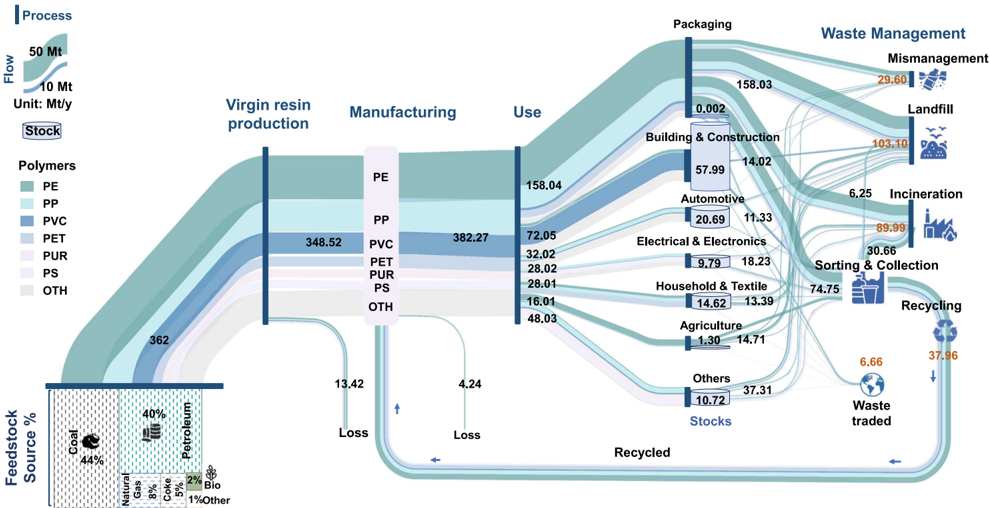
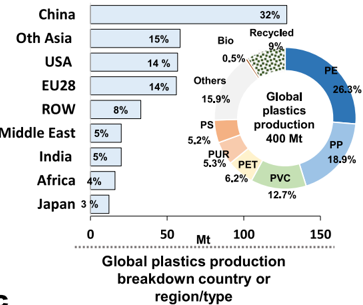
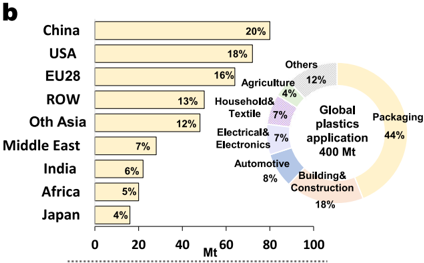
- Global plastics production in 2022 was 400 Mt: 362 Mt virgin resin and 38 Mt secondary plastics. About 98% of virgin plastics came from fossil-fuel feedstocks (44% coal, 40% petroleum, 8% natural gas, 5% coke, 1% other), while only 2% came from bio sources.
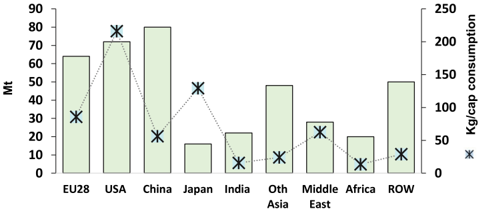
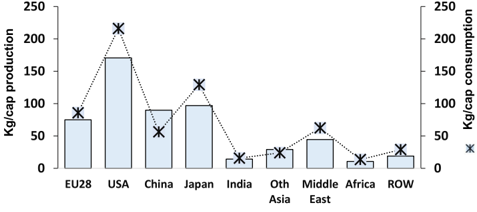
- A total of 436.66 Mt of plastics were traded in 2022, with final products alone accounting for 111 Mt. China was the largest producer (32%) and consumer (20%) of plastics and accounted for 40% of global output of final plastic products.
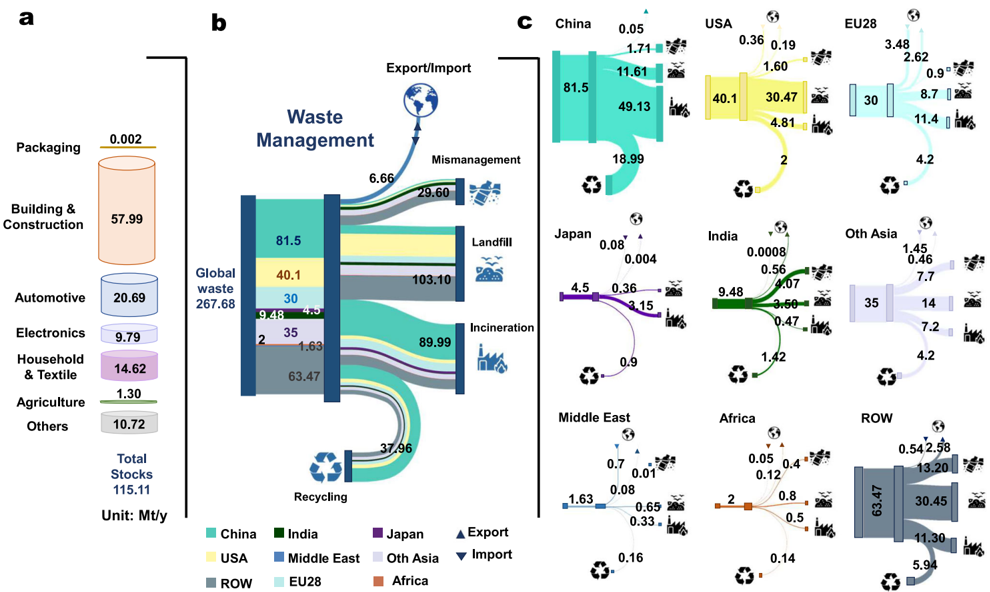
- Global plastic waste generated in 2022 was 267.68 Mt. Landfill remained the main destination at 103.37 Mt (40%), incineration accounted for 34%, and the global recycling rate remained stagnant at 9% (38 Mt); mismanaged waste was 29.60 Mt.
- EU28 emerged as a net importer of plastic waste, accounting for 52% of global plastic waste imports, while China was the largest regional waste generator at 81.5 Mt (30%). China’s incineration rate was 60% (49.13 Mt), and the USA landfilled 76% (30.47 Mt) of its plastic waste with a 5% recycling rate.
Methods
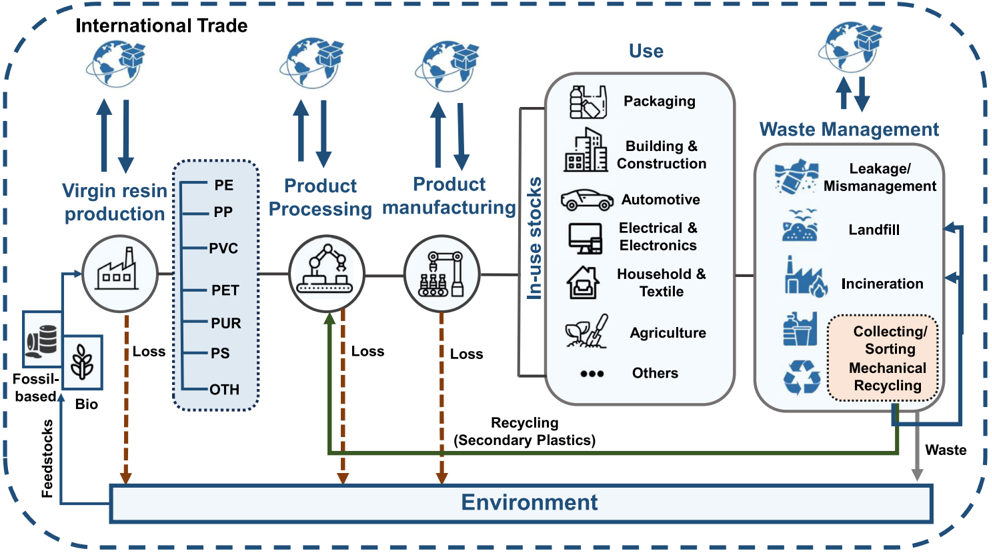
- The study uses a global trade-linked material flow analysis for 2022, covering virgin resin production, processing and manufacturing, use, and waste management. It includes polymers PE, PP, PVC, PET, PUR, PS, and others, and use sectors packaging, building and construction, automotive, electrical and electronics, household and textile, agriculture, and others.
- Data were collected from national statistics, industry reports, and international databases including UN Comtrade, using 566 HS codes across feedstocks, additives, primary plastics, intermediate plastics, final plastics, and waste. The analysis applies mass balance principles, a delay model for use-stage outflows, and sensitivity analysis varying production by ±10% and ±20%, consumption by ±5% and ±10%, waste generation by ±5 and ±10 kg per capita, and product plastic content by ±2% and ±10%.
- Plastics stocks and waste generation were calculated using mass balance equations, and trade data were cross-checked with regional trade reports and industry publications.
Limitations
- The paper states that variations in data collection practices across regions may introduce inaccuracies; that the global accounting is complex and limited in analyzing specific additives, focusing mainly on commonly used and traded additives; and that informal recycling systems are not accounted for, which may mean the global recycling rate is underestimated.
- The text also makes evident that losses are quantified as entering the environment but their specific aquatic or terrestrial pathways and ultimate destinations are not modeled, and the analysis is limited to the year 2022 without including cumulative waste from previous years.
Model-written summary. Check it against the paper before relying on it.
Integrity signals
Registry
Cites
Statistics
Figures
Verification
Claims the paper makes
9 Valid · 3 Not valid · 10 Not checked · 104 Own results and interpretations
At least one cited source doesn’t support this claim or points to a different paper, and none confirmed it — see the verdicts below.
In the paper
“while the global recycling rate remained stagnant (9%)”
- Also stated in: § The global shift of plastic trade patterns · plain
“The global recycling rate remain stagnant showing little progress from previous estimates 1 , accounting of 9% of primary production.”
§ Complexities of the global plastics supply chain revealed in a trade-linked material flow analysis Check for updates > Abstract
What the sources say
- Disputedcites [1] 1. Geyer, R., Jambeck, J. R. & Law, K. L. Production, use, and fate of all plastics ever made. Science 3, e1700782 (2017). sourceExperimental — accuracy not yet measured
Results and Discussion reports that global recycling of nonfiber plastic waste increased to 18% in 2014; the 9% rate that remained steady since 2012 applies to the United States, not the world. The paper’s other global 9% figure is the cumulative share of plastic waste recycled between 1950 and 2015, not a stagnant rate or a share of primary production. (LLM, conf=0.90)
Checked by a reasoning model — may be wrong.
plain- Asserted: passes — The authors put it forward as true.
- Checkable: passes — It can be checked against evidence.
- Load-bearing: passes — The paper’s conclusions depend on it.
- Based: passes — The paper gives a reason why it holds.
- Also stated in: § The global shift of plastic trade patterns · plain
Every source the paper cites for this claim was checked and supports it.
In the paper
“Yet, a large number of additives and monomers produced and traded in the global market have been identified as substances of potential concern for their toxicity based on the European Union criteria 48 .”
§ Complexities of the global plastics supply chain revealed in a trade-linked material flow analysis Check for updates > The global shift of plastic trade patterns
What the sources say
- Supportedcites [48] 48. Wiesinger, H., Wang, Z. & Hellweg, S. Deep dive into plastic monomers, additives, and processing aids. Environ. Sci. Technol. 55, 9339-9351 (2021). source
The Abstract says the study examined plastic monomers, additives, and processing aids on the global market and identified over 2,400 substances of potential concern under European Union criteria. Section 3.3 gives the more precise figure of 2,486, including 2,368 with toxicity of concern. (LLM, conf=0.94)
plain- Asserted: passes — The authors put it forward as true.
- Checkable: passes — It can be checked against evidence.
- Load-bearing: unclear — It is unclear whether the paper’s conclusions depend on it.
- Based: passes — The paper gives a reason why it holds.
- Supported
The cited sources support only part of this claim — read each source’s verdict below.
In the paper
“This amount shows improvement from the historical accumulated waste in landfill estimated by Geyer et al. 1 (79% of the total waste).”
§ Complexities of the global plastics supply chain revealed in a trade-linked material flow analysis Check for updates > Global and regional plastics waste management
What the sources say
- Partly supportedcites [1] 1. Geyer, R., Jambeck, J. R. & Law, K. L. Production, use, and fate of all plastics ever made. Science 3, e1700782 (2017). sourceExperimental — accuracy not yet measured
The Results and Discussion estimate that, of plastic waste generated from 1950 to 2015, 12% was incinerated and 9% recycled, leaving roughly 79% discarded. But the paper says discarded waste accumulated in landfills or the natural environment; it does not estimate that 79% went to landfills alone. (LLM, conf=0.88)
plainstates a cause- Asserted: passes — The authors put it forward as true.
- Checkable: passes — It can be checked against evidence.
- Load-bearing: unclear — It is unclear whether the paper’s conclusions depend on it.
- Based: passes — The paper gives a reason why it holds.
- Partly supported
A result the paper states — it cites no source for it, so there is none to check. The quote shows it is in the paper.
In the paper
“A total of 348.52 Mt of virgin plastics were processed, and the total amount of plastics manufactured in 2022 was around 386.41 Mt (comprising the recycled plastic diverted in the manufacturing stage).”
§ Complexities of the global plastics supply chain revealed in a trade-linked material flow analysis Check for updates > Global trade-linked plastics material flow analysis
plain- Asserted: passes — The authors put it forward as true.
- Checkable: passes — It can be checked against evidence.
- Load-bearing: unclear — It is unclear whether the paper’s conclusions depend on it.
- Based: passes — The paper gives a reason why it holds.
A result the paper reports from its own data — it cites no other source for it, so there is none to check. The quote shows it is in the paper.
In the paper
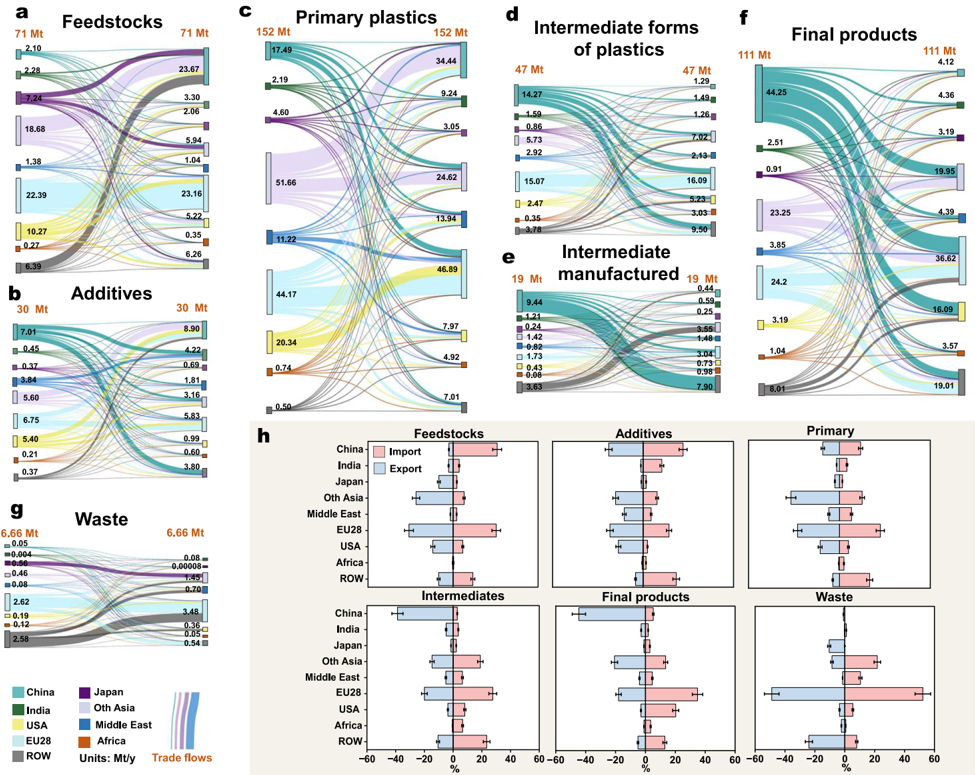
“with final products alone accounting for 111 Mt”
- Also stated in: § Global trade-linked plastics material flow analysis · plain
“Final plastics products accounted for the largest trade share along the whole supply chain of plastics with a total of 111 Mt (Fig. 2f).”
§ Complexities of the global plastics supply chain revealed in a trade-linked material flow analysis Check for updates > Abstract
plain- Asserted: passes — The authors put it forward as true.
- Checkable: passes — It can be checked against evidence.
- Load-bearing: passes — The paper’s conclusions depend on it.
- Based: passes — The paper gives a reason why it holds.
- Also stated in: § Global trade-linked plastics material flow analysis · plain
42 more claims
Create a free account to see all 126 claims and to verify the 1 reference still open.
- Probably not a substantial claim. 29
- It may state two separate claims as one. 63
Claims other papers make about this one
Each is checked against this paper’s own text: does it say what the citing paper says it does?
The source backs part of the claim, not all of it — or backs it for a different population, condition or comparison.
In the citing paper
“According to Houssini et al. [11] , the five leading plastics by global production share are polyethylene (PE, 26.3%), polypropylene (PP, 18.9%), polyvinyl chloride (PVC, 12.7%), polyethylene terephthalate (PET, 6.2%), and polystyrene (PS, 5.2%).”
From Functional carbon materials from waste plastics: synthesis and applications (2025) · cites this paper as [11]
Experimental — accuracy not yet measuredThe cited source says what the claim attributes to it.
In the citing paper
“Although about 34% of plastic waste is processed this way, the method has clear limitations [11] .”
From Functional carbon materials from waste plastics: synthesis and applications (2025) · cites this paper as [11]
The cited source says what the claim attributes to it.
In the citing paper
“Landfilling [11] , currently the most widely used disposal method (≈40% of total), offers advantages such as low cost, operational simplicity, and large processing capacity.”
From Functional carbon materials from waste plastics: synthesis and applications (2025) · cites this paper as [11]
Self-check
Percentages, sums and reported differences re-computed from the paper’s own numbers.
Each contradiction between two passages listed here was confirmed by an independent check.
Rated major: it would touch a result — a value a result rests on, reported and recomputed p-values on opposite sides of the significance level, two passages that conflict with no sign which is right, or a cited work retracted before this paper was published.
In the paper
§ Complexities of the global plastics supply chain revealed in a trade-linked material flow analysis Check for updates > Global trade-linked plastics material flow analysis
“The total amount of plastics stocks amounted to ~115 Mt”
§ Complexities of the global plastics supply chain revealed in a trade-linked material flow analysis Check for updates > The global shift of plastic trade patterns
“our analysis account for plastics stock (141.58Mt) that are not included in the waste stream for 2022”
Rated minor: it would not touch a result — a value no result rests on, a p-value that stays on the same side of the significance level, or a conflict that is clerical, resolved elsewhere in the paper, or outside its own findings.
In the paper
§ Complexities of the global plastics supply chain revealed in a trade-linked material flow analysis Check for updates > Global trade-linked plastics material flow analysis
“China is the largest exporter of intermediate forms of plastics (14.21 Mt)”
§ Complexities of the global plastics supply chain revealed in a trade-linked material flow analysis Check for updates > Global trade-linked plastics material flow analysis
“EU28 was responsible for 15.07 Mt of intermediate forms of plastics”
Rated minor: it would not touch a result — a value no result rests on, a p-value that stays on the same side of the significance level, or a conflict that is clerical, resolved elsewhere in the paper, or outside its own findings.
In the paper
“Final plastics products accounted for the largest trade share along the whole supply chain of plastics with a total of 111 Mt (Fig. 2f).China, as one the countries with the largest manufacturing capacity exported a total of 44.25 Mt (45%)”
§ Complexities of the global plastics supply chain revealed in a trade-linked material flow analysis Check for updates > Global trade-linked plastics material flow analysis
Reported 45 · recomputed 39.864865
Rated minor: it would not touch a result — a value no result rests on, a p-value that stays on the same side of the significance level, or a conflict that is clerical, resolved elsewhere in the paper, or outside its own findings.
In the paper
“The global plastic waste traded in 2022 accounted to 6.66 Mt (Fig. 2g).EU28 exported 49% and imported more than 52% of the global plastic waste.”
§ Complexities of the global plastics supply chain revealed in a trade-linked material flow analysis Check for updates > Global trade-linked plastics material flow analysis
Reported 49 · recomputed 39.339339
Rated minor: it would not touch a result — a value no result rests on, a p-value that stays on the same side of the significance level, or a conflict that is clerical, resolved elsewhere in the paper, or outside its own findings.
In the paper
“Around 152 Mt of plastics were exported as primary plastics (Fig. 2c).Oth Asia region dominates as the largest exporters of primary plastics accounting with 51.55 Mt (32%)”
§ Complexities of the global plastics supply chain revealed in a trade-linked material flow analysis Check for updates > Global trade-linked plastics material flow analysis
Reported 32 · recomputed 33.914474
Citations
Cites
Production, use, and fate of all plastics ever made
Geyer, R., Jambeck, J. R., & Law, K. L. (2017) · Science Advances · doi:10.1126/sciadv.1700782 · Cited by 18,606 · cited 4×
“Theglobalrecyclingrateremainstagnantshowinglittleprogressfrom previous estimates 1 , accounting of 9% of primary production.”
InfluentialAnomalous collapses of Nares Strait ice arches leads to enhanced export of Arctic sea ice
Moore, G. W. K., Howell, S. E. L., Brady, M., Xu, X., & McNeil, K. (2021) · Nature Communications · doi:10.1038/s41467-020-20314-w · Cited by 5,155
International Labour Organization
(2022) · Permanent Missions to the United Nations · doi:10.18356/9789210018289c229 · Cited by 4,331
Hahladakis, J. N., Velis, C. A., Weber, R., Iacovidou, E., & Purnell, P. (2018) · Journal of Hazardous Materials · doi:10.1016/j.jhazmat.2017.10.014 · Cited by 3,873
Future Scenarios of Global Plastic Waste Generation and Disposal
Lebreton, L., & Andrady, A. (2019) · Palgrave Communications · doi:10.1057/s41599-018-0212-7 · Cited by 2,327
Waste Mismanagement in Developing Countries: A Review of Global Issues
Ferronato, N., & Torretta, V. (2019) · International Journal of Environmental Research and Public Health · doi:10.3390/ijerph16061060 · Cited by 2,293
Classify plastic waste as hazardous
Rochman, C. M., Browne, M. A., Halpern, B. S., Hentschel, B. T., Hoh, E., Karapanagioti, H. K., Rios-Mendoza, L. M., Takada, H., Teh, S., & Thompson, R. C. (2013) · Nature · doi:10.1038/494169a · Cited by 1,752 · cited 1×
“Theglobaldemandforplastics hasquadrupledoverthepastdecades 1 anditisprojectedtodoubleby2050 2 , resulting in severe impacts on the environment and human health 3,4 .”
Law, K. L., & Thompson, R. C. (2014) · Science · doi:10.1126/science.1254065 · Cited by 1,471
Principles for a sustainable circular economy
Velenturf, A. P. M., & Purnell, P. (2021) · Sustainable Production and Consumption · doi:10.1016/j.spc.2021.02.018 · Cited by 1,350
The world of plastic waste: A review
Nayanathara Thathsarani Pilapitiya, P. G. C., & Ratnayake, A. S. (2024) · Cleaner Materials · doi:10.1016/j.clema.2024.100220 · Cited by 1,034
Research works printed but not linked: 2
- 6. UNEP. Historic day in the campaign to beat plastic pollution: Nations commit to develop a legally binding agreement https://www.unep. org/news-and-stories/press-release/historic-day-campaign-beat- plastic-pollution-nations-commit-develop (2022).
- Ministry of Environment. Plastic Resource Circulation Strategy https://www.env.go.jp/press/106866.html (2019).
Cited by
Items 101–200 of 330
Zhang, X., Tang, Y., Wang, J., Zhang, W., Nduagu, E. I., Richa, K., ROUX, T. W., & Chen, W. (2026) · Resources Conservation and Recycling · doi:10.1016/j.resconrec.2026.108927 · Cited by 2
Hasnain, M., Ali, F., Hira, I., Zainab, R., Shanableh, A., & Abideen, Z. (2025) · Environmental Research · doi:10.1016/j.envres.2025.122572 · Cited by 3
A taxonomy-inspired hierarchical classification of plastic litter
Rangel-Buitrago, N. G., Paternina-Ramos, A., Brabo, L., Filho, F. J. S., Ben-Haddad, M., García‐Romero, L., Peña‐Alonso, C., Martín, J. G., Cooper, J. A. G., Neal, W. J., et al. (2026) · Anthropocene · doi:10.1016/j.ancene.2026.100561 · Cited by 2
Biotechnology for plastic production, degradation, and upcycling
Zhan, C., Zhang, Z., Li, G., Zhao, Q., Chen, X., & Zeng, A. (2026) · Green Carbon · doi:10.1016/j.greenca.2026.08.001 · Cited by 1
Brenda, F., Barbi, S., Montorsi, M., Nottiani, D. G., Grimaldi, M., Pitirollo, O., Sciancalepore, C., Milanese, D., & Cespi, D. (2026) · ACS Sustainable Chemistry & Engineering · doi:10.1021/acssuschemeng.5c13077 · Cited by 1
Plastic waste in concrete: Data-driven insights into strength behavior
Miah, A., & Islam, M. J. (2026) · Cleaner Engineering and Technology · doi:10.1016/j.clet.2026.101154 · Cited by 1
Molnár, J. R., Hsu, Y., & Uyama, H. (2026) · Polymer Degradation and Stability · doi:10.1016/j.polymdegradstab.2026.111929 · Cited by 1
Wang, X., Luo, C., Hu, J., & Palanki, S. (2026) · Frontiers in Energy Research · doi:10.3389/fenrg.2026.1726062 · Cited by 1
Lenssen, E. S., Skrabanja, T. L. P., Vrisekoop, N., Scibetta, L., van den Berg, A. E. T., Adriaans, K., Caiazzo, L., Montereali, M., Manzo, S., Snapkow, I., et al. (2026) · Environmental Pollution · doi:10.1016/j.envpol.2026.127894 · Cited by 1
Precision bond cleavage in waste plastics: Directed catalytic upcycling
Zhang, Y., Wang, Y., & Li, A. (2026) · Renewable and Sustainable Energy Reviews · doi:10.1016/j.rser.2026.117028 · Cited by 1
Huang, H., Kang, Z., Huang, X., Zhu, Y., Zhou, X., Lin, Z., & Liu, W. (2026) · Journal of Analytical and Applied Pyrolysis · doi:10.1016/j.jaap.2026.107771 · Cited by 2
Jing, M., Zhang, X., Li, X., Tan, L., Niu, Z., & Ma, Y. (2026) · Environmental Research · doi:10.1016/j.envres.2026.123973 · Cited by 3
Mondal, R., Sen, K., Paul, A., Majumder, A., & Majumder, S. (2026) · Endocrine and Metabolic Science · doi:10.1016/j.endmts.2026.100318 · Cited by 4
Transforming pallet systems for global shipping decarbonization
Zhang, T., Wang, H., Wen, Z., Zhang, L., Fei, F., Lin, A., & Ekins, P. (2026) · Environmental Impact Assessment Review · doi:10.1016/j.eiar.2026.108448 · Cited by 1
Fernandes, C., Oliveira, H., Rocha-Santos, T., & Bastos, V. (2026) · Polymers · doi:10.3390/polym18091091 · Cited by 2
Morris, S., Sarlin, P. J., Morris, S., Morris, S., & Joseph, P. (2026) · Regional Studies in Marine Science · doi:10.1016/j.rsma.2026.105088 · Cited by 2
Recent polymer modification strategies for reducing plastic waste and enhancing recyclability
Dey, H., Sheikh, M. R. K., & Shuvo, A. N. (2026) · Polymers and Polymer Composites · doi:10.1177/09673911261441896 · Cited by 3
Jiang, T., Qu, M., Liu, X., Du, W., Cha, S., Meng, Y., Zhou, X., Deng, Z., & Gong, M. (2026) · Nature Synthesis · doi:10.1038/s44160-026-01047-y · Cited by 3
Villarrubia-Gómez, P., Palm, E., Almroth, B. C., & Cornell, S. (2026) · Environmental Science & Policy · doi:10.1016/j.envsci.2026.104403 · Cited by 1
Yang, C., Bai, Y., Lin, Q., Sun, J., Li, K., Bai, Y., & Shang, H. (2026) · Journal of Analytical and Applied Pyrolysis · doi:10.1016/j.jaap.2026.107876 · Cited by 3
Waste delinking: A pathway to degrowth?
Karimzadeh, S. (2025) · Ecological Economics · doi:10.1016/j.ecolecon.2025.108869 · Cited by 1
Chen, F., Yu, X., Liu, S., Hong, S., Nie, Q., & Bai, B. (2026) · International Journal of Hydrogen Energy · doi:10.1016/j.ijhydene.2026.157371 · Cited by 1
Study on biodegradation dynamics of biopolymers under aerobic composting environment
Kundu, P., Muhammed, M., Ananthakrishnan, G., Aryajyothis, C., & Saharuba, P. M. (2026) · Journal of Environmental Science and Health Part A · doi:10.1080/10934529.2026.2713879 · Cited by 1
Gamboa-Suárez, M. A., Posada, N. C., Suárez-Rodríguez, S. J., Blanco‐Tirado, C., Sierra, C. A., Quintero-Silva, M. J., & Combariza, M. Y. (2025) · Carbohydrate Polymer Technologies and Applications · doi:10.1016/j.carpta.2025.101010 · Cited by 4
Chemicals in plastics differentially affect the transcriptome of MCF-7 breast cancer cells
Matteo, G., Eickmeyer, D. C., Bradford, L. M., Meier, M. J., Williams, A., Barton‐Maclaren, T. S., Corton, J. C., Yauk, C. L., & Atlas, E. (2026) · Archives of Toxicology · doi:10.1007/s00204-026-04376-1 · Cited by 1
Microplastic contamination in ice cream: Occurrence, exposure assessment, and potential health risks
Akkemik, Y., Tekinşen, K. K., Doğan, V., & Gökmen, S. (2026) · Journal of Food Composition and Analysis · doi:10.1016/j.jfca.2026.108955 · Cited by 3
Reducing greenhouse gas emissions from polymer processing at end-of-use
Gao, Y., Meng, F., Hawkin, J. L., Cullen, J. M., & Serrenho, A. C. (2026) · Journal of Cleaner Production · doi:10.1016/j.jclepro.2026.148308 · Cited by 1
Majumder, S., DeLoid, G. M., Kaur, M., Eshun, G. B., Alotaibi, S., Das, M., Zuverza‐Mena, N., Sadik, O. A., White, J. C., & Demokritou, P. (2026) · Journal of Hazardous Materials · doi:10.1016/j.jhazmat.2026.142773 · Cited by 2
TURHAN, D. Ö., Benli, C. A., Yürekli, M., & Güngördü, A. (2026) · Ecotoxicology · doi:10.1007/s10646-026-03028-5 · Cited by 5
Bukhari, N. T. M., Bairwan, R. D., Haafiz, M. K. M., Norizan, M. N., Abdullah, C., & Rawi, N. F. M. (2025) · SSRN Electronic Journal · doi:10.2139/ssrn.5437861 · Cited by 2
Health Impacts of Micro- and Nanoplastics in Humans: Systematic Review of In Vivo EvidencePreprint
Anna, H. A. T., Tang, D. H., Yong, C. T., Ng, J. J., & Ho, A. F. W. (2025) · medRxiv · doi:10.1101/2025.07.10.25331209 · Cited by 2
Jiang, S., Wang, H., Xia, T., Ning, P., Lu, H., Rui, A., Zhou, S., Bai, X., & Hou, Q. (2025) · Land Degradation and Development · doi:10.1002/ldr.70351 · Cited by 2
Enzymatic depolymerization of polyurethanes: discovery, mechanisms, and engineering of hydrolases
Kwon, P., Wang, Y., Zhou, J., Liu, J., Dong, W., & Jiang, M. (2026) · Bioresource Technology · doi:10.1016/j.biortech.2026.135204 · Cited by 2
Zhang, R., Yin, Z., Liu, G., Liu, H., Liu, Y., Zhu, M., Guo, J., Feng, Q., Liu, L., & Chen, Y. (2026) · Resources Conservation and Recycling · doi:10.1016/j.resconrec.2026.108880 · Cited by 1
Han, G., Ai, Z., Zhang, W., Yuan, Y., Xiong, T., Zhan, H., Leng, L., & Li, H. (2026) · Journal of Hazardous Materials · doi:10.1016/j.jhazmat.2026.142535 · Cited by 1
Mnyango, J. I., & Hlangothi, S. P. (2026) · Frontiers in Built Environment · doi:10.3389/fbuil.2026.1892617 · Cited by 1
Shadap, M., & Ayyasamy, S. (2026) · Springer series on polymer and composite materials · doi:10.1007/978-3-032-16034-8_27 · Cited by 2
Cartoni, F., BERRUGI, V., Aboudia, A., Chadni, M., Gigante, V., & Coltelli, M. (2026) · Polymers · doi:10.3390/polym18121553 · Cited by 1
Akbari, P., Stout, W., Foroutan, H., & Bukvic, S. (2026) · Marine Policy · doi:10.1016/j.marpol.2026.107221 · Cited by 2
Engineering plastic nanoparticles for super-resolution tracking of lipid membrane interactions
Osmanbasic, E., Sil, D., Tripathi, G., Haider, J. B., Ghorai, A., & Dutta, C. (2025) · Environmental Science Nano · doi:10.1039/d5en00599j · Cited by 2
Shrestha, K., Luong, T., Lal, P., Fiore, J., Singh, A., Rucker, C., & Ferdinand, R. (2026) · The Science of The Total Environment · doi:10.1016/j.scitotenv.2026.182074 · Cited by 2
Hydroclimatic-driven pulse enrichment amplifies riverine microplastic export in developing countries
Qin, H., Liu, М., Zhang, Y., Zhang, Q., Xiao, C., Zhou, C., Cai, X., Qiu, X., & Wang, X. (2026) · Science · doi:10.1126/science.aeb4487 · Cited by 2
From global north to south: governing contaminants of emerging concern in water systems
Hlongwa, N., Parry, V., Makhahlela, B., Kibirige, D., & Carden, K. (2026) · Environmental Research Letters · doi:10.1088/1748-9326/ae3782 · Cited by 2
Deep geological disposal of plastic waste: Pros and cons
Minasyan, H. A. (2025) · F1000Research · doi:10.12688/f1000research.149702.2 · Cited by 1
Sakovich, A., McClymont, E. L., Rowlands, E., & Manno, C. (2026) · Frontiers in Marine Science · doi:10.3389/fmars.2026.1866517 · Cited by 1
Enzyme-Loaded Microcapsules as Intracellular Organelles for the Degradation of Nanoplastics by Cells
Liu, X., Chow, J., Wang, W., Dierkes, R. F., Feliu, N., Schulz, F., Streit, W. R., & Parak, W. J. (2025) · ACS Nano · doi:10.1021/acsnano.5c15213 · Cited by 1
Li, S., Song, T., Sun, Y., Hou, H., Zhu, G., Wang, L., Wang, Q., & Xu, G. (2026) · Green Chemistry · doi:10.1039/d6gc00376a · Cited by 1
Labi, M. M., Begum, M., Jaman, M. F., Alam, S., Uddin, M. N., Islam, S., Sultana, N. N., & Rahman, M. M. (2026) · Emerging contaminants · doi:10.1016/j.emcon.2026.100708 · Cited by 1
Rajasekhar, S., & Subramanian, S. (2026) · Journal of Hazardous Materials Advances · doi:10.1016/j.hazadv.2026.101206 · Cited by 3
Bhattacharya, A., Yadav, S., Kundu, N., Khinvasara, P., Aseri, G. K., & Jain, N. (2026) · Archives of Microbiology · doi:10.1007/s00203-026-04833-6 · Cited by 4
Lazaro‐Hdez, C., Miranda-Pinzon, M., Vicente-Vinas, M. D. P., Boronat, T., & Martínez, J. I. (2026) · Journal of Polymers and the Environment · doi:10.1007/s10924-026-03813-7 · Cited by 3
Agostini, F., Baruzzo, V., Real‐Fernández, F., Satta, A., Raga, R., Penzo, D., Modesti, M., Valerin, M. C., Campanaro, S., Treu, L., et al. (2026) · Bioresource Technology · doi:10.1016/j.biortech.2026.135332 · Cited by 2
Shin, B., Singh, A. K., Cheon, J.-A., Kwon, J., & Ko, S. (2026) · Food Packaging and Shelf Life · doi:10.1016/j.fpsl.2026.101839
Developmental exposure to microplastics: A hidden threat to early brain maturation
Ijomone, O. K., Inyang, H. O., Inelo, U. I., Afolabi, H. O., Aneke, O. V., Oladele, T. S., Oluwatunase, G. O., Adeleye, O. O., Olukoya, A. C., Olajide, T. S., et al. (2026) · Advances in neurotoxicology · doi:10.1016/bs.ant.2026.03.012
Lu, Y., Ren, H., Lv, Z., Zhang, T., Zhang, J., & Ren, L. (2026) · Journal of Hazardous Materials · doi:10.1016/j.jhazmat.2026.143284
Liao, Y., Okulov, A. V., Mitrašinović, A. M., Yu, D., Qin, H., & Tian, Q. (2026) · Journal of environmental chemical engineering · doi:10.1016/j.jece.2026.124688 · Cited by 1
Almroth, B. C., Ralston, R., Tilsted, J. P., Balayannis, A., Bertram, M. G., Olsen, T., & Short, D. (2025) · SSRN Electronic Journal · doi:10.2139/ssrn.5265702
Association between exposure to microplastics and lipid disorders: A case-control study
Lu, W., Xu, X., Fan, L., Zhang, H., Zhong, C., Tu, C., Shen, H., Qiu, L., Lan, M., He, M., et al. (2026) · Journal of Advanced Research · doi:10.1016/j.jare.2026.02.020
Circular economy in polystyrene photodegradation to valuable chemicals
Sarkar, C., Chowdhury, S., Paul, R., & Bhaumik, A. (2026) · Chemical Communications · doi:10.1039/d6cc03723b
Houssini, K., Li, J., Liang, S. I., Shan, C., Mperejekumana, P., & Tan, Q. (2026) · Cell Reports Sustainability · doi:10.1016/j.crsus.2026.100859
Self-citationEvaluating the adaptive mechanisms and remediation strategies of microalgae against nanoplastics
Tiwari, M., Choudhary, S., Kiran, B. R., & Poluri, K. M. (2026) · Journal of Water Process Engineering · doi:10.1016/j.jwpe.2026.110919
Wieczorek, P., Sykutera, D., & Czyżewski, P. (2025) · Polimery · doi:10.14314/polimery.2025.7.8 · Cited by 1
From Olefins to Polyolefin Plastics: Polymerization Catalysis and Material Design
Wang, C., Zhao, J., & Ma, W. (2026) · IntechOpen eBooks · doi:10.5772/intechopen.1017168
de Lima, D. L. S., Ruy, A. D. D. S., Gomes, R. M. D. O., Pessôa, L. C., Pinto, J. C., & Pontes, L. A. M. (2026) · Waste Management · doi:10.1016/j.wasman.2026.115872 · Cited by 1
Moreira, M. F., Magosso, N. S. S., de Souza, P. V., Fioretto, M. N., Ferreira, I. S., Rocha, V. A., Pinha, V. C., Quadreli, D. H., Fernandes, G. S. A., Justulin, L. A., et al. (2026) · Environmental Pollution · doi:10.1016/j.envpol.2026.128622 · Cited by 1
Wei, Z., Li, K., Wang, R., & Zhou, C. (2026) · Circular Economy · doi:10.1016/j.cec.2026.100220
Giraldo, J. A. P., Jo, H. M., Ahn, M. R., Choi, J.-H., Kim, H., & Park, S. (2026) · Journal of Bioresources and Bioproducts · doi:10.1016/j.jobab.2026.100264 · Cited by 1
Mechanistic insights into PET and PU degradation on bio-inspired dual-metal catalysts
Xu, H.-Y., & Yu, Z.-W. (2025) · Nano Research · doi:10.26599/nr.2026.94908386 · Cited by 2
Su, Y., Luo, C., Haque, M. E., Gao, K., Robinson, B., Chen, Y., Bhattacharyya, D., Hu, J., & WANG, Y. (2026) · Carbon Energy · doi:10.1002/cey2.70277
Riverine microplastics in the Hungarian Danube: distribution, sources, and characterisation
Jahanpeyma, P., & Baranya, S. (2026) · Hidrológiai Közlöny · doi:10.59258/hk.24053
Baniya, S., Mohanta, T., Yacoub, M., et al. (2026) · Microplastics · doi:10.3390/microplastics5030145
Zhou, S., Zhou, Y., Vincenzo, F. D., et al. (2025) · bioRxiv (Cold Spring Harbor Laboratory) · doi:10.1101/2025.02.01.636025
Scientist's warning on recasting our relationship with plastics: Looking to the broader context
Rhodes, C. J., & Fresh-lands Environmental Actions, R. (2026) · Clean Technologies and Recycling · doi:10.3934/ctr.2026004 · Cited by 1
Prakash, L. E., & Jacob, A. (2026) · Polymer-Plastics Technology and Materials · doi:10.1080/25740881.2026.2702991
Future Research Directions on Plastic-Food Interactions and Global Sustainability Goals
Shahzad, M. M., Karim, A., Umer, M. A., Khan, M. A., Latif, F., & Khan, M. K. A. (2026) · Springer eBooks · doi:10.1007/978-3-032-17411-6_18
Galmiz, O., Tomei, G., Marotta, E., & Machala, Z. (2026) · Applied Surface Science Advances · doi:10.1016/j.apsadv.2026.101051
Packaging 4.0 in the dairy industry
Cahyana, Y., Adzkia, Q. A. A., Jaluwardhana, R. S., Noviyanti, A. R., & Aït‐Kaddour, A. (2026) · Elsevier eBooks · doi:10.1016/b978-0-443-44730-3.00006-7
Sedlmeier, J. E., Gamer, E., Höglinger, B., Walker, F., Brühl, C. A., & Petschenka, G. (2025) · bioRxiv (Cold Spring Harbor Laboratory) · doi:10.1101/2025.10.15.682505 · Cited by 1
Yuan, L., Gao, Z., Shi, L., Guan, C., Peng, D., Fang, S., Zhang, W., & Liu, Y. (2026) · CHINESE JOURNAL OF CATALYSIS (CHINESE VERSION) · doi:10.1016/s1872-2067(26)65067-x
孔露静, Jia, J., Zhang, R., & Wei, Y. (2026) · International Journal of Hydrogen Energy · doi:10.1016/j.ijhydene.2026.155911
Comparative Environmental and Social Life Cycle Assessment of Mulching Films
Lubytė, D., Kliaugaitė, D., Varžinskas, V., & Lekavičius, V. (2026) · Sustainability · doi:10.3390/su18094545
Fischer, C., Hart, A., Somorowsky, F., Stauch, C., Lau, D., Sextl, G., & Furgal, J. C. (2026) · Journal of Materials Chemistry A · doi:10.1039/d6ta00284f · Cited by 1
Wu, S., Zheng, X. C., Chen, C., Sun, Z.-F., Wu, K.-K., Xing, D.-F., Yang, S.-S., Wang, A.-J., Ren, N. Q., & Zhao, L. (2026) · Biotechnology Advances · doi:10.1016/j.biotechadv.2026.108810 · Cited by 1
Preliminary assessment of airborne microplastics: a case study of Bandung City, Indonesia
Shandy, A. F., Fujii, Y., Tiaraputri, Z. A., Ishida, S., Iriana, W., Lestari, P., Niida, Y., & Okochi, H. (2026) · Asian Journal of Atmospheric Environment · doi:10.1007/s44273-026-00099-y
Metadata
- Authors
- Houssini, K., Li, J., & Tan, Q.
- Affiliations
- State Key Joint Laboratory of Environment Simulation and Pollution Control (CN)
- Corresponding author
- Tan, Quanyin
- Venue
- Communications Earth & Environment
- Published
- 2025-04-10
- Volume
- 6
- Issue
- 1
- ISSN
- 2662-4435 (ISSN-L)
- OpenAlex
- W4409329462
- Semantic Scholar
- ad7a75e649886693a1f7ebffcf4c058b5e79a45e
- Cited by
- 363
- References
- 57
- Citations by year
- 2026: 277 · 2025: 86
- FWCI
- 85.16
- Type
- journal article
- Language
- en
- Open access
- gold
- doi.org
- Licence
- cc-by
- creativecommons.org/licenses/by/4.0 (tdm)
- creativecommons.org/licenses/by/4.0 (vor)
- Locations
- Communications Earth & Environment (publishedVersion, cc-by)
- DOAJ (DOAJ: Directory of Open Access Journals) (submittedVersion, cc-by-sa)
- Funders
- National Natural Science Foundation of China (72274105, W2433174)
- Topics
- Physical Sciences › Environmental Science › Pollution › Microplastics and Plastic Pollution
- Physical Sciences › Environmental Science › Environmental Engineering › Environmental Impact and Sustainability
- Physical Sciences › Environmental Science › Environmental Engineering › Sustainability and Ecological Systems Analysis
- Keywords
- plastic waste disposal, incineration, landfill, plastic waste imports, income inequality, plastic pollution
About these checks
Registry, retraction, Cites and statistics results are computed, not judged, with one exception: a printed reference that no index lists is read once by a model before it counts as a citation error. Claims are extracted by a model and kept only when their quote appears verbatim in the text; each cited source is then checked, with a model’s help, for whether it says what the claim relies on. Those verdicts can be wrong — read the claim’s quote and the cited source before relying on one.
The claim verdicts this report counts are experimental: their accuracy is not yet measured.
A language model drew the claims from the paper on 2026-10-11, under version 3 of the claim definition (model deepseek-v4.1-flash, prompt extract-v3).
A second model labelled each claim on 2026-10-11 (model jev-1.13-20260917, definition revision gold-guideline-v0.2).
Cited sources are checked with a language model’s help (gpt-6-sol).
Statistics and arithmetic are recomputed, not judged.
Confidence bands are shown only for fields calibrated on our annotated test set. None is calibrated yet, so no band is shown.
What counts as a claim ›How we measure confidence ›How we check this ›
Are you an author, or do you see a problem with this page? Request a review
Data sources
Bibliographic data: Semantic Scholar, OpenAlex, Crossref.
Contains information from the Semantic Scholar Academic Graph Datasets, made available under the ODC Attribution License (ODC-BY 1.0).
Semantic Scholar’s data is described in: Kinney, R., et al. (2023). The Semantic Scholar Open Data Platform. arXiv:2301.10140.
