

Human-like intuitive behavior and reasoning biases emerged in large language models but disappeared in ChatGPT
Open accessThe DOI matches its Crossref record; 21 of the 21 references it cites were found in a registry or an index.
Abstract
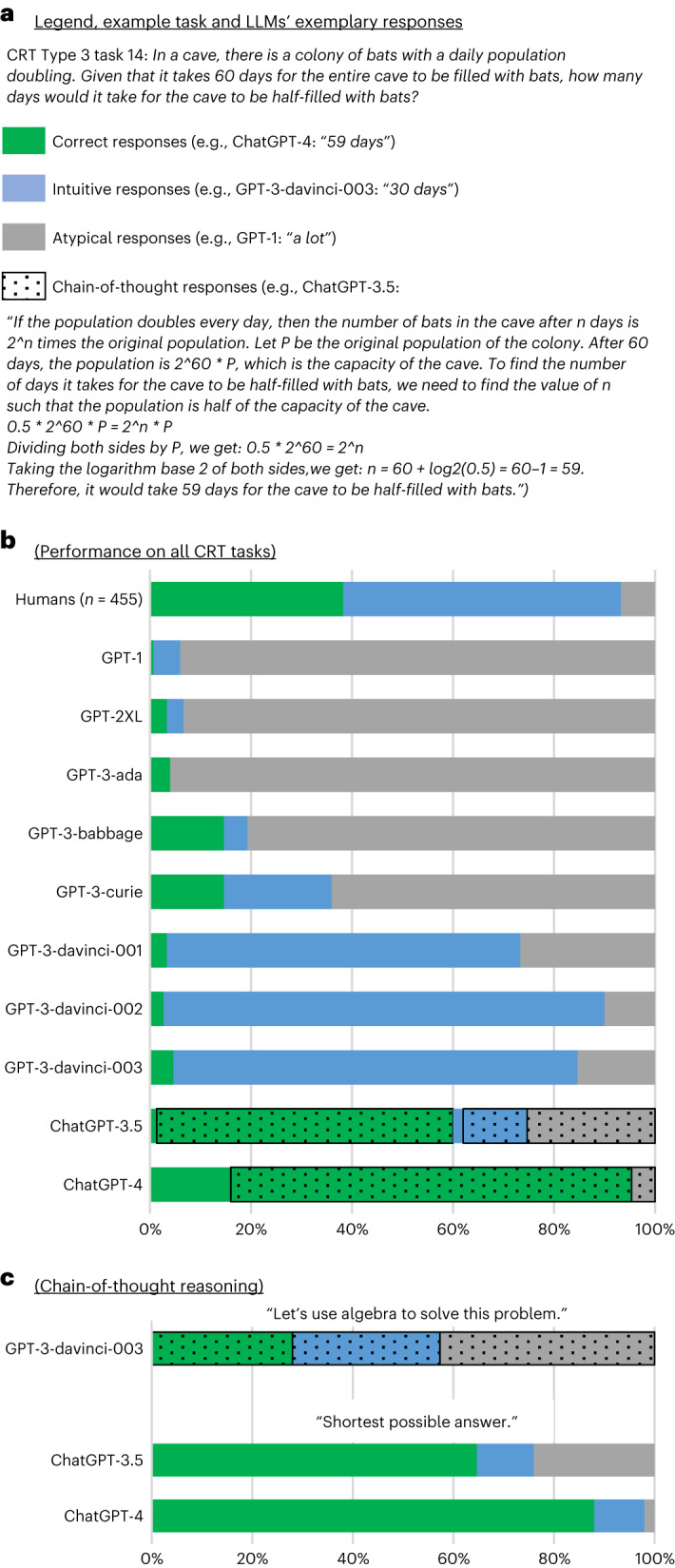
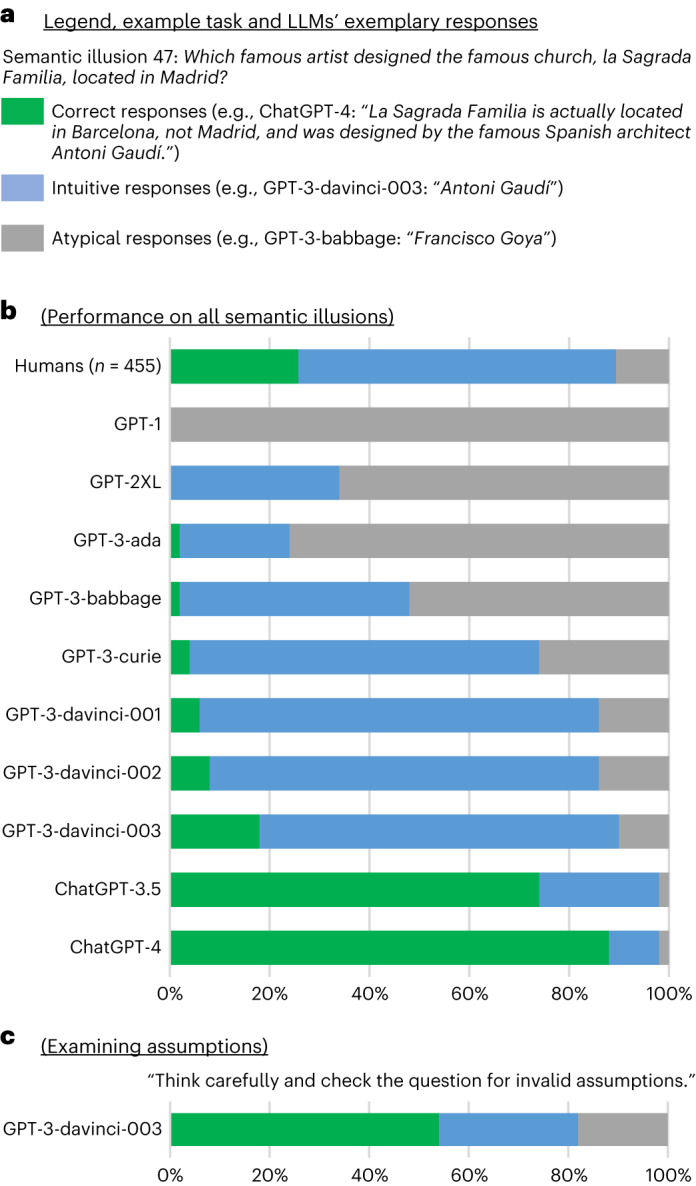
We design a battery of semantic illusions and cognitive reflection tests, aimed to elicit intuitive yet erroneous responses. We administer these tasks, traditionally used to study reasoning and decision-making in humans, to OpenAI’s generative pre-trained transformer model family. The results show that as the models expand in size and linguistic proficiency they increasingly display human-like intuitive system 1 thinking and associated cognitive errors. This pattern shifts notably with the introduction of ChatGPT models, which tend to respond correctly, avoiding the traps embedded in the tasks. Both ChatGPT-3.5 and 4 utilize the input–output context window to engage in chain-of-thought reasoning, reminiscent of how people use notepads to support their system 2 thinking. Yet, they remain accurate even when prevented from engaging in chain-of-thought reasoning, indicating that their system-1-like next-word generation processes are more accurate than those of older models. Our findings highlight the value of applying psychological methodologies to study large language models, as this can uncover previously undetected emergent characteristics.
Overview
The claims and statistics of this paper haven’t been checked yet.
Free: it reads the open-access text and checks the first 5 claims that cite a source we can check. Create a free account to check every claim.
Integrity signals
Registry
Cites
Statistics
Figures
Verification
Claims the paper makes
The claims and statistics of this paper haven’t been checked yet.
Free: it reads the open-access text and checks the first 5 claims that cite a source we can check. Create a free account to check every claim.
Claims other papers make about this one
Each is checked against this paper’s own text: does it say what the citing paper says it does?
The source backs part of the claim, not all of it — or backs it for a different population, condition or comparison.
In the citing paper
“To effectively predict the next word in a sentence generated by a human, LLMs must model not only grammar and vocabulary but also the psychological processes humans use when generating language (35, 36).”
From Evaluating large language models in theory of mind tasks (2024) · cites this paper as [35]
Experimental — accuracy not yet measuredThe source backs part of the claim, not all of it — or backs it for a different population, condition or comparison.
In the citing paper
“Interestingly, there is evidence from several studies showing that, while the previous generation of models frequently exhibited human-like heuristics and biases, they have largely disappeared in the latest generation of LLMs (Chen, Liu, et al., 2023;Hagendorff et al., 2023).”
From Machine Psychology (2023) · cites this paper as Hagendorff et al., 2023
Experimental — accuracy not yet measuredThe cited source says what the claim attributes to it.
In the citing paper
“LLMs trained to predict the next word in a sentence surprised their creators not only by their inclination to be racist and sexist (34) but also by their emergent reasoning and arithmetic skills (35), ability to translate between languages (22), and propensity to semantic priming (36).”
From Evaluating large language models in theory of mind tasks (2024) · cites this paper as [35]
In the citing paper
“These learning scaffolds ensure that learners verify, reason, and transfer rather than merely consuming fl uent text 166,169 .”
From A Metacognitive Approach to Learning and Performance in Human-AI Interaction (2026) · cites this paper as [169]
Self-check
Percentages, sums and reported differences re-computed from the paper’s own numbers.
The self-check needs the paper’s full text.
Citations
Cites
Tversky, A., & Kahneman, D. (1974) · Science · doi:10.1126/science.185.4157.1124 · Cited by 28,810
Language Models are Few-Shot Learners
Brown, T. B., Mann, B., Ryder, N., Subbiah, M., Kaplan, J., Dhariwal, P., Neelakantan, A., Shyam, P., Sastry, G., Askell, A., et al. (2020) · arXiv · doi:10.48550/arxiv.2005.14165 · Cited by 23,372
Deep reinforcement learning from human preferences
Christiano, P., Leike, J., Brown, T. B., Martic, M., Legg, S., & Amodei, D. (2017) · arXiv · doi:10.48550/arxiv.1706.03741 · Cited by 7,379 · cited 1×
“Second, it could be that the shift was driven by the employment of reinforcement learning from human feedback 18,19 .”
BackgroundCognitive Reflection and Decision Making
Frederick, S. (2005) · Journal of Economic Perspectives · doi:10.1257/089533005775196732 · Cited by 5,256
Chain-Of-Thought Prompting Elicits Reasoning in Large Language Models
Wei, J., Wang, X., Schuurmans, D., Bosma, M., Ichter, B., Xia, F., Chi, E., Le, Q. V., & Zhou, D. (2022) · Advances in Neural Information Processing Systems 35 · doi:10.52202/068431-1800 · Cited by 4,505
Chain-of-Thought Prompting Elicits Reasoning in Large Language Models
Wei, J., Wang, X., Schuurmans, D., Bosma, M., Ichter, B., Xia, F., Chi, E., Le, Q., & Zhou, D. (2022) · arXiv · doi:10.48550/arxiv.2201.11903 · Cited by 4,263 · cited 2×
“Yet, past research and the results presented here suggest that, like humans, LLMs can also engage in system-2-like cognitive processes 4 .”
ResultTraining language models to follow instructions with human feedback
Ouyang, L., Wu, J., Jiang, X., Almeida, D., Wainwright, C. L., Mishkin, P., Zhang, C., Agarwal, S., Slama, K., Ray, A., et al. (2022) · arXiv · doi:10.48550/arxiv.2203.02155 · Cited by 4,208 · cited 2×
“While reinforcement learning from human feedback has been employed since GPT-3 text-davinci-002 19 , this procedure was enhanced in ChatGPT training: AI trainers played both sides: the user and an AI assistant 20 .”
BackgroundMethodThe empirical case for two systems of reasoning.
Sloman, S. A. (1996) · Psychological Bulletin · doi:10.1037//0033-2909.119.1.3 · Cited by 3,848
Emergent Abilities of Large Language Models
Wei, J., Tay, Y., Bommasani, R., Raffel, C., Zoph, B., Borgeaud, S., Yogatama, D., Bosma, M., Zhou, D., Metzler, D., et al. (2022) · arXiv · doi:10.48550/arxiv.2206.07682 · Cited by 1,264
The Cognitive Reflection Test as a predictor of performance on heuristics-and-biases tasks
Toplak, M. E., West, R. F., & Stanovich, K. E. (2011) · Memory & Cognition · doi:10.3758/s13421-011-0104-1 · Cited by 1,047 · cited 1×
“In humans, CRT and semantic illusions are good predictors of ability to engage in unbiased, reflective, and rational decision-making, as well as overall cognitive ability.(17,32) Thus, LLMs’ ability to solve CRT and semantic illusions should increase as their overall ability increases.”
Background
Research works printed but not linked: 4
- Radford, A., Narasimhan, K., Salimans, T. & Sutskever, I. Improving language understanding by generative pre-training. Preprint at https://paperswithcode.com/paper/improving-language-understanding-by (2018).
- Radford, A. et al. Language models are unsupervised multitask learners. Preprint at https://paperswithcode.com/paper/language-models-are-unsupervised-multitask (2019).
- Jones, E. & Steinhardt, J. Capturing failures of large language models via human cognitive biases. 36th Conference on Neural Information Processing Systems (2022).
- Nye, M., Tessler, M. H., Tenenbaum, J. B. & Lake, B. M. Improving coherence and consistency in neural sequence models with dual-system, neuro-symbolic reasoning. 35th Conference on Neural Information Processing Systems (2021).
Cited by
Items 301–329 of 329
Chavez, A. D. J. G., Gutiérrez-López, E., Flores, D., Gonzalez-Fraga, J. A., Montes-y-Gómez, M., & Chávez, E. (2026) · IEEE Access · doi:10.1109/access.2026.3717256
“Previous work suggests that LLMs exhibit human-like behavior in certain aspects of reasoning [63], [64], for example, it has been observed that these models employ internal representations of color-related words, which tend to reflect objective facts about human perception of color [20], [65].”
Beuria, J. (2026) · SSRN Electronic Journal · doi:10.2139/ssrn.6504379
Responsible AI Needs Neural Constraints, Not Just Post-Hoc GovernancePreprint
Caglar, L. R., & Lin, B. (2026) · SSRN Electronic Journal · doi:10.2139/ssrn.6864239
Shopping By Algorithm: How Agentic AI Deploys Human Heuristics as a Surrogate ConsumerPreprint
Wadi, D., & Ma, Y. (2026) · SSRN Electronic Journal · doi:10.2139/ssrn.6938899
Shen, Y., Yang, W., & Shen, Y. (2026) · IEEE Access · doi:10.1109/access.2026.3717981
“Cognitive-bias work in LLMs [2], [15], [16], [17] probes biases inside models on medical or general benchmarks, not bias expressed in corporate disclosures, and stops at detection without mitigation.”
Chen, Z.-S., Jiao, W.-C., Tsang, Y.-P., Wu, C.-H., & Wang, X.-J. (2026) · Group Decision and Negotiation · doi:10.1007/s10726-026-10017-w · Cited by 1
“Parallel studies indicate that LLMs replicate a spectrum of human cognitive biases within behavioral economic experiments, notably manifesting heightened loss aversion in Pros - pect Theory tasks compared to human baselines (Hagendorff et al. 2023 ; Acerbi and Stubbersfield 2023).”
Khan, S., Samuelsson, J. G., Cai, X., Natarajan, K., & Madhavan, S. (2026) · Drug Discovery Today · doi:10.1016/j.drudis.2026.104754 · Cited by 1
Dougherty, J. P., & Gallenstein, R. (2026) · AI & Society · doi:10.1007/s00146-026-03240-1
“It may be that models display less cognitive biases as models become more advanced, suggesting that recent advancement in AI models make them less similar to humans in some respects (Hagendorff et al. 2023).”
A moral Turing test: How belief and source shape detection of and agreement with LLM judgments
Garcia, B., Qian, C., & Palminteri, S. (2026) · PLoS ONE · doi:10.1371/journal.pone.0353391
Theory-Guided Deception Detection: A RAG-Based Artificial Intelligence ExplorationPreprint
Markowitz, D. M., & Levine, T. R. (2026) · arXiv (Cornell University) · doi:10.48550/arxiv.2608.08881
“Different models have different reasoning abilities (Hagendorff et al., 2023; Moreira, 2026; Parmar et al., 2024), suggesting it is also important to explore how various LLMs perform on such judgment and decision-making tasks like deception detection.”
Oechsner, C., Leusmann, J., Zhang, X., Weber, T., Butz, A. M., & Mayer, S. (2026) · Mensch und Computer (MuC) · doi:10.1145/3820253.3820269
Zhao, L., Zheng, H., Zhu, B., & Liu, C. (2026) · Decision Support Systems · doi:10.1016/j.dss.2026.114761 · Cited by 1
A structured framework for human–AI resemblance: Evidence, inference and perception
Wang, P., Law, E. L., Zou, L., Jiang, Y., Hertwig, R., PAAS, F. G. W. C., & Laureys, S. (2026) · Physics of Life Reviews · doi:10.1016/j.plrev.2026.09.003
Mapping the Emerging Social Science of Large Language ModelsPreprint
Zhao, Z., Yang, Y., Jia, X., Dong, Z., & Wang, C. (2026) · arXiv (Cornell University) · doi:10.48550/arxiv.2609.07598
Robber Bots: Autonomous AI Agents Mirroring the Darker Side of Human Commerce
Soltes, E. F., Petersson, L., Jung, H., & Wennström, A. (2026) · Harvard Data Science Review · doi:10.1162/99608f92.8f4a0273 · Cited by 1
Ideology by Alphabet: Option Order and the Measurement of Machine Political PreferencesPreprint
Olah, T., Erdey, L., Tőkés, T., & Nádasi, L. (2026) · Research Square · doi:10.21203/rs.3.rs-11063104/v1
Enterprise AI Governance Architecture: Integrating Security, Risk, Compliance, and Human Oversight
Bellala, K. R. (2026) · International Journal of Science and Research (IJSR) · doi:10.21275/sr26919094233
Generating Quality Word-Association Puzzles
Khadka, A., Nassar, M., Islam, M. A., & Kaddoura, S. (2026) · Annals of Computer Science and Information Systems · doi:10.15439/2026f7130
“We apply knowledge distillation for capability transfer in lateral-thinking puzzle generation, a task that requires “System 2 thinking” [12].”
Maheshwari, S., & Singhal, P. (2026) · ACM Conference on Recommender Systems (RecSys) · doi:10.1145/3773078.3831807
Abduction In Silico: Large Language Models Replicate Human Inference to the Best Explanation
Douven, I. (2026) · Minds and Machines · doi:10.1007/s11023-026-09803-x
“…ranging from large proprietary systems (e.g., Using already published experimental materials raises the concern of data contamination (see, e.g., Hagendorff et al., 2023a): the original scenarios from Douven and Mirabile (2018) may well have been part of the models’ training corpora, so that…”
Karakaş, S., Durmaz, N., & Yeşilçayır, M. (2026) · Al-Qarawiyyin Jurnal Ilmu Ushuluddin · doi:10.64691/7hnxtq10
“Increasing model parameters merely enriches the network of probabilistic relations without transforming its existence into an intellectual subject (Hagendorff, Fabi, & Kosinski, 2023).”
The AI Trias Politica: Redefining Roles in the Modern Workplace
Ameryan, M., van den Bosch, P., Emerencia, A. C., & Blaauw, F. (2026) · IFIP advances in information and communication technology · doi:10.1007/978-3-032-41234-8_3
Quince, Z., Lindqvist, A. L., & Chen, P. (2025) · Research in Engineering Education Symposium (REES) · doi:10.52202/086293-0054 · Cited by 1
DeSchryver, M., Henriksen, D., Leahy, A. S., & Lindsay, S. G. (2026) · Oxford University Press eBooks · doi:10.1093/9780197832431.003.0005 · Cited by 1
Modeling urban perception with large language models: A systematic review
Wedyan, M., Saeidi-Rizi, F., & Peng, T. (2026) · Cities · doi:10.1016/j.cities.2026.107744
Questioning Plausibility and Creativity in Collaborative LLM-Assisted 3D Design among Humans and AI
Xuan, V. D., Murphy, D., Tran, K.-T., Vu, Q. G., O’Sullivan, B., & Nguyen, H. D. (2026) · Procedia Computer Science · doi:10.1016/j.procs.2026.10.376
Nudging Decision Models: Do Digital Nudges Steer Fast, Generation-Free AI Agents?Preprint
Kaltenpoth, S., Halimeh, H., Bösch, K., & Müller, O. (2026) · arXiv (Cornell University) · doi:10.48550/arxiv.2611.09264
Imperfectly Imperfect: Evaluating Graded Cognitive Diversity in LLM Persona SimulationsPreprint
Weatherhead, S., Newell, B., Belbasis, A., & Salim, F. D. (2026) · arXiv (Cornell University) · doi:10.48550/arxiv.2611.10508
Zengi, C. A., & KILIÇASLAN, E. (2026) · Societies · doi:10.3390/soc16110404
Metadata
- Authors
- Hagendorff, T., Fabi, S., & Kosinski, M.
- Affiliations
- University of Stuttgart (DE)
- University of California San Diego (US)
- Venue
- Nature Computational Science
- Published
- 2023-10-05
- Volume
- 3
- Issue
- 10
- Pages
- 833-838
- ISSN
- 2662-8457 (ISSN-L)
- PMC
- PMC10766525
- OpenAlex
- W4387378202
- Semantic Scholar
- 0bfc05adcddd4fe5d1335d96cc313c41526d4558
- Cited by
- 243
- References
- 16
- Citations by year
- 2026: 87 · 2025: 78 · 2024: 71 · 2023: 7
- FWCI
- 22.91
- Type
- journal article
- Language
- en
- Open access
- hybrid
- doi.org
- Licence
- cc-by
- creativecommons.org/licenses/by/4.0 (tdm)
- creativecommons.org/licenses/by/4.0 (vor)
- Locations
- Nature Computational Science (publishedVersion, cc-by)
- Funders
- Ministerium für Wissenschaft, Forschung und Kunst Baden-Württemberg (Az. 33-7533-9-19/54/5)
- Interchange Forum for Reflecting on Intelligent Systems (IRIS) at the University of Stuttgart
- Topics
- Physical Sciences › Computer Science › Artificial Intelligence › Topic Modeling
- Physical Sciences › Computer Science › Artificial Intelligence › Natural Language Processing Techniques
- Social Sciences › Decision Sciences › General Decision Sciences › Decision-Making and Behavioral Economics
- Keywords
- large language models, ChatGPT, intuitive thinking, cognitive biases, System 2 thinking, chain-of-thought reasoning, semantic illusions, cognitive reflection, model size, context window, emergent behavior, human-like reasoning
About these checks
Registry, retraction, Cites and statistics results are computed, not judged, with one exception: a printed reference that no index lists is read once by a model before it counts as a citation error. Claims are extracted by a model and kept only when their quote appears verbatim in the text; each cited source is then checked, with a model’s help, for whether it says what the claim relies on. Those verdicts can be wrong — read the claim’s quote and the cited source before relying on one.
Statistics and arithmetic are recomputed, not judged.
Confidence bands are shown only for fields calibrated on our annotated test set. None is calibrated yet, so no band is shown.
What counts as a claim ›How we measure confidence ›How we check this ›
Are you an author, or do you see a problem with this page? Request a review
Data sources
Bibliographic data: Semantic Scholar, OpenAlex, Crossref.
Contains information from the Semantic Scholar Academic Graph Datasets, made available under the ODC Attribution License (ODC-BY 1.0).
Semantic Scholar’s data is described in: Kinney, R., et al. (2023). The Semantic Scholar Open Data Platform. arXiv:2301.10140.
