

Human-like intuitive behavior and reasoning biases emerged in large language models but disappeared in ChatGPT
Open accessThe DOI matches its Crossref record; 21 of the 21 references it cites were found in a registry or an index.
Abstract
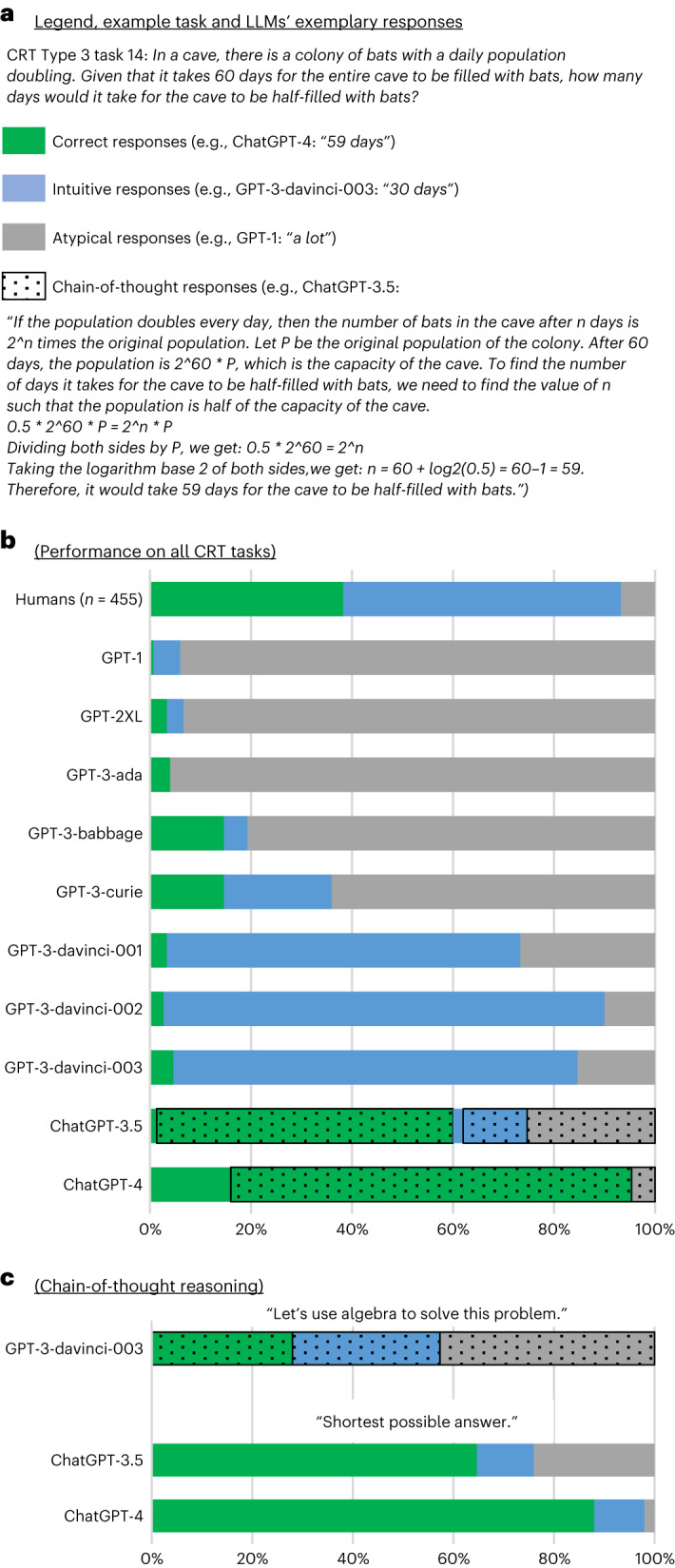
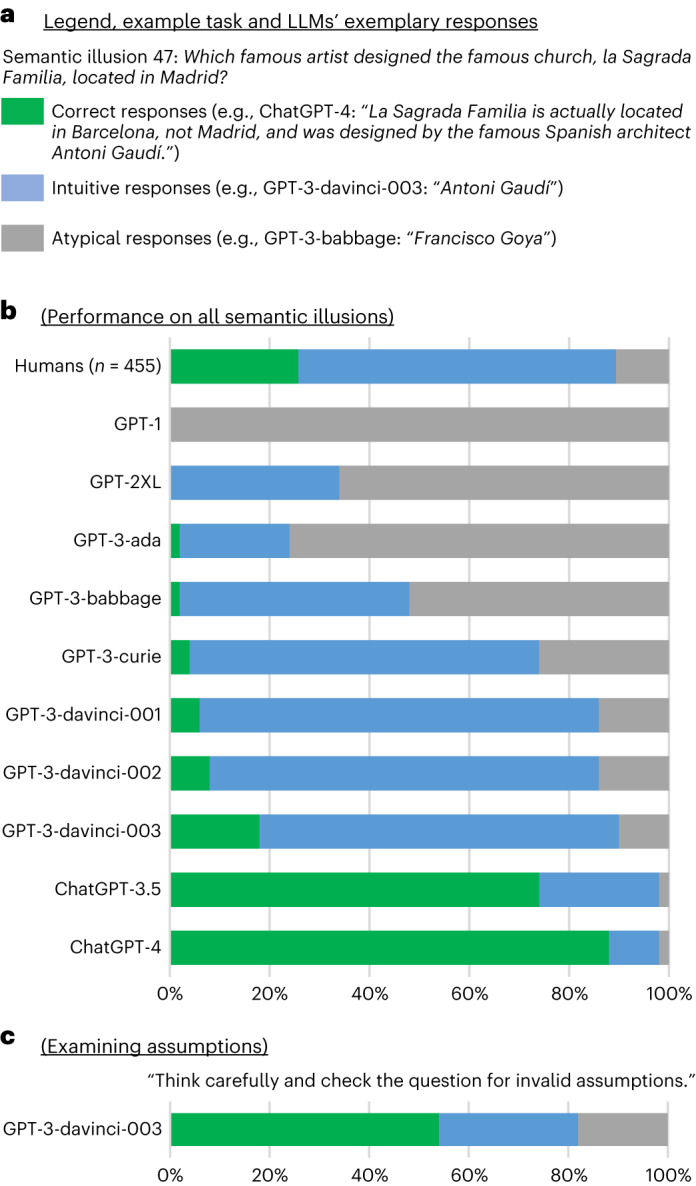
We design a battery of semantic illusions and cognitive reflection tests, aimed to elicit intuitive yet erroneous responses. We administer these tasks, traditionally used to study reasoning and decision-making in humans, to OpenAI’s generative pre-trained transformer model family. The results show that as the models expand in size and linguistic proficiency they increasingly display human-like intuitive system 1 thinking and associated cognitive errors. This pattern shifts notably with the introduction of ChatGPT models, which tend to respond correctly, avoiding the traps embedded in the tasks. Both ChatGPT-3.5 and 4 utilize the input–output context window to engage in chain-of-thought reasoning, reminiscent of how people use notepads to support their system 2 thinking. Yet, they remain accurate even when prevented from engaging in chain-of-thought reasoning, indicating that their system-1-like next-word generation processes are more accurate than those of older models. Our findings highlight the value of applying psychological methodologies to study large language models, as this can uncover previously undetected emergent characteristics.
Overview
The claims and statistics of this paper haven’t been checked yet.
Free: it reads the open-access text and checks the first 5 claims that cite a source we can check. Create a free account to check every claim.
Integrity signals
Registry
Cites
Statistics
Figures
Verification
Claims the paper makes
The claims and statistics of this paper haven’t been checked yet.
Free: it reads the open-access text and checks the first 5 claims that cite a source we can check. Create a free account to check every claim.
Claims other papers make about this one
Each is checked against this paper’s own text: does it say what the citing paper says it does?
The source backs part of the claim, not all of it — or backs it for a different population, condition or comparison.
In the citing paper
“To effectively predict the next word in a sentence generated by a human, LLMs must model not only grammar and vocabulary but also the psychological processes humans use when generating language (35, 36).”
From Evaluating large language models in theory of mind tasks (2024) · cites this paper as [35]
Experimental — accuracy not yet measuredThe source backs part of the claim, not all of it — or backs it for a different population, condition or comparison.
In the citing paper
“Interestingly, there is evidence from several studies showing that, while the previous generation of models frequently exhibited human-like heuristics and biases, they have largely disappeared in the latest generation of LLMs (Chen, Liu, et al., 2023;Hagendorff et al., 2023).”
From Machine Psychology (2023) · cites this paper as Hagendorff et al., 2023
Experimental — accuracy not yet measuredThe cited source says what the claim attributes to it.
In the citing paper
“LLMs trained to predict the next word in a sentence surprised their creators not only by their inclination to be racist and sexist (34) but also by their emergent reasoning and arithmetic skills (35), ability to translate between languages (22), and propensity to semantic priming (36).”
From Evaluating large language models in theory of mind tasks (2024) · cites this paper as [35]
In the citing paper
“These learning scaffolds ensure that learners verify, reason, and transfer rather than merely consuming fl uent text 166,169 .”
From A Metacognitive Approach to Learning and Performance in Human-AI Interaction (2026) · cites this paper as [169]
Self-check
Percentages, sums and reported differences re-computed from the paper’s own numbers.
The self-check needs the paper’s full text.
Citations
Cites
Tversky, A., & Kahneman, D. (1974) · Science · doi:10.1126/science.185.4157.1124 · Cited by 28,810
Language Models are Few-Shot Learners
Brown, T. B., Mann, B., Ryder, N., Subbiah, M., Kaplan, J., Dhariwal, P., Neelakantan, A., Shyam, P., Sastry, G., Askell, A., et al. (2020) · arXiv · doi:10.48550/arxiv.2005.14165 · Cited by 23,372
Deep reinforcement learning from human preferences
Christiano, P., Leike, J., Brown, T. B., Martic, M., Legg, S., & Amodei, D. (2017) · arXiv · doi:10.48550/arxiv.1706.03741 · Cited by 7,379 · cited 1×
“Second, it could be that the shift was driven by the employment of reinforcement learning from human feedback 18,19 .”
BackgroundCognitive Reflection and Decision Making
Frederick, S. (2005) · Journal of Economic Perspectives · doi:10.1257/089533005775196732 · Cited by 5,256
Chain-Of-Thought Prompting Elicits Reasoning in Large Language Models
Wei, J., Wang, X., Schuurmans, D., Bosma, M., Ichter, B., Xia, F., Chi, E., Le, Q. V., & Zhou, D. (2022) · Advances in Neural Information Processing Systems 35 · doi:10.52202/068431-1800 · Cited by 4,505
Chain-of-Thought Prompting Elicits Reasoning in Large Language Models
Wei, J., Wang, X., Schuurmans, D., Bosma, M., Ichter, B., Xia, F., Chi, E., Le, Q., & Zhou, D. (2022) · arXiv · doi:10.48550/arxiv.2201.11903 · Cited by 4,263 · cited 2×
“Yet, past research and the results presented here suggest that, like humans, LLMs can also engage in system-2-like cognitive processes 4 .”
ResultTraining language models to follow instructions with human feedback
Ouyang, L., Wu, J., Jiang, X., Almeida, D., Wainwright, C. L., Mishkin, P., Zhang, C., Agarwal, S., Slama, K., Ray, A., et al. (2022) · arXiv · doi:10.48550/arxiv.2203.02155 · Cited by 4,208 · cited 2×
“While reinforcement learning from human feedback has been employed since GPT-3 text-davinci-002 19 , this procedure was enhanced in ChatGPT training: AI trainers played both sides: the user and an AI assistant 20 .”
BackgroundMethodThe empirical case for two systems of reasoning.
Sloman, S. A. (1996) · Psychological Bulletin · doi:10.1037//0033-2909.119.1.3 · Cited by 3,848
Emergent Abilities of Large Language Models
Wei, J., Tay, Y., Bommasani, R., Raffel, C., Zoph, B., Borgeaud, S., Yogatama, D., Bosma, M., Zhou, D., Metzler, D., et al. (2022) · arXiv · doi:10.48550/arxiv.2206.07682 · Cited by 1,264
The Cognitive Reflection Test as a predictor of performance on heuristics-and-biases tasks
Toplak, M. E., West, R. F., & Stanovich, K. E. (2011) · Memory & Cognition · doi:10.3758/s13421-011-0104-1 · Cited by 1,047 · cited 1×
“In humans, CRT and semantic illusions are good predictors of ability to engage in unbiased, reflective, and rational decision-making, as well as overall cognitive ability.(17,32) Thus, LLMs’ ability to solve CRT and semantic illusions should increase as their overall ability increases.”
Background
Research works printed but not linked: 4
- Radford, A., Narasimhan, K., Salimans, T. & Sutskever, I. Improving language understanding by generative pre-training. Preprint at https://paperswithcode.com/paper/improving-language-understanding-by (2018).
- Radford, A. et al. Language models are unsupervised multitask learners. Preprint at https://paperswithcode.com/paper/language-models-are-unsupervised-multitask (2019).
- Jones, E. & Steinhardt, J. Capturing failures of large language models via human cognitive biases. 36th Conference on Neural Information Processing Systems (2022).
- Nye, M., Tessler, M. H., Tenenbaum, J. B. & Lake, B. M. Improving coherence and consistency in neural sequence models with dual-system, neuro-symbolic reasoning. 35th Conference on Neural Information Processing Systems (2021).
Cited by
Items 201–300 of 329
Moklis, M. H., Avian, C., Kolor, E., Rubel, M., & Cross, J. S. (2026) · Studies in Infrastructure and Control · doi:10.1007/978-3-032-17462-8_12 · Cited by 5
LLMs displaying less cognitive bias are not necessarily better decision makers
Dentella, V., Marelli, M., & Rinaldi, L. (2026) · Nature Machine Intelligence · doi:10.1038/s42256-026-01208-w · Cited by 2
de Faria, A. D. S. R., da Silveira, M. V., & dos Santos, A. C. F. (2026) · Journal of Environment and Sustainability Education · doi:10.62672/joease.v4i1.174 · Cited by 1
“…in detail, the present study draws on these findings to inform its research design, using a problem known to elicit conceptual difficulties in human learners as a diagnostic tool to examine whether similar reasoning limitations emerge in AI systems (Hagendorff et al., 2022; Yax et al., 2023).”
Do large language model outputs exhibit algorithm aversion? A case study using GPT-3.5
Liu, Z., He, X., Xie, Y., & Zhou, R. (2026) · International Journal of Industrial Ergonomics · doi:10.1016/j.ergon.2026.103937 · Cited by 2
Hawkins, T., Cassenti, D. N., & Zaroukian, E. G. (2026) · Behavior Research Methods · doi:10.3758/s13428-026-02979-1 · Cited by 1
Exploring attribution bias in LLMs: Social influences and prompt-based mitigation
Jiang, L., Cao, J., Zhu, G., & Wang, Y. (2026) · Technology in Society · doi:10.1016/j.techsoc.2026.103361 · Cited by 1
Deck, L., Allmendinger, S., Müller, L., & Kühl, N. (2026) · ACM Conference on Fairness, Accountability, and Transparency (FAccT) · doi:10.1145/3805689.3806731 · Cited by 1
Pagliaro, A. (2026) · Electronics · doi:10.3390/electronics15112428 · Cited by 1
Exploring migration research with large language model: methods and insights
Iacus, S. M., Qi, H., & Han, J. (2026) · Royal Society Open Science · doi:10.1098/rsos.251577 · Cited by 1
Puutio, T. A., & Do, M. (2026) · Group Decision and Negotiation · doi:10.1007/s10726-026-10006-z · Cited by 2
“…example, Binz and Schulz (2023) demonstrate that GPT-3 exhibits choice patterns consistent with established models from cognitive psychology, while other studies document human-like attitudes toward risk, loss aversion, and probability weighting in LLM-generated decisions (Hagendorff et al. 2023).”
Simulating strategic interactions with AI agents
Tranchero, M., Brenninkmeijer, C.-F., Murugan, A., & Nagaraj, A. (2026) · Strategic Management Journal · doi:10.1002/smj.70112 · Cited by 5
A Case Study on the Application of GAI in Elementary Science Education
Jiang, X., Wan, Z., & Deng, Y. (2026) · International Conference on Computer Science and Technologies in Education (CSTE) · doi:10.1109/cste69562.2026.11649675 · Cited by 1
“GAI aims to create new content, such as text, images, audio, and video, based on patterns learned from training data, which has attracted significant attention [4] and demonstrated notable advantages comparable to human-level cognition [5].”
Hu, J., Li, Y., Song, R., Lyu, K., & Chang, Y. (2026) · Artificial Intelligence · doi:10.1016/j.artint.2026.104625 · Cited by 1
Large language models for computational social science
Xu, F., Shao, C., Chen, L., Zeng, Q., Chen, Z., Sukiennik, N., Wang, J., Gao, C., Wang, H., Lian, J., et al. (2026) · Nature Human Behaviour · doi:10.1038/s41562-026-02539-9 · Cited by 2
Decoding the AI’s Gaze: Unraveling ChatGPT’s Evaluation of Poetic Creativity
Fischer, N., Dischinger, E., & Gunser, V. E. (2024) · Communications in computer and information science · doi:10.1007/978-3-031-62110-9_19 · Cited by 2
Rationality of Thought Improves Reasoning in Large Language Models
Gou, T., Zhang, B., Sun, Z., Wang, J., Liu, F., Wang, Y., & Wang, J. (2024) · Lecture notes in computer science · doi:10.1007/978-981-97-5501-1_26 · Cited by 6
On the Cultural Sensitivity of Large Language Models: GPT's Ability to Simulate Human Self-Concept
Luo, Y., Du, J. S., & Qiu, L. (2024) · International Conference on Behavioral, Economic, and Socio-Cultural Computing · doi:10.1109/besc64747.2024.10780488 · Cited by 3
Ferreira, G., Amidei, J., Nieto, R., & Kaltenbrunner, A. (2025) · ACM Transactions on Computing for Healthcare · doi:10.1145/3712301 · Cited by 3
Ask, T. F., Lugo, R. G., Sütterlin, S., Canham, M., Hermansen, D., & Knox, B. J. (2023) · HAL · doi:10.14339/sto-mp-hfm-361-p12-pdf · Cited by 1
Quantifying Uncert-AI-nty: Testing the Accuracy of LLMs’ Confidence JudgmentsPreprint
Cash, T. N., Oppenheimer, D. M., Christie, S., & Devgan, M. (2025) · PsyArXiv (OSF Preprints) · doi:10.31234/osf.io/47df5_v3 · Cited by 1
Large Language Models in the Workplace: A Social PerspectivePreprint
Li, M., Wei, L., & Yao, Y. (2025) · SSRN Electronic Journal · doi:10.2139/ssrn.5222006 · Cited by 1
How Human is the Machine? Evidence from 66,000 Conversations with Large Language ModelsPreprint
Stamatogiannakisa, A., Ghodsinia, A., Etminanrad, S., Gonçalves, D., & Santos, D. (2025) · SSRN Electronic Journal · doi:10.2139/ssrn.5425016 · Cited by 1
Designing AI-Agents with Personalities: A Psychometric ApproachPreprint
Huang, M., Zhang, X., Soto, C. J., & Evans, J. A. (2025) · PsyArXiv (OSF Preprints) · doi:10.31234/osf.io/2kfw3_v2 · Cited by 2
Strategic Reflectivism In Intelligent SystemsPreprint
Byrd, N. (2025) · RePEc: Research Papers in Economics · doi:10.48550/arxiv.2505.22987 · Cited by 1
“…signs of reflective thinking [10, 45] (see “correct-but-unreflective” in Table 1 ), Hagendorf and colleagues found that language models continued to outperform humans on reflection tests even when they could not exhibit signs of reflective thinking, such as chain-of-thought reasoning [23] ( Fig.”
Zgliczyński-Cuber, T. (2025) · arXiv (Cornell University) · doi:10.48550/arxiv.2507.11552 · Cited by 1
Wihbey, J., & D'Alonzo, S. (2025) · SSRN Electronic Journal · doi:10.2139/ssrn.5533958 · Cited by 1
Artificially Biased Intelligence: Does AI Think Like a Human Investor?Preprint
Keshavarz, J., Seagraves, C., & Sirmans, S. (2026) · SSRN Electronic Journal · doi:10.2139/ssrn.5998954 · Cited by 4
Thakur, A., Murray, T., Rodriguez, P., & Hilbert, M. (2026) · SSRN Electronic Journal · doi:10.2139/ssrn.6083909 · Cited by 2
Large language model research: Knowledge structure, thematic evolution, and future research agendaPreprint
Cao, X., Yang, B., Yang, X., Wang, Q., & Cao, N. (2026) · Research Square · doi:10.21203/rs.3.rs-8876513/v1 · Cited by 1
Miklian, J., Hoelscher, K., & Katsos, J. E. (2026) · SSRN Electronic Journal · doi:10.2139/ssrn.6210099 · Cited by 1
Halimeh, H., Kaltenpoth, S., Bösch, K., & Müller, O. (2026) · SSRN Electronic Journal · doi:10.2139/ssrn.6582539 · Cited by 1
AnchorBench: A Multi-Pathway Benchmark for the Anchoring Effect in LLMsPreprint
Borjigin, Y., Hermann, A., Cyron, C. J., & Aydin, R. C. (2026) · arXiv (Cornell University) · doi:10.48550/arxiv.2608.14320 · Cited by 4
“Recent work shows that LLMs exhibit broader human-like cognitive biases across reasoning and decision-making (Jones & Steinhardt, 2022; Hagendorff et al., 2023; Echterhoff et al., 2024; Itzhak et al., 2024), and more directly that anchoring appears in LLMs (Nguyen, 2024; Lou & Sun, 2025; Huang et…”
Evaluation of Multi-Turn Consistency in LLM Agents: Survival Analysis and Failure-Rationale TaxonomyPreprint
Bogdanov, I., Manakina, O., & Lung, C. (2026) · arXiv (Cornell University) · doi:10.48550/arxiv.2609.29508 · Cited by 2
Understanding large language models demands distinguishing human projection from machine cognition
Li, L., Teng, Y., Wang, Y., & Hu, X. (2026) · Communications Psychology · doi:10.1038/s44271-026-00508-6
“Forinstance, psychology providesscalesandteststo evaluate LLM ’ s cognitive biases 7 ; neuroscience investigates the features and circuitswithinLLM 8 ;statisticalphysicsprovidesacomplexitydescriptionof the emergent ability 9 and scaling law 10 ; and economics likens LLM to a market that aggregates…”
When Your AI Agent Succumbs to Peer-Pressure: Studying Opinion-Change Dynamics of LLMs
Mehdizadeh, A., & Hilbert, M. (2025) · arXiv · doi:10.48550/arxiv.2510.19107
“Moreover, the capacity of LLMs to generate structured arguments, simulate hypothetical reasoning, and operate under uncertainty [34, 35, 36] opens up new research opportunities.”
How Multimodal can Predict Human JudgmentPreprint
Du, M. (2023) · PsyArXiv (OSF Preprints) · doi:10.31234/osf.io/ejrvk
Large language models as linguistic simulators and cognitive models in human researchPreprint
Lin, Z. (2024) · PsyArXiv (OSF Preprints) · doi:10.31234/osf.io/uqxcb
Yan, T., Zhang, Y., Han, J., Liu, Z., Barnhart, W. R., Sun, S., Zhou, J., Ji, F., & He, J. (2024) · doi:10.2196/preprints.58054
Exploring the intricacies of human memory and its analogous representation in ChatGPT
Hamam, H. (2024) · Indonesian Journal of Electrical Engineering and Computer Science · doi:10.11591/ijeecs.v34.i3.pp1760-1769
“This study aims to delve deeper into this analogy, exploring how AI models [2]–[4], specifically ChatGPT, replicate the associative processes of human memory.”
BackgroundKrupıć, D., Matijević, D., Šuvak, N., Ševerdija, D., & Maltar, J. (2024) · Research Square · doi:10.21203/rs.3.rs-4257623/v1
Coninck, D. D., Devillé, C., Bavel, J. V., de Winter, P., Toelen, J., & Leeuwen, K. G. V. (2024) · Families Systems & Health · doi:10.1037/fsh0000883
Uhler, L., Jordan, V., Buder, J., Huff, M., & Papenmeier, F. (2026) · Communications Psychology · doi:10.1038/s44271-026-00403-0
“33,34), which could lead to the assumption that addition bias is less prevalent in the LLM than in humans.”
Huang, K., Liu, C., Wu, C.-C., Sheu, B., & Yang, C. (2024) · doi:10.2196/preprints.60565
Are Large Language Models Immune to Representativeness Bias? Evidence and ConjecturesPreprint
Li, S., & Rui, H. (2024) · SSRN Electronic Journal · doi:10.2139/ssrn.4976447
Семеновна, Р. А., & Воронин, А. Н. (2024) · Research Square · doi:10.21203/rs.3.rs-5425532/v1
Rawson, Z. (2024) · Open Access Victoria University of Wellington | Te Herenga Waka (Figshare) · doi:10.26686/wgtn.28028579
Adaptive Planning: Comparing Human and AI Responses in Premortem Planning
Veinott, E. S., & Lehman, B. R. (2024) · Lecture notes in computer science · doi:10.1007/978-3-031-76827-9_15
The Negotiation Trap An Experiment on a Large Language ModelPreprint
Engel, C. (2024) · SSRN Electronic Journal · doi:10.2139/ssrn.5076291
Toward a new foundation for AI
Wollowski, M. (2025) · Elsevier eBooks · doi:10.1016/b978-0-443-29246-0.00002-x
Prompt Engineering Guidelines for Economic Research *Preprint
Vansteenberghe, É. (2025) · SSRN Electronic Journal · doi:10.2139/ssrn.5133210
Revolutionizing Market Research with Artificial Intelligence
Teutloff, J. K. (2025) · IGI Global eBooks · doi:10.4018/979-8-3693-6437-6.ch018
Towards an AI Course Based on Neural Networks
Wollowski, M. (2025) · Proceedings of the AAAI Conference on Artificial Intelligence · doi:10.1609/aaai.v39i28.35179 · Cited by 2
“In this presentation, we show and discuss LLMs reasoning ability as detailed in several resources (Zhang and et al. 2022; Hagendorff, Fabi, and Kosinski 2023; Russell 2019; Chen et al. 2023).”
Quantifying Uncert-AI-nty: Testing the Accuracy of LLMs’ Confidence JudgmentsPreprint
Cash, T. N., Oppenheimer, D. M., Christie, S., & Devgan, M. (2025) · PsyArXiv (OSF Preprints) · doi:10.31234/osf.io/47df5_v2
REVOLUTION OR DISTRACTION? ANALYZING GENERATIVE AI’S IMPACT ON UNDERGRADUATE STUDENT PERFORMANCE
Abdulrauf, A., Abodunrin, O. B., & Omoloba, O. (2025) · FUDMA Journal of Sciences · doi:10.33003/fjs-2025-0904-3574
Evaluation of Large Language Models’ True Belief Inference Capability
Yu, Y., Ni, Q., & Wei, T. (2025) · Learning and analytics in intelligent systems · doi:10.1007/978-3-031-94266-2_1
Housing Price Estimation and Reasoning Based on a Large Language Model
Bae, S., Jung, L., Nam, S., An, S., & Ahn, K. (2025) · Blockchain technologies · doi:10.1007/978-981-96-5833-6_2
Kang, C., Zhao, S., & Ye, S. (2025) · International Conference on Education and Training Technologies (ICETT) · doi:10.1109/icett66247.2025.11137074
“Teacher Professional Development Generative Artificial Intelligence (Gen AI) has demonstrated a level of mental ability comparable to that of humans in many tasks [8] and has been predicted to "change education" [9].”
Conspiracy Theories as Culturally Evolved Epistemologies: A Perspective for the Age of AIPreprint
D'Errico, M., & Yasseri, T. (2025) · SocArXiv (OSF Preprints) · doi:10.31235/osf.io/4wsjv_v1
Leveraging Large Language Models for Subjectivity Detection on Ride-Hailing App Review
Arifin, V., Putri, Y. A., & Wiputra, R. (2025) · International Conference on Man-Machine Systems (ICoMMS) · doi:10.1109/icomms66553.2025.11200406
“LLMs are advanced deep-learning models trained on massive amounts of textual data, allowing them to comprehend complex linguistic structures and generate coherent and contextually meaningful responses while closely mirroring human cognitive abilities [13].”
Reasoning in the Wild: The Public Works of Reason
Thalos, M. (2025) · Routledge eBooks · doi:10.4324/9781003517597
GPT’s emotion venting and punishment: the evolution from chaos to order
Wang, G., Li, J., Wang, W., Wang, Y., & Niu, X. (2025) · Humanities and Social Sciences Communications · doi:10.1057/s41599-025-06197-6
“To ensure the models produced highly probable responses, minimize variance across outputs, and enhance the replicability of our results, each session consisted of 100 rounds with the temperature parameter set to 0 (Rathje et al., 2024; Hagendorff et al., 2023).”
Artificial intelligence in the role of a counselor
Senica, P. (2024) · Repository of the University of Ljubljana (University of Ljubljana)
How to build nice robots : Ethics from theory to machine implementation
Stenseke, J. (2025) · Lund University Publications (Lund University) · Cited by 1
Reasoning Capabilities of Large Language Models in Games
Poglitsch, C., Giner, A., & Pirker, J. (2025) · IEEE Transactions on Games · doi:10.1109/tg.2025.3645858
“LLMs have limitations, including the possibility of inaccuracies or a “hallucinated” output resulting in factual incorrectness and misinformation [16].”
Cross-Lingual Probing and Community-Grounded Analysis of Gender Bias in Low-Resource Bengali
Reaj, M. A. H., Gupta, R. D., Pritha, J. S., Noman, A. A., Ahmed, A., Mohiuddin, G. M., & Liew, T. H. (2025) · International Conference on Smart Cities, Automation & Intelligent Computing Systems (ICON-SONICS) · doi:10.1109/icon-sonics67145.2025.11309238 · Cited by 1
“Md Asgor Hossain Reaj Rajan Das Gupta Jui Saha Pritha particularly for disadvantaged groups [1], [2].”
Opuszko, M., & Böhm, P. (2026) · Communications in computer and information science · doi:10.1007/978-3-032-12313-8_7
Exploring Cognitive Biases in LLM Predictions: Probability Matching in GPT-4o Mini
Zaroukian, E. G. (2026) · Lecture notes in computer science · doi:10.1007/978-3-032-13184-3_27
Consumption and Savings with Large Language Model AgentsPreprint
Verstyuk, S., & Douglas, M. R. (2026) · SSRN Electronic Journal · doi:10.2139/ssrn.6037936 · Cited by 2
Ma, L., Tang, S., Yang, X., & Bu, H. (2025) · International Conference on Digital Economy and Computer Science (DECS) · doi:10.1145/3785706.3785865
“According to cognitive bias theory [12], there is a discrepancy between anchors’ perceived value of the live-streaming content and the needs of the consumers.”
Stolle, C. M., Yu, R., & Huang, Y. (2026) · Computers in Human Behavior Artificial Humans · doi:10.1016/j.chbah.2026.100250
When LLM Agents Disagree, Do Humans Mirror? Behavioral Comparisons on Moral Dilemmas
Deng, H., Wang, S., Wang, R., Wei, X., Wei, C., & Liu, Q. (2025) · International Conference on Machine Intelligence and Nature-Inspired Computing (MIND) · doi:10.1109/mind67540.2025.11351781
Tekoäly työkaluna käyttöliittymäkehityksessä : Suunnittelijan rooli tekoälyn aikakaudella
Kariniemi, K. (2024) · Tampere University Institutional Repository (Tampere University)
Khan, M. T., Ee, J., & Tripathi, S. (2026) · Open Journal of Social Sciences · doi:10.4236/jss.2026.143015
Wang, D., Jin, T., Wang, G., Liu, S., Wang, K., Hu, D., Liu, J., & Liu, X. (2026) · Knowledge-Based Systems · doi:10.1016/j.knosys.2026.115838
Lee, J., & Esposito, A. G. (2026) · Educational Psychology · doi:10.1080/01443410.2026.2651729
Yang, Y., Wang, T., Pan, M., Zhang, Y., Yue, Y., & Fu, M. (2026) · Science China Information Sciences · doi:10.1007/s11432-025-4852-4 · Cited by 2
Miklian, J., Hoelscher, K., & Katsos, J. (2026) · SSRN Electronic Journal · doi:10.2139/ssrn.6644227
Le-Hoang, P. V., Cam-Tu, N. T., Thu-Ha, N. T., & Nguyen-Tan, L. (2026) · Review of Marketing Science · doi:10.1515/roms-2025-0099
Wu, J. (2026) · Journal of Education Humanities and Social Sciences · doi:10.54097/b2mb8b80
“Moreover, the rational nature of AI decision-making helps reduce human cognitive biases and improve the objectivity and fairness of assessment [9,10].”
Multi-Agent Collaboration for Semantic-Aware 3D Scene Synthesis in Critical-Safety Applications
Xuan, V. D., Vo, H., Pham, H. Q. V., Murphy, D., & Nguyen, H. D. (2026) · IEEE Conference on Artificial Intelligence (CAI) · doi:10.1109/cai68641.2026.11536198
“However, single-agent systems face limitations [23], leading to growing interest in multi-agent systems.”
Han, T., Liu, T., Shen, Y., & Bao, Q. (2026) · Transportation Letters · doi:10.1080/19427867.2026.2684677
Designing cognition-driven Human-AI teaming: A Three-Layer Cognitive Framework (TriC)
Yin, Y., Jin, E., Pan, H., Ji, X., Zhang, Y., Liu, Y., Shen, M., & Gao, Z. (2026) · Computers in Human Behavior Reports · doi:10.2139/ssrn.6890561
User Influence and Model Vulnerability: Human-Like Cognitive Bias In Conversational AI Systems
Belcheva, V., & Ermakova, T. (2026) · AIS Electronic Library (AISeL)
How reliable are LLMs when it comes to playing dice?Preprint
Avena, L., Bet, G., & Busoni, B. (2026) · arXiv (Cornell University) · doi:10.48550/arxiv.2606.07515
“Finally, in the article [10] the tasks were administered to the family of OpenAI GPT models ranging from GPT-1 to ChatGPT-4, and it is clear that as the number of model parameters increases, errors in the cognitive tests conducted decrease, with GPT-4 achieving an accuracy rate of over 90%.”
Humane artificial intelligence. From foundations to application and policy framework
Riva, G., & Chiriatti, M. (2025) · PubliCatt (Università Cattolica del Sacro Cuore)
Grander, K., Mosub, V., & Kordova, S. K. (2026) · Frontiers in Artificial Intelligence · doi:10.3389/frai.2026.1808549
LLMs as Research Instruments for Problems in Engineering Management: A Context Modeling Framework
Qin, R., Mansouri, A., Zhen, D., Erfani, A., & Cui, Q. (2026) · Journal of Management in Engineering · doi:10.1061/jmenea.meeng-7519 · Cited by 2
Choi, H. S., & Cheng, D. S. (2026) · SSRN Electronic Journal · doi:10.2139/ssrn.6962764
MMFN: MLLMs-guided Multi-source Information Fusion Network for Multimodal Fake News Detection
Zhang, R., Ji, S., Lv, J., Li, N., & Li, H. (2026) · ACM Transactions on Multimedia Computing Communications and Applications · doi:10.1145/3820376
“The news text conveys abundant key information, while the reasoning text produced by MLLM supplies critical evidential cues.”
Shin, K. S. (2026) · arXiv (Cornell University) · doi:10.48550/arxiv.2606.26529
Wang, L., Zhang, L., Zhang, Y., Zhang, L. L., & Xie, X. (2026) · Diagnostics · doi:10.3390/diagnostics16132020
“This downstream reasoning advantage directly translates to substantial clinical utility, addressing the logical reasoning limitations of conventional LLMs highlighted by Ha-gendorff et al. [31].”
Mori, R., Harada, K., Mizuno, S., Onishi, T., Horiguchi, I., Sakamoto, K., Horibe, K., Kojima, T., Matsuo, Y., & Iwasawa, Y. (2026) · Transactions of the Japanese Society for Artificial Intelligence · doi:10.1527/tjsai.41-4_an40-g
Rédiger des prompts efficaces (promptologie)
Viseur, R. (2025) · ORBi UMONS
Semantic vs. surface-level errors: Consequences for detecting illusions
Hsu, H., & Kaiser, E. M. (2026) · Proceedings of the Linguistic Society of America · doi:10.3765/plsa.v11i1.6151
“Target sentences were primarily adapted stimuli from previous studies (e.g. Speckmann & Unkelbach, 2021; Hagendorff et al., 2022; Davis & Abrams, 2016); the remainder of targets were original sentences following the same design.”
Fu, S., Sedikides, C., Zhou, W., & Zhou, X. (2026) · Personality and Social Psychology Bulletin · doi:10.1177/01461672261499423
Simulated quiet quitting risk in generative agents under crisis management strategies
Hong, R., Yao, F., Ye, P., Wang, T., & Zhang, Z. D. (2026) · Discover Computing · doi:10.21203/rs.3.rs-9988749/v1
Transferring Strategic Thinking From Large to Small Language Models for Multi-Agent Systems
Lorè, N., Ilami, S., & Heydari, B. (2026) · ASME Open Journal of Engineering · doi:10.1115/1.4072118 · Cited by 1
Implicit Reasoning Steering via Concept ChainingPreprint
Ye, X., Chavan, S., Huang, Y., Nahin, S. K., Chen, M., Chhabra, A., & Zhou, B. (2026) · arXiv (Cornell University) · doi:10.48550/arxiv.2607.14242
“Rather than reflecting a firmly grounded conclusion, the final prediction may emerge from a delicate balance between reliable reasoning paths and biased shortcuts, heuristics, or latent associations (Li et al., 2024b; Hagendorff et al., 2023).”
Hidayat, L. R. (2026) · Decision Sciences in Human Learning and Development · doi:10.64268/decision.v1i1.9
“The intuitive system operates quickly and automatically, while the analytical system requires effort and conscious reasoning (Hagendorff et al., 2023; Luoma & Martela, 2021).”
Delaflor, M., & Toxtli, C. (2026) · ACM Conference on Conversational User Interfaces (CUI) · doi:10.1145/3816046.3816233
Metadata
- Authors
- Hagendorff, T., Fabi, S., & Kosinski, M.
- Affiliations
- University of Stuttgart (DE)
- University of California San Diego (US)
- Venue
- Nature Computational Science
- Published
- 2023-10-05
- Volume
- 3
- Issue
- 10
- Pages
- 833-838
- ISSN
- 2662-8457 (ISSN-L)
- PMC
- PMC10766525
- OpenAlex
- W4387378202
- Semantic Scholar
- 0bfc05adcddd4fe5d1335d96cc313c41526d4558
- Cited by
- 243
- References
- 16
- Citations by year
- 2026: 87 · 2025: 78 · 2024: 71 · 2023: 7
- FWCI
- 22.91
- Type
- journal article
- Language
- en
- Open access
- hybrid
- doi.org
- Licence
- cc-by
- creativecommons.org/licenses/by/4.0 (tdm)
- creativecommons.org/licenses/by/4.0 (vor)
- Locations
- Nature Computational Science (publishedVersion, cc-by)
- Funders
- Ministerium für Wissenschaft, Forschung und Kunst Baden-Württemberg (Az. 33-7533-9-19/54/5)
- Interchange Forum for Reflecting on Intelligent Systems (IRIS) at the University of Stuttgart
- Topics
- Physical Sciences › Computer Science › Artificial Intelligence › Topic Modeling
- Physical Sciences › Computer Science › Artificial Intelligence › Natural Language Processing Techniques
- Social Sciences › Decision Sciences › General Decision Sciences › Decision-Making and Behavioral Economics
- Keywords
- large language models, ChatGPT, intuitive thinking, cognitive biases, System 2 thinking, chain-of-thought reasoning, semantic illusions, cognitive reflection, model size, context window, emergent behavior, human-like reasoning
About these checks
Registry, retraction, Cites and statistics results are computed, not judged, with one exception: a printed reference that no index lists is read once by a model before it counts as a citation error. Claims are extracted by a model and kept only when their quote appears verbatim in the text; each cited source is then checked, with a model’s help, for whether it says what the claim relies on. Those verdicts can be wrong — read the claim’s quote and the cited source before relying on one.
Statistics and arithmetic are recomputed, not judged.
Confidence bands are shown only for fields calibrated on our annotated test set. None is calibrated yet, so no band is shown.
What counts as a claim ›How we measure confidence ›How we check this ›
Are you an author, or do you see a problem with this page? Request a review
Data sources
Bibliographic data: Semantic Scholar, OpenAlex, Crossref.
Contains information from the Semantic Scholar Academic Graph Datasets, made available under the ODC Attribution License (ODC-BY 1.0).
Semantic Scholar’s data is described in: Kinney, R., et al. (2023). The Semantic Scholar Open Data Platform. arXiv:2301.10140.
