

Human-like intuitive behavior and reasoning biases emerged in large language models but disappeared in ChatGPT
Open accessThe DOI matches its Crossref record; 21 of the 21 references it cites were found in a registry or an index.
Abstract
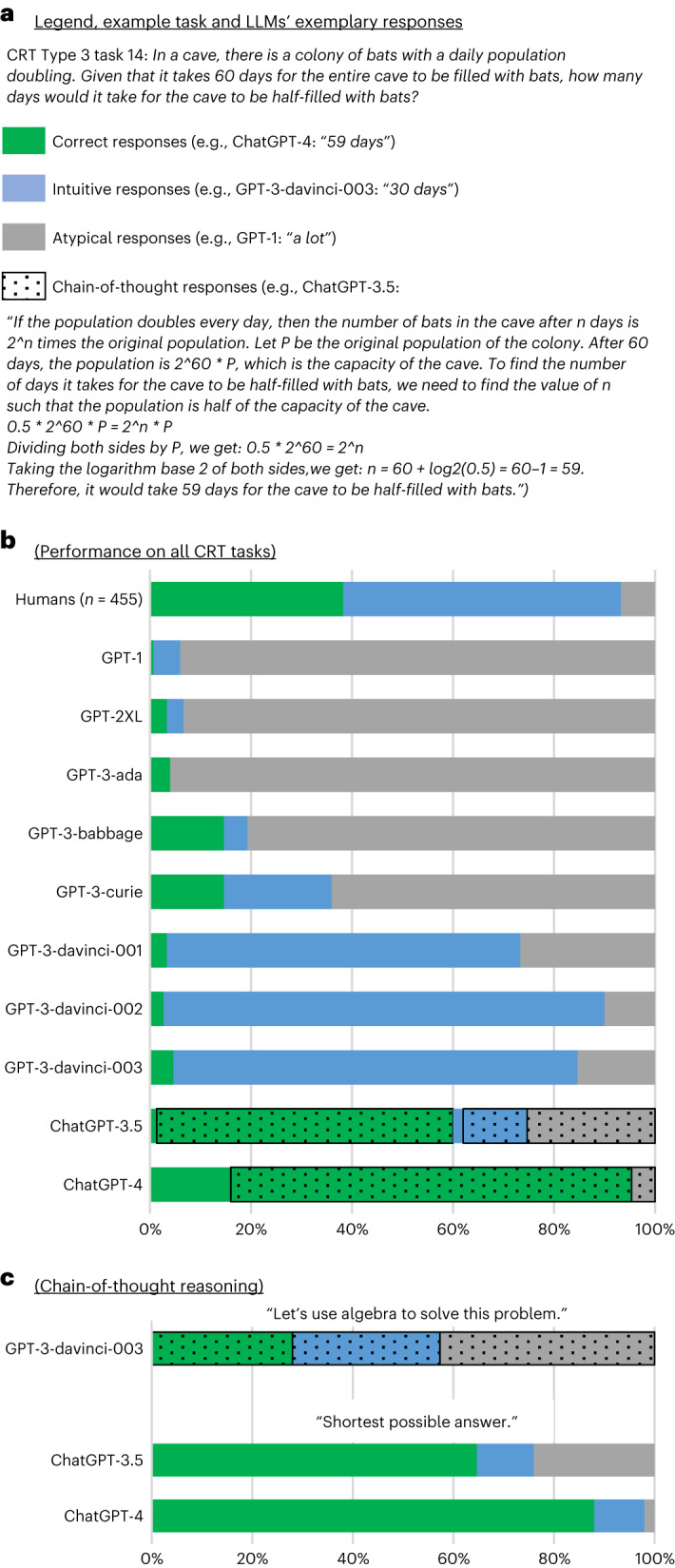
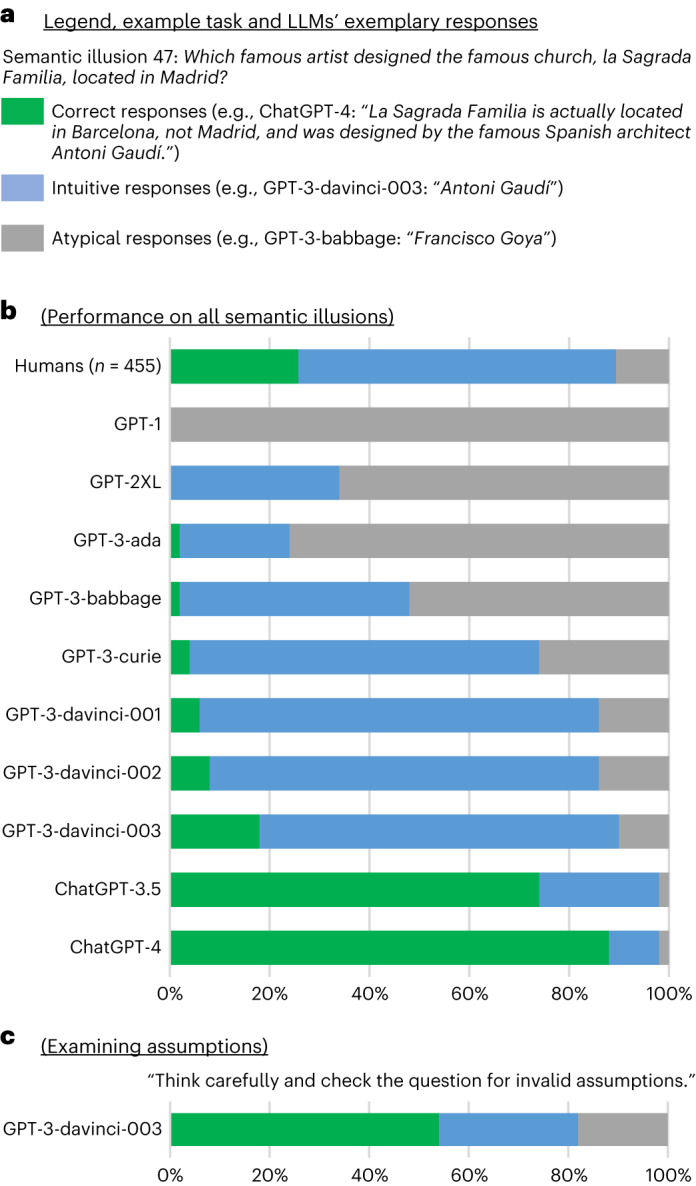
We design a battery of semantic illusions and cognitive reflection tests, aimed to elicit intuitive yet erroneous responses. We administer these tasks, traditionally used to study reasoning and decision-making in humans, to OpenAI’s generative pre-trained transformer model family. The results show that as the models expand in size and linguistic proficiency they increasingly display human-like intuitive system 1 thinking and associated cognitive errors. This pattern shifts notably with the introduction of ChatGPT models, which tend to respond correctly, avoiding the traps embedded in the tasks. Both ChatGPT-3.5 and 4 utilize the input–output context window to engage in chain-of-thought reasoning, reminiscent of how people use notepads to support their system 2 thinking. Yet, they remain accurate even when prevented from engaging in chain-of-thought reasoning, indicating that their system-1-like next-word generation processes are more accurate than those of older models. Our findings highlight the value of applying psychological methodologies to study large language models, as this can uncover previously undetected emergent characteristics.
Overview
The claims and statistics of this paper haven’t been checked yet.
Free: it reads the open-access text and checks the first 5 claims that cite a source we can check. Create a free account to check every claim.
Integrity signals
Registry
Cites
Statistics
Figures
Verification
Claims the paper makes
The claims and statistics of this paper haven’t been checked yet.
Free: it reads the open-access text and checks the first 5 claims that cite a source we can check. Create a free account to check every claim.
Claims other papers make about this one
Each is checked against this paper’s own text: does it say what the citing paper says it does?
The source backs part of the claim, not all of it — or backs it for a different population, condition or comparison.
In the citing paper
“To effectively predict the next word in a sentence generated by a human, LLMs must model not only grammar and vocabulary but also the psychological processes humans use when generating language (35, 36).”
From Evaluating large language models in theory of mind tasks (2024) · cites this paper as [35]
Experimental — accuracy not yet measuredThe source backs part of the claim, not all of it — or backs it for a different population, condition or comparison.
In the citing paper
“Interestingly, there is evidence from several studies showing that, while the previous generation of models frequently exhibited human-like heuristics and biases, they have largely disappeared in the latest generation of LLMs (Chen, Liu, et al., 2023;Hagendorff et al., 2023).”
From Machine Psychology (2023) · cites this paper as Hagendorff et al., 2023
Experimental — accuracy not yet measuredThe cited source says what the claim attributes to it.
In the citing paper
“LLMs trained to predict the next word in a sentence surprised their creators not only by their inclination to be racist and sexist (34) but also by their emergent reasoning and arithmetic skills (35), ability to translate between languages (22), and propensity to semantic priming (36).”
From Evaluating large language models in theory of mind tasks (2024) · cites this paper as [35]
In the citing paper
“These learning scaffolds ensure that learners verify, reason, and transfer rather than merely consuming fl uent text 166,169 .”
From A Metacognitive Approach to Learning and Performance in Human-AI Interaction (2026) · cites this paper as [169]
Self-check
Percentages, sums and reported differences re-computed from the paper’s own numbers.
The self-check needs the paper’s full text.
Citations
Cites
Tversky, A., & Kahneman, D. (1974) · Science · doi:10.1126/science.185.4157.1124 · Cited by 28,810
Language Models are Few-Shot Learners
Brown, T. B., Mann, B., Ryder, N., Subbiah, M., Kaplan, J., Dhariwal, P., Neelakantan, A., Shyam, P., Sastry, G., Askell, A., et al. (2020) · arXiv · doi:10.48550/arxiv.2005.14165 · Cited by 23,372
Deep reinforcement learning from human preferences
Christiano, P., Leike, J., Brown, T. B., Martic, M., Legg, S., & Amodei, D. (2017) · arXiv · doi:10.48550/arxiv.1706.03741 · Cited by 7,379 · cited 1×
“Second, it could be that the shift was driven by the employment of reinforcement learning from human feedback 18,19 .”
BackgroundCognitive Reflection and Decision Making
Frederick, S. (2005) · Journal of Economic Perspectives · doi:10.1257/089533005775196732 · Cited by 5,256
Chain-Of-Thought Prompting Elicits Reasoning in Large Language Models
Wei, J., Wang, X., Schuurmans, D., Bosma, M., Ichter, B., Xia, F., Chi, E., Le, Q. V., & Zhou, D. (2022) · Advances in Neural Information Processing Systems 35 · doi:10.52202/068431-1800 · Cited by 4,505
Chain-of-Thought Prompting Elicits Reasoning in Large Language Models
Wei, J., Wang, X., Schuurmans, D., Bosma, M., Ichter, B., Xia, F., Chi, E., Le, Q., & Zhou, D. (2022) · arXiv · doi:10.48550/arxiv.2201.11903 · Cited by 4,263 · cited 2×
“Yet, past research and the results presented here suggest that, like humans, LLMs can also engage in system-2-like cognitive processes 4 .”
ResultTraining language models to follow instructions with human feedback
Ouyang, L., Wu, J., Jiang, X., Almeida, D., Wainwright, C. L., Mishkin, P., Zhang, C., Agarwal, S., Slama, K., Ray, A., et al. (2022) · arXiv · doi:10.48550/arxiv.2203.02155 · Cited by 4,208 · cited 2×
“While reinforcement learning from human feedback has been employed since GPT-3 text-davinci-002 19 , this procedure was enhanced in ChatGPT training: AI trainers played both sides: the user and an AI assistant 20 .”
BackgroundMethodThe empirical case for two systems of reasoning.
Sloman, S. A. (1996) · Psychological Bulletin · doi:10.1037//0033-2909.119.1.3 · Cited by 3,848
Emergent Abilities of Large Language Models
Wei, J., Tay, Y., Bommasani, R., Raffel, C., Zoph, B., Borgeaud, S., Yogatama, D., Bosma, M., Zhou, D., Metzler, D., et al. (2022) · arXiv · doi:10.48550/arxiv.2206.07682 · Cited by 1,264
The Cognitive Reflection Test as a predictor of performance on heuristics-and-biases tasks
Toplak, M. E., West, R. F., & Stanovich, K. E. (2011) · Memory & Cognition · doi:10.3758/s13421-011-0104-1 · Cited by 1,047 · cited 1×
“In humans, CRT and semantic illusions are good predictors of ability to engage in unbiased, reflective, and rational decision-making, as well as overall cognitive ability.(17,32) Thus, LLMs’ ability to solve CRT and semantic illusions should increase as their overall ability increases.”
Background
Research works printed but not linked: 4
- Radford, A., Narasimhan, K., Salimans, T. & Sutskever, I. Improving language understanding by generative pre-training. Preprint at https://paperswithcode.com/paper/improving-language-understanding-by (2018).
- Radford, A. et al. Language models are unsupervised multitask learners. Preprint at https://paperswithcode.com/paper/language-models-are-unsupervised-multitask (2019).
- Jones, E. & Steinhardt, J. Capturing failures of large language models via human cognitive biases. 36th Conference on Neural Information Processing Systems (2022).
- Nye, M., Tessler, M. H., Tenenbaum, J. B. & Lake, B. M. Improving coherence and consistency in neural sequence models with dual-system, neuro-symbolic reasoning. 35th Conference on Neural Information Processing Systems (2021).
Cited by
Items 101–200 of 329
A Looming Replication Crisis in Evaluating Behavior in Language Models? Evidence and SolutionsPreprint
Vaugrante, L., Niepert, M., & Hagendorff, T. (2024) · arXiv (Cornell University) · doi:10.48550/arxiv.2409.20303 · Cited by 14
Self-citationExamining the Feasibility of Large Language Models as Survey Respondents
Kitadai, A., Ogawa, K., & Nishino, N. (2024) · IEEE International Conference on Big Data (BigData) · doi:10.1109/bigdata62323.2024.10825497 · Cited by 14
Natural and artificial intelligence – the psychotechnical agenda of the 21st century
Webster, C. S. (2025) · Journal of Psychology and AI · doi:10.1080/29974100.2025.2491445 · Cited by 11
Collins, A. C., Lekkas, D., Heinz, M. V., Annor, J., Ruan, F., & Jacobson, N. C. (2024) · Journal of Psychiatric Research · doi:10.1016/j.jpsychires.2025.09.057 · Cited by 13
LLM Post-Training: A Deep Dive into Reasoning Large Language Models
Kumar, K., Ashraf, T., Thawakar, O., Anwer, R. M., Cholakkal, H., Shah, M., Yang, M.-H., Torr, P. H. S., Khan, F. S., & Khan, S. (2025) · arXiv · doi:10.48550/arxiv.2502.21321 · Cited by 10
“For the scope of this work, “ reasoning ” in LLMs refers to their ability to generate logically coherent responses based on statistical patterns in data rather than explicit logical inference or symbolic manipulation.”
Natural intelligence in autonomous vehicles: Redefining the path to human-centric adoption
Banda, L. G., & Chandra, S. (2024) · Journal of Retailing and Consumer Services · doi:10.1016/j.jretconser.2024.104195 · Cited by 10
Zhang, Y., Huang, T., Liu, C., Miller, A. N., Yang, M., Harris, I. A., Sawaguchi, T., Miclau, T., Tian, M., Chui, C. S., et al. (2026) · Digital Health · doi:10.1177/20552076251412989 · Cited by 10
“35 Regarding comprehensiveness, all three models showed similarly high scores, indicating their ability to cover relevant information on hip fracture topics has matured.”
Kleinert, S., & Urbig, D. (2026) · Entrepreneurship Theory and Practice · doi:10.1177/10422587261430320 · Cited by 13
Torres–Martínez, S. (2024) · Language and Semiotic Studies · doi:10.1515/lass-2024-0018 · Cited by 9
Phelps, S., & Russell, Y. I. (2025) · Journal of Physics: Complexity · doi:10.1088/2632-072x/ada711 · Cited by 8
“Nonetheless, there is a strongly emerging consensus that scientists should study the behaviour of an LLM-chatbot in the same manner that one should study the behaviour of a human or animal [51; 57; 55; 58; 59; 60; 61; 62; 63; 64; 65].”
BackgroundAuxiliary task demands mask the capabilities of smaller language models
Hu, J., & Frank, M. C. (2024) · arXiv · doi:10.48550/arxiv.2404.02418 · Cited by 8
“We report results averaged over all problem types.”
InfluentialDivergent patterns of probabilistic reasoning in humans and GPT-5
Imannezhad, P., Pothos, E. M., & Wills, A. J. (2026) · Frontiers in Psychology · doi:10.3389/fpsyg.2026.1782184 · Cited by 9
Fostier, J., Leemans, E., Meeussen, L., Wulleman, A., Doren, S. V., Coninck, D. D., & Toelen, J. (2024) · Future · doi:10.3390/future2010003 · Cited by 8
“As such, ChatGPT is able to generate human-like responses across a broad spectrum of user prompts [3,4].”
BackgroundResultInfluentialLei, P., Liang, R., Zhao, A., Sun, R., Yi, F., Zhong, J., Li, R., Zhu, S., Zhang, S., & Wu, S. (2024) · International Journal of Surgery · doi:10.1097/js9.0000000000001775 · Cited by 8
“…initially conceptualized as a ‘ chatbot, ’ prompted us to explore the potential of LLMs as a complementary tool in addressing psychosocial scenarios, particularly within urological contexts (e.g. anxiety related to urinary incontinence, erectile dysfunction, and presurgical patients) [1,19,20] .”
scaron, G. B. (2024) · SSRN Electronic Journal · doi:10.2139/ssrn.4943486 · Cited by 8
Signatures of human-like processing in Transformer forward passesPreprint
Hu, J., Lepori, M. A., & Franke, M. (2025) · arXiv (Cornell University) · doi:10.48550/arxiv.2504.14107 · Cited by 8
“Our findings also extend prior observations by Hagendorff et al. (2023) on the output behavior of models from the GPT family in competitor interference tasks to a more diverse class of models and measures derived from the dynamics of the forward pass.”
AMULED: Addressing Moral Uncertainty using Large language models for Ethical Decision-making
Dubey, R. K., Dailisan, D. N., & Mahajan, S. (2026) · Frontiers in Artificial Intelligence · doi:10.3389/frai.2026.1754973 · Cited by 9
“To demonstrate the robustness of our results, each set of experiments is performed with 50 replicates, each run with a different random seed.”
Are Large Language Models Aligned with People’s Social Intuitions for Human–Robot Interactions?
Wachowiak, L., Coles, A., Çeliktutan, O., & Canal, G. (2024) · IEEE/RSJ International Conference on Intelligent Robots and Systems (IROS) · doi:10.1109/iros58592.2024.10801325 · Cited by 10
“Hagendorff et al. [21] show that these cognitive biases tend to vanish when experimenting with the most recent models, such as GPT-3.”
Una aproximación a ChatGPT como herramienta jurídica: sesgos, capacidades y utilidades futuras
Dolmestch, R. N., & Fuentes-Loureiro, M.-Á. (2023) · IDP Revista de Internet Derecho y Política · doi:10.7238/idp.v0i39.417024 · Cited by 9
Large language models and humans converge in judging public figures’ personalities
Cao, X., & Kosiński, M. (2024) · PNAS Nexus · doi:10.1093/pnasnexus/pgae418 · Cited by 7
“These include translating between languages (2), solving reasoning and mathematical tasks (3), and distinguishing between the mental states of different characters in a story (4).”
BackgroundPoglitsch, C., Szakács, F., & Pirker, J. (2025) · International Conference on the Foundations of Digital Games (FDG) · doi:10.1145/3723498.3723702 · Cited by 12
Effective Generative AI: The Human-Algorithm CentaurPreprint
Saghafian, S. (2023) · SSRN Electronic Journal · doi:10.2139/ssrn.4587250 · Cited by 7
Large Language Models Amplify Human Biases in Moral Decision-MakingPreprint
Cheung, V., Maier, M., & Lieder, F. (2024) · PsyArXiv (OSF Preprints) · doi:10.31234/osf.io/aj46b · Cited by 7
Kaur, A., Aird, A., Borman, H., Nicastro, A., Leontjeva, A., Pizzato, L. A. S., & Jermyn, D. (2025) · ACM Conference on User Modeling, Adaptation and Personalization (UMAP) · doi:10.1145/3699682.3728339 · Cited by 10
Impact of Request Formats on Effort Estimation: Are LLMs Different Than Humans?
Çalıklı, G., & Alhamed, M. (2025) · Proceedings of the ACM on software engineering. · doi:10.1145/3715771 · Cited by 7
The emergence of strategic reasoning of large language models
Kader, G., & Lee, D. (2026) · Journal of Behavioral and Experimental Economics · doi:10.1016/j.socec.2026.102643 · Cited by 6
Generative AI as a Supportive Tool for Scientific Research
Weinberg, A. I. (2024) · Springer eBooks · doi:10.1007/978-3-031-46238-2_1 · Cited by 8
The possibility paradox: How technology both expands and contracts possibilities
Laurent, C. D. S. (2024) · Possibility Studies & Society · doi:10.1177/27538699241232742 · Cited by 6
“Yes, Large Language Models (LLMs) can hold seemingly intelligent conversations (Hagendorff et al., 2023), creatively solve problems (Doshi & Hauser, 2023) and even pass the Turing test (Biever, 2023).”
BackgroundComprehensive survey of large models-driving intelligent decision making
Zheng, Y., Wu, T., Xiao, X., & Xu, Z. (2025) · Applied Soft Computing · doi:10.1016/j.asoc.2025.113524 · Cited by 6
Humans and LLMs rate deliberation as superior to intuition on complex reasoning tasks
Neys, W. D., & Raoelison, M. (2025) · Communications Psychology · doi:10.1038/s44271-025-00320-8 · Cited by 6
Leveraging imperfection with MEDLEY: a multi-model approach harnessing bias in medical AI
Abtahi, F., Astaraki, M., & Seoane, F. (2026) · Frontiers in Artificial Intelligence · doi:10.3389/frai.2026.1701665 · Cited by 5
Homophily-induced emergence of biased structures in LLM-based multi-agent AI systems
Mehdizadeh, A., & Hilbert, M. (2025) · Social Network Analysis and Mining · doi:10.1007/s13278-025-01535-7 · Cited by 17
“…generate decision processes [31, 7, 32, 33]. and their nuanced, but tractable reasoning based on contextual, incomplete or constrained information [34, 35], allows for a rich research agenda that can provide valuable insights into the nature and consequences of the myriad of networks currently…”
Human–AI complementarity needs augmentation, not emulation
Lin, Z. (2026) · Nature Reviews Psychology · doi:10.1038/s44159-026-00536-3 · Cited by 7
Shared Minds: The Cognitive Parallels Between Humans and Artificial Intelligence
Tremblay, S., Marois, A., Zare, M., & Lafond, D. (2026) · Human Behavior and Emerging Technologies · doi:10.1155/hbe2/9946143 · Cited by 5
Applying large language models to travel satisfaction analysis
Xu, P., & Wang, D. (2026) · Artificial Intelligence for Transportation · doi:10.1016/j.ait.2026.100079 · Cited by 6
Position Paper: Unlocking the Potential of AI Researchers in Scientific Discovery—What Is Missing?
Yu, H., Liu, S., Yang, H., Yan, Y., Qu, M., & Jin, Y. (2026) · International Joint Conference on Neural Networks (IJCNN) · doi:10.1109/ijcnn69854.2026.11729527 · Cited by 5
ICDAR 2023 Competition on Visual Question Answering on Business Document Images
Raja, S., Mondal, A., & Jawahar, C. V. (2023) · Lecture notes in computer science · doi:10.1007/978-3-031-41679-8_26 · Cited by 14
Artificial Agents in Operations Management ExperimentsPreprint
Kirshner, S. N. (2024) · SSRN Electronic Journal · doi:10.2139/ssrn.4726933 · Cited by 9
Li, X. R., Tang, H., Chen, S., Wang, Z., Chen, R., & Abram, M. (2024) · arXiv (Cornell University) · doi:10.48550/arxiv.2407.02028 · Cited by 9
Ask, T. F., Sütterlin, S., Müller, L., Lugo, R. G., Saari, D., Grahn, H., Canham, M., Hermansen, D., & Knox, B. J. (2025) · PsyArXiv (OSF Preprints) · doi:10.31234/osf.io/2ftqc_v1 · Cited by 11
LLM Agents Display Human Biases but Exhibit Distinct Learning PatternsPreprint
Horowitz, I., & Plonsky, O. (2025) · arXiv (Cornell University) · doi:10.48550/arxiv.2503.10248 · Cited by 6
“While language models display many human-like intuitions (Hagendorff, Fabi, & Kosinski, 2023) and behavioral similarities, including abstract reasoning (Yehudai, Karidi, Stanovsky, Goldstein, & Abend, 2024), communication (Liu, Sumers, Dasgupta, & Griffiths, 2024; Liu, Yen, Marjieh, Griffiths, &…”
Understanding the Dark Side of LLMs' Intrinsic Self-Correction
Zhang, Q., Wang, D., Qian, H., Li, Y., Zhang, T., Huang, M., Xu, K., Li, H., Yan, L., & Qiu, H. (2025) · Proceedings of the 63rd Annual Meeting of the Association for Computational Linguistics (Volume 1: Long Papers) · doi:10.18653/v1/2025.acl-long.1314 · Cited by 36
AI4Research: a survey of artificial intelligence for scientific research
Chen, Q., Yang, M., Qin, L., Liu, J., Yan, Z., Guan, J., Peng, D., Ji, Y., Li, H., Hu, M., et al. (2026) · Science China Information Sciences · doi:10.1007/s11432-025-5000-y · Cited by 4
Perrin, P. B., Christ, B. R., Vargas, T. A., Dini, M. E., Ertman, B., Cull, S. L., Rivera, D., Xia, B., Andrews-Ash, E. E., Mona, L., et al. (2026) · Rehabilitation Psychology · doi:10.1037/rep0000639 · Cited by 4
Large language models for autism: evaluating theory of mind tasks in a gamified environment
Poglitsch, C., Reiss, A., Wriessnegger, S. C., & Pirker, J. (2025) · Scientific Reports · doi:10.1038/s41598-025-18608-4 · Cited by 5
LLM agents reveal how human bias shapes path-dependent market dynamics
Hashimoto, R., Takayanagi, T., Suzuki, M., & Izumi, K. (2026) · Journal of Computational Social Science · doi:10.1007/s42001-026-00465-4 · Cited by 5
“Since LLMs are trained on diverse human-generated texts, there is growing speculation that they may exhibit behavioral biases similar to those of humans [21 ].”
A First Look at AI Trends in Value-Aligned Software Engineering Publications: Human-LLM Insights
Mougouei, D., Azarnik, A., Fahmideh, M., Mougouei, E., Dam, H. K., Khan, A. A., Rafi, S., Khan, J. A., & Ahmad, A. (2025) · IEEE/ACM International Conference on Software Engineering: Software Engineering in Society (ICSE-SEIS) · doi:10.1109/icse-seis66351.2025.00014 · Cited by 6
Recognizing and enhancing sapient agency within AIs: a free will perspective
Sheldon, K. M. (2025) · Discover Psychology · doi:10.1007/s44202-025-00425-5 · Cited by 4
“Still, some delayed intuition [28] and meta-learning models [77] are beginning to be developed, in which AI searches are allowed to take more time or more cycles to operate.”
Human realignment: An empirical study of LLMs as legal decision-aids in moral dilemmas
Engel, C., Hermstrüwer, Y., & Kim, A. (2026) · Artificial Intelligence and Law · doi:10.1007/s10506-026-09517-6 · Cited by 6
Heuristics and Biases in AI Decision-Making: Implications for Responsible AGI
Saeedi, P., Goodarzi, M., & Canbaz, M. A. (2025) · International Conference on Artificial Intelligence, Robotics and Control (AIRC) · doi:10.1109/airc64931.2025.11077505 · Cited by 5
“5 and GPT-4, have shown improvements in addressing cognitive biases, particularly in chain-of-thought (system 2) prompting compared to zero-shot (system 1) approaches [16].”
Engel, C., Grossmann, M. R. P., & Ockenfels, A. (2025) · Experimental Economics · doi:10.1017/eec.2025.10038 · Cited by 6
Cognitive bias in large language models: Cautious optimism meets anti-Panglossian meliorismPreprint
Thorstad, D. (2023) · arXiv (Cornell University) · doi:10.48550/arxiv.2311.10932 · Cited by 6
Dual Traits in Probabilistic Reasoning of Large Language ModelsPreprint
Li, S., & Rui, H. (2024) · arXiv (Cornell University) · doi:10.48550/arxiv.2412.11009 · Cited by 4
Code Owns the Simulation, Jev Owns the EvaluationPreprint
Yang, Y., Tang, H., Ma, Y., Fan, X., Wang, W., Li, J., & Yang, T. (2026) · arXiv (Cornell University) · doi:10.48550/arxiv.2610.01834 · Cited by 4
Mediating Cognitive Biases in Business Decisions Using LLMS
Friedman, N., Krug, M., & Mountford, S. J. (2025) · IEEE Conference on Artificial Intelligence (CAI) · doi:10.1109/cai64502.2025.00054 · Cited by 3
“By testing LLMs on semantic illusions and cognitive reflection tests, Hagendorff et al. [7] found that older models displayed human-like intuitive system 1 thinking [12] associated with cognitive errors.”
Prosocial When Simple and Cold-Hearted When Complex: How Task Difficulty Shapes LLM Behavior
Kirshner, S. N., Pan, Y., & Wu, J. X. (2025) · Decision Analysis · doi:10.1287/deca.2025.0396 · Cited by 3
Krupıć, D., Matijević, D., Šuvak, N., Maltar, J., & Ševerdija, D. (2025) · Computers in Human Behavior Artificial Humans · doi:10.1016/j.chbah.2025.100234 · Cited by 4
Reasoning About Human Values in GitHub Issues: What Can a Large Language Model Reveal?
Mougouei, D., Haque, A., Nurwidyantoro, A., Mougouei, E., Fahmideh, M., Shahin, M., Dharmawan, A., Widodo, T. W., & Dam, H. K. (2026) · International Journal of Human-Computer Interaction · doi:10.1080/10447318.2025.2594137 · Cited by 3
“In this paper, we exploit ChatGPT’s automated reasoning capabilities (Hagendorff et al., 2023; Xie et al., 2024) to infer (reveal and explain) both explicit and implicit alignments of GitHub issues with a broad range of human values based on issue discussions.”
Malingering depression: a comparative study of human and GPT-3.5 performance
Battista, F., Lanciano, T., Ribatti, R. M., & Curci, A. (2026) · Current Psychology · doi:10.1007/s12144-025-09009-x · Cited by 4
“Studies have shown that ChatGPT demonstrates deductive reasoning, a coher - ent chain of thought, and proficiency in handling long-term dependencies in its responses (Hagendorff et al., 2023; Kung et al., 2023 ).”
Li, D., Lin, R., Wang, Z., & Li, Y. (2026) · Journal of Reliability Science and Engineering · doi:10.1088/3050-2454/ae524c · Cited by 4
Cognitive Readiness for Human-AI Collaboration
Tremblay, S., de Hemptinne, D., Teyssier‐Roberge, G., Gallant, A., Marois, A., & Lafond, D. (2026) · Human Factors The Journal of the Human Factors and Ergonomics Society · doi:10.1177/00187208261474345 · Cited by 7
Generative Künstliche Intelligenz: Mögliche Auswirkungen auf die psychologische Forschung
Buder, J., Lindner, M. A., Oestermeier, U., Huff, M., Gerjets, P. H., Utz, S., & Creß, U. (2024) · Psychologische Rundschau · doi:10.1026/0033-3042/a000699 · Cited by 4
ChatGPT as a research proxy: simulating human attitudes in social science research
Семеновна, Р. А., & Воронин, А. Н. (2026) · Journal of Computational Social Science · doi:10.1007/s42001-025-00452-1 · Cited by 3
“The concept of employing LLMs as in silica “model organisms” [ 53] has attracted significant attention [ 1 , 3 , 7 , 13 , 18 , 21 , 24 , 27 , 47 ].”
Owls are Wise and Foxes are Unfaithful: Uncovering Animal Stereotypes in Vision Language Models
Aman, T., Nadeem, M., Sohail, S. S., Anas, M., & Cambria, E. (2025) · Lecture notes in computer science · doi:10.1007/978-981-96-8197-6_31 · Cited by 3
Road Rage Against the Machine: Humans and LLMs Share a Blame Bias Against Driverless Cars
Chu, Y., Liu, P., Savulescu, J., & Earp, B. D. (2025) · International Journal of Human-Computer Interaction · doi:10.1080/10447318.2025.2526593 · Cited by 3
“In certain contexts, they appear to exhibit human-like capabilities and behaviors (Binz & Schulz, 2023; Hagendorff et al., 2023) or reflect the opinions of specific population groups (Santurkar et al., 2023), as probed through cognitive psychology tests.”
Synthetic Participants Generated by Large Language Models: A Systematic Literature Review
Kuric, E., Demcak, P., & Krajcovic, M. (2026) · doi:10.21203/rs.3.rs-9057643/v1 · Cited by 2
Xiong, Y., & Wu, S. (2025) · Acta Psychologica · doi:10.1016/j.actpsy.2025.105518 · Cited by 2
Chadimová, M., Jurášek, E., & Kliegr, T. (2025) · Information Processing & Management · doi:10.1016/j.ipm.2025.104493 · Cited by 2
Uchoa, A. P., Oliveira, C., Motta, C. L. R., & Schneider, D. (2026) · Computers · doi:10.3390/computers15010024 · Cited by 3
Cognitive bias in AI legal decision-making
Santtila, P. O., Sun, Y., Maso, E. D., & Zappalà, A. (2026) · Artificial Intelligence and Law · doi:10.1007/s10506-025-09499-x · Cited by 2
Evaluating Fairness in LLM Negotiator Agents via Economic Games Using Multi-Agent Systems
Khaki, A. M. Z., & Choi, A. (2026) · Mathematics · doi:10.3390/math14030458 · Cited by 4
Uchoa, A. P., Oliveira, C., Motta, C. L. R., & Schneider, D. (2026) · Communications in computer and information science · doi:10.1007/978-3-032-16451-3_23 · Cited by 5
AIPsychoBench: Understanding the Psychometric Differences Between LLMs and Humans
Xie, W., Wang, Z., Ma, S., Sun, X., Chen, K., Wang, E., Liu, W., & Tong, H. (2026) · Topics in Cognitive Science · doi:10.1111/tops.70041 · Cited by 3
“…research draws on human psychological methods to perform psychometric evaluations of LLM in terms of cognitive abilities (Coda-Forno et al., 2024; Hagendorff et al., 2023; Wang et al., 2023), personality traits (Jiang et al., 2023, 2024; Pan & Zeng, 2023; Yang et al., 2024), and even psychotic…”
Venerito, V., Lopalco, G., Iannone, F., & Gupta, L. (2026) · The Lancet Rheumatology · doi:10.1016/s2665-9913(26)00076-7 · Cited by 6
Brain-inspired large model mindreading
Jin, J., Hu, Y., Wang, Z., Pan, Y., Ma, B., Dong, B., Dong, J., & Pei, G. (2026) · NeuroImage · doi:10.1016/j.neuroimage.2026.122108 · Cited by 4
Iwamoto, R., Ishihara, T., & Ida, T. (2026) · Journal of Behavioral and Experimental Economics · doi:10.1016/j.socec.2026.102634 · Cited by 4
Wisdom of LLM Crowds: Aggregation and Contamination in Language Model Ensembles
Douven, I. (2026) · ACM Transactions on Social Computing · doi:10.1145/3839337 · Cited by 3
Li, X., & Jiang, C. (2024) · doi:10.1145/3698383.3699622 · Cited by 2
Can Generative AI be used to improve doctor/patient relationship?
Ispas, F., Belciug, S., Nagy, R. D., & Iliescu, D. G. (2024) · Procedia Computer Science · doi:10.1016/j.procs.2024.09.267 · Cited by 2
Strugatski, A., & Alexandron, G. (2026) · Computers and Education Artificial Intelligence · doi:10.1016/j.caeai.2026.100668 · Cited by 2
Transitive Inference in Large Language Models and Prompting Intervention
Wu, W., & Deng, W. (2025) · IEEE International Conference on Acoustics Speech and Signal Processing · doi:10.1109/icassp49660.2025.10889585 · Cited by 3
“The ‘temperature’ parameter was set to 0, so as to improve the consistency and reproducibility of models’ responses [22], while all other parameters were remained unchanged as the default values.”
Estimating Belief Updates in AI-Driven Drone Controls for Urban Search and Rescue Operations
Sun, B., Wu, J., You, H., & Du, J. (2025) · Journal of Construction Engineering and Management · doi:10.1061/jcemd4.coeng-15747 · Cited by 2
A Comparison of Artificial Intelligence and Human Responses in Audit ExperimentsPreprint
MacKenzie, N. L., Moon, J., Rykowski, S., Swanquist, Q. T., & Whited, R. L. (2025) · SSRN Electronic Journal · doi:10.2139/ssrn.5036687 · Cited by 6
Khatoon, H., Khan, M. L., & Irshad, A. (2025) · PsyArXiv (OSF Preprints) · doi:10.31234/osf.io/xy82z · Cited by 2
Quantifying Uncert-AI-nty: Testing the Accuracy of LLMs’ Confidence JudgmentsPreprint
Cash, T. N., Oppenheimer, D. M., Christie, S., & Devgan, M. (2025) · PsyArXiv (OSF Preprints) · doi:10.31234/osf.io/47df5_v4 · Cited by 2
Wu, J., Guo, D., & Yiu, S. (2026) · arXiv (Cornell University) · doi:10.48550/arxiv.2605.08716 · Cited by 2
A metacognitive approach to learning and performance in human-AI interaction
Fan, Y., Yan, L., Molenaar, I., Greiff, S., & Gašević, D. (2026) · Communications Psychology · doi:10.1038/s44271-026-00548-y · Cited by 1
“These learning scaffolds ensure that learners verify, reason, and transfer rather than merely consuming fl uent text 166,169 .”
Nonlinear transformation of probabilities by large language models
Hintze, A., Bisht, C., Schossau, J., & Hertwig, R. (2025) · Computers in Human Behavior: Artificial Humans · doi:10.1016/j.chbah.2025.100227 · Cited by 1
Generative Artificial Intelligence in Elementary School Science Teaching and Learning
Zhang, Q., Wang, Y., Ding, Y., Yuan, P., Dai, Z., & Peng, X. (2024) · International Conference on Educational Technology (ICET) · doi:10.1109/icet62460.2024.10867936 · Cited by 1
“It has also demonstrated significant advantages comparable to the level of human mind in various fields such as data analysis, pattern recognition and intelligent decision-making [2].”
A Synergistic Integration Between Large Language Models and the Best-Worst Method
Briegel, H., & Tipdecho, T. (2025) · Lecture notes in operations research · doi:10.1007/978-3-031-76766-1_2 · Cited by 1
What should philosophers do with “deceptive” intuition pumps? Restrictionism vs reformism
Matsuda, A., & Takeshita, M. (2025) · Philosophical Psychology · doi:10.1080/09515089.2025.2498745 · Cited by 1
“…to think that LLMs can have intuitions or something equivalent, partly based on the report that some LLMs have human-like intuitive (i.e., unreflective) responses to some psychological tasks (Hagendorff et al., 2023), we admit that this is a controversial issue that requires extensive discussion.”
Gopalakrishnan, A., Ramya, G., Preethiya, T., Paranthaman, R. N., Ashwini, S., & Dhwarithaa, R. (2025) · Advances in computational intelligence and robotics book series · doi:10.4018/979-8-3373-1419-8.ch002 · Cited by 2
Legal Knowledge Generation Based on LLM Prompt Engineering
Yang, A., Zhao, L., & Gong, Y. (2025) · Lecture notes in computer science · doi:10.1007/978-3-032-06326-7_2 · Cited by 1
Sensorimotor Regularities as Alignment between Humans and Large Language Models
Li, J., Hu, J., & Kristensson, P. O. (2026) · ACM Transactions on Computer-Human Interaction · doi:10.1145/3778353 · Cited by 1
Can large language models mimic airline passenger preferences?
Voltes-Dorta, A., & Suau-Sánchez, P. (2025) · Artificial Intelligence for Transportation · doi:10.1016/j.ait.2025.100034 · Cited by 6
Exploratory analysis of logical and intuitive reasoning in large language models
Peruchini, M., & Teixeira, J. M. (2026) · International Journal of Data Science and Analytics · doi:10.1007/s41060-025-00942-5 · Cited by 2
“Experiments related to cognitive psychology with LLMs were already conducted in scientific literature [5, 14, 29) providing valuable insights on the subject.”
Traceable Latent Variable Discovery Based on Multi-Agent Collaboration
Du, H., Hu, T., Huang, Y., Zhao, Y., Liu, G., Gu, T., Kou, G., & Yang, C. (2026) · International World Wide Web Conference (WWW) · doi:10.1145/3774904.3792244 · Cited by 3
Are Language Models Good at Lateral Thinkingƒ
Khadka, A., Nassar, M., & Khare, S. (2025) · International Conference on Foundation and Large Language Models (FLLM) · doi:10.1109/fllm67465.2025.11391211 · Cited by 2
“In contrast, System 2 thinking is slower and more deliberate, relying on logical reasoning and critical analysis to make decisions [11].”
Zhang, T., Liang, S., Zheng, W., Koutsoumpis, A., Oostrom, J. K., & de Vries, R. E. (2026) · IEEE Transactions on Affective Computing · doi:10.1109/taffc.2026.3667846 · Cited by 3
“Here, we use chain-of-thought prompting strategy (i.e., ask the LLMs to think about and output why they rate the personality traits like this) inspired by previous works [18], [74] from the LLMs community.”
Metadata
- Authors
- Hagendorff, T., Fabi, S., & Kosinski, M.
- Affiliations
- University of Stuttgart (DE)
- University of California San Diego (US)
- Venue
- Nature Computational Science
- Published
- 2023-10-05
- Volume
- 3
- Issue
- 10
- Pages
- 833-838
- ISSN
- 2662-8457 (ISSN-L)
- PMC
- PMC10766525
- OpenAlex
- W4387378202
- Semantic Scholar
- 0bfc05adcddd4fe5d1335d96cc313c41526d4558
- Cited by
- 243
- References
- 16
- Citations by year
- 2026: 87 · 2025: 78 · 2024: 71 · 2023: 7
- FWCI
- 22.91
- Type
- journal article
- Language
- en
- Open access
- hybrid
- doi.org
- Licence
- cc-by
- creativecommons.org/licenses/by/4.0 (tdm)
- creativecommons.org/licenses/by/4.0 (vor)
- Locations
- Nature Computational Science (publishedVersion, cc-by)
- Funders
- Ministerium für Wissenschaft, Forschung und Kunst Baden-Württemberg (Az. 33-7533-9-19/54/5)
- Interchange Forum for Reflecting on Intelligent Systems (IRIS) at the University of Stuttgart
- Topics
- Physical Sciences › Computer Science › Artificial Intelligence › Topic Modeling
- Physical Sciences › Computer Science › Artificial Intelligence › Natural Language Processing Techniques
- Social Sciences › Decision Sciences › General Decision Sciences › Decision-Making and Behavioral Economics
- Keywords
- large language models, ChatGPT, intuitive thinking, cognitive biases, System 2 thinking, chain-of-thought reasoning, semantic illusions, cognitive reflection, model size, context window, emergent behavior, human-like reasoning
About these checks
Registry, retraction, Cites and statistics results are computed, not judged, with one exception: a printed reference that no index lists is read once by a model before it counts as a citation error. Claims are extracted by a model and kept only when their quote appears verbatim in the text; each cited source is then checked, with a model’s help, for whether it says what the claim relies on. Those verdicts can be wrong — read the claim’s quote and the cited source before relying on one.
Statistics and arithmetic are recomputed, not judged.
Confidence bands are shown only for fields calibrated on our annotated test set. None is calibrated yet, so no band is shown.
What counts as a claim ›How we measure confidence ›How we check this ›
Are you an author, or do you see a problem with this page? Request a review
Data sources
Bibliographic data: Semantic Scholar, OpenAlex, Crossref.
Contains information from the Semantic Scholar Academic Graph Datasets, made available under the ODC Attribution License (ODC-BY 1.0).
Semantic Scholar’s data is described in: Kinney, R., et al. (2023). The Semantic Scholar Open Data Platform. arXiv:2301.10140.
