

Scientific publications that use promotional language in the abstract receive more citations and public attention
Open accessThe DOI matches its Crossref record; 68 of the 68 references it cites were found in a registry or an index; 47 of the 80 sources its claims cite were checked for support.
Abstract
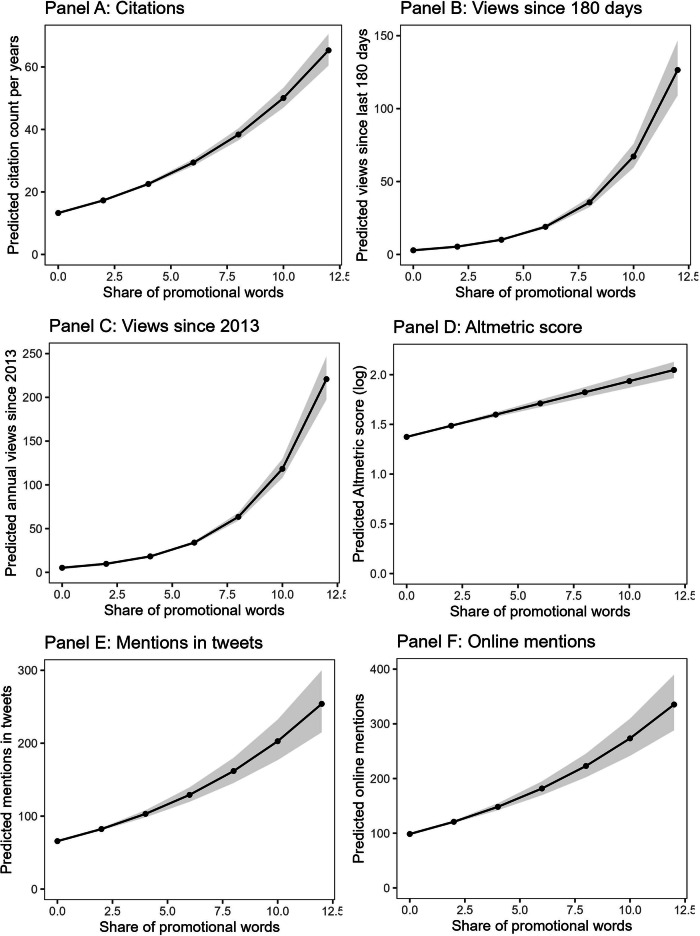
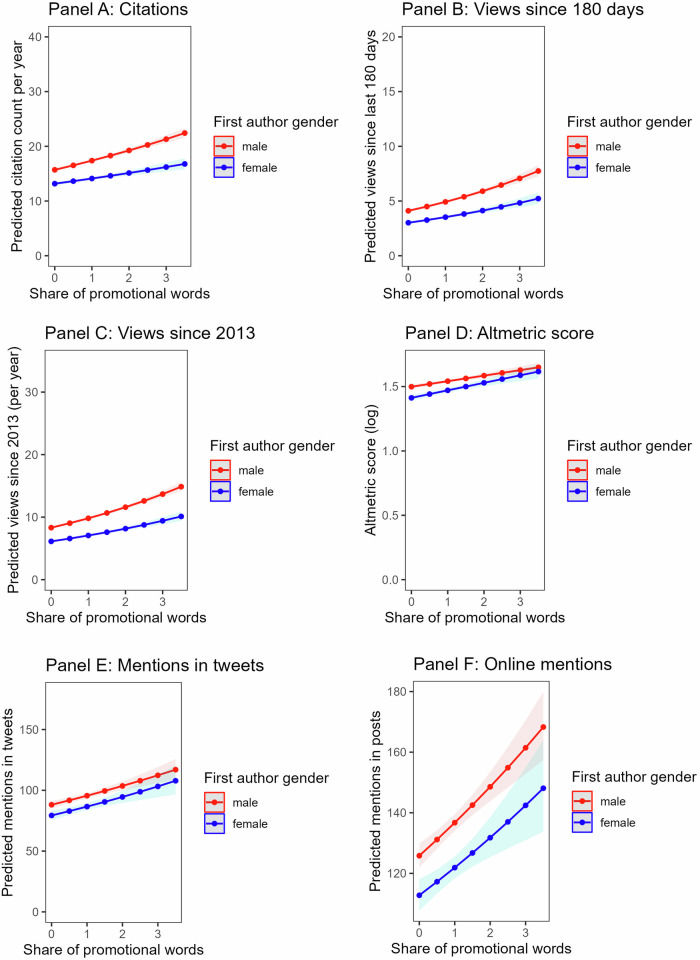
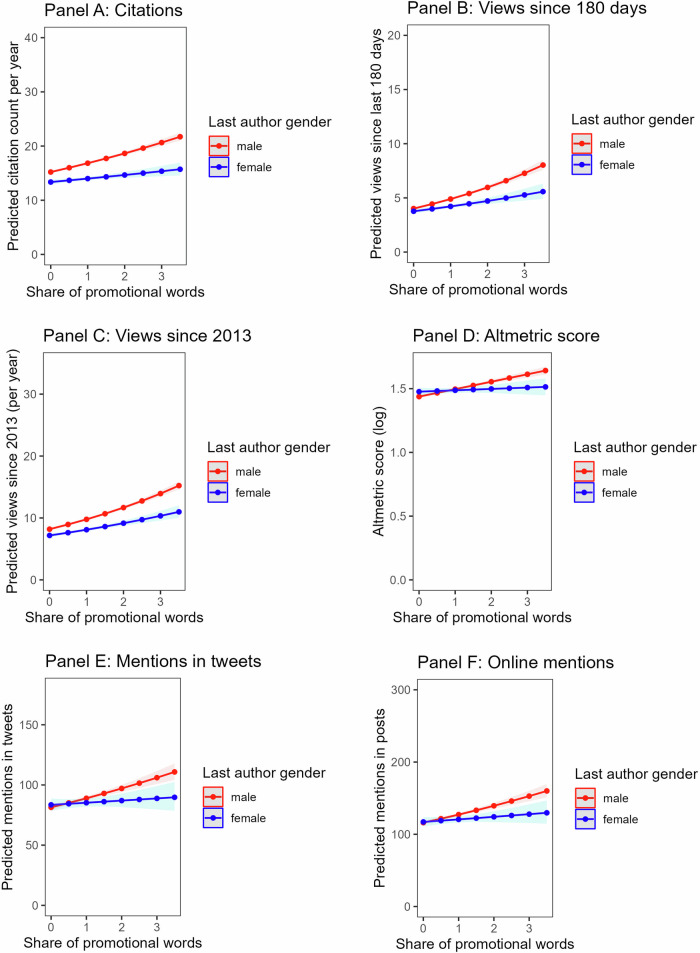
Researchers often use promotional language ("hyping") in scientific publications to draw attention to their findings. Here we examined whether promotional language is indeed associated with higher academic impact and public attention. A content analysis of over 130,000 abstracts published in three major interdisciplinary outlets (PNAS: 84,603; Science: 25,142; Nature: 26,870) between 1991 and 2023 showed that promotional language predicted more citations and more full-length paper views, more paper mentions in online media and higher Altmetric scores. Further, additional analyses by first and last author gender (first female author n = 15,368, first male author n = 32,873, last female author n = 10,218, last male author n = 46,606) showed that despite women being often advised to engage in more self-promotion, following this advice was not significantly associated with a smaller gender gap in impact indicators. If anything, promotional language predicted a larger gender gap with men (vs. women) receiving even more citations, paper views and mentions in the media. Our findings highlight the role of communication strategies in academic impact and public attention, as well as gender diversity in academia.
Overview
CoChat Summary
TL;DR
A content analysis of 136,615 abstracts from PNAS, Science, and Nature (1991–2023) found that greater use of promotional language predicted more citations, paper views, online mentions, and higher Altmetric scores. Gender analyses did not show that promotional language narrowed impact gaps; when interactions were significant, it was associated with larger gaps favoring men.
Key findings
- Promotional language predicted academic impact: increasing promotional language by 1% (about 2 words in an average 180-word abstract) was associated with 9–14% more citations per year (IRR = 1.14 without controls; 1.09 with controls), 14–37% more paper access in the last 180 days (IRR = 1.37; 1.16), and 14–37% more views since 2013 per year (IRR = 1.37; 1.14).
- It also predicted public attention: 3–6% higher Altmetric score (b = 0.08; 0.03), 4–12% more Twitter/X mentions (IRR = 1.12; 1.04), and 5–11% more online mentions overall (IRR = 1.11; 1.05).
- Female first authors used 6% less promotional language than male first authors (t = 6.77, p < 0.001, d = 0.06); last-author gender showed no significant difference. Papers with female first or last authors had poorer impact (18–34% difference), and female first-author papers had lower Altmetric scores and online mentions (5–13%). Promotional language × gender interactions were significant in 3/12 first-author models and 7/12 last-author models; when significant, the impact gap increased with promotional language.
- Exploratory temporal analyses found the association between promotional language and citations per year diminished over time, while associations with the other five impact indicators increased over time.
Methods
- Dataset: all accessible Web of Science records for PNAS, Science, and Nature downloaded June 5, 2023; duplicates, records without DOI or abstract, and non-primary research items were removed. Final sample: 136,615 abstracts (PNAS 84,603; Science 25,142; Nature 26,870) published 1991–2023; Altmetric outcomes were available for n = 64,693 records.
- Measures: promotional language was measured with a validated 139-word dictionary as the share of promotional words per abstract (median = 0.73 per 100 words; M = 0.86, SD = 0.83). Impact outcomes were Web of Science citation count per year, usage in the last 180 days, and usage since 2013 per year; public attention outcomes were Altmetric score, overall online mentions (“posts”), and Twitter/X mentions. Author gender was classified for first and last authors using gender_guesser, with validation agreement of 197/200 and a 1.5% error rate.
- Analysis: negative binomial regressions for count outcomes and linear regression on log-transformed Altmetric score, with and without controls (journal, publication year, abstract word count, author number, institutional diversity, LIWC positivity, and subject field). Robustness checks restricted to post-2011 papers, excluded 2023 papers, and excluded abstracts with promotional-language shares >3 SD above the mean.
Limitations
- Stated: usage indicators reflect only access through the Web of Science platform and may underreport readership; citation and impact metrics are affected by factors unrelated to quality, such as discipline; the dictionary approach may overlook context, nuance, evolving language, and polysemous words; gender detection from first names is problematic for Asian and androgynous names, so gender analyses likely reflect Western-name trends; the correlational design precludes causal conclusions; the sample is limited to three high-impact interdisciplinary journals; Altmetric score calculation lacks transparency; and the focus on first/last authors and gender leaves other identities and CRediT roles unexamined.
- Evident: the observational design cannot rule out confounding by paper quality, novelty, or significance; the sample is restricted to three journals, limiting generalizability to humanities or lower-impact outlets.
Model-written summary. Check it against the paper before relying on it.
Integrity signals
Registry
Cites
Statistics
Figures
Verification
Claims the paper makes
29 Valid · 4 Not valid · 13 Not checked · 70 Own results and interpretations
The cited sources support only part of this claim — read each source’s verdict below.
In the paper
“Female academics continue to lag behind in terms of key output criteria, such as citations and visibility33–37.”
§ Scientific publications that use promotional language in the abstract receive more citations and public attention > Introduction > Self-promotion, gender and the backlash hypothesis
What the sources say
- Partly supportedcites [33] Chatterjee, P. & Werner, R. M. Gender disparity in citations in high-impact journal articles. JAMA Netw. Open 4, e2114509–e2114509 (2021). 34213560 PMC8254129 sourceExperimental — accuracy not yet measured
The Conclusions report fewer citations for articles by women in high-impact medical journals, and the Discussion reports prior findings of lower visibility for women in academic medicine. These passages support the claim in that setting, but not its unqualified extension to female academics across all fields. (LLM, conf=0.85)
- Not checked — no full text of the sourcecites [34] Tahamtan, I., Safipour Afshar, A. & Ahamdzadeh, K. Factors affecting number of citations: a comprehensive review of the literature. Scientometrics 107, 1195–1225 (2016). source
- Not checked — no full text of the sourcecites [35] Jagsi, R. et al. The “gender gap” in authorship of academic medical literature—a 35 year perspective. N. Eng. J. Med. 355, 281–287 (2006). 16855268 source
- Partly supportedcites [36] Mamtani, M. et al. Quantifying gender disparity in physician authorship among commentary articles in three high-impact medical journals: an observational study. BMJ Open 10, e034056 (2020). 32102817 PMC7044872 sourceExperimental — accuracy not yet measured
The Results (Abstract; page unavailable) show that women physicians were less represented than men as first and last authors of commentary articles. The Conclusions (page unavailable) describe this as an attenuation of women’s voice in academia, supporting the visibility point in academic medicine. The paper does not report a gender gap in citation counts or establish the claim for female academics generally. (LLM, conf=0.86)
- Partly supportedcites [37] Silver, J. K. et al. Assessment of women physicians among authors of perspective-type articles published in high-impact pediatric journals. JAMA Netw. Open 1, e180802–e180802 (2018). 30646033 PMC6324294 sourceExperimental — accuracy not yet measured
The Discussion (page unavailable) reports that women physicians were underrepresented among authors of scholarly perspective-type articles, supporting a narrower claim about publication visibility. The paper does not establish that female academics generally receive fewer citations; its findings concern authorship in four pediatric journals. (LLM, conf=0.86)
plain- Asserted: passes — The authors put it forward as true.
- Checkable: passes — It can be checked against evidence.
- Load-bearing: passes — The paper’s conclusions depend on it.
- Based: passes — The paper gives a reason why it holds.
- Partly supported
Every source the paper cites for this claim was checked and supports it.
In the paper
“As prior research suggests that women are, on average, less likely to use promotional language25,28, this rhetorical strategy could represent an additional barrier to recognition – thereby exacerbating gender-based inequalities in academic impact.”
§ Scientific publications that use promotional language in the abstract receive more citations and public attention > Introduction > Self-promotion, gender and the backlash hypothesis
What the sources say
- Supportedcites [25] Qiu, H. S., Peng, H., Fosse, H. B., Woodruff, T. K. & Uzzi, B. Use of promotional language in grant applications and grant success. JAMA Netw. Open 7, e2448696 (2024). 39661389 PMC11635532 source
The Results report that men used more promotional words on average than women PIs in grant applications (1.0% vs 0.9%). The Conclusions likewise state that men tended to use more promotional language than women across funding levels. This supports the citing sentence’s average gender comparison. (LLM, conf=0.93)
- Supportedcites [28] Lerchenmueller, M. J., Sorenson, O. & Jena, A. B. Gender differences in how scientists present the importance of their research: observational study. BMJ367, l6573 (2019). PMC7190066 31843745 source
The Results (Gender differences in positive presentation) report that women and men used positive words in a similar fashion, but women used them less often. The Discussion (Conclusions) specifies that this finding concerns positive language in the titles and abstracts of research articles, supporting the claim in its academic context. (LLM, conf=0.91)
hedgedstates an association- Asserted: passes — The authors put it forward as true.
- Checkable: passes — It can be checked against evidence.
- Load-bearing: passes — The paper’s conclusions depend on it.
- Based: passes — The paper gives a reason why it holds.
- Supported
The cited sources support only part of this claim — read each source’s verdict below.
In the paper
“while Web of Science provides reliable data on citation count”
§ Scientific publications that use promotional language in the abstract receive more citations and public attention > Discussion > Strengths, limitations and future directions
What the sources say
- Partly supportedcites [33] Chatterjee, P. & Werner, R. M. Gender disparity in citations in high-impact journal articles. JAMA Netw. Open 4, e2114509–e2114509 (2021). 34213560 PMC8254129 sourceExperimental — accuracy not yet measured
The Methods > Data section says the authors obtained citation counts through Web of Science, supporting that it provides citation-count data. The paper does not assess or state that those data are reliable; its use of the database alone does not establish that qualifier. No page number is available in our copy. (LLM, conf=0.82)
plain- Asserted: passes — The authors put it forward as true.
- Checkable: passes — It can be checked against evidence.
- Load-bearing: passes — The paper’s conclusions depend on it.
- Based: passes — The paper gives a reason why it holds.
- Partly supported
A result the paper reports from its own data — it cites no other source for it, so there is none to check. The quote shows it is in the paper.
In the paper
“The last author gender by promotional language interaction reached significance in 7 out of 12 models”
§ Scientific publications that use promotional language in the abstract receive more citations and public attention > Results > Author gender
plainstates an association- Asserted: passes — The authors put it forward as true.
- Checkable: passes — It can be checked against evidence.
- Load-bearing: unclear — It is unclear whether the paper’s conclusions depend on it.
- Based: passes — The paper gives a reason why it holds.
- Rests on 2 assumptions not shown here.
A result the paper reports from its own data — it cites no other source for it, so there is none to check. The quote shows it is in the paper.
In the paper
“we found that the association between promotional language and impact has diminished over time when impact is measured as citation count (per year).”
§ Scientific publications that use promotional language in the abstract receive more citations and public attention > Results > Exploratory analyses: Temporal evolution
plainstates an association- Asserted: passes — The authors put it forward as true.
- Checkable: passes — It can be checked against evidence.
- Load-bearing: unclear — It is unclear whether the paper’s conclusions depend on it.
- Based: passes — The paper gives a reason why it holds.
- Rests on an assumption not shown here.
46 more claims
Create a free account to see all 116 claims and to verify the 5 references still open.
- Probably not a substantial claim. 49
- It may state two separate claims as one. 32
Statistics that don’t add up
Each reported p-value recomputed from its test statistic and degrees of freedom, each partial η² from its F, and each ratio, mean difference or B printed with a p checked against its own confidence interval.
Rated minor: it would not touch a result — a value no result rests on, a p-value that stays on the same side of the significance level, or a conflict that is clerical, resolved elsewhere in the paper, or outside its own findings.
In the paper
“t (11261) = 0.64, p = 0.122”
§ Scientific publications that use promotional language in the abstract receive more citations and public attention > Results > Author gender
Reported p = .122 · recomputed p = .522
Statistics recomputed
Every reported test result, recomputed from its test statistic and degrees of freedom. A result shows as not adding up only once an independent check has confirmed it.
- Doesn’t add upt(11261) = 0.64reported p = .122 · recomputed p = .522
“t (11261) = 0.64, p = .122”
- Consistentt(31632) = 6.77reported p < .001 · recomputed p < .001
“t (31632) = 6.77, p < .001”
- Consistentt(15380) = -0.22reported p = .828 · recomputed p = .826
“t (15380) = -0.22, p = .828”
- Consistentt(42308) = 11.64reported p < .001 · recomputed p < .001
“t (42308) = 11.64, p < .001”
- Consistentt(42714) = 12.33reported p < .001 · recomputed p < .001
“t (42714) = 12.33, p < .001”
7 more recomputed tests
Create a free account to see every test the Stats check recomputed.
Self-check
Percentages, sums and reported differences re-computed from the paper’s own numbers.
Each contradiction between two passages listed here was confirmed by an independent check.
Rated major: it would touch a result — a value a result rests on, reported and recomputed p-values on opposite sides of the significance level, two passages that conflict with no sign which is right, or a cited work retracted before this paper was published.
In the paper
§ Scientific publications that use promotional language in the abstract receive more citations and public attention > Results > Exploratory analyses: Temporal evolution
“In contrast, with respect to other five indicators of impact (usage per year since 2013, usage since the last 180 days, Altmetric score, number of mentions in tweets and online posts), the positive association between promotional language use and impact increased with time.”
§ Scientific publications that use promotional language in the abstract receive more citations and public attention > Results > Exploratory analyses: Temporal evolution
“views since 180 days, model without controls: IRR = 0.997, 95%CI [0.996, 0.999], p < 0.001, model with controls: IRR = 0.999, 95%CI [0.998, 1.001], p = 0.251”
Rated minor: it would not touch a result — a value no result rests on, a p-value that stays on the same side of the significance level, or a conflict that is clerical, resolved elsewhere in the paper, or outside its own findings.
In the paper
§ Scientific publications that use promotional language in the abstract receive more citations and public attention > Results > Impact
“model with controls: IRR = 0.03, 95%CI [0.03-0.04], p < 0.001”
§ Scientific publications that use promotional language in the abstract receive more citations and public attention > Methods > Analytic strategy
“For the analyses of the Altmetric score, we used a linear regression on the log-transformed Altmetric score.”
Rated minor: it would not touch a result — a value no result rests on, a p-value that stays on the same side of the significance level, or a conflict that is clerical, resolved elsewhere in the paper, or outside its own findings.
In the paper
§ Scientific publications that use promotional language in the abstract receive more citations and public attention > Results > Impact
“model with controls: IRR = 1.04, 95%CI [1.03–1.5], p < 0.001”
§ Scientific publications that use promotional language in the abstract receive more citations and public attention > Results > Impact
“| Promotional language | 1.09 | 1.08 – 1.10 | <0.001 | 1.16 | 1.14 – 1.17 | <0.001 | 1.14 | 1.13 – 1.15 | <0.001 | 0.03 | 0.03 – 0.04 | <0.001 | 1.04 | 1.03 – 1.05 | <0.001 | 1.05 | 1.03 – 1.06 | <0.001 |”
Rated minor: it would not touch a result — a value no result rests on, a p-value that stays on the same side of the significance level, or a conflict that is clerical, resolved elsewhere in the paper, or outside its own findings.
In the paper
§ Scientific publications that use promotional language in the abstract receive more citations and public attention > Discussion > Strengths, limitations and future directions
“with some reflecting the impact achieved more recently (focusing on citations within the last six months)”
§ Scientific publications that use promotional language in the abstract receive more citations and public attention > Methods > Measures
“For usage count since last 180 days, we took its raw value; for usage count since 2013, we computed the count per year”
Citations
Cites
Rudman, L. A. (1998) · Journal of Personality and Social Psychology · doi:10.1037/0022-3514.74.3.629 · Cited by 1,511
Why are women penalized for success at male tasks?: the implied communality deficit
Heilman, M. E., & Okimoto, T. G. (2007) · Journal of Applied Psychology · doi:10.1037/0021-9010.92.1.81 · Cited by 999
Factors Affecting Number of Citations: A Comprehensive Review of the Literature
Tahamtan, I., Safipour Afshar, A., & Ahamdzadeh, K. (2016) · Scientometrics · doi:10.1007/s11192-016-1889-2 · Cited by 912
The “Gender Gap” in Authorship of Academic Medical Literature — A 35-Year Perspective
Jagsi, R., Guancial, E. A., Worobey, C. C., Henault, L. E., Chang, Y., Starr, R., Tarbell, N. J., & Hylek, E. M. (2006) · New England Journal of Medicine · doi:10.1056/nejmsa053910 · Cited by 870
Multi-University Research Teams: Shifting Impact, Geography, and Stratification in Science
Jones, B. F., Wuchty, S., & Uzzi, B. (2008) · Science · doi:10.1126/science.1158357 · Cited by 812
Backlash effects for disconfirming gender stereotypes in organizations
Rudman, L. A., & Phelan, J. E. (2008) · Research in Organizational Behavior · doi:10.1016/j.riob.2008.04.003 · Cited by 776 · cited 5×
“Further, drawing from the literature on gender differences in the advantages of self-promotion 8,9 , we examined whether the use of promotional language is associated with equal advantages for male and female scientists.”
InfluentialAlarming trends in US domestic violence during the COVID-19 pandemic
Boserup, B., McKenney, M., & Elkbuli, A. (2020) · The American Journal of Emergency Medicine · doi:10.1016/j.ajem.2020.04.077 · Cited by 715 · cited 1×
“Promotional language includes negatively connoted words as well (e.g., dire, dismal, daunting, alarming), which can be used to signal the signi fi cance of the work (e.g., “ Alarming trends in US domestic violence during the COVID-19 pandemic ” 30 ).”
Trust, Confidence, and Expertise in a Judge-Advisor System
Sniezek, J. A., & Van Swol, L. M. (2001) · Organizational Behavior and Human Decision Processes · doi:10.1006/obhd.2000.2926 · Cited by 469
Communicating uncertainty about facts, numbers and science
van der Bles, A. M., van der Linden, S., Freeman, A. L. J., Mitchell, J., Galvao, A. B., Zaval, L., & Spiegelhalter, D. J. (2019) · Royal Society Open Science · doi:10.1098/rsos.181870 · Cited by 456 · cited 1×
“Most importantly, recent studies have shown that incorporating uncertain language in science communication reduces trust in the message content as well as in its source, and even hinders information diffusion 20 – 22 .”
Williams, M. J., & Tiedens, L. Z. (2016) · Psychological Bulletin · doi:10.1037/bul0000039 · Cited by 374 · cited 1×
“For example,womenwhoexhibitself-promotingbehaviorstendtobeperceivedas lesslikeable,whichobstructstheircareers 9,44 .”
Gender Disparity in Citations in High-Impact Journal Articles
Chatterjee, P., & Werner, R. M. (2021) · JAMA Network Open · doi:10.1001/jamanetworkopen.2021.14509 · Cited by 367
The effects of communicating uncertainty on public trust in facts and numbers
van der Bles, A. M., van der Linden, S., Freeman, A. L. J., & Spiegelhalter, D. J. (2020) · Proceedings of the National Academy of Sciences · doi:10.1073/pnas.1913678117 · Cited by 348
Men Set Their Own Cites High: Gender and Self-citation across Fields and over TimePreprint
King, M. M., Bergstrom, C. T., Correll, S. J., Jacquet, J., & West, J. D. (n.d.) · OSF Preprints (OSF Preprints) · Cited by 348
Men Set Their Own Cites High: Gender and Self-citation across Fields and over Time
King, M. M., Bergstrom, C. T., Correll, S. J., Jacquet, J., & West, J. D. (2017) · Socius: Sociological Research for a Dynamic World · doi:10.1177/2378023117738903 · Cited by 275
Intuitive evaluation of likelihood judgment producers: evidence for a confidence heuristic
Price, P. C., & Stone, E. R. (2004) · Journal of Behavioral Decision Making · doi:10.1002/bdm.460 · Cited by 272
Use caution when applying behavioural science to policy
IJzerman, H., Lewis, N. A., Przybylski, A. K., Weinstein, N., DeBruine, L., Ritchie, S. J., Vazire, S., Forscher, P. S., Morey, R. D., Ivory, J. D., et al. (2020) · Nature Human Behaviour · doi:10.1038/s41562-020-00990-w · Cited by 262
The Gender Gap in Self-Promotion
Exley, C. L., & Kessler, J. B. (2022) · The Quarterly Journal of Economics · doi:10.1093/qje/qjac003 · Cited by 250 · cited 1×
“Women ’ s lower tendency to engage in self-promotion has been blamed for their underrepresentation in science 38 .”
Gazni, A., & Didegah, F. (2011) · Scientometrics · doi:10.1007/s11192-011-0343-8 · Cited by 221
Gender differences in how scientists present the importance of their research: observational study
Lerchenmueller, M. J., Sorenson, O., & Jena, A. B. (2019) · BMJ · doi:10.1136/bmj.l6573 · Cited by 211 · cited 5×
“Wefocusedon fi rst(primaryor leading) and last (senior) authors ’ gender, as these usually represent the strongest contributions – a practice common in prior studies 28,33 .”
InfluentialGarten, J., Hoover, J., Johnson, K. M., Boghrati, R., Iskiwitch, C., & Dehghani, M. (2018) · Behavior Research Methods · doi:10.3758/s13428-017-0875-9 · Cited by 177 · cited 1×
“…to have driven our fi ndings, we encourage future research to adopt more advanced text analysis methods that are better equipped to handle such limitations – such as distributed dictionary representation (DDR), which enables a more semantically nuanced measurement based on an initial dictionary 60 .”
Lean in - Women, Work and the Will to Lead
Sandberg, S. (2015) · NHRD Network Journal · doi:10.1177/0974173920150225 · Cited by 173
Uncertainty is associated with biased expectancies and heightened responses to aversion.
Grupe, D. W., & Nitschke, J. B. (2011) · Emotion · doi:10.1037/a0022583 · Cited by 145 · cited 1×
“Humans generally fi nd uncertainty unpleasant; it is associated with heightened stress responses to negative stimuliandriskinformation 13,14 .”
Certainty in Language Increases Consumer Engagement on Social Media
Pezzuti, T., Leonhardt, J. M., & Warren, C. (2021) · Journal of Interactive Marketing · doi:10.1016/j.intmar.2020.06.005 · Cited by 143 · cited 1×
“Further, people are less likely to recommend newspaper articles that use more uncertain language and to share corporate advertisements that include more linguistic expressions of uncertainty (e.g., hedging) 18,19 .”
Han, P. K. J., Klein, W. M. P., Lehman, T., Killam, B., Massett, H., & Freedman, A. N. (2011) · Medical Decision Making · doi:10.1177/0272989x10371830 · Cited by 135 · cited 1×
“Humans generally fi nd uncertainty unpleasant; it is associated with heightened stress responses to negative stimuliandriskinformation 13,14 .”
Silver, J. K., Poorman, J. A., Reilly, J. M., Spector, N. D., Goldstein, R., & Zafonte, R. D. (2018) · JAMA Network Open · doi:10.1001/jamanetworkopen.2018.0802 · Cited by 121
Prejudice Toward Female Leaders: Backlash Effects and Women’s Impression Management Dilemma
Phelan, J. E., & Rudman, L. A. (2010) · Social and Personality Psychology Compass · doi:10.1111/j.1751-9004.2010.00306.x · Cited by 120 · cited 1×
“Studies have shown thatwomenwhodoengageinself-promotiontendtoexperienceabacklash,as self-promotionisincongruentwiththegenderstereotypeofmodesty 9,42,43 .”
Hype and Public Trust in Science
Master, Z., & Resnik, D. B. (2013) · Science and Engineering Ethics · doi:10.1007/s11948-011-9327-6 · Cited by 119 · cited 1×
“A pervasive view among meta-researchers is that it could lead to a “ loss of objectivity ” 64 , exaggeration and sensationalization of the results, ultimately undermining reproducibility and threatening public trust in science 2,4,5,65,66 .”
Aspiring to greater intellectual humility in science
Hoekstra, R., & Vazire, S. (2021) · Nature Human Behaviour · doi:10.1038/s41562-021-01203-8 · Cited by 117 · cited 1×
“Similarly, open science advocates and policy analysis researchers have repeatedly highlighted the importanceofacknowledgingtheuncertaintiesandlimitationsofpublished research fi ndings 67 – 69 – practices rather incompatible with hyping.”
Understanding the Problem of “Hype”: Exaggeration, Values, and Trust in Science
Intemann, K. K. (2020) · Canadian Journal of Philosophy · doi:10.1017/can.2020.45 · Cited by 108
Early-career setback and future career impact
Wang, Y., Jones, B. F., & Wang, D. (2019) · Nature Communications · doi:10.1038/s41467-019-12189-3 · Cited by 107 · cited 1×
“Whilegrantsarecentralforinnovationandscientists ’ careers 26,27 ,grant proposals, for the largest part, outline future research plans and therefore cannot fully capturethe academicand publicimpactof science.”
Hsiao, T.-K., & Schneider, J. (2021) · Quantitative Science Studies · doi:10.1162/qss_a_00155 · Cited by 98 · cited 1×
“Wedecided tokeep retracted publications and publications with an expression of concern as they usually continue to receive citations 48 .”
NIH funding and the pursuit of edge science
Packalen, M., & Bhattacharya, J. (2020) · Proceedings of the National Academy of Sciences · doi:10.1073/pnas.1910160117 · Cited by 87 · cited 1×
“Whilegrantsarecentralforinnovationandscientists ’ careers 26,27 ,grant proposals, for the largest part, outline future research plans and therefore cannot fully capturethe academicand publicimpactof science.”
VanHelene, A. D., Khatri, I. S., Hilton, C. B., Mishra, S., Uzun, E. D. G., & Warner, J. L. (2024) · PLOS Digital Health · doi:10.1371/journal.pdig.0000456 · Cited by 87
Leydesdorff, L., & Shin, J. C. (2011) · Journal of the American Society for Information Science and Technology · doi:10.1002/asi.21511 · Cited by 86 · cited 1×
“The downside of our focus on available and established metrics (e.g., citations) to measure impact in academia is that these metrics are known to be affected by factors not related to the quality of the work, such as the academic discipline 58 .”
Millar, N., Salager-Meyer, F., & Budgell, B. (2019) · English for Specific Purposes · doi:10.1016/j.esp.2019.02.004 · Cited by 85 · cited 3×
“The dictionary has been extensively validated in prior work 1,23,24 .”
Communicating uncertainty in policy analysis
Manski, C. F. (2019) · Proceedings of the National Academy of Sciences · doi:10.1073/pnas.1722389115 · Cited by 78
‘Our striking results demonstrate …’: Persuasion and the growth of academic hype
Hyland, K., & Jiang, F. (. (2021) · Journal of Pragmatics · doi:10.1016/j.pragma.2021.06.018 · Cited by 74 · cited 6×
“It has been suggested that by reducing hedging and embracing promotional language, authors aim to present their fi ndings more assertively, enhancing their appeal to editors, reviewers, and readers 2,12 .”
InfluentialEpistemic stance and the construction of knowledge in science writing: A diachronic corpus study
Poole, R., Gnann, A., & Hahn-Powell, G. (2019) · Journal of English for Academic Purposes · doi:10.1016/j.jeap.2019.100784 · Cited by 71 · cited 1×
“A similar shift was documented by Poole et al. in biochemical research articles, with epistemic stance markers expressing certainty (boosters) increasing, while those indicating doubt or uncertainty (hedges) decreasing 11 .”
Hu, Y.-H., Tai, C.-T., Liu, K. E., & Cai, C.-F. (2020) · Journal of Informetrics · doi:10.1016/j.joi.2019.101004 · Cited by 62
Early-career setback and future career impact
Wang, Y., Jones, B. F., & Wang, D. (2019) · RePEc: Research Papers in Economics · Cited by 58
Millar, N., Batalo, B., & Budgell, B. (2022) · JAMA Network Open · doi:10.1001/jamanetworkopen.2022.28676 · Cited by 57
Men Set Their Own Cites High: Gender and Self-citation across Fields and over TimePreprint
King, M. M., Bergstrom, C. T., Correll, S. J., Jacquet, J., & West, J. D. (2018) · SocArXiv (OSF Preprints) · doi:10.31235/osf.io/wqy2s · Cited by 56
Rinaldi, A. (2012) · EMBO reports · doi:10.1038/embor.2012.39 · Cited by 45
Cross‐cultural differences in self‐promotion: A study of self‐citations in management journals
Deschacht, N., & Maes, B. (2016) · Journal of Occupational and Organizational Psychology · doi:10.1111/joop.12162 · Cited by 45 · cited 1×
“We encourage future studies to devote more attention to automated gender disambiguation efforts, potentially using other gender detection methods (e.g., evaluating authors ’ university homepages 62 ) to ensure the methodological inclusivity and the classi fi cation accuracy across cultures.”
Fraser, V. J., & Martin, J. G. (2009) · Respiratory Research · doi:10.1186/1465-9921-10-35 · Cited by 40
Follow My Lead: Assertive Cheap Talk and the Gender Gap
Manian, S., & Sheth, K. (2021) · Management Science · doi:10.1287/mnsc.2020.3837 · Cited by 35 · cited 1×
“Inanotherstudy, even though using assertive langauge in written communication positively affectedthecredibilityofbothfemaleandmaleleaders,femaleleaderswereless likely to use it, undermining their in fl uence and impact 47 .”
Superlative Scientific Writing
Scott, S. L., & Jones, C. W. (2017) · ACS Catalysis · doi:10.1021/acscatal.7b00566 · Cited by 32
Over‐promotion and caution in abstracts of preprints during the COVID‐19 crisis
Bordignon, F., Ermakova, L., & Noel, M. (2021) · Learned Publishing · doi:10.1002/leap.1411 · Cited by 31
Yao, M., Wei, Y., & Wang, H. (2023) · Scientometrics · doi:10.1007/s11192-023-04759-6 · Cited by 31
Is There a Hype Problem in Science? If So, How Is It Addressed?
Weingart, P. (2017) · Oxford University Press eBooks · doi:10.1093/oxfordhb/9780190497620.013.12 · Cited by 27
Promotional language and the adoption of innovative ideas in science
Peng, H., Qiu, H. S., Fosse, H. B., & Uzzi, B. (2024) · Proceedings of the National Academy of Sciences · doi:10.1073/pnas.2320066121 · Cited by 26 · cited 6×
“…the information on records ’ features that have been previously associated with higher impact and / or promotional language in prior studies 2,24,52,53 : journal (Science, Nature, PNAS), publication year, word count (number of words in the abstract), number of authors, institutional…”
InfluentialWaung, M., Hymes, R., Beatty, J. E., & McAuslan, P. (2015) · International Journal of Selection and Assessment · doi:10.1111/ijsa.12119 · Cited by 25
Sebo, P. (2021) · Journal of the Medical Library Association JMLA · doi:10.5195/jmla.2022.1289 · Cited by 24 · cited 1×
“Yet,gender classi fi cation based on fi rst names (when done by humans or algorithms) is often problematic in the context of Asian names, as they are frequently androgynous (i.e., commonly used by both males and females) 61 .”
Mamtani, M., Shofer, F., Mudan, A., Khatri, U., Walker, R., Perrone, J., & Aysola, J. (2020) · BMJ Open · doi:10.1136/bmjopen-2019-034056 · Cited by 21
Using supervised learning to classify metadata of research data by field of study
Weber, T., Kranzlmüller, D. A., Fromm, M., & de Sousa, N. T. (2020) · Quantitative Science Studies · doi:10.1162/qss_a_00049 · Cited by 18
The gender gap in scholarly self-promotion on social media
Peng, H., Teplitskiy, M., Romero, D. M., & Horvát, E.-Á. (2025) · Nature Communications · doi:10.1038/s41467-025-60590-y · Cited by 17
Shinohara, K., Suganuma, A. M., Imai, H., Takeshima, N., Hayasaka, Y., & Furukawa, T. A. (2017) · PLOS ONE · doi:10.1371/journal.pone.0184786 · Cited by 15 · cited 2×
“Forexample,Shinoharaetal.analysisofpsychiatry trial papers revealed that 30% of abstracts contained exaggerated claims relative to the full text 32 .”
More confident, less formal: stylistic changes in academic psychology writing from 1970 to 2016
Wheeler, M. A., Vylomova, E., McGrath, M. J., & Haslam, N. (2021) · Scientometrics · doi:10.1007/s11192-021-04166-9 · Cited by 15
Backlash for high self‐promotion at hiring depends on candidates' gender and age
Krings, F., Manoharan, S., & Mendes de Oliveira, A. (2023) · International Journal of Selection and Assessment · doi:10.1111/ijsa.12410 · Cited by 15
Examining the trade‐off between confidence and optimism in future forecasts
Stavrova, O., & Evans, A. M. (2019) · Journal of Behavioral Decision Making · doi:10.1002/bdm.2087 · Cited by 12
Self-citationExpressions of Doubt in Online News Discussions
Evans, A. M., Stavrova, O., Rosenbusch, H., & Brandt, M. J. (2023) · Social Science Computer Review · doi:10.1177/08944393211034163 · Cited by 12 · cited 2×
“Further, people are less likely to recommend newspaper articles that use more uncertain language and to share corporate advertisements that include more linguistic expressions of uncertainty (e.g., hedging) 18,19 .”
Self-citationExpressions of uncertainty in online science communication hinder information diffusion
Stavrova, O., Kleinberg, B., Evans, A. M., & Ivanović, M. (2024) · PNAS Nexus · doi:10.1093/pnasnexus/pgae439 · Cited by 9
Self-citationWu, D., Wu, H., & Li, J. (2024) · Scientometrics · doi:10.1007/s11192-024-05074-4 · Cited by 8 · cited 3×
“Indeed,in management studies, the rapid increase in the use of positive language in recent years was restricted to high impact journals, where it was also linked to a higher number of citations (relative to lower impact journals) 29 .”
Leydesdorff, L., & Shin, J. C. (2010) · arXiv (Cornell University) · doi:10.48550/arxiv.1010.2465 · Cited by 7
Sebo, P. (2022) · Journal of the Medical Library Association · doi:10.5195/jmla.2022.1528 · Cited by 5
Use of Promotional Language in Grant Applications and Grant Success
Qiu, H. S., Peng, H., Fosse, H. B., Woodruff, T. K., & Uzzi, B. (2024) · JAMA Network Open · doi:10.1001/jamanetworkopen.2024.48696 · Cited by 5 · cited 5×
“Recent analyses of grant applications connected the useofpromotionalwordsingrantproposalswithincreasedfundingrates 23 – 25 .”
InfluentialHalvorson, R. T., Wong, L. H., & Feeley, B. T. (2024) · JAAOS: Global Research and Reviews · doi:10.5435/jaaosglobal-d-24-00109 · Cited by 4 · cited 1×
“The use of promotional language in published research papers has soared inthelastdecades 1 – 3 .”
Iyer, M. S., & Jagsi, R. (2024) · JAMA Network Open · doi:10.1001/jamanetworkopen.2024.48659 · Cited by 1
Research works printed but not linked: 3
- Rudman, L. A. Self-promotion as a risk factor for women: the costs and benefits of counterstereotypical impression management. J. Pers. Soc. Psychol. 74, 629 (1998). 9523410 · DOI · Paper page
- Stavrova, O., Kleinberg, B., Evans, A. M. & Ivanović, M. Expressions of uncertainty in online science communication hinder information diffusion. PNAS Nexus 3, pgae439 (2024). 39430220 PMC11489878 · DOI · Paper page
- Wheatley, D. Drama in research papers. Eur. Sci. Editing 40, 14–16 (2014).
Cited by
Su, Y., Wu, C., & Xu, H. (2026) · IEEE Transactions on Professional Communication · doi:10.1109/tpc.2026.3686899 · Cited by 1
(2025) · Communications Psychology · doi:10.1038/s44271-025-00317-3
Insights from the “Women in Evolutionary Biology Workshop” on gender equality in science
Kyomen, S., Ramirez, M. A., Glynatsi, N. E., Rodríguez-Sánchez, G. T., & de Azevedo-Lopes, A. (2025) · Evolution · doi:10.1093/evolut/qpaf255
Wu, H., Li, J., & Wu, D. (2026) · Scientometrics · doi:10.1007/s11192-025-05526-5 · Cited by 1
“Despite the growing concerns, the credibility of positive words in scientific papers has yet to undergo rigorous empirical scrutiny (Stavrova et al., 2025).”
InfluentialNakamura, S., Tada, K., Yamashita, Y., Inomata, N., Sakata, K., Ito, K., Kuroda, Y., Yoshizumi, F., Kouso, H., Iwaki, K., et al. (2026) · Surgery Today · doi:10.1007/s00595-026-03383-0
“The PROMO set consisted of emphatic or positively framed expressions that have been independently identified and validated in earlier studies as markers of promotional or overstated language in scientific writing, regardless of AI use [ 8, 9 ].”
Influential
Metadata
- Authors
- Stavrova, O., Kleinberg, B., Evans, A. M., & Ivanović, M.
- Affiliations
- Tilburg University (NL)
- Allstate (United States) (US)
- Belgrade Open School (RS)
- Corresponding author
- Stavrova, Olga
- Venue
- Communications Psychology
- Published
- 2025-08-05
- Volume
- 3
- Issue
- 1
- Pages
- 118-118
- ISSN
- 2731-9121 (ISSN-L)
- PMC
- PMC12325648
- OpenAlex
- W4412956396
- Cited by
- 8
- References
- 65
- Citations by year
- 2026: 6 · 2025: 2
- FWCI
- 5.07
- Type
- journal article
- Language
- en
- Open access
- gold
- doi.org
- Licence
- cc-by
- creativecommons.org/licenses/by/4.0 (tdm)
- creativecommons.org/licenses/by/4.0 (vor)
- Locations
- Communications Psychology (publishedVersion, cc-by)
- PubMed Central (publishedVersion, cc-by)
- Research portal (Tilburg University) (publishedVersion, cc-by)
- PubMed (publishedVersion)
- MADOC (University of Mannheim) (acceptedVersion, cc-by)
- DOAJ (DOAJ: Directory of Open Access Journals) (submittedVersion, cc-by-sa)
- Topics
- Social Sciences › Library and Information Sciences › scientometrics and bibliometrics research
- Social Sciences › Library and Information Sciences › Academic Writing and Publishing
- Social Sciences › Library and Information Sciences › Academic Publishing and Open Access
- Keywords
- promotional language, scientific abstracts, citation impact, public attention, Altmetric score, author gender, science communication
About these checks
Registry, retraction, Cites and statistics results are computed, not judged, with one exception: a printed reference that no index lists is read once by a model before it counts as a citation error. Claims are extracted by a model and kept only when their quote appears verbatim in the text; each cited source is then checked, with a model’s help, for whether it says what the claim relies on. Those verdicts can be wrong — read the claim’s quote and the cited source before relying on one.
The claim verdicts this report counts are experimental: their accuracy is not yet measured.
A language model drew the claims from the paper on 2026-10-10, under version 3 of the claim definition (model deepseek-v4.1-flash, prompt extract-v3).
A second model labelled each claim on 2026-10-10 (model jev-1.13-20260917, definition revision gold-guideline-v0.2).
Cited sources are checked with a language model’s help (gpt-6-sol).
Statistics and arithmetic are recomputed, not judged.
Confidence bands are shown only for fields calibrated on our annotated test set. None is calibrated yet, so no band is shown.
What counts as a claim ›How we measure confidence ›How we check this ›
Are you an author, or do you see a problem with this page? Request a review
Data sources
Bibliographic data: Semantic Scholar, OpenAlex, Crossref.
Contains information from the Semantic Scholar Academic Graph Datasets, made available under the ODC Attribution License (ODC-BY 1.0).
Semantic Scholar’s data is described in: Kinney, R., et al. (2023). The Semantic Scholar Open Data Platform. arXiv:2301.10140.
