

High levels of untreated distress and fatigue in cancer patients
Open accessThe DOI matches its Crossref record; 37 of the 39 references it cites were found in a registry or an index.
Abstract
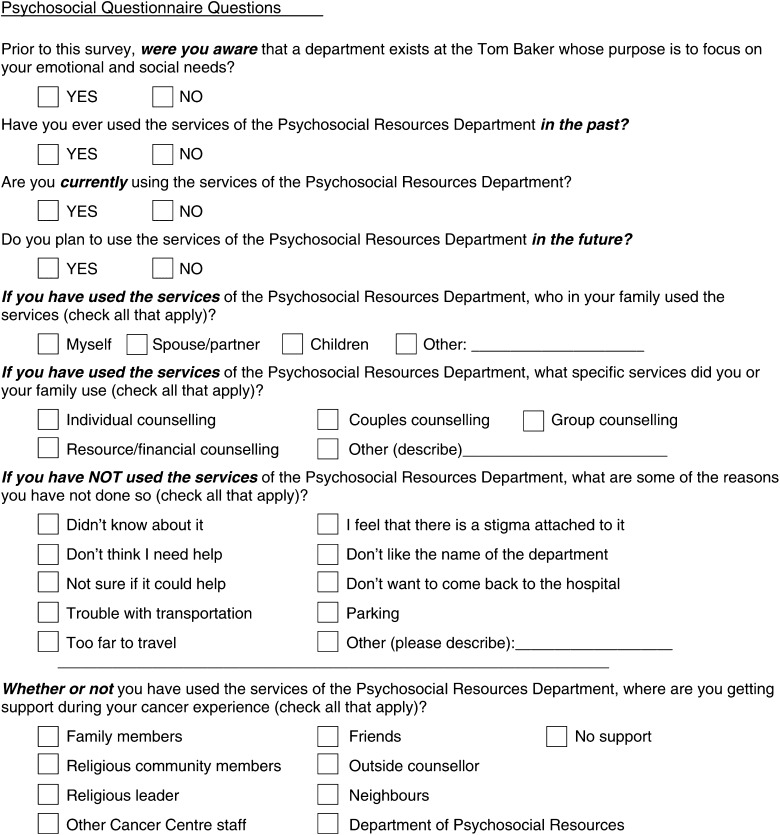
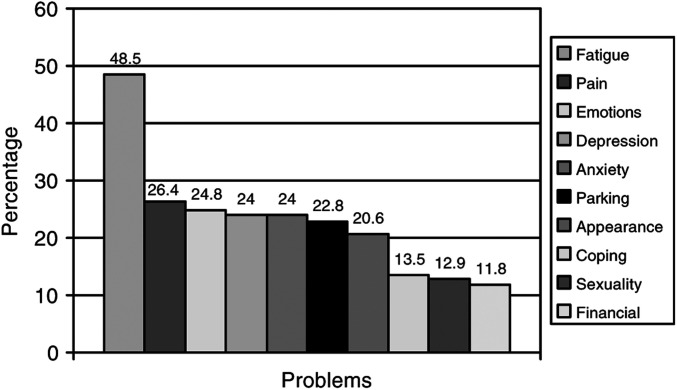
The purpose of the study was to assess a large representative sample of cancer patients on distress levels, common psychosocial problems, and awareness and use of psychosocial support services. A total of 3095 patients were assessed over a 4-week period with the Brief Symptom Inventory-18 (BSI-18), a common problems checklist, and on awareness and use of psychosocial resources. Full data was available on 2776 patients. On average, patients were 60 years old, Caucasian (78.3%), and middle class. Approximately, half were attending for follow-up care. Types of cancer varied, with the largest groups being breast (23.5%), prostate (16.9%), colorectal (7.5%), and lung (5.8%) cancer patients. Overall, 37.8% of all patients met criteria for general distress in the clinical range. A higher proportion of men met case criteria for somatisation, and more women for depression. There were no gender differences in anxiety or overall distress severity. Minority patients were more likely to be distressed, as were those with lower income, cancers other than prostate, and those currently on active treatment. Lung, pancreatic, head and neck, Hodgkin's disease, and brain cancer patients were the most distressed. Almost half of all patients who met distress criteria had not sought professional psychosocial support nor did they intend to in the future. In conclusion, distress is very common in cancer patients across diagnoses and across the disease trajectory. Many patients who report high levels of distress are not taking advantage of available supportive resources. Barriers to such use, and factors predicting distress and use of psychosocial care, require further exploration.
Overview
The claims and statistics of this paper haven’t been checked yet.
Free: it reads the open-access text and checks the first 5 claims that cite a source we can check. Create a free account to check every claim.
Integrity signals
Registry
Cites
Statistics
Figures
Verification
Claims the paper makes
The claims and statistics of this paper haven’t been checked yet.
Free: it reads the open-access text and checks the first 5 claims that cite a source we can check. Create a free account to check every claim.
Claims other papers make about this one
Each is checked against this paper’s own text: does it say what the citing paper says it does?
The source backs part of the claim, not all of it — or backs it for a different population, condition or comparison.
In the citing paper
“There are significant barriers to accessing traditional therapist-based interventions, including limited availability [3], prohibitive travel distances [4], reluctance to disclose distress [3], and concerns about mental health stigma [3].”
From Uptake and adherence to an online intervention for cancer-related distress: older age is not a barrier to adherence but may be a barrier to uptake (2017) · cites this paper as [4]
Experimental — accuracy not yet measuredThe source backs part of the claim, not all of it — or backs it for a different population, condition or comparison.
In the citing paper
“A cancer diagnosis is associated with high levels of distress, leading to frequent anxiety, depression, fear of recurrence/progression, sleep disturbance, and fatigue in both patients and caregivers [1–8].”
From Being present: A single-arm feasibility study of audio-based mindfulness meditation for colorectal cancer patients and caregivers (2018) · cites this paper as [1]
Experimental — accuracy not yet measuredThe source backs part of the claim, not all of it — or backs it for a different population, condition or comparison.
In the citing paper
“A metastatic cancer diagnosis is associated with high levels of distress in patients and caregivers.”
From Being present: A single-arm feasibility study of audio-based mindfulness meditation for colorectal cancer patients and caregivers (2018) · cites this paper as [1]
Experimental — accuracy not yet measuredThe cited source says what the claim attributes to it.
In the citing paper
“While an estimated 35–45% of cancer patients report psychological distress [1, 12], distress is most common during active treatment [13, 14].”
From Being present: A single-arm feasibility study of audio-based mindfulness meditation for colorectal cancer patients and caregivers (2018) · cites this paper as [1]
In the citing paper
“more than one in three cancer patients and survivors experience significant levels of psychological distress.4”
1 more claim about this paper
Create a free account to see every claim other papers make about this one.
Self-check
Percentages, sums and reported differences re-computed from the paper’s own numbers.
The self-check needs the paper’s full text.
Citations
Cites
The prevalence of psychiatric disorders among cancer patients
Derogatis, L. R. (1983) · JAMA: The Journal of the American Medical Association · doi:10.1001/jama.1983.03330300035030 · Cited by 1,575 · cited 2×
“Previous studies have documented that approximately one-third of all oncology patients will experience significant levels of distress associated with diagnosis and treatment of cancer, which warrants psychosocial treatment (Derogatis et al., 1983; Stefanek et al., 1987; Zabora et al., 1997; Sellick and Crooks, 1999; Z…”
BackgroundDistress Management, Version 3.2019, NCCN Clinical Practice Guidelines in Oncology
Riba, M. B., Donovan, K. A., Andersen, B., Braun, I., Breitbart, W. S., Brewer, B. W., Buchmann, L. O., Clark, M. M., Collins, M., Corbett, C., et al. (2019) · Journal of the National Comprehensive Cancer Network · doi:10.6004/jnccn.2019.0048 · Cited by 871
Meyer, T. J., & Mark, M. M. (1995) · Health Psychology · doi:10.1037/0278-6133.14.2.101 · Cited by 689 · cited 2×
“This is of concern given that many empirically supported treatments for distress in cancer patients are widely available (for reviews, see Fawzy et al., 1995; Meyer and Mark, 1995; Bottomley, 1997; Iacovino and Reesor, 1997; Fawzy, 1999; Carlson and Bultz, 2003a).”
BackgroundCritical Review of Psychosocial Interventions in Cancer Care
Fawzy, F. I. (1995) · Archives of General Psychiatry · doi:10.1001/archpsyc.1995.03950140018003 · Cited by 560 · cited 1×
“This is of concern given that many empirically supported treatments for distress in cancer patients are widely available (for reviews, see Fawzy et al., 1995; Meyer and Mark, 1995; Bottomley, 1997; Iacovino and Reesor, 1997; Fawzy, 1999; Carlson and Bultz, 2003a).”
BackgroundA New Psychosocial Screening Instrument for Use With Cancer Patients
Zabora, J., Brintzenhofeszoc, K., Jacobsen, P., Curbow, B., Piantadosi, S., Hooker, C., Owens, A., & Derogatis, L. (2001) · Psychosomatics · doi:10.1176/appi.psy.42.3.241 · Cited by 440 · cited 7×
“The BSI-18 is the version that the Johns Hopkins group has been recently using in their screening programme, and on which they have published norms from a large sample of patients (Zabora et al., 2001b).”
BackgroundMethodResultInfluentialCarlson, L. E., & Bultz, B. D. (2003) · Journal of Psychosomatic Research · doi:10.1016/s0022-3999(03)00514-2 · Cited by 351 · cited 5×
“Several agencies, both American and International, have developed guidelines for psychosocial care, which include screening guidelines (see Carlson and Bultz (2003b) for an overview of distress screening issues).”
BackgroundMethodInfluentialSelf-citationVelikova, G., Wright, E. P., Smith, A. B., Cull, A., Gould, A., Forman, D., Perren, T., Stead, M., Brown, J., & Selby, P. J. (1999) · Journal of Clinical Oncology · doi:10.1200/jco.1999.17.3.998 · Cited by 339 · cited 2×
“…computer-based technology is convincing, in terms of its reliability, acceptability to patients, and utility in improving clinical care around psychosocial issues (Taenzer et al., 1997; Velikova et al., 1999; Taenzer et al., 2000; McLachlan et al., 2001; Carlson et al., 2001; Bezjak et al., 2001).”
BackgroundAge-related differences in the quality of life of breast carcinoma patients after treatment
Wenzel, L. B., Fairclough, D. L., Brady, M. J., Cella, D., Garrett, K. M., Kluhsman, B. C., Crane, L. A., & Marcus, A. C. (1999) · Cancer · doi:10.1002/(sici)1097-0142(19991101)86:9<1768::aid-cncr19>3.0.co;2-o · Cited by 329 · cited 1×
“Previous reports indicate that younger patients may suffer higher levels of distress (Wenzel et al., 1999; Carlson and Bultz, 2002), theorised to be due to a larger disruption of social and familial roles at earlier developmental stages, such as raising small children and establishing careers.”
BackgroundMcLachlan, S.-A., Allenby, A., Matthews, J., Wirth, A., Kissane, D., Bishop, M., Beresford, J., & Zalcberg, J. (2001) · Journal of Clinical Oncology · doi:10.1200/jco.2001.19.21.4117 · Cited by 295 · cited 2×
“…computer-based technology is convincing, in terms of its reliability, acceptability to patients, and utility in improving clinical care around psychosocial issues (Taenzer et al., 1997; Velikova et al., 1999; Taenzer et al., 2000; McLachlan et al., 2001; Carlson et al., 2001; Bezjak et al., 2001).”
BackgroundBenefits of psychosocial oncology care: improved quality of life and medical cost offset.
Carlson, L. E., & Bultz, B. D. (2003) · Health and Quality of Life Outcomes · doi:10.1186/1477-7525-1-8 · Cited by 269
Self-citation
Research works printed but not linked: 5
- Carlson LE, Bultz BD (2002) Efficacy vs. cost of psychosocial interventions: an evidence-based call for action. Oncol Exchange 1: 34–51
- Derogatis LR (1983) SCL-90-R: Administration, Scoring and Procedures Manual-II, 2nd edn. Baltimore, MD: Clinical Psychometric Research
- Derogatis LR (1993) Brief Symptom Inventory: Administration, scoring, and procedures manual. Minneapolis, MN: National Computer Systems, Inc
- Derogatis LR (2001) Brief Symptom Inventory 18: Administration, Scoring and Procedures Manual. Minneapolis, MN: NCS Pearson Inc
- Taenzer P, Bultz BD, Carlson LE, Speca M, DeGagne T, Olson K, Doll R, Rosberger Z (2000) Impact of computerized quality of life screening on physician behaviour and patient satisfaction in lung cancer outpatients. Psychooncology 9: 203–213 10871716 · doi:10.1002/1099-1611(200005/06)9:3<203::aid-pon453>3.0.co;2-y
Cited by
Items 901–935 of 935
Wybrane wskaźniki i przeżycia depresyjnego i lęku u osób, które przeżyły nowotwór (cancer survivors)
Boleková, V., Naništová, E., & Chlebcová, V. (2023) · Studia Mazowieckie · doi:10.54539/sm.43
Robinson, A., Slight, R. D., Husband, A., & Slight, S. P. (2023) · doi:10.2196/preprints.48510
What Is the Clinical Course of Hematologic Malignancies?
Dhawale, T. M., & El-Jawahri, A. R. (2023) · Elsevier eBooks · doi:10.1016/b978-0-323-84702-5.00038-5
Prendergast, H. M., Stratton, R., Butler, N. I., Mannan, N., & Khosla, S. (2024) · Journal of Cancer Education · doi:10.1007/s13187-024-02435-8 · Cited by 1
“This is consistent with what has been reported previously in the literature [7].”
Psychological Distress among Patients with Suspected Sarcoma Requiring Biopsy Confirmation
Ng, Y. H. (2023) · International Journal of Science and Research (IJSR) · doi:10.21275/sr23630155703
Bourgognon, F., Béchet, D., Huin‐Schohn, C., Strelow, A., Demarche, L., Guillou, M., Adam, V. S., Fall, E., & Omorou, A. Y. (2024) · Frontiers in Psychology · doi:10.3389/fpsyg.2024.1409308 · Cited by 1
Ottarsdottir, E., Ghavidel, F. Z., & Wehling, E. I. (2024) · Disability and Rehabilitation · doi:10.1080/09638288.2024.2391103
“Carlson, et al. [57] discussed that cancer patients require different levels of support at various stages in their disease course.”
Singh, S., Spiropoulos, A., Deleemans, J. M., & Carlson, L. E. (2024) · Cancers · doi:10.3390/cancers16172996
“A meta-analysis demonstrated that anxiety was significantly more prevalent in survivors of cancer than in healthy controls, [3] and more than one-third of Canadian survivors of cancer experienced symptoms of distress, including fatigue, depression, and anxiety [4].”
BackgroundSelf-citationQuality of Life and cost of living in colon cancer patients
Kouris, I., Kalogianni, A., Kapadochos, T., Kiranoudi, A., Pavlatou, N., Kyriakopoulos, A., & Toylia, G. (2025) · International Journal of Advanced Statistics and Probability · doi:10.12681/healthresj.38210
Predictors of distress among individuals with cancer reporting physical problems
Dierkes, M., Cai, Y., Trotta, V., Policicchio, P., Wen, S., Dzwil, G., Davis, N., & Stout, N. L. (2025) · Supportive Care in Cancer · doi:10.1007/s00520-025-09534-2 · Cited by 2
“This is consistent with previous findings suggesting high distress is present among breast and gynecological cancers [39], while older studies suggest patients diagnosed with head and neck, lung, hematologic, and brain cancer report higher distress [40].”
Exploring referrals to a specialist NHS cancer psychology service: a retrospective audit
Boughey, H., & Lobley, K. (2025) · Cancer Nursing Practice · doi:10.7748/cnp.2025.e1902
Kalliola, S., Kettunen, P., Eskelinen, O., Kosonen, K., Rostila, I., & Leander, A. (2012)
Fairview Cancer Rehab Program Outcomes and Effectiveness: a Pilot Study
Adami, K., Koch, E., Meier, A. D., & Vaughn, L. (2014) · SOPHIA (St. Catherine University)
ATT LEVA MED LUNGCANCER - PATIENTERS UPPLEVELSER AV SJUKDOM OCH VÅRD
Lövgren, M. (2011) · KTH Publication Database DiVA (KTH Royal Institute of Technology)
Wolf, S., Zanker, J., Sommer, F., Vlasenko, D., Pinto, D. R. M., Hoffmann, M., Anthuber, M., & Schrempf, M. C. (2023) · Figshare · doi:10.6084/m9.figshare.22603132
Palliative Care Needs in Survivors of Critical Illness
Perfetti, A. R., Lee, J., Lincoln, T. E., & Thurston, A. L. (2026) · Cambridge University Press eBooks · doi:10.1017/9781009501477.048
Cohorst, A., & Kajonius, P. (2026) · Journal of Psychopharmacology · doi:10.1177/02698811261424199
“Mindfulness has also been associated with reduced distress and anxiety in cancer patients (Carlson et al., 2004; Piet et al., 2012).”
Zozaya, C. (2011) · theses.fr (ABES) · doi:10.70675/b75e2ef9z6f09z47baz856az41e640fc99f6 · Cited by 1
Baek, S., Shin, J., & Park, S. (2026) · Research Square · doi:10.21203/rs.3.rs-9366397/v1
Haakenstad, E. K., Neville, B. A., Manni, M., Zhang, S., Toffler, D. H., Mastropietro, M., Herrera, H., Harper, S., Procter, S. M., Ennis, A., et al. (2026) · Research Connections · doi:10.1093/rescon/vmag052
Emotional impairments in patients with chemotherapy-induced polyneuropathy
Tikhonova, O. A., Сергеевна, Д. Е., & Сергеевич, Д. Д. (2026) · Russian neurological Journal · doi:10.30629/2658-7947-2026-31-1-37-46
Enteral feeding practices during head and neck cancer treatment: A retrospective chart reviewPreprint
Tsoupatkis, K., Ho, J., Ibbetson, J., der Meer, L. V., & Stringer, E. (2026) · Research Square · doi:10.21203/rs.3.rs-9407105/v1
Roy, A., Raut, A., Chaudhary, A., Mandal, S., Dangi, D., Sewani, K., Pathan, A., & Shinde, M. (2026) · Journal of Psychosocial Oncology · doi:10.1080/07347332.2026.2695783
Chen, L., X, X., Ding, F., Guo, Z., Wang, X., & Chen, M. (2026) · BMC Public Health · doi:10.1186/s12889-026-28655-9
“There has been insufficient in-depth investigation into the moderating effects of key patient characteris-tics—such as cancer type, age, and treatment stage—on the efficacy and applicability of VR interventions [33–35].”
Seo, A. (2026) · The Arts in Psychotherapy · doi:10.1016/j.aip.2026.102520
Loneliness and Mental State in Cancer
Koç, M., Tel, H., Başak, M., Aydın, H. T., Akkaya, Ç., & Kısaoğlu, Ö. (2026) · Global Nursing Insights · doi:10.31125/globnursinsights.1806061
Huang, T. Q., McClellan, S. R., Brooks, G. A., Trombley, M. J., Kummet, C. M., & Keating, N. L. (2026) · JCO Oncology Practice · doi:10.1200/op-26-00383
Briggs, R. J., Green, A., Chambers, S., Dunn, J. L., & Heneka, N. (2026) · Collegian · doi:10.1016/j.colegn.2026.10.002
Emotional distress in older adults with cancer : a multilevel longitudinal study.
Schapmire, T. J. (2012) · ThinkIR: The University of Louisville's Institutional Repository (University of Louisville) · doi:10.18297/etd/1269
AFRONTAMIENTO DE ESTRÉS A TRAVÉS DEL ESTADIO EN EL CÁNCER DE MAMA
Collon, M. D. M., & Milidoni, O. (2009) · I Congreso Internacional de Investigación y Práctica Profesional en Psicología XVI Jornadas de Investigación Quinto Encuentro de Investigadores en Psicología del MERCOSUR
Metadata
- Authors
- Carlson, L. E., Angen, M., Cullum, J., Goodey, E., Koopmans, J., Lamont, L., MacRae, J. H., Martin, M., Pelletier, G., Robinson, J., Simpson, J. S. A., Speca, M., Tillotson, L., & Bultz, B. D.
- Affiliations
- University of Calgary (CA)
- Corresponding author
- Carlson, L E
- Venue
- British Journal of Cancer
- Published
- 2004-05-25
- Volume
- 90
- Issue
- 12
- Pages
- 2297-2304
- ISSN
- 0007-0920 (ISSN-L)
- 1532-1827
- PMC
- PMC2410292
- OpenAlex
- W2143584015
- Cited by
- 939
- References
- 39
- Citations by year
- 2026: 19 · 2025: 15 · 2024: 29 · 2023: 29 · 2022: 61 · 2021: 59 · 2020: 50 · 2019: 35 · 2018: 62 · 2017: 52 · 2016: 59 · 2015: 58 · 2014: 54 · 2013: 54 · 2012: 67
- FWCI
- 8.66
- Type
- journal article
- Language
- en
- Open access
- hybrid
- doi.org
- Licence
- cc-by-nc-sa
- www.springer.com/tdm (unspecified)
- Locations
- British Journal of Cancer (publishedVersion, cc-by-nc-sa)
- PubMed Central (publishedVersion, cc-by)
- PubMed (publishedVersion)
- Libraries and Cultural Resources (University of Calgary) (submittedVersion, cc-by-nc-sa)
- Funders
- Canadian Institutes of Health Research
- Topics
- Health Sciences › Medicine › Oncology › Cancer survivorship and care
- Health Sciences › Medicine › Public Health, Environmental and Occupational Health › Palliative and Oncologic Care
- Social Sciences › Psychology › Clinical Psychology › Family Support in Illness
- Keywords
- cancer patients, psychological distress, fatigue, psychosocial support, help-seeking, somatization, depression, anxiety, Brief Symptom Inventory-18, psychosocial problems, barriers to care, gender differences, socioeconomic factors, minority patients
- MeSH terms
- Adult, Aged, Counseling, Cross-Sectional Studies, Fatigue, Female, Humans, Income, Male, Mass Screening, Mental Health Services, Middle Aged, Minority Groups, Neoplasms, Social Support, Stress, Psychological
About these checks
Registry, retraction, Cites and statistics results are computed, not judged, with one exception: a printed reference that no index lists is read once by a model before it counts as a citation error. Claims are extracted by a model and kept only when their quote appears verbatim in the text; each cited source is then checked, with a model’s help, for whether it says what the claim relies on. Those verdicts can be wrong — read the claim’s quote and the cited source before relying on one.
Statistics and arithmetic are recomputed, not judged.
Confidence bands are shown only for fields calibrated on our annotated test set. None is calibrated yet, so no band is shown.
What counts as a claim ›How we measure confidence ›How we check this ›
Are you an author, or do you see a problem with this page? Request a review
Data sources
Bibliographic data: Semantic Scholar, OpenAlex, Crossref.
Contains information from the Semantic Scholar Academic Graph Datasets, made available under the ODC Attribution License (ODC-BY 1.0).
Semantic Scholar’s data is described in: Kinney, R., et al. (2023). The Semantic Scholar Open Data Platform. arXiv:2301.10140.
