

High levels of untreated distress and fatigue in cancer patients
Open accessThe DOI matches its Crossref record; 37 of the 39 references it cites were found in a registry or an index.
Abstract
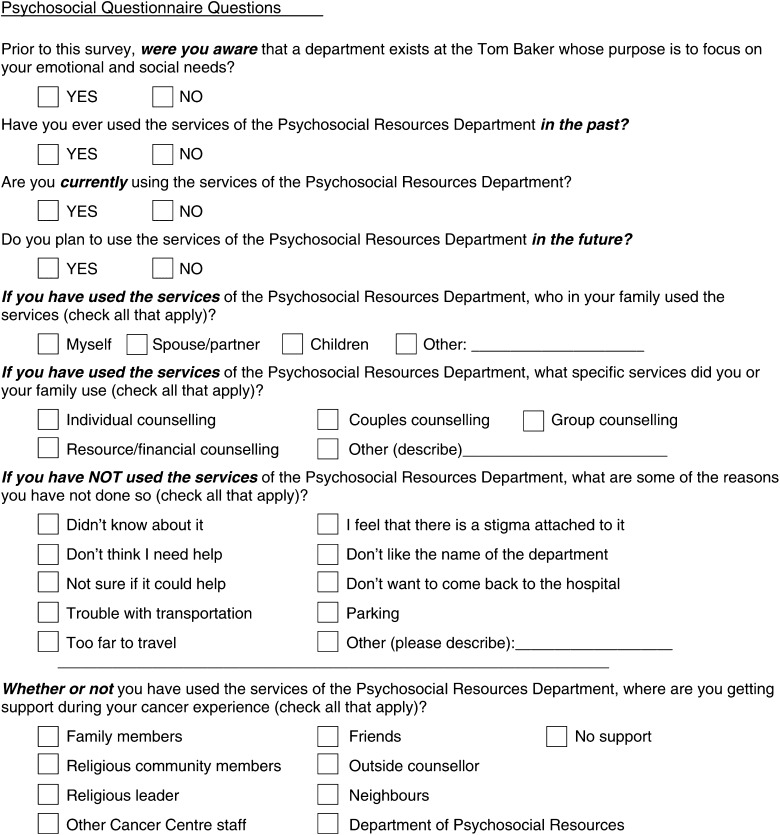
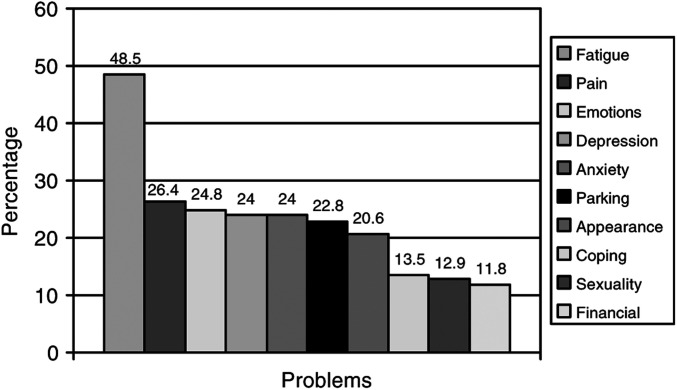
The purpose of the study was to assess a large representative sample of cancer patients on distress levels, common psychosocial problems, and awareness and use of psychosocial support services. A total of 3095 patients were assessed over a 4-week period with the Brief Symptom Inventory-18 (BSI-18), a common problems checklist, and on awareness and use of psychosocial resources. Full data was available on 2776 patients. On average, patients were 60 years old, Caucasian (78.3%), and middle class. Approximately, half were attending for follow-up care. Types of cancer varied, with the largest groups being breast (23.5%), prostate (16.9%), colorectal (7.5%), and lung (5.8%) cancer patients. Overall, 37.8% of all patients met criteria for general distress in the clinical range. A higher proportion of men met case criteria for somatisation, and more women for depression. There were no gender differences in anxiety or overall distress severity. Minority patients were more likely to be distressed, as were those with lower income, cancers other than prostate, and those currently on active treatment. Lung, pancreatic, head and neck, Hodgkin's disease, and brain cancer patients were the most distressed. Almost half of all patients who met distress criteria had not sought professional psychosocial support nor did they intend to in the future. In conclusion, distress is very common in cancer patients across diagnoses and across the disease trajectory. Many patients who report high levels of distress are not taking advantage of available supportive resources. Barriers to such use, and factors predicting distress and use of psychosocial care, require further exploration.
Overview
The claims and statistics of this paper haven’t been checked yet.
Free: it reads the open-access text and checks the first 5 claims that cite a source we can check. Create a free account to check every claim.
Integrity signals
Registry
Cites
Statistics
Figures
Verification
Claims the paper makes
The claims and statistics of this paper haven’t been checked yet.
Free: it reads the open-access text and checks the first 5 claims that cite a source we can check. Create a free account to check every claim.
Claims other papers make about this one
Each is checked against this paper’s own text: does it say what the citing paper says it does?
The source backs part of the claim, not all of it — or backs it for a different population, condition or comparison.
In the citing paper
“There are significant barriers to accessing traditional therapist-based interventions, including limited availability [3], prohibitive travel distances [4], reluctance to disclose distress [3], and concerns about mental health stigma [3].”
From Uptake and adherence to an online intervention for cancer-related distress: older age is not a barrier to adherence but may be a barrier to uptake (2017) · cites this paper as [4]
Experimental — accuracy not yet measuredThe source backs part of the claim, not all of it — or backs it for a different population, condition or comparison.
In the citing paper
“A cancer diagnosis is associated with high levels of distress, leading to frequent anxiety, depression, fear of recurrence/progression, sleep disturbance, and fatigue in both patients and caregivers [1–8].”
From Being present: A single-arm feasibility study of audio-based mindfulness meditation for colorectal cancer patients and caregivers (2018) · cites this paper as [1]
Experimental — accuracy not yet measuredThe source backs part of the claim, not all of it — or backs it for a different population, condition or comparison.
In the citing paper
“A metastatic cancer diagnosis is associated with high levels of distress in patients and caregivers.”
From Being present: A single-arm feasibility study of audio-based mindfulness meditation for colorectal cancer patients and caregivers (2018) · cites this paper as [1]
Experimental — accuracy not yet measuredThe cited source says what the claim attributes to it.
In the citing paper
“While an estimated 35–45% of cancer patients report psychological distress [1, 12], distress is most common during active treatment [13, 14].”
From Being present: A single-arm feasibility study of audio-based mindfulness meditation for colorectal cancer patients and caregivers (2018) · cites this paper as [1]
In the citing paper
“more than one in three cancer patients and survivors experience significant levels of psychological distress.4”
1 more claim about this paper
Create a free account to see every claim other papers make about this one.
Self-check
Percentages, sums and reported differences re-computed from the paper’s own numbers.
The self-check needs the paper’s full text.
Citations
Cites
The prevalence of psychiatric disorders among cancer patients
Derogatis, L. R. (1983) · JAMA: The Journal of the American Medical Association · doi:10.1001/jama.1983.03330300035030 · Cited by 1,575 · cited 2×
“Previous studies have documented that approximately one-third of all oncology patients will experience significant levels of distress associated with diagnosis and treatment of cancer, which warrants psychosocial treatment (Derogatis et al., 1983; Stefanek et al., 1987; Zabora et al., 1997; Sellick and Crooks, 1999; Z…”
BackgroundDistress Management, Version 3.2019, NCCN Clinical Practice Guidelines in Oncology
Riba, M. B., Donovan, K. A., Andersen, B., Braun, I., Breitbart, W. S., Brewer, B. W., Buchmann, L. O., Clark, M. M., Collins, M., Corbett, C., et al. (2019) · Journal of the National Comprehensive Cancer Network · doi:10.6004/jnccn.2019.0048 · Cited by 871
Meyer, T. J., & Mark, M. M. (1995) · Health Psychology · doi:10.1037/0278-6133.14.2.101 · Cited by 689 · cited 2×
“This is of concern given that many empirically supported treatments for distress in cancer patients are widely available (for reviews, see Fawzy et al., 1995; Meyer and Mark, 1995; Bottomley, 1997; Iacovino and Reesor, 1997; Fawzy, 1999; Carlson and Bultz, 2003a).”
BackgroundCritical Review of Psychosocial Interventions in Cancer Care
Fawzy, F. I. (1995) · Archives of General Psychiatry · doi:10.1001/archpsyc.1995.03950140018003 · Cited by 560 · cited 1×
“This is of concern given that many empirically supported treatments for distress in cancer patients are widely available (for reviews, see Fawzy et al., 1995; Meyer and Mark, 1995; Bottomley, 1997; Iacovino and Reesor, 1997; Fawzy, 1999; Carlson and Bultz, 2003a).”
BackgroundA New Psychosocial Screening Instrument for Use With Cancer Patients
Zabora, J., Brintzenhofeszoc, K., Jacobsen, P., Curbow, B., Piantadosi, S., Hooker, C., Owens, A., & Derogatis, L. (2001) · Psychosomatics · doi:10.1176/appi.psy.42.3.241 · Cited by 440 · cited 7×
“The BSI-18 is the version that the Johns Hopkins group has been recently using in their screening programme, and on which they have published norms from a large sample of patients (Zabora et al., 2001b).”
BackgroundMethodResultInfluentialCarlson, L. E., & Bultz, B. D. (2003) · Journal of Psychosomatic Research · doi:10.1016/s0022-3999(03)00514-2 · Cited by 351 · cited 5×
“Several agencies, both American and International, have developed guidelines for psychosocial care, which include screening guidelines (see Carlson and Bultz (2003b) for an overview of distress screening issues).”
BackgroundMethodInfluentialSelf-citationVelikova, G., Wright, E. P., Smith, A. B., Cull, A., Gould, A., Forman, D., Perren, T., Stead, M., Brown, J., & Selby, P. J. (1999) · Journal of Clinical Oncology · doi:10.1200/jco.1999.17.3.998 · Cited by 339 · cited 2×
“…computer-based technology is convincing, in terms of its reliability, acceptability to patients, and utility in improving clinical care around psychosocial issues (Taenzer et al., 1997; Velikova et al., 1999; Taenzer et al., 2000; McLachlan et al., 2001; Carlson et al., 2001; Bezjak et al., 2001).”
BackgroundAge-related differences in the quality of life of breast carcinoma patients after treatment
Wenzel, L. B., Fairclough, D. L., Brady, M. J., Cella, D., Garrett, K. M., Kluhsman, B. C., Crane, L. A., & Marcus, A. C. (1999) · Cancer · doi:10.1002/(sici)1097-0142(19991101)86:9<1768::aid-cncr19>3.0.co;2-o · Cited by 329 · cited 1×
“Previous reports indicate that younger patients may suffer higher levels of distress (Wenzel et al., 1999; Carlson and Bultz, 2002), theorised to be due to a larger disruption of social and familial roles at earlier developmental stages, such as raising small children and establishing careers.”
BackgroundMcLachlan, S.-A., Allenby, A., Matthews, J., Wirth, A., Kissane, D., Bishop, M., Beresford, J., & Zalcberg, J. (2001) · Journal of Clinical Oncology · doi:10.1200/jco.2001.19.21.4117 · Cited by 295 · cited 2×
“…computer-based technology is convincing, in terms of its reliability, acceptability to patients, and utility in improving clinical care around psychosocial issues (Taenzer et al., 1997; Velikova et al., 1999; Taenzer et al., 2000; McLachlan et al., 2001; Carlson et al., 2001; Bezjak et al., 2001).”
BackgroundBenefits of psychosocial oncology care: improved quality of life and medical cost offset.
Carlson, L. E., & Bultz, B. D. (2003) · Health and Quality of Life Outcomes · doi:10.1186/1477-7525-1-8 · Cited by 269
Self-citation
Research works printed but not linked: 5
- Carlson LE, Bultz BD (2002) Efficacy vs. cost of psychosocial interventions: an evidence-based call for action. Oncol Exchange 1: 34–51
- Derogatis LR (1983) SCL-90-R: Administration, Scoring and Procedures Manual-II, 2nd edn. Baltimore, MD: Clinical Psychometric Research
- Derogatis LR (1993) Brief Symptom Inventory: Administration, scoring, and procedures manual. Minneapolis, MN: National Computer Systems, Inc
- Derogatis LR (2001) Brief Symptom Inventory 18: Administration, Scoring and Procedures Manual. Minneapolis, MN: NCS Pearson Inc
- Taenzer P, Bultz BD, Carlson LE, Speca M, DeGagne T, Olson K, Doll R, Rosberger Z (2000) Impact of computerized quality of life screening on physician behaviour and patient satisfaction in lung cancer outpatients. Psychooncology 9: 203–213 10871716 · doi:10.1002/1099-1611(200005/06)9:3<203::aid-pon453>3.0.co;2-y
Cited by
Items 801–900 of 935
Merluzzi, T. V., Salamanca‐Balen, N., & Philip, E. J. (2024) · Ethnicity and Health · doi:10.1080/13557858.2024.2347569 · Cited by 3
“…number of issues that cancer patients experience that can exacerbate distress (van Nuenen et al. 2019) and negatively impact quality of life (QOL) (Carlson et al. 2004; Dekker et al. 2020), such as stress related to major life events (Langford et al. 2017; Merluzzi et al. 2019), comorbid disease…”
Introduction to Psychoneuroimmunology and Diseases
Yazdanpanah, N., & Rezaei, N. (2024) · Integrated science · doi:10.1007/978-3-031-72079-6_1 · Cited by 1
Yun, S., Sleiman, J., Yoo, S., & Chung, S. (2025) · Psychiatric Quarterly · doi:10.1007/s11126-025-10159-1 · Cited by 2
Long, N., Yerly, C., & Perey, L. (2015) · Psycho-Oncologie · doi:10.1007/s11839-015-0515-5 · Cited by 1
Prostate Cancer Survivors: Physical, Emotional and Practical Concerns from the LIVESTRONG survey
Adsul, P., Darwish, O. M., & Siddiqui, S. A. (2016) · AIMS Public Health · doi:10.3934/publichealth.2016.2.216 · Cited by 1
“[7] In addition, several prostate cancer survivors also experience clinically relevant general distress, increased anxiety and nearly 10% suffer major depressive disorder.[8,9] As patients continue to live longer following treatment, they are vulnerable to various late effects that may impact function, activities of d…”
BackgroundSchwartz, L. A., Rowland, J. H., & Shad, A. T. (2014) · Oxford University Press eBooks · doi:10.1093/med/9780199335114.003.0033 · Cited by 1
ПРОЦЕНА ДИСТРЕСА ОНКОЛОШКИХ ПАЦИЈЕНАТА НАКОН ЗАВРШЕТКА ЛЕЧЕЊА
Klikovac, T. (2019) · TEME · doi:10.22190/teme180515022k · Cited by 1
The Psycho-Oncologist—A Critical Role in a Cancer Center Survivorship Program
Bultz, B. D., & Walker, L. M. (2020) · European Urology Focus · doi:10.1016/j.euf.2020.08.005 · Cited by 1
Self-citationPaudel, B., Paudel, B. D., Mishra, R., Karki, O., Shahi, R., & Poudyal, B. S. (2020) · Journal of Nepal Medical Association · doi:10.31729/jnma.5194 · Cited by 2
Radiation Oncology Program Directors' Attitudes Toward Twenty-Seven Discrete Palliative Care Skills
Chang, E. M., Walling, A. M., Raldow, A. C., Lee, P. P., & Martin, E. J. (2021) · Journal of Palliative Medicine · doi:10.1089/jpm.2021.0147 · Cited by 1
“20 This may become increasingly relevant as quality metrics for oncology care are more widely adopted in radiation on-cology.”
Scocca, G., & Meunier, F. (2021) · Springer eBooks · doi:10.1007/978-3-030-78648-9_3 · Cited by 1
Spiritual distress of patients living with cancer in Northern Vietnam
Ku, Y. L., Ha, L. T., Kuo, S.-M., & Chen, S. (2022) · International Journal of Palliative Nursing · doi:10.12968/ijpn.2022.28.3.114 · Cited by 1
Garland, S. N. (2012) · Libraries and Cultural Resources (University of Calgary) · doi:10.5072/prism/27123 · Cited by 1
de Albuquerque, K. F. (2016) · Digital Library of Theses and Dissertations (Universidade de São Paulo) · doi:10.11606/t.7.2016.tde-24112015-125910 · Cited by 1
Effectiveness of Specialized Palliative Care for Patients with Advanced Cancer
Zimmermann, C. (2010) · TSpace (University of Toronto) · Cited by 2
Zwahlen, D. (2011) · Cited by 1
Admiraal, J. M. (2020) · University of Groningen research database (University of Groningen / Centre for Information Technology) · doi:10.33612/diss.112109033 · Cited by 2
Rosenheck, M., & Hirsh, R. A. (2022) · medRxiv · doi:10.1101/2022.10.19.22281272 · Cited by 1
Assessment of quality of life of breast cancer patients attending a tertiary hospital in BangladeshPreprint
Islam, K. F., Awal, A., Shaon, F. T. U., Hossain, M. B., Samson, A., Momo, J. S., Hasan, M., Hanif, A. A. M., Mahmud, I., & Mridha, M. K. (2022) · medRxiv · doi:10.1101/2022.12.02.22283032 · Cited by 2
“A study conducted in Canada (25)supports this finding saying that almost half of the patients included in that study reported fatigue as a problem.”
BackgroundInfluentialSuissa, V. (2017) · theses.fr (ABES) · doi:10.70675/46c8255dz264fz47e9z8721z931a84c196a0 · Cited by 11
Zernicke, K. A. (2015) · Libraries and Cultural Resources (University of Calgary) · doi:10.11575/prism/27180
Guill, B., & Raynor, R. H. (2008) · Cambridge University Press eBooks · doi:10.1017/cbo9780511545900.022
The experiences of colorectal cancer patients : a longitudinal perspective
Browne, S. E. (2013) · Enlighten: Theses (The University of Glasgow)
Avaliação diagnóstica do distress : contribuições para rotina de atendimento em serviço de oncologia
Decat, C. S. (2008) · Americanae (AECID Library) · Cited by 4
DISTRESS AND HEALTH INFORMATION INTERESTS OF WOMEN FOLLOWING A BENIGN BREAST BIOPSY
Steffens, R. F. (2008) · UKnowledge (University of Kentucky)
The importance of psychosocial care
Menyhért, M., Csikós, Á., Radványi, I., & Busa, C. (2014) · Orvosi Hetilap · doi:10.1556/oh.2015.30163
Steindórsdóttir, B. D. (2013)
Minstrell, M. (2012) · UTAS Research Repository · doi:10.25959/23205854 · Cited by 1
Promoção da saúde na doença oncológica: Intervenção de redução do stress baseada no mindfulness
Teixeira, R. J., & Pereira, M. G. (2009) · Psychologica · doi:10.14195/1647-8606_50_13 · Cited by 4
Complementary Mind–Body Therapies in Cancer
Monti, D., & Newberg, A. B. (2012) · Springer eBooks · doi:10.1007/978-1-4614-4866-2_20 · Cited by 1
The Wants and Needs of Older Cancer Survivors When Searching for Online Social Support
Fraser, K. (2011) · Library and Archives Canada (Government of Canada)
Symtom, besvär och tid hos kvinnor och män med lungcancer
Lövgren, M. (2009) · Figshare
Shame and guilt in lung cancer
Dirkse, D., & Giese‐Davis, J. (2012)
Supportive Care Project Final Report
Lethborg, C. E. (2010)
Tübingen, O., & Hals, A. A. (2005)
Exploring Symptom Clusters in Individuals Undergoing Surgery for Pancreatic Cancer
Burrell, S. A., Smeltzer, S. C., & Yeo, T. P. (2016) · Sigma Theta Tau International's 26th International Nursing Research Congress
Acknowledgments +Bibliography +Index
Kirkengen, A. L. (2013) · Zeta Books · doi:10.7761/9789731997476_9
Lera, A. T., Miranda, M. D. C., Lopes, L. D. S., Trevizan, B., Anto, D. V., Zanellato, R. M., Tiemi, L., Tateyama, C., Fêde, Â., Cubero, D. D. I. G., et al. (2011) · Cited by 17
Cook, S. A. (2016) · University of Liverpool · doi:10.17638/02023947
Oti, N. O. O., Addy, E. A., Agyemang, C. O., & Vanderpuye, V. D. N. K. (2016) · Journal of Health, Medicine and Nursing
Online Psychosocial Support for Oncology Patients: A Group Facilitation Manual
Richards, K. (2013) · The Scholars Repository - LLU (Loma Linda University)
Lang, M. (2015) · Libraries and Cultural Resources (University of Calgary) · doi:10.5072/prism/27850 · Cited by 1
Melatonin as a Medicament for the 24/7 Society: Cancer
Cardinali, D. P. (2016) · Springer eBooks · doi:10.1007/978-3-319-41679-3_14
Groff, S. L. (2013) · Libraries and Cultural Resources (University of Calgary) · doi:10.5072/prism/26032
Piloting an Intervention to Improve Continuity in Lung Cancer Patients
Richey, S. L. (2016) · UKnowledge (University of Kentucky)
Evaluating Use of an Online Intervention for Cancer Patients with Distress
Gorlick, A. (2013) · The Scholars Repository - LLU (Loma Linda University)
Ry, B. A. R., & Bult, D. (2008)
Stepped care targeting psychological distress in head and neck and lung cancer patients
Krebber, A. M. H. (2016) · Digital Academic REpository of VU University Amsterdam (Vrije Universiteit Amsterdam)
Resende, L. C. (2016) · RIUnB Institutional Repository (University of Brasília) · doi:10.26512/2016.08.d.22108
Expanded Behavioral Model for Online Support Services
Boxley, L. (2011) · The Scholars Repository - LLU (Loma Linda University)
Thygesen, M. K. (2016) · Nursing & Care Open Access Journal · doi:10.15406/ncoaj.2016.01.00016
“A cancer trajectory is stressful for patients and lack of information, communication and support from healthcare professionals as well as socially contributes to this distress [1-5].”
BackgroundIdentification of Areas of Patient Need Using the Cancer Support Source Program
Ross, E. J. (2017) · Journal of International Crisis and Risk Communication Research
Fear of Cancer Recurrence Among Survivors of Adult Cancers
Galica, J. (2017) · TSpace (University of Toronto)
Lin, Y. (2017) · Archives of Nursing Practice and Care · doi:10.17352/2581-4265.000017
“000017 within fi ve years after treatment [29].”
BackgroundThe psychosocial needs of rural cancer patients.
Gunn, K. M. (2013) · Adelaide Research & Scholarship (AR&S) (University of Adelaide)
Application of Distress Thermometer in Patients with Prostatic Cancer and Prostatitis
Wang, X., Chen, C.-X., Wang, Q., & Wang, L. (2017) · Open Journal of Urology · doi:10.4236/oju.2017.712027
Emotional intelligence and locus of control of adult breast cancer patients receiving treatment
Swartz, E. (2010) · Nelson Mandela University Research Repository
McCowan, M. E. (2018) · Libraries and Cultural Resources (University of Calgary) · doi:10.11575/prism/31865
Wong, V., Amarasekera, C. A., Victorson, D. E., Burns, J. L., Cella, D. F., & KUNDU, S. D. (2018) · Canadian Urological Association Journal · doi:10.5489/cuaj.5373
Rehabilitation Counsellor’s Role in Enhancing Work and Quality of Life for Cancer Survivors
Kettaneh, A. A. (2018) · Research & Investigations in Sports Medicine · doi:10.31031/rism.2018.02.000540
“Although many individuals with cancer continue to work during and after treatment, reduction of work hours or discontinuing work is common [6-9].”
BackgroundOptimizing Community and Hospital Services Using the Cancer Support Source Program
Ross, E. J., Wiener, C. H., Robinson, D. C., & Cassisi, J. E. (2018) · Journal of Patient Experience · doi:10.1177/2374373518808309
“Items focused on emotional concerns were retained with or shifted to factor 1 (Emotional Distress/Patient and Family Counselor Referral), items with a focus on physical concerns were retained with or shifted to factor 2 (Physical Health Concerns/Medical Care Provider Referral), and items with a focus on resource conce…”
BackgroundInfluentialMasuda, M., Hongo, T., Ikebe, M., Fukushima, J., Rikimaru, F., Toh, S., Morita, M., Higaki, Y., & Toh, Y. (2018) · Nihon Kikan Shokudoka Gakkai Kaiho · doi:10.2468/jbes.69.364
La détresse des patients gravement malades est-elle mesurable et par qui ?
Lander, A. V. (2018) · Psycho-Oncologie · doi:10.3166/pson-2018-0044
Lee, V., Reilly, R. C., Laux, K., & Robitaille, A. (2018) · PubMed Central
Lee, V., Reilly, R. C., Laux, K., & Robitaille, A. (2018) · PubMed · Cited by 2
Antidepressant-like effects of 3,4-methylenedioxymethamphetamine (MDMA, ecstasy).
Majumder, I. (2010) · Adelaide Research & Scholarship (AR&S) (University of Adelaide)
Ahrens, T. (2019) · Deutsche Zeitschrift für Akupunktur · doi:10.1007/s42212-019-0194-4
Screening of Distress and Referral Need in Dutch oncology practice
van Nuenen, F. M. (2019) · University of Groningen research database (University of Groningen / Centre for Information Technology) · doi:10.33612/diss.97362459
de la Rubia, J. M., & Ávila, M. M. (2019) · PSICUMEX · doi:10.36793/psicumex.v9i2.306
Prevalence of anxiety disorder among workers with cancer in Amman, JordanPreprint
Shreea, A. R. A., Lee, K., Ismail, S. N. S., Subhi, N., Abu‐Shanab, S., Mashrqi, Z. J. R., & Rasdi, I. B. (2020) · medRxiv · doi:10.1101/2020.04.08.20058032 · Cited by 1
“3%) [16] d = Acceptable difference using 5% (0.”
MethodPsychosocial Consequences and Lifestyle Interventions
Moore‐Higgs, G. J., & Ligibel, J. A. (2009) · Elsevier eBooks · doi:10.1016/b978-1-4160-5221-0.00091-7
Acolatse, N. (2020) · Texila international journal of academic research · doi:10.21522/tijar.2014.07.01.art003 · Cited by 1
Surveying Indigenous Cancer Support Needs Survey Design and Development
Stringer, L. (2020) · HARVEST (University of Saskatchewan)
Stellenwert der Psychoonkologie in der Urologie
Herschbach, P. (2020) · Deutsche Zeitschrift für Onkologie · doi:10.1055/a-1303-2919
“Wahrscheinlich ist dies ein Grund für die Unter- und Fehlversorgung in diesem Bereich [7].”
BackgroundInfluentialPsychological considerations in oncodermatology: a patient cohort with unique challenges
Chawla, S., & Heelan, K. (2021) · International Journal of Dermatology · doi:10.1111/ijd.15433
The inflammatory response in surgical oncology: potential sequelae in elderly patients
Plas, M. (2021) · University of Groningen research database (University of Groningen / Centre for Information Technology) · doi:10.33612/diss.159657966
Development of a survivorship screening tool in survivors of hematopoietic cell transplant
Hydeman, J. A., Pailler, M. E., Paplham, P. D., & Zevon, M. A. (2021) · Journal of Cancer Survivorship · doi:10.1007/s11764-021-01043-5
“It is estimated that up to 35% of cancer survivors experience ongoing emotional distress [2, 3], 40% experience chronic fatigue [2], up to 50% experience sleep impairment [4], and as many as 33% experience chronic pain symptoms [5].”
BackgroundLee, H. J., Kim, Y. A., Ryu, S. Y., Chun, M., Yim, C., Kang, H., Kang, J. H., Huh, J., Kim, J., Lim, K., et al. (2021) · Research Square · doi:10.21203/rs.3.rs-753682/v1
Siwik, C. J. (2020) · ThinkIR: The University of Louisville's Institutional Repository (University of Louisville) · doi:10.18297/etd/3477
Pereira, D., Silva, E. R., Carvalho-Maia, C., Monteiro-Reis, S., Lourenço, C., Calisto, R., Teixeira, R. J., Carlson, L. E., Bart, G., Vainio, S. J., et al. (2021) · doi:10.21203/rs.3.rs-968587/v1
Self-citationComplementary Mind-Body Therapies in Cancer
Hriso, C., Newberg, A. B., & Monti, D. (2022) · Springer eBooks · doi:10.1007/978-3-030-85702-8_13
Η επίδραση της συμβουλευτικής και της άσκησης στην ποιότητα ζωής των καρκινοπαθών
Papastergiou, D. (2021) · doi:10.12681/eadd/50901
Psychological aspect of cancer: From stressor to cancer progression (Review)
Li (2009) · Experimental and Therapeutic Medicine · doi:10.3892/etm_000003
“…of psychological stress among cancer patients and the adverse effects on cancer outcomes. however, stress-related disorders in cancer patients are not adequately assessed nor treated due to the limited knowledge of the psychological aspect of cancer and the ineffectiveness of psychotherapies (3,4).”
Determine symptoms experienced by the patients with advanced cancer and the factors affecting them
Özçelik, H. (2015) · Turkish Journal of Oncology · doi:10.5505/tjoncol.2015.1152
Interdisziplinäre Onkologie — Tumorerkrankungen und deren Folgen
Clemm, C., Pouget-Schors, D., & Wandl, U. B. (2008) · Springer eBooks · doi:10.1007/978-3-540-72352-3_19
A Survey on Mental Health Status and Related Factors among Cancer Patients in IranPreprint
taheri, M., Afshari, M., alidoost, S., Gorji, H. A., & Rakhshan, A. (2019) · Research Square · doi:10.21203/rs.2.11682/v1
“Most studies show that mental illnesses among cancer patients is 20-40% [15-20]; however, the findings of this study reported higher prevalence of psychiatric disorders among cancer patients, that is, above 50% [21-22].”
BackgroundMarcus, D. A. (2012) · Springer eBooks · doi:10.1007/978-1-4614-3378-1_1
Lin, C.-M., & Rong, J. (2022) · International Journal of Studies in Nursing · doi:10.20849/ijsn.v7i2.1080
“The most frequently experienced problem was fatigue, pain, dyspnea, cough, managing emotions/stress, depression, and anxiety (Carlson et al., 2004; Kenny et al., 2008; Ostroff et al., 2011; Poghosyan et al., 2013).”
BackgroundInfluentialØvlisen, A. K. (2021) · VBN Forskningsportal (Aalborg Universitet) · doi:10.54337/aau460286298 · Cited by 1
Maass, S. W. M. C. (2022) · University of Groningen research database (University of Groningen / Centre for Information Technology) · doi:10.33612/diss.223541306
Rondanina, G., Siri, G., Marra, D., & DeCensi, A. (2022) · Research Square · doi:10.21203/rs.3.rs-1953964/v1
Rudolph, K., Brambs, C., Kiechle, M. B., Nest, A., Pichler, T., & Paepke, D. (2022) · Research Square · doi:10.21203/rs.3.rs-1963024/v1
Bickel, E. A. (2023) · University of Groningen research database (University of Groningen / Centre for Information Technology) · doi:10.33612/diss.652112417
Husebo, S. B. (2023) · Springer eBooks · doi:10.1007/978-3-662-65768-3_9
Metadata
- Authors
- Carlson, L. E., Angen, M., Cullum, J., Goodey, E., Koopmans, J., Lamont, L., MacRae, J. H., Martin, M., Pelletier, G., Robinson, J., Simpson, J. S. A., Speca, M., Tillotson, L., & Bultz, B. D.
- Affiliations
- University of Calgary (CA)
- Corresponding author
- Carlson, L E
- Venue
- British Journal of Cancer
- Published
- 2004-05-25
- Volume
- 90
- Issue
- 12
- Pages
- 2297-2304
- ISSN
- 0007-0920 (ISSN-L)
- 1532-1827
- PMC
- PMC2410292
- OpenAlex
- W2143584015
- Cited by
- 939
- References
- 39
- Citations by year
- 2026: 19 · 2025: 15 · 2024: 29 · 2023: 29 · 2022: 61 · 2021: 59 · 2020: 50 · 2019: 35 · 2018: 62 · 2017: 52 · 2016: 59 · 2015: 58 · 2014: 54 · 2013: 54 · 2012: 67
- FWCI
- 8.66
- Type
- journal article
- Language
- en
- Open access
- hybrid
- doi.org
- Licence
- cc-by-nc-sa
- www.springer.com/tdm (unspecified)
- Locations
- British Journal of Cancer (publishedVersion, cc-by-nc-sa)
- PubMed Central (publishedVersion, cc-by)
- PubMed (publishedVersion)
- Libraries and Cultural Resources (University of Calgary) (submittedVersion, cc-by-nc-sa)
- Funders
- Canadian Institutes of Health Research
- Topics
- Health Sciences › Medicine › Oncology › Cancer survivorship and care
- Health Sciences › Medicine › Public Health, Environmental and Occupational Health › Palliative and Oncologic Care
- Social Sciences › Psychology › Clinical Psychology › Family Support in Illness
- Keywords
- cancer patients, psychological distress, fatigue, psychosocial support, help-seeking, somatization, depression, anxiety, Brief Symptom Inventory-18, psychosocial problems, barriers to care, gender differences, socioeconomic factors, minority patients
- MeSH terms
- Adult, Aged, Counseling, Cross-Sectional Studies, Fatigue, Female, Humans, Income, Male, Mass Screening, Mental Health Services, Middle Aged, Minority Groups, Neoplasms, Social Support, Stress, Psychological
About these checks
Registry, retraction, Cites and statistics results are computed, not judged, with one exception: a printed reference that no index lists is read once by a model before it counts as a citation error. Claims are extracted by a model and kept only when their quote appears verbatim in the text; each cited source is then checked, with a model’s help, for whether it says what the claim relies on. Those verdicts can be wrong — read the claim’s quote and the cited source before relying on one.
Statistics and arithmetic are recomputed, not judged.
Confidence bands are shown only for fields calibrated on our annotated test set. None is calibrated yet, so no band is shown.
What counts as a claim ›How we measure confidence ›How we check this ›
Are you an author, or do you see a problem with this page? Request a review
Data sources
Bibliographic data: Semantic Scholar, OpenAlex, Crossref.
Contains information from the Semantic Scholar Academic Graph Datasets, made available under the ODC Attribution License (ODC-BY 1.0).
Semantic Scholar’s data is described in: Kinney, R., et al. (2023). The Semantic Scholar Open Data Platform. arXiv:2301.10140.
