

Synergy between intention recognition and commitments in cooperation dilemmas
Open accessThe DOI matches its Crossref record; 56 of the 56 references it cites were found in a registry or an index.
Abstract
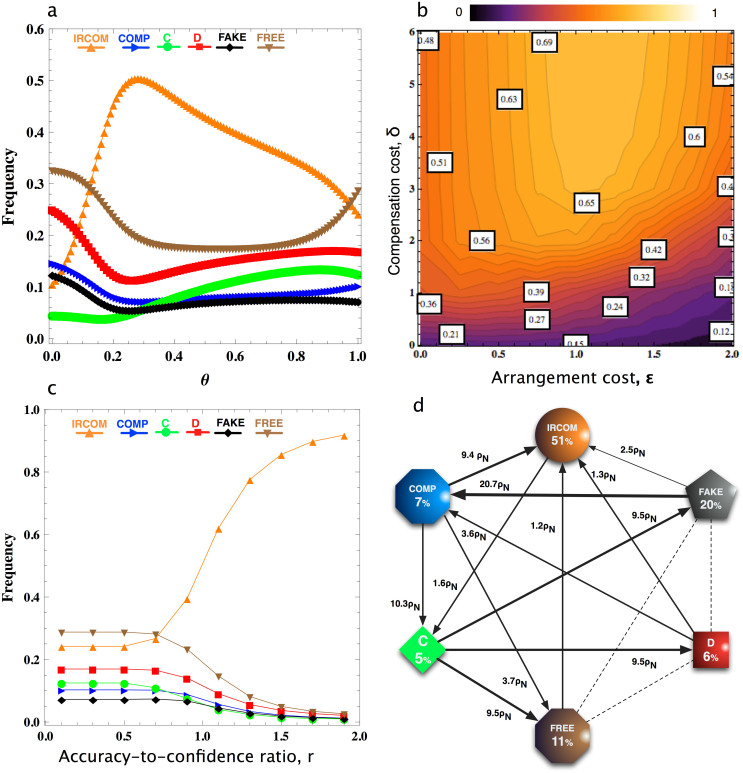
Commitments have been shown to promote cooperation if, on the one hand, they can be sufficiently enforced and on the other hand, the cost of arranging them is justified with respect to the benefits of cooperation. When either of these constraints is not met it leads to the prevalence of commitment free-riders, such as those who commit only when someone else pays to arrange the commitments. Here, we show how intention recognition may circumvent such weakness of costly commitments. We describe an evolutionary model, in the context of the one-shot Prisoner's Dilemma, showing that if players first predict the intentions of their co-player and propose a commitment only when they are not confident enough about their prediction, the chances of reaching mutual cooperation are largely enhanced. We find that an advantageous synergy between intention recognition and costly commitments depends strongly on the confidence and accuracy of intention recognition. In general, we observe an intermediate level of confidence threshold leading to the highest evolutionary advantage, showing that neither unconditional use of commitment nor intention recognition can perform optimally. Rather, our results show that arranging commitments is not always desirable, but that they may be also unavoidable depending on the strength of the dilemma.
Overview
The claims and statistics of this paper haven’t been checked yet.
Free: it reads the open-access text and checks the first 5 claims that cite a source we can check. Create a free account to check every claim.
Integrity signals
Registry
Cites
Statistics
Figures


Verification
Claims the paper makes
The claims and statistics of this paper haven’t been checked yet.
Free: it reads the open-access text and checks the first 5 claims that cite a source we can check. Create a free account to check every claim.
Claims other papers make about this one
Each is checked against this paper’s own text: does it say what the citing paper says it does?
The source backs part of the claim, not all of it — or backs it for a different population, condition or comparison.
In the citing paper
“populations that combine the use of direct punishment with commitment achieve higher proportions of cooperation than if commitment was used alone [35, 47].”
From Investigating the impact of direct punishment on the emergence of cooperation in multi-agent reinforcement learning systems (2025) · cites this paper as [47]
Experimental — accuracy not yet measuredThe check wasn’t confident either way, so it gives no verdict — never disputed.
In the citing paper
“However, there is also evidence that unjust punishment can be restrained by commitment mechanisms [35, 47].”
From Investigating the impact of direct punishment on the emergence of cooperation in multi-agent reinforcement learning systems (2025) · cites this paper as [47]
Experimental — accuracy not yet measured
Self-check
Percentages, sums and reported differences re-computed from the paper’s own numbers.
The self-check needs the paper’s full text.
Citations
Cites
Governing the Commons: The Evolution of Institutions for Collective Action
Ostrom, E. (1990) · doi:10.1017/cbo9780511807763 · Cited by 20,653
Governing the Commons: The Evolution of Institutions for Collective Action
Field, B. C., & Ostrom, E. (1992) · Land Economics · doi:10.2307/3146384 · Cited by 18,859
Five Rules for the Evolution of Cooperation
Nowak, M. A. (2006) · Science · doi:10.1126/science.1133755 · Cited by 5,894
Evolutionary Games and Population Dynamics
Hofbauer, J., & Sigmund, K. (1998) · doi:10.1017/cbo9781139173179 · Cited by 5,502
Understanding and sharing intentions: The origins of cultural cognition
Tomasello, M., Carpenter, M., Call, J., Behne, T., & Moll, H. (2005) · Behavioral and Brain Sciences · doi:10.1017/s0140525x05000129 · Cited by 4,882
Passions within reason: the strategic role of the emotions
(1989) · Choice Reviews Online · doi:10.5860/choice.26-4535 · Cited by 2,967
Evolutionary Dynamics: Exploring the Equations of Life
NOWAK, M. A. (2006) · doi:10.2307/j.ctvjghw98 · Cited by 2,438
Evolutionary dynamics: exploring the equations of life
(2007) · Choice Reviews Online · doi:10.5860/choice.44-4439 · Cited by 1,488
Emergence of cooperation and evolutionary stability in finite populations
Nowak, M. A., Sasaki, A., Taylor, C., & Fudenberg, D. (2004) · Nature · doi:10.1038/nature02414 · Cited by 1,399
Evolutionary dynamics of group interactions on structured populations: a review
Perc, M., Gómez-Gardeñes, J., Szolnoki, A., Floría, L. M., & Moreno, Y. (2013) · Journal of The Royal Society Interface · doi:10.1098/rsif.2012.0997 · Cited by 1,340
Research works printed but not linked: 2
- Goodenough O. R. Law and the biology of commitment. In: Nesse, R. M. (ed.) Evolution and the capacity for commitment, 262– 291 (New York: Russell Sage, 2001).
- Han T. A. Intention Recognition, Commitments and Their Roles in the Evolution of Cooperation: From Artificial Intelligence Techniques to Evolutionary Game Theory Models, vol. 9 (Springer SAPERE series, 2013).
Cited by
A World Unto Itself: Human Communication as Active Inference
Vasil, J., Badcock, P. B., Constant, A., Friston, K., & Ramstead, M. J. D. (2020) · Frontiers in Psychology · doi:10.3389/fpsyg.2020.00417 · Cited by 94
Local and global stimuli in reinforcement learning
Jia, D., Guo, H., Song, Z., Ши, Л., Deng, X., Perc, M., & Wang, Z. (2021) · New Journal of Physics · doi:10.1088/1367-2630/ac170a · Cited by 109
“On the other hand, humans and many species are capable of complex cognition, many of the cognitive skills have been considered as mechanisms for promoting the evolution of cooperation, such as learning [42], theory of mind [43], intent recognition [44, 45], intelligence [46], emotion [47, 48], etc.”
BackgroundInteractive diversity promotes the evolution of cooperation in structured populations
Su, Q., Li, A., Zhou, L., & Wang, L. (2016) · New Journal of Physics · doi:10.1088/1367-2630/18/10/103007 · Cited by 94
Evolution of commitment and level of participation in public goods games
Han, T. A., Pereira, L. M., & Lenaerts, T. (2017) · Autonomous Agents and Multi-Agent Systems · doi:10.1007/s10458-016-9338-4 · Cited by 82
“In the two-player setting (namely, the Prisoner’s Dilemma) the behavior of proposing prior commitments has been shown to promote the evolution of cooperation if the cost of arranging commitment is sufficiently small compared to the cost of cooperation [19,23,25].”
BackgroundMethodInfluentialSelf-citationHan, T. A. (2022) · Journal of The Royal Society Interface · doi:10.1098/rsif.2022.0036 · Cited by 78
“On the other hand, existing models of commitment formation assume that a compensation 4 from a commitment violating player is transferred internally to a commitment compliant coplayer, via institutional enforcement (Han and Lenaerts, 2016, Han et al., 2015a, 2013, MartinezVaquero et al., 2015).”
BackgroundSelf-citationCommitment to Cooperation and Peer Punishment: Its Evolution
Sasaki, T., Okada, I., Uchida, S., & Chen, X. (2015) · Games · doi:10.3390/g6040574 · Cited by 53
Voluntary safety commitments provide an escape from over-regulation in AI development
Han, T. A., Lenaerts, T., Santos, F. C., & Pereira, L. M. (2021) · Technology in Society · doi:10.1016/j.techsoc.2021.101843 · Cited by 67
Self-citationEmergent behaviours in multi-agent systems with Evolutionary Game Theory
Han, T. A. (2022) · AI Communications · doi:10.3233/aic-220104 · Cited by 65
“Asking for prior commitments can just be used as a strategy to clarify the intentions of others, whilst at the same time manifesting our own [41,47].”
Self-citationSharma, G., Guo, H., Shen, C., & Tanimoto, J. (2023) · Journal of The Royal Society Interface · doi:10.1098/rsif.2023.0301 · Cited by 50
A synergy of costly punishment and commitment in cooperation dilemmas
Han, T. A., & Lenaerts, T. (2016) · Adaptive Behavior · doi:10.1177/1059712316653451 · Cited by 40
Self-citationEvolution of coordination in pairwise and multi-player interactions via prior commitments
Ogbo, N. B., Elragig, A., & Han, T. A. (2021) · Adaptive Behavior · doi:10.1177/1059712321993166 · Cited by 39
“When the co-player accepts the143 6 commitment though later does not honour it, she has to compensate the honouring co-player at a personal144 cost δ.145 Differently from previous models on PD and PGG where an agreed outcome leads to the same payoff146 for all parties in the agreement (mutual cooperation benefit), in…”
InfluentialSelf-citationEmergence of Social Punishment and Cooperation through Prior Commitments
Han, T. A. (2016) · Proceedings of the AAAI Conference on Artificial Intelligence · doi:10.1609/aaai.v30i1.10120 · Cited by 33
“In fact, commitments can be enforced through several different means, such as legal contracts, pledges, emotion and also the reputation device itself (Nesse 2001; Han, Pereira, and Santos 2012; Han, Pereira, and Lenaerts 2015; Han et al. 2015).”
BackgroundSelf-citationReciprocity-based cooperative phalanx maintained by overconfident players
Szolnoki, A., & Chen, X. (2018) · Physical review. E · doi:10.1103/physreve.98.022309 · Cited by 33
Emergence of cooperation in two-agent repeated games with reinforcement learning
Ding, Z.-W., Zheng, G.-Z., Cai, C.-R., Cai, W., Chen, L., Zhang, J., & Wang, X. (2023) · Chaos Solitons & Fractals · doi:10.1016/j.chaos.2023.114032 · Cited by 35
“Humans and many other creatures, however, have a sophisticated cognitive capacity, such as reinforcement learning [32], behaviour prediction [33], intention recognition [34, 35], and intelligence from social interactions [36].”
BackgroundSocial Manifestation of Guilt Leads to Stable Cooperation in Multi-Agent Systems
Pereira, L. M., Lenaerts, T., Martínez-Vaquero, L. A., & Han, T. A. (2017) · Adaptive Agents and Multi-Agents Systems · doi:10.65109/fkdk2827 · Cited by 35
“Hence, detecting another’s proclivity to cheat, albeit checked by guilt, allots intention recognition an important role to play even when the intention is not carried out [15, 17, 14].”
BackgroundSelf-citationQuan, J., Zhou, Y., Ma, X., Wang, X., & Yang, J. (2021) · Knowledge-Based Systems · doi:10.1016/j.knosys.2021.107550 · Cited by 24
“Especially, individuals’ behavioral evolution driven by the cognition process has been studied [37-39] and its promoting role in the evolution of cooperation has also been demonstrated [40].”
BackgroundCimpeanu, T., Santos, F. C., & Han, T. A. (2023) · Dynamic Games and Applications · doi:10.1007/s13235-023-00502-1 · Cited by 23
“Several solutions have been identified, including pool incentives with second-order punishments [39, 53], democratic decisions [27], commitment formation [21, 25, 49] and hybrid incentives [10, 20].”
BackgroundSelf-citationWhen agreement-accepting free-riders are a necessary evil for the evolution of cooperation
Martínez-Vaquero, L. A., Han, T. A., Pereira, L. M., & Lenaerts, T. (2017) · Scientific Reports · doi:10.1038/s41598-017-02625-z · Cited by 24
Self-citationCompetition of punishment and reward among inequity-averse individuals in spatial public goods games
Wang, X., Ding, R., Zhao, J., Chen, W., & Gu, C. (2022) · Chaos Solitons & Fractals · doi:10.1016/j.chaos.2022.111862 · Cited by 22
Emergence of cooperation in the one-shot Prisoner’s dilemma through Discriminatory and Samaritan AIs
Zimmaro, F., Miranda, M., Fernández, J. M. R., López, J. A. M., Reddel, M., Widler, V., Antonioni, A., & Han, T. A. (2024) · Journal of The Royal Society Interface · doi:10.1098/rsif.2024.0212 · Cited by 30
Self-citationPereira, L. M., & Lopes, A. B. (2020) · Studies in applied philosophy, epistemology and rational ethics · doi:10.1007/978-3-030-39630-5 · Cited by 20
Self-citationCentralized versus Personalized Commitments and Their Influence on Cooperation in Group Interactions
Han, T. A., Pereira, L. M., Martínez-Vaquero, L. A., & Lenaerts, T. (2017) · Proceedings of the AAAI Conference on Artificial Intelligence · doi:10.1609/aaai.v31i1.10704 · Cited by 17
“Existing game theoretical models of prior commitments have focused on the first approach, in which the agents themselves, prior to an interaction, pay the cost to arrange a reliable commitment with their peers (Han, Pereira, and Santos 2012b; Han et al. 2013a; Hasan and Raja 2013; Han et al. 2015a; Han 2016; Han, Pere…”
BackgroundSelf-citationEvolution of commitment in the spatial public goods game through institutional incentives
Flores, L. S., & Han, T. A. (2024) · Applied Mathematics and Computation · doi:10.1016/j.amc.2024.128646 · Cited by 28
“They enable individuals to reach mutual cooperation even when there is little knowledge about others’ past behaviours [22, 24, 33, 42], as it requires them to reveal their preferences or intentions [25, 44, 50].”
BackgroundSelf-citationUnderstanding the game behavior with sentiment and unequal status in cooperation network
Liu, M., Ma, Y., Song, L., & Liu, C. (2020) · Knowledge-Based Systems · doi:10.1016/j.knosys.2020.106588 · Cited by 14
Evolutionary Dynamics of Coordinated Cooperation
Ohtsuki, H. (2018) · Frontiers in Ecology and Evolution · doi:10.3389/fevo.2018.00062 · Cited by 13
“Recently, a series of papers analyzed the effect of such pre-commitments on evolution of cooperation (Han et al., 2013, 2015a,b, 2017a,b; Sasaki et al., 2015; Han and Lenaerts, 2016) and found that pre-commitments were effective in enhancing cooperation.”
Signalling boosts the evolution of cooperation in repeated group interactions
Martinez-Vaquero, L. A., Santos, F. C., & Trianni, V. (2020) · Journal of The Royal Society Interface · doi:10.1098/rsif.2020.0635 · Cited by 11
“One could also consider more complex signals [66], individual intentions [67] and reciprocal strategies that react differently for each configuration of the group in terms of the cooperation level observed in the previous round, for instance, discriminating between a few and many cooperators [29,32].”
BackgroundSelf-citationCooperation among unequal players with aspiration-driven learning
Chen, F., Zhou, L., & Wang, L. (2024) · Journal of The Royal Society Interface · doi:10.1098/rsif.2023.0723 · Cited by 12
“In fact, a seemingly simpler task, which is to infer co-players ’ intentions in the next interaction, namely, intention recognition, remains a difficult task [39 – 43].”
BackgroundFujimoto, Y., & Kaneko, K. (2021) · Journal of Physics Complexity · doi:10.1088/2632-072x/ac301a · Cited by 12
Words are not wind - how public joint commitment and reputation solve the Prisoner's Dilemma
Krellner, M., & Han, T. A. (2025) · Applied Mathematics and Computation · doi:10.1016/j.amc.2025.129530 · Cited by 12
Self-citationDasgupta, N., & Musolesi, M. (2025) · Autonomous Agents and Multi-Agent Systems · doi:10.1007/s10458-025-09698-5 · Cited by 8
“As a result, a variety of social mechanisms have been proposed for the development of cooperative AI systems in recent years [1, 5, 26].”
InfluentialLeadership scenarios in prisoner’s dilemma game
Babajanyan, S. G., Melkikh, A. V., & ALLAHVERDYAN, A. E. (2019) · Physica A Statistical Mechanics and its Applications · doi:10.1016/j.physa.2019.123020 · Cited by 8
“[64] H.”
BackgroundFunctional dynamic by intention recognition in iterated games
Fujimoto, Y., & Kaneko, K. (2019) · New Journal of Physics · doi:10.1088/1367-2630/ab0459 · Cited by 7
Sun, Z., Wang, M., Zhang, W., Li, Y., Wang, D., & Dong, F. (2019) · International Journal of Environmental Research and Public Health · doi:10.3390/ijerph16091588 · Cited by 9
“Undoubtedly, due to the asymmetric information, the parties cannot accurately identify the intentions of others [38].”
BackgroundGuo, T., He, Z., Chen, S., Ши, Л., & Tanimoto, J. (2024) · Computational Economics · doi:10.1007/s10614-024-10559-8 · Cited by 6
“…repeated game settings (Axelrod, 1980), where players engage with their opponents over multiple rounds, and one-shot games augmented with additional layers of information such as reputation (Bolton et al., 2005), costly signaling (Gintis et al., 2001), and other factors (Han et al., 2015).”
Evolution of Human-Like Social Grooming Strategies Regarding Richness and Group Size
Takano, M., & Ichinose, G. (2018) · Frontiers in Ecology and Evolution · doi:10.3389/fevo.2018.00008 · Cited by 7
Investment preference promotes cooperation in spatial public goods game
Chang, S., Zhang, Z., Li, Y., Wu, Y. E., & Xie, Y. (2018) · PLoS ONE · doi:10.1371/journal.pone.0206486 · Cited by 6
Han, T. A., & Pereira, L. M. (2019) · Springer eBooks · doi:10.1007/978-3-658-17483-5_15 · Cited by 5
Self-citationTime delay effects on evolutionary dynamics of N-player trust game with diverse investment behaviors
Su, X., Guo, R., Hua, S., Liu, L., & Zhang, L. (2024) · Applied Mathematics and Computation · doi:10.1016/j.amc.2024.129177 · Cited by 6
Nakamura, M., & Ohtsuki, H. (2016) · Games · doi:10.3390/g7030019 · Cited by 4
“…and neurological evidence, there is still a need for a theoretical understanding of the role of such state-of-mind recognition in cooperation; to the best of our knowledge, only a few studies have focused on examining the interplay between state-of-mind recognition and cooperation [18,19].”
BackgroundEvolution of Coordination Through Institutional Incentives: An Evolutionary Game Theory Approach
Ogbo, N. B., Song, Z., & Han, T. A. (2025) · International Conference on Distributed Artificial Intelligence (DAI) · doi:10.1145/3772429.3772434 · Cited by 6
“Commitment mechanisms restrict an agent’s strategic choices, thereby influencing others’ anticipations and decisions [33, 48, 71].”
Self-citationThe importance of commitment for stable cooperation
Krellner, M., & Han, T. A. (2023) · Physics of Life Reviews · doi:10.1016/j.plrev.2023.07.012 · Cited by 4
Self-citationCoordination Dynamics in Technology Adoption: Lessons From an Evolutionary Game Theoretical Analysis
Ogbo, N. B., & Han, T. A. (2024) · Advances in medical technologies and clinical practice book series · doi:10.4018/979-8-3693-3226-9.ch016 · Cited by 5
Self-citationOn evolution of non-binding commitments
Song, Z., & Han, T. A. (2025) · Physics of Life Reviews · doi:10.1016/j.plrev.2025.01.006 · Cited by 4
Self-citationWang, J., Chen, W., Yu, F., Zhou, S., He, J., Xu, W., & Dai, W. (2024) · Applied Mathematics and Computation · doi:10.1016/j.amc.2024.128672 · Cited by 2
I Can Help! Cooperative Task Behaviour through Plan Recognition and Planning
Geib, C., Craenen, B. G. W., & Petrick, R. P. A. (2016) · Cited by 1
Towards unified characterization of cooperation mechanisms
Han, T. A. (2015) · Physics of Life Reviews · doi:10.1016/j.plrev.2015.06.006 · Cited by 1
Self-citationModeling Collective Morality via Evolutionary Game Theory
Pereira, L. M., & Saptawijaya, A. (2016) · Studies in applied philosophy, epistemology and rational ethics · doi:10.1007/978-3-319-29354-7_9 · Cited by 1
Self-citationConditions for the Evolution of Apology and Forgiveness in Populations of Autonomous Agents
Lenaerts, T., Martínez-Vaquero, L. A., & Pereira, L. M. (2016) · TeesRep (Teesside University) · Cited by 1
Self-citationHan, T. A., & Pereira, L. M. (2018) · Springer eBooks · doi:10.1007/978-3-658-17484-2_15-1 · Cited by 2
Self-citationEvolutionary Dynamics of Direct and Indirect Reciprocities With Directional Interactions
Wei, H., Zhang, J., & Zhang, C. (2023) · IEEE Transactions on Computational Social Systems · doi:10.1109/tcss.2023.3326352 · Cited by 1
“…(representing direct reciprocity) and GSCO (representing indirect reciprocity) [35], direct reciprocity in regular networks [13], the evolution of apology and forgiveness within direct reciprocity [38], and the role of intention recognition in shaping cooperation under indirect reciprocity [39].”
BackgroundEmergence of Cooperation in Group Interactions: Avoidance vs. Restriction
Pereira, L. M., & Lenaerts, T. (2016) · National Conference on Artificial Intelligence
Self-citationCommitment and Participation in Public Goods Games
Pereira, L. M., & Lenaerts, T. (2017) · VUBIR (Vrije Universiteit Brussel) · doi:10.5555/3091125.3091322
Self-citationZiotti, V. C. (2019) · Digital Library of Theses and Dissertations (Universidade de São Paulo) · doi:10.11606/d.96.2019.tde-07032019-105005
Evolutionary hypergame dynamics: Introspection reasoning and social learning
Zhang, F., Wu, T., Zhang, G., & Wang, L. (2026) · Physics Letters A · doi:10.1016/j.physleta.2026.132180
Metadata
- Authors
- Han, T. A., Santos, F. C., Lenaerts, T., & Pereira, L. M.
- Affiliations
- Teesside University (GB)
- Instituto de Engenharia de Sistemas e Computadores Investigação e Desenvolvimento (PT)
- Université Libre de Bruxelles (BE)
- Corresponding author
- Han, The Anh
- Venue
- Scientific Reports
- Published
- 2015-03-20
- Volume
- 5
- Issue
- 1
- Pages
- 9312-9312
- ISSN
- 2045-2322 (ISSN-L)
- PMC
- PMC4366807
- OpenAlex
- W2019593420
- Cited by
- 54
- References
- 55
- Citations by year
- 2025: 4 · 2024: 7 · 2023: 6 · 2022: 3 · 2021: 4 · 2020: 6 · 2019: 5 · 2018: 5 · 2017: 3 · 2016: 9 · 2015: 2
- FWCI
- 20.96
- Type
- journal article
- Language
- en
- Open access
- gold
- doi.org
- Licence
- cc-by
- creativecommons.org/licenses/by/4.0 (tdm)
- creativecommons.org/licenses/by/4.0 (vor)
- Locations
- Scientific Reports (publishedVersion, cc-by)
- PubMed Central (publishedVersion, cc-by)
- PubMed (publishedVersion)
- Teesside University Research Portal (Teesside University) (publishedVersion, cc-by-nc-nd)
- Dépôt institutionnel de l'Université libre de Bruxelles (Université Libre de Bruxelles) (submittedVersion, other-oa)
- VUBIR (Vrije Universiteit Brussel) (submittedVersion)
- Funders
- Fundação para a Ciência e a Tecnologia (UID/CEC/50021/2013, EXPL/EEI-SII/2556/2013)
- Topics
- Social Sciences › Sociology and Political Science › Evolutionary Game Theory and Cooperation
- Social Sciences › Economics, Econometrics and Finance › Economics and Econometrics › Experimental Behavioral Economics Studies
- Social Sciences › Decision Sciences › Management Science and Operations Research › Game Theory and Applications
- Keywords
- intent classification, costly commitment, cooperation, prisoner's dilemma, evolutionary game theory, mutual cooperation
- MeSH terms
- Cooperative Behavior, Humans, Reward
About these checks
Registry, retraction, Cites and statistics results are computed, not judged, with one exception: a printed reference that no index lists is read once by a model before it counts as a citation error. Claims are extracted by a model and kept only when their quote appears verbatim in the text; each cited source is then checked, with a model’s help, for whether it says what the claim relies on. Those verdicts can be wrong — read the claim’s quote and the cited source before relying on one.
Statistics and arithmetic are recomputed, not judged.
Confidence bands are shown only for fields calibrated on our annotated test set. None is calibrated yet, so no band is shown.
What counts as a claim ›How we measure confidence ›How we check this ›
Are you an author, or do you see a problem with this page? Request a review
Data sources
Bibliographic data: Semantic Scholar, OpenAlex, Crossref.
Contains information from the Semantic Scholar Academic Graph Datasets, made available under the ODC Attribution License (ODC-BY 1.0).
Semantic Scholar’s data is described in: Kinney, R., et al. (2023). The Semantic Scholar Open Data Platform. arXiv:2301.10140.
