

The DOI matches its Crossref record; 18 of the 18 references it cites were found in a registry or an index.
Genomic study of the Ket: a Paleo-Eskimo-related ethnic group with significant ancient North Eurasian ancestry
Published version of a preprint
Abstract
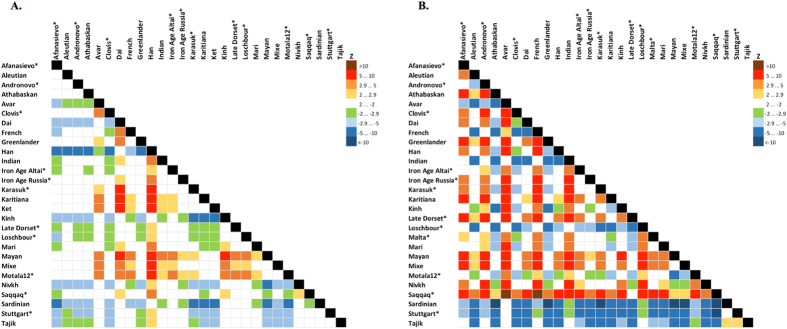
The Kets, an ethnic group in the Yenisei River basin, Russia, are considered the last nomadic hunter-gatherers of Siberia and Ket language has no transparent affiliation with any language family. We investigated connections between the Kets and Siberian and North American populations, with emphasis on the Mal’ta and Paleo-Eskimo ancient genomes, using original data from 46 unrelated samples of Kets and 42 samples of their neighboring ethnic groups (Uralic-speaking Nganasans, Enets and Selkups). We genotyped over 130,000 autosomal SNPs, identified mitochondrial and Y-chromosomal haplogroups and performed high-coverage genome sequencing of two Ket individuals. We established that Nganasans, Kets, Selkups and Yukaghirs form a cluster of populations most closely related to Paleo-Eskimos in Siberia (not considering indigenous populations of Chukotka and Kamchatka). Kets are closely related to modern Selkups and to some Bronze and Iron Age populations of the Altai region, with all these groups sharing a high degree of Mal’ta ancestry. Implications of these findings for the linguistic hypothesis uniting Ket and Na-Dene languages into a language macrofamily are discussed.
Overview
The claims and statistics of this paper haven’t been checked yet.
Run the check — free, no account needed. It reads the open-access text and checks the sources it cites.
Integrity signals
Registry
Cites
Statistics
Figures
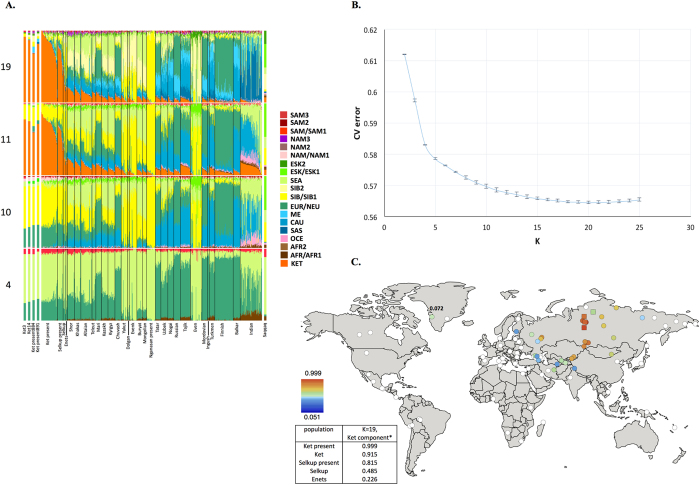
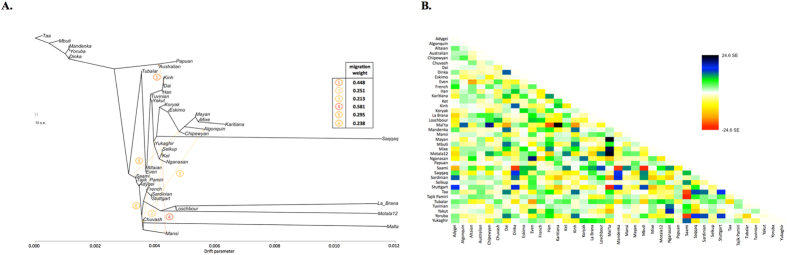
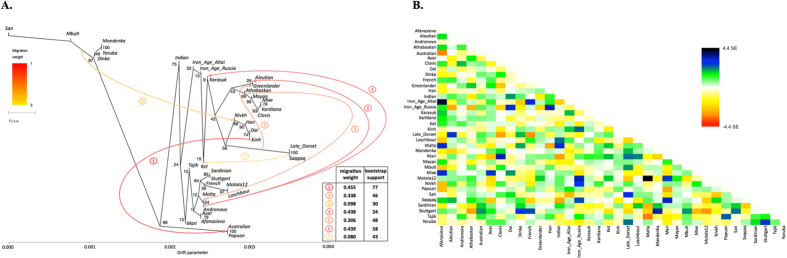
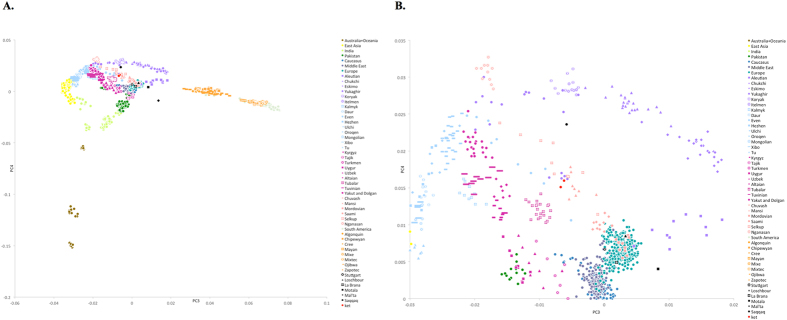
Verification
Claims the paper makes
The claims and statistics of this paper haven’t been checked yet.
Run the check — free, no account needed. It reads the open-access text and checks the sources it cites.
Claims other papers make about this one
Each is checked against this paper’s own text: does it say what the citing paper says it does?
In the citing paper
“Genetic evidence showed that Yeniseian and Samoyedic speakers had genetic affinities to northern Altaians with high frequencies of haplogroup Q-M242 (xL54), while southern Altaians had many L54 samples and showed similarities with Turkic-speaking populations (Dulik et al. 2012b; Battaglia et al. 2013; Flegontov et al. 2016).”
From Dispersals of the Siberian Y-chromosome haplogroup Q in Eurasia (2018) · cites this paper as Flegontov et al. 2016
Self-check
Percentages, sums and reported differences re-computed from the paper’s own numbers.
The self-check needs the paper’s full text.
Citations
Cites
Population Structure and Eigenanalysis
Patterson, N., Price, A. L., & Reich, D. (2006) · PLoS Genetics · doi:10.1371/journal.pgen.0020190 · Cited by 5,280
Integrating common and rare genetic variation in diverse human populations
The International HapMap 3 Consortium (2010) · Nature · doi:10.1038/nature09298 · Cited by 3,026
ANGSD: Analysis of Next Generation Sequencing Data
Korneliussen, T. S., Albrechtsen, A., & Nielsen, R. (2014) · BMC Bioinformatics · doi:10.1186/s12859-014-0356-4 · Cited by 2,982
Ancient Admixture in Human History
Patterson, N., Moorjani, P., Luo, Y., Mallick, S., Rohland, N., Zhan, Y., Genschoreck, T., Webster, T., & Reich, D. (2012) · Genetics · doi:10.1534/genetics.112.145037 · Cited by 2,848
Inference of population splits and mixtures from genome-wide allele frequency data
Pickrell, J. K., & Pritchard, J. K. (2012) · PLoS Genetics · doi:10.1371/journal.pgen.1002967 · Cited by 2,731
The complete genome sequence of a Neanderthal from the Altai Mountains
Prüfer, K., Racimo, F., Patterson, N., Jay, F., Sankararaman, S., Sawyer, S., Heinze, A., Renaud, G., Sudmant, P. H., de Filippo, C., et al. (2014) · Nature · doi:10.1038/nature12886 · Cited by 2,254
A high-coverage genome sequence from an archaic denisovan individual
Meyer, M., Kircher, M., Gansauge, M.-T., Li, H., Racimo, F., Mallick, S., Schraiber, J. G., Jay, F., Prüfer, K., de Filippo, C., et al. (2012) · Science · doi:10.1126/science.1224344 · Cited by 1,967
Massive migration from the steppe was a source for Indo-European languages in Europe
Haak, W., Lazaridis, I., Patterson, N., Rohland, N., Mallick, S., Llamas, B., Brandt, G., Nordenfelt, S., Harney, E., Stewardson, K., et al. (2015) · Nature · doi:10.1038/nature14317 · Cited by 1,940
Population genomics of Bronze Age Eurasia
Allentoft, M. E., Sikora, M., Sjögren, K.-G., Rasmussen, S., Rasmussen, M., Stenderup, J., Damgaard, P. B., Schroeder, H., Ahlström, T., Vinner, L., et al. (2015) · Nature · doi:10.1038/nature14507 · Cited by 1,550
Genome-wide patterns of selection in 230 ancient Eurasians
Mathieson, I., Lazaridis, I., Rohland, N., Mallick, S., Patterson, N., Roodenberg, S. A., Harney, E., Stewardson, K., Fernandes, D., Novak, M., et al. (2015) · Nature · doi:10.1038/nature16152 · Cited by 1,515
Ancient human genomes suggest three ancestral populations for present-day Europeans
Lazaridis, I., Patterson, N., Mittnik, A., Renaud, G., Mallick, S., Kirsanow, K., Sudmant, P. H., Schraiber, J. G., Castellano, S., Lipson, M., et al. (2014) · Nature · doi:10.1038/nature13673 · Cited by 1,357
Upper Palaeolithic Siberian genome reveals dual ancestry of Native Americans
Raghavan, M., Skoglund, P., Graf, K. E., Metspalu, M., Albrechtsen, A., Moltke, I., Rasmussen, S., Stafford Jr, T. W., Orlando, L., Metspalu, E., et al. (2014) · Nature · doi:10.1038/nature12736 · Cited by 963
Ancient human genome sequence of an extinct Palaeo-Eskimo
Rasmussen, M., Li, Y., Lindgreen, S., Pedersen, J. S., Albrechtsen, A., Moltke, I., Metspalu, M., Metspalu, E., Kivisild, T., Gupta, R., et al. (2010) · Nature · doi:10.1038/nature08835 · Cited by 849
An aboriginal Australian genome reveals separate human dispersals into Asia
Rasmussen, M., Guo, X., Wang, Y., Lohmueller, K. E., Rasmussen, S., Albrechtsen, A., Skotte, L., Lindgreen, S., Metspalu, M., Jombart, T., et al. (2011) · Science · doi:10.1126/science.1211177 · Cited by 787
The genome of a Late Pleistocene human from a Clovis burial site in western Montana
Rasmussen, M., Anzick, S. L., Waters, M. R., Skoglund, P., DeGiorgio, M., Stafford, T. W., Rasmussen, S., Moltke, I., Albrechtsen, A., Doyle, S. M., et al. (2014) · Nature · doi:10.1038/nature13025 · Cited by 562
Genomic evidence for the Pleistocene and recent population history of Native Americans
Raghavan, M., Steinrücken, M., Harris, K., Schiffels, S., Rasmussen, S., DeGiorgio, M., Albrechtsen, A., Valdiosera, C., Ávila-Arcos, M. C., Malaspinas, A.-S., et al. (2015) · Science · doi:10.1126/science.aab3884 · Cited by 540
Derived immune and ancestral pigmentation alleles in a 7,000-year-old Mesolithic European
Olalde, I., Allentoft, M. E., Sánchez-Quinto, F., Santpere, G., Chiang, C. W. K., DeGiorgio, M., Prado-Martinez, J., Rodríguez, J. A., Rasmussen, S., Quilez, J., et al. (2014) · Nature · doi:10.1038/nature12960 · Cited by 360
Genomic structure in Europeans dating back at least 36,200 years
Seguin-Orlando, A., Korneliussen, T. S., Sikora, M., Malaspinas, A.-S., Manica, A., Moltke, I., Albrechtsen, A., Ko, A., Margaryan, A., Moiseyev, V., et al. (2014) · Science · doi:10.1126/science.aaa0114 · Cited by 315
Research works printed but not linked: 37
- Vajda, E. J. Loanwords in Ket. The Typology of Loanwords, ed. Haspelmath, M., Tadmoor, U. Oxford: Oxford University Press, 125–139 (2009). · DOI
- Vajda, E. J. Yeniseian Peoples and Languages: a History of Their Study with an Annotated Bibliography and a Source Guide. Surrey, England: Curzon Press, 389 p. (2001).
- Dul’zon, A. P. Ketskie toponimy Zapadnoy Sibiri [Ket toponyms of Western Siberia]. Uchenye Zapisky Tomskogo Gosudarstvennogo Pedagogicheskogo Instituta [Scholarly Proceedings of Tomsk State Pedagogical Institute] 18, 91–111 (1959).
- Vajda, E. J. Siberian landscapes in Ket traditional culture. Landscape and Culture in Northern Eurasia, ed. Jordan, P. Walnut Creek, CA: Left Coast Press, 297–304 (2011).
- Vajda, E. J. Siberian link with Na-Dene languages. The Dene-Yeniseian Connection, ed. Kari, J., Potter, B. A. Anthropological Papers of the University of Alaska: New Series 5, 33–99 (2010).
- Comrie, B. The Dene-Yeniseian hypothesis: an introduction. The Dene-Yeniseian Connection, ed. Kari, J., Potter, B. A. Anthropological Papers of the University of Alaska: New Series 5, 25–32 (2010).
- Ruhlen, M. The origin of the Na-Dene. Proc. Natl. Acad. Sci. USA 95, 13994–13996 (1998). · DOI
- Potter, B. A. Archaeological patterning in Northeast Asia and Northwest North America: an examination of the Dene-Yeniseian hypothesis. The Dene-Yeniseian Connection, ed. Kari, J., Potter, B. A. Anthropological Papers of the University of Alaska: New Series 5, 138–167 (2010).
- Scott, R. G. & O’Rourke, D. Genes across Beringia: a physical anthropological perspective on the Dene-Yeniseian hypothesis. The Dene-Yeniseian Connection, ed. Kari, J., Potter, B. A. Anthropological Papers of the University of Alaska: New Series 5, 119–137 (2010).
- Ives, J. W. Dene-Yeniseian, migration and prehistory. The Dene-Yeniseian Connection, ed. Kari, J., Potter, B. A. Anthropological Papers of the University of Alaska: New Series 5, 324–334 (2010).
- Fedorova, S. a. et al. Autosomal and uniparental portraits of the native populations of Sakha (Yakutia): implications for the peopling of Northeast Eurasia. BMC Evol. Biol. 13, 127 (2013). · DOI
- Yunusbayev, B. et al. The genetic legacy of the expansion of Turkic-speaking nomads across Eurasia. PLoS Genet. 11, e1005068 (2015). · DOI · Paper page
- Elhaik, E. et al. The GenoChip: a new tool for genetic anthropology. Genome Biol. Evol. 5, 1021–1031 (2013). · DOI
- Raghavan, M. et al. The genetic prehistory of the New World Arctic. Science 345, 1255832 (2014).
- McGhee, R. Ancient People of the Arctic. Vancouver: UBC Press (1996).
- Reich, D. et al. Reconstructing Native American population history. Nature 488, 370–374 (2012). · DOI · Paper page
- Tamm, E. et al. Beringian standstill and spread of Native American founders. PLoS One 2, e829 (2007). · DOI · Paper page
- Gilbert, M. T. P. et al. Paleo-Eskimo mtDNA genome reveals matrilineal discontinuity in Greenland. Science 320, 1787–1789 (2008). · DOI
- Malhi, R. S. et al. Native American mtDNA prehistory in the American Southwest. Am. J. Phys. Anthropol. 120, 108–124 (2003). · DOI
- Sicoli, M. A. & Holton, G. Linguistic phylogenies support back-migration from Beringia to Asia. PLoS One 9, e91722 (2014). · DOI
- Pringle, H. Welcome to Beringia. Science 343, 961–963 (2014). · DOI
- Elhaik, E. et al. Geographic population structure analysis of worldwide human populations infers their biogeographical origins. Nat. Commun. 5, 3513 (2014). · DOI
- Kozlov, K. et al. Differential Evolution approach to detect recent admixture. BMC Genomics 16 Suppl 8, S9 (2015). · DOI
- Alexander, D. H., Novembre, J. & Lange, K. Fast model-based estimation of ancestry in unrelated individuals. Genome Res. 19, 1655–1664 (2009). · DOI · Paper page
- Quinque, D., Kittler, R., Kayser, M., Stoneking, M. & Nasidze, I. Evaluation of saliva as a source of human DNA for population and association studies. Anal. Biochem. 353, 272–277 (2006). · DOI
- Abecasis, G. R. et al. An integrated map of genetic variation from 1,092 human genomes. Nature 491, 56–65 (2012). · DOI · Paper page
- Purcell, S. et al. PLINK: a tool set for whole-genome association and population-based linkage analyses. Am. J. Hum. Genet. 81, 559–575 (2007). · DOI · Paper page
- Behar, D. M. et al. The genome-wide structure of the Jewish people. Nature 466, 238–242 (2010). · DOI
- Cardona, A. et al. Genome-wide analysis of cold adaptation in indigenous Siberian populations. PLoS One 9, e98076 (2014). · DOI
- Li, J. Z. et al. Worldwide human relationships inferred from genome-wide patterns of variation. Science 319, 1100–1104 (2008). · DOI
- Kidd, J. R. et al. Single nucleotide polymorphisms and haplotypes in Native American populations. Am. J. Phys. Anthropol. 146, 495–502 (2011). · DOI
- Silva-Zolezzi, I. et al. Analysis of genomic diversity in Mexican Mestizo populations to develop genomic medicine in Mexico. Proc. Natl. Acad. Sci. 106, 8611–8616 (2009). · DOI · Paper page
- Surakka, I. et al. Founder population-specific HapMap panel increases power in GWA studies through improved imputation accuracy and CNV tagging. Genome Res. 20, 1344–1351 (2010). · DOI
- Yunusbayev, B. et al. The Caucasus as an Asymmetric Semipermeable Barrier to Ancient Human Migrations. Mol. Biol. Evol. 29, 359–365 (2011). · DOI
- Behar, D. M. et al. No Evidence from Genome-Wide Data of a Khazar Origin for the Ashkenazi Jews. Hum. Biol. 85, 859–900 (2013). · DOI
- Verdu, P. et al. Patterns of Admixture and Population Structure in Native Populations of Northwest North America. PLoS Genet. 10, e1004530 (2014). · DOI
- Axelsson, E., Willerslev, E., Gilbert, M. T. P. & Nielsen, R. The Effect of Ancient DNA Damage on Inferences of Demographic Histories. Mol. Biol. Evol. 25, 2181–2187 (2008). · DOI · Paper page
Cited by
Dispersals of the Siberian Y-chromosome haplogroup Q in Eurasia
Huang, Y.-Z., Pamjav, H., Flegontov, P., Stenzl, V., Wen, S.-Q., Tong, X.-Z., Wang, C.-C., Wang, L.-X., Wei, L.-H., Gao, J.-Y., et al. (2018) · Molecular Genetics and Genomics · doi:10.1007/s00438-017-1363-8 · Cited by 34
Self-citation
Metadata
- Authors
- Flegontov, P., Changmai, P., Zidkova, A., Logacheva, M. D., Altınışık, N. E., Flegontova, O., Gelfand, M. S., Gerasimov, E. S., Khrameeva, E. E., Konovalova, O. P., Neretina, T., Nikolsky, Y. V., Starostin, G., Stepanova, V. V., Travinsky, I. V., Tříska, M., Tříska, P., & Tatarinova, T. V.
- Venue
- Scientific Reports
- Published
- 2016-02-11
- Volume
- 6
- Issue
- 1
- ISSN
- 2045-2322
- PMC
- PMC4750364
- Cited by
- 57
- References
- 18
- Language
- en
About these checks
Registry, retraction, Cites and statistics results are computed, not judged, with one exception: a printed reference that no index lists is read once by a model before it counts as a citation error. Claims are extracted by a model and kept only when their quote appears verbatim in the text; each cited source is then checked, with a model’s help, for whether it says what the claim relies on. Those verdicts can be wrong — read the claim’s quote and the cited source before relying on one.
Statistics and arithmetic are recomputed, not judged.
Confidence bands are shown only for fields calibrated on our annotated test set. None is calibrated yet, so no band is shown.
What counts as a claim ›How we measure confidence ›How we check this ›
Are you an author, or do you see a problem with this page? Request a review
