

Amyloidogenic amyloid-β-peptide variants induce microbial agglutination and exert antimicrobial activity
Open accessThe DOI matches its Crossref record; 54 of the 54 references it cites were found in a registry or an index.
Abstract
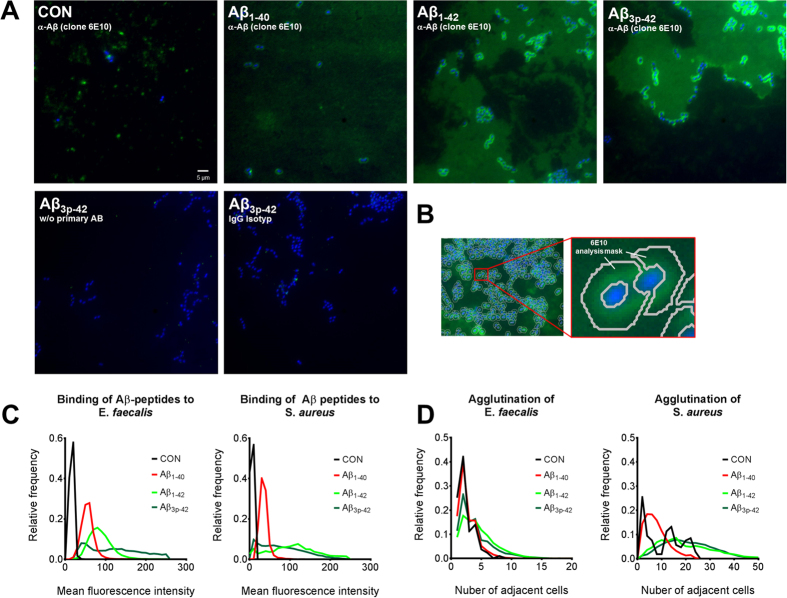
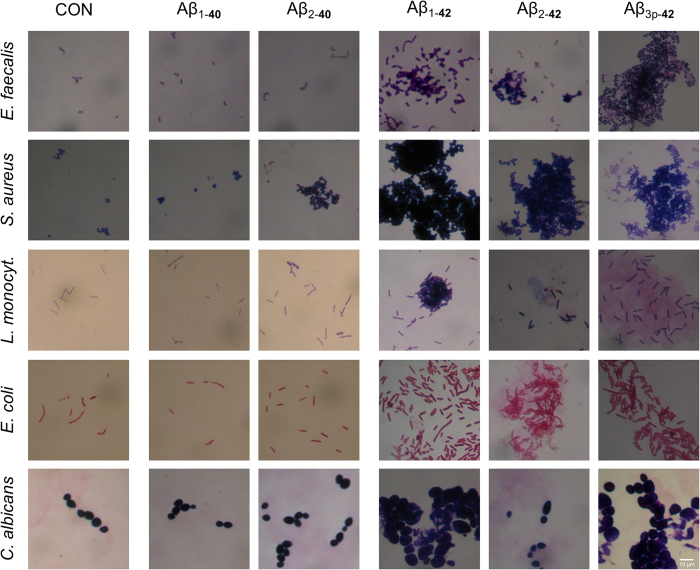
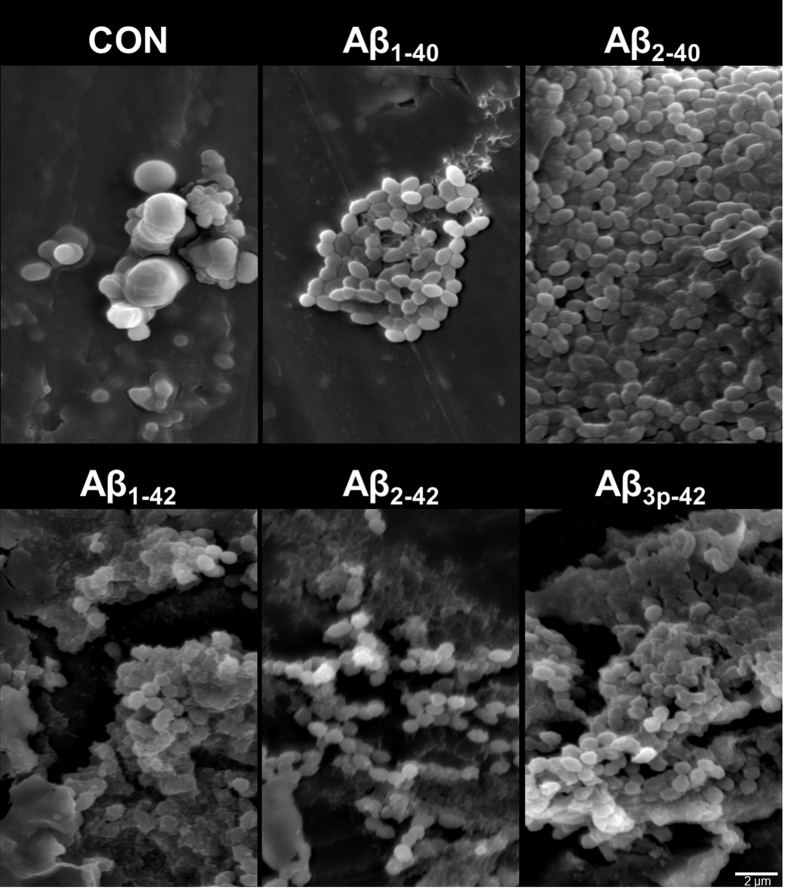
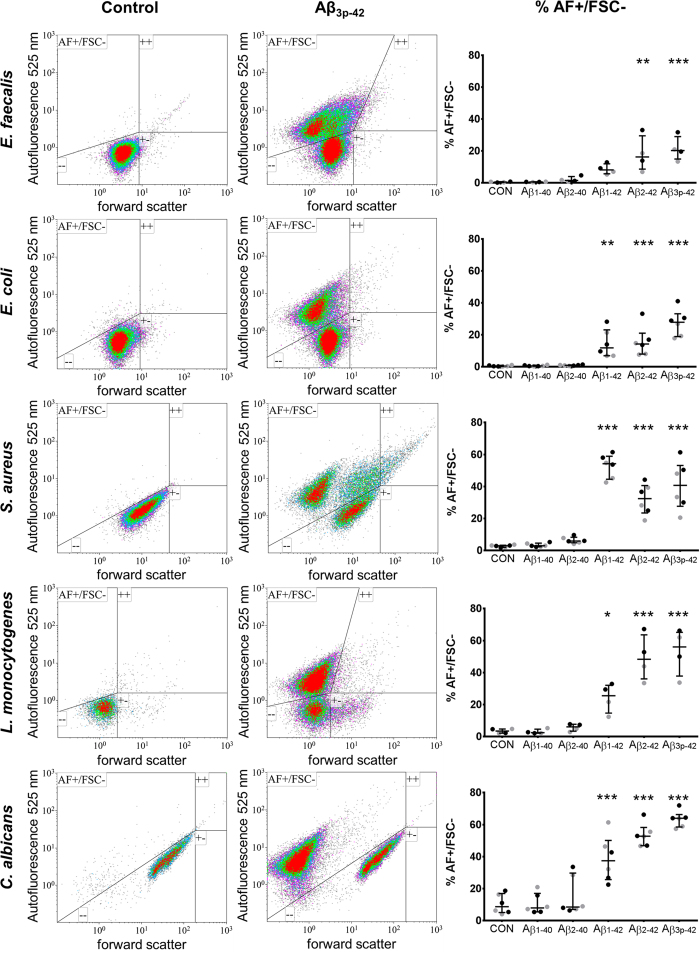
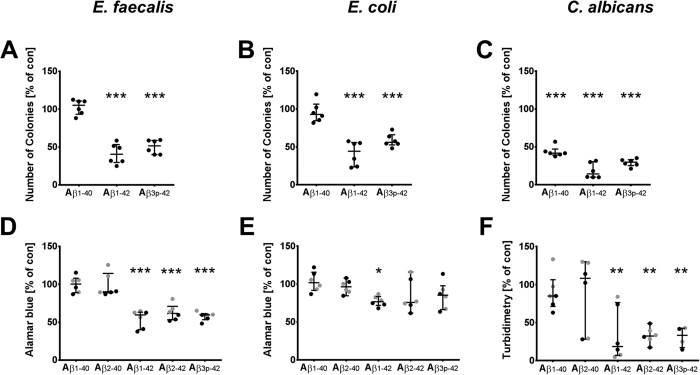
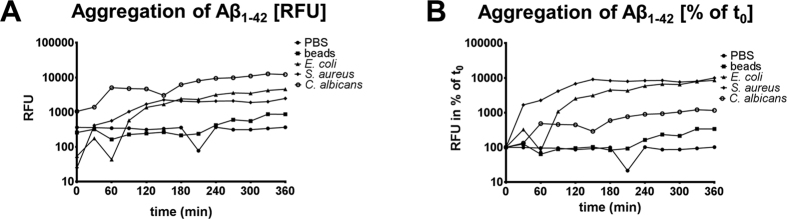
Amyloid-β (Aβ) peptides are the main components of the plaques found in the brains of patients with Alzheimer’s disease. However, Aβ peptides are also detectable in secretory compartments and peripheral blood contains a complex mixture of more than 40 different modified and/or N- and C-terminally truncated Aβ peptides. Recently, anti-infective properties of Aβ peptides have been reported. Here, we investigated the interaction of Aβ peptides of different lengths with various bacterial strains and the yeast Candida albicans. The amyloidogenic peptides Aβ 1-42, Aβ 2-42 and Aβ 3p-42 but not the non-amyloidogenic peptides Aβ 1-40 and Aβ 2-40 bound to microbial surfaces. As observed by immunocytochemistry, scanning electron microscopy and Gram staining, treatment of several bacterial strains and Candida albicans with Aβ peptide variants ending at position 42 (Aβ x-42) caused the formation of large agglutinates. These aggregates were not detected after incubation with Aβ x-40. Furthermore, Aβ x-42 exerted an antimicrobial activity on all tested pathogens, killing up to 80% of microorganisms within 6 h. Aβ 1-40 only had a moderate antimicrobial activity against C. albicans. Agglutination of Aβ 1-42 was accelerated in the presence of microorganisms. These data demonstrate that the amyloidogenic Aβ x-42 variants have antimicrobial activity and may therefore act as antimicrobial peptides in the immune system.
Overview
The claims and statistics of this paper haven’t been checked yet.
Free: it reads the open-access text and checks the first 5 claims that cite a source we can check. Create a free account to check every claim.
Integrity signals
Registry
Cites
Statistics
Figures
Verification
Claims the paper makes
The claims and statistics of this paper haven’t been checked yet.
Free: it reads the open-access text and checks the first 5 claims that cite a source we can check. Create a free account to check every claim.
Claims other papers make about this one
Each is checked against this paper’s own text: does it say what the citing paper says it does?
The source backs part of the claim, not all of it — or backs it for a different population, condition or comparison.
In the citing paper
“Aβ peptides are able to interact and entrap various bacterial strains and viruses, such as HSV1 and HSV6, block their entry into the host cells to replicate.402–404”
From Amyloid β-based therapy for Alzheimer’s disease: Challenges, successes and future (2023) · cites this paper as [402]
Experimental — accuracy not yet measured
Self-check
Percentages, sums and reported differences re-computed from the paper’s own numbers.
The self-check needs the paper’s full text.
Citations
Cites
Molecular modeling of protein-glycosaminoglycan interactions.
Cardin, A. D., & Weintraub, H. J. (1989) · Arteriosclerosis: An Official Journal of the American Heart Association, Inc. · doi:10.1161/01.atv.9.1.21 · Cited by 1,301
The Alzheimer's Disease-Associated Amyloid β-Protein Is an Antimicrobial Peptide
Soscia, S. J., Kirby, J. E., Washicosky, K. J., Tucker, S. M., Ingelsson, M., Hyman, B., Burton, M. A., Goldstein, L. E., Duong, S., Tanzi, R. E., et al. (2010) · PLoS ONE · doi:10.1371/journal.pone.0009505 · Cited by 1,060
Kumar, D. K. V., Choi, S. H., Washicosky, K. J., Eimer, W. A., Tucker, S., Ghofrani, J., Lefkowitz, A., McColl, G., Goldstein, L. E., Tanzi, R. E., et al. (2016) · Science Translational Medicine · doi:10.1126/scitranslmed.aaf1059 · Cited by 971
An overview of APP processing enzymes and products.
Chow, V. W., Mattson, M. P., Wong, P. C., & Gleichmann, M. (2010) · NeuroMolecular Medicine · doi:10.1007/s12017-009-8104-z · Cited by 684
Take five—BACE and the γ‐secretase quartet conduct Alzheimer's amyloid β‐peptide generation
Haass, C. (2004) · The EMBO Journal · doi:10.1038/sj.emboj.7600061 · Cited by 550
Microbes and Alzheimer’s Disease
Itzhaki, R. F., Lathe, R., Balin, B. J., Ball, M. J., Bearer, E. L., Braak, H., Bullido, M. J., Carter, C., Clerici, M., Cosby, S. L., et al. (2016) · Journal of Alzheimer’s Disease · doi:10.3233/jad-160152 · Cited by 532
Izadpanah, A., & Gallo, R. L. (2005) · Journal of the American Academy of Dermatology · doi:10.1016/j.jaad.2004.08.026 · Cited by 380
Phenotypic and Biochemical Analyses of BACE1- and BACE2-deficient Mice
Dominguez, D., Tournoy, J., Hartmann, D., Huth, T., Cryns, K., Deforce, S., Serneels, L., Camacho, I. E., Marjaux, E., Craessaerts, K., et al. (2005) · Journal of Biological Chemistry · doi:10.1074/jbc.m505249200 · Cited by 359
Bacterial programmed cell death: making sense of a paradox
Bayles, K. W. (2014) · Nature Reviews Microbiology · doi:10.1038/nrmicro3136 · Cited by 315
Amino-terminal Deletions Enhance Aggregation of β-Amyloid Peptides in Vitro
Pike, C. J., Overman, M. J., & Cotman, C. W. (1995) · Journal of Biological Chemistry · doi:10.1074/jbc.270.41.23895 · Cited by 302
Cited by
Alzheimer Disease: An Update on Pathobiology and Treatment Strategies
Long, J. M., & Holtzman, D. M. (2019) · Cell · doi:10.1016/j.cell.2019.09.001 · Cited by 3,204
“Aβ also forms fibrils that entrap bacteria and fungal cells, leading to agglutination in vitro (Kumar et al., 2016; Spitzer et al., 2016).”
Dominy, S. S., Lynch, C., Ermini, F., Benedyk, M., Marczyk, A., Konradi, A., Nguyen, M., Haditsch, U., Raha, D., Griffin, C., et al. (2019) · Science Advances · doi:10.1126/sciadv.aau3333 · Cited by 1,966
Amyloid β-based therapy for Alzheimer’s disease: Challenges, successes and future
Zhang, Y., Chen, H., Li, R., Sterling, K., & Song, W. (2023) · Signal Transduction and Targeted Therapy · doi:10.1038/s41392-023-01484-7 · Cited by 988
The antimicrobial protection hypothesis of Alzheimer’s disease
Moir, R. D., Lathe, R., & Tanzi, R. E. (2018) · Alzheimer's & Dementia · doi:10.1016/j.jalz.2018.06.3040 · Cited by 456
“[41] Spitzer P, Condic M, Herrmann M, Oberstein TJ, ScharinMehlmann M, Gilbert DF, et al.”
BackgroundResultThe impact of the microbiota-gut-brain axis on Alzheimer’s disease pathophysiology
Doifode, T., Giridharan, V. V., Generoso, J. S., Bhatti, G., Collodel, A., Schulz, P. E., Forlenza, O. V., & Barichello, T. (2021) · Pharmacological Research · doi:10.1016/j.phrs.2020.105314 · Cited by 347
Altered Gut Microbiome Composition and Tryptic Activity of the 5xFAD Alzheimer’s Mouse Model
Brandscheid, C., Schuck, F., Reinhardt, S., Schäfer, K.-H., Pietrzik, C. U., Grimm, M., Hartmann, T., Schwiertz, A., & Endres, K. (2017) · Journal of Alzheimer s Disease · doi:10.3233/jad-160926 · Cited by 318
“However, analysis of various microbiota revealed that although agglutination by amyloidogenic A (cid:2) specieswasobservedforalltestedorganisms,efficacy differed(e.g., E. coli : reduction of colony forming units of about 50%; C. albicans : reduction of about 85%, [62]).”
16S rRNA Next Generation Sequencing Analysis Shows Bacteria in Alzheimer’s Post-Mortem Brain
Emery, D. C., Shoemark, D. K., Batstone, T. E., Waterfall, C. M., Coghill, J. A., Cerajewska, T. L., Davies, M., West, N. X., & Allen, S. J. (2017) · Frontiers in Aging Neuroscience · doi:10.3389/fnagi.2017.00195 · Cited by 317
“…since Aβ42 found in plaques has anti-microbiological activity, protecting against both bacterial and fungal infections (Soscia et al., 2010; Heneka et al., 2015a; Kumar et al., 2016; Spitzer et al., 2016) their presence may be indirect evidence for a microbial-induced neuroinflammatory response.”
BackgroundThe Physiological Roles of Amyloid-β Peptide Hint at New Ways to Treat Alzheimer's Disease
Brothers, H. M., Gosztyla, M. L., & Robinson, S. R. (2018) · Frontiers in Aging Neuroscience · doi:10.3389/fnagi.2018.00118 · Cited by 314
“These findings were confirmed by Spitzer et al. who found that 25–50µg/mL of Aß42 agglutinated and reduced the viability of four bacterial species and the yeast C. albicans (Spitzer et al., 2016).”
ResultDe Chiara, G., Piacentini, R., Fabiani, M., Mastrodonato, A., Marcocci, M. E., Limongi, D., Napoletani, G., Protto, V., Coluccio, P., Celestino, I., et al. (2019) · PLOS Pathogens · doi:10.1371/journal.ppat.1007617 · Cited by 266
Alzheimer’s Amyloid-β is an Antimicrobial Peptide: A Review of the Evidence
Gosztyla, M. L., Brothers, H. M., & Robinson, S. R. (2018) · Journal of Alzheimer’s Disease · doi:10.3233/jad-171133 · Cited by 245
Tohidpour, A., Morgun, A. V., Boitsova, E. B., Malinovskaya, N. A., Martynova, G. P., Khilazheva, E. D., Kopylevich, N. V., Gertsog, G. E., & Salmina, A. B. (2017) · Frontiers in Cellular and Infection Microbiology · doi:10.3389/fcimb.2017.00276 · Cited by 178
“Since β-amyloid shows antimicrobial properties in vitro (Welling et al., 2015; Spitzer et al., 2016), it is postulated that the excessive accumulation of β-amyloid in AD brain could reflect the response of brain neuronal cells to microbial agents.”
BackgroundMolecular Mechanisms for Herpes Simplex Virus Type 1 Pathogenesis in Alzheimer’s Disease
Harris, S. A., & Harris, E. A. (2018) · Frontiers in Aging Neuroscience · doi:10.3389/fnagi.2018.00048 · Cited by 148
“Aβ1–42 exhibited AMP activity against all microbes tested and killed up to 80% of pathogens within 6 h of exposure (Spitzer et al., 2016).”
Roles and Mechanisms of Gut Microbiota in Patients With Alzheimer’s Disease
Wu, S., Liu, X., Jiang, R., Yan, X., & Ling, Z. (2021) · Frontiers in Aging Neuroscience · doi:10.3389/fnagi.2021.650047 · Cited by 143
Wu, Y., Du, S., Johnson, J. L., Tung, H.-Y., Landers, C. T., Liu, Y., Seman, B. G., Wheeler, R. T., Costa-Mattioli, M., Kheradmand, F., et al. (2019) · Nature Communications · doi:10.1038/s41467-018-07991-4 · Cited by 143
Sinha, S., Zheng, L., Mu, Y., Ng, W. J., & Bhattacharjya, S. (2017) · Scientific Reports · doi:10.1038/s41598-017-18102-6 · Cited by 112
Human Herpesvirus 6 Detection in Alzheimer’s Disease Cases and Controls across Multiple Cohorts
Allnutt, M. A., Johnson, K., Bennett, D. A., Connor, S. M., Troncoso, J. C., Pletnikova, O., Albert, M. S., Resnick, S. M., Scholz, S. W., De Jager, P. L., et al. (2020) · Neuron · doi:10.1016/j.neuron.2019.12.031 · Cited by 119
Why are Functional Amyloids Non-Toxic in Humans?
Jackson, M. P., & Hewitt, E. W. (2017) · Biomolecules · doi:10.3390/biom7040071 · Cited by 114
Linking mechanisms of periodontitis to Alzheimer's disease
Sadrameli, M., Bathini, P., & Alberi, L. (2020) · Current Opinion in Neurology · doi:10.1097/wco.0000000000000797 · Cited by 89
“amyloid species forming a fibrillary trap with demonstrated microbicidal activity [82].”
BackgroundVojtechova, I., Machacek, T., Kristofikova, Z., Stuchlik, A., & Petrasek, T. (2022) · PLOS Pathogens · doi:10.1371/journal.ppat.1010929 · Cited by 92
Influence of self-assembly on the performance of antimicrobial peptides
Häffner, S. M., & Malmsten, M. (2018) · Current Opinion in Colloid & Interface Science · doi:10.1016/j.cocis.2018.09.002 · Cited by 84
Recent Advances and Challenges in Nanodelivery Systems for Antimicrobial Peptides (AMPs)
Tang, Z., Ma, Q., Chen, X., Chen, T., Ying, Y., Xi, X., Wang, L., Ma, C., Shaw, C., & Zhou, M. (2021) · Antibiotics · doi:10.3390/antibiotics10080990 · Cited by 78
Human Herpesviruses 6A and 6B in Brain Diseases: Association versus Causation
Komaroff, A. L., Pellett, P. E., & Jacobson, S. (2020) · Clinical Microbiology Reviews · doi:10.1128/cmr.00143-20 · Cited by 89
Olfactory dysfunction in the pathophysiological continuum of dementia
Bathini, P., Brai, E., & Auber, L. A. (2019) · Ageing Research Reviews · doi:10.1016/j.arr.2019.100956 · Cited by 82
“Amyloid-β peptides have agglutinating properties forming a microbicidal trap likely and limiting the pathogen’s dissemination ability (Spitzer et al., 2016; Kumar et al., 2016).”
BackgroundGut microbiota regulate cognitive deficits and amyloid deposition in a model of Alzheimer’s disease
Li, Z., Zhu, H., Guo, Y., Du, X., & Qin, C. (2020) · Journal of Neurochemistry · doi:10.1111/jnc.15031 · Cited by 78
Modulation of β-Amyloid Fibril Formation in Alzheimer’s Disease by Microglia and Infection
Brown, M. R., Radford, S. E., & Hewitt, E. W. (2020) · Frontiers in Molecular Neuroscience · doi:10.3389/fnmol.2020.609073 · Cited by 67
Petrlová, J., Hansen, F. C., van der Plas, M. J. A., Huber, R. G., Mörgelin, M., Malmsten, M., Bond, P. J., & Schmidtchen, A. (2017) · Proceedings of the National Academy of Sciences · doi:10.1073/pnas.1619609114 · Cited by 65
“Moreover, amyloidogenic amyloid β-peptide variants have been shown to exert antimicrobial activity (27, 28).”
BackgroundDietary Regulation of Gut-Brain Axis in Alzheimer’s Disease: Importance of Microbiota Metabolites
Frausto, D. M., Forsyth, C. B., Keshavarzian, A., & Voigt, R. M. (2021) · Frontiers in Neuroscience · doi:10.3389/fnins.2021.736814 · Cited by 61
Unravelling the antimicrobial activity of peptide hydrogel systems: current and future perspectives
Cross, E. R., Coulter, S. M., Pentlavalli, S., & Laverty, G. (2021) · Soft Matter · doi:10.1039/d1sm00839k · Cited by 63
Physiological Roles of Monomeric Amyloid-β and Implications for Alzheimer’s Disease Therapeutics
Jeong, H., Shin, H., Hong, S., & Kim, Y. S. (2022) · Experimental Neurobiology · doi:10.5607/en22004 · Cited by 66
“[28] showed only Aβ40 as effective against the same species.”
BackgroundThe Use of Antimicrobial and Antiviral Drugs in Alzheimer’s Disease
Iqbal, U., Zeng, E., & Pasinetti, G. M. (2020) · International Journal of Molecular Sciences · doi:10.3390/ijms21144920 · Cited by 57
Exploring pathological link between antimicrobial and amyloid peptides
Tang, Y., Zhang, Y., Zhang, D., Liu, Y., Nussinov, R., & Zheng, J. (2024) · Chemical Society Reviews · doi:10.1039/d3cs00878a · Cited by 56
What Is the “Relevant” Amyloid β42 Concentration?
Raskatov, J. A. (2019) · ChemBioChem · doi:10.1002/cbic.201900097 · Cited by 58
Supramolecular Peptide Assemblies as Antimicrobial Scaffolds
Simonson, A. W., Aronson, M. R., & Medina, S. H. (2020) · Molecules · doi:10.3390/molecules25122751 · Cited by 52
The Post-amyloid Era in Alzheimer's Disease: Trust Your Gut Feeling
Osorio, C., Kanukuntla, T., Diaz, E., Jafri, N., Cummings, M., & Sfera, A. (2019) · Frontiers in Aging Neuroscience · doi:10.3389/fnagi.2019.00143 · Cited by 49
Amyloid peptides with antimicrobial and/or microbial agglutination activity
Chen, D., Liu, X., Chen, Y., & Lin, H. (2022) · Applied Microbiology and Biotechnology · doi:10.1007/s00253-022-12246-w · Cited by 48
Li, R., Wang, J., Xiong, W., Luo, Y., Feng, H., Zhou, H., Peng, Y., He, Y., & Ye, Q. (2024) · Frontiers in Microbiology · doi:10.3389/fmicb.2024.1358179 · Cited by 58
Zhang, Y., Liu, Y., Tang, Y., Zhang, D., He, H., Wu, J., & Zheng, J. (2021) · Chemical Science · doi:10.1039/d1sc01133b · Cited by 48
Bruno, F., Malvaso, A., Canterini, S., & Bruni, A. C. (2022) · Antibiotics · doi:10.3390/antibiotics11060726 · Cited by 47
Nguyen, H. L., Linh, H. Q., Krupa, P., Penna, G. L., & Li, M. S. (2022) · The Journal of Physical Chemistry B · doi:10.1021/acs.jpcb.2c01769 · Cited by 42
“91 ■ ASSOCIATED CONTENT * s ı Supporting Information The Supporting Information is available free of charge at https://pubs.acs.org/doi/10.1021/acs.jpcb.2c01769.”
InfluentialSwanson, L. C., Rimkus, S. A., Ganetzky, B., & Wassarman, D. A. (2020) · G3 Genes Genomes Genetics · doi:10.1534/g3.120.401377 · Cited by 45
Harnessing cerebral organoids for Alzheimer's disease research
Bubnys, A., & Tsai, L. (2021) · Current Opinion in Neurobiology · doi:10.1016/j.conb.2021.10.003 · Cited by 45
A closer look at the mycobiome in Alzheimer’s disease: Fungal species, pathogenesis and transmission
Phuna, Z. X., & Madhavan, P. (2022) · European Journal of Neuroscience · doi:10.1111/ejn.15599 · Cited by 41
“These Aβ peptides had killed up to 80% of pathogens within 6 h, suggesting a strong antimicrobial activity, which again supported the antimicrobial protection hypothesis (Spitzer et al., 2016).”
BackgroundLung endothelium, tau, and amyloids in health and disease
Balczon, R., Lin, M. T., Voth, S. B., Nelson, A. R., Schupp, J. C., Wagener, B. M., Pittet, J., & Stevens, T. (2023) · Physiological Reviews · doi:10.1152/physrev.00006.2023 · Cited by 40
Abrahamson, E. E., Zheng, W., Muralidaran, V., Ikonomović, M. D., Bloom, D. C., Nimgaonkar, V. L., & D’Aiuto, L. (2020) · Journal of Virology · doi:10.1128/jvi.02219-20 · Cited by 42
“Ab exhibits antimicrobial properties (18) against a range of bacterial pathogens (19), influenza A virus (20), and herpesviruses (13), and its accumulation in AD may be”
BackgroundWaiker, D. K., Verma, A., Akhilesh, A., Gajendra, T. A., Singh, N., Roy, A., Dilnashin, H., Tiwari, V., Trigun, S. K., Singh, S. P., et al. (2023) · ACS Chemical Neuroscience · doi:10.1021/acschemneuro.3c00245 · Cited by 40
Impact of Gut Microbiome Manipulation in 5xFAD Mice on Alzheimer’s Disease-Like Pathology
Guilherme, M. D. S., Nguyen, V. T. T., Reinhardt, C., & Endres, K. (2021) · Microorganisms · doi:10.3390/microorganisms9040815 · Cited by 41
Amyloid aggregation and membrane activity of the antimicrobial peptide uperin 3.5
Martin, L. L., Kubeil, C., Piantavigna, S., Tikkoo, T., Gray, N. P., John, T., Calabrese, A. N., Liu, Y., Hong, Y., Hossain, M. A., et al. (2018) · Peptide Science · doi:10.1002/pep2.24052 · Cited by 37
Virulent Pseudomonas aeruginosa infection converts antimicrobial amyloids into cytotoxic prions
Voth, S. B., Gwin, M. S., Francis, C. M., Balczon, R., Frank, D. W., Pittet, J., Wagener, B. M., Moser, S. A., ALEXEYEV, M. F., Housley, N. A., et al. (2020) · The FASEB Journal · doi:10.1096/fj.202000051rrr · Cited by 38
The role of full-length apoE in clearance of Gram-negative bacteria and their endotoxins
Petruk, G., Elvén, M., Hartman, E., Davoudi, M., Schmidtchen, A., Puthia, M., & Petrlová, J. (2021) · Journal of Lipid Research · doi:10.1016/j.jlr.2021.100086 · Cited by 36
“with α-helical and β-sheet structural features (60), such as amyloid β peptides (61, 62), tau (63), and temporins (64).”
BackgroundBashir, Y., & Khan, A. U. (2022) · Frontiers in Neuroscience · doi:10.3389/fnins.2022.1030694 · Cited by 38
“Aβ peptide is the main component of the plaques found in AD patients (Spitzer et al., 2016).”
BackgroundPetrlová, J., Petruk, G., Huber, R. G., McBurnie, E. W., van der Plas, M. J. A., Bond, P. J., Puthia, M., & Schmidtchen, A. (2020) · Journal of Biological Chemistry · doi:10.1074/jbc.ra120.012741 · Cited by 34
“This connection between host defense and aggregation suggest that control of bacteria and its products is a common theme for many amyloidogenic proteins (20), such as amyloid-β-peptide variants (21,22), peptides from ß-amyloid precursor protein, and the prion protein (13,23).”
BackgroundViral Infections, Are They a Trigger and Risk Factor of Alzheimer’s Disease?
Rippee‐Brooks, M. D., Wu, W., Dong, J., Pappolla, M. A., Fang, X., & Bao, X. (2024) · Pathogens · doi:10.3390/pathogens13030240 · Cited by 31
“However, of the reports of A β peptide acting as an antimicrobial agent through its putative protective function as a trap for pathogens [82–84], the group of Drs. Zhang and Zheng explored this possible connection of ZIKV with AD and showed that APP is stabilized by interacting with ZIKV and also…”
BackgroundImpact of Acute and Chronic Amyloid-β Peptide Exposure on Gut Microbial Commensals in the Mouse
Guilherme, M. D. S., Todorov, H., Osterhof, C., Möllerke, A., Cub, K., Hankeln, T., Gerber, S., & Endres, K. (2020) · Frontiers in Microbiology · doi:10.3389/fmicb.2020.01008 · Cited by 32
Moir, R. D., & Tanzi, R. E. (2019) · Frontiers in Aging Neuroscience · doi:10.3389/fnagi.2019.00070 · Cited by 32
Gour, S., Kumar, V., Singh, A. K., Gadhave, K., Goyal, P., Pandey, J., Giri, R., & Yadav, J. K. (2019) · Journal of Peptide Science · doi:10.1002/psc.3151 · Cited by 29
Human antimicrobial peptide LL-37 contributes to Alzheimer’s disease progression
Chen, X., Deng, S., Wang, W., Castiglione, S., Duan, Z., Luo, L., Cianci, F., Zhang, X., Xu, J., Li, H., et al. (2022) · Molecular Psychiatry · doi:10.1038/s41380-022-01790-6 · Cited by 27
Vega, S. C., Martínez, D. A., Chalá, M. D. S., Vargas, H. A., & Rosas, J. E. (2018) · Frontiers in Microbiology · doi:10.3389/fmicb.2018.00329 · Cited by 27
“These results agree with those obtained for other cationic peptides studied at the surface of these bacteria (Winfred et al., 2014; Spitzer et al., 2016), which suggest that the mechanism of action of each peptide involves the membrane.”
ResultLiu, J., Li, Q., Wang, C., Shao, J., Wang, T., Wu, D., Ma, K., Yan, G., & Yin, D. (2020) · Biofouling · doi:10.1080/08927014.2020.1759559 · Cited by 27
Spitzer, P., Walter, M., Göth, C., Oberstein, T. J., Linning, P., Knölker, H., Kornhuber, J., & Maler, J. M. (2020) · Frontiers in Immunology · doi:10.3389/fimmu.2020.01967 · Cited by 28
Self-citationWiatrak, B., & Balon, K. (2020) · Molecular Neurobiology · doi:10.1007/s12035-020-02204-w · Cited by 29
The elusive role of herpesviruses in Alzheimer’s disease: current evidence and future directions
Piotrowski, S. L., Tucker, A., & Jacobson, S. (2023) · NeuroImmune Pharmacology and Therapeutics · doi:10.1515/nipt-2023-0011 · Cited by 24
Amyloidogenic Peptides: New Class of Antimicrobial Peptides with the Novel Mechanism of Activity
Galzitskaya, O. V., Kurpe, S., Panfilov, A. V., Glyakina, A. V., Grishin, S. Y., Kochetov, A. P., Deryusheva, E. I., Валериевич, М. А., Kravchenko, S. V., Domnin, P. A., et al. (2022) · International Journal of Molecular Sciences · doi:10.3390/ijms23105463 · Cited by 23
“Some forms of Aβ peptide and Eosinophil Cationic Protein result in the death of microorganisms and the clumps of bacteria after treatment [7,23].”
BackgroundHost immune responses in the central nervous system during fungal infections
Reyes, E. Y., & Shinohara, M. L. (2022) · Immunological Reviews · doi:10.1111/imr.13101 · Cited by 23
“A β has antimicrobial activities 265,266 and efficiently aids the clearance of Candida by enhancing microglial phagocytosis and antifungal activity 164 .”
White, M. R., Kandel, R., Hsieh, I.-N., Luna, X. D., & Hartshorn, K. L. (2018) · PLoS ONE · doi:10.1371/journal.pone.0194001 · Cited by 25
Wang, Y., Song, X., Wang, Y., Huang, L., Luo, W., Li, F., Qin, S., Wang, Y., Xiao, J., Wu, Y., et al. (2020) · Critical Reviews in Microbiology · doi:10.1080/1040841x.2020.1794789 · Cited by 24
Role of the gut microbiome in Alzheimer’s disease
Chok, K. C., Ng, K. Y., Koh, R. Y., & Chye, S. M. (2021) · Reviews in the Neurosciences · doi:10.1515/revneuro-2020-0122 · Cited by 23
Maturation of an Antimicrobial Peptide Inhibits Aeromonas hydrophila Infection in Crayfish
Zhao, B.-R., Zheng, Y., Gao, J., & Wang, X. (2020) · The Journal of Immunology · doi:10.4049/jimmunol.1900688 · Cited by 22
Periodontal Pathogens and Neuropsychiatric Health
Wadhawan, A., Reynolds, M. A., Makkar, H., Scott, A. J., Potocki, E., Hoisington, A. J., Brenner, L. A., Dagdag, A., Lowry, C. A., Dwivedi, Y., et al. (2020) · Current Topics in Medicinal Chemistry · doi:10.2174/1568026620666200110161105 · Cited by 24
Nemergut, M., Batkova, T., Vigašová, D., Bartoš, M., Hlozankova, M., Schenkmayerová, A., Lišková, B., Sheardová, K., Vyhnálek, M., Hort, J., et al. (2022) · The Science of The Total Environment · doi:10.1016/j.scitotenv.2022.157114 · Cited by 23
Reassessing neurodegenerative disease: immune protection pathways and antagonistic pleiotropy
Provenzano, F., & Deleidi, M. (2021) · Trends in Neurosciences · doi:10.1016/j.tins.2021.06.006 · Cited by 21
Do microbes play a role in Alzheimer's disease?
Williams, Z. A. P., Láng, L., Nicolas, S., Clarke, G. A., Cryan, J. F., Vauzour, D., & Nolan, Y. M. (2024) · Microbial Biotechnology · doi:10.1111/1751-7915.14462 · Cited by 22
“Specifically, A β variants can trigger agglutination of microbes by binding to surface carbohydrates found on microbes, which prevents microbial entry into host cells and tissues and/or promotes phagocytosis by microglia (Eimer et al., 2018; Spitzer et al., 2016; Vojtechova et al., 2022).”
BackgroundHosseininasab, S. S. M., Ebrahimi, R., Yaghoobpoor, S., Kazemi, K., Khakpour, Y., Hajibeygi, R., Mohamadkhani, A., Fathi, M., Vakili, K. G., Tavasol, A., et al. (2025) · Frontiers in Neuroscience · doi:10.3389/fnins.2024.1513095 · Cited by 21
Infectious Agents as Potential Drivers of α‐Synucleinopathies
Linard, M., Ravier, A., Mougué, L., Grgurina, I., Boutillier, A., Foubert‐Samier, A., Blanc, F., & Helmer, C. (2022) · Movement Disorders · doi:10.1002/mds.28925 · Cited by 19
Spitzer, P., Lang, R., Oberstein, T. J., Lewczuk, P., Ermann, N., Huttner, H. B., Masouris, I., Kornhuber, J., Ködel, U., & Maler, J. M. (2018) · Frontiers in Aging Neuroscience · doi:10.3389/fnagi.2018.00152 · Cited by 23
“By agglutinatingmicroorganisms and exerting a direct antimicrobial activity, Aβ peptides have been shown to accumulate around microorganisms in vitro (Soscia et al., 2010; Torrent et al., 2012; Kumar et al., 2016; Spitzer et al., 2016).”
BackgroundSelf-citationHoldbrook, D. A., Huber, R. G., Marzinek, J. K., Stubbusch, A. K., Schmidtchen, A., & Bond, P. J. (2019) · Pharmacological Research · doi:10.1016/j.phrs.2019.104372 · Cited by 18
Systemic Immune Dyshomeostasis Model and Pathways in Alzheimer’s Disease
Talwar, P., Kushwaha, S. S., Gupta, R., & Agarwal, R. (2019) · Frontiers in Aging Neuroscience · doi:10.3389/fnagi.2019.00290 · Cited by 18
The broad‐spectrum antibiofilm activity of amyloid‐forming hexapeptides
Chen, D., Li, J., Pan, T. S., Wu, R., Tao, Y., & Lin, H. (2020) · Microbial Biotechnology · doi:10.1111/1751-7915.13721 · Cited by 19
“these effects were not investigated (Spitzer et al., 2016).”
BackgroundJohn, T., Greene, G. W., Patil, N. A., Dealey, T. J. A., Hossain, M. A., Abel, B., & Martin, L. L. (2019) · Langmuir · doi:10.1021/acs.langmuir.9b02063 · Cited by 19
Zhou, X., Kumar, P., Bhuyan, D. J., Jensen, S. O., Roberts, T. L., & Münch, G. W. (2023) · Biomolecules · doi:10.3390/biom13111568 · Cited by 18
“In a further, more comprehensive study, next-generation sequencing (NGS) was used to identify fungal species in the brains of AD patients using the Illumina platform.”
MethodProliferation characteristics of cells cultured under periodic versus static conditions
Gilbert, D. F., Mofrad, S. A., Friedrich, O., & Wiest, J. (2018) · Cytotechnology · doi:10.1007/s10616-018-0263-z · Cited by 17
Self-citationModulation of Innate Immunity by Amyloidogenic Peptides
Westwell-Roper, C. Y., & Verchere, C. B. (2019) · Trends in Immunology · doi:10.1016/j.it.2019.06.005 · Cited by 18
Smith, K. J., & Findlay, E. G. (2022) · Discovery Immunology · doi:10.1093/discim/kyac003 · Cited by 16
Tatiparti, K., Sau, S., Rauf, M. A., & Iyer, A. K. (2020) · Drug Discovery Today · doi:10.1016/j.drudis.2020.09.025 · Cited by 17
Amyloid Proteins in Plant-Associated Microbial Communities
Gómez‐Pérez, D., Chaudhry, V., Kemen, A. C., & Kemen, E. M. (2021) · Microbial Physiology · doi:10.1159/000516014 · Cited by 15
“Additionally, the study of antimicrobial properties of many of the known amyloids, including pathology-associated ones, has gained a lot of traction in recent years [Soscia et al., 2010; Kagan et al., 2011; Spitzer et al., 2016; Gosztyla et al., 2018; Martin et al., 2018].”
BackgroundBagheri, S., Saboury, A. A., & Saso, L. (2024) · Cells · doi:10.3390/cells13151293 · Cited by 13
“Interestingly, studies have demonstrated that A β 42 dimers exhibit distinct characteristics compared to A β 40 dimers [98].”
BackgroundThe association between oral diseases and neurodegenerative disorders
Soiniemi, L., Solje, E., Suominen, A. L., Kanninen, K. M., & Kullaa, A. M. (2024) · Journal of Alzheimer s Disease · doi:10.1177/13872877241289548 · Cited by 14
“32,33 Periodontal pathogens in general have been associated with neurodegenerative disorders by the production of short-chain fatty acids, such as butyric acid which can cause neurodegeneration via stress and changes in calcium signaling.”
CD47-amyloid-β-CD74 signaling triggers adaptive immunosuppression in sepsis
Feng, Z., Wang, L., Li, Y., Wei, Y., Zhou, Y., Wang, S., Zhang, X., Jiang, C., Liao, X., Kang, Y. M., et al. (2025) · EMBO Reports · doi:10.1038/s44319-025-00442-4 · Cited by 16
“…clinically relevant microorganisms (Soscia et al, 2010), and the amyloidogenic peptides A β 1-42, A β 2-42, and A β 3p-42 are able to bind to the surfaces of various bacterial strains and Candida albicans and exert potent antimicrobial activities against all these pathogens (Spitzer et al, 2016).”
Bai, Y. T., Wang, W., Bi, W., & Chen, Q. (2025) · International Journal of Biological Macromolecules · doi:10.1016/j.ijbiomac.2025.145641 · Cited by 15
Lim, J. Y., Lee, J. E., Kim, H. K., Park, Y.-J., Jeon, J. H., Park, S.-A., Lee, N., Lee, I. H., Kim, D. H., Yang, S.-H., et al. (2022) · Cells · doi:10.3390/cells11152285 · Cited by 12
Shah, A., Morris, J. A., & Wray, M. (2020) · Medical Hypotheses · doi:10.1016/j.mehy.2020.110035 · Cited by 12
Wickstead, E. S., Irving, M. A., Getting, S. J., & McArthur, S. (2021) · FEBS Journal · doi:10.1111/febs.15861 · Cited by 11
Zn(II) binding to pramlintide results in a structural kink, fibril formation and antifungal activity
Dudek, D., Dzień, E., Wątły, J., Matera-Witkiewicz, A., Mikołajczyk, A., Hajda, A., Olesiak‐Bańska, J., & Rowińska‐Żyrek, M. (2022) · Scientific Reports · doi:10.1038/s41598-022-24968-y · Cited by 12
Endres, K. (2020) · Molecules · doi:10.3390/molecules25040925 · Cited by 11
Do herpesviruses play a role in Alzheimer’s disease pathogenesis?
Allnutt, M. A., & Jacobson, S. (2019) · Drug Discovery Today Disease Models · doi:10.1016/j.ddmod.2019.10.006 · Cited by 9
Norins, L. C. (2021) · Antibiotics · doi:10.3390/antibiotics10030327 · Cited by 8
“Interestingly, Aβ itself may in fact be an antimicrobial peptide in the immune system [48].”
BackgroundWiatrak, B., Krzyżak, E., Szczęśniak-Sięga, B. M., Szandruk-Bender, M., Szeląg, A., & Nowak, B. (2022) · Pharmacological Reports · doi:10.1007/s43440-022-00414-8 · Cited by 9
“Since then, Aβ has been found to possess antibacterial and antifungal properties both in vitro and in vivo [11, 12].”
BackgroundToczyłowski, K., Wojtkowska, M., & Sulik, A. (2019) · European Journal of Clinical Microbiology & Infectious Diseases · doi:10.1007/s10096-019-03569-0 · Cited by 8
Schütz, D., Read, C., Groß, R. M., Röcker, A., Rode, S., Annamalai, K., Fändrich, M., & Münch, J. (2021) · ACS Omega · doi:10.1021/acsomega.1c00068 · Cited by 10
Cuervo-Zanatta, D., Pérez-Grijalva, B., González-Magaña, E., Hernández-Acosta, J., Murugesan, S., García-Mena, J., & Perez‐Cruz, C. (2021) · Studies in natural products chemistry · doi:10.1016/b978-0-12-819489-8.00019-3 · Cited by 8
Diversity of amyloid beta peptide actions
Mardanyan, S. S., Sharoyan, S. G., & Antonyan, A. A. (2024) · Reviews in the Neurosciences · doi:10.1515/revneuro-2023-0100 · Cited by 5
Metadata
- Authors
- Spitzer, P., Condic, M., Herrmann, M., Oberstein, T. J., Scharin-Mehlmann, M., Gilbert, D. F., Friedrich, O., Grömer, T., Kornhuber, J., Lang, R., & Maler, J. M.
- Affiliations
- Friedrich-Alexander-Universität Erlangen-Nürnberg (DE)
- Corresponding author
- Spitzer, Philipp
- ORCID
- Venue
- Scientific Reports
- Published
- 2016-09-14
- Volume
- 6
- Issue
- 1
- Pages
- 32228-32228
- ISSN
- 2045-2322 (ISSN-L)
- PMC
- PMC5021948
- OpenAlex
- W2519969044
- Cited by
- 128
- References
- 54
- Citations by year
- 2026: 10 · 2025: 9 · 2024: 9 · 2023: 6 · 2022: 18 · 2021: 17 · 2020: 24 · 2019: 15 · 2018: 13 · 2017: 6 · 2016: 1
- FWCI
- 12.01
- Type
- journal article
- Language
- en
- Open access
- gold
- doi.org
- Licence
- cc-by
- creativecommons.org/licenses/by/4.0 (tdm)
- creativecommons.org/licenses/by/4.0 (vor)
- Locations
- Scientific Reports (publishedVersion, cc-by)
- PubMed Central (publishedVersion, cc-by)
- PubMed (publishedVersion)
- OPUS FAU (Kooperativer Bibliotheksverbund Berlin-Brandenburg (KOBV), on behalf of the Universitätsbibliothek Erlangen-Nürnberg) (submittedVersion, cc-by)
- Funders
- Friedrich-Alexander-Universität Erlangen-Nürnberg
- Deutsche Forschungsgemeinschaft
- Topics
- Life Sciences › Immunology and Microbiology › Microbiology › Antimicrobial Peptides and Activities
- Life Sciences › Neuroscience › Cellular and Molecular Neuroscience › Alzheimer's disease research and treatments
- Life Sciences › Immunology and Microbiology › Applied Microbiology and Biotechnology › Antimicrobial agents and applications
- Keywords
- amyloid-beta, amyloidogenic variants, antimicrobial activity, Candida albicans, Alzheimer's disease, amyloid-beta 42, Aβ40, antimicrobial peptides, pathogenic bacteria
- MeSH terms
- Anti-Infective Agents, Bacteria, Candida albicans, Humans, Microscopy, Electron, Scanning, Peptide Fragments, Enterococcus faecalis, Amyloid beta-Peptides, Microbial Viability
About these checks
Registry, retraction, Cites and statistics results are computed, not judged, with one exception: a printed reference that no index lists is read once by a model before it counts as a citation error. Claims are extracted by a model and kept only when their quote appears verbatim in the text; each cited source is then checked, with a model’s help, for whether it says what the claim relies on. Those verdicts can be wrong — read the claim’s quote and the cited source before relying on one.
Statistics and arithmetic are recomputed, not judged.
Confidence bands are shown only for fields calibrated on our annotated test set. None is calibrated yet, so no band is shown.
What counts as a claim ›How we measure confidence ›How we check this ›
Are you an author, or do you see a problem with this page? Request a review
Data sources
Bibliographic data: Semantic Scholar, OpenAlex, Crossref.
Contains information from the Semantic Scholar Academic Graph Datasets, made available under the ODC Attribution License (ODC-BY 1.0).
Semantic Scholar’s data is described in: Kinney, R., et al. (2023). The Semantic Scholar Open Data Platform. arXiv:2301.10140.
