

ALMA and NACO observations towards the young exoring transit system J1407 (V1400 Cen)
Open accessThe DOI matches its Crossref record; 37 of the 37 references it cites were found in a registry or an index; 8 of the 13 sources its claims cite were checked for support.
Abstract
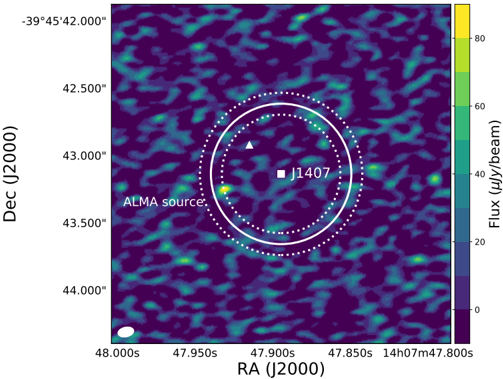
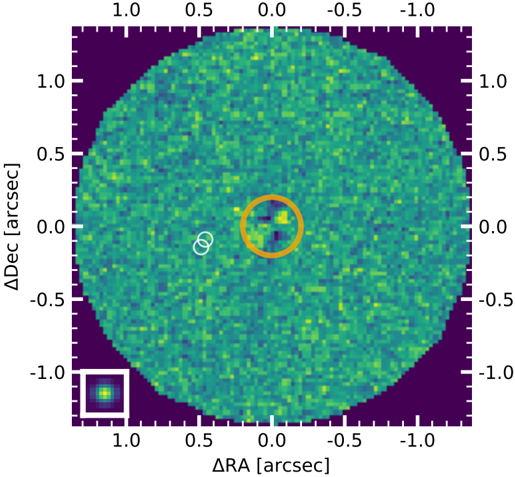
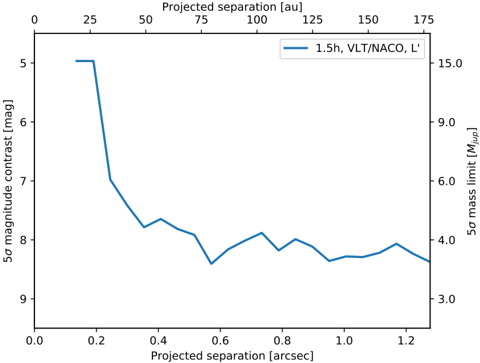
Our aim was to directly detect the thermal emission of the putative exoring system responsible for the complex deep transits observed in the light curve for the young Sco-Cen star 1SWASP J140747.93-394542.6 (V1400 Cen, hereafter J1407), confirming it as the occulter seen in May 2007, and to determine its orbital parameters with respect to the star. Methods. We used the Atacama Large Millimeter/submillimeter Array (ALMA) to observe the field centred on J1407 in the 340 GHz (Band 7) continuum in order to determine the flux and astrometric location of the ring system relative to the star. We used the VLT/NACO camera to observe the J1407 system in March 2019 and to search for the central planetary mass object at thermal infrared wavelengths. Results. We detect no point source at the expected location of J1407, and derive an upper limit 3σ level of 57.6 μJy. There is a point source detected at an angular separation consistent with the expected location for a free-floating ring system that occulted J1407 in May 2007, with a flux of 89 μJy consistent with optically thin dust surrounding a massive substellar companion. At 3.8 μm with the NACO camera, we detect the star J1407 but no other additional point sources within 1.3 arcsec of the star, with a lower bound on the sensitivity of 6 MJup at the location of the ALMA source, and down to 4 MJup in the sky background limit.
Overview
CoChat Summary
## TL;DR
ALMA detected a 4.7σ point source near J1407, but no source at the star itself; NACO found no additional point sources within 1.3″ of J1407. The paper argues the ALMA source is most consistent with either a free-floating dusty substellar object with an upper mass limit of 6 MJup or a background galaxy, while any bound ring system around J1407 must contain dust smaller than 1 mm.
## Key findings
- ALMA Band 7 imaging detected an unresolved point source with peak flux 89 μJy/beam and rms 19 μJy/beam, i.e. a 4.7σ detection, at (14:07:47.9311, −39:45:43.26068) (ICRS).
- No point source was detected at the expected position of J1407; the paper gives a 3σ upper limit of 57.6 μJy at the star’s location.
- The ALMA source lies 438 ± 8 mas from J1407, corresponding to 61 au at the distance of J1407, and the paper says this is too far to be gravitationally bound to the star.
- NACO L′-band observations detected J1407 but no additional point sources within 1.3 arcseconds; the sensitivity reaches 6 MJup at 30 au (0.25″) and <4 MJup beyond 100 au (0.70″).
- From the NACO non-detection, the authors infer an upper mass limit of 6 MJup for any central object at the ALMA source position.
## Methods
- The study combines ALMA Band 7 (340 GHz) continuum imaging from 2017 July 20, 22, and 24 (about 2 hours on source, 5.11 hours total) with VLT/NACO L′-band imaging from 2019 March 1.
- ALMA data were reduced in CASA 4.7.2; the secondary phase calibrator was removed because it was a double source, and the final calibrated data were imaged with natural weighting.
- NACO data were processed with PynPoint and PCA-based angular differential imaging; the authors used fake companion injection and AMES-Cond models to convert contrast limits into companion masses.
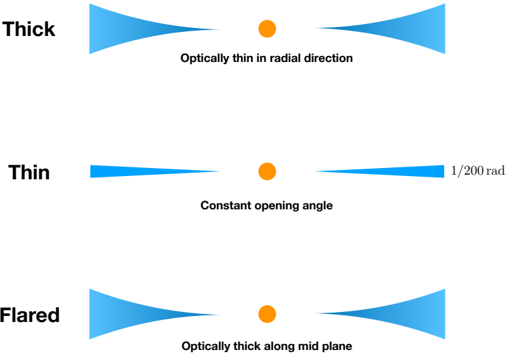
- They then compared the ALMA detection and limits to radiative-transfer models (MCMax) for different dust geometries and ring-system separations.
## Limitations
- The paper states that the background-galaxy hypothesis cannot be ruled out without a second ALMA epoch.
- The paper also says a second-epoch ALMA observation would be needed to confirm the predicted 43 mas/yr proper motion if the source is the 2007 occulter.
- Evident from the text: the ALMA source is unresolved and the interpretation depends on astrometry and model assumptions about dust size, geometry, and ring-system separation.
Model-written summary. Check it against the paper before relying on it.
Integrity signals
Registry
Cites
Statistics
Figures
Verification
Claims the paper makes
5 Valid · 2 Not valid · 4 Not checked · 20 Own results and interpretations
The cited sources support only part of this claim — read each source’s verdict below.
In the paper
“This indicates that the rings are geometrically thin (with a height-todiameter ratio hring = dring 0 : 001; Mamajek et al. 2012)”
What the sources say
- Partly supportedcites Mamajek et al. 2012 matched to “PLANETARY CONSTRUCTION ZONES IN OCCULTATION: DISCOVERY OF AN EXTRASOLAR RING SYSTEM TRANSITING A YOUNG SUN-LIKE STAR AND FUTURE PROSPECTS FOR DETECTING ECLIPSES BY CIRCUMSECONDARY AND CIRCUMPLANETARY DISKS” (2012) sourceExperimental — accuracy not yet measured
Section 3.7, “A Preliminary Model” (page unavailable), describes the eclipsing disk as extremely thin, with an inferred aspect ratio h/r of about 0.01. It does not establish the claimed height-to-diameter ratio of ≤0.001; the much smaller ratio in Section 3.6 concerns a different proposed explanation. (LLM, conf=0.86)
hedgedSingle case- Asserted: passes — The authors put it forward as true.
- Checkable: passes — It can be checked against evidence.
- Load-bearing: passes — The paper’s conclusions depend on it.
- Based: passes — The paper gives a reason why it holds.
- Partly supported
The cited sources that could be checked couldn’t confirm or dispute this claim.
In the paper
“and the probability of finding a galaxy within the annulus representing a 35 km = s free-floating object is 0.0029, or 1 in 341.”
What the sources say
- Could not verifycites Aravena et al. 2016 matched to “THE ALMA SPECTROSCOPIC SURVEY IN THE HUBBLE ULTRA DEEP FIELD: CONTINUUM NUMBER COUNTS, RESOLVED 1.2 mm EXTRAGALACTIC BACKGROUND, AND PROPERTIES OF THE FAINTEST DUSTY STAR-FORMING GALAXIES” (2016) sourceExperimental — accuracy not yet measured
Section 4 (Number Counts; page unavailable) reports galaxy counts per unit area, but does not calculate the probability of finding a galaxy in an annulus around a 35 km/s free-floating object. Searches for the annulus, 0.0029, and 1 in 341 found no matching calculation in our copy. (LLM, conf=0.76)
plain- Asserted: passes — The authors put it forward as true.
- Checkable: passes — It can be checked against evidence.
- Load-bearing: passes — The paper’s conclusions depend on it.
- Based: passes — The paper gives a reason why it holds.
- Could not verify
The cited sources that could be checked couldn’t confirm or dispute this claim.
In the paper
“The probability of finding more than zero galaxies within a radius of 0 : 5 arcseconds is around 0.0047, or 1 in 212”
What the sources say
- Could not verifycites Aravena et al. 2016 matched to “THE ALMA SPECTROSCOPIC SURVEY IN THE HUBBLE ULTRA DEEP FIELD: CONTINUUM NUMBER COUNTS, RESOLVED 1.2 mm EXTRAGALACTIC BACKGROUND, AND PROPERTIES OF THE FAINTEST DUSTY STAR-FORMING GALAXIES” (2016) sourceExperimental — accuracy not yet measured
Section 4 (Number Counts; page unavailable) reports cumulative 1.2 mm source counts, but the retrieved passages do not give a probability for a galaxy of at least 89 μJy within 0.5 arcsec. Searches for 0.0047, 1 in 212, the flux threshold, and chance associations did not locate the claimed calculation in our copy. (LLM, conf=0.73)
hedged- Asserted: passes — The authors put it forward as true.
- Checkable: passes — It can be checked against evidence.
- Load-bearing: passes — The paper’s conclusions depend on it.
- Based: passes — The paper gives a reason why it holds.
- Could not verify
Every source the paper cites for this claim was checked and supports it.
In the paper
“The small number of statistically independent patches close to the central star means that a correction is required to the sensitivity as described in Mawet et al. (2014), and we apply this correction to the contrast curve.”
What the sources say
- Supportedcites Mawet et al. 2014 matched to “FUNDAMENTAL LIMITATIONS OF HIGH CONTRAST IMAGING SET BY SMALL SAMPLE STATISTICS” (2014) source
Section 3.4 provides a recipe for calculating contrast curves that accounts for small sample sizes. The Conclusion states that small-sample statistics impose a contrast penalty at small angles and recommends accounting for it. The citing authors’ application of that correction to their NACO curve is their own reported action, not a result attributed to Mawet et al. (LLM, conf=0.93)
plainstates a cause- Asserted: passes — The authors put it forward as true.
- Checkable: passes — It can be checked against evidence.
- Load-bearing: passes — The paper’s conclusions depend on it.
- Based: passes — The paper gives a reason why it holds.
- Supported
The cited sources support only part of this claim — read each source’s verdict below.
In the paper
“Analysis of the optical light curve show sharp transitions in optical depth, implying the presence of discontinuities in particle density with ring radius, very similar to the rings of Saturn.”
What the sources say
- Partly supportedcites Mamajek et al. 2012 matched to “PLANETARY CONSTRUCTION ZONES IN OCCULTATION: DISCOVERY OF AN EXTRASOLAR RING SYSTEM TRANSITING A YOUNG SUN-LIKE STAR AND FUTURE PROSPECTS FOR DETECTING ECLIPSES BY CIRCUMSECONDARY AND CIRCUMPLANETARY DISKS” (2012) sourceExperimental — accuracy not yet measured
Section 3.3 (Eclipse Substructure; page unavailable) reports dips and intervals with little extinction that may indicate gaps. Section 3.7 (A Preliminary Model; page unavailable) fits the light curve with rings of different optical depths, but calls the model non-unique. The copy does not establish sharp optical-depth transitions or particle-density discontinuities like those in Saturn’s rings. (LLM, conf=0.85)
plainstates a causeSingle case- Asserted: passes — The authors put it forward as true.
- Checkable: passes — It can be checked against evidence.
- Load-bearing: passes — The paper’s conclusions depend on it.
- Based: passes — The paper gives a reason why it holds.
- Partly supported
14 more claims
Create a free account to see all 31 claims and to verify the 1 reference still open.
- It may state two separate claims as one. 9
- The quote only partly states this claim. 2
- Probably not a substantial claim. 3
Claims other papers make about this one
Each is checked against this paper’s own text: does it say what the citing paper says it does?
The source backs part of the claim, not all of it — or backs it for a different population, condition or comparison.
In the citing paper
“an unresolved source was seen in the ALMA data (M. A. Kenworthy et al. 2020) with a peak flux of 79 µ Jy, spatially offset from the position expected for J1407 given its proper motion, suggesting a chance transit.”
From Non-detection of J1407 b in ALMA Band 7 Observations (2025) · cites this paper as M. A. Kenworthy et al. 2020
Experimental — accuracy not yet measuredThe source backs part of the claim, not all of it — or backs it for a different population, condition or comparison.
In the citing paper
“thick disks with dust grains larger than 1mm, as favoured in the previous paper, of any mass are now ruled out.”
From Non-detection of J1407 b in ALMA Band 7 Observations (2025) · cites this paper as M. A. Kenworthy et al. (2020)
Experimental — accuracy not yet measuredThe source backs part of the claim, not all of it — or backs it for a different population, condition or comparison.
In the citing paper
“The latter was dismissed based on statistically small chances of an object with that flux being detected that close to J1407.”
From Non-detection of J1407 b in ALMA Band 7 Observations (2025) · cites this paper as M. A. Kenworthy et al. (2020)
Experimental — accuracy not yet measured
Self-check
Percentages, sums and reported differences re-computed from the paper’s own numbers.
Each contradiction between two passages listed here was confirmed by an independent check.
Rated minor: it would not touch a result — a value no result rests on, a p-value that stays on the same side of the significance level, or a conflict that is clerical, resolved elsewhere in the paper, or outside its own findings.
In the paper
§ 6.1. An upper limit on a ring system around J1047
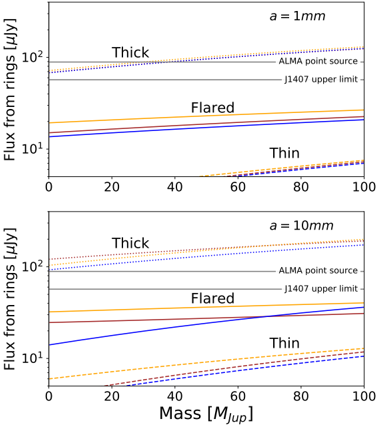
“The three di erent colours represent di erent distances of the ring system from the star: 5, 10, and 15 au for yellow, orange, and blue, respectively.”
§ 5. Modelling of a ring system at millimetre wavelengths
“Colours correspond to separations from the star J1407: Yellow 5 au, orange 10 au, blue 16 au.”
Citations
Cites
Matplotlib: a 2D graphics environment
Hunter, J. D. (2007) · Computing in Science & Engineering · doi:10.1109/mcse.2007.55 · Cited by 39,249 · cited 1×
“This research made use of Astropy (http://www.astropy.org), a community-developed core Python package for Astronomy (Astropy Collaboration 2013; Price-Whelan et al. 2018) and of Matplotlib (Hunter 2007).”
MethodAstropy: A community Python package for astronomy
The Astropy Collaboration, Robitaille, T. P., Tollerud, E. J., Greenfield, P., Droettboom, M., Bray, E., Aldcroft, T., Davis, M., Ginsburg, A., Price-Whelan, A. M., et al. (2013) · Astronomy & Astrophysics · doi:10.1051/0004-6361/201322068 · Cited by 14,620
Gaia Data Release 2: Summary of the contents and survey properties
Gaia Collaboration, Brown, A. G. A., Vallenari, A., Prusti, T., de Bruijne, J. H. J., Babusiaux, C., Bailer-Jones, C. A. L., Biermann, M., Evans, D. W., Eyer, L., et al. (2018) · Astronomy & Astrophysics · doi:10.1051/0004-6361/201833051 · Cited by 8,442
Binary Companions of Evolved Stars in APOGEE DR14: Search Method and Catalog of ∼5000 Companions
Price-Whelan, A. M., Hogg, D. W., Rix, H.-W., De Lee, N., Majewski, S. R., Nidever, D. L., Troup, N., Fernández-Trincado, J. G., García-Hernández, D. A., Longa-Peña, P., et al. (2018) · The Astronomical Journal · doi:10.3847/1538-3881/aac387 · Cited by 3,756 · cited 1×
“This research made use of Astropy (http://www.astropy.org), a community-developed core Python package for Astronomy (Astropy Collaboration 2013; Price-Whelan et al. 2018) and of Matplotlib (Hunter 2007).”
MethodEstimating Distance from Parallaxes. IV. Distances to 1.33 Billion Stars in Gaia Data Release 2
Bailer-Jones, C. A. L., Rybizki, J., Fouesneau, M., Mantelet, G., & Andrae, R. (2018) · The Astronomical Journal · doi:10.3847/1538-3881/aacb21 · Cited by 1,829 · cited 1×
“…∼16 Myr old, 0.9 M , V = 12.3 mag K5 star with parallax 7.1835 ± 0.0447 mas (Gaia Collaboration 2018), Article published by EDP Sciences A115, page 1 of 6 consistent with d = 138.7 ± 0.6 pc (Bailer-Jones et al. 2018) and membership of the Sco-Cen OB association (Mamajek et al. 2012).”
BackgroundInfluentialEvolutionary models for cool brown dwarfs and extrasolar giant planets. The case of HD 209458
Baraffe, I., Chabrier, G., Barman, T. S., Allard, F., & Hauschildt, P. H. (2003) · Astronomy & Astrophysics · doi:10.1051/0004-6361:20030252 · Cited by 1,566 · cited 1×
“To convert from sensitivity in magnitudes to companion mass, we use the AMES-Cond (Baraffe et al. 2003; Allard et al. 2001) models for conversion of contrast to Jupiter masses and assume an age of 16 Myr corresponding to the age of Sco-Cen, with the resultant contrast curve shown in Fig.”
MethodProtoplanetary Disks and Their Evolution
Williams, J. P., & Cieza, L. A. (2011) · Annual Review of Astronomy and Astrophysics · doi:10.1146/annurev-astro-081710-102548 · Cited by 1,403 · cited 5×
“Models for the luminosity of the central substellar object are taken from Baraffe et al. (2008) for an age of 16 Myr.”
BackgroundInfluentialThe Limiting Effects of Dust in Brown Dwarf Model Atmospheres
Allard, F., Hauschildt, P. H., Alexander, D. R., Tamanai, A., & Schweitzer, A. (2001) · The Astrophysical Journal · doi:10.1086/321547 · Cited by 1,062
Angular Differential Imaging: A Powerful High‐Contrast Imaging Technique
Marois, C., Lafreniere, D., Doyon, R., Macintosh, B., & Nadeau, D. (2006) · The Astrophysical Journal · doi:10.1086/500401 · Cited by 1,015 · cited 1×
“The data were obtained in cube burst mode, with telescope pupil tracking (Kasper et al. 2009) enabled to minimise the effect of residual speckles from the telescope optics for optimal Angular Differential Imaging (ADI; Marois et al. 2006).”
MethodPlanet-Disk Interaction and Orbital Evolution
Kley, W., & Nelson, R. P. (2012) · Annual Review of Astronomy and Astrophysics · doi:10.1146/annurev-astro-081811-125523 · Cited by 722 · cited 1×
“Once a planetary embryo forms within the CSD, a circumplanetary disk (CPD) builds inside the gravitational domain of the embryo, and gas and dust are transported through this disk and accrete onto the planet (see reviews by e.g. Armitage 2011; Kley & Nelson 2012).”
BackgroundDynamics of Protoplanetary Disks
Armitage, P. J. (2011) · Annual Review of Astronomy and Astrophysics · doi:10.1146/annurev-astro-081710-102521 · Cited by 517 · cited 1×
“Once a planetary embryo forms within the CSD, a circumplanetary disk (CPD) builds inside the gravitational domain of the embryo, and gas and dust are transported through this disk and accrete onto the planet (see reviews by e.g. Armitage 2011; Kley & Nelson 2012).”
BackgroundFormation of the Galilean Satellites: Conditions of Accretion
Canup, R. M., & Ward, W. R. (2002) · The Astronomical Journal · doi:10.1086/344684 · Cited by 433 · cited 1×
“…http://cdsarc. u-strasbg.fr/viz-bin/cat/J/A+A/633/A115 planet in a short time (Szulágyi et al. 2014; Perez et al. 2015) or possibly on longer timescales depending on the planet formation mechanism (Szulágyi et al. 2017) and may form moons within the Hill radius of the planet (Canup & Ward 2002).”
BackgroundFUNDAMENTAL LIMITATIONS OF HIGH CONTRAST IMAGING SET BY SMALL SAMPLE STATISTICS
Mawet, D., Milli, J., Wahhaj, Z., Pelat, D., Absil, O., Delacroix, C., Boccaletti, A., Kasper, M., Kenworthy, M., Marois, C., et al. (2014) · The Astrophysical Journal · doi:10.1088/0004-637x/792/2/97 · Cited by 369 · cited 1×
“The small number of statistically independent patches close to the central star means that a correction is required to the sensitivity as described in Mawet et al. (2014), and we apply this correction to the contrast curve.”
MethodSelf-citationThe first WASP public data release
Butters, O. W., West, R. G., Anderson, D. R., Collier Cameron, A., Clarkson, W. I., Enoch, B., Haswell, C. A., Hellier, C., Horne, K., Joshi, Y., et al. (2010) · Astronomy and Astrophysics · doi:10.1051/0004-6361/201015655 · Cited by 368
pynpoint: an image processing package for finding exoplanets
Amara, A., & Quanz, S. P. (2012) · Monthly Notices of the Royal Astronomical Society · doi:10.1111/j.1365-2966.2012.21918.x · Cited by 338 · cited 1×
“Processing the data with the latest release of the PynPoint package (Stolker et al. 2019) and applying Principal Component Analysis (PCA; Amara & Quanz 2012) results in a sensitivity map for point sources.”
MethodBaraffe, I., Chabrier, G., & Barman, T. (2008) · Astronomy & Astrophysics · doi:10.1051/0004-6361:20079321 · Cited by 338
Modeling optical properties of cosmic dust grains using a distribution of hollow spheres
Min, M., Hovenier, J. W., & de Koter, A. (2005) · Astronomy and Astrophysics · doi:10.1051/0004-6361:20041920 · Cited by 334 · cited 1×
“The opacities are computed using irregularly shaped grains (applying the method by Min et al. 2005) composed of a mixture of silicate and ice (40% Mg rich pyroxene, 60% water ice).”
MethodSelf-citationRadiative transfer in very optically thick circumstellar disks
Min, M., Dullemond, C. P., Dominik, C., de Koter, A., & Hovenier, J. W. (2009) · Astronomy & Astrophysics · doi:10.1051/0004-6361/200811470 · Cited by 260
Self-citationACCRETION OF JUPITER-MASS PLANETS IN THE LIMIT OF VANISHING VISCOSITY
Szulágyi, J., Morbidelli, A., Crida, A., & Masset, F. (2014) · The Astrophysical Journal · doi:10.1088/0004-637x/782/2/65 · Cited by 214 · cited 1×
“…CDS via anonymous ftp to cdsarc.u-strasbg.fr (130.79.128.5) or via http://cdsarc. u-strasbg.fr/viz-bin/cat/J/A+A/633/A115 planet in a short time (Szulágyi et al. 2014; Perez et al. 2015) or possibly on longer timescales depending on the planet formation mechanism (Szulágyi et al. 2017) and may…”
BackgroundInfluentialPLANET FORMATION SIGNPOSTS: OBSERVABILITY OF CIRCUMPLANETARY DISKS VIA GAS KINEMATICS
Perez, S., Dunhill, A., Casassus, S., Roman, P., Szulágyi, J., Flores, C., Marino, S., & Montesinos, M. (2015) · The Astrophysical Journal Letters · doi:10.1088/2041-8205/811/1/l5 · Cited by 160 · cited 1×
“…to cdsarc.u-strasbg.fr (130.79.128.5) or via http://cdsarc. u-strasbg.fr/viz-bin/cat/J/A+A/633/A115 planet in a short time (Szulágyi et al. 2014; Perez et al. 2015) or possibly on longer timescales depending on the planet formation mechanism (Szulágyi et al. 2017) and may form moons within the…”
BackgroundInfluentialAravena, M., Decarli, R., Walter, F., Cunha, E. D., Bauer, F. E., Carilli, C. L., Daddi, E., Elbaz, D., Ivison, R. J., Riechers, D. A., et al. (2016) · The Astrophysical Journal · doi:10.3847/1538-4357/833/1/68 · Cited by 154 · cited 3×
“Using the galaxy counts measured at 1.3 mm with ALMA from Aravena et al. (2016) we estimate the source background count at 850 µm (Band 7) by estimating the number counts at 1.2 mm and then converting to 850 µm number counts.”
BackgroundMethodInfluentialThe kinematics of the Scorpius-Centaurus OB association from Gaia DR1
Wright, N. J., & Mamajek, E. E. (2018) · Monthly Notices of the Royal Astronomical Society · doi:10.1093/mnras/sty207 · Cited by 144 · cited 1×
“The Sco-Cen association and its subgroups are unbound Wright & Mamajek (2018) with a 3D velocity dispersion in UCL region of 2.45 km s−1, leading to an implied 1D velocity dispersion of 1.4 km s−1 at the location of J1407, meaning that this object is unbound from the association and will leave it…”
BackgroundInfluentialSelf-citationMamajek, E. E., Quillen, A. C., Pecaut, M. J., Moolekamp, F., Scott, E. L., Kenworthy, M. A., Cameron, A. C., & Parley, N. R. (2012) · The Astronomical Journal · doi:10.1088/0004-6256/143/3/72 · Cited by 140 · cited 4×
“This indicates that the rings are geometrically thin (with a height-todiameter ratio hring/dring ≈ 0.001; Mamajek et al. 2012) We note that this estimate is only valid where large gradients in the light curve are seen; during the time of smallest projected separation of J1407 behind the disk…”
BackgroundInfluentialSelf-citationAPLpy v2.0: The Astronomical Plotting Library in Python
Robitaille, T. (2019) · Figshare · doi:10.5281/zenodo.2567476 · Cited by 138
APLpy v2.0: The Astronomical Plotting Library in Python
Robitaille, T. (2019) · Figshare · doi:10.5281/zenodo.2567475 · Cited by 138
MODELING GIANT EXTRASOLAR RING SYSTEMS IN ECLIPSE AND THE CASE OF J1407B: SCULPTING BY EXOMOONS?
Kenworthy, M. A., & Mamajek, E. E. (2015) · The Astrophysical Journal · doi:10.1088/0004-637x/800/2/126 · Cited by 123 · cited 7×
“…marginally consistent with a free-floating object that transited J1407 in 2007 and is moving with a transverse velocity of 35 km s−1 relative to J1407 (assuming source is co-distant with J1407) derived from the 2007 observations (Kenworthy & Mamajek 2015), as indicated by the white circle in Fig.”
BackgroundMethodInfluentialSelf-citationPynPoint: a modular pipeline architecture for processing and analysis of high-contrast imaging data
Stolker, T., Bonse, M. J., Quanz, S. P., Amara, A., Cugno, G., Bohn, A. J., & Boehle, A. (2018) · Astronomy and Astrophysics · doi:10.1051/0004-6361/201834136 · Cited by 70 · cited 1×
“Processing the data with the latest release of the PynPoint package (Stolker et al. 2019) and applying Principal Component Analysis (PCA; Amara & Quanz 2012) results in a sensitivity map for point sources.”
MethodSelf-citationSzulágyi, J., Mayer, L., & Quinn, T. (2017) · Monthly Notices of the Royal Astronomical Society · doi:10.1093/mnras/stw2617 · Cited by 58 · cited 1×
“…http://cdsarc. u-strasbg.fr/viz-bin/cat/J/A+A/633/A115 planet in a short time (Szulágyi et al. 2014; Perez et al. 2015) or possibly on longer timescales depending on the planet formation mechanism (Szulágyi et al. 2017) and may form moons within the Hill radius of the planet (Canup & Ward 2002).”
BackgroundTiscareno, M. S. (2013) · Planets, Stars and Stellar Systems · doi:10.1007/978-94-007-5606-9_7 · Cited by 37
Mass and period limits on the ringed companion transiting the young star J1407
Kenworthy, M. A., Lacour, S., Kraus, A., Triaud, A. H. M. J., Mamajek, E. E., Scott, E. L., Ségransan, D., Ireland, M., Hambsch, F.-J., Reichart, D. E., et al. (2015) · Monthly Notices of the Royal Astronomical Society · doi:10.1093/mnras/stu2067 · Cited by 36 · cited 4×
“Heating from the primary star J1407 and from the companion J1407b are taken into account using the stellar parameters listed in van Werkhoven et al. (2014) and A115, page 4 of 6 Kenworthy et al. (2015), and for a range of semi-major separations of the ring system from the central star.”
BackgroundMethodInfluentialSelf-citationAnalysis of 1SWASP J140747.93−394542.6 eclipse fine-structure: hints of exomoons
van Werkhoven, T. I. M., Kenworthy, M. A., & Mamajek, E. E. (2014) · Monthly Notices of the Royal Astronomical Society · doi:10.1093/mnras/stu725 · Cited by 29 · cited 2×
“Heating from the primary star J1407 and from the companion J1407b are taken into account using the stellar parameters listed in van Werkhoven et al. (2014) and A115, page 4 of 6 Kenworthy et al. (2015), and for a range of semi-major separations of the ring system from the central star.”
BackgroundMethodSelf-citationUpper limits on protolunar disc masses using ALMA observations of directly imaged exoplanets
Sebastian Perez, M., Marino, S., Casassus, S., Baruteau, C., Zurlo, A., Flores, C., & Chauvin, G. (2019) · Monthly Notices of the Royal Astronomical Society · doi:10.1093/mnras/stz1775 · Cited by 26 · cited 1×
“…stage is not strongly constrained by observations (upper limits of millimetre-sized particles to CPDs around known exoplanets are reported in Pérez et al. 2019), but the large solid angle subtended by the Hill sphere filling disk and rings imply that transits of these systems may be common…”
BackgroundConstraints on the size and dynamics of the J1407b ring system
Rieder, S., & Kenworthy, M. A. (2016) · Astronomy & Astrophysics · doi:10.1051/0004-6361/201629567 · Cited by 23 · cited 1×
“…strongly ruled out with these studies and the diameter of the ring system model, along with the detailed smallscale structure deduced from nightly flux variations, makes it very challenging to explain the apparent stability and coherence of the rings (Zanazzi & Lai 2017; Rieder & Kenworthy 2016).”
BackgroundSelf-citationExtended transiting discs and rings around planets and brown dwarfs: theoretical constraints
Zanazzi, J. J., & Lai, D. (2017) · Monthly Notices of the Royal Astronomical Society · doi:10.1093/mnras/stw2629 · Cited by 21 · cited 1×
“…strongly ruled out with these studies and the diameter of the ring system model, along with the detailed smallscale structure deduced from nightly flux variations, makes it very challenging to explain the apparent stability and coherence of the rings (Zanazzi & Lai 2017; Rieder & Kenworthy 2016).”
BackgroundExtended Transiting Disks and Rings Around Planets and Brown Dwarfs: Theoretical Constraints
Zanazzi, J. J., & Lai, D. (2016) · arXiv · doi:10.48550/arxiv.1605.02365 · Cited by 21
Mentel, R. T., Kenworthy, M. A., Cameron, D. A., Scott, E. L., Mellon, S. N., Hudec, R., Birkby, J. L., Mamajek, E. E., Schrimpf, A., Reichart, D. E., et al. (2018) · Astronomy & Astrophysics · doi:10.1051/0004-6361/201834004 · Cited by 14 · cited 2×
“Subsequent papers have detailed the search for successive eclipses in photometric data (Kenworthy & Mamajek 2015; Mentel et al. 2018) through radial velocity and direct imaging with full aperture and non-redundant mask imaging (Kenworthy et al. 2015) that have placed successively more stringent…”
BackgroundSelf-citationSutton, P. J. (2019) · Monthly Notices of the Royal Astronomical Society · doi:10.1093/mnras/stz563 · Cited by 5 · cited 1×
“Another challenge is whether the ring gaps are caused by mean-motion resonances (MMRs) or by direct clearing, and the elliptical orbit at periastron disfavours the MMR hypothesis (Sutton 2019).”
Background
Research works printed but not linked: 5
- Kasper, 2009, The Messenger, 137, 8
- Lenzen, 2003, SPIE Conf. Ser., 4841, 944
- McMullin, 2007, ASP Conf. Ser., 376, 127
- Pojmanski, 2002, Acta Astron., 52, 397
- Rousset, 2003, SPIE Conf. Ser., 4839, 140
Cited by
The Structure and Stability of Extended, Inclined Circumplanetary Disc or Ring Systems
Speedie, J., & Zanazzi, J. J. (2020) · Monthly Notices of the Royal Astronomical Society · doi:10.1093/mnras/staa2068 · Cited by 10
New constraints on the presence of debris disks around G 196-3 B and VHS J125601.92–125723.9 b
Zakhozhay, O. V., Osorio, M. R. Z., Béjar, V. J. S., Climent, J. B., Guirado, J. C., Gauza, B., Lodieu, N., Semenov, D. A., Pérez-Torres, M. Á., Azulay, R., et al. (2023) · Astronomy and Astrophysics · doi:10.1051/0004-6361/202345944 · Cited by 2
Detecting and Characterizing Exomoons and Exorings
Teachey, A. (2024) · Springer eBooks · doi:10.1007/978-3-319-30648-3_211-1 · Cited by 4
A Self-Gravitating Exoring Around J1407b and Implications for In-Situ Exomoon Formation
Sutton, P. J., Albery, B., & Muff, J. (2022) · Frontiers in Astronomy and Space Sciences · doi:10.3389/fspas.2022.819933 · Cited by 2
Beyond Circular Eclipsers (BeyonCE) light curve modelling: I. Shallot Explorer
van Dam, D. M., & Kenworthy, M. A. (2024) · Astronomy & Astrophysics · doi:10.1051/0004-6361/202245620 · Cited by 1
Self-citation
Metadata
- Authors
- Kenworthy, M. A., Klaassen, P. D., Min, M., van der Marel, N., Bohn, A. J., Kama, M., Triaud, A., Hales, A., Monkiewicz, J., Scott, E., & Mamajek, E. E.
- Affiliations
- Leiden University (NL)
- Royal Observatory (GB)
- Space Research Organisation Netherlands (NL)
- University of Cambridge (GB)
- University of Birmingham (GB)
- National Radio Astronomy Observatory (US)
- Arizona State University (US)
- Chinese Academy of Sciences (CN)
- California Institute of Technology (US)
- Venue
- Astronomy & Astrophysics
- Publisher
- EDP Sciences
- Published
- 2020-01
- Volume
- 633
- Pages
- A115
- ISSN
- 0004-6361 (ISSN-L)
- 1432-0746
- OpenAlex
- W2992814457
- Cited by
- 5
- References
- 35
- Citations by year
- 2025: 1 · 2024: 2 · 2023: 1 · 2020: 1
- FWCI
- 0.13
- Type
- journal article
- Language
- en
- Open access
- bronze
- doi.org
- Locations
- Astronomy and Astrophysics (publishedVersion)
- arXiv (Cornell University) (submittedVersion)
- NPARC (submittedVersion)
- University of Birmingham Research Portal (University of Birmingham) (submittedVersion, other-oa)
- Leiden Repository (Leiden University) (submittedVersion)
- Data Archiving and Networked Services (DANS) (submittedVersion, other-oa)
- arXiv (Cornell University)
- Funders
- European Research Council (678194)
- Topics
- Physical Sciences › Physics and Astronomy › Astronomy and Astrophysics › Stellar, planetary, and galactic studies
- Physical Sciences › Physics and Astronomy › Astronomy and Astrophysics › Astrophysics and Star Formation Studies
- Physical Sciences › Earth and Planetary Sciences › Space and Planetary Science › Astro and Planetary Science
- Keywords
- thermal infrared emission, substellar companions, dust grains, orbital elements, young stellar objects, millimeter continuum emission
About these checks
Registry, retraction, Cites and statistics results are computed, not judged, with one exception: a printed reference that no index lists is read once by a model before it counts as a citation error. Claims are extracted by a model and kept only when their quote appears verbatim in the text; each cited source is then checked, with a model’s help, for whether it says what the claim relies on. Those verdicts can be wrong — read the claim’s quote and the cited source before relying on one.
The claim verdicts this report counts are experimental: their accuracy is not yet measured.
A language model drew the claims from the paper on 2026-10-11, under version 3 of the claim definition (model deepseek-v4.1-flash, prompt extract-v3).
A second model labelled each claim on 2026-10-11 (model jev-1.13-20260917, definition revision gold-guideline-v0.2).
Cited sources are checked with a language model’s help (gpt-6-sol).
Statistics and arithmetic are recomputed, not judged.
Confidence bands are shown only for fields calibrated on our annotated test set. None is calibrated yet, so no band is shown.
What counts as a claim ›How we measure confidence ›How we check this ›
Are you an author, or do you see a problem with this page? Request a review
Data sources
Bibliographic data: Semantic Scholar, OpenAlex, Crossref.
Contains information from the Semantic Scholar Academic Graph Datasets, made available under the ODC Attribution License (ODC-BY 1.0).
Semantic Scholar’s data is described in: Kinney, R., et al. (2023). The Semantic Scholar Open Data Platform. arXiv:2301.10140.
