

Bidirectional reduction effects of perceived stress and general self-efficacy among college students: a cross-lagged study
Open accessThe DOI matches its Crossref record; 60 of the 60 references it cites were found in a registry or an index.
Abstract
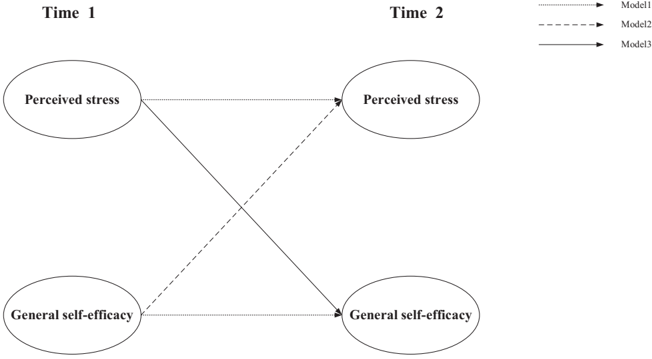
Perceived stress and general self-efficacy are important issues closely related to the mental health and academic performance of college students. Previous studies have explored the correlation between perceived stress and general self-efficacy, but the understanding of the reciprocal effects of these two factors is still limited. Based on two-wave longitudinal data, this study investigated the bidirectional relationship between perceived stress and general self-efficacy in a sample of Chinese college students. The correlation results showed that perceived stress was significantly negatively correlated with general self-efficacy. Furthermore, by cross-lagged analysis, it was found that perceived stress can significantly negatively predict subsequent general self-efficacy and that general self-efficacy can significantly negatively predict subsequent perceived stress. Bidirectional reduction effects between perceived stress and general self-efficacy are observed among Chinese college students. The results emphasize the necessity of timely stress intervention for college students and the establishment of measures to enhance general self-efficacy.
Overview
The claims and statistics of this paper haven’t been checked yet.
Free: it reads the open-access text and checks the first 5 claims that cite a source we can check. Create a free account to check every claim.
Integrity signals
Registry
Cites
Statistics
Figures
Verification
Claims the paper makes
The claims and statistics of this paper haven’t been checked yet.
Free: it reads the open-access text and checks the first 5 claims that cite a source we can check. Create a free account to check every claim.
Claims other papers make about this one
Each is checked against this paper’s own text: does it say what the citing paper says it does?
The check wasn’t confident either way, so it gives no verdict — never disputed.
In the citing paper
“The Sociocultural Self Model complements this by emphasizing the interdependent nature of self-concept in Chinese society, where individuals define themselves through family expectations and social roles [31].”
From Parental expectation and psychological distress of Chinese youth: the chain mediating effects of core self-worth and perceived stress (2025) · cites this paper as [31]
Experimental — accuracy not yet measured
Self-check
Percentages, sums and reported differences re-computed from the paper’s own numbers.
The self-check needs the paper’s full text.
Citations
Cites
Hu, L., & Bentler, P. M. (1999) · Structural Equation Modeling A Multidisciplinary Journal · doi:10.1080/10705519909540118 · Cited by 108,788
Kessler, R. C., Berglund, P., Demler, O., Jin, R., Merikangas, K. R., & Walters, E. E. (2005) · Archives of General Psychiatry · doi:10.1001/archpsyc.62.6.593 · Cited by 20,391
Significance tests and goodness of fit in the analysis of covariance structures.
Bentler, P. M., & Bonett, D. G. (1980) · Psychological Bulletin · doi:10.1037//0033-2909.88.3.588 · Cited by 19,023
Social Cognitive Theory: An Agentic Perspective
Bandura, A. (2001) · Annual Review of Psychology · doi:10.1146/annurev.psych.52.1.1 · Cited by 15,510
Sawyer, S. M., Azzopardi, P. S., Wickremarathne, D., & Patton, G. C. (2018) · The Lancet Child & Adolescent Health · doi:10.1016/s2352-4642(18)30022-1 · Cited by 3,666
Hattie, J. (2008) · doi:10.4324/9780203887332 · Cited by 3,051
Depression Anxiety Stress Scales
Lovibond, S. H., & Lovibond, P. F. (2011) · PsycTESTS Dataset · doi:10.1037/t01004-000 · Cited by 2,416
Klassen, R. M., & Chiu, M. M. (2010) · Journal of Educational Psychology · doi:10.1037/a0019237 · Cited by 2,353
The prevalence and correlates of depression, anxiety, and stress in a sample of college students
Beiter, R., Nash, R., McCrady, M., Rhoades, D., Linscomb, M., Clarahan, M., & Sammut, S. (2015) · Journal of Affective Disorders · doi:10.1016/j.jad.2014.10.054 · Cited by 2,030
Is General Self-Efficacy a Universal Construct?1
Scholz, U., Gutiérrez Doña, B., Sud, S., & Schwarzer, R. (2002) · European Journal of Psychological Assessment · doi:10.1027//1015-5759.18.3.242 · Cited by 1,637
Sources of Self-Efficacy in School: Critical Review of the Literature and Future Directions
Usher, E. L., & Pajares, F. (2008) · Review of Educational Research · doi:10.3102/0034654308321456 · Cited by 1,514
College Students: Mental Health Problems and Treatment Considerations
Pedrelli, P., Nyer, M., Yeung, A., Zulauf, C., & Wilens, T. (2015) · Academic Psychiatry · doi:10.1007/s40596-014-0205-9 · Cited by 1,325
General self-efficacy in various domains of human functioning: evidence from five countries
Luszczynska, A., Gutiérrez‐Doña, B., & Schwarzer, R. (2005) · International Journal of Psychology · doi:10.1080/00207590444000041 · Cited by 1,127
Persistence of mental health problems and needs in a college student population
Zivin, K., Eisenberg, D., Gollust, S. E., & Golberstein, E. (2009) · Journal of Affective Disorders · doi:10.1016/j.jad.2009.01.001 · Cited by 784
Caprara, G. V., Vecchione, M., Alessandri, G., Gerbino, M., & Barbaranelli, C. (2011) · British Journal of Educational Psychology · doi:10.1348/2044-8279.002004 · Cited by 558
The longitudinal impact of self-efficacy and career goals on objective and subjective career success
Abele, A. E., & Spurk, D. (2009) · Journal of Vocational Behavior · doi:10.1016/j.jvb.2008.10.005 · Cited by 525
Galante, J., Dufour, G., Vainre, M., Wagner, A. P., Stochl, J., Benton, A., Lathia, N., Howarth, E., & Jones, P. B. (2018) · The Lancet Public Health · doi:10.1016/s2468-2667(17)30231-1 · Cited by 516
Hackett, G., Betz, N. E., Casas, J. M., & Rocha-Singh, I. A. (1992) · Journal of Counseling Psychology · doi:10.1037//0022-0167.39.4.527 · Cited by 515
The use of item parcels in structural equation modelling: Non-normal data and small sample sizes
Hau, K., & Marsh, H. W. (2004) · British Journal of Mathematical and Statistical Psychology · doi:10.1111/j.2044-8317.2004.tb00142.x · Cited by 467
College life is stressful today – Emerging stressors and depressive symptoms in college students
Acharya, L., Jin, L., & Collins, W. (2018) · Journal of American College Health · doi:10.1080/07448481.2018.1451869 · Cited by 410
Ebstrup, J. F., Eplov, L. F., Pisinger, C., & Jørgensen, T. (2011) · Anxiety, Stress & Coping · doi:10.1080/10615806.2010.540012 · Cited by 359
Deckro, G. R., Ballinger, K. M., Hoyt, M., Wilcher, M., Dusek, J., Myers, P., Greenberg, B., Rosenthal, D. S., & Benson, H. (2002) · Journal of American College Health · doi:10.1080/07448480209603446 · Cited by 353
Handbook of stress, coping, and health: implications for nursing research, theory, and practice
(2001) · Choice Reviews Online · doi:10.5860/choice.38-2774 · Cited by 339
Shapiro, D. H., Jr., Schwartz, C. E., & Astin, J. A. (1996) · American Psychologist · doi:10.1037//0003-066x.51.12.1213 · Cited by 327
College English writing affect: Self-efficacy and anxiety
Woodrow, L. (2011) · System · doi:10.1016/j.system.2011.10.017 · Cited by 313
College Student Stressors: A Review of the Qualitative Research
Hurst, C. S., Baranik, L. E., & Daniel, F. (2013) · Stress and Health · doi:10.1002/smi.2465 · Cited by 312
Cicognani, E. (2011) · Journal of Applied Social Psychology · doi:10.1111/j.1559-1816.2011.00726.x · Cited by 197
Cage, E., Jones, E., Ryan, G., Hughes, G., & Spanner, L. (2021) · Journal of Further and Higher Education · doi:10.1080/0309877x.2021.1875203 · Cited by 168
Stress, coping and suicide ideation in Chinese college students
Zhang, X., Wang, H., Xia, Y., Liu, X., & Jung, E. (2012) · Journal of Adolescence · doi:10.1016/j.adolescence.2011.10.003 · Cited by 157
Self-citationYikealo, D., Yemane, B., & Karvinen, I. (2018) · Open Journal of Social Sciences · doi:10.4236/jss.2018.611004 · Cited by 136
Academic stress as a predictor of chronic stress in university students
Pozos-Radillo, B. E., Preciado-Serrano, M. D. L., Acosta-Fernández, M., Aguilera-Velasco, M. D. L. Á., & Delgado-García, D. D. (2014) · Psicología Educativa · doi:10.1016/j.pse.2014.05.006 · Cited by 122
MyStudentBody-stress: an online stress management intervention for college students
Chiauzzi, E., Brevard, J., Thurn, C., Decembrele, S., & Lord, S. (2008) · Journal of Health Communication · doi:10.1080/10810730802281668 · Cited by 119
Self Efficacy, Health Promoting Behaviors, and Symptoms of Stress among University Students
Han, K. S. (2005) · Daehan ganho haghoeji · doi:10.4040/jkan.2005.35.3.585 · Cited by 106
Carter, J. S., Garber, J., Ciesla, J. A., & Cole, D. A. (2006) · Journal of Abnormal Psychology · doi:10.1037/0021-843x.115.3.428 · Cited by 101
Liu, X., Zhang, Y., Gao, W., & Cao, X. (2023) · Humanities and Social Sciences Communications · doi:10.1057/s41599-023-02252-2 · Cited by 89
Self-citationLiu, X., Guo, Y.-X., & Wang, X. (2023) · World Journal of Psychiatry · doi:10.5498/wjp.v13.i7.409 · Cited by 88
Self-citationThe Relationship between Self-efficacy and Stress among Iranian EFL Teachers
Vaezi, S., & Fallah, N. (2011) · Journal of Language Teaching and Research · doi:10.4304/jltr.2.5.1168-1174 · Cited by 87
Stress, coping, and internet use of college students.
Deatherage, S., Servaty-Seib, H. L., & Aksoz, I. (2014) · Journal of American College Health · doi:10.1080/07448481.2013.843536 · Cited by 85
How Generalizable Are Adolescents' Beliefs About Pro‐Drug Pressures and Resistance Self‐Efficacy?1
Hays, R. D., & Ellickson, P. L. (1990) · Journal of Applied Social Psychology · doi:10.1111/j.1559-1816.1990.tb00414.x · Cited by 78
McKay, M. T., Dempster, M., & Byrne, D. G. (2014) · Journal of Youth Studies · doi:10.1080/13676261.2014.901494 · Cited by 69
Kodish, T., Lau, A. S., Gong-Guy, E., Congdon, E. L., Arnaudova, I., Schmidt, M., Shoemaker, L., & Craske, M. G. (2021) · Administration and Policy in Mental Health and Mental Health Services Research · doi:10.1007/s10488-021-01163-1 · Cited by 69
Waaktaar, T., Borge, A. I. H., Fundingsrud, H. P., Christie, H. J., & Torgersen, S. (2004) · Journal of Adolescence · doi:10.1016/j.adolescence.2003.09.006 · Cited by 67
Zhai, X., Ye, M., Wang, C., Gu, Q., Huang, T., Wang, K., Chen, Z., & Fan, X. (2020) · Mental Health and Physical Activity · doi:10.1016/j.mhpa.2020.100323 · Cited by 67
Şahin, F., & Çetin, F. (2017) · Psychological Studies · doi:10.1007/s12646-016-0382-6 · Cited by 66
Luo, Y., Gao, W., & Liu, X. (2022) · Frontiers in Psychology · doi:10.3389/fpsyg.2022.877343 · Cited by 65
Self-citationBurgstahler, M. S., & Stenson, M. C. (2019) · Journal of American College Health · doi:10.1080/07448481.2019.1590371 · Cited by 62
Artificial intelligence-assisted psychosis risk screening in adolescents: Practices and challenges
Cao, X.-J., & Liu, X.-Q. (2022) · World Journal of Psychiatry · doi:10.5498/wjp.v12.i10.1287 · Cited by 60
Self-citationYang, T., Yang, X. Y., Yu, L., Cottrell, R. R., & Jiang, S. (2017) · International Journal for Equity in Health · doi:10.1186/s12939-017-0618-7 · Cited by 59
Liu, X., Ji, X., & Zhang, Y. (2023) · Heliyon · doi:10.1016/j.heliyon.2023.e15750 · Cited by 50
Self-citationWang, H., Yang, X. Y., Yang, T., Cottrell, R. R., Yu, L., Feng, X., & Jiang, S. (2015) · International Journal for Equity in Health · doi:10.1186/s12939-015-0152-4 · Cited by 42
Liu, X., Zhang, Y., Cao, X., & Gao, W. (2023) · Current Psychology · doi:10.1007/s12144-023-05184-x · Cited by 42
Self-citationMolla Jafar, H., Salabifard, S., Mousavi, S. M., & Sobhani, Z. (2015) · Global Journal of Health Science · doi:10.5539/gjhs.v8n6p47 · Cited by 39
Cao, X., & Liu, X. (2023) · Behavioral Sciences · doi:10.3390/bs13100876 · Cited by 38
Self-citationTime Use and Cognitive Achievement among Adolescents in China: Depression Symptoms as Mediators
Cao, X., & Liu, X. (2023) · Journal of Intelligence · doi:10.3390/jintelligence11050088 · Cited by 36
Self-citationCao, X., Zhang, Q., & Liu, X. (2023) · International Journal of Mental Health Promotion · doi:10.32604/ijmhp.2023.029365 · Cited by 34
Self-citationLiu, X., Zhang, Y., & Cao, X. (2023) · European Journal of Psychology of Education · doi:10.1007/s10212-023-00764-8 · Cited by 34
Self-citationAnalyzing Peer Pressure and Self-Efficacy Expectations Among Adolescents
Kiran-Esen, B. (2012) · Social Behavior and Personality An International Journal · doi:10.2224/sbp.2012.40.8.1301 · Cited by 32
Cao, X. (2023) · Psychological Reports · doi:10.1177/00332941231175833 · Cited by 28
Self-citationLiu, X., Zhang, Y., & Luo, Y. (2023) · Healthcare · doi:10.3390/healthcare11212813 · Cited by 23
Self-citationThe Correlation Between Metacognition Level with Self-Efficacy of Biology Education College Students
Ridlo, S., & Lutfiya, F. (2017) · Journal of Physics Conference Series · doi:10.1088/1742-6596/824/1/012067 · Cited by 13
Research works printed but not linked: 16
- Bandura A (1986) Social foundations of thought and action: a social cognitive theory. Prentice Hall, Englewood Cliffs, NJ. pp. 23-28
- Broman CL (2005) Stress, race and substance use in college. college Student. Journal 39(2):340-353
- Chan GC, Koh D (2007) Understanding the psychosocial and physical work environment in a Singapore medical school. Singap Med J 48(2):166-171
- Ehrenberg MF, Cox DN (1991) The relationship between self-efficacy and depression in adolescents. Adolescence 26(102):361
- Goldman CS, Wong EH (1997) Stress and the college student. Education 117:604
- Lazarus RS (1966) Psychological stress and the coping process. McGraw Hill
- Lazarus RS (1966) Psychological stress and the coping process. McGraw Hill Li H, Lin C (2003) College stress and psychological well-being of Chinese college students. Acta Psychol Sin 35(2):222-230
- McDonald S, McDonald E, Roberts A (2017) Effects of novel dog exposure on college students' stress prior to examination. North Am J Psychol 19:477
- Mowday RT, Porter LW, Steers RM (2013) Employee-organization linkages: The psychology of commitment, absenteeism, and turnover. Academic press
- Plunkett SW, Radmacher KA, Moll-Phanara D (2000) Adolescent life events, stress, and coping: A comparison of communities and genders. Prof Sch Couns 3(5):356
- Ross SE, Niebling BC, Heckert TM(1999) Sources of stress among college students. Coll Stud J 33:312
- Schunk DH, Pintrich PR, Meece JL (2008) Motivation in education: Theory, research, and applications. Upper Saddle River, N.J: Pearson/Merrill Prentice Hall Schwarzer R (1997) Optimistic self-beliefs: assessment of general perceived self- efficacy in thirteen cultures. World Psychol 3(1):177-190
- Schwarzer R (1997) Optimistic self-beliefs: assessment of general perceived self-efficacy in thirteen cultures. World Psychol 3(1):177–190
- Schwarzer R, Jerusalem M (1995) Generalized Self-Efficacyscale. In: Weinman J, Wright S, Johnston M. Measures in health psychology: auser's portfolio. Causal and control beliefs. NFER-NELSON, Windsor, UK. pp. 35-37
- Tong Y, Song S (2004) A study on general self-efficacy and subjective well-being of low SES-college students in a Chinese university. Coll Stud J 38(4):637
- Weinstein L, Laverghetta A (2009) College student stress and satisfaction with life. Coll Stud J 43(4):1161-1162
Cited by
Benítez-Agudelo, J. C., Restrepo, D., Navarro-Jiménez, E., & Clemente‐Suárez, V. J. (2025) · BMC Psychology · doi:10.1186/s40359-025-03041-z · Cited by 136
“In the academic context, stress arises from the interaction between perceived demands (e.g., exams, deadlines, academic workload) and the individual’s coping resources [11, 12].”
Liu, X., Zhu, C., Dong, Z., & Luo, Y. (2024) · Behavioral Sciences · doi:10.3390/bs14070537 · Cited by 90
“Previous studies have shown a significant negative correlation between general self-efficacy and stress, providing evidence for our research on the relationship between academic self-efficacy and stress among elite college students [54].”
ResultSelf-citationLiu, X., & Wang, J. (2024) · Humanities and Social Sciences Communications · doi:10.1057/s41599-024-03686-y · Cited by 85
Self-citationSong, X., & Hu, Q. (2024) · BMC Public Health · doi:10.1186/s12889-024-20738-9 · Cited by 47
Huang, Y., Yuan, Y., Sun, W., & Li, P. (2025) · Humanities and Social Sciences Communications · doi:10.1057/s41599-025-05316-7 · Cited by 45
Metadata
- Authors
- Liu, X., Li, Y., & Cao, X.
- Affiliations
- Tianjin University (CN)
- Peking University (CN)
- Corresponding author
- Liu, Xinqiao
- Cao, Xiaojie
- Venue
- Humanities and Social Sciences Communications
- Published
- 2024-02-15
- Volume
- 11
- Issue
- 1
- ISSN
- 2055-1045 (ISSN-L)
- 2662-9992
- OpenAlex
- W4391841797
- Cited by
- 54
- References
- 60
- Citations by year
- 2026: 14 · 2025: 21 · 2024: 19
- FWCI
- 42.45
- Type
- journal article
- Language
- en
- Open access
- gold
- doi.org
- Licence
- cc-by
- creativecommons.org/licenses/by/4.0 (tdm)
- creativecommons.org/licenses/by/4.0 (vor)
- Locations
- Humanities and Social Sciences Communications (publishedVersion, cc-by)
- RePEc: Research Papers in Economics (submittedVersion)
- DOAJ (DOAJ: Directory of Open Access Journals) (submittedVersion, cc-by-sa)
- Greater South Information System
- Funders
- Tianjin Municipal Education Commission (2021JWZD02)
- Topics
- Social Sciences › Psychology › Developmental and Educational Psychology › Student Stress and Coping
- Social Sciences › Psychology › Clinical Psychology › Health and Well-being Studies
- Social Sciences › Psychology › Social Psychology › Stress and Burnout Research
- Keywords
- perceived stress, general self-efficacy, bidirectional relationship, reciprocal effects, university students, student mental health, stress interventions, Chinese university students
About these checks
Registry, retraction, Cites and statistics results are computed, not judged, with one exception: a printed reference that no index lists is read once by a model before it counts as a citation error. Claims are extracted by a model and kept only when their quote appears verbatim in the text; each cited source is then checked, with a model’s help, for whether it says what the claim relies on. Those verdicts can be wrong — read the claim’s quote and the cited source before relying on one.
Statistics and arithmetic are recomputed, not judged.
Confidence bands are shown only for fields calibrated on our annotated test set. None is calibrated yet, so no band is shown.
What counts as a claim ›How we measure confidence ›How we check this ›
Are you an author, or do you see a problem with this page? Request a review
Data sources
Bibliographic data: Semantic Scholar, OpenAlex, Crossref.
Contains information from the Semantic Scholar Academic Graph Datasets, made available under the ODC Attribution License (ODC-BY 1.0).
Semantic Scholar’s data is described in: Kinney, R., et al. (2023). The Semantic Scholar Open Data Platform. arXiv:2301.10140.
