

Components of Aesthetic Experience: Aesthetic Fascination, Aesthetic Appraisal, and Aesthetic Emotion
Open accessThe DOI matches its Crossref record; 103 of the 103 references it cites were found in a registry or an index.
Abstract
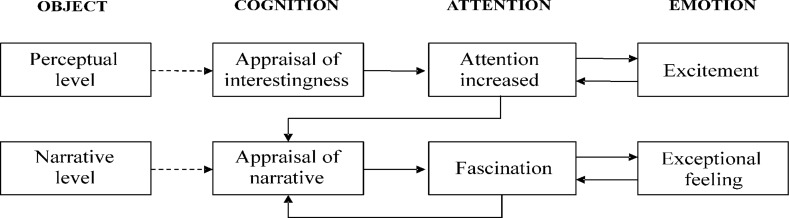
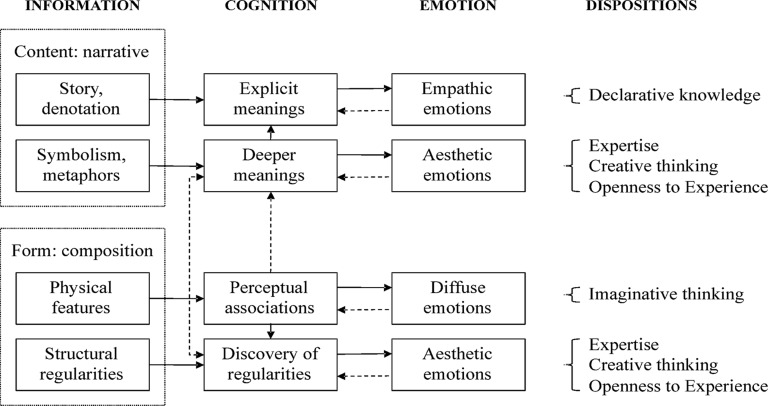
In this paper aesthetic experience is defined as an experience qualitatively different from everyday experience and similar to other exceptional states of mind. Three crucial characteristics of aesthetic experience are discussed: fascination with an aesthetic object (high arousal and attention), appraisal of the symbolic reality of an object (high cognitive engagement), and a strong feeling of unity with the object of aesthetic fascination and aesthetic appraisal. In a proposed model, two parallel levels of aesthetic information processing are proposed. On the first level two sub-levels of narrative are processed, story (theme) and symbolism (deeper meanings). The second level includes two sub-levels, perceptual associations (implicit meanings of object's physical features) and detection of compositional regularities. Two sub-levels are defined as crucial for aesthetic experience, appraisal of symbolism and compositional regularities. These sub-levels require some specific cognitive and personality dispositions, such as expertise, creative thinking, and openness to experience. Finally, feedback of emotional processing is included in our model: appraisals of everyday emotions are specified as a matter of narrative content (eg, empathy with characters), whereas the aesthetic emotion is defined as an affective evaluation in the process of symbolism appraisal or the detection of compositional regularities.
Overview
The claims and statistics of this paper haven’t been checked yet.
Free: it reads the open-access text and checks the first 5 claims that cite a source we can check. Create a free account to check every claim.
Integrity signals
Registry
Cites
Statistics
Figures
Verification
Claims the paper makes
The claims and statistics of this paper haven’t been checked yet.
Free: it reads the open-access text and checks the first 5 claims that cite a source we can check. Create a free account to check every claim.
Claims other papers make about this one
Each is checked against this paper’s own text: does it say what the citing paper says it does?
The source backs part of the claim, not all of it — or backs it for a different population, condition or comparison.
In the citing paper
“Empirical studies on visual [31], auditory [42] and haptic aesthetic experiences [57] [8] all converge in intertwining perception with embodied cognition.”
From Crafting Critical Heritage Discourses into Interactive Exhibition Design (2020) · cites this paper as [31]
Experimental — accuracy not yet measuredThe cited source says what the claim attributes to it.
In the citing paper
“The aesthetic experience is not the experience of beauty -for it can be pleasant or unpleasant; it is characterized by intense attention, extended cognitive engagement, and affective responses [31].”
From Crafting Critical Heritage Discourses into Interactive Exhibition Design (2020) · cites this paper as [31]
Self-check
Percentages, sums and reported differences re-computed from the paper’s own numbers.
The self-check needs the paper’s full text.
Citations
Cites
Well-being : the foundations of hedonic psychology
Kahneman, D. J., Diener, E. F., & Schwarz, N. (1999) · Cited by 8,305
The fusiform face area: a module in human extrastriate cortex specialized for face perception
Kanwisher, N., McDermott, J., & Chun, M. M. (1997) · The Journal of Neuroscience · doi:10.1523/jneurosci.17-11-04302.1997 · Cited by 7,738
Maslow, A. (1962) · D Van Nostrand eBooks · doi:10.1037/10793-000 · Cited by 7,192
Journal of Consciousness Studies
(2022) · Journal of Consciousness Studies · doi:10.53765/20512201 · Cited by 6,832
Csíkszentmihályi, M. (1975) · Cited by 5,690
What are emotions? And how can they be measured?
Scherer, K. R. (2005) · Social Science Information · doi:10.1177/0539018405058216 · Cited by 4,264 · cited 1×
“Koestler (1970) put aesthetic experience in the framework of creative processes emerging in art, science, humour, and playing.”
BackgroundFlow: The Psychology of Optimal Experience
Mirvis, P. H., & Csikszentmihalyi, M. (1991) · The Academy of Management Review · doi:10.2307/258925 · Cited by 3,611
Mood and judgment: The affect infusion model (AIM).
Forgas, J. P. (1995) · Psychological Bulletin · doi:10.1037/0033-2909.117.1.39 · Cited by 3,470 · cited 2×
“W J Cupchik G C, Gebotys R J, 1990 “Interest and pleasure as dimensions of aesthetic response” Empirical Studies of the Arts 8 1–14 J Cupchik G C, Vartanian O, Crawley A, Mikulis D J, 2009 “Viewing artworks: Contributions of cognitive control and perceptual facilitation to aesthetic experience” Brain and Cognition 70…”
InfluentialDynamic predictions: Oscillations and synchrony in top–down processing
Engel, A. K., Fries, P., & Singer, W. (2001) · Nature Reviews Neuroscience · doi:10.1038/35094565 · Cited by 3,454 · cited 1×
“However, other studies suggested that consciousness is not concentrated at local brain regions but is associated with globally distributed networks across a large scale of neuronal groups (cf Baars 2002; Engel et al 2001; Freeman 1991; Kanwisher 2001; Rees 2001a; Tononi and Edelman 1998; Watt 2004).”
BackgroundStory and Discourse: Narrative Structure in Fiction and Film
Austin, T. R., & Chatman, S. (1979) · The Journal of Aesthetics and Art Criticism · doi:10.2307/430732 · Cited by 2,658
Research works printed but not linked: 15
- Arnheim R 1980 Visual thinking Berkeley and Los Angeles University of California Press
- Brooks C Warren R P 1979 Modern rhetoric New York Harcourt Brace Jovanovich
- Eco U 2004 History of beauty Rizzoli International Publications
- Eco U 2007 On ugliness Rizzoli International Publications
- Frijda N H 1986 The emotions Cambridge Cambridge University Press
- Gardner H 1993 Creating minds New York Basic Books
- Gombrich E H 1969 Art and illusion Princeton New Jersey Princeton University Press
- Janković D Marković S 2001 Takete—Maluma phenomenon Perception 30 29
- Kabat-Zinn J 1998 Meditation Psycho-oncology New York Oxford University Press
- Koestler A 1970 The act of creation London Pan Books
- Marković S Janković D 2001 Implicit and explicit features of visual Gestalten Perception 30 30
- Marković S Janković D Subotić I 2002 Implicitna i eksplicitna svojstva vizuelnog gestalt [Implicit and explicit features of visual Gestalt] Psihološka istraživanja 11/ 12 75 112
- Neperud R W 1989 The relationship of art training and sex differences to aesthetic valuing Visual Arts Research 12 1 9
- Ognjenović P 1997 Psihološka teorija umetnosti [Psychological theory of art] Belgrade Institut za psihologiju
- Sternberg R J Lubart T I 1995 Defying the crowd New York Free Press
Cited by
Items 201–300 of 345
Learning and experience: Aesthetics of multimodal texts in Higher Education
Garrido, J. D. R., Hernández-León, E., Sandoval, B. F., & Aillon-Newman, M. (2018) · Digital Education Review · doi:10.1344/der.2018.33.170-184 · Cited by 2
“A more intense focus on the contemplated object, with the impression that it transcends time and space, with the added sensation that, although familiar, that object has become strange to the observer (estrangement), in addition to changes in the emotional state: these are a few of the characteristic traits of the aes…”
BackgroundInfluentialFrega, A. L., & Murata, C. (2018) · Revista de Psicología · doi:10.24215/2422572xe013 · Cited by 2
Illustration as a Visual Communication Culturel Product Aesthetic Line in Visual Representation
Demir, T. (2020) · Advances in media, entertainment and the arts (AMEA) book series · doi:10.4018/978-1-7998-4655-0.ch007 · Cited by 2
Aesthetic Intelligence and Aesthetic Experience in Children
Lilly, K. V., & Venukapalli, S. (2020) · International Journal of Education (IJE) · doi:10.5121/ije.2020.8404 · Cited by 4
The Effects of Psychotic Tendencies on Aesthetic Preferences of Paintings
Stojilović, I. Z. (2022) · Empirical Studies of the Arts · doi:10.1177/02762374221143723 · Cited by 2
“Conditions similar to Enhanced Awareness states have previously been described as “Object and I for myself” (Ognjenovic, 2003), absorption (Tellegen & Atkinson, 1974), peak experience (Maslow, 1971), flow (Csikszentmihalyi, 1997), aesthetic experience (Funch, 1997; Marković, 2012) and “exceptional state of mind” (Pelo…”
BackgroundInfluentialThe Cognitive Value of Aesthetic Emotions
Consoli, G. (2022) · Art & Perception · doi:10.1163/22134913-bja10040 · Cited by 3
Aesthetic Experience in Theatre in Non-Formal Education: a Review of Creativity Theory
Dalila, S., Yanuartuti, S., & Sabri, I. (2023) · JURNAL KREATIVITAS PENGABDIAN KEPADA MASYARAKAT (PKM) · doi:10.33024/jkpm.v6i7.10002 · Cited by 2
“In early definitions of aesthetic experience and similar phenomena, three characteristics could be identified as important and distinctive (Marković, 2012).”
BackgroundGray, R. H. (2017) · D-Scholarship@Pitt (University of Pittsburgh) · Cited by 3
Abstract Shape Aesthetics: Contour, Complexity, Motion, and Individual Variability
Soranzo, A., Bertacchini, F., & Bertamini, M. (2024) · Art & Perception · doi:10.1163/22134913-bja10057 · Cited by 4
“It is known that aesthetics is positively correlated with arousal (Marković, 2012).”
BackgroundBaumbach, S. (2022) · Routledge eBooks · doi:10.4324/9780367809843-13 · Cited by 1
Piecychna, B. (2023) · Studies in Logic Grammar and Rhetoric · doi:10.2478/slgr-2023-0009 · Cited by 1
The aesthetic experience of general beauty and ugly-cute memes: the role of emotion
Li, J., An, Y., & Xia, T. (2024) · Frontiers in Psychology · doi:10.3389/fpsyg.2024.1340552 · Cited by 2
“The complete aesthetic response involves perceptual processing, cognitive evaluation, cultural knowledge, and emotions such as pleasure or surprise (Leder et al., 2004; Marković, 2012).”
BackgroundJovanović, O., Dimitrijević, A. A., Mutavdžin, D., & Bogunović, B. (2024) · Open Book Publishers · doi:10.11647/obp.0389 · Cited by 12
Watanuki, S. (2025) · Frontiers in Neuroscience · doi:10.3389/fnins.2024.1443578 · Cited by 3
Museum Education in the Digital Age: The Impact of Digitisation on the Aesthetic Experience
Ya, G. (2025) · International Journal of Education and Humanities · doi:10.54097/apxfge36 · Cited by 4
Blanco, Á. D., Kroupi, E., Soria‐Frisch, A., Gazzaley, A. H., Anadol, R., Maiques, A., & Ruffini, G. (2025) · The Arts in Psychotherapy · doi:10.1016/j.aip.2025.102347 · Cited by 4
Narrative transportation cues in direct-to-consumer advertisements: an analysis of visual content
Montgomery, S. L. (2025) · Frontiers in Communication · doi:10.3389/fcomm.2025.1474051 · Cited by 2
“These experiences are communicated through the discourse of a story, which includes emotional appeals, aesthetic experience (engagement through emotional expression), and the objects and places represented (Cohn, 2013; Markovi´c, 2012).”
Şen, G. (2025) · International Journal of Human-Computer Interaction · doi:10.1080/10447318.2025.2543557 · Cited by 1
Moral beauty, natural beauty, and artistic beauty cause self-transcendent emotions
Mattheiss, S. R., Zabihian, S., & Diessner, R. (2025) · Journal of Moral Education · doi:10.1080/03057240.2025.2588303 · Cited by 4
Kähler, S. T., Luna‐Rodriguez, A., & Jacobsen, T. (2026) · Results in Engineering · doi:10.1016/j.rineng.2026.109599 · Cited by 1
Embodied neuroaesthetics and the psychotherapeutic relational field
Vaisvaser, S. (2026) · Frontiers in Psychology · doi:10.3389/fpsyg.2026.1759744 · Cited by 5
“…or “fas-cination,” are savored for their own sake, linked with subjectively felt intensity, or rewarding emotional arousal (Fuchs et al., 2014; Koch, 2020; Marković, 2012; Menninghaus et al., 2019; Zickfeld et al., 2019), which may foster the processing of a broad repertoire of both positively…”
Taherysayah, F., Westermann, C., Liang, H., Marinovic, W., Sayah, F. T., Wu, H., & Li, Z. (2026) · She ji · doi:10.1016/j.sheji.2026.02.002 · Cited by 1
From real to sur-real: Rethinking authenticity in the tourism experience
Zhang, Q., Hu, J., Han, Y. F., Miao, L., & Yang, F. X. (2026) · Annals of Tourism Research · doi:10.1016/j.annals.2026.104269 · Cited by 1
Evaluating and documenting affect in the art museum
Canning, E. (2018) · Digital Heritage International Congress · doi:10.1109/digitalheritage.2018.8810096 · Cited by 1
Beauty in everyday motion: Electrophysiological correlates of aesthetic preference for human walking
Hayashi, S., Nishimura, Y., Ikeda, Y., Nakashima, H., Egashira, Y., Ukezono, M. M., Uono, S., Okada, T., & Higuchi, S. (2022) · Neuropsychologia · doi:10.1016/j.neuropsychologia.2022.108232 · Cited by 2
WORKSHEET: REMEDIAL MATERIALS IN TEACHING MATHEMATICS 10
EMBALLA, R. O. (2022) · International Journal of Research Publications · doi:10.47119/ijrp1001061820223752 · Cited by 1
The Place of Action in the Landscape of Aesthetic Experience
Charles, D. R. (2023) · Open Philosophy · doi:10.1515/opphil-2022-0264 · Cited by 1
Exploring the Influence of Aesthetic interaction using Personal Information Devices at Work
Nam, H., Kim, J., Park, C., & Kim, C. (2023) · International Association of Societies of Design Research Congress (IASDR) · doi:10.21606/iasdr.2023.861 · Cited by 1
Benefit as a Standard Unit of Measure for Arts Organizations: A Conceptual Analysis
Keeney, K. P., & DeVereaux, C. (2023) · Culture and Local Governance · doi:10.18192/clg-cgl.v8i1.6663 · Cited by 1
Rani, N. A., Hashim, M. E. A., Mustafa, W. A., Idris, M. Z., Al‐Jawahry, H. M., & Ramadan, G. M. (2023) · International Conference on Mobile Networks and Wireless Communications (ICMNWC) · doi:10.1109/icmnwc60182.2023.10435812 · Cited by 1
“Nevertheless, to attain both immersive and aesthetic experiences will lead to measuring user’s sense of presence [6], appraisal [7], and appreciation [3] especially for historical-based virtual environment.”
BackgroundOn the nature, uses and functions of imagination in education: A multidisciplinary approach
Gelmi, A. (2024) · Educational Philosophy and Theory · doi:10.1080/00131857.2024.2376635 · Cited by 3
“…in attentional focus, and a sense of loss of time; aesthetic appraisal or cognitive engagement which allows one to transcend generic uses of meaning; aesthetic emotions which give rise to feelings of unity and connectedness with the object of aesthetic fascination and appraisal (Marković, 2012).”
The Emotional Impact of Aesthetic Appreciation on Individual and Collective Well-being
Vanderheiden, E. (2025) · Springer eBooks · doi:10.1007/978-3-031-86449-0_15 · Cited by 6
Rani, N. A., Hashim, M. E. A., Idris, M. Z., & Wibawanto, W. (2025) · Progress in Computers and Learning · doi:10.37934/picl.4.1.1839 · Cited by 1
Limites da experiência estética
Anchieta, W. (2019) · Significação Revista de Cultura Audiovisual · doi:10.11606/issn.2316-7114.sig.2019.150259 · Cited by 1
The Relationship between Knowledge about the Artist’s Mental Illness and Artwork Reception
Tofilski, M., & Stawski, F. (2019) · Psych · doi:10.3390/psych1010007 · Cited by 1
“The reception of art is a complex, multistage, and multifaceted process, ranging from perception, which is different to being in contact with a typical object (Marković 2012 [1]; Klawiter and Wiener 2015 [2]), to conscious evaluation.”
BackgroundРычкова, С. И., Сандимиров, Р. И., & Kosobutskaya, L. V. (2019) · Human Physiology · doi:10.1134/s0362119719050165 · Cited by 1
Exploring the Landscape of Emotion in Aesthetic Experience
Cupchik, G. C. (2020) · Oxford University Press eBooks · doi:10.1093/oxfordhb/9780198824350.013.6 · Cited by 1
Sfyris, P., & Doukakis, S. (2021) · Journal of Education Teaching and Social Studies · doi:10.22158/jetss.v3n2p27 · Cited by 1
“According to modern research, art and specifically aesthetic 28 Published by SCHOLINK INC. knowledge (Marković, 2012).”
MethodPercepciones y actitudes ambientales de los usuarios del Mercado Alianza en Torreón, México.
Luna, J. B., & Suárez, L. A. D. L. F. (2022) · CONTEXTO Revista de la Facultad de Arquitectura de la Universidad Autónoma de Nuevo León · doi:10.29105/contexto16.24-367 · Cited by 1
“Es destacable que la satisfacción de necesidades corporales como la alimentación, tampoco es una experiencia estética, pues esta última se relaciona con los placeres de la mente (Markovic 2012).”
BackgroundInfluentialLidegaard, C., Bille, T., & Baldin, A. (2022) · The Journal of Arts Management Law and Society · doi:10.1080/10632921.2022.2102557 · Cited by 1
“In developing a model on esthetic information processing, Marković (2012) has examined the components of art experience and identifies three crucial and distinctive characteristics of art experiences: (1) the attention aspect, (2) the cognitive aspect, and (3) the affective aspect.”
MethodCONSTITUIÇÃO IDENTITÁRIA DOCENTE EM DRAMATIZAÇÃO: DINÂMICA DOS POSICIONAMENTOS EM CONFLITO
Araújo, P. C., & Borges, F. T. (2022) · Psicologia em Estudo · doi:10.4025/psicolestud.v28i0.49085 · Cited by 1
García, M. R. C. (2022) · AUS · doi:10.4206/aus.2022.n32-12 · Cited by 1
From photographers to viewers – what makes editorial photos interesting?
Halonen, R. (2014) · Aaltodoc (Aalto University) · Cited by 3
Mapping urban residents’ place attachment to historic environments: a case study of Edinburgh
Wang, Y. (2021) · Enlighten: Theses (The University of Glasgow) · doi:10.5525/gla.thesis.82345 · Cited by 5
Kim, H. C., & Kim, H.-G. (2016) · International Journal of Software Engineering and Its Applications · doi:10.14257/ijseia.2016.10.4.06
“"They lose their self-consciousness, the awareness of the surrounding environment, and the sense of time [6]" With the temporal aspect of the interactive experience in mind, artists/designers can program temporal elements within their work to increase time spent with the work, in order to augment…”
BackgroundThe neglected emotion of interest and its relevance to consumer psychology
Sung, B. (2016) · The University of Queensland · doi:10.14264/uql.2016.97
Haslwanter, C. (2017) · Springer eBooks · doi:10.1007/978-3-658-17254-1_13
The How or the What : The Impact of Narrative Style on Empathy
Öhberg, A., & Paul, K. (2017) · KTH Publication Database DiVA (KTH Royal Institute of Technology)
Görsel İletişim Tasarımında Estetik Deneyim ve İlk İzlenimin Önemi
Ertürk, M. (2018) · Idil Journal of Art and Language · doi:10.7816/idil-07-41-08
Sotiropoulou-Zormpala, M. (2019) · Springer eBooks · doi:10.1007/978-981-13-8993-1_8
Conclusion: Evidences of Artistic Thinking in the Schools
Costes-Onishi, P. (2019) · Springer eBooks · doi:10.1007/978-981-13-8993-1_16
KIRYAMAN, A. G. E. (2019) · International Journal of Interdisciplinary and Intercultural Art · doi:10.29228/ijiia.7.74
“That is why “ aesthetic experience can be defined as a special state of mind that is qualitatively different from the everyday experience ” (Marković, 2012, p. 1).”
Implicit Measures in the Aesthetic Domain
Palumbo, L. (2019) · Oxford University Press eBooks · doi:10.1093/oxfordhb/9780198824350.013.11
The Experience of Integrative Functional Beauty as Design Aesthetics
Oh, B., & Oh, B. (2019) · Archives of Design Research · doi:10.15187/adr.2019.11.32.4.163
K PROBLEMATIKE GEOMETRIZOVANIA KRÁSY A ESTETICKÝCH POJMOV
Démuth, A. (2020) · Filozofia · doi:10.31577/filozofia.2020.75.2.4
Al-Annoz, E. (2020) · Journal Port Science Research · doi:10.36371/port.2020.3.1
“Aesthetic preference is among the components of aesthetic experience to develop individual attitudes and tendencies through Tasting it for artistic works from this standpoint [2].”
BackgroundMovaghati, S. (2020) · Rupkatha Journal on Interdisciplinary Studies in Humanities · doi:10.21659/rupkatha.v12n4.27
“In this mental state, a person is fascinated with a particular object, whereas the surrounding environment is shadowed,” and “self-awareness is reduced” (Marković, 2012, p.12).”
BackgroundAESTHETICS, SEMIOTICS AND ILLUSTRATIVE ANALYSIS OF YORUBA CULTURAL MOTIFS
Azeem, B. O., & Philip, A. O. (2021) · International journal of advance research and innovative ideas in education
EXPERIMENTAL AESTHETICS AND AESTHETIC EMOTIONS:REVIEW OF THE TRENDS IN THE WEST
Shestova, M. (2021) · Вестник Московского государственного областного университета · doi:10.18384/2310-7235-2021-1-47-54 · Cited by 1
Muzejska medijacija umjetnosti u ,,bijeloj kocki”
Miklošević, Ž. (2021) · Život umjetnosti · doi:10.31664/zu.2021.108.03
La experiencia estética y la recreación cerebral
Gómez, J. L. D. (2020) · Mente y Cultura · doi:10.17711/myc.2020.010
Pinney, J., & Carroll, F. (2022) · Lecture notes in computer science · doi:10.1007/978-3-031-06424-1_27
The Asian Conference on Ethics, Religion & Philosophy 2022 Official Conference Proceedings
(2022) · Asian Conference on Ethics, Religion and Philosophy official conference proceedings · doi:10.22492/issn.2187-476x.2022 · Cited by 1
PLAGUE AND PESTILENCE IN THE EARLY ISLAMIC LITERATURE VIEWED FROM A CULTURAL RESILIENCE FRAMEWORK
Muna, N., Nurhamidah, I., & Idriz, M. (2022) · Jurnal Lektur Keagamaan · doi:10.31291/jlka.v20i2.1092
Aesthetics Education and Literacies
Barton, G. M. (2023) · Springer briefs in education · doi:10.1007/978-981-19-7750-3_3
Argue Position on Whether Aesthetic Experience can be Scientifically Measured
Liu, X. (2023) · Research in Health Science · doi:10.22158/rhs.v8n1p56
In What Ways Can We Have Positive Responses to Evil Characters in Film?
Guo, Y. P. (2023) · International Journal of Social Science and Humanity · doi:10.18178/ijssh.2023.v13.1126
Güzel Sanatlar Eğitimi Bölümü Öğrencilerinin Estetik Kavramına İlişkin Metaforik Algıları
ÇETİNKAYA, P. R. (2023) · Gazi Üniversitesi Gazi Eğitim Fakültesi Dergisi · doi:10.17152/gefad.1185243
THE EFFECT OF AESTHETIC EXPERIENCE ON SATISFACTION AND BEHAVIORAL INTENTION: THE CASE OF KASTAMONU
Şimşek, A. (2023) · Çatalhöyük Uluslararası Turizm ve Sosyal Araştırmalar Dergisi · doi:10.58455/cutsad.1236183 · Cited by 1
Güncel Sanatta Estetik Deneyim ve Oyun
Uçar, M. (2023) · Art-e Sanat Dergisi · doi:10.21602/sduarte.1258715
In What Ways Can We Have Positive Responses to Evil Characters in Film?
Guo, Y. P. (2023) · International Journal of Social Science and Humanity · doi:10.18178/ijssh.2023.v13.1151
Aesthetic Engagement as a Pathway to Mental Health and Well-being
Hughes, E., & Berleant, A. (2023) · Oxford University Press eBooks · doi:10.1093/oxfordhb/9780192866929.013.12
DYNAMIC MODEL OF AESTHETIC PERCEPTION
Yaskevych, O., Turetska, K. I., Kechur, R., & Bychkovska, O. N. (2023) · Habitus · doi:10.32782/2663-5208.2023.52.35
Developing Clinician Insight into Practice Through the Aesthetic Lens
Younie, L. (2023) · Oxford University Press eBooks · doi:10.1093/oxfordhb/9780192866929.013.58
Affect-Space Framework를 이용한 대학생의 음악감상에서의 미적 경험 분석
배, 수., & 배, 수. (2023) · 음악교육연구 · doi:10.30775/kmes.52.4.67 · Cited by 1
Towards an aesthetics of grammar learning: lifting the veil on language
Ainsworth, S., & Bell, H. (2024) · Frontiers in Education · doi:10.3389/feduc.2023.1305532 · Cited by 1
“Similarly, Marković (2012) notes that the creation of ‘virtual reality’ is a key characteristic of aesthetic experience.”
The Aesthetic Experience of Dance in People Living with Psychotic Illness
Pracana, C., & Wang, M. (2024) · doi:10.36315/2024padix07
Korean Music Education Society, & Kim, S. (2024) · 음악교육연구 · doi:10.30775/kmes.53.1.25
Sanatta Estetik Deneyime Yönelik Bir Süreç Tasarım Modeli: Estetik Bilişselcilik
Laçinbay, K. (2024) · Art Vision · doi:10.32547/artvision.1446722
The social, political, and aesthetic implications of disgust
Karinen, A. K. (2024) · doi:10.5463/thesis.551
Aesthetic Value in Marketing Art Gallery: Conceptualization and Scale Development
Subiharto, J., Dharmmesta, B. S., Sutikno, B., & Siswomihardjo, S. W. (2024) · Jurnal Dinamika Manajemen · doi:10.15294/jdm.v15i1.49361 · Cited by 2
Robinson, C. R., & Keown, D. J. (2024) · Psychology of Music · doi:10.1177/03057356241250316
“Markovic (2012) proposed three definitions of aesthetic experience.”
(2024) · Journal of System and Management Sciences · doi:10.33168/jsms.2024.1116 · Cited by 2
“During this state of intense concentration, the audience becomes deeply engrossed in a particular object, leading to a diminished sense of self, a detachment from the surrounding environment, and a distortion of temporal concepts, akin to psychological states such as mental flow (Marković, 2012).”
2. The Role of Affective Dimensions in the Aesthetic Experience of Music
Janković, D., & Mađarev, M. (2024) · Open Book Publishers · doi:10.11647/obp.0389.02
Environmental Ethics in Foreign Language Teaching: an Eco-social Aesthetics Multimodality Dimension
Володимирівна, К. А., Savchenko, N., Shamaieva, I., & Sanjayan, T. (2024) · The Journal of V N Karazin Kharkiv National University Series Foreign Philology Methods of Foreign Language Teaching · doi:10.26565/2786-5312-2024-99-15
Object and Subject Approaches in the Psychology of Art Perception: A Review of Empirical Research
Leonova, A. V. (2025) · Journal of Modern Foreign Psychology · doi:10.17759/jmfp.2025140102
Expressive characteristics of fashion design through sensory experiences
Shin, H.-R., & Yum, M. (2025) · The Research Journal of the Costume Culture · doi:10.29049/rjcc.2025.33.1.61
Designing Fractal Expressions for Immersive Aesthetic Experiences
Gerhardt, E., Geiger, C., & Säger, M. (2025) · IEEE Conference on Virtual Reality and 3D User Interfaces Abstracts and Workshops (VRW) · doi:10.1109/vrw66409.2025.00466
“Marković [2] argues that there is a broad consensus that aesthetic experience is a state of mind that is qualitatively different from everyday experience and is considered to be a psychological process in which attention is focused on one entity and all other entities are relegated to the…”
Sadarić, A., Knoop, C.-I., & Škerlavaj, M. (2025) · Springer eBooks · doi:10.1007/978-3-031-76902-3_18
Lin, Y., de Beeck, H. O., & Wagemans, J. P. (2025) · PsyArXiv (OSF Preprints) · doi:10.31234/osf.io/gf3k8_v3
The Human AffectomePreprint
Schiller, D., Yu, A. N. C., Alia‐Klein, N., Becker, S., Cromwell, H. C., Dolcos, F., Eslinger, P. J., Frewen, P., Kemp, A. H., Pace-Schott, E. F., et al. (2022) · PsyArXiv (OSF Preprints) · doi:10.31234/osf.io/9nu32_v1 · Cited by 5
Ismael Quiles y el diálogo interreligioso e intercultural como experiencia estética
Taddeo, R. H. (2025) · TSN Transatlantic Studies Network · doi:10.24310/tsn.18.2025.21360
Metadata
- Authors
- Marković, S.
- Affiliations
- University of Belgrade (RS)
- Corresponding author
- Marković, Slobodan
- ORCID
- Marković, Slobodan
- Venue
- i-Perception
- Publisher
- SAGE Publications
- Published
- 2012-01
- Volume
- 3
- Issue
- 1
- Pages
- 1-17
- ISSN
- 2041-6695 (ISSN-L)
- PMC
- PMC3485814
- OpenAlex
- W2096535767
- Cited by
- 346
- References
- 102
- Citations by year
- 2026: 28 · 2025: 42 · 2024: 34 · 2023: 40 · 2022: 49 · 2021: 39 · 2020: 16 · 2019: 21 · 2018: 23 · 2017: 18 · 2016: 12 · 2015: 12 · 2014: 7 · 2013: 2 · 2012: 3
- FWCI
- 3.93
- Type
- journal article
- Language
- en
- Open access
- gold
- doi.org
- Licence
- cc-by-nc-nd
- journals.sagepub.com/page/policies/text-and-data-mining-license (tdm)
- Locations
- i-Perception (publishedVersion, cc-by-nc-nd)
- Europe PMC (PubMed Central) (publishedVersion, cc-by-nc-nd)
- PubMed Central (publishedVersion, cc-by-nc-nd)
- PubMed (publishedVersion)
- DOAJ (DOAJ: Directory of Open Access Journals) (submittedVersion, cc-by-sa)
- Topics
- Life Sciences › Neuroscience › Cognitive Neuroscience › Aesthetic Perception and Analysis
- Social Sciences › Arts and Humanities › Philosophy › Ethics, Aesthetics, and Art
- Social Sciences › Arts and Humanities › Visual Arts and Performing Arts › Art, Aesthetics, and Perception
- Keywords
- aesthetic experience, aesthetic appreciation, symbolism, narrative, emotional processing, expertise, creative thinking, openness to experience, empathy, affective evaluation
About these checks
Registry, retraction, Cites and statistics results are computed, not judged, with one exception: a printed reference that no index lists is read once by a model before it counts as a citation error. Claims are extracted by a model and kept only when their quote appears verbatim in the text; each cited source is then checked, with a model’s help, for whether it says what the claim relies on. Those verdicts can be wrong — read the claim’s quote and the cited source before relying on one.
Statistics and arithmetic are recomputed, not judged.
Confidence bands are shown only for fields calibrated on our annotated test set. None is calibrated yet, so no band is shown.
What counts as a claim ›How we measure confidence ›How we check this ›
Are you an author, or do you see a problem with this page? Request a review
Data sources
Bibliographic data: Semantic Scholar, OpenAlex, Crossref.
Contains information from the Semantic Scholar Academic Graph Datasets, made available under the ODC Attribution License (ODC-BY 1.0).
Semantic Scholar’s data is described in: Kinney, R., et al. (2023). The Semantic Scholar Open Data Platform. arXiv:2301.10140.
