

Components of Aesthetic Experience: Aesthetic Fascination, Aesthetic Appraisal, and Aesthetic Emotion
Open accessThe DOI matches its Crossref record; 103 of the 103 references it cites were found in a registry or an index.
Abstract
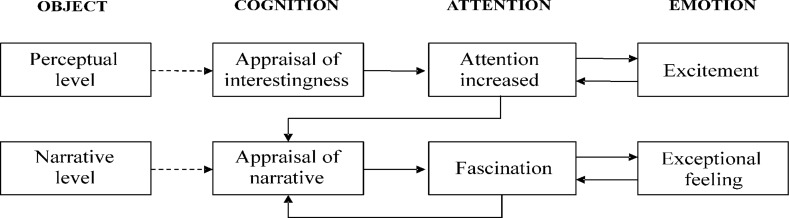
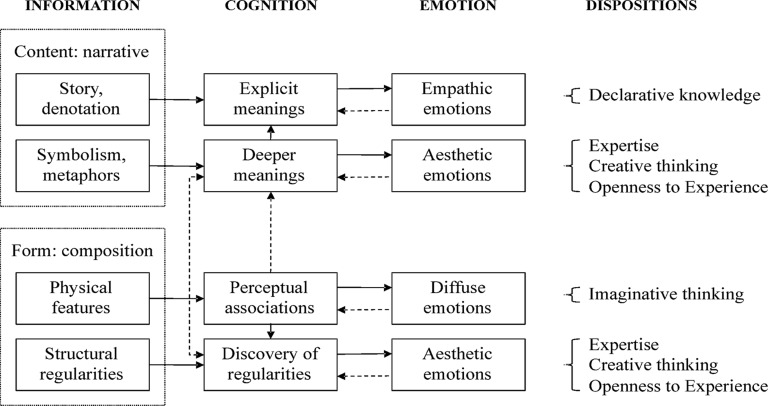
In this paper aesthetic experience is defined as an experience qualitatively different from everyday experience and similar to other exceptional states of mind. Three crucial characteristics of aesthetic experience are discussed: fascination with an aesthetic object (high arousal and attention), appraisal of the symbolic reality of an object (high cognitive engagement), and a strong feeling of unity with the object of aesthetic fascination and aesthetic appraisal. In a proposed model, two parallel levels of aesthetic information processing are proposed. On the first level two sub-levels of narrative are processed, story (theme) and symbolism (deeper meanings). The second level includes two sub-levels, perceptual associations (implicit meanings of object's physical features) and detection of compositional regularities. Two sub-levels are defined as crucial for aesthetic experience, appraisal of symbolism and compositional regularities. These sub-levels require some specific cognitive and personality dispositions, such as expertise, creative thinking, and openness to experience. Finally, feedback of emotional processing is included in our model: appraisals of everyday emotions are specified as a matter of narrative content (eg, empathy with characters), whereas the aesthetic emotion is defined as an affective evaluation in the process of symbolism appraisal or the detection of compositional regularities.
Overview
The claims and statistics of this paper haven’t been checked yet.
Free: it reads the open-access text and checks the first 5 claims that cite a source we can check. Create a free account to check every claim.
Integrity signals
Registry
Cites
Statistics
Figures
Verification
Claims the paper makes
The claims and statistics of this paper haven’t been checked yet.
Free: it reads the open-access text and checks the first 5 claims that cite a source we can check. Create a free account to check every claim.
Claims other papers make about this one
Each is checked against this paper’s own text: does it say what the citing paper says it does?
The source backs part of the claim, not all of it — or backs it for a different population, condition or comparison.
In the citing paper
“Empirical studies on visual [31], auditory [42] and haptic aesthetic experiences [57] [8] all converge in intertwining perception with embodied cognition.”
From Crafting Critical Heritage Discourses into Interactive Exhibition Design (2020) · cites this paper as [31]
Experimental — accuracy not yet measuredThe cited source says what the claim attributes to it.
In the citing paper
“The aesthetic experience is not the experience of beauty -for it can be pleasant or unpleasant; it is characterized by intense attention, extended cognitive engagement, and affective responses [31].”
From Crafting Critical Heritage Discourses into Interactive Exhibition Design (2020) · cites this paper as [31]
Self-check
Percentages, sums and reported differences re-computed from the paper’s own numbers.
The self-check needs the paper’s full text.
Citations
Cites
Well-being : the foundations of hedonic psychology
Kahneman, D. J., Diener, E. F., & Schwarz, N. (1999) · Cited by 8,305
The fusiform face area: a module in human extrastriate cortex specialized for face perception
Kanwisher, N., McDermott, J., & Chun, M. M. (1997) · The Journal of Neuroscience · doi:10.1523/jneurosci.17-11-04302.1997 · Cited by 7,738
Maslow, A. (1962) · D Van Nostrand eBooks · doi:10.1037/10793-000 · Cited by 7,192
Journal of Consciousness Studies
(2022) · Journal of Consciousness Studies · doi:10.53765/20512201 · Cited by 6,832
Csíkszentmihályi, M. (1975) · Cited by 5,690
What are emotions? And how can they be measured?
Scherer, K. R. (2005) · Social Science Information · doi:10.1177/0539018405058216 · Cited by 4,264 · cited 1×
“Koestler (1970) put aesthetic experience in the framework of creative processes emerging in art, science, humour, and playing.”
BackgroundFlow: The Psychology of Optimal Experience
Mirvis, P. H., & Csikszentmihalyi, M. (1991) · The Academy of Management Review · doi:10.2307/258925 · Cited by 3,611
Mood and judgment: The affect infusion model (AIM).
Forgas, J. P. (1995) · Psychological Bulletin · doi:10.1037/0033-2909.117.1.39 · Cited by 3,470 · cited 2×
“W J Cupchik G C, Gebotys R J, 1990 “Interest and pleasure as dimensions of aesthetic response” Empirical Studies of the Arts 8 1–14 J Cupchik G C, Vartanian O, Crawley A, Mikulis D J, 2009 “Viewing artworks: Contributions of cognitive control and perceptual facilitation to aesthetic experience” Brain and Cognition 70…”
InfluentialDynamic predictions: Oscillations and synchrony in top–down processing
Engel, A. K., Fries, P., & Singer, W. (2001) · Nature Reviews Neuroscience · doi:10.1038/35094565 · Cited by 3,454 · cited 1×
“However, other studies suggested that consciousness is not concentrated at local brain regions but is associated with globally distributed networks across a large scale of neuronal groups (cf Baars 2002; Engel et al 2001; Freeman 1991; Kanwisher 2001; Rees 2001a; Tononi and Edelman 1998; Watt 2004).”
BackgroundStory and Discourse: Narrative Structure in Fiction and Film
Austin, T. R., & Chatman, S. (1979) · The Journal of Aesthetics and Art Criticism · doi:10.2307/430732 · Cited by 2,658
Research works printed but not linked: 15
- Arnheim R 1980 Visual thinking Berkeley and Los Angeles University of California Press
- Brooks C Warren R P 1979 Modern rhetoric New York Harcourt Brace Jovanovich
- Eco U 2004 History of beauty Rizzoli International Publications
- Eco U 2007 On ugliness Rizzoli International Publications
- Frijda N H 1986 The emotions Cambridge Cambridge University Press
- Gardner H 1993 Creating minds New York Basic Books
- Gombrich E H 1969 Art and illusion Princeton New Jersey Princeton University Press
- Janković D Marković S 2001 Takete—Maluma phenomenon Perception 30 29
- Kabat-Zinn J 1998 Meditation Psycho-oncology New York Oxford University Press
- Koestler A 1970 The act of creation London Pan Books
- Marković S Janković D 2001 Implicit and explicit features of visual Gestalten Perception 30 30
- Marković S Janković D Subotić I 2002 Implicitna i eksplicitna svojstva vizuelnog gestalt [Implicit and explicit features of visual Gestalt] Psihološka istraživanja 11/ 12 75 112
- Neperud R W 1989 The relationship of art training and sex differences to aesthetic valuing Visual Arts Research 12 1 9
- Ognjenović P 1997 Psihološka teorija umetnosti [Psychological theory of art] Belgrade Institut za psihologiju
- Sternberg R J Lubart T I 1995 Defying the crowd New York Free Press
Cited by
Items 301–345 of 345
Половые различия структурной организации фасцинации личности
Karpov, A. A., & Strel’tsova, M. A. (2025) · Vestnik Yaroslavskogo gosudarstvennogo universiteta im P G Demidova Seriya gumanitarnye nauki · doi:10.18255/1996-5648-2025-2-352-360
Emotion und die Strukturen der Musik
Blutner, R. (2025) · Springer eBooks · doi:10.1007/978-3-662-71771-4_10
Shestova, M., & Kozhukhar, K. A. (2025) · Experimental Psychology (Russia) · doi:10.17759/exppsy.2025180210
Stojilović, I. Z. (2025) · IntechOpen eBooks · doi:10.5772/intechopen.1011978 · Cited by 5
What Is It to Enjoy Observing the Growth of Crops or Aesthetics?
Tsunashima, H. (2025) · Urban agriculture · doi:10.1007/978-3-032-01598-3_5
Srinivas, T. (2025) · Duke University Press eBooks · doi:10.1215/9781478061502-004
Srinivas, T. (2025) · Duke University Press eBooks · doi:10.1215/9781478061502-003
(2025) · Duke University Press eBooks · doi:10.1215/9781478061502-002
(2025) · Duke University Press eBooks · doi:10.1215/9781478061502-001
Srinivas, T. (2025) · Duke University Press eBooks · doi:10.1215/9781478061502-012
Srinivas, T. (2025) · Duke University Press eBooks · doi:10.1215/9781478061502-007
Mirrors and Masks: An Anthropology of Beauty
Srinivas, T. (2025) · Duke University Press eBooks · doi:10.1215/9781478061502-009
Srinivas, T. (2025) · Duke University Press eBooks · doi:10.1215/9781478061502-006
Srinivas, T. (2025) · Duke University Press eBooks · doi:10.1215/9781478061502-011
Srinivas, T. (2025) · Duke University Press eBooks · doi:10.1215/9781478061502-010
Srinivas, T. (2025) · Duke University Press eBooks · doi:10.1215/9781478061502-005
Srinivas, T. (2025) · Duke University Press eBooks · doi:10.1215/9781478061502-008
Социальный самоконтроль в структуре фасцинативности личности
Strel’tsova, M. A. (2025) · Vestnik Yaroslavskogo gosudarstvennogo universiteta im P G Demidova Seriya gumanitarnye nauki · doi:10.18255/1996-5648-2025-3-536-543
Teachers’ Perspectives on Media Educational Practices in Elementary School Classrooms
Lahiji, A. (2015) · University Library - University of Saskatchewan (University of Saskatchewan) · Cited by 1
Zhao, N., Guo, H., & Pan, J. (2025) · Global Cases & Practices of Vocational Education · doi:10.64345/591638274
Wenhan, Z., Minjie, W., Xing, F., & Da, Z. (2025) · Research Square · doi:10.21203/rs.3.rs-8390644/v1
What can Adorno’s understanding of aesthetic experience offer for the health and medical humanities?
Rajala, A. I. (2025) · Medicine Health Care and Philosophy · doi:10.1007/s11019-025-10316-0
An Emotional A.I. Based Multi-Model for Affective Artificial Perception
Soualah, M. T., Saveh, F., Madani, K., & Amarger, V. (2025) · IEEE International Conference on Intelligent Data Acquisition and Advanced Computing Systems: Technology and Applications (IDAACS) · doi:10.1109/idaacs68557.2025.11322027
“Concerning aesthetic emotions, beyond their basic definition as the emotions that can arise when a human perceives and evaluates a stimulus for its aesthetic appeal or virtues, opinions on the precise characterization and range of aesthetic emotions diverge [9], [10].”
Differentiating Visual Usability from Aesthetics in Visual Experience
Silvennoinen, J. M., Kujala, T., & Haapakoski, M. (2026) · International Journal of Human-Computer Interaction · doi:10.1080/10447318.2026.2639826 · Cited by 3
Machine-Learning Based Artificial Affective Perception For Machines’ Emotional Awareness
Saveh, F., Soualah, M. T., Madani, K., Amarger, V., & Chebira, A. (2025) · IEEE International Conference on Advances in Data-Driven Analytics and Intelligent Systems (ADACIS) · doi:10.1109/adacis65663.2025.11437061
“Concerning aesthetic emotions, beyond their basic definition as the emotions that can arise when a human perceives and evaluates a stimulus for its aesthetic appeal or virtues, opinions on the precise characterization and range of aesthetic emotions diverge [9], [10].”
Moreira, A. J. F. (2021) · theses.fr (ABES) · doi:10.70675/eeb29b1fz5d56z436dz9b0dz51d1d927828f
Ryder, H., & Filgueiras, A. (2026) · The Arts in Psychotherapy · doi:10.1016/j.aip.2026.102475
Kunze, K., Xu, M., Peng, D., de Oliveira, L. O., Shao, R., Meng, X., Hoppe, M., & Barbareschi, G. (2026) · Augmented Humans International Conference (AHs) · doi:10.1145/3795011.3795056
“Aesthetic appraisal theories suggest that such phenomena arise from a mismatch between the perceived complexity of an artistic performance and the spectator’s self-assessed understanding of it [34, 47, 48].”
A Yogic Neuroscience Framework of Aesthetic Experiences
Eesha, Sharma, G., & Kumar, J. (2026) · Studies in Rhythm Engineering · doi:10.1007/978-3-032-21704-2_6
The imaginary intervention: a conceptual framework for applied imagination in public health
Pressman, C. S., Fischer, A., Wylie, R., & Finn, E. (2026) · Critical Public Health · doi:10.1080/09581596.2026.2674214
Ben, S. (2026) · Future Business Journal · doi:10.1186/s43093-026-00874-x
“Drawing on Świątek et al. [31] and Marković [21], the six AE first-order dimensions (PD, UD, ED, CD, FDPC, and FDFE) are conceptualised as facets of a unified experiential gestalt rather than independent constructs.”
Looking up for delight: How artwork placement improves consumption experience in restaurants
Liang, S., Zhang, T., Li, J., & Zhou, Y. (2026) · International Journal of Hospitality Management · doi:10.1016/j.ijhm.2026.104771 · Cited by 1
SoTA: An Interactive Art Exhibition for Public AI Engagement
Choi, J., Hwang, I., Park, S., Cho, H., Bae, H., & Kang, Y. (2026) · Designing Interactive Systems Conference · doi:10.1145/3800645.3812889
“Aesthetic experience is defined as an altered state of consciousness fundamentally different from everyday experiences, characterised by intense attention, fascination, and suspended self-awareness [84, 96].”
Dijital Çağda Bir Sanat Deneyiminin Otoetnografisi: Contemporary Istanbul Örneği
Takmaklı, A. Ö. (2026) · Medya ve Kültür · doi:10.60077/medkul.1824690
Yijing as aesthetic signal: Driving premium pricing in luxury hotels
Liu, S., Li, Z. M., & Zhang, Y. (2026) · Journal of Hospitality and Tourism Management · doi:10.1016/j.jhtm.2026.101489
Welcome to the Weird Film Club: what do children experience when watching experimental animations?
Gallagher, L. (2026) · Film Education Journal · doi:10.14324/fej.09.1.04
Lin, X., Norman, H., Kamsin, I. F., Yang, H., Xu, N., & Zhang, W. (2026) · Education and Information Technologies · doi:10.1007/s10639-026-14098-7
“Building on this view, contemporary models suggest that aesthetic expe - rience typically begins with an initial phase of perceptual orientation, followed by stages of cognitive elaboration and interpretation, and culminating in emotional responses (Marković, 2012; Pelowski & Akiba, 2011).”
Makurat, D., Olszewska, M., & Dreszer, J. (2026) · Perception · doi:10.1177/03010066261474794
When Deeper Analysis Weakens Aesthetic Experience: Behavioral and Brain Network EvidencePreprint
Ha, L., Sun, C., & Tang, R. (2026) · bioRxiv (Cold Spring Harbor Laboratory) · doi:10.64898/2026.08.06.743328
“The perceptual dimension comprises structure, color, spatiality, and complexity; the affective dimension comprises pleasure, impact, relaxation, and harmony; and the semantic dimension comprises abstractness versus realism, imaginative evocation, and profundity of meaning (Marković, 2012).”
Kong, X., Toroghi, R. M., Jafarian, M., & Hoseinnezhad, Z. (2026) · Research Square · doi:10.21203/rs.3.rs-10326206/v1
Basuki, Satwiko, P., & Wijaya, R. R. (2026) · Budownictwo i Architektura · doi:10.35784/bud-arch.7157
“User preferences are influenced by cognitive and emotional factors [26–29].”
Liu, L., Yu, L., Guo, H., Gao, Z., Peng, Y., Wang, Y., Yang, Q., Liu, Z., & Lyu, X. (2026) · International Journal of Human-Computer Interaction · doi:10.1080/10447318.2026.2722523
Arce, A. E. V., & Moreno, M. P. (2026) · Frontiers in Human Dynamics · doi:10.3389/fhumd.2026.1937926
Chamberland, C., perichon, V., & Tremblay, S. (2026) · Frontiers in Psychology · doi:10.3389/fpsyg.2026.1960728
“Whether this representational space is adequate for art is contested (e.g., Fontaine et al., 2007; Marković, 2012; Schindler et al., 2017).”
Metadata
- Authors
- Marković, S.
- Affiliations
- University of Belgrade (RS)
- Corresponding author
- Marković, Slobodan
- ORCID
- Marković, Slobodan
- Venue
- i-Perception
- Publisher
- SAGE Publications
- Published
- 2012-01
- Volume
- 3
- Issue
- 1
- Pages
- 1-17
- ISSN
- 2041-6695 (ISSN-L)
- PMC
- PMC3485814
- OpenAlex
- W2096535767
- Cited by
- 346
- References
- 102
- Citations by year
- 2026: 28 · 2025: 42 · 2024: 34 · 2023: 40 · 2022: 49 · 2021: 39 · 2020: 16 · 2019: 21 · 2018: 23 · 2017: 18 · 2016: 12 · 2015: 12 · 2014: 7 · 2013: 2 · 2012: 3
- FWCI
- 3.93
- Type
- journal article
- Language
- en
- Open access
- gold
- doi.org
- Licence
- cc-by-nc-nd
- journals.sagepub.com/page/policies/text-and-data-mining-license (tdm)
- Locations
- i-Perception (publishedVersion, cc-by-nc-nd)
- Europe PMC (PubMed Central) (publishedVersion, cc-by-nc-nd)
- PubMed Central (publishedVersion, cc-by-nc-nd)
- PubMed (publishedVersion)
- DOAJ (DOAJ: Directory of Open Access Journals) (submittedVersion, cc-by-sa)
- Topics
- Life Sciences › Neuroscience › Cognitive Neuroscience › Aesthetic Perception and Analysis
- Social Sciences › Arts and Humanities › Philosophy › Ethics, Aesthetics, and Art
- Social Sciences › Arts and Humanities › Visual Arts and Performing Arts › Art, Aesthetics, and Perception
- Keywords
- aesthetic experience, aesthetic appreciation, symbolism, narrative, emotional processing, expertise, creative thinking, openness to experience, empathy, affective evaluation
About these checks
Registry, retraction, Cites and statistics results are computed, not judged, with one exception: a printed reference that no index lists is read once by a model before it counts as a citation error. Claims are extracted by a model and kept only when their quote appears verbatim in the text; each cited source is then checked, with a model’s help, for whether it says what the claim relies on. Those verdicts can be wrong — read the claim’s quote and the cited source before relying on one.
Statistics and arithmetic are recomputed, not judged.
Confidence bands are shown only for fields calibrated on our annotated test set. None is calibrated yet, so no band is shown.
What counts as a claim ›How we measure confidence ›How we check this ›
Are you an author, or do you see a problem with this page? Request a review
Data sources
Bibliographic data: Semantic Scholar, OpenAlex, Crossref.
Contains information from the Semantic Scholar Academic Graph Datasets, made available under the ODC Attribution License (ODC-BY 1.0).
Semantic Scholar’s data is described in: Kinney, R., et al. (2023). The Semantic Scholar Open Data Platform. arXiv:2301.10140.
