

Components of Aesthetic Experience: Aesthetic Fascination, Aesthetic Appraisal, and Aesthetic Emotion
Open accessThe DOI matches its Crossref record; 103 of the 103 references it cites were found in a registry or an index.
Abstract
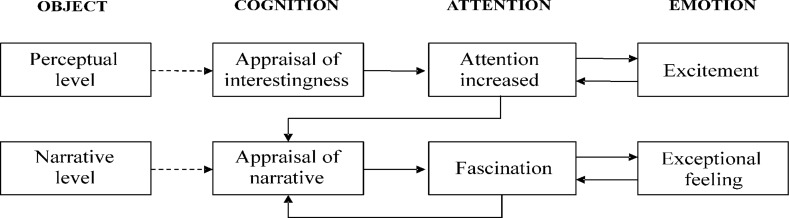
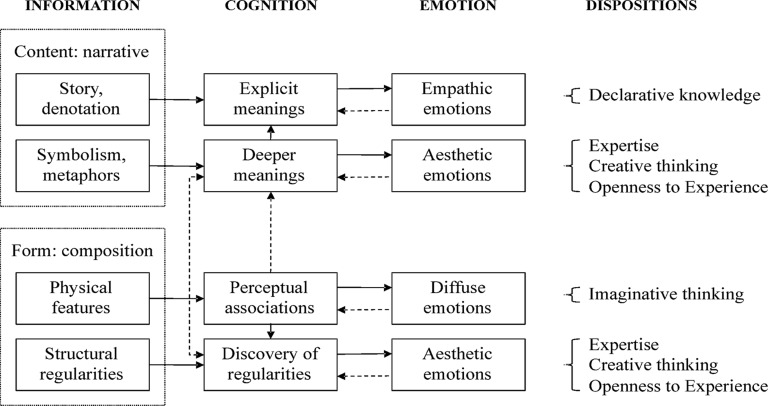
In this paper aesthetic experience is defined as an experience qualitatively different from everyday experience and similar to other exceptional states of mind. Three crucial characteristics of aesthetic experience are discussed: fascination with an aesthetic object (high arousal and attention), appraisal of the symbolic reality of an object (high cognitive engagement), and a strong feeling of unity with the object of aesthetic fascination and aesthetic appraisal. In a proposed model, two parallel levels of aesthetic information processing are proposed. On the first level two sub-levels of narrative are processed, story (theme) and symbolism (deeper meanings). The second level includes two sub-levels, perceptual associations (implicit meanings of object's physical features) and detection of compositional regularities. Two sub-levels are defined as crucial for aesthetic experience, appraisal of symbolism and compositional regularities. These sub-levels require some specific cognitive and personality dispositions, such as expertise, creative thinking, and openness to experience. Finally, feedback of emotional processing is included in our model: appraisals of everyday emotions are specified as a matter of narrative content (eg, empathy with characters), whereas the aesthetic emotion is defined as an affective evaluation in the process of symbolism appraisal or the detection of compositional regularities.
Overview
The claims and statistics of this paper haven’t been checked yet.
Free: it reads the open-access text and checks the first 5 claims that cite a source we can check. Create a free account to check every claim.
Integrity signals
Registry
Cites
Statistics
Figures
Verification
Claims the paper makes
The claims and statistics of this paper haven’t been checked yet.
Free: it reads the open-access text and checks the first 5 claims that cite a source we can check. Create a free account to check every claim.
Claims other papers make about this one
Each is checked against this paper’s own text: does it say what the citing paper says it does?
The source backs part of the claim, not all of it — or backs it for a different population, condition or comparison.
In the citing paper
“Empirical studies on visual [31], auditory [42] and haptic aesthetic experiences [57] [8] all converge in intertwining perception with embodied cognition.”
From Crafting Critical Heritage Discourses into Interactive Exhibition Design (2020) · cites this paper as [31]
Experimental — accuracy not yet measuredThe cited source says what the claim attributes to it.
In the citing paper
“The aesthetic experience is not the experience of beauty -for it can be pleasant or unpleasant; it is characterized by intense attention, extended cognitive engagement, and affective responses [31].”
From Crafting Critical Heritage Discourses into Interactive Exhibition Design (2020) · cites this paper as [31]
Self-check
Percentages, sums and reported differences re-computed from the paper’s own numbers.
The self-check needs the paper’s full text.
Citations
Cites
Well-being : the foundations of hedonic psychology
Kahneman, D. J., Diener, E. F., & Schwarz, N. (1999) · Cited by 8,305
The fusiform face area: a module in human extrastriate cortex specialized for face perception
Kanwisher, N., McDermott, J., & Chun, M. M. (1997) · The Journal of Neuroscience · doi:10.1523/jneurosci.17-11-04302.1997 · Cited by 7,738
Maslow, A. (1962) · D Van Nostrand eBooks · doi:10.1037/10793-000 · Cited by 7,192
Journal of Consciousness Studies
(2022) · Journal of Consciousness Studies · doi:10.53765/20512201 · Cited by 6,832
Csíkszentmihályi, M. (1975) · Cited by 5,690
What are emotions? And how can they be measured?
Scherer, K. R. (2005) · Social Science Information · doi:10.1177/0539018405058216 · Cited by 4,264 · cited 1×
“Koestler (1970) put aesthetic experience in the framework of creative processes emerging in art, science, humour, and playing.”
BackgroundFlow: The Psychology of Optimal Experience
Mirvis, P. H., & Csikszentmihalyi, M. (1991) · The Academy of Management Review · doi:10.2307/258925 · Cited by 3,611
Mood and judgment: The affect infusion model (AIM).
Forgas, J. P. (1995) · Psychological Bulletin · doi:10.1037/0033-2909.117.1.39 · Cited by 3,470 · cited 2×
“W J Cupchik G C, Gebotys R J, 1990 “Interest and pleasure as dimensions of aesthetic response” Empirical Studies of the Arts 8 1–14 J Cupchik G C, Vartanian O, Crawley A, Mikulis D J, 2009 “Viewing artworks: Contributions of cognitive control and perceptual facilitation to aesthetic experience” Brain and Cognition 70…”
InfluentialDynamic predictions: Oscillations and synchrony in top–down processing
Engel, A. K., Fries, P., & Singer, W. (2001) · Nature Reviews Neuroscience · doi:10.1038/35094565 · Cited by 3,454 · cited 1×
“However, other studies suggested that consciousness is not concentrated at local brain regions but is associated with globally distributed networks across a large scale of neuronal groups (cf Baars 2002; Engel et al 2001; Freeman 1991; Kanwisher 2001; Rees 2001a; Tononi and Edelman 1998; Watt 2004).”
BackgroundStory and Discourse: Narrative Structure in Fiction and Film
Austin, T. R., & Chatman, S. (1979) · The Journal of Aesthetics and Art Criticism · doi:10.2307/430732 · Cited by 2,658
Research works printed but not linked: 15
- Arnheim R 1980 Visual thinking Berkeley and Los Angeles University of California Press
- Brooks C Warren R P 1979 Modern rhetoric New York Harcourt Brace Jovanovich
- Eco U 2004 History of beauty Rizzoli International Publications
- Eco U 2007 On ugliness Rizzoli International Publications
- Frijda N H 1986 The emotions Cambridge Cambridge University Press
- Gardner H 1993 Creating minds New York Basic Books
- Gombrich E H 1969 Art and illusion Princeton New Jersey Princeton University Press
- Janković D Marković S 2001 Takete—Maluma phenomenon Perception 30 29
- Kabat-Zinn J 1998 Meditation Psycho-oncology New York Oxford University Press
- Koestler A 1970 The act of creation London Pan Books
- Marković S Janković D 2001 Implicit and explicit features of visual Gestalten Perception 30 30
- Marković S Janković D Subotić I 2002 Implicitna i eksplicitna svojstva vizuelnog gestalt [Implicit and explicit features of visual Gestalt] Psihološka istraživanja 11/ 12 75 112
- Neperud R W 1989 The relationship of art training and sex differences to aesthetic valuing Visual Arts Research 12 1 9
- Ognjenović P 1997 Psihološka teorija umetnosti [Psychological theory of art] Belgrade Institut za psihologiju
- Sternberg R J Lubart T I 1995 Defying the crowd New York Free Press
Cited by
Items 101–200 of 345
Bertamini, M., & Blakemore, C. (2019) · Frontiers in Psychology · doi:10.3389/fpsyg.2019.02033 · Cited by 15
“These terms are, however, still debated in the literature (Leder et al., 2004; Marković, 2012; Menninghaus et al., 2019).”
BackgroundBarton, G. M., & Le, A. H. (2022) · The Australian Journal of Language and Literacy · doi:10.1007/s44020-022-00006-2 · Cited by 13
“Much research on perceptions of aesthetics was conducted using interviews and observations (in ethnography) to measure aesthetic response capabilities (e.g., Kusumasondjaja, 2019; Johnson, 2007; Marković, 2010, 2012; Polovina & Marković, 2006).”
BackgroundWan, Y. K. P., Wu, D. C. W., Zhang, Z., & Cheng, W. L. A. (2024) · Current Issues in Tourism · doi:10.1080/13683500.2024.2349705 · Cited by 17
“Another main aesthetic feature of VR technology is the ability to elicit joy (Markovic´, 2012).”
Interactionist Approach to Visual Aesthetics in HCI
Silvennoinen, J. M. (2021) · Lecture notes in computer science · doi:10.1007/978-3-030-78221-4_8 · Cited by 20
Applying Game Design Elements in the Workplace
Suh, A. (2015) · International Conference on Information Systems · Cited by 15
Świątek, A. H., Szczęśniak, M., Wojtkowiak, K., Stempień, M., & Chmiel, M. (2023) · Frontiers in Psychology · doi:10.3389/fpsyg.2023.1214928 · Cited by 14
Effect of E-Servicescape on Emotional Response and Revisit Intention in an Internet Shopping Mall
Li, Z., Tulcanaza-Prieto, A. B., & Lee, C. W. (2024) · Journal of theoretical and applied electronic commerce research · doi:10.3390/jtaer19030099 · Cited by 14
Ko, E., Lee, E., Kim, K. H., Oh, N., & Yin, M. (2024) · Journal of Global Fashion Marketing · doi:10.1080/20932685.2024.2403378 · Cited by 10
“Although aesthetics is well established in the literature (Horng & Hsu, 2020; Marković, 2012), only a few studies have provided physiological evidence for the subjective phenomenon of individuals’ aesthetic experience (Pearce et al., 2016).”
Pupil responses to implied motion in figurative and abstract paintings
Castellotti, S., Scipioni, L., Mastandrea, S., & Viva, M. M. D. (2021) · PLoS ONE · doi:10.1371/journal.pone.0258490 · Cited by 15
The Perceptual Organisation of Visual Elements: Lines
Albertazzi, L., Canal, L., Micciolo, R., & Hachen, I. (2021) · Brain Sciences · doi:10.3390/brainsci11121585 · Cited by 10
“Sharp lines, for example, are associated with aggression [19].”
BackgroundPositive fEMG Patterns with Ambiguity in Paintings
Jakesch, M., Goller, J., & Leder, H. (2017) · Frontiers in Psychology · doi:10.3389/fpsyg.2017.00785 · Cited by 12
“(Markovic, 2012, p. 12).”
Kaube, H., Eiserbeck, A., & Rahman, R. A. (2023) · PLoS ONE · doi:10.1371/journal.pone.0281082 · Cited by 12
Weigand, R., & Jacobsen, T. (2021) · Quarterly Journal of Experimental Psychology · doi:10.1177/17470218211050194 · Cited by 9
“Several influential information-processing models of aesthetic experience also highlight the roles of perceptual processing and attentional mechanisms in the generation of the aesthetic response (Chatterjee, 2011; Leder et al., 2004; Marković, 2012).”
BackgroundAesthetic Perception of Stage Setups in Dance
Kempe, M., & Heinen, T. (2022) · European Journal of Sport Sciences · doi:10.24018/ejsport.2022.1.4.30 · Cited by 9
“Aesthetic experience is described as a state of mind that comprises focusing on an object, feeling a strong connection to that object, and thus reducing the perception of the surrounding environment when observing and evaluating that object (Cupchik & Winston, 1996; Marković, 2010; 2012).”
BackgroundAssessing the aesthetic attractivity of European butterflies: A web-based survey protocol
van Tongeren, E., Sistri, G., Zingaro, V., Cini, A., Dapporto, L., & Portera, M. (2023) · PLoS ONE · doi:10.1371/journal.pone.0283360 · Cited by 12
A PCA-based Method to Map Aesthetic Movements from Dancer to Robotic Arm
Saviano, G., Villani, A., & Prattichizzo, D. (2023) · IEEE Workshop on Advanced Robotics and its Social Impacts (ARSO) · doi:10.1109/arso56563.2023.10187492 · Cited by 9
“Nine indices were selected to quantify the user perception and opinion on aesthetic of the movements and the resulting choreography according to [32] and [33], respectively.”
Method“I like how it looks but it is not beautiful”: Sensory appeal beyond beauty
Muth, C., Briesen, J., & Carbon, C. (2019) · Poetics · doi:10.1016/j.poetic.2019.101376 · Cited by 10
“…aesthetic “pleasures of the mind” referring to a concept by Kubovy (1999) and states that “even ugly things can elicit aesthetic experience (eg, aesthetic fascination with deformation, monstrous, grotesque, morbid, horrible, and other kinds of ugliness; cf Eco 2004, 2007)” (Marković, 2012, p. 2).”
BackgroundMari, E., Quaglieri, A., Lausi, G., Boccia, M., Pizzo, A., Baldi, M., Barchielli, B., Burrai, J., Piccardi, L., & Giannini, A. M. (2021) · Behavioral Sciences · doi:10.3390/bs11110144 · Cited by 12
Shakespeare sonnet reading: An empirical study of emotional responses
Papp-Zipernovszky, O., Mangen, A., Jacobs, A. M., & Lüdtke, J. (2021) · Language and Literature International Journal of Stylistics · doi:10.1177/09639470211054647 · Cited by 12
“The relatively low number of factors is in accordance with Jacobs et al. (2016) as well as Markovic (2012), who found that liking judgements of visual material could be explained by a two- or three-dimensional space: beauty and roughness in the first case and arousal plus attention (that Markovic…”
BackgroundMridha, M., Kuys, B., & Suhaimi, S. N. (2022) · Buildings · doi:10.3390/buildings13010019 · Cited by 10
The “Creativity Crisis” as a Mind in Crisis: A Cultural-Historical Activity Theory Position
Maouch, M. E., Jin, Z., Zhao, K., & Zhang, Y. (2023) · Integrative Psychological and Behavioral Science · doi:10.1007/s12124-023-09808-6 · Cited by 11
“The world view is also stressed when discussing the universal and cultural level of human social cognition (e.g., see Jacobsen, 2006; Markovi´c, 2012; Chatterjee & Vartanian, 2014; Redies, 2015).”
A Systemic Perspective for Sonification Aesthetics
Seiça, M., Roque, L., Martins, P., & Cardoso, A. (2021) · International Conference on Auditory Display (ICAD) · doi:10.21785/icad2021.033 · Cited by 13
“Marković’s model [31] characterises an aesthetic experience as four parallel streams of information processing through cognitive processes that originate emotional responses, with underlying dispositions in three dimensions (information, cognition and emotion).”
BackgroundGerger, G., Pelowski, M. J., & Ishizu, T. (2018) · Emotion · doi:10.1037/emo0000528 · Cited by 10
A Unified Model of Game Design, Through the Lens of User Experience
de Wit, J. (2021) · CHI Conference Extended Abstracts on Human Factors in Computing Systems (CHI EA) · doi:10.1145/3411763.3451778 · Cited by 10
Lin, W., & Chang, Y.-C. (2022) · Frontiers in Psychology · doi:10.3389/fpsyg.2022.1059572 · Cited by 8
“To be a part of an aesthetic experience, beauty must transcend from its extrinsic to intrinsic values (Marković, 2012).”
BackgroundRani, N. A., Hashim, M. E. A., & Idris, M. Z. (2023) · Journal of Advanced Research in Applied Sciences and Engineering Technology · doi:10.37934/araset.33.3.112123 · Cited by 11
Eye Tracking Based Objective Evaluation of Visual Aesthetics: A Review
Nayak, B. K., & Karmakar, S. (2018) · Advances in intelligent systems and computing · doi:10.1007/978-3-319-94706-8_41 · Cited by 11
The Emotional Meaning of Pure Music
Blutner, R. (2024) · Mind and Matter · doi:10.53765/mm2024.165 · Cited by 9
Neural representations of visual aesthetic experience (VAE): a meta-analysis
Feng, X., Gan, J., Huang, X., & Luo, S. (2021) · Culture and Brain · doi:10.1007/s40167-021-00102-z · Cited by 9
Jacobi, C. J., Varga, P. J., Jessani, Z., & Vaidyanathan, B. (2024) · Frontiers in Psychology · doi:10.3389/fpsyg.2023.1197870 · Cited by 11
“Experiences of beauty, wonder, and awe have also been linked to improved wellbeing and quality of life (Wanzer et al., 2020; Jacobi et al., 2022) as well as with domains of self-transcendence, such as motivation and emotion (Marković, 2012).”
BackgroundAdolescents’ Conceptions of “Good” Grandparents: A Reversal Theory Approach
Giraudeau, C., Duflos, M., & Chasseigne, G. (2020) · Journal of Intergenerational Relationships · doi:10.1080/15350770.2020.1804034 · Cited by 12
“…as addictions (Burris & O’Connell, 2003), risk-taking behaviors (Sandseter, 2010), creativity (Griffin & McDermott, 1998), esthetic experience (Marković, 2012), stress (Thatcher et al., 2011), dangerous sports (Breivik, 2010), religious conversion (Lakhdar et al., 2007), sexuality…”
Concreteness of semantic interpretations of abstract and representational artworks
Schepman, A., & Rodway, P. (2021) · Acta Psychologica · doi:10.1016/j.actpsy.2021.103269 · Cited by 9
Loonker, M., Ppali, S., von Jungenfeld, R., Efstratiou, C., & Covaci, A. (2022) · Designing Interactive Systems Conference · doi:10.1145/3532106.3533468 · Cited by 7
“Such experiences emerge from ‘being-there’ and are associated with the intertwining of perception, attention, action, memory, imagination, thought, and emotion [42].”
BackgroundHow Do We Understand Artworks? Exploring the Role of Artwork Inherent Features in Art Processing
Specker, E., Douda, M., & Leder, H. (2023) · Empirical Studies of the Arts · doi:10.1177/02762374231201074 · Cited by 8
“Furthermore, a recent review (Sarasso et al., 2020, in line with Markovic ́ , 2012) argued that the aesthetic experience is characterized by an attentional shift towards the perceptual features of an object and is paired with an inhibition of an object-identi fi cation “ habit ” (p. 11 ).”
Background9-12 Yaş Çocukların Estetik Değer Algılarının İncelenmesi
Demirel, İ. N. (2018) · İnönü Üniversitesi Eğitim Fakültesi Dergisi · doi:10.17679/inuefd.346720 · Cited by 12
Fogliano, F., Fabbrini, F., de Souza, A. G., de Freitas, G. H. F., Machado, J. P., & Sarra, R. L. (2019) · Lecture notes in computer science · doi:10.1007/978-3-030-22219-2_25 · Cited by 7
Gómez, F. J. M. (2019) · Estudios Ingleses de la Universidad Complutense · doi:10.5209/cjes.63808 · Cited by 7
When Art Is Not Mastered but Creates Insights. Shifting In and Out of Semantic Instability
Muth, C., & Carbon, C. (2019) · Art & Perception · doi:10.1163/22134913-20191118 · Cited by 8
Affective metadata for object experiences in the art museum
Canning, E. (2018) · TSpace (University of Toronto) · doi:10.17605/osf.io/p3c5h · Cited by 7
Chia, S., Hartanto, A., & Tong, E. M. W. (2025) · Computers in Human Behavior Artificial Humans · doi:10.1016/j.chbah.2025.100217 · Cited by 15
Sarami, A., Afhami, R., & Wagemans, J. P. (2021) · Art & Perception · doi:10.1163/22134913-bja10028 · Cited by 6
Cruz, A. (2023) · Culture & Psychology · doi:10.1177/1354067x231191484 · Cited by 7
“This enjoyment of the pleasure of one ’ s experience, rather than the pleasure of the actual experience, is a form of savouring (Markovi´c, 2012; Sundararajan, 2015).”
InfluentialEEG-Based Evaluation of Aesthetic Experience Using BiLSTM Network
Wang, P., Feng, H., Du, X., Nie, R., Lin, Y., Ma, C., & Zhang, L. (2023) · International Journal of Human-Computer Interaction · doi:10.1080/10447318.2023.2278926 · Cited by 7
The Art of Experiencing Art: On the Nature and the Origins of the Mode of Art eXperience (MAX)
Goetz, I., & Carbon, C. (2023) · Journal of Perceptual Imaging · doi:10.2352/j.percept.imaging.2023.6.000403 · Cited by 7
Factor structure of audiences' physical experience while watching dance
Vukadinovic, M. S., & Marković, S. (2021) · PsyCh Journal · doi:10.1002/pchj.513 · Cited by 15
Self-citationArt Education When the World Is on Fire
Cosier, K. (2021) · Studies in Art Education · doi:10.1080/00393541.2021.1975949 · Cited by 7
“Although not all feelings that arise from aesthetic experience move us toward joining the fight for justice, engagement with community-based activist art can (Markovic, 2012).”
BackgroundOn the Aesthetic Perception of Gymnastic Body Postures and Their Corresponding Figural Shapes
Vinken, P. M., & Berneiwtz, L. (2022) · European Journal of Sport Sciences · doi:10.24018/ejsport.2022.1.6.44 · Cited by 6
“However, the perception of (aesthetic) stimuli is related to the contextual, visual, and sensory-motor experiences of the observer (Chatterjee & Vartanian, 2014; Christensen & Calvo-Merino, 2013; Marković, 2012).”
BackgroundThe Unique Aesthetic Experience of VR Technology
Fu, X., Zhou, Z., & Zhu, X. (2023) · Highlights in Science Engineering and Technology · doi:10.54097/hset.v44i.7317 · Cited by 6
An interdisciplinary journey towards an aesthetics of sonification experience
Seiça, M., Roque, L., Martins, P., & Cardoso, A. (2023) · Journal on Multimodal User Interfaces · doi:10.1007/s12193-023-00416-7 · Cited by 11
Decontaminating Taste: Minimizing Nona esthetic Biases in Aesthetic Appraisal
Lundy, D. E. (2016) · Review of Arts and Humanities · doi:10.15640/rah.v5n1a2 · Cited by 8
Mixing pleasure and beauty: positive aesthetic experience in Old English poetry
Gómez, F. J. M. (2020) · The Journal of English Studies · doi:10.18172/jes.4417 · Cited by 6
Ontological and conceptual challenges in the study of aesthetic experience
Xenakis, I., & Arnellos, A. (2022) · Philosophical Psychology · doi:10.1080/09515089.2022.2062314 · Cited by 8
“…hedonic/aesthetic ones that are formed through a special aesthetic emotion that perceivers ought to evoke when they interact with objects of art (see, e.g., the frameworks of Leder, 2013; Marković, 2012; Pelowski et al., 2017; for a critique, see Nadal & Skov, 2017; Ayala & Cela-Conde, 2017).”
BackgroundMinmin, H., & Mo, L. (2024) · Empirical Studies of the Arts · doi:10.1177/02762374241298883 · Cited by 12
“For instance, Markovic ́ (2012) de fi nes aesthetic experience as a distinct experience that differs from everyday experiences and resembles other exceptional states of mind.”
‘Pic first, eat later’: An investigation into motivations behind the ‘foodstagramming’ phenomenon
Dyce, V., Marcella-Hood, M., & Pirie, E. (2024) · Hospitality & Society · doi:10.1386/hosp_00086_1 · Cited by 19
Droit‐Volet, S., Dambrun, M., & Monier, F. (2024) · Acta Psychologica · doi:10.1016/j.actpsy.2024.104232 · Cited by 7
Unraveling the interplay of emotions in art and music: An event-related potential investigation
Benedetto, F. D., Ghiraldini, E., Capizzi, N., & Proverbio, A. M. (2024) · Psychology of Music · doi:10.1177/03057356241245997 · Cited by 6
The role of aesthetic quality in urban spaces to influence use of active transport modes
Stefánsdóttir, H., Næss, P., Heinonen, J. T., & Czepkiewicz, M. (2024) · Journal of Urbanism International Research on Placemaking and Urban Sustainability · doi:10.1080/17549175.2024.2342720 · Cited by 5
“The characteristics of attention that consequently become a matter of evaluation depend on the traveling person’s interestedness (Markovic 2012) and how well the situation meets their desire (Berleant 2015).”
Ambivalent Emotional Experiences of Everyday Visual and Musical Objects
Maksimainen, J. P., Eerola, T., & Saarikallio, S. H. (2019) · SAGE Open · doi:10.1177/2158244019876319 · Cited by 9
“This supports prior research demonstrating beauty as a core concept through which aesthetic responses to music (Istok et al., 2009) and visual arts (e.g., Silvia, 2009; Silvia & Brown, 2007; see also Markovic, 2012) are conceptualized in people’s descriptions.”
MethodHOW TELECOMMUTERS BALANCE WORK AND THEIR PERSONAL LIVES
Miller, T. (2016) · ProQuest Demo Repository · doi:10.13140/rg.2.2.27975.50083 · Cited by 8
Augustin, M., & Wagemans, J. P. (2012) · i-Perception · doi:10.1068/i0541ed · Cited by 5
Le, T. M. D. (2026) · International Journal of Tourism Cities · doi:10.1080/20565607.2026.2614286 · Cited by 4
Online delight and digitally mediated leisure experience: evidence from festival media
Mesana, J. C. B. (2026) · Annals of Leisure Research · doi:10.1080/11745398.2026.2651325 · Cited by 5
“This aligns with aesthetic frameworks of leisure that interpret admiration and fas-cination as responses to form, skill, and symbolic expressiveness. rather than as mere approval (Kriegel 2023; Marković 2012; Whiting 2023).”
On the biological basis of beauty
Mendelson, T. C., Renoult, J. P., Rosenthal, G. G., & Shuker, D. M. (2025) · Biological reviews/Biological reviews of the Cambridge Philosophical Society · doi:10.1111/brv.70014 · Cited by 7
Structure of subjective experience of classical music
Živanović, M., Marković, M. V., & Bogunović, B. (2018) · Psihologija · doi:10.2298/psi170116009z · Cited by 4
“…accompanied by high arousal and attention, and overall high cognitive engagement and immersion into the object of art (Csikszentmihalyi, 1975; Csikszentmihalyi & Rathunde 1993; Frijda, 1989; Marković, 2012; Ognjenovic, PSIHOLOGIJA, 2018, Vol. 51(4), 397–411 1997; Tellegen & Atkinson, 1974).”
BackgroundResultФЕСТИВАЛІ ЯК ДРАЙВЕРИ РОЗВИТКУ КРЕАТИВНИХ ІНДУСТРІЙ: ІСТОРИКО-КУЛЬТУРОЛОГІЧНИЙ ПІДХІД
Pletsan, K. V. (2022) · Питання культурології · doi:10.31866/2410-1311.39.2022.256927 · Cited by 4
Wei, R., Lyu, X., Liang, Z., & You, Y. (2024) · Inquiry · doi:10.1080/0020174x.2024.2335998 · Cited by 5
“According to Markovi ć (2012), aesthetic experience can be summarised into three key features, which are both crucial and unique in understanding and describing aesthetic experience.”
Dışavurumcu Sanat Yoluyla Estetik Değer Öğretimi
Demirel, İ. N. (2018) · Gazi Üniversitesi Gazi Eğitim Fakültesi Dergisi · doi:10.17152/gefad.393942 · Cited by 4
An Aesthetic Model for Popular Illustration
Lin, Y.-C. (2022) · Empirical Studies of the Arts · doi:10.1177/02762374211047972 · Cited by 5
“It comes from people’s attempt to appraise novel, complex, but understandable objects (Markovic, 2012; Silvia, 2005a, 2005b, 2005c).”
BackgroundBo, H. H., & Zhang, J. J. (2024) · Journal of Marketing Development and Competitiveness · doi:10.33423/jmdc.v18i1.6892 · Cited by 5
“Marković (2012) stated three components of aesthetic experiences – fascination, appraisal, and emotion.”
BackgroundZdravić-Mihailović, D. (2021) · Facta Universitatis Series Philosophy Sociology Psychology and History · doi:10.22190/fupsph2101087z · Cited by 4
Wahed, W. J. E., Yusoff, S. B. H. M., & Saad, N. (2019) · Journal of Visual Art and Design · doi:10.5614/j.vad.2019.11.2.5 · Cited by 4
“Therefore, the public needs to be well-informed about these traditional motifs before wearing them [10].”
BackgroundPromoting student well‐being: Exploring participatory arts in a higher education institution
Wang, H., Tseng, M., & Wei, S. (2023) · Psychology in the Schools · doi:10.1002/pits.23115 · Cited by 6
Xenakis, I., & Arnellos, A. (2025) · Phenomenology and the Cognitive Sciences · doi:10.1007/s11097-025-10084-5 · Cited by 5
Complex emotional experiences: theoretical significance, ways of induction and therapeutic potential
Salikova, D. A., & Kosonogov, V. (2025) · Current Psychology · doi:10.1007/s12144-024-07207-7 · Cited by 4
“Previous research indicates that aesthetic experience is more aligned with arousal and so-called interestingness than with other subjective dimensions such as pleasure and harmony (Marković, 2012).”
Sulejmanov, F. (2018) · Psihologija · doi:10.2298/psi170131010s · Cited by 3
“Although this is in line with some previous studies (Rawlings, Barrantes, Vidal, & Furnham, 2000; Ruch & Hehl, 1998), there is evidence that such equalization has limitations (Leder, Belke, Oeberst, & Augustin, 2004; Marković, 2012) which will be outlined in the discussion.”
BackgroundResultMetaphorical Thinking in Designing Meaningful Experience with Product Interaction: A Critical Review
Qin, Z., & Ng, S. (2021) · Advances in intelligent systems and computing · doi:10.1007/978-3-030-63335-6_4 · Cited by 3
Narrativity and Literariness Affect the Aesthetic Attitude in Text Reading
Wimmer, L., El-Salahi, L., Lee, H. W. J., & Ferguson, H. J. (2022) · Empirical Studies of the Arts · doi:10.1177/02762374221095482 · Cited by 6
“This is because according to the traditional philosophical conception outlined above, the aesthetic attitude is adopted in the service of an intense aesthetic experience; aesthetic emotions, in turn, contribute to the intensity of aesthetic experiences (Marković, 2012).”
Aesthetics in Nursing Practice as Experienced by Children During Hospitalization in Philippines
Kongsuwan, W., Galvez, B. L., & Betriana, F. (2024) · Advances in Nursing Science · doi:10.1097/ans.0000000000000532 · Cited by 3
Evaluating Biophilic Design’s Effects on Virtual Museum Perception and Behavior
Dalay, L., & Aytaç, G. (2024) · Art & Perception · doi:10.1163/22134913-bja10063 · Cited by 3
Epigenesis and Coherence of the Aesthetic Mechanism
Desideri, F. (2015) · Aisthesis Pratiche linguaggi e saperi dell’estetico · doi:10.13128/aisthesis-16204 · Cited by 3
“The dynamic space7 in which the aesthetic mechanism works is thus conceivable as a space 5 I refer here, in particular, to Slobodan Markovic, working at the Laboratory of Experimental Psychology at the University of Belgrade, whose paper appeared in «i-Perception» (Markovic [2012]) and is devoted to Components of Aest…”
BackgroundInfluential(2021) · International Journal of Media and Information Literacy · doi:10.13187/ijmil.2021.2.416 · Cited by 7
“The emotions evoked by the video set were closely related to the content of the narrative and the sequence of events in the movies (Markovic, 2012).”
BackgroundHashim, M. E. A., Idris, M. Z., & Said, C. S. (2022) · Lecture notes of the Institute for Computer Sciences, Social Informatics and Telecommunications Engineering · doi:10.1007/978-3-030-99188-3_19 · Cited by 4
Sotiropoulou-Zormpala, M., & Argyriadi, A. (2015) · Croatian Journal of Education - Hrvatski časopis za odgoj i obrazovanje · doi:10.15516/cje.v17i0.827 · Cited by 6
Engaging first-graders in language arts through ‘arts-flow activities’
Argyriadi, A., & Sotiropoulou-Zormpala, M. (2017) · Curriculum Perspectives · doi:10.1007/s41297-016-0005-3 · Cited by 3
“These findings demonstrated that the experimental activities can function along the standards of a holistic approach to teaching (Garcia 2014; Markovic 2011; Miller 2007; Noddings 2004; Pope 2001).”
BackgroundUbuntu aesthetics in African theatre of the South
Sidogi, P., & Ndou, H. (2021) · South African Theatre Journal · doi:10.1080/10137548.2021.2020157 · Cited by 5
“The parameters of this paper do not allow for a nuanced synthesization of the historical and shifting meanings of aesthetics, however, in its most rudimentary understanding, aesthetics denotes the artistic ‘appraisal of the symbolic reality of an object’ (Markovic 2012, p. 1).”
BackgroundReflections on Beauty: Immanuel Kant and Semir Zeki
(2016) · doi:10.15242/icehm.ed1116072 · Cited by 3
Pizzolante, M., & Chirico, A. (2022) · Lecture notes in computer science · doi:10.1007/978-3-031-15553-6_24 · Cited by 6
The Aesthetic Experience, Flow, and Smart Technology: Viewing Art in a Virtual Environment
Ikard, C. F. (2016) · ScholarWorks (Walden University) · Cited by 7
Multisensory Imagery Enhances the Aesthetic Evaluation of Paintings: A Virtual Reality Study
Chen, Z., Han, Z., Wu, L., & Huang, J. (2026) · Empirical Studies of the Arts · doi:10.1177/02762374251412761 · Cited by 3
“Moreover, according to existing literature, emotional experience during aesthetic processing is closely related to aesthetic evaluations and may share similar neural mechanisms (Boutoleau-Bretonnière et al., 2016; Chatterjee & Vartanian, 2014; Markovic ́ , 2012).”
Lee, C.-R. (2026) · Cogent Education · doi:10.1080/2331186x.2026.2639782 · Cited by 2
Costes-Onishi, P., Baildon, M. C., Kehk, B. L., & Azlan, A. (2026) · Social Sciences & Humanities Open · doi:10.1016/j.ssaho.2026.102701 · Cited by 4
Does self-reported chronic pain influence savoring of aesthetic experiences?
Weigand, R., Moosmayer, A., & Jacobsen, T. (2021) · PLoS ONE · doi:10.1371/journal.pone.0259198 · Cited by 3
Jin, N. P., Kim, S.-H., & Merkebu, J. (2022) · International Journal of Hospitality & Tourism Administration · doi:10.1080/15256480.2022.2104773 · Cited by 3
“Since aesthetic experience is considered a special state of mind, it highlights objects, situations, or events wherein people can engage (Markvoić, 2012).”
BackgroundInfluentialInfluencia del interés por las artes visuales en las soft skills de los futuros maestros
Flores, M. D. P. A., Esteve‐Faubel, R. P., & Chust-Pérez, V. (2022) · TECHNO REVIEW International Technology Science and Society Review /Revista Internacional de Tecnología Ciencia y Sociedad · doi:10.37467/revtechno.v11.4409 · Cited by 2
“…consigo una mayor capacidad de análisis crítico y relacional (Álvarez, 2015), por lo que, esta podría vincularse con la experiencia estética que se caracteriza por la capacidad de análisis crítico y valoración por las artes, además de la fascinación por la estética y lo bello (Marcović, 2012).”
Gómez, F. J. M. (2023) · Cognitive Semantics · doi:10.1163/23526416-bja10055 · Cited by 2
Contribution of Affect and Cognition in Shaping Aesthetic Responses
Stojilović, I. Z. (2023) · Primenjena psihologija · doi:10.19090/pp.v16i2.2432 · Cited by 4
Maouch, M. E., Chen, R., & Jin, Z. (2024) · Integrative Psychological and Behavioral Science · doi:10.1007/s12124-024-09819-x · Cited by 2
“…1990; Kielian-Gilbert, 1991; Barron, 1995; Smith et al., 1995; Lindqvist, 2003; Boden, 2005; Thomson et al., 2006; Welling, 2007; Lindqvist, 2003; Marković, 2012; Magro, 2013; Leb-uda, 2014; Simonton, 2014; Engeström, 2015; Brecht, 2016; Hogan, 2017; Writing Coach, 2017; Montuori & Donnelly,…”
An experimental study on differences in aesthetic experience according to thermal environments
Kwun, S., & Chun, C. (2024) · Building and Environment · doi:10.1016/j.buildenv.2024.111590 · Cited by 2
FACTOR STRUCTURE AND ELEMENTS OF HOME-RELATED SUBJECTIVE WELL-BEING
ARIMA, Y., MUNAKATA, J., & ITAMI, H. (2024) · Journal of Environmental Engineering (Transactions of AIJ) · doi:10.3130/aije.89.282 · Cited by 2
Mathisen, F. K. S., Grøttjord-Glenne, T., Berge, K. G., & Brattabø, I. V. (2025) · Child Protection and Practice · doi:10.1016/j.chipro.2025.100094 · Cited by 5
Metadata
- Authors
- Marković, S.
- Affiliations
- University of Belgrade (RS)
- Corresponding author
- Marković, Slobodan
- ORCID
- Marković, Slobodan
- Venue
- i-Perception
- Publisher
- SAGE Publications
- Published
- 2012-01
- Volume
- 3
- Issue
- 1
- Pages
- 1-17
- ISSN
- 2041-6695 (ISSN-L)
- PMC
- PMC3485814
- OpenAlex
- W2096535767
- Cited by
- 346
- References
- 102
- Citations by year
- 2026: 28 · 2025: 42 · 2024: 34 · 2023: 40 · 2022: 49 · 2021: 39 · 2020: 16 · 2019: 21 · 2018: 23 · 2017: 18 · 2016: 12 · 2015: 12 · 2014: 7 · 2013: 2 · 2012: 3
- FWCI
- 3.93
- Type
- journal article
- Language
- en
- Open access
- gold
- doi.org
- Licence
- cc-by-nc-nd
- journals.sagepub.com/page/policies/text-and-data-mining-license (tdm)
- Locations
- i-Perception (publishedVersion, cc-by-nc-nd)
- Europe PMC (PubMed Central) (publishedVersion, cc-by-nc-nd)
- PubMed Central (publishedVersion, cc-by-nc-nd)
- PubMed (publishedVersion)
- DOAJ (DOAJ: Directory of Open Access Journals) (submittedVersion, cc-by-sa)
- Topics
- Life Sciences › Neuroscience › Cognitive Neuroscience › Aesthetic Perception and Analysis
- Social Sciences › Arts and Humanities › Philosophy › Ethics, Aesthetics, and Art
- Social Sciences › Arts and Humanities › Visual Arts and Performing Arts › Art, Aesthetics, and Perception
- Keywords
- aesthetic experience, aesthetic appreciation, symbolism, narrative, emotional processing, expertise, creative thinking, openness to experience, empathy, affective evaluation
About these checks
Registry, retraction, Cites and statistics results are computed, not judged, with one exception: a printed reference that no index lists is read once by a model before it counts as a citation error. Claims are extracted by a model and kept only when their quote appears verbatim in the text; each cited source is then checked, with a model’s help, for whether it says what the claim relies on. Those verdicts can be wrong — read the claim’s quote and the cited source before relying on one.
Statistics and arithmetic are recomputed, not judged.
Confidence bands are shown only for fields calibrated on our annotated test set. None is calibrated yet, so no band is shown.
What counts as a claim ›How we measure confidence ›How we check this ›
Are you an author, or do you see a problem with this page? Request a review
Data sources
Bibliographic data: Semantic Scholar, OpenAlex, Crossref.
Contains information from the Semantic Scholar Academic Graph Datasets, made available under the ODC Attribution License (ODC-BY 1.0).
Semantic Scholar’s data is described in: Kinney, R., et al. (2023). The Semantic Scholar Open Data Platform. arXiv:2301.10140.
