

Situating the default-mode network along a principal gradient of macroscale cortical organization
Open accessThe DOI matches its Crossref record; 100 of the 100 references it cites were found in a registry or an index; 26 of the 58 sources its claims cite were checked for support.
Abstract
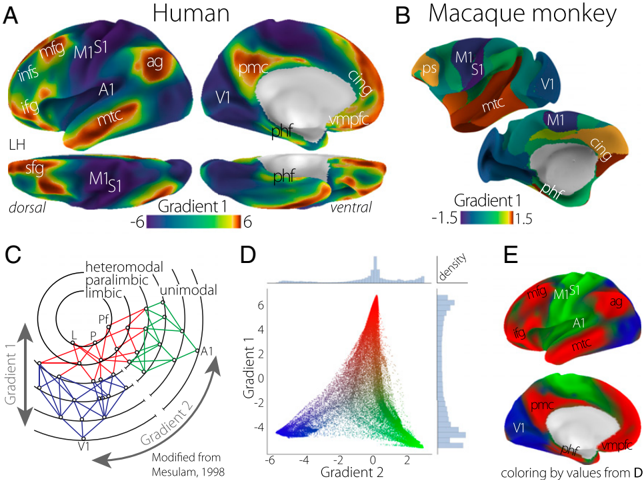
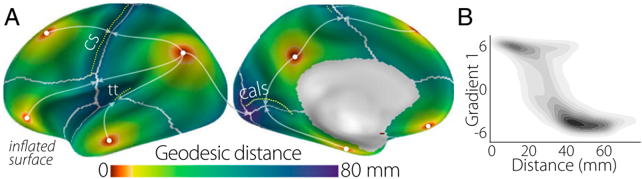
Understanding how the structure of cognition arises from the topographical organization of the cortex is a primary goal in neuroscience. Previous work has described local functional gradients extending from perceptual and motor regions to cortical areas representing more abstract functions, but an overarching framework for the association between structure and function is still lacking. Here, we show that the principal gradient revealed by the decomposition of connectivity data in humans and the macaque monkey is anchored by, at one end, regions serving primary sensory/motor functions and at the other end, transmodal regions that, in humans, are known as the default-mode network (DMN). These DMN regions exhibit the greatest geodesic distance along the cortical surface-and are precisely equidistant-from primary sensory/motor morphological landmarks. The principal gradient also provides an organizing spatial framework for multiple large-scale networks and characterizes a spectrum from unimodal to heteromodal activity in a functional metaanalysis. Together, these observations provide a characterization of the topographical organization of cortex and indicate that the role of the DMN in cognition might arise from its position at one extreme of a hierarchy, allowing it to process transmodal information that is unrelated to immediate sensory input.
Overview
CoChat Summary
TL;DR
The paper identifies a principal connectivity gradient in human and macaque cortex that runs from primary/unimodal sensory-motor regions to transmodal default-mode network (DMN) regions. It argues that the DMN’s position at one extreme, maximally distant from primary areas, helps explain its role in abstract, stimulus-independent cognition.
Key findings
- A principal gradient of functional connectivity, derived from 91,282 cortical/subcortical grayordinates at 2 mm resolution in 820 healthy adults (1 hour resting-state fMRI per participant, HCP S900), is anchored by primary/unimodal visual, somatosensory/motor, and auditory regions at one end and DMN regions at the other.
- Seven peak DMN nodes are maximally distant along the cortical surface from primary sensory/motor landmarks; four are equidistant from the central sulcus, and geodesic distance from DMN peaks relates to the principal gradient with \(R^2 = 0.55\). Beyond 40 mm from DMN peaks, cortex exclusively consists of unimodal regions.
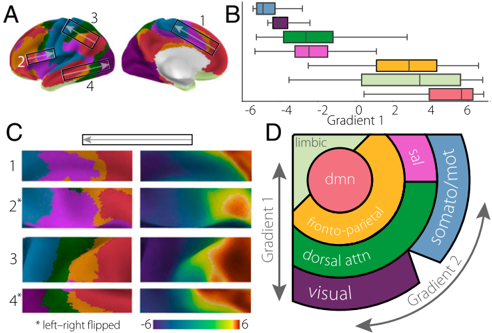
- The principal gradient orders the 7-network Yeo parcellation, with DMN at one extreme and visual/motor networks at the other; the limbic network is an exception, spanning a wide range of values.
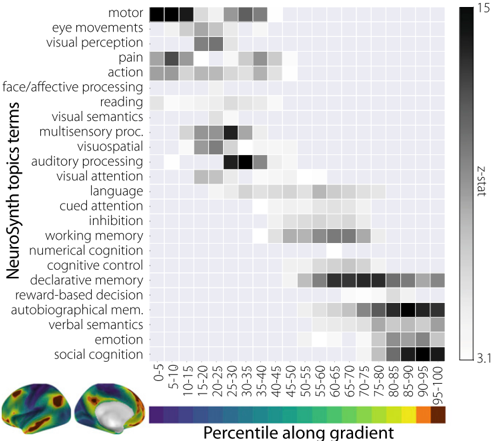
- A NeuroSynth meta-analysis using 24 topic terms shows a functional shift along the gradient: motor, visual perception, multisensory, and auditory terms at the unimodal end; cued attention, inhibition, and working memory in the middle; and social cognition, verbal semantics, and autobiographical memory at the DMN end.
Methods
- Human data were from the Human Connectome Project dense connectome S900 release: 91,282 grayordinates at 2 mm resolution, based on 1 hour of resting-state fMRI from 820 healthy adults, with no further processing beyond HCP minimal preprocessing including 2 mm FWHM smoothing.
- The main analysis used diffusion embedding, a nonlinear dimensionality reduction method, to extract connectivity gradients (“connectopies”) rather than discrete network parcellations; the same embedding was applied to a publicly available macaque tract-tracing database.
- Additional analyses calculated minimum geodesic distance from 7 DMN peak nodes, related gradient values to the 7-network Yeo parcellation, and performed a NeuroSynth meta-analysis with 24 topic terms across 5-percentile bins of the principal gradient.
Limitations
- Stated: the limbic network captures an extensive range of gradient values, which the authors suggest may be due to low signal-to-noise in the original parcellation data and may not accurately reflect its constituent regions’ connectivity.
- Stated: future studies are needed to better characterize transitions between large-scale connectivity patterns and to identify where processing occurs stepwise versus gradientially.
- Evident from the text: the macaque cross-species correspondence is described as “initial evidence” that the axis may be phylogenetically conserved, and the analyses are descriptive/spatial rather than causal tests of the proposed hierarchy.
Model-written summary. Check it against the paper before relying on it.
Integrity signals
Registry
Cites
Statistics
Figures

Verification
Claims the paper makes
14 Valid · 2 Not valid · 11 Not checked · 50 Own results and interpretations
The cited sources support only part of this claim — read each source’s verdict below.
In the paper
“Second, the location of the DMN as equidistant from all sensory/motor systems is aligned with its broad range of functions that require integration between multiple sensory systems, including episodic [51] and semantic memory [52-54], social cognition [55, 56], goal-directed working memory tasks [26, 32, 33, 35] and reward-guided decision making [57, 58].”
What the sources say
- Supportedcites [51] Schacter DL, Addis DR (2007) The cognitive neuroscience of constructive memory: remembering the past and imagining the future. Philos Trans R Soc Lond B Biol Sci 362(1481):773786. 661 662 663 source
Split into 2 atoms — 2 confirmed, 0 partially supported, 0 disputed, 0 misattributed, 0 unverifiable. Expand the claim to see per-atom verdicts.
- Supportedcites [52] Binder JR, Desai RH, Graves WW, Conant LL (2009) Where is the semantic system? a critical review and meta-analysis of 120 functional neuroimaging studies. Cereb Cortex 19(12):27672796. 664 665 source
The citation to this paper is attached to the semantic-memory part of the sentence, not the other listed functions. “Semantic Processing and the ‘Default Network’” says the semantic system closely resembles the default network, while “The Semantic System of the Human Brain” describes its regions as receiving multimodal input and supporting integrative processes. Page numbers are unavailable in our copy. (LLM, conf=0.91)
- Not checked — no full text of the sourcecites [53] Jefferies E (2013) The neural basis of semantic cognition: converging evidence from neuropsychology, neuroimaging and TMS. Cortex 49(3):611-625. 666 source
- Partly supportedcites [54] Constantinescu AO, O'Reilly JX, Behrens TEJ (2016) Organizing conceptual knowledge in humans with a gridlike code. Science 352(6292):1464-8. sourceExperimental — accuracy not yet measured
Split into 2 atoms — 1 confirmed, 1 partially supported, 0 disputed, 0 misattributed, 0 unverifiable. Expand the claim to see per-atom verdicts.
- Not checked — no full text of the sourcecites [55] Amodio DM, Frith CD (2006) Meeting of minds: the medial frontal cortex and social cognition. Nat Rev Neurosci 7(4):268-277. source
- Supportedcites [56] Amft M et al. (2015) Definition and characterization of an extended social-affective default network. Brain Struct Funct 220(2):1031-49. source
Split into 2 atoms — 2 confirmed, 0 partially supported, 0 disputed, 0 misattributed, 0 unverifiable. Expand the claim to see per-atom verdicts.
plainstates an association- Asserted: passes — The authors put it forward as true.
- Checkable: passes — It can be checked against evidence.
- Load-bearing: passes — The paper’s conclusions depend on it.
- Based: passes — The paper gives a reason why it holds.
- Supported
The cited sources support only part of this claim — read each source’s verdict below.
In the paper
“The DMN is at a maximal distance from systems involved in perception and action in both functional connectivity and anatomical space, indicating that the neural activity in these regions is likely to be comparably insulated from direct environmental input [49, 50].”
What the sources say
- Partly supportedcites [49] Kiebel SJ, Daunizeau J, Friston KJ (2008) A hierarchy of time-scales and the brain. PLoS Comput Biol 4(11):e1000209. 659 660 sourceExperimental — accuracy not yet measured
The Introduction and Discussion > Neuroscience Account describe higher cortical levels as farther from sensory input and as representing slower-changing context. But the paper does not identify the DMN as such a level or establish that activity in DMN regions is insulated from direct environmental input; its Conclusion says representations at different levels interact. (LLM, conf=0.78)
- Partly supportedcites [50] Friston K (2013) Life as we know it. J R Soc Interface 10(86):20130475. sourceExperimental — accuracy not yet measured
The Heuristic proof (page unavailable) says a Markov blanket insulates internal states from direct access to external states, and the Proof of principle > The Markov blanket section reports no direct connections between those states in a simulation. The paper does not identify DMN regions as those internal states or establish that DMN activity is insulated from environmental input. (LLM, conf=0.84)
hedged- Asserted: passes — The authors put it forward as true.
- Checkable: passes — It can be checked against evidence.
- Load-bearing: passes — The paper’s conclusions depend on it.
- Based: passes — The paper gives a reason why it holds.
- Partly supported
Every source the paper cites for this claim was checked and supports it.
In the paper
“The principal gradient illustrates a broader topographic organization of large-scale connectivity [38] that accounts for the spatial arrangement of local processing streams throughout the cerebral cortex.”
What the sources say
- Supportedcites [38] Jbabdi S, Sotiropoulos SN, Behrens TE (2013) The topographic connectome. Curr Opin Neurobiol 23(2):207-15. 643 644 source
The Introduction (page unavailable) describes topographic, spatial patterns in large-scale connections between grey-matter regions. The citation is attached to that broader organization of connectivity; the sentence’s interpretation of the principal gradient is the citing authors’ framing. (LLM, conf=0.87)
plainstates a cause- Asserted: passes — The authors put it forward as true.
- Checkable: passes — It can be checked against evidence.
- Load-bearing: passes — The paper’s conclusions depend on it.
- Based: passes — The paper gives a reason why it holds.
- Supported
The sources with a verdict support this claim; the rest weren’t checked yet, have no full text we could read, or their verdicts aren’t rated yet.
In the paper
“Notably, our results are consistent with a recent modification of the rostral-caudal processing gradient described within lateral frontal cortex [59, 60].”
What the sources say
- Supportedcites [59] Goulas A, Uylings HBM, Stiers P (2014) Mapping the hierarchical layout of the structural network of the macaque prefrontal cortex. Cereb Cortex 24(5):1178-94. 684 source
In the ABH Optimization section (page unavailable), the paper reports that the strict anterior–posterior gradient was not observed even when the analysis was limited to lateral prefrontal regions. In the Relation Between Asymmetry-Based Hierarchy and Laminar-Based Hierarchy section (page unavailable), it proposes a laminar-based hierarchy as a more plausible basis for models of that gradient. This supports the citation's identification of a modification; the citing authors' statement that their own results are consistent with it is their interpretation. (LLM, conf=0.86)
- Not checked — no full text of the sourcecites [60] Nee DE, D'Esposito M (2016) The hierarchical organization of the lateral prefrontal cortex. eLife 5. source
plainstates an association- Asserted: passes — The authors put it forward as true.
- Checkable: passes — It can be checked against evidence.
- Load-bearing: unclear — It is unclear whether the paper’s conclusions depend on it.
- Based: passes — The paper gives a reason why it holds.
- Supported
A result the paper reports from its own data — it cites no other source for it, so there is none to check. The quote shows it is in the paper.
In the paper
“Here we show that the principal gradient revealed by the decomposition of connectivity data in humans and the macaque monkey is anchored, at one end, by regions serving primary sensory/motor functions and, at the other, by transmodal regions that, in humans, are known as the default-mode network (DMN).”
- Also stated in: § Situating the default-mode network in a principal gradient of macroscale cortical organization · p. 2 · plain
“We describe an overarching organization of large-scale connectivity that situates the default-mode network at the opposite end of a spectrum from primary sensory and motor regions.”
- Also stated in: § Results · p. 3 · plain
“The principal gradient (Figure 1A), which accounts for the greatest variance in connectivity in the human brain (see Figure S1), is anchored at one end by the primary and unimodal visual, somatosensory/motor, and auditory regions. At the other end are regions including the angular gyrus, rostral anterior cingulate, posteromedial cortex, middle temporal gyrus, and middle and superior frontal gyri -”
boostedstates an association- Asserted: passes — The authors put it forward as true.
- Checkable: passes — It can be checked against evidence.
- Load-bearing: passes — The paper’s conclusions depend on it.
- Based: passes — The paper gives a reason why it holds.
- Also stated in: § Situating the default-mode network in a principal gradient of macroscale cortical organization · p. 2 · plain
33 more claims
Create a free account to see all 77 claims and every source verdict.
- The quote only partly states this claim. 1
- It may state two separate claims as one. 24
- Probably not a substantial claim. 21
Claims other papers make about this one
Each is checked against this paper’s own text: does it say what the citing paper says it does?
The cited source says what the claim attributes to it.
In the citing paper
“Because the DMN integrates information from multiple pathways (Binder and Desai 2011; Margulies et al. 2016), we propose that, as stimulus information travels up the cortical hierarchy of timescales during encoding, from low-level sensory areas up to high-level areas, a form of compression takes place (Hasson et al. 2015).”
From How We Transmit Memories to Other Brains: Constructing Shared Neural Representations Via Communication (2017) · cites this paper as Margulies et al. 2016
Citations
Cites
A Global Geometric Framework for Nonlinear Dimensionality Reduction
Tenenbaum, J. B., Silva, V. D., & Langford, J. C. (2000) · Science · doi:10.1126/science.290.5500.2319 · Cited by 13,585
Jenkinson, M., Bannister, P., Brady, M., & Smith, S. (2002) · NeuroImage · doi:10.1006/nimg.2002.1132 · Cited by 11,888
Jenkinson, M., Beckmann, C. F., Behrens, T. E. J., Woolrich, M. W., & Smith, S. M. (2012) · NeuroImage · doi:10.1016/j.neuroimage.2011.09.015 · Cited by 11,314
A tutorial on spectral clustering
von Luxburg, U. (2007) · Statistics and Computing · doi:10.1007/s11222-007-9033-z · Cited by 10,349
Fischl, B. (2012) · NeuroImage · doi:10.1016/j.neuroimage.2012.01.021 · Cited by 9,526
The organization of the human cerebral cortex estimated by intrinsic functional connectivity
Thomas Yeo, B. T., Krienen, F. M., Sepulcre, J., Sabuncu, M. R., Lashkari, D., Hollinshead, M., Roffman, J. L., Smoller, J. W., Zöllei, L., Polimeni, J. R., et al. (2011) · Journal of Neurophysiology · doi:10.1152/jn.00338.2011 · Cited by 9,182
The organization of the human cerebellum estimated by intrinsic functional connectivity
Buckner, R. L., Krienen, F. M., Castellanos, A., Diaz, J. C., & Yeo, B. T. T. (2011) · Journal of Neurophysiology · doi:10.1152/jn.00339.2011 · Cited by 7,304
Separate visual pathways for perception and action
Goodale, M. A., & Milner, A. D. (1992) · Trends in Neurosciences · doi:10.1016/0166-2236(92)90344-8 · Cited by 6,519
Functional connectivity in the resting brain: a network analysis of the default mode hypothesis
Greicius, M. D., Krasnow, B., Reiss, A. L., & Menon, V. (2003) · Proceedings of the National Academy of Sciences · doi:10.1073/pnas.0135058100 · Cited by 6,358
The WU-Minn Human Connectome Project: An overview
Van Essen, D. C., Smith, S. M., Barch, D. M., Behrens, T. E. J., Yacoub, E., & Ugurbil, K. (2013) · NeuroImage · doi:10.1016/j.neuroimage.2013.05.041 · Cited by 5,651
Research works printed but not linked: 2
- Von Bonin G, Bailey P (1947)
- Langs G, Golland P , Tie Y, Rigolo L, Golby AJ (2010) Functional geometry alignment and localization of brain areas. Adv. Neural Inf. Process. Syst. 1:1225-1233.
Cited by
Items 1,601–1,700 of 2,372
Wang, X., Chen, H., Wen, R., Ou, P., Huang, Y., Deng, L., Shi, L., Chen, W., Chen, H., Wang, J., et al. (2024) · CNS Neuroscience & Therapeutics · doi:10.1111/cns.14842 · Cited by 2
Jang, H., Dai, R., Mashour, G. A., Hudetz, A. G., & Huang, Z. (2024) · Brain Sciences · doi:10.3390/brainsci14090880 · Cited by 3
“D) continuum [45–47].”
MethodLimited cerebellar gradient extension in temporal lobe epilepsy with dystonic posturing
Li, W., Chen, J., Qin, Y., Jiang, S., Li, X., Zhang, H., Luo, C., Gong, Q., Zhou, D., & An, D. (2024) · Epilepsia Open · doi:10.1002/epi4.13056 · Cited by 2
“The principal functional gradient of the cortex was found to span from unimodal (primary sensory/motor regions) to transmodal regions (known as the default mode network [DMN] in humans), 23 which was in accord with the neural basis of the spectrum from sensory to cognitive processing.”
covSTATIS: A multi-table technique for network neuroscience
Baracchini, G., Yu, J., Rieck, J. R., Beaton, D., Guillemot, V., Grady, C. L., Abdi, H., & Spreng, R. N. (2024) · Aperture Neuro · doi:10.52294/001c.124518 · Cited by 5
Li, X., Wang, H., Wang, X., Shao, J., Sun, Y., Zhu, R., Yao, Z., & Lü, Q. (2024) · Journal of Psychiatric Research · doi:10.1016/j.jpsychires.2024.12.001 · Cited by 2
Synthesizing Attachment Theory with the REBUS Model: An Agenda Proposal for Psychedelic Science
Cherniak, A. D., Carhart-Harris, R. L., Brulin, J. G., Mikulincer, M., Östlind, S., & Granqvist, P. (2024) · Oxford University Press eBooks · doi:10.1093/oxfordhb/9780192844064.013.17 · Cited by 3
Labek, K., & Viviani, R. (2025) · Neuroreport · doi:10.1097/wnr.0000000000002130 · Cited by 2
“A second possible interpretation of this finding is based on their location at points of transition between activations and deactivations, suggesting time-on-task effects to be embedded in the global modulation of the signal observed in the task [22].”
Revealing the Multivariate Associations Between Autistic Traits and Principal Functional Connectome
Lee, J., Byeon, K., Kim, S., Park, B., & Park, H. (2025) · Neuroinformatics · doi:10.1007/s12021-025-09720-x · Cited by 3
“Similar to previous work on normative and ASD populations (Hong et al., 2019; Margulies et al., 2016), we identified the representative cortical axes of sensory-transmodal, motor-visual, and multiple demand-task negative systems.”
InfluentialAnterior-posterior systematic deficits of cortical thickness in early-onset schizophrenia
Fan, Y., Xu, Y. J., Wan, B., Sheng, W., Wang, C., Yang, M., Valk, S. L., & Chen, H. (2025) · Communications Biology · doi:10.1038/s42003-025-08216-3 · Cited by 4
“Tocharacterize the systematic gradient pattern of cortical organization, a nonlinear dimensionality reduction technique, also called “ diffusion embedding ” has been proposed 26,27 .”
InfluentialJang, Y., Namgung, J. Y., Noh, E., & Park, B. (2025) · NeuroImage Clinical · doi:10.1016/j.nicl.2025.103817 · Cited by 2
“Manifold learning is a promising approach for assessing connectome organization (Haak et al., 2018; Margulies et al., 2016).”
InfluentialLi, H., Shi, H., Jiang, S., Hou, C., Pei, H., Wu, H., Bringas-Vega, M. L., Yao, G., Yao, D., & Luo, C. (2025) · NeuroImage · doi:10.1016/j.neuroimage.2025.121318 · Cited by 5
“Second, the DMN, which positions at the top of functional hierarchical structure (Margulies et al., 2016), is recognized as a core brain network with strong intrinsic stability (Ferguson and Anderson, 2012).”
Runnqvist, E., & Kell, C. A. (2025) · Current Opinion in Behavioral Sciences · doi:10.1016/j.cobeha.2025.101573 · Cited by 2
Wu, G., Song, L., Zhang, G., Xu, Y., Fang, J., Xiong, S., Yang, W., & Jiang, L. (2025) · CNS Neuroscience & Therapeutics · doi:10.1111/cns.70562 · Cited by 1
Diffusion trajectory of atypical morphological development in autism spectrum disorder
Yu, F., Zhao, W., Li, Y., Yin, Q., Wang, X., Huang, X., Li, L., Shan, X., Hu, W., Ming, Y., et al. (2025) · Communications Biology · doi:10.1038/s42003-025-08874-3 · Cited by 4
“We then mapped these regions into the functional gradient space, using a standardized cortical gradient provided by the Margulies et al (D) Atypical regions projected onto the principal functional gradients of the cerebral cortex (Gradient 1 and Gradient 2; Margulies et al., 2016).”
InfluentialAutomatic encoding of a target position relative to a natural scene
Nishimura, N., Uchimura, M., & Kitazawa, S. (2019) · Journal of Neurophysiology · doi:10.1152/jn.00032.2018 · Cited by 2
“It may seem that implicated regions are different, but the precuneus is reported to have rich functional connections with the temporal lobe where the ventral pathway converges (Margulies et al. 2009, 2016).”
BackgroundCapturing Context Is Not Enough: The Embodied Impact of Story and Emotion in Ethnographic Film
Lemelson, R., & Tucker, A. (2020) · Cambridge University Press eBooks · doi:10.1017/9781108695374.023 · Cited by 2
Stendel, M. S., Ramstead, M. J. D., & Veissière, S. P. L. (2020) · Cambridge University Press eBooks · doi:10.1017/9781108695374.026 · Cited by 2
Normal development of the brain: a survey of joint structural–functional brain studies
Namiranian, R., Malakshan, S. R., Moghaddam, H. A., Khadem, A. A., & Jafari, R. (2022) · Reviews in the Neurosciences · doi:10.1515/revneuro-2022-0017 · Cited by 4
How cognitive neuroscience can enhance education and population mental health
Jia, T., & Schumann, G. (2022) · 中国科学通报:英文版 · doi:10.1016/j.scib.2022.07.001 · Cited by 6
Jiang, J., Guoyu, Z. H. A. O., Yingbo, M. A., Ding, G., & Lanfang, L. I. U. (2023) · Advances in Psychological Science · doi:10.3724/sp.j.1042.2023.01002 · Cited by 3
Human brain white matter function analysis based on functional gradient
Liu, J., Chen, Y., Yang, Z., & Yang, C. (2022) · IEEE International Conference on Frontiers Technology of Information and Computer (ICFTIC) · doi:10.1109/icftic57696.2022.10075268 · Cited by 4
“Referring to the previous study [4], [6], [9], we computed the affinity matrix by retaining only the top 10% of weighted connections in each row of the functional connection matrix.”
MethodJiang, S., Wang, Y., Pei, H., Li, H., Chen, J., Yao, Y., Li, Q., Yao, D., & Luo, C. (2024) · CNS Neuroscience & Therapeutics · doi:10.1111/cns.14672 · Cited by 1
“39 The activation map of ND_GTCS showed a decreased association with cerebral gradient 1 compared to HC and AEDs_GTCS.”
BackgroundCastellanos, F. X. (2024) · 中国科学通报:英文版 · doi:10.1016/j.scib.2024.05.047 · Cited by 2
Self-citationAboitiz, F. (2017) · Palgrave Macmillan UK eBooks · doi:10.1057/978-1-137-54060-7_7 · Cited by 2
Control of Functional Connectivity in Cerebral Cortex by Basal Ganglia Mediated SynchronizationPreprint
Pouzzner, D. (2017) · arXiv (Cornell University) · doi:10.48550/arxiv.1708.00779 · Cited by 7
“html 76/119 from primary areas are typified by the most distant connections, particularly implicating lateral and medial frontoparietal cortex (Margulies et al. 2016; Oligschläger et al. 2019).”
BackgroundMapping the Dark Side: Visual Selectivity of Default Network DeactivationsPreprint
Knapen, T. H. J., Es, D. V., & Barendregt, M. (2018) · bioRxiv (Cold Spring Harbor Laboratory) · doi:10.1101/292524 · Cited by 2
Pailthorpe, B. A. (2019) · bioRxiv (Cold Spring Harbor Laboratory) · doi:10.1101/755041 · Cited by 3
“Correlations amongst multi-modal cortical gradients [61] have been suggested as a brain organising principle, consistent with the concept of sensorimotor to transmodal spatial gradients [62].”
BackgroundDifferential vulnerability of the cerebellum in healthy ageing and Alzheimer’s diseasePreprint
Gellersen, H. M., Guell, X., & Sami, S. A. K. (2020) · medRxiv · doi:10.1101/2020.02.04.20019380 · Cited by 2
Age-related decrements in cortical gyrification: Evidence from an accelerated longitudinal datasetPreprint
Madan, C. R. (2020) · bioRxiv (Cold Spring Harbor Laboratory) · doi:10.1101/2020.03.05.979344 · Cited by 4
Chiou, R. Y.-C., Humphreys, G. F., & Ralph, M. A. L. (2019) · bioRxiv (Cold Spring Harbor Laboratory) · doi:10.1101/864603 · Cited by 2
Urchs, S. G. W., Nguyen, H. D., Moreau, C. A., Dansereau, C. L., Tam, A., Evans, A. C., & Bellec, P. (2020) · bioRxiv (Cold Spring Harbor Laboratory) · doi:10.1101/2020.06.01.127688 · Cited by 1
Decoding social knowledge in the human brainPreprint
Alcalá-López, D., & Soto, D. (2020) · bioRxiv (Cold Spring Harbor Laboratory) · doi:10.1101/2020.08.18.255513 · Cited by 1
Emergence of Canonical Functional Networks from the Structural ConnectomePreprint
Xie, X., Damasceno, P. F., Cai, C., Nagarajan, S. S., & Raj, A. (2020) · bioRxiv (Cold Spring Harbor Laboratory) · doi:10.1101/2020.09.16.300384 · Cited by 2
“These findings supports other works suggesting there is a possible organizational hierarchy, or gradients of topographical organization that spatially constraints cortical function [70, 71, 72, 73, 74].”
BackgroundResultHierarchical modelling of functional brain networks in population and individuals from big fMRI dataPreprint
Farahibozorg, S.-R., Bijsterbosch, J. D., Gong, W., et al. (2021) · bioRxiv (Cold Spring Harbor Laboratory) · doi:10.1101/2021.02.01.428496 · Cited by 2
Slow Cortical Waves through Cyclicity AnalysisPreprint
Abraham, I., Shahsavarani, S., Zimmerman, B., Husain, F. T., & Baryshnikov, Y. M. (2021) · bioRxiv (Cold Spring Harbor Laboratory) · doi:10.1101/2021.05.16.444387 · Cited by 2
Kuhnke, P., Chapman, C. A., Cheung, V. K. M., Turker, S., Graessner, A., Martin, S., Williams, K. A., & Hartwigsen, G. (2021) · Research Square · doi:10.21203/rs.3.rs-1193371/v1 · Cited by 2
Cabral, J., Fernandes, F. F., & Shemesh, N. (2022) · bioRxiv (Cold Spring Harbor Laboratory) · doi:10.1101/2022.01.06.475200 · Cited by 2
Banks, M. I., Krause, B. M., Berger, D. G., Campbell, D. I., Boes, A. D., Bruss, J., Kovach, C. K., Kawasaki, H., Steinschneider, M., & Nourski, K. V. (2022) · bioRxiv (Cold Spring Harbor Laboratory) · doi:10.1101/2022.02.06.479292 · Cited by 1
Markicevic, M., Sturman, O., Bohacek, J., et al. (2022) · bioRxiv (Cold Spring Harbor Laboratory) · doi:10.1101/2022.03.11.483972 · Cited by 2
The (Un)Learning of Social Functions and its Significance for Mental HealthPreprint
Flechsenhar, A., Kanske, P., Krach, S., et al. (2022) · doi:10.31234/osf.io/bze7g · Cited by 2
Boring, M. J., Richardson, R. M., & Ghuman, A. S. (2022) · bioRxiv (Cold Spring Harbor Laboratory) · doi:10.1101/2022.05.05.490070 · Cited by 2
“Gradients of functional connectivity are also seen along this axis, with decreasing unimodal connectivity and increasing transmodal connectivity along cortical hierarchies (2, 16).”
BackgroundZink, N., Lenartowicz, A., & Markett, S. (2020) · Neuroscience and Biobehavioral Reviews · doi:10.31234/osf.io/be7nm · Cited by 68
“…2016), and in line with the recognized significance of functional connectivity patterns to neural organization and function (Collin et al., 2014; Margulies et al., 2016; van den Heuvel et al., 2012; van den Heuvel and Sporns, 2013), that EFs are neither a strictly top-down generated process nor…”
BackgroundOxygen and the Spark of Human Brain Evolution: a Complex Systems AccountPreprint
Luppi, A., Rosas, F. E., Noonan, M. P., Mediano, P. A. M., Kringelbach, M. L., Carhart-Harris, R. L., Stamatakis, E. A., Vernon, A. C., & Turkheimer, F. (2022) · Preprints.org · doi:10.20944/preprints202206.0002.v1 · Cited by 2
Bo, K., Kraynak, T. E., Kwon, M., Sun, M. M. C., Gianaros, P. J., & Wager, T. D. (2023) · bioRxiv (Cold Spring Harbor Laboratory) · doi:10.1101/2023.04.26.538485 · Cited by 2
“TPJ aITG, and anterior PFC also appear to be among the most integrative, transmodal areas in the brain (Margulies et al., 2016), positioned above unimodal sensory hierarchies and thus in a position to regulate them based on conceptual context.”
BackgroundDisruptions of Hierarchical Cortical Organisation in Early Psychosis and SchizophreniaPreprint
Holmes, A., Levi, P. T., Chen, Y., Chopra, S., Aquino, K. M., Pang, J. C. S., & Fornito, A. (2023) · medRxiv · doi:10.1101/2023.05.02.23289376 · Cited by 2
Experience sampling reveals the role that covert goal states play in task-relevant behaviorPreprint
Mckeown, B., Strawson, W., Zhang, M., Turnbull, A. G., Konu, D., Karapanagiotidis, T., Wang, H.-T., Leech, R., Xu, T., Hardikar, S., et al. (2023) · bioRxiv (Cold Spring Harbor Laboratory) · doi:10.1101/2023.07.12.548563 · Cited by 2
Self-citationDeciphering complex brain spatiotemporal dynamics shaping diverse human behaviorPreprint
Liu, B., Tian, X., Peng, Y., Wang, M., Sun, Y., Lou, J., Xian, J., He, Y., Hu, K., Wang, Q., et al. (2023) · Research Square · doi:10.21203/rs.3.rs-3344208/v1 · Cited by 2
Relating sex differences in cortical and hippocampal microstructure to sex hormonesPreprint
Küchenhoff, S., Bayrak, Ş., Zsido, R. G., Saberi, A., Bernhardt, B. C., Weis, S., Schaare, H. L., Sacher, J., Eickhoff, S. B., & Valk, S. L. (2023) · bioRxiv (Cold Spring Harbor Laboratory) · doi:10.1101/2023.11.01.565213 · Cited by 1
“First, we calculated an affinity matrix of the MPC with a normalized angle kernel function and then decomposed it nonlinearly onto a set of 10 principal eigenvectors, namely the gradients (Margulies et al., 2016; Paquola, Wael, et al., 2019).”
MethodSelf-citationFunctional connectivity-based attractor dynamics of the human brain in rest, task, and disease
Englert, R., Kincses, B., Kotikalapudi, R., Gallitto, G., Li, J., Hoffschlag, K., Woo, C., Wager, T. D., Timmann, D., Bingel, U., et al. (2024) · eLife · doi:10.1101/2023.11.03.565516 · Cited by 10
“Nevertheless, attractor states should not be confused with the conventional notion of brain substates ( Chen et al., 2015 ; Kringel-bach and Deco, 2020 ) and large-scale functional gradients ( Margulies et al., 2016 ).”
InfluentialA neurocomputational account of the link between social perception and social actionPreprint
Bas, L. M., Roberts, I. D., Hutcherson, C. A. C., & Tusche, A. (2023) · eLife · doi:10.7554/elife.92539.1 · Cited by 2
Momi, D., Wang, Z., Parmigiani, S., Mikulan, E., Bastiaens, S. P., Oveisi, M. P., Kadak, K., Gaglioti, G., Waters, A. C., Hill, S., et al. (2024) · bioRxiv (Cold Spring Harbor Laboratory) · doi:10.1101/2024.02.26.581277 · Cited by 2
Petersen, M., Coenen, M., DeCarli, C. S., Luca, A. D., van der Lelij, E. J., Initiative, A. D. N., Barkhof, F., Benke, T., Chen, C., Dal‐Bianco, P., et al. (2024) · medRxiv · doi:10.1101/2024.03.28.24305007 · Cited by 2
“43 However, some studies suggest biological meaning in anticorrelations of BOLD signal fluctuations.”
Self-citationThe origins and emergence of self-representationPreprint
Southgate, V. (2024) · doi:10.31234/osf.io/ys659 · Cited by 1
Nordin, K., Pedersen, R., Falahati, F., Johansson, J. J., Grill, F., Andersson, M., Korkki, S. M., Bäckman, L., Zalesky, A., Rieckmann, A., et al. (2024) · eLife · doi:10.7554/elife.97658.1 · Cited by 2
He, Y., Zeng, D., Li, Q., Chu, L., Dong, X., Liang, X., Sun, L., Liao, X., Zhao, T., Chen, X., et al. (2024) · bioRxiv (Cold Spring Harbor Laboratory) · doi:10.1101/2024.06.14.598973 · Cited by 2
Functional Hierarchy of the Human Neocortex from Cradle to GravePreprint
Taylor, H. P., Huynh, K. M., Thung, K., Lin, G., Lyu, W., Lin, W., Ahmad, S., & Yap, P. (2024) · bioRxiv (Cold Spring Harbor Laboratory) · doi:10.1101/2024.06.14.599109 · Cited by 2
Functionally Adaptive Structural Basis Sets of the Brain: A Dynamic Fusion ApproachPreprint
Duda, M., Chen, J., Belger, A., Ford, J. M., Mathalon, D. H., Preda, A., Turner, J. A., van Erp, T. G. M., Pearlson, G. D., & Calhoun, V. D. (2024) · bioRxiv (Cold Spring Harbor Laboratory) · doi:10.1101/2024.06.18.599621 · Cited by 3
Hardikar, S., Mckeown, B., Schaare, H. L., Wallace, R. S., Xu, T., Lauckner, M. E., Valk, S. L., Margulies, D. S., Turnbull, A. G., Bernhardt, B. C., et al. (2024) · eLife · doi:10.7554/elife.93689.2 · Cited by 5
Self-citationHuman brain anatomy and atlases
Amunts, K., & Zachlod, D. (2024) · Elsevier eBooks · doi:10.1016/b978-0-12-820480-1.00187-x · Cited by 2
Connectome-Based Attractor Dynamics Underlie Brain Activity in Rest, Task, and DiseasePreprint
Englert, R., Kincses, B., Kotikalapudi, R., Gallitto, G., Li, J., Hoffschlag, K., Woo, C., Wager, T. D., Timmann, D., Bingel, U., et al. (2024) · eLife · doi:10.7554/elife.98725.1 · Cited by 5
Functional Reorganization across Four Episodes in Bipolar DisorderPreprint
Liu, X., Wan, B., Zhang, X.-H., Cui, R., Long, S., Ge, R., Liu, L., Xiao, J., Liu, Z.-Q., Yan, J., et al. (2024) · medRxiv · doi:10.1101/2024.09.03.24312957 · Cited by 2
The Growing Little Brain: Cerebellar Functional Development from Cradle to SchoolPreprint
Lyu, W., Thung, K., Huynh, K. M., Wang, L., Lin, W., Ahmad, S., & Yap, P. (2024) · bioRxiv (Cold Spring Harbor Laboratory) · doi:10.1101/2024.10.12.617938 · Cited by 2
“Beyond contralaterality, another key feature we observed is the hierarchical organization of primary and higher-order networks within the cerebellum, closely aligned with the S-A axis 67 .”
Scholz, R., Benn, R. A., Shevchenko, V., Klatzmann, U., Wei, W., Alberti, F., Chiou, R. Y.-C., Zhang, X.-H., Leech, R., Smallwood, J., et al. (2024) · bioRxiv (Cold Spring Harbor Laboratory) · doi:10.1101/2024.11.13.621472 · Cited by 3
Self-citationProcrustes Alignment in Individual-level Analyses of Functional GradientsPreprint
Sasse, L., Paquola, C., Dukart, J., Hoffstaedter, F., Eickhoff, S. B., & Patil, K. R. (2024) · bioRxiv (Cold Spring Harbor Laboratory) · doi:10.1101/2024.11.26.625368 · Cited by 2
Self-citationMoodie, J. E., Buchanan, C. R., Fürtjes, A. E., Conole, E. L. S., Stolicyn, A., Corley, J., Ferguson, K. J., Hernández, M. D. C. V., Maniega, S. M., Russ, T. C., et al. (2024) · bioRxiv (Cold Spring Harbor Laboratory) · doi:10.1101/2024.12.17.628670 · Cited by 3
Cortical Manifolds in Cognitive Recovery following Supratentorial NeurosurgeryPreprint
Poologaindran, A., Romero-García, R., Luppi, A. I., Hart, M. G., Santarius, T., Price, S. J., Sughrue, M. E., Bethlehem, R. A. I., Sonkusare, S., Erez, Y., et al. (2025) · medRxiv · doi:10.1101/2025.01.16.25320459 · Cited by 2
Nordin, K., Pedersen, R., Falahati, F., Johansson, J. J., Grill, F., Andersson, M., Korkki, S. M., Bäckman, L., Zalesky, A., Rieckmann, A., et al. (2025) · eLife · doi:10.7554/elife.97658.2 · Cited by 8
Distinct distributed brain networks dissociate self-generated mental statesPreprint
Anderson, N. L., Salvo, J. J., Smallwood, J., & Braga, R. M. (2025) · bioRxiv (Cold Spring Harbor Laboratory) · doi:10.1101/2025.02.27.640604 · Cited by 5
“…including the bilateral dorsal and ventral visual streams, whereas the transmodal networks are widely distributed across frontal, parietal, temporal, and midline association areas (e.g., see Yeo et al., 2011; Mesulam, 1998; Margulies et al., 2016; Felleman & Van Essen, 1991; Du et al., 2024).”
Self-citationShaping sensory-association axis: genetics, transcriptomics, and relation to neuropsychiatryPreprint
Wan, B., He, Y., Warrier, V., John, A., Kirschner, M., Eickhoff, S. B., Bethlehem, R. A. I., & Valk, S. L. (2025) · medRxiv · doi:10.1101/2025.03.03.25323242 · Cited by 3
“Next, we employed the nonlinear dimensionality reduction technique 3 to generate the gradients of the FC matrix.”
InfluentialSelf-citationBasile, G. A., Ielo, A., Bonanno, L., Cerasa, A., Santoro, G., Milardi, D., Anastasi, G., Torre, A., Baldari, S., Laudicella, R., et al. (2025) · eLife · doi:10.7554/elife.100937.2 · Cited by 2
Dexmedetomidine produces more sleep-like brain activity compared to propofolPreprint
Krause, B. M., Dappen, E. R., Mueller, R. N., Kawasaki, H., Sanders, R. D., Nourski, K. V., & Banks, M. I. (2025) · bioRxiv (Cold Spring Harbor Laboratory) · doi:10.1101/2025.05.27.656383 · Cited by 2
Disentangling Prediction and Feedback in Social Brain Networks: A Predictive Processing ApproachPreprint
Wang, Y., Davidow, J. Y., Lane, R. D., & Satpute, A. B. (2025) · bioRxiv (Cold Spring Harbor Laboratory) · doi:10.1101/2025.06.10.658968 · Cited by 3
Canonical neurodevelopmental trajectories of structural and functional manifoldsPreprint
Monaghan, A., Bethlehem, R. A. I., Akarca, D., Margulies, D. S., the CALM Team, & Astle, D. E. (2025) · eLife · doi:10.7554/elife.103097.2 · Cited by 2
Self-citationHow Do Language-Specific Concepts Relate to Cognition?
Kemmerer, D. L. (2019) · Oxford University Press eBooks · doi:10.1093/oso/9780190682620.003.0006 · Cited by 3
The Neural Mechanisms Underlying Social Norms: Norm Detection, Punishment, and Compliance
Mu, Y., & Gelfand, M. J. (2020) · Cambridge University Press eBooks · doi:10.1017/9781108695374.015 · Cited by 2
Nanda, A., & Rubinov, M. (2023) · NeuroImage · doi:10.1016/j.neuroimage.2023.120110 · Cited by 2
“Specifically, seminal studies (Margulies et al., 2016; Bolt et al., 2022) have used sophisticated dimension-reduction methods to show strong statistical associations between networks and gradients.”
InfluentialUnsupervised pattern and outlier detection for pedestrian trajectories using diffusion maps
Zeng, F., Bode, N. W. F., Groß, T., & Homer, M. (2023) · Physica A Statistical Mechanics and its Applications · doi:10.1016/j.physa.2023.129449 · Cited by 1
“Diffusion maps have also been used in a similar way across systems, including cortical organisation embedding [10], bacterial metabolic niche space mapping [11,12], wireless localisation [13], and biodiversity estimation [14].”
Tang, Q., Zhang, G., Fan, Y., Sheng, W., Yang, C., Liu, L., Liu, X., Liu, H., Guo, Y., Gao, Q. C., et al. (2024) · Journal of Affective Disorders · doi:10.1016/j.jad.2024.03.038 · Cited by 2
Zeng, D., Li, Q., Li, D., & Li, S. (2024) · Medicine in Novel Technology and Devices · doi:10.1016/j.medntd.2024.100302 · Cited by 3
Canonical neurodevelopmental trajectories of structural and functional manifolds
Monaghan, A., Bethlehem, R. A. I., Akarca, D., Margulies, D. S., the CALM Team, & Astle, D. E. (2026) · eLife · doi:10.7554/elife.103097.3 · Cited by 1
Self-citationPark, Y., Namgung, J. Y., Kim, C. Y., Park, Y., & Park, B. (2024) · Heliyon · doi:10.1016/j.heliyon.2024.e33134 · Cited by 1
“For example, geodesic distance reflected functional hierarchy differentiating sensory and transmodal (i.e., default mode and frontoparietal) regions [39,40].”
BackgroundLim, J., Lee, J., Kim, G. H., Kim, H.-R., Shin, D. W., Lee, K., Baek, M. J., Ko, E., Kim, B. J., Kim, S., et al. (2024) · Frontiers in Aging Neuroscience · doi:10.3389/fnagi.2024.1430408 · Cited by 2
Labek, K., & Viviani, R. (2024) · Brain Sciences · doi:10.3390/brainsci14111158 · Cited by 2
“The DMN, which is coextensive with semantic association areas [15], is the terminal point of increasingly abstract multi-modal encodings of external and internal representations [16] and differs from unimodal association areas in displaying extensive long-range connectivity [17–19].”
Mancini, V., & Nour, M. M. (2025) · Biological Psychiatry Global Open Science · doi:10.1016/j.bpsgos.2024.100412 · Cited by 3
“The default mode network, which sits at the apex of such a hierarchy (8), has been shown to represent narrative schemas during naturalistic viewing paradigms, and to encode structural priors regarding how the stream of sensory data segments into meaningful events extending over seconds (9).”
Gyral peak variations between HCP and CHCP: functional and structural implications
Cao, G., Zhang, S., He, Z., Wang, Z., Guo, L., Yan, Z., Han, J., Jiang, X., & Zhang, T. (2025) · Brain Structure and Function · doi:10.1007/s00429-025-02894-9 · Cited by 2
“For each row in W , we retained the top 10 of connection values, setting all other connections to zero (Margulies et al. 2016; Hong et al. 2019; Shen et al. 2023).”
Exploring the transmission of cognitive task information through optimal brain pathways
Wang, Z., Yang, Y., Huang, Z., Zhao, W., Su, K., Zhu, H., & Yin, D. (2025) · PLoS Computational Biology · doi:10.1371/journal.pcbi.1012870 · Cited by 2
“Moreover, functional organization, such as the connectivity gradient, is tightly linked to the spatial geometry of the brain network [72].”
Gonzalo, I. (2025) · Multisensory Research · doi:10.1163/22134808-bja10143 · Cited by 1
Disruption of structural connectome hierarchy in age-related hearing loss
Zhen, Y., Zheng, H., Zheng, Y., Zheng, Z., Yang, Y., & Tang, S. (2025) · Frontiers in Neuroscience · doi:10.3389/fnins.2025.1555553 · Cited by 1
Li, H., Wang, L., He, J., et al. (2025) · Lecture notes in computer science · doi:10.1007/978-981-96-3294-7_5 · Cited by 1
Borne, A., Perrone‐Bertolotti, M., Bulteau, C., Cousin, É., Roger, É., & Baciu, M. (2025) · Brain Structure and Function · doi:10.1007/s00429-025-02923-7 · Cited by 2
“…is consistent with established models, where the integration of DMN and FPN regions plays a crucial role in higher-order language processing, testifying to the transmodal nature of cognitive functions integrated into large networks (Fedo - renko and Thompson-Schill 2014; Margulies et al. 2016 ).”
Roy, N., Singleton, S. P., Jamison, K. W., Mukherjee, P., Shah, S. A., & Kuceyeski, A. F. (2025) · NeuroImage Clinical · doi:10.1016/j.nicl.2025.103799 · Cited by 3
“The dot product was taken of the absolute value of each centroid vector with a functional connectivity gradient vector indicating each of the 86 regions ’ positions in the top-down vs. bottom-up processing hierarchy (Margulies et al., 2016).”
Transition and dynamic reconfiguration in late-life depression based on hidden Markov model
Xiao, H., Kang, C., Zhao, W. D., & Guo, S. (2025) · npj Mental Health Research · doi:10.1038/s44184-025-00137-7 · Cited by 3
“As previous study 46 , we set the threshold for the group-averaged functional connectivity matrix at 90%.”
Agosta, F., Tripodi, C., Viskontas, I. V., Gorno‐Tempini, M. L., Canu, E., & Filippi, M. (2025) · Neuromethods · doi:10.1007/978-1-0716-4438-6_15 · Cited by 1
Li, H., Shao, X., He, F., He, C., Yang, Y., Ge, Y., Chen, R., Wang, Z. L., Gong, Y., Long, X., et al. (2025) · Epilepsia · doi:10.1111/epi.18485 · Cited by 5
“The emergence of these two modules aligns with their positioning along major gradients that reflect the hierarchical organization of mac-roscale brain networks, 18,19 highlighting their conserved and fundamental roles.”
Brain Functional Connectome Gradients Analysis Study of Chronic Back Pain
Junchao, Y. A. N. G., Xiaolong, Y. I. N., Huang, L. T., JIANG, F., Li, Z., & Liang, S. (2024) · Rehabilitation Medicine · doi:10.3724/sp.j.1329.2024.05006 · Cited by 2
The Neural Processes Underpinning Flexible Semantic Retrieval in Visual and Auditory Modalities
Shao, X., Zhang, M., Wang, X., Gouws, A. D., Jackson, R. L., Smallwood, J., Krieger‐Redwood, K., & Jefferies, E. (2026) · Human Brain Mapping · doi:10.1002/hbm.70536 · Cited by 1
Self-citationXiayan, C., Dai, H., Niu, L., Zini, C., Li, X., Yuanyuan, Z., Qingzi, Z., Lin, K., & Ruibin, Z. (2025) · Human Brain Mapping · doi:10.1002/hbm.70277 · Cited by 4
Neural networks underlying magnitude perception: a specific meta-analysis of fMRI studies
Şimşek, H., Sırmatel-Bakrıyanık, B., Erdoğan, B. D., Balcı, F., & Çíçek, M. (2025) · Cerebral Cortex · doi:10.1093/cercor/bhaf163 · Cited by 4
“The neural basis of brain functions was recently shown to be organized in hierarchically continuous gradients, and the recent advancement of Gradi ATOM was based on this notion (Margulies et al. 2016; Huntenburg et al. 2018; Cona et al. 2021).”
Altered Striatal Functional Gradients in Obsessive-Compulsive Disorder
Webb, L., Hearne, L. J., Tian, Y., Zalesky, A., Robinson, C., Hall, C. V., Sonkusare, S., Burgher, B., Breakspear, M. J., Meyer, G. M., et al. (2025) · Biological Psychiatry Cognitive Neuroscience and Neuroimaging · doi:10.1016/j.bpsc.2025.07.006 · Cited by 5
Brain‐Wide Spatiotemporally Distinct Traveling Waves Drive Anxiety‐Like Behaviors in Mice
Liu, J., Mo, J., Wang, X., Ma, Y., Tian, S., Wang, Q., Kong, P., An, Z., Ding, L., Ren, J. L., et al. (2025) · Advanced Science · doi:10.1002/advs.202411867 · Cited by 1
Metadata
- Authors
- Margulies, D. S., Ghosh, S. S., Goulas, A., Falkiewicz, M., Huntenburg, J. M., Langs, G., Bezgin, G., Eickhoff, S. B., Castellanos, F. X., Petrides, M., Jefferies, E., & Smallwood, J.
- Affiliations
- Max Planck Institute for Human Cognitive and Brain Sciences (DE)
- Harvard University (US)
- University Medical Center Hamburg-Eppendorf (DE)
- MIT Computer Science and Artificial Intelligence Laboratory (US)
- Montreal Neurological Institute and Hospital (CA)
- Forschungszentrum Jülich (DE)
- Nathan Kline Institute for Psychiatric Research (US)
- University of York (GB)
- ORCID
- Venue
- Proceedings of the National Academy of Sciences
- Publisher
- National Academy of Sciences
- Published
- 2016-10-18
- Volume
- 113
- Issue
- 44
- Pages
- 12574-12579
- ISSN
- 0027-8424 (ISSN-L)
- 1091-6490
- PMC
- PMC5098630
- OpenAlex
- W2536956629
- Cited by
- 2,321
- References
- 96
- Citations by year
- 2026: 365 · 2025: 381 · 2024: 388 · 2023: 292 · 2022: 233 · 2021: 218 · 2020: 215 · 2019: 109 · 2018: 65 · 2017: 50 · 2016: 4
- FWCI
- 48.22
- Type
- journal article
- Language
- en
- Open access
- bronze
- doi.org
- Locations
- Proceedings of the National Academy of Sciences (publishedVersion)
- PubMed Central (publishedVersion)
- PubMed (publishedVersion)
- White Rose Research Online (University of Leeds, The University of Sheffield, University of York) (submittedVersion)
- DSpace@MIT (Massachusetts Institute of Technology) (submittedVersion, cc-by-nc)
- Funders
- EC | European Research Council (283530-SEMBIND, WANDERINGMINDS - 646927)
- John Templeton Foundation (Prospective Psychology Stage 2: A Research Competition)
- Gouvernement du Canada | Canadian Institutes of Health Research (FDN-143212)
- NIH (1R01EB020740-01A1, 1P41EB019936-01A1, 3R01MH092380-04S2, 1U01MH108168-01)
- Topics
- Life Sciences › Neuroscience › Cognitive Neuroscience › Functional Brain Connectivity Studies
- Health Sciences › Medicine › Radiology, Nuclear Medicine and Imaging › Advanced Neuroimaging Techniques and Applications
- Life Sciences › Neuroscience › Cognitive Neuroscience › Neural dynamics and brain function
- Keywords
- default mode network, cortical topography, geodesic distance, cortical connectivity, large-scale brain networks, structure-function relationship, macaque cortex, human cortex
- MeSH terms
- Animals, Brain, Brain Mapping, Humans, Macaca, Magnetic Resonance Imaging, Models, Neurological, Nerve Net, Sensation, Sensorimotor Cortex
About these checks
Registry, retraction, Cites and statistics results are computed, not judged, with one exception: a printed reference that no index lists is read once by a model before it counts as a citation error. Claims are extracted by a model and kept only when their quote appears verbatim in the text; each cited source is then checked, with a model’s help, for whether it says what the claim relies on. Those verdicts can be wrong — read the claim’s quote and the cited source before relying on one.
The claim verdicts this report counts are experimental: their accuracy is not yet measured.
A language model drew the claims from the paper on 2026-09-30, under version 3 of the claim definition (model deepseek-v4.1-flash, prompt extract-v3).
A second model labelled each claim on 2026-09-30 (model jev-1.13-20260917, definition revision gold-guideline-v0.2).
Cited sources are checked with a language model’s help (gpt-6-sol).
Statistics and arithmetic are recomputed, not judged.
Confidence bands are shown only for fields calibrated on our annotated test set. None is calibrated yet, so no band is shown.
What counts as a claim ›How we measure confidence ›How we check this ›
Are you an author, or do you see a problem with this page? Request a review
Data sources
Bibliographic data: Semantic Scholar, OpenAlex, Crossref.
Contains information from the Semantic Scholar Academic Graph Datasets, made available under the ODC Attribution License (ODC-BY 1.0).
Semantic Scholar’s data is described in: Kinney, R., et al. (2023). The Semantic Scholar Open Data Platform. arXiv:2301.10140.
