

Speaker gaze increases information coupling between infant and adult brains
Open accessPublished version of a preprint
The DOI matches its Crossref record; 45 of the 45 references it cites were found in a registry or an index.
Abstract
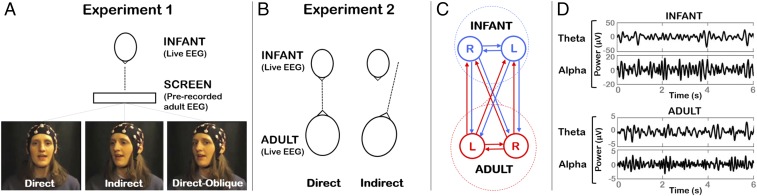
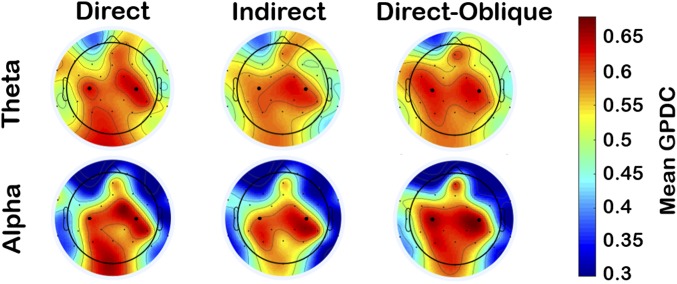
Significance: During communication, social ostensive signals (like gaze) are exchanged in a temporally contingent manner. Synchronized behavior creates social connectedness within human dyads, and even infants synchronize behaviorally with adults. However, the neural mechanisms that support infant–adult synchronization are unknown. Here, we provide evidence that infants up-regulate neural synchronization with adult partners when offered direct ostensive gaze, as compared with gaze aversion. Gaze therefore brings infant–adult neural activity into mutual alignment, creating a joint-networked state that may facilitate communicative success. Further, infants’ own communicative attempts were positively associated with adults’ neural synchronization to them, indicating mutual regulation of synchronization within infant–adult dyads. Thus, interpersonal neural synchronization may provide a mechanism by which infants construct their own earliest social networks.
Overview
The claims and statistics of this paper haven’t been checked yet.
Free: it reads the open-access text and checks the first 5 claims that cite a source we can check. Create a free account to check every claim.
Integrity signals
Registry
Cites
Statistics
Figures
Verification
Claims the paper makes
The claims and statistics of this paper haven’t been checked yet.
Free: it reads the open-access text and checks the first 5 claims that cite a source we can check. Create a free account to check every claim.
Claims other papers make about this one
Each is checked against this paper’s own text: does it say what the citing paper says it does?
The source backs part of the claim, not all of it — or backs it for a different population, condition or comparison.
In the citing paper
“In contrast, functional near-infrared spectroscopy (fNIRS) [8] and electroencephalography (EEG) [9] are wearable technologies that can be deployed in real-life settings [10,11,12], enabling more naturalistic hyperscanning.”
From Naturalistic Hyperscanning with Wearable Magnetoencephalography (2023) · cites this paper as [10]
Experimental — accuracy not yet measured
Self-check
Percentages, sums and reported differences re-computed from the paper’s own numbers.
The self-check needs the paper’s full text.
Citations
Cites
Controlling the False Discovery Rate: A Practical and Powerful Approach to Multiple Testing
Benjamini, Y., & Hochberg, Y. (1995) · Journal of the Royal Statistical Society Series B: Statistical Methodology · doi:10.1111/j.2517-6161.1995.tb02031.x · Cited by 109,482 · cited 2×
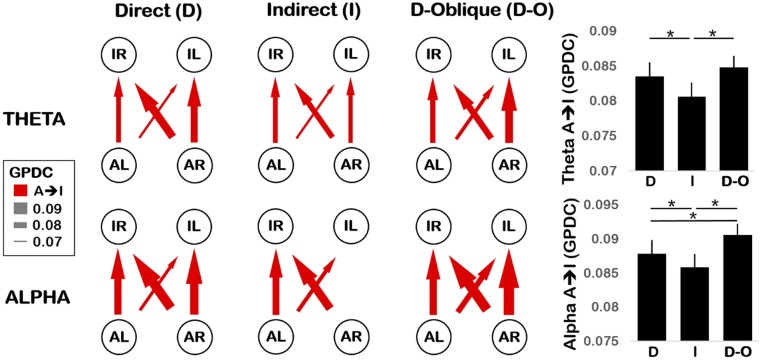
“05, Benjamini–Hochberg false discovery rate (FDR) corrected] (32) (see Fig.”
MethodInvestigating causal relations by econometric models and cross-spectral methods
Granger, C. W. J. (1969) · Econometrica · doi:10.2307/1912791 · Cited by 22,989
Adjusting batch effects in microarray expression data using empirical Bayes methods
Johnson, W. E., Li, C., & Rabinovic, A. (2007) · Biostatistics · doi:10.1093/biostatistics/kxj037 · Cited by 8,658
A Multiple Comparison Procedure for Comparing Several Treatments with a Control
Dunnett, C. W. (1955) · Journal of the American Statistical Association · doi:10.1080/01621459.1955.10501294 · Cited by 6,094 · cited 1×
“To assess the specific gaze effects at each frequency, we conducted planned pairwise comparisons using Dunnett’s multiple range t-test [29], which independently controls for familywise error rate without a prior F-test.”
MethodApprenticeship in thinking: cognitive development in social context
(1990) · Choice Reviews Online · doi:10.5860/choice.28-0612 · Cited by 5,464 · cited 2×
“Temporally contingent social interactions between adults and infants play a vital role in supporting early learning across multiple domains of language, cognition and socio-emotional development [1,2].”
BackgroundMethodApprenticeship in Thinking: Cognitive Development in Social Context
Rogoff, B. (1990) · doi:10.1093/oso/9780195059731.001.0001 · Cited by 4,709
Controlling the false discovery rate in behavior genetics research
Benjamini, Y., Drai, D., Elmer, G., Kafkafi, N., & Golani, I. (2001) · Behavioural Brain Research · doi:10.1016/s0166-4328(01)00297-2 · Cited by 4,146
Cortical oscillations and speech processing: emerging computational principles and operations
Giraud, A.-L., & Poeppel, D. (2012) · Nature Neuroscience · doi:10.1038/nn.3063 · Cited by 1,917 · cited 2×
“Previous research has also suggested that infants, like adults (20), show neural synchronization (or phase-locking) of cortical oscillatory activity to temporal structures in auditory signals (21).”
BackgroundPartial directed coherence: a new concept in neural structure determination
Baccalá, L. A., & Sameshima, K. (2001) · Biological Cybernetics · doi:10.1007/pl00007990 · Cited by 1,779 · cited 1×
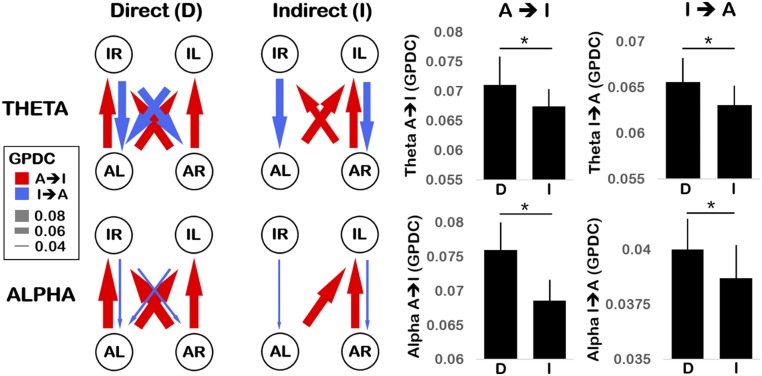
“Partial Directed Coherence (PDC) is a directional causal measure of direct flows between channels [11-13].”
BackgroundCsibra, G., & Gergely, G. (2009) · Trends in Cognitive Sciences · doi:10.1016/j.tics.2009.01.005 · Cited by 1,648
Dunbar, R. I. M., & Shultz, S. (2007) · Science · doi:10.1126/science.1145463 · Cited by 1,542
Low-frequency neuronal oscillations as instruments of sensory selection
Schroeder, C. E., & Lakatos, P. (2009) · Trends in Neurosciences · doi:10.1016/j.tins.2008.09.012 · Cited by 1,528 · cited 4×
“Further, since phase resetting optimizes information transfer between dyadic partners (33), stronger intentional signals could produce more effective phase resetting, which would increase the potential for mutual communication and learning within the dyad.”
BackgroundInfluentialEye contact detection in humans from birth
Farroni, T., Csibra, G., Simion, F., & Johnson, M. H. (2002) · Proceedings of the National Academy of Sciences · doi:10.1073/pnas.152159999 · Cited by 1,442 · cited 2×
“From birth, infants prefer to look at pictures of faces with direct gaze over averted gaze (9).”
BackgroundFeldman, R. (2007) · Journal of Child Psychology and Psychiatry · doi:10.1111/j.1469-7610.2006.01701.x · Cited by 1,317 · cited 2×
“Phase resetting due to synchronization triggers that are more prevalent during mutual than indirect gaze may, potentially, offer the means for providing contingent feedback (in which the child responds to the parent, and vice versa) within the framework of the periodic oscillatory activity that structures and scaffold…”
BackgroundBrain-to-brain coupling: a mechanism for creating and sharing a social world
Hasson, U., Ghazanfar, A. A., Galantucci, B., Garrod, S., & Keysers, C. (2012) · Trends in Cognitive Sciences · doi:10.1016/j.tics.2011.12.007 · Cited by 1,140
Determinants of Infant Behavior
&NA; (1964) · The Journal of Nervous and Mental Disease · doi:10.1097/00005053-196409000-00015 · Cited by 996
Speaker-listener neural coupling underlies successful communication
Stephens, G. J., Silbert, L. J., & Hasson, U. (2010) · Proceedings of the National Academy of Sciences · doi:10.1073/pnas.1008662107 · Cited by 970 · cited 1×
“Further, the strength of speaker–listener neural synchronization predicts communication success (26).”
BackgroundThe Emergence of the Speech Capacity
Oller, D. K. (2000) · Psychology Press eBooks · doi:10.4324/9781410602565 · Cited by 756 · cited 3×
“Infants’ vocalisations were manually coded from videos recorded during the experimental session according to Oller’s [1] infraphonological acoustic classification system.”
MethodGaze Following in Human Infants Depends on Communicative Signals
Senju, A., & Csibra, G. (2008) · Current Biology · doi:10.1016/j.cub.2008.03.059 · Cited by 749 · cited 1×
“Infants rely heavily on the temporal dynamics of facial cues such as eye contact and gaze direction to infer intention, meaning and causality [3-5], which is unsurprising given that”
Background(2001) · PubMed · Cited by 662
Social Feedback to Infants’ Babbling Facilitates Rapid Phonological Learning
Goldstein, M. H., & Schwade, J. A. (2008) · Psychological Science · doi:10.1111/j.1467-9280.2008.02117.x · Cited by 620 · cited 1×
“Similarly, Goldstein & Schwade [3] found that only infants who received live contingent feedback from their mothers showed re-structuring of their babbling patterns.”
BackgroundSocial Connection Through Joint Action and Interpersonal Coordination
Marsh, K. L., Richardson, M. J., & Schmidt, R. C. (2009) · Topics in Cognitive Science · doi:10.1111/j.1756-8765.2009.01022.x · Cited by 583
Mother and infant coordinate heart rhythms through episodes of interaction synchrony
Feldman, R., Magori-Cohen, R., Galili, G., Singer, M., & Louzoun, Y. (2011) · Infant Behavior and Development · doi:10.1016/j.infbeh.2011.06.008 · Cited by 505 · cited 1×
“For example, patterns of temporally synchronous activity between parent and child during social interaction have been noted for gaze (13), vocalizations (14), affect (15), autonomic arousal (16, 17), and hormones (18).”
BackgroundNeural Synchronization during Face-to-Face Communication
Jiang, J., Dai, B., Peng, D., Zhu, C., Liu, L., & Lu, C. (2012) · The Journal of Neuroscience · doi:10.1523/jneurosci.2926-12.2012 · Cited by 489 · cited 1×
“Limitations and Conclusion Our results converge with previous dual functional near-infrared spectroscopy (fNIRS) studies (24, 37) where greater frontal neural synchronization between adults was observed during eye contact.”
ResultThe temporal structure of face-to-face communication between mothers and infants.
Kaye, K., & Fogel, A. (1980) · Developmental Psychology · doi:10.1037//0012-1649.16.5.454 · Cited by 459 · cited 1×
“For example, patterns of temporally synchronous activity between parent and child during social interaction have been noted for gaze (13), vocalizations (14), affect (15), autonomic arousal (16, 17), and hormones (18).”
BackgroundBROOKS, R., & MELTZOFF, A. N. (2008) · Journal of Child Language · doi:10.1017/s030500090700829x · Cited by 404 · cited 3×
“Infants rely heavily on the temporal dynamics of facial cues such as eye contact and gaze direction to infer intention, meaning and causality [3-5], which is unsurprising given that”
BackgroundMethod(2007) · W W Norton & Co eBooks · Cited by 369
Cohn, J. F., & Tronick, E. Z. (1988) · Developmental Psychology · doi:10.1037/0012-1649.24.3.386 · Cited by 364
The Neurobehavioral and Social-Emotional Development of Infants and Children
Wood, W. C. (2008) · Journal of the American Academy of Child & Adolescent Psychiatry · doi:10.1097/01.chi.0b013e3181825b46 · Cited by 349
The infant's role in mother–infant communications
Murray, L., & Trevarthen, C. (1986) · Journal of Child Language · doi:10.1017/s0305000900000271 · Cited by 313 · cited 1×
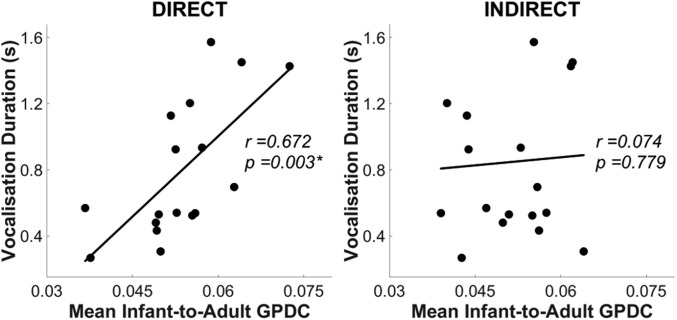
“One possible reason for this could be that infants’ vocalizations (which were communicative signals to the adult and could potentially trigger phase resetting) acted as a social feedback mechanism to positively reinforce and sustain dyadic synchronicity (8, 31, 35).”
BackgroundSensitivity of Newborn Auditory Cortex to the Temporal Structure of Sounds
Telkemeyer, S., Rossi, S., Koch, S. P., Nierhaus, T., Steinbrink, J., Poeppel, D., Obrig, H., & Wartenburger, I. (2009) · The Journal of Neuroscience · doi:10.1523/jneurosci.1246-09.2009 · Cited by 280 · cited 1×
“Previous research has also suggested that infants, like adults (20), show neural synchronization (or phase-locking) of cortical oscillatory activity to temporal structures in auditory signals (21).”
BackgroundFrom faces to hands: Changing visual input in the first two years
Fausey, C. M., Jayaraman, S., & Smith, L. B. (2016) · Cognition · doi:10.1016/j.cognition.2016.03.005 · Cited by 280 · cited 1×
“Infants rely heavily on the temporal dynamics of facial cues such as eye contact and gaze direction to infer intention, meaning, and causality (3–5), which is unsurprising given that infants’ early visual experience is heavily composed of faces (6).”
BackgroundThe teleological origins of mentalistic action explanations: A developmental hypothesis
Csibra, G., & Gergely, G. (1998) · Developmental Science · doi:10.1111/1467-7687.00039 · Cited by 255 · cited 1×
“T contingent social interactions between adults and infants play a vital role in supporting early learning across multiple domains of language, cognition, and socioemotional development (1, 2).”
BackgroundMothers' and fathers' singing to infants.
Trehub, S. E., Unyk, A. M., Kamenetsky, S. B., & Hill, D. S. (1997) · Developmental Psychology · doi:10.1037//0012-1649.33.3.500 · Cited by 242 · cited 1×
“Sung nursery rhymes were used because these are integral to play and caretaking routines with infants, such as during feeding and putting to sleep (38).”
BackgroundStress Contagion: Physiological Covariation Between Mothers and Infants
Waters, S. F., West, T. V., & Mendes, W. B. (2014) · Psychological Science · doi:10.1177/0956797613518352 · Cited by 231 · cited 1×
“For example, patterns of temporally synchronous activity between parent and child during social interaction have been noted for gaze (13), vocalizations (14), affect (15), autonomic arousal (16, 17), and hormones (18).”
Background“Stay Tuned”: Inter-Individual Neural Synchronization During Mutual Gaze and Joint Attention
Saito, D. N., Tanabe, H. C., Izuma, K., Hayashi, M. J., Morito, Y., Komeda, H., Uchiyama, H., Kosaka, H., Okazawa, H., Fujibayashi, Y., et al. (2010) · Frontiers in Integrative Neuroscience · doi:10.3389/fnint.2010.00127 · Cited by 226 · cited 1×
“Limitations and Conclusion Our results converge with previous dual functional near-infrared spectroscopy (fNIRS) studies (24, 37) where greater frontal neural synchronization between adults was observed during eye contact.”
Measuring speaker–listener neural coupling with functional near infrared spectroscopy
Liu, Y., Piazza, E. A., Simony, E., Shewokis, P. A., Onaral, B., Hasson, U., & Ayaz, H. (2017) · Scientific Reports · doi:10.1038/srep43293 · Cited by 180
Mechanisms of Eye Gaze Perception during Infancy
Farroni, T., Johnson, M. H., & Csibra, G. (2004) · Journal of Cognitive Neuroscience · doi:10.1162/0898929042304787 · Cited by 178 · cited 1×
“By 4 mo, direct gaze elicits a larger amplitude in the face-sensitive N170 event-related potential (ERP) relative to averted gaze (10), which suggests that gaze also enhances infants’ neural processing of face-related information.”
BackgroundAcoustic-Emergent Phonology in the Amplitude Envelope of Child-Directed Speech
Leong, V., & Goswami, U. (2015) · PLoS ONE · doi:10.1371/journal.pone.0144411 · Cited by 153
Self-citationSpangler, G. (1991) · Early Human Development · doi:10.1016/0378-3782(91)90116-k · Cited by 131 · cited 1×
“For example, patterns of temporally synchronous activity between parent and child during social interaction have been noted for gaze (13), vocalizations (14), affect (15), autonomic arousal (16, 17), and hormones (18).”
BackgroundSpeech vs. singing: infants choose happier sounds
Corbeil, M., Trehub, S. E., & Peretz, I. (2013) · Frontiers in Psychology · doi:10.3389/fpsyg.2013.00372 · Cited by 119 · cited 1×
“Infants are equally or more behaviorally responsive to sung compared with spoken language (39); thus, sung speech is likely to evoke a robust neural response from infants.”
BackgroundSynchrony of brains and bodies during implicit interpersonal interaction
Hari, R., Himberg, T., Nummenmaa, L., Hämäläinen, M., & Parkkonen, L. T. (2013) · Trends in Cognitive Sciences · doi:10.1016/j.tics.2013.01.003 · Cited by 118 · cited 1×
“social interactions (see [22,23] for reviews).”
Social elicitation of infant vocal behavior
Bloom, K. (1975) · Journal of Experimental Child Psychology · doi:10.1016/0022-0965(75)90025-9 · Cited by 62 · cited 4×
“Gaze also acts to release and reinforce infants’ own social responses such as smiling and vocalization (7, 8).”
BackgroundResultInfluentialAtzaba‐Poria, N., Deater-Deckard, K. D., & Bell, M. A. (2016) · Child Development · doi:10.1111/cdev.12583 · Cited by 45
Gaze following: A mechanism for building social connections between infants and adults.
Rechele Brooks, A., & Meltzoff, A. N. (2013) · American Psychological Association eBooks · doi:10.1037/14250-010 · Cited by 40
Cited by
Using second-person neuroscience to elucidate the mechanisms of social interaction
Redcay, E., & Schilbach, L. (2019) · Nature Reviews Neuroscience · doi:10.1038/s41583-019-0179-4 · Cited by 738
Accessing the Inaccessible: Redefining Play as a Spectrum
Zosh, J. M., Hirsh-Pasek, K., Hopkins, E. J., Jensen, H., Liu, C., Neale, D., Solis, S. L., & Whitebread, D. (2018) · Frontiers in Psychology · doi:10.3389/fpsyg.2018.01124 · Cited by 433
“between a parent and infant promotes neural connectivity and communication bidirectionally (Leong et al., 2017).”
BackgroundInteractional synchrony: signals, mechanisms and benefits
Hoehl, S., Fairhurst, M., & Schirmer, A. (2021) · Social Cognitive and Affective Neuroscience · doi:10.1093/scan/nsaa024 · Cited by 231
“, 2017) and theta band (Leong et al., 2017) as well as for different phase measures including phase coupling between individuals (Novembre et al.”
BackgroundThe effects of interaction quality on neural synchrony during mother-child problem solving
Nguyen, T., Schleihauf, H., Kayhan, E., Matthes, D., Vrtička, P., & Hoehl, S. (2020) · Cortex · doi:10.1016/j.cortex.2019.11.020 · Cited by 225
“Consequently, the coupling of rhythmic brain activity can emerge dyadically through language or motion, but can be also externally triggered through joint attention or music (Cirelli, Trehub, & Trainor, 2018; Leong et al., 2017; Nummenmaa, Lahnakoski, & Glerean, 2018).”
BackgroundResultInfluentialInfant and Adult Brains Are Coupled to the Dynamics of Natural Communication
Piazza, E. A., Hasenfratz, L., Hasson, U., & Lew-Williams, C. (2020) · Psychological Science · doi:10.1177/0956797619878698 · Cited by 202
“indirect) gaze (Leong et al., 2017) and showing parents’ neural responsiveness to infants’ attention (Wass et al.”
BackgroundResult
Metadata
- Authors
- Leong, V., Byrne, E., Clackson, K., Georgieva, S., Lam, S., & Wass, S.
- Affiliations
- Nanyang Technological University (SG)
- MRC Cognition and Brain Sciences Unit (GB)
- University of Cambridge (GB)
- University of East London (GB)
- Corresponding author
- Leong, Victoria
- Venue
- Proceedings of the National Academy of Sciences
- Publisher
- National Academy of Sciences
- Published
- 2017-11-28
- Volume
- 114
- Issue
- 50
- Pages
- 13290-13295
- ISSN
- 0027-8424 (ISSN-L)
- 1091-6490
- PMC
- PMC5740679
- OpenAlex
- W2951647174
- Cited by
- 299
- References
- 45
- Citations by year
- 2026: 31 · 2025: 31 · 2024: 31 · 2023: 39 · 2022: 41 · 2021: 42 · 2020: 39 · 2019: 32 · 2018: 13
- FWCI
- 32.91
- Type
- journal article
- Language
- en
- Open access
- hybrid
- doi.org
- Licence
- Locations
- Proceedings of the National Academy of Sciences (publishedVersion, cc-by-nc-nd)
- bioRxiv (Cold Spring Harbor Laboratory) (acceptedVersion, cc-by-nc-nd)
- Europe PMC (PubMed Central) (publishedVersion, cc-by-nc-nd)
- PubMed Central (publishedVersion, cc-by-nc-nd)
- PubMed (publishedVersion)
- UEL Research Repository (University of East London) (acceptedVersion)
- DR-NTU (Nanyang Technological University) (submittedVersion)
- UEL Research Repository (University of East London) (submittedVersion, cc-by-nc-nd)
- UEA Digital Repository (University of East Anglia) (submittedVersion)
- Apollo (University of Cambridge) (submittedVersion)
- Apollo
- Funders
- RCUK | Economic and Social Research Council (ES/N006461/1, ES/N017560/1)
- Lucy Cavendish College, Cambridge University (Junior Research Fellowship)
- Topics
- Social Sciences › Psychology › Social Psychology › Action Observation and Synchronization
- Social Sciences › Psychology › Developmental and Educational Psychology › Child and Animal Learning Development
- Life Sciences › Neuroscience › Cognitive Neuroscience › Neural dynamics and brain function
- Keywords
- infant gaze, direct gaze, adult-infant interaction, neuronal synchronization, information coupling, infant vocalizations, early communication, partial directed coherence, Granger causality
- MeSH terms
- Adult, Brain, Female, Fixation, Ocular, Humans, Infant, Language, Male, Nonverbal Communication, Speech Perception
About these checks
Registry, retraction, Cites and statistics results are computed, not judged, with one exception: a printed reference that no index lists is read once by a model before it counts as a citation error. Claims are extracted by a model and kept only when their quote appears verbatim in the text; each cited source is then checked, with a model’s help, for whether it says what the claim relies on. Those verdicts can be wrong — read the claim’s quote and the cited source before relying on one.
Statistics and arithmetic are recomputed, not judged.
Confidence bands are shown only for fields calibrated on our annotated test set. None is calibrated yet, so no band is shown.
What counts as a claim ›How we measure confidence ›How we check this ›
Are you an author, or do you see a problem with this page? Request a review
Data sources
Bibliographic data: Semantic Scholar, OpenAlex, Crossref.
Contains information from the Semantic Scholar Academic Graph Datasets, made available under the ODC Attribution License (ODC-BY 1.0).
Semantic Scholar’s data is described in: Kinney, R., et al. (2023). The Semantic Scholar Open Data Platform. arXiv:2301.10140.
