

The DOI matches its Crossref record; 71 of the 71 references it cites were found in a registry or an index.
Cell-specific and region-specific transcriptomics in the multiple sclerosis model: Focus on astrocytes
Open accessAbstract
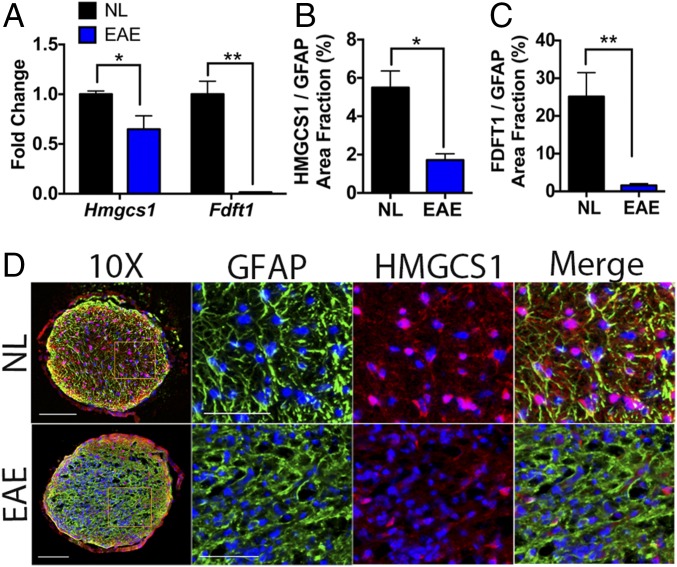
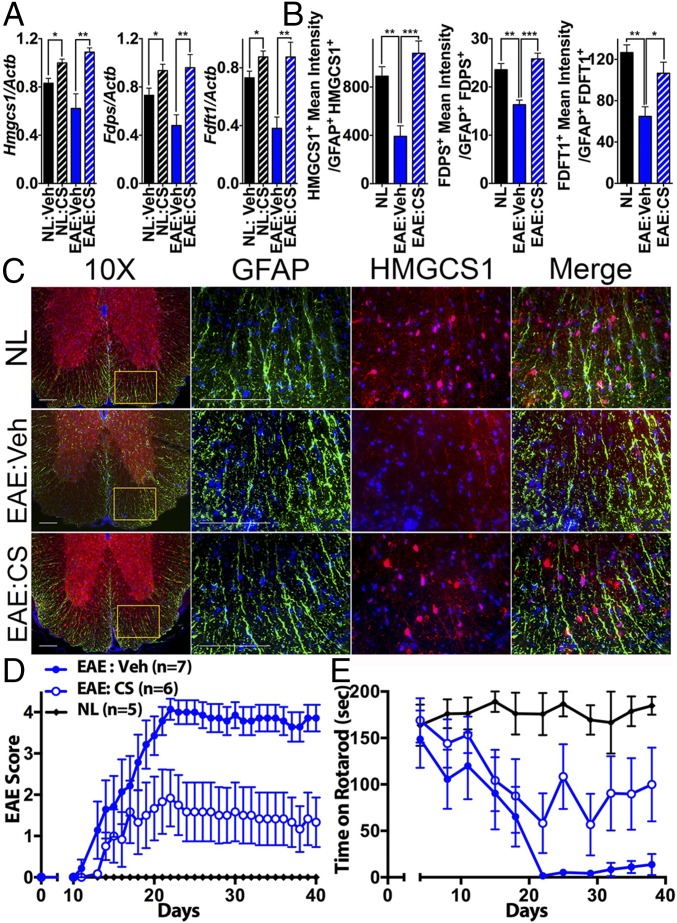
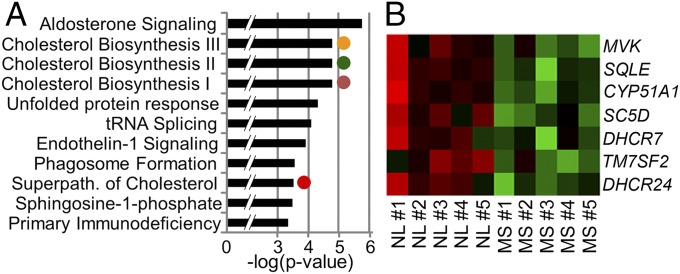
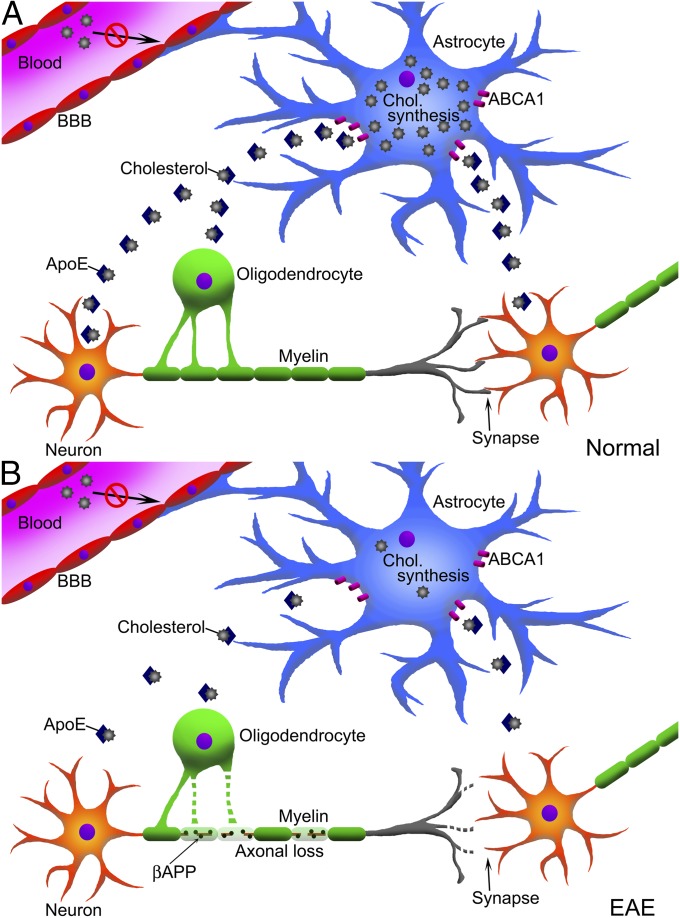
Significance: Molecular mechanisms underlying distinct disabilities during neurological diseases may differ based on the neurological pathway involved. Multiple sclerosis (MS) is multifocal, characterized by distinct disabilities affecting walking, vision, cognition, and fatigue. Neuroprotective treatments tailored for each disability may be more effective than nonspecific treatments aiming to reduce a composite of disabilities in clinical trials. Here, we use the MS model to apply a cell-specific and region-specific gene expression approach to discover targets in distinct neuroanatomic regions. Altered cholesterol synthesis gene expression in astrocytes in spinal cord and optic nerve was identified as a potential target for walking and visual disabilities, respectively. This disability-specific discovery approach represents a strategy for finding neuroprotective treatments for multifocal neurodegenerative diseases.
Overview
The claims and statistics of this paper haven’t been checked yet.
Run the check — free, no account needed. It reads the open-access text and checks the sources it cites.
Integrity signals
Registry
Cites
Statistics
Figures
Verification
Claims the paper makes
The claims and statistics of this paper haven’t been checked yet.
Run the check — free, no account needed. It reads the open-access text and checks the sources it cites.
Claims other papers make about this one
Each is checked against this paper’s own text: does it say what the citing paper says it does?
The source backs part of the claim, not all of it — or backs it for a different population, condition or comparison.
In the citing paper
“Such transcriptomic profiling specifically shows that reactive astrocytes adopt distinct molecular states in different disease models48,66–70, in different CNS regions70, and in brain tumors71.”
From Reactive astrocyte nomenclature, definitions, and future directions (2021) · cites this paper as [70]
Experimental — accuracy not yet measuredThe cited source says what the claim attributes to it.
In the citing paper
“Likewise, reactive astrocytes are also diverse, as unequivocally demonstrated by microarray-based66–68 and RNAseq-based48,69–71 transcriptomic profiling of mouse bulk astrocytes48,66–70 or of astrocyte populations preselected according to cell-surface markers71.”
From Reactive astrocyte nomenclature, definitions, and future directions (2021) · cites this paper as [70]
The cited source says what the claim attributes to it.
In the citing paper
“These studies also suggested complex functional changes in reactive astrocytes, including novel regenerative functions70, proliferation, and neural stem cell potential68, as well as loss of homeostatic functions66.”
From Reactive astrocyte nomenclature, definitions, and future directions (2021) · cites this paper as [70]
Self-check
Percentages, sums and reported differences re-computed from the paper’s own numbers.
The self-check needs the paper’s full text.
Citations
Cites
Cognitive impairment in multiple sclerosis
Chiaravalloti, N. D., & DeLuca, J. (2008) · The Lancet Neurology · doi:10.1016/s1474-4422(08)70259-x · Cited by 2,088
Astrocyte scar formation aids central nervous system axon regeneration
Anderson, M. A., Burda, J. E., Ren, Y., Ao, Y., O’Shea, T. M., Kawaguchi, R., Coppola, G., Khakh, B. S., Deming, T. J., & Sofroniew, M. V. (2016) · Nature · doi:10.1038/nature17623 · Cited by 1,851
Self-citationCNS synaptogenesis promoted by glia-derived cholesterol
Mauch, D. H., Nägler, K., Schumacher, S., Göritz, C., Müller, E.-C., Otto, A., & Pfrieger, F. W. (2001) · Science · doi:10.1126/science.294.5545.1354 · Cited by 1,711
Diversity of astrocyte functions and phenotypes in neural circuits
Khakh, B. S., & Sofroniew, M. V. (2015) · Nature Neuroscience · doi:10.1038/nn.4043 · Cited by 1,239
Self-citationAstrocyte barriers to neurotoxic inflammation
Sofroniew, M. V. (2015) · Nature Reviews Neuroscience · doi:10.1038/nrn3898 · Cited by 1,202
Self-citationMicroglia development follows a stepwise program to regulate brain homeostasis
Matcovitch-Natan, O., Winter, D. R., Giladi, A., Vargas Aguilar, S., Spinrad, A., Sarrazin, S., Ben-Yehuda, H., David, E., Zelada González, F., Perrin, P., et al. (2016) · Science · doi:10.1126/science.aad8670 · Cited by 1,180
Youssef, S., Stüve, O., Patarroyo, J. C., Ruiz, P. J., Radosevich, J. L., Hur, E. M., Bravo, M., Mitchell, D. J., Sobel, R. A., Steinman, L., et al. (2002) · Nature · doi:10.1038/nature01158 · Cited by 1,096
Cell-type-specific isolation of ribosome-associated mRNA from complex tissues
Sanz, E., Yang, L., Su, T., Morris, D. R., McKnight, G. S., & Amieux, P. S. (2009) · Proceedings of the National Academy of Sciences · doi:10.1073/pnas.0907143106 · Cited by 976
High cholesterol level is essential for myelin membrane growth
Saher, G., Brügger, B., Lappe-Siefke, C., Möbius, W., Tozawa, R.-I., Wehr, M. C., Wieland, F., Ishibashi, S., & Nave, K.-A. (2005) · Nature Neuroscience · doi:10.1038/nn1426 · Cited by 799
Differential regulation of central nervous system autoimmunity by TH1 and TH17 cells
Stromnes, I. M., Cerretti, L., Liggitt, D., Harris, R. A., & Goverman, J. M. (2008) · Nature Medicine · doi:10.1038/nm1715 · Cited by 644
Cited by
Sorted by citations
Reactive astrocyte nomenclature, definitions, and future directions
Escartin, C., Galea, E., Lakatos, A., O’Callaghan, J. P., Petzold, G. C., Serrano-Pozo, A., Steinhäuser, C., Volterra, A., Carmignoto, G., Agarwal, A., et al. (2021) · Nature Neuroscience · doi:10.1038/s41593-020-00783-4 · Cited by 2,513
Self-citationIdentification of region-specific astrocyte subtypes at single cell resolution
Batiuk, M. Y., Martirosyan, A., Wahis, J., de Vin, F., Marneffe, C., Kusserow, C., Koeppen, J., Viana, J. F., Oliveira, J. F., Voet, T., et al. (2020) · Nature Communications · doi:10.1038/s41467-019-14198-8 · Cited by 805
Astrocyte Reactivity: Subtypes, States, and Functions in CNS Innate Immunity
Sofroniew, M. V. (2020) · Trends in Immunology · doi:10.1016/j.it.2020.07.004 · Cited by 721
Self-citationFunction and therapeutic value of astrocytes in neurological diseases
Lee, H.-G., Wheeler, M. A., & Quintana, F. J. (2022) · Nature Reviews Drug Discovery · doi:10.1038/s41573-022-00390-x · Cited by 662
MAFG-driven astrocytes promote CNS inflammation
Wheeler, M. A., Clark, I. C., Tjon, E. C., Li, Z., Zandee, S. E. J., Couturier, C. P., Watson, B. R., Scalisi, G., Alkwai, S., Rothhammer, V., et al. (2020) · Nature · doi:10.1038/s41586-020-1999-0 · Cited by 501
Metadata
- Authors
- Itoh, N., Itoh, Y., Tassoni, A., Ren, E., Kaito, M., Ohno, A., Ao, Y., Farkhondeh, V., Johnsonbaugh, H., Burda, J., Sofroniew, M. V., & Voskuhl, R. R.
- Affiliations
- University of California, Los Angeles (US)
- Department of Neurobiology, University of California, Los Angeles, CA 90095
- Corresponding author
- Voskuhl, Rhonda R.
- ORCID
- Venue
- Proceedings of the National Academy of Sciences
- Publisher
- National Academy of Sciences
- Published
- 2017-12-26
- Volume
- 115
- Issue
- 2
- Pages
- E302-E309
- ISSN
- 0027-8424 (ISSN-L)
- 1091-6490
- PMC
- PMC5777065
- OpenAlex
- W2777702274
- Cited by
- 253
- References
- 71
- Citations by year
- 2026: 10 · 2025: 22 · 2024: 25 · 2023: 38 · 2022: 37 · 2021: 42 · 2020: 40 · 2019: 27 · 2018: 12
- FWCI
- 16.96
- Type
- journal article
- Language
- en
- Open access
- hybrid
- doi.org
- Licence
- Locations
- Proceedings of the National Academy of Sciences (publishedVersion, cc-by-nc-nd)
- Europe PMC (PubMed Central) (publishedVersion, cc-by-nc-nd)
- PubMed Central (publishedVersion, cc-by-nc-nd)
- PubMed (publishedVersion)
- eScholarship (California Digital Library) (submittedVersion)
- eScholarship (California Digital Library) (submittedVersion, cc-by-nc-nd)
- Funders
- Conrad N. Hilton Foundation (20150232)
- Office of Extramural Research, National Institutes of Health (R01NS096748)
- California Community Foundation (BAPP-15-118094)
- Topics
- Health Sciences › Medicine › Clinical Neurology › Multiple Sclerosis Research Studies
- Life Sciences › Neuroscience › Neurology › Neuroinflammation and Neurodegeneration Mechanisms
- Life Sciences › Biochemistry, Genetics and Molecular Biology › Molecular Biology › Single-cell and spatial transcriptomics
- Keywords
- multiple sclerosis, experimental autoimmune encephalomyelitis, astrocytes, region-specific gene expression, RiboTag, cholesterol biosynthesis, neuroinflammation, spinal cord, optic nerve, optic chiasm, cerebellum, cerebral cortex, hippocampus, multifocality
- MeSH terms
- Animals, Astrocytes, Cholesterol, Encephalomyelitis, Autoimmune, Experimental, Gene Expression Regulation, Homeostasis, Mice, Inbred C57BL, Multiple Sclerosis, RNA, Messenger, Down-Regulation, Up-Regulation, Mice, Transcriptome
About these checks
Registry, retraction, Cites and statistics results are computed, not judged, with one exception: a printed reference that no index lists is read once by a model before it counts as a citation error. Claims are extracted by a model and kept only when their quote appears verbatim in the text; each cited source is then checked, with a model’s help, for whether it says what the claim relies on. Those verdicts can be wrong — read the claim’s quote and the cited source before relying on one.
Statistics and arithmetic are recomputed, not judged.
Confidence bands are shown only for fields calibrated on our annotated test set. None is calibrated yet, so no band is shown.
What counts as a claim ›How we measure confidence ›How we check this ›
Are you an author, or do you see a problem with this page? Request a review
