

The DOI matches its Crossref record; 72 of the 72 references it cites were found in a registry or an index.
Genetic analysis of social-class mobility in five longitudinal studies
Open accessAbstract
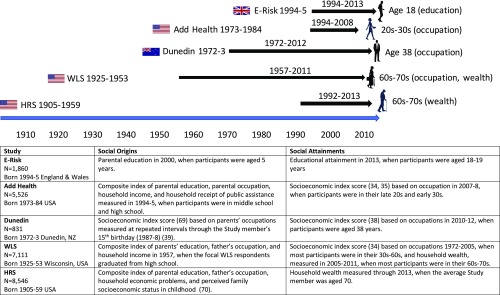
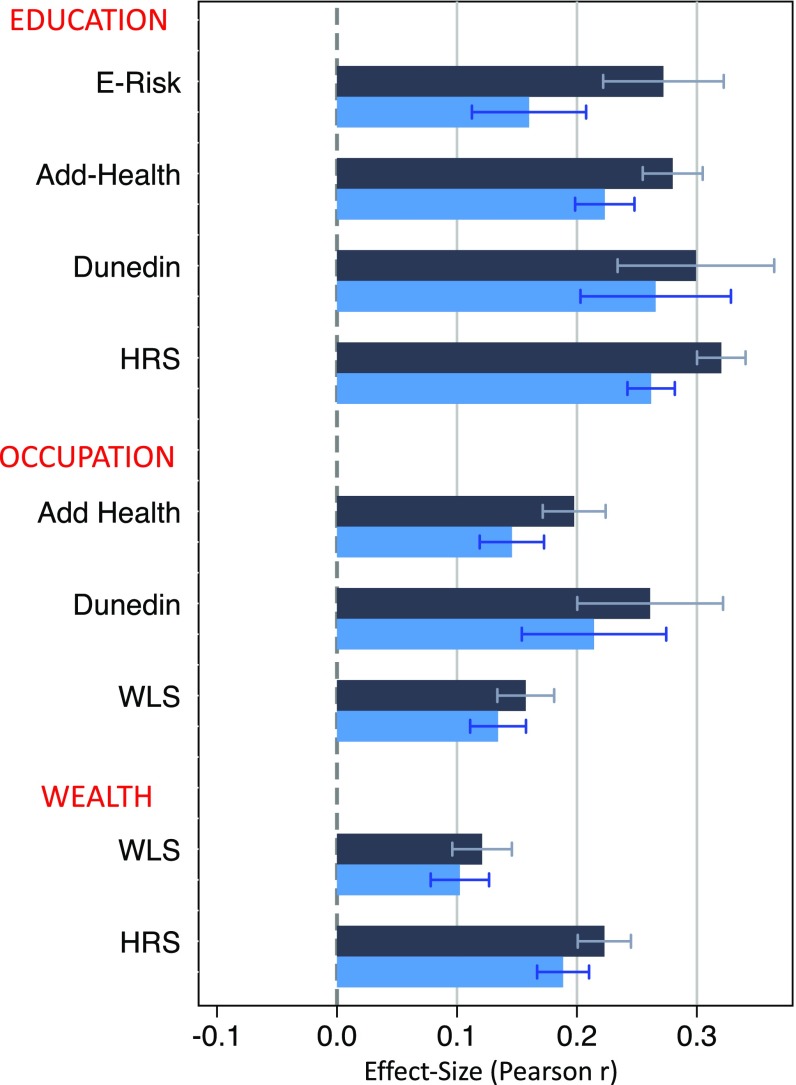
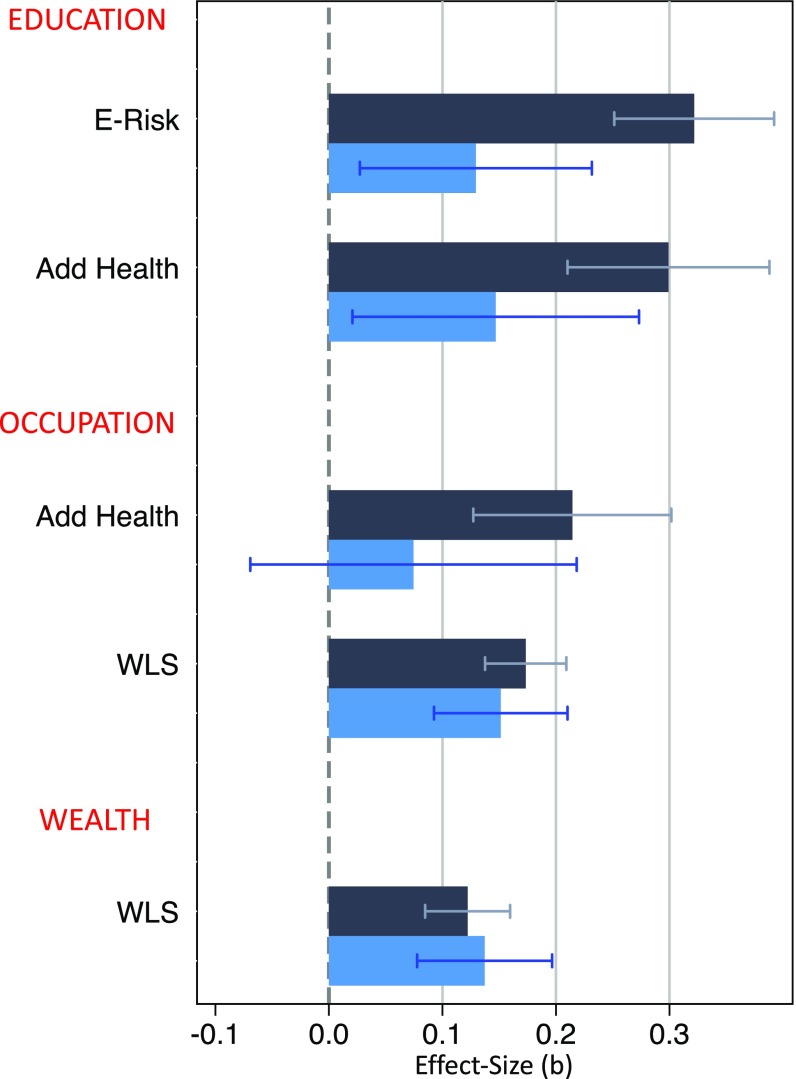
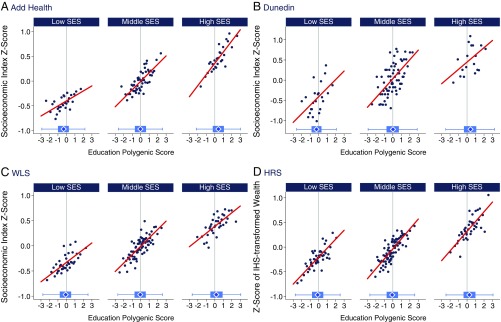
Significance: Genome-wide association study (GWAS) discoveries about educational attainment have raised questions about the meaning of the genetics of success. These discoveries could offer clues about biological mechanisms or, because children inherit genetics and social class from parents, education-linked genetics could be spurious correlates of socially transmitted advantages. To distinguish between these hypotheses, we studied social mobility in five cohorts from three countries. We found that people with more education-linked genetics were more successful compared with parents and siblings. We also found mothers’ education-linked genetics predicted their children’s attainment over and above the children’s own genetics, indicating an environmentally mediated genetic effect. Findings reject pure social-transmission explanations of education GWAS discoveries. Instead, genetics influences attainment directly through social mobility and indirectly through family environments.
Overview
The claims and statistics of this paper haven’t been checked yet.
Run the check — free, no account needed. It reads the open-access text and checks the sources it cites.
Integrity signals
Registry
Cites
Statistics
Figures
Verification
Claims the paper makes
The claims and statistics of this paper haven’t been checked yet.
Run the check — free, no account needed. It reads the open-access text and checks the sources it cites.
Claims other papers make about this one
Each is checked against this paper’s own text: does it say what the citing paper says it does?
The cited source says what the claim attributes to it.
In the citing paper
“This remainder is due to assortment on phenotypes correlated with the EA PGI other than EA, cognitive performance, and vocabulary—possibly including various personality traits42-44—and sources of social homogamy other than genetic ancestry captured by the top 40 PCs—possibly including geographic location at courtship age45,46, socioeconomic status, and social class47.”
From Polygenic prediction of educational attainment within and between families from genome-wide association analyses in 3 million individuals (2022) · cites this paper as [47]
Self-check
Percentages, sums and reported differences re-computed from the paper’s own numbers.
The self-check needs the paper’s full text.
Citations
Cites
Principal components analysis corrects for stratification in genome-wide association studies
Price, A. L., Patterson, N. J., Plenge, R. M., Weinblatt, M. E., Shadick, N. A., & Reich, D. (2006) · Nature Genetics · doi:10.1038/ng1847 · Cited by 10,248 · cited 1×
“Within each dataset, we regressed SSGAC-computed polygenic scores on the first 10 principal components estimated from the genome-wide SNP data (67) and calculated residual values.”
MethodSocial conditions as fundamental causes of disease.
Link, B. G., & Phelan, J. (1995) · Journal of Health and Social Behavior · doi:10.2307/2626958 · Cited by 5,722
The American Occupational Structure.
Blalock, H. M., Blau, P. M., Duncan, O. D., & Tyrée, A. (1968) · American Sociological Review · doi:10.2307/2092399 · Cited by 4,412
An atlas of genetic correlations across human diseases and traits
ReproGen Consortium, Bulik-Sullivan, B., Psychiatric Genomics Consortium, Genetic Consortium for Anorexia Nervosa of the Wellcome Trust Case Control Consortium 3, Finucane, H. K., Anttila, V., Gusev, A., Day, F. R., Loh, P.-R., Duncan, L., et al. (2015) · Nature Genetics · doi:10.1038/ng.3406 · Cited by 4,255
10 Years of GWAS Discovery: Biology, Function, and Translation
Visscher, P. M., Wray, N. R., Zhang, Q., Sklar, P., McCarthy, M. I., Brown, M. A., & Yang, J. (2017) · The American Journal of Human Genetics · doi:10.1016/j.ajhg.2017.06.005 · Cited by 3,719
How People Make Their Own Environments: A Theory of Genotype Environment Effects
Scarr, S., & McCartney, K. (1983) · Child Development · doi:10.1111/j.1467-8624.1983.tb03884.x · Cited by 2,895 · cited 3×
“This evidence supports theory in the social sciences that frames genetics as one mechanism among several through which social position is transmitted across generations (9, 20, 21, 59).”
BackgroundSocial Conditions as Fundamental Causes of Disease
Link, B. G., & Phelan, J. C. (1995) · PubMed · doi:10.13016/rpln-eiwa · Cited by 2,684
23andMe Research Team, Lee, J. J., COGENT (Cognitive Genomics Consortium), Social Science Genetic Association Consortium, Wedow, R., Okbay, A., Kong, E., Maghzian, O., Zacher, M., Nguyen-Viet, T. A., et al. (2018) · Nature Genetics · doi:10.1038/s41588-018-0147-3 · Cited by 2,470
Self-citationMeta-analysis of the heritability of human traits based on fifty years of twin studies
Polderman, T. J. C., Benyamin, B., de Leeuw, C. A., Sullivan, P. F., van Bochoven, A., Visscher, P. M., & Posthuma, D. (2015) · Nature Genetics · doi:10.1038/ng.3285 · Cited by 2,467
An Equilibrium Theory of the Distribution of Income and Intergenerational Mobility
Becker, G. S., & Tomes, N. (1979) · Journal of Political Economy · doi:10.1086/260831 · Cited by 2,243 · cited 1×
“This evidence supports theory in the social sciences that frames genetics as one mechanism among several through which social position is transmitted across generations (9, 20, 21, 59).”
Background
Research works printed but not linked: 2
- J Lee, , Gene discovery and polygenic prediction from a 1.1-million-person GWAS of educational attainment. Nat Genet, in press.
- WB Elley, JC Irving, Revised socioeconomic index for New-Zealand. N Z J Educ Stud 11, 25–36 (1976).
Cited by
Sorted by citations
Items 201–300 of 318
Incarceration, polygenic risk, and depressive symptoms among males in late adulthood
Liu, H., Tanksley, P. T., Motz, R. T., Kail, R. M., & Barnes, J. C. (2021) · Social Science Research · doi:10.1016/j.ssresearch.2021.102683 · Cited by 3
Socioeconomic and genomic roots of verbal ability from current evidence
Guo, G., Lin, M.-J., & Harris, K. M. (2022) · npj Science of Learning · doi:10.1038/s41539-022-00137-8 · Cited by 8
Self-citationNeighborhood Contexts, Family Characteristics, and Non-Cognitive Skills among Adolescents
Pai, M., Barr, P. B., & Schnellinger, R. P. (2023) · Journal of Human Behavior in the Social Environment · doi:10.1080/10911359.2023.2292233 · Cited by 3
“Family socioeconomic status (SES) was composed of the first principal component (~53% of the variance) across parental education, parental occupation, household income, and household receipt of public assistance (Belsky et al., 2018).”
Goings, T. C., Martinez, A., Joseph, P. L., Goode, R. W., & Bauer, D. J. (2023) · Journal of Psychoactive Drugs · doi:10.1080/02791072.2023.2297193 · Cited by 3
The 20-year documentary of genetic nurturing: The realization of Harris’s insight
Grigorenko, E. L. (2024) · Developmental Review · doi:10.1016/j.dr.2024.101151 · Cited by 3
Exploring Genetic Influences on Birth WeightPreprint
Trejo, S. (2020) · doi:10.31235/osf.io/7j59q · Cited by 3
The Economics and Econometrics of Gene-Environment InterplayPreprint
Biroli, P., Galama, T. J., von Hinke, S., van Kippersluis, H., Rietveld, C. A., & Thom, K. (2022) · SSRN Electronic Journal · doi:10.2139/ssrn.4048082 · Cited by 4
Gene-Environment Pathways to Cognitive Intelligence and Psychotic-Like Experiences in ChildrenPreprint
Park, J., Lee, E., Cho, G., Hwang, H., Kim, B., Kim, G., Joo, Y. Y., & Cha, J. (2023) · doi:10.7554/elife.88117.3 · Cited by 3
Schnettler, S., & Huinink, J. J. (2024) · KZfSS Kölner Zeitschrift für Soziologie und Sozialpsychologie · doi:10.1007/s11577-024-00972-0 · Cited by 3
Wu, Q., Klinkhammer, H., Kunwar, K., Staerk, C., Maj, C., & Mayr, A. J. (2026) · Proceedings of the National Academy of Sciences · doi:10.1073/pnas.2529164123 · Cited by 2
“…LDL vPRS showed larger LDL reductions associated with statin use, while individuals with higher BMI vPRS showed stronger associations with physical activity and sedentary behavior, highlighting an application of PRS in gene–environment interactions with potential implications for personalized…”
Predicting Cognitive-Ability Differences from Genetic and Brain-Imaging Data
Willoughby, E. A., & Lee, J. J. (2021) · Cambridge University Press eBooks · doi:10.1017/9781108635462.022 · Cited by 2
Decoupling Genetics from Attainments: The Role of Social Environments
Fletcher, J. M. (2019) · Economics & Human Biology · doi:10.1016/j.ehb.2023.101259 · Cited by 2
Self-citationPolygenic scores for social science: Clarification, consensus, and controversy
BURT, C. H. (2023) · Behavioral and Brain Sciences · doi:10.1017/s0140525x23000845 · Cited by 2
Lippert, A. M., Corsi, D. J., Kim, R., Wedow, R., Kim, J., Taddess, B. A., & Subramanian, S. V. (2024) · Nicotine & Tobacco Research · doi:10.1093/ntr/ntae146 · Cited by 2
Self-citationTrejo, S., & Kanopka, K. (2024) · Proceedings of the National Academy of Sciences · doi:10.1073/pnas.2405725121 · Cited by 2
Genetic Endowments, Educational Outcomes, and the Moderating Influence of School Quality
Arold, B. W., Hufe, P., & Stöckli, M. (2025) · Journal of Political Economy Microeconomics · doi:10.1086/738878 · Cited by 2
Mackenbach, J. P. (2019) · Oxford University Press eBooks · doi:10.1093/oso/9780198831419.003.0006 · Cited by 2
BURT, C. H. (2022) · Behavioral and Brain Sciences · doi:10.1017/s0140525x21001552 · Cited by 2
Moral Hazard Heterogeneity: Genes and Health Insurance Influence Smoking after a Health ShockPreprint
Biroli, P., & Zwyssig, L. (2021) · bioRxiv (Cold Spring Harbor Laboratory) · doi:10.1101/2021.03.05.434163 · Cited by 3
“factors shaping health behaviors, we contribute to the burgeoning literature studying geneenvironment interactions (Barcellos, Carvalho and Turley, 2018; Belsky et al., 2018; Caspi et al., 2002; Fletcher, 2012; Papageorge and Thom, 2020; Schmitz and Conley, 2017a,b; Wedow et al., 2018).”
BackgroundGene-Environment Effects on Female FertilityPreprint
Barban, N., Cao, E. D., & Francesconi, M. (2021) · SSRN Electronic Journal · doi:10.2139/ssrn.3938650 · Cited by 4
Genetic Endowments, Income Dynamics, and Wealth Accumulation Over the LifecyclePreprint
Barth, D. J., Papageorge, N., Thom, K., & Velásquez‐Giraldo, M. (2022) · SSRN Electronic Journal · doi:10.2139/ssrn.4182029 · Cited by 2
Dobewall, H., Vaalavuo, M., Böckerman, P., Viinikainen, J., Sirniö, O., Kantojärvi, K., Pehkonen, J., Raitakari, O. T., & Lehtimäki, T. J. (2024) · doi:10.31235/osf.io/g453y · Cited by 2
Mackenbach, J. P. (2019) · Oxford University Press eBooks · doi:10.1093/oso/9780198831419.003.0003 · Cited by 1
Evolution, biology, and society
Hopcroft, R. L., Dippong, J., Liu, H., & Kail, R. M. (2022) · Edward Elgar Publishing eBooks · doi:10.4337/9781789909432.00021 · Cited by 1
Rasmussen, S. H. R., Weinschenk, A. C., Dawes, C. T., Hjelmborg, J., & Klemmensen, R. (2022) · Social Psychological and Personality Science · doi:10.1177/19485506221137161 · Cited by 1
“For example, we know from previous studies that genes associated with educational attainment are also associated with social mobility and inequality (Barth et al., 2020; Belsky et al., 2018; McGue et al., 2020).”
Genetics for ‘equality’? The politics of knowledge production in educational genomics
Kotouza, D. (2025) · History of the Human Sciences · doi:10.1177/09526951251314314 · Cited by 1
“Belsky et al. (2018) claim their research proves PGIs for EA are ‘ not confounded ’ by parental levels of education (Belsky et al. , 2018), although, as Lee et al. (2018) reveal, when demographic characteristics such as income and parental education are controlled for, the PGI for EA predicts only…”
Lessons in adjusting for genetic confounding in population research on education and health
Zacher, M. L., & Wedow, R. (2025) · SSM - Population Health · doi:10.1016/j.ssmph.2025.101834 · Cited by 1
Self-citationLeban, L., & Doherty, S. L. (2025) · Victims & Offenders · doi:10.1080/15564886.2025.2505031 · Cited by 1
“Socioeconomic status was measured using a principal components analysis score combining parent education, parent occupation, household income, and household receipt of public assistance (Belsky et al., 2018).”
¿Una explicación del conflicto social? clase social y fundamentos morales. Tres metaanálisis
Castilla-Estévez, D. (2025) · International journal of psychological research · doi:10.21500/20112084.6456 · Cited by 1
“The relationship between education level, income, and socioeconomic status has been shown in various studies (Belsky et al., 2018; Kim et al., 2015; Wright & Perrone, 1977), and their relationship with human morality has also been investigated, although the number of studies involved had been…”
Fanelli, G., Chatwin, H., Holde, K. E. V., Demontis, D., Børglum, A. D., Mortensen, P. B., Vilhjálmsson, B. J., Bulik, C. M., Serretti, A., Fabbri, C., et al. (2026) · Journal of the American Academy of Child & Adolescent Psychiatry · doi:10.1016/j.jaac.2026.06.017 · Cited by 1
Timpson, N. J., & Dudbridge, F. (2018) · Wellcome Open Research · doi:10.12688/wellcomeopenres.14870.1 · Cited by 1
Patterns of health inequalities explained
Mackenbach, J. P. (2019) · Oxford University Press eBooks · doi:10.1093/oso/9780198831419.003.0004 · Cited by 1
The relational genomics of cognitive function: A longitudinal study
Das, A. (2021) · Social Science & Medicine · doi:10.1016/j.socscimed.2021.113698 · Cited by 1
Mutations du mythe de l’ADN, étapes de matérialisation du gène
Dheur, S., & Saupe, S. J. (2021) · Tracés · doi:10.4000/traces.12265 · Cited by 1
Paternal Incarceration, Polygenic Scores, and Children’s Educational Attainment
Liu, H., & Clark, B. (2022) · Journal of Developmental and Life-Course Criminology · doi:10.1007/s40865-022-00213-y · Cited by 1
“This is likely because lower education polygenic scores are associated with a number of predictors of higher incarceration risk, such as lower education, lower income, and higher risk of criminal behavior (Belsky et al., 2018; Liu, 2019; Liu et al., 2021; Wertz et al., 2018).”
BackgroundMethodInfluentialIdentifying Genetic Loci Associated with Complex Trait Variability
Miao, J., & Lu, Q. (2022) · Springer handbooks of computational statistics · doi:10.1007/978-3-662-65902-1_13 · Cited by 1
Sechs Paradigmen der Persönlichkeitspsychologie
Neyer, F. J., & Asendorpf, J. B. (2024) · Springer eBooks · doi:10.1007/978-3-662-67385-0_2 · Cited by 1
Reynolds, A., Greenfield, E. A., & Nepomnyaschy, L. (2024) · Advances in Life Course Research · doi:10.1016/j.alcr.2024.100608 · Cited by 1
Graham, C., Hummer, R. A., & Halpern, C. T. (2024) · Social Science & Medicine · doi:10.1016/j.socscimed.2024.117548 · Cited by 1
Chen, J., & Weng, A. X. (2025) · Economics & Human Biology · doi:10.1016/j.ehb.2025.101498 · Cited by 1
Les scores polygéniques pangénomiques comme nouvelle forme de mesure de l’humain
Dheur, S., & Saupe, S. J. (2020) · Bulletin d’histoire et d’épistémologie des sciences de la vie · doi:10.3917/bhesv.271.0067 · Cited by 2
Genetic Contribution to Concern for Nature and Proenvironmental Behavior
Chang, C., Nghiem, T. P. L., Fan, Q., Tan, C. L. Y., Oh, R. R. Y., Lin, B. B., Shanahan, D. F., Fuller, R. A., Gaston, K. J., & Carrasco, L. R. (2021) · BioScience · doi:10.1093/biosci/biab103 · Cited by 1
Kirkegaard, E. O. W., & Carl, N. (2022) · Comparative Sociology · doi:10.1163/15691330-bja10063 · Cited by 1
Ericsson, M. (2019) · Figshare · Cited by 1
Cognitive Functioning and Socioeconomic Status across the Early Life CoursePreprint
Reason, M., Yang, Y. C., Aiello, A. E., Belsky, D. W., Harris, K. M., Plassman, B. L., & Stebbins, R. C. (2020) · doi:10.31235/osf.io/mtu2h · Cited by 1
Self-citationPereira, R. D. (2022) · SSRN Electronic Journal · doi:10.2139/ssrn.4116304 · Cited by 1
Gene-Environment Pathways to Cognitive Development and Psychotic-Like Experiences in ChildrenPreprint
Park, J., Lee, E., Cho, G., Hwang, H., Kim, B., Kim, G., Joo, Y. Y., & Cha, J. (2023) · doi:10.7554/elife.88117.1 · Cited by 1
Tanksley, P. T., Logan, M. W., & Barnes, J. C. (2023) · medRxiv · doi:10.1101/2023.06.26.23291910 · Cited by 1
Sbarra, D. A., Trejo, S., Harden, K. P., Oliver, J. C., & Klimentidis, Y. C. (2023) · doi:10.31234/osf.io/g5vk4 · Cited by 1
Selita, F. (2023) · OSF Preprints (OSF Preprints) · doi:10.31219/osf.io/avuq4 · Cited by 1
Ørstavik, R. E. (2018) · Tidsskrift for Den norske legeforening · doi:10.4045/tidsskr.18.0688
“A recently published study showed, for example, that among siblings who had grown up together, the one with the highest genetic score had the longest period of education (4).”
BackgroundMackenbach, J. P. (2019) · Oxford University Press eBooks · doi:10.1093/oso/9780198831419.003.0005
Multivariate polygenic models in personalized psychiatry
Алфимова, М. В. (2019) · V M BEKHTEREV REVIEW OF PSYCHIATRY AND MEDICAL PSYCHOLOGY · doi:10.31363/2313-7053-2019-4-1-55-57
“Уже показано, что PGRS образования матери улучшает предикцию социального успеха человека, основанную на его собственном образовательном PGRS [2].”
The Social Gradient in Adolescent Mental Health
Weinberg, D. (2021) · Utrecht University Repository (Utrecht University) · doi:10.33540/736
Genes, Environments and Life Trajectories
Kovas, Y. V., & Selita, F. (2021) · Palgrave Macmillan UK eBooks · doi:10.1057/978-1-349-96048-4_2 · Cited by 1
Practical ship stability for beginners
Green, G. A. (1939) · Brown, Son & Ferguson eBooks
Gene-Environment Pathways to Cognitive Intelligence and Psychotic-Like Experiences in ChildrenPreprint
Park, J., Lee, E., Cho, G., Hwang, H., Kim, B., Kim, G., Joo, Y. Y., & Cha, J. (2021) · medRxiv · doi:10.1101/2021.12.28.21268440
SOCIODEMOGRAPHIC AND PHENOTYPIC CHARACTERISTICS AND RELATIONSHIP IN THE TEACHING OF GENETICS
Ribeiro, A. M., & Lago, V. M. (2022) · Health and Society · doi:10.51249/hs.v2i01.591
Gender, Genes, and Income: How Equality of Opportunity Changed in Norway Across the 20th CenturyPreprint
Isungset, M. A., Baier, T., & Lyngstad, T. H. (2021) · SocArXiv (OSF Preprints) · doi:10.31235/osf.io/e5wjk · Cited by 2
Rasmussen, S. H. R., Weinschenk, A. C., Dawes, C., Hjelmborg, J., & Klemmensen, R. (2021) · doi:10.31234/osf.io/agn8t
Predictive Modeling Approaches
Barbey, A. K., Karama, S., & Haier, R. J. (2021) · Cambridge University Press eBooks · doi:10.1017/9781108635462.020
Genetic Endowments, Income Dynamics, and Wealth Accumulation Over the LifecyclePreprint
Barth, D. J., Papageorge, N., Thom, K., & Velásquez‐Giraldo, M. (2022) · SSRN Electronic Journal · doi:10.2139/ssrn.4190172
Horwitz, I. M. (2019) · American Educational Research Association Annual Meeting (AERA) · doi:10.3102/1435306
(2022) · Journal of Economic Literature · doi:10.1257/jel.60.3.1058.r2
(2022) · Journal of Economic Literature · doi:10.1257/jel.60.3.1058
Genome Editing with CRISPR‐Cas Systems
Lotfy, P., & Hsu, P. D. (2022) · Wiley eBooks · doi:10.1002/9781683673798.ch11
Molecular Genetics and Mid-Career Economic MobilityPreprint
Minard, P. (2022) · SSRN Electronic Journal · doi:10.2139/ssrn.4200454
“…research has shown that a polygenic score for educational attainment predicts income, wealth, and stock market participation (Barth, Papageorge and Thom, 2020; Sias, Starks and Turtle 2020), and social mobility across generations (Belsky et al. 2018) in samples not used to construct the PGSs.”
BackgroundInfluentialMerchant, E. K. (2023) · IntechOpen eBooks · doi:10.5772/intechopen.1001293
Gene-Environment Pathways to Cognitive Intelligence and Psychotic-Like Experiences in ChildrenPreprint
Park, J., Lee, E., Cho, G., Hwang, H., Kim, B., Kim, G., Joo, Y. Y., & Cha, J. (2023) · doi:10.7554/elife.88117.2
Genetic endowments for social capital: An investigation accounting for genetic nurturing effects
Lebenbaum, M., Gagnon, F., de Oliveira, C., & Laporte, A. (2023) · Economics & Human Biology · doi:10.1016/j.ehb.2023.101316
Bernardi, F., & Ghirardi, G. (2023) · doi:10.31235/osf.io/rgzd7
Socioeconomic (dis)continuity across generations
Fakkel, M. (2024) · Utrecht University Repository (Utrecht University) · doi:10.33540/2042
Wilson, S., & Rea‐Sandin, G. (2024) · Elsevier eBooks · doi:10.1016/b978-0-323-96023-6.00116-0 · Cited by 1
Do Personality Traits Evolve Individually? (Rather than Carved at Nature's Joints?)Preprint
Johnson, W. (2024) · PsyArXiv (OSF Preprints) · doi:10.31234/osf.io/7xjev
Ruks, M., & Diewald, M. (2024) · Springer eBooks · doi:10.1007/978-3-658-43624-7_14
Mackenbach, J. P. (2019) · Oxford University Press eBooks · doi:10.1093/oso/9780198831419.002.0003
Mackenbach, J. P. (2019) · Oxford University Press eBooks · doi:10.1093/oso/9780198831419.005.0001
Mackenbach, J. P. (2019) · Oxford University Press eBooks · doi:10.1093/oso/9780198831419.002.0005
Mackenbach, J. P. (2019) · Oxford University Press eBooks · doi:10.1093/oso/9780198831419.002.0001
Mackenbach, J. P. (2019) · Oxford University Press eBooks · doi:10.1093/oso/9780198831419.002.0008
Kurze Geschichte der Persönlichkeitspsychologie
Asendorpf, J. B. (2024) · Springer eBooks · doi:10.1007/978-3-662-68451-1_2
The dysgenics objection to longtermism
de Vries, B. (2024) · Futures · doi:10.1016/j.futures.2024.103417 · Cited by 3
Dobewall, H., Lehti, H., Sirniö, O., & Vaalavuo, M. (2024) · SocArXiv (OSF Preprints) · doi:10.31235/osf.io/3jvzn
Aiello, A. E., Momkus, J., Stebbins, R. C., Zhang, Y. S., Martin, C. L., Yang, Y. C., Gaydosh, L. M., Hargrove, T. W., Hazzouri, A. Z. A., & Harris, K. M. (2024) · medRxiv · doi:10.1101/2024.10.31.24316509
Self-citationGraham, C. (2025) · Social Problems · doi:10.1093/socpro/spaf004
Ralston, M. L., & Herndon, M. (2025) · American Journal of Criminal Justice · doi:10.1007/s12103-025-09821-y
“Using a detailed measure developed by Belsky et al. (2018), we control for respondents’ parents’ socioeconomic status at Wave I.”
Dobewall, H., Lehti, H., Sirniö, O., & Vaalavuo, M. (2025) · Research Square · doi:10.21203/rs.3.rs-6717200/v1
Ruks, M., & Diewald, M. (2025) · Springer eBooks · doi:10.1007/978-3-658-48028-8_14
Genetics, Stratification, and Meritocracy
Uchikoshi, F., & Conley, D. (2025) · Oxford University Press eBooks · doi:10.1093/oxfordhb/9780197539484.013.31
Self-citationO’Shields, J., Slavich, G. M., & Mowbray, O. P. (2025) · Brain Behavior and Immunity · doi:10.1016/j.bbi.2025.106190
Refugees’ IQs are Normatively Consequential
Oshal, T. (2025) · Journal of Controversial Ideas · doi:10.63466/jci05030006
Why Do Black Women Have a Higher Obesity Prevalence Than White Women in the United States?
Frisco, M. L., Graham, C., & Hook, J. V. (2025) · Demography · doi:10.1215/00703370-12352812
Dwaraka, V. B., Aronica, L., Carreras-Gallo, N., Robinson, J. L., Hennings, T., Carter, M. M., Corley, M. J., Lin, A., Turner, L., Smith, R., et al. (2024) · Figshare · doi:10.6084/m9.figshare.26751362
Dwaraka, V. B., Aronica, L., Carreras-Gallo, N., Robinson, J. L., Hennings, T., Carter, M. M., Corley, M. J., Lin, A., Turner, L., Smith, R., et al. (2024) · Figshare · doi:10.6084/m9.figshare.26391705
Dwaraka, V. B., Aronica, L., Carreras-Gallo, N., Robinson, J. L., Hennings, T., Carter, M. M., Corley, M. J., Lin, A., Turner, L., Smith, R., et al. (2024) · Figshare · doi:10.6084/m9.figshare.26391680
Dwaraka, V. B., Aronica, L., Carreras-Gallo, N., Robinson, J. L., Hennings, T., Carter, M. M., Corley, M. J., Lin, A., Turner, L., Smith, R., et al. (2024) · Figshare · doi:10.6084/m9.figshare.26751365
Tuder, S. (2025) · Social Science & Medicine · doi:10.1016/j.socscimed.2025.118879
Morris, T., Wright, L., Shireby, G. L., & Bann, D. (2026) · Proceedings of the National Academy of Sciences · doi:10.1073/pnas.2516460123 · Cited by 1
“…that have observed steeper educational PGI gradients among groups from more advantaged socioeconomic backgrounds in other national contexts (19, 24–26, 42) Our samples were too small to investigate the presence of higher - order interactions i.e., how GxE interactions we observed varied across…”
Gene–Environment Interactions with Essential Heterogeneity
Hollenbach, J., Schmitz, H., & Westphal, M. (2026) · The Economic Journal · doi:10.1093/ej/ueag010
Metadata
- Authors
- Belsky, D. W., Domingue, B. W., Wedow, R., Arseneault, L., Boardman, J. D., Caspi, A., Conley, D., Fletcher, J. M., Freese, J., Herd, P., Moffitt, T. E., Poulton, R., Sicinski, K., Wertz, J., & Harris, K. M.
- Affiliations
- Duke University (US)
- Stanford University (US)
- University of Colorado Boulder (US)
- King's College London (GB)
- Princeton University (US)
- University of Wisconsin–Madison (US)
- Department of Sociology, Stanford University, Stanford, CA 94305;
- University of Otago (NZ)
- University of North Carolina at Chapel Hill (US)
- Corresponding author
- Belsky, Daniel W.
- Harris, Kathleen Mullan
- ORCID
- Venue
- Proceedings of the National Academy of Sciences
- Publisher
- National Academy of Sciences
- Published
- 2018-07-09
- Volume
- 115
- Issue
- 31
- Pages
- E7275-E7284
- ISSN
- 0027-8424 (ISSN-L)
- 1091-6490
- PMC
- PMC6077729
- OpenAlex
- W2848694795
- Cited by
- 315
- References
- 72
- Citations by year
- 2026: 21 · 2025: 26 · 2024: 36 · 2023: 35 · 2022: 42 · 2021: 47 · 2020: 34 · 2019: 65 · 2018: 8
- FWCI
- 87.42
- Type
- journal article
- Language
- en
- Update notices
- correction (2018-11-05)
- Open access
- hybrid
- doi.org
- Licence
- Locations
- Proceedings of the National Academy of Sciences (publishedVersion, cc-by-nc-nd)
- Europe PMC (PubMed Central) (publishedVersion, cc-by-nc-nd)
- PubMed Central (publishedVersion, cc-by-nc-nd)
- PubMed (publishedVersion)
- RePEc: Research Papers in Economics (submittedVersion)
- Research Portal (King's College London) (submittedVersion, cc-by-nc-nd)
- Funders
- Office of Extramural Research, National Institutes of Health (R01HD077482, P01HD31921, R01HD073342, R01HD060726, R01AG032282)
- UK Medical Research Council (G1002190, MR/P005918/1)
- Jacobs Foundation (Jacobs Prize, Early Career Fellowship)
- Russel Sage Foundation (961704)
- National Science Foundation (DGE1144083)
- Topics
- Social Sciences › Sociology and Political Science › Intergenerational and Educational Inequality Studies
- Life Sciences › Biochemistry, Genetics and Molecular Biology › Genetics › Genetic Associations and Epidemiology
- Social Sciences › Psychology › Experimental and Cognitive Psychology › Cognitive Abilities and Testing
- Keywords
- social mobility, educational attainment, polygenic risk score, upward mobility, socioeconomic attainment, wealth accumulation, parental socioeconomic status, family environment
- MeSH terms
- Educational Status, Genetic Testing, Humans, Longitudinal Studies, Occupations, Social Class, Social Mobility, Siblings, Genome-Wide Association Study
About these checks
Registry, retraction, Cites and statistics results are computed, not judged, with one exception: a printed reference that no index lists is read once by a model before it counts as a citation error. Claims are extracted by a model and kept only when their quote appears verbatim in the text; each cited source is then checked, with a model’s help, for whether it says what the claim relies on. Those verdicts can be wrong — read the claim’s quote and the cited source before relying on one.
Statistics and arithmetic are recomputed, not judged.
Confidence bands are shown only for fields calibrated on our annotated test set. None is calibrated yet, so no band is shown.
What counts as a claim ›How we measure confidence ›How we check this ›
Are you an author, or do you see a problem with this page? Request a review
