

The DOI matches its Crossref record; 72 of the 72 references it cites were found in a registry or an index.
Genetic analysis of social-class mobility in five longitudinal studies
Open accessAbstract
Significance: Genome-wide association study (GWAS) discoveries about educational attainment have raised questions about the meaning of the genetics of success. These discoveries could offer clues about biological mechanisms or, because children inherit genetics and social class from parents, education-linked genetics could be spurious correlates of socially transmitted advantages. To distinguish between these hypotheses, we studied social mobility in five cohorts from three countries. We found that people with more education-linked genetics were more successful compared with parents and siblings. We also found mothers’ education-linked genetics predicted their children’s attainment over and above the children’s own genetics, indicating an environmentally mediated genetic effect. Findings reject pure social-transmission explanations of education GWAS discoveries. Instead, genetics influences attainment directly through social mobility and indirectly through family environments.
Overview
The claims and statistics of this paper haven’t been checked yet.
Run the check — free, no account needed. It reads the open-access text and checks the sources it cites.
Integrity signals
Registry
Cites
Statistics
Figures
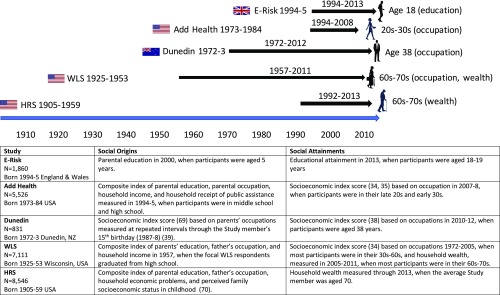
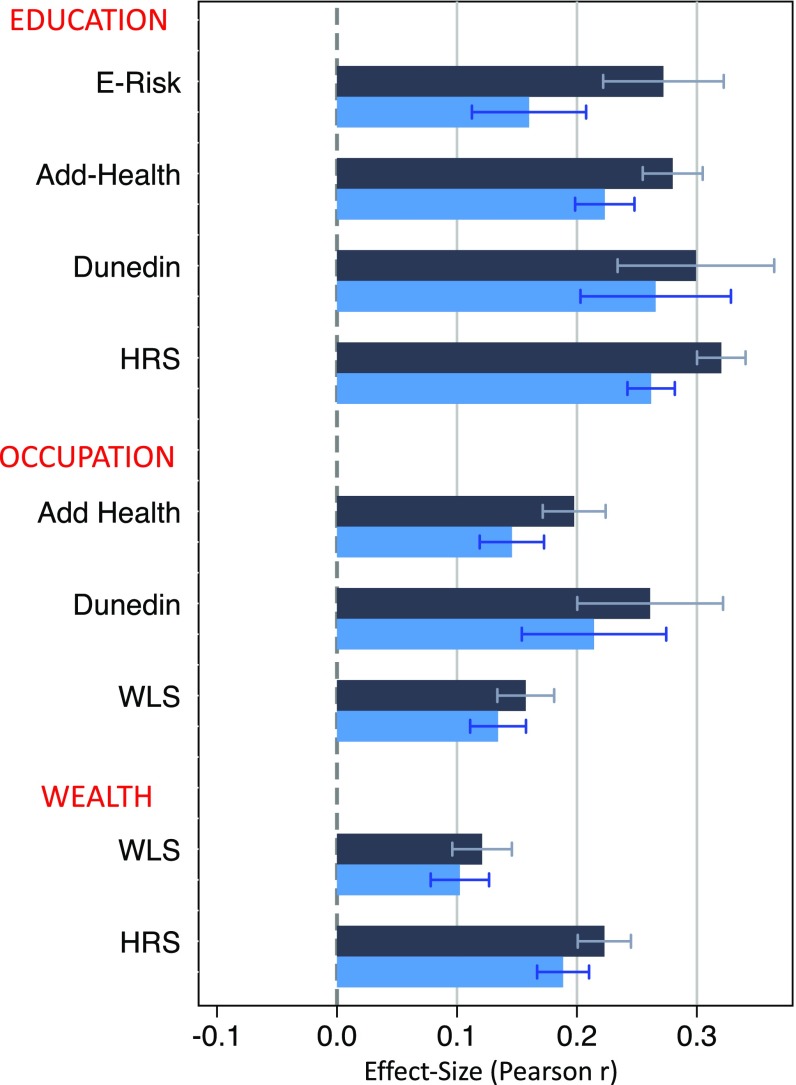
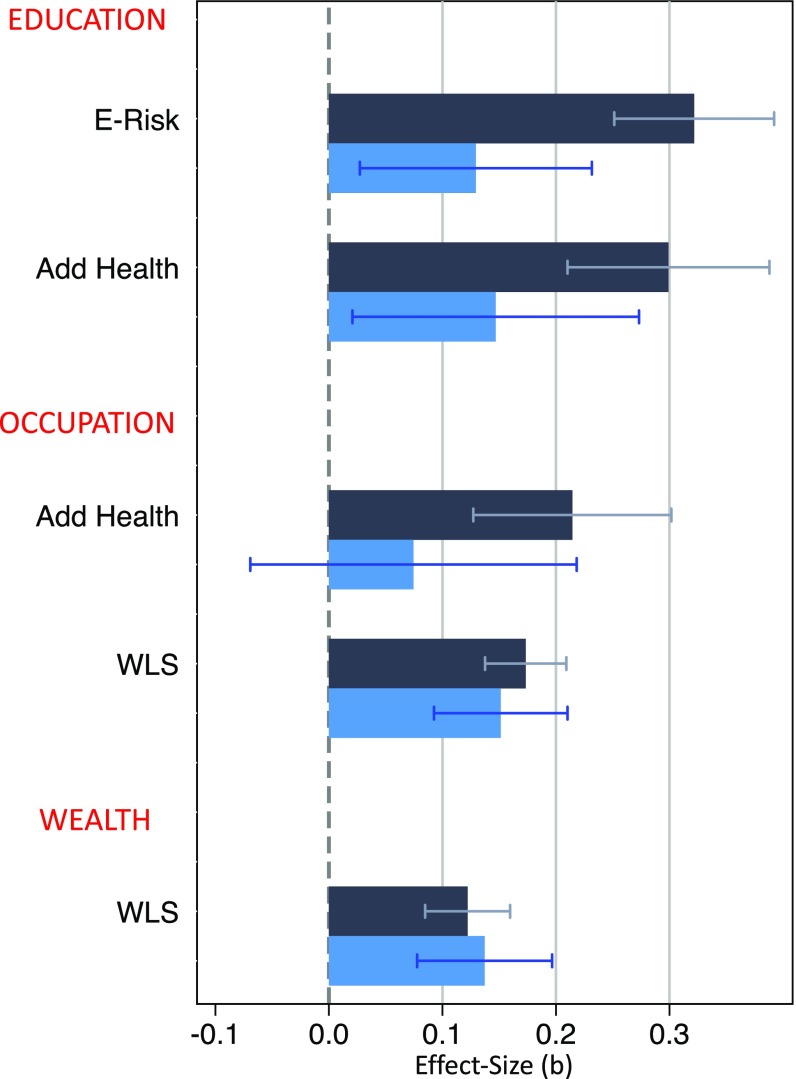
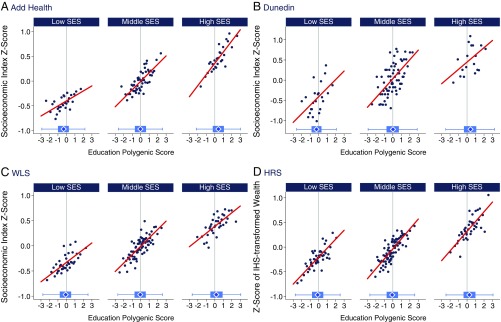
Verification
Claims the paper makes
The claims and statistics of this paper haven’t been checked yet.
Run the check — free, no account needed. It reads the open-access text and checks the sources it cites.
Claims other papers make about this one
Each is checked against this paper’s own text: does it say what the citing paper says it does?
The cited source says what the claim attributes to it.
In the citing paper
“This remainder is due to assortment on phenotypes correlated with the EA PGI other than EA, cognitive performance, and vocabulary—possibly including various personality traits42-44—and sources of social homogamy other than genetic ancestry captured by the top 40 PCs—possibly including geographic location at courtship age45,46, socioeconomic status, and social class47.”
From Polygenic prediction of educational attainment within and between families from genome-wide association analyses in 3 million individuals (2022) · cites this paper as [47]
Self-check
Percentages, sums and reported differences re-computed from the paper’s own numbers.
The self-check needs the paper’s full text.
Citations
Cites
Principal components analysis corrects for stratification in genome-wide association studies
Price, A. L., Patterson, N. J., Plenge, R. M., Weinblatt, M. E., Shadick, N. A., & Reich, D. (2006) · Nature Genetics · doi:10.1038/ng1847 · Cited by 10,248 · cited 1×
“Within each dataset, we regressed SSGAC-computed polygenic scores on the first 10 principal components estimated from the genome-wide SNP data (67) and calculated residual values.”
MethodSocial conditions as fundamental causes of disease.
Link, B. G., & Phelan, J. (1995) · Journal of Health and Social Behavior · doi:10.2307/2626958 · Cited by 5,722
The American Occupational Structure.
Blalock, H. M., Blau, P. M., Duncan, O. D., & Tyrée, A. (1968) · American Sociological Review · doi:10.2307/2092399 · Cited by 4,412
An atlas of genetic correlations across human diseases and traits
ReproGen Consortium, Bulik-Sullivan, B., Psychiatric Genomics Consortium, Genetic Consortium for Anorexia Nervosa of the Wellcome Trust Case Control Consortium 3, Finucane, H. K., Anttila, V., Gusev, A., Day, F. R., Loh, P.-R., Duncan, L., et al. (2015) · Nature Genetics · doi:10.1038/ng.3406 · Cited by 4,255
10 Years of GWAS Discovery: Biology, Function, and Translation
Visscher, P. M., Wray, N. R., Zhang, Q., Sklar, P., McCarthy, M. I., Brown, M. A., & Yang, J. (2017) · The American Journal of Human Genetics · doi:10.1016/j.ajhg.2017.06.005 · Cited by 3,719
How People Make Their Own Environments: A Theory of Genotype Environment Effects
Scarr, S., & McCartney, K. (1983) · Child Development · doi:10.1111/j.1467-8624.1983.tb03884.x · Cited by 2,895 · cited 3×
“This evidence supports theory in the social sciences that frames genetics as one mechanism among several through which social position is transmitted across generations (9, 20, 21, 59).”
BackgroundSocial Conditions as Fundamental Causes of Disease
Link, B. G., & Phelan, J. C. (1995) · PubMed · doi:10.13016/rpln-eiwa · Cited by 2,684
23andMe Research Team, Lee, J. J., COGENT (Cognitive Genomics Consortium), Social Science Genetic Association Consortium, Wedow, R., Okbay, A., Kong, E., Maghzian, O., Zacher, M., Nguyen-Viet, T. A., et al. (2018) · Nature Genetics · doi:10.1038/s41588-018-0147-3 · Cited by 2,470
Self-citationMeta-analysis of the heritability of human traits based on fifty years of twin studies
Polderman, T. J. C., Benyamin, B., de Leeuw, C. A., Sullivan, P. F., van Bochoven, A., Visscher, P. M., & Posthuma, D. (2015) · Nature Genetics · doi:10.1038/ng.3285 · Cited by 2,467
An Equilibrium Theory of the Distribution of Income and Intergenerational Mobility
Becker, G. S., & Tomes, N. (1979) · Journal of Political Economy · doi:10.1086/260831 · Cited by 2,243 · cited 1×
“This evidence supports theory in the social sciences that frames genetics as one mechanism among several through which social position is transmitted across generations (9, 20, 21, 59).”
BackgroundMiller, G. E., Chen, E., & Parker, K. J. (2011) · Psychological Bulletin · doi:10.1037/a0024768 · Cited by 1,785
The American Occupational Structure.
Hansen, W. L., Blau, P. M., Duncan, O. D., & Tyrée, A. (1968) · American Sociological Review · doi:10.2307/2092400 · Cited by 1,684
Power and predictive accuracy of polygenic risk scores
Dudbridge, F. (2013) · PLoS Genetics · doi:10.1371/journal.pgen.1003348 · Cited by 1,509 · cited 3×
“For the E-Risk Study and the Dunedin Study, polygenic scores were computed following the method described by Dudbridge (30) using the PRSice software (65).”
MethodSocioeconomic Status Modifies Heritability of IQ in Young Children
Turkheimer, E., Haley, A., Waldron, M., D'Onofrio, B., & Gottesman, I. I. (2003) · Psychological Science · doi:10.1046/j.0956-7976.2003.psci_1475.x · Cited by 1,373
Breen, R., & Jönsson, J. Ö. (2005) · Annual Review of Sociology · doi:10.1146/annurev.soc.31.041304.122232 · Cited by 1,358 · cited 1×
“Occupational structures and opportunities for upward mobility vary from country to country and across historical time and social context (37).”
BackgroundModeling Linkage Disequilibrium Increases Accuracy of Polygenic Risk Scores
Vilhjálmsson, B. J., Yang, J., Finucane, H. K., Gusev, A., Lindström, S., Ripke, S., Genovese, G., Loh, P.-R., Bhatia, G., Do, R., et al. (2015) · The American Journal of Human Genetics · doi:10.1016/j.ajhg.2015.09.001 · Cited by 1,303
Genome-wide association study identifies 74 loci associated with educational attainment
Okbay, A., Beauchamp, J. P., Fontana, M. A., Lee, J. J., Pers, T. H., Rietveld, C. A., Turley, P., Chen, G.-B., Emilsson, V., Meddens, S. F. W., et al. (2016) · Nature · doi:10.1038/nature17671 · Cited by 1,297
Self-citationNew approaches to population stratification in genome-wide association studies
Price, A. L., Zaitlen, N., Reich, D., & Patterson, N. J. (2010) · Nature Reviews Genetics · doi:10.1038/nrg2813 · Cited by 1,226 · cited 1×
“Second, analyses do not completely exclude potential bias due to population stratification (50), the nonrandom patterning of genotypes across different ancestries.”
BackgroundU.S. Disparities in Health: Descriptions, Causes, and Mechanisms
Adler, N. E., & Rehkopf, D. H. (2008) · Annual Review of Public Health · doi:10.1146/annurev.publhealth.29.020907.090852 · Cited by 1,212
PRSice: Polygenic Risk Score software
Euesden, J., Lewis, C. M., & O’Reilly, P. F. (2014) · Bioinformatics · doi:10.1093/bioinformatics/btu848 · Cited by 1,201 · cited 1×
“For the E-Risk Study and the Dunedin Study, polygenic scores were computed following the method described by Dudbridge (30) using the PRSice software (65).”
MethodPoulton, R., Caspi, A., Milne, B. J., Thomson, W. M., Taylor, A., Sears, M. R., & Moffitt, T. E. (2002) · The Lancet · doi:10.1016/s0140-6736(02)11602-3 · Cited by 1,010
Self-citationThe Social Stratification of Aging and Health
House, J. S., Lepkowski, J. M., Kinney, A. M., Mero, R. P., Kessler, R. C., & Herzog, A. R. (1994) · Journal of Health and Social Behavior · doi:10.2307/2137277 · Cited by 957
The nature of nurture: Effects of parental genotypes
Kong, A., Thorleifsson, G., Frigge, M. L., Vilhjalmsson, B. J., Young, A. I., Thorgeirsson, T. E., Benonisdottir, S., Oddsson, A., Halldorsson, B. V., Masson, G., et al. (2018) · Science · doi:10.1126/science.aan6877 · Cited by 949 · cited 3×
“One way to test for such environmental transmission is to test if parental genetics predicts their children’s attainments over and above the child’s own genetics (22, 29).”
BackgroundResultSocial and Economic Returns to College Education in the United States
Hout, M. (2012) · Annual Review of Sociology · doi:10.1146/annurev.soc.012809.102503 · Cited by 943 · cited 1×
“Recently, genome-wide association studies (GWAS) have discovered molecular genetic associations with education (10–12), a determinant of social class (13).”
BackgroundThe Economics of Human Development and Social Mobility
Heckman, J. J., & Mosso, S. (2014) · Annual Review of Economics · doi:10.1146/annurev-economics-080213-040753 · Cited by 940 · cited 1×
“These skills represent intervention targets in their own right, for example by policies and programs that safeguard perinatal development and provide enriching, stable family and educational environments (64).”
Background4. Socioeconomic Indexes for Occupations: A Review, Update, and Critique
Hauser, R. M., & Warren, J. R. (1997) · Sociological Methodology · doi:10.1111/1467-9531.271028 · Cited by 932
GWAS of 126,559 Individuals Identifies Genetic Variants Associated with Educational Attainment
Rietveld, C. A., Medland, S. E., Derringer, J., Yang, J., Esko, T., Martin, N. W., Westra, H.-J., Shakhbazov, K., Abdellaoui, A., Agrawal, A., et al. (2013) · Science · doi:10.1126/science.1235488 · Cited by 827
Self-citationTrends and Variation in Assortative Mating: Causes and Consequences
Schwartz, C. R. (2013) · Annual Review of Sociology · doi:10.1146/annurev-soc-071312-145544 · Cited by 725 · cited 1×
“Because people tend to have children with mates from the same social class (26, 27), these historical differences in social position could carry a genetic signature.”
BackgroundThe Nature of Nurture: Genetic Influence on “Environmental” Measures
Plomin, R., & Bergeman, C. S. (1991) · Behavioral and Brain Sciences · doi:10.1017/s0140525x00070278 · Cited by 556
The new genetics of intelligence
Plomin, R. J., & von Stumm, S. (2018) · Nature Reviews Genetics · doi:10.1038/nrg.2017.104 · Cited by 525 · cited 1×
“Instead, under this explanation, a person’s genetics would influence their development of traits and behaviors that, in turn, contribute to their educational success (16, 19).”
BackgroundDoes childhood health affect chronic morbidity in later life?
Blackwell, D. L., Hayward, M. D., & Crimmins, E. M. (2001) · Social Science & Medicine · doi:10.1016/s0277-9536(00)00230-6 · Cited by 424
Buss, D. M. (1985) · Cited by 423
Variation in the Heritability of Educational Attainment: An International Meta-Analysis
Branigan, A. R., McCallum, K. J., & Freese, J. (2013) · Social Forces · doi:10.1093/sf/sot076 · Cited by 360 · cited 1×
“Twin studies and related designs establish that genetics influences education and social class (6, 7), but they are mostly silent on the nature of this influence (8, 9).”
BackgroundLarge Cross-National Differences in Gene × Socioeconomic Status Interaction on Intelligence
Tucker-Drob, E. M., & Bates, T. C. (2016) · Psychological Science · doi:10.1177/0956797615612727 · Cited by 359
Adolescent depression and educational attainment: results using sibling fixed effects
Fletcher, J. M. (2010) · Health Economics · doi:10.1002/hec.1526 · Cited by 353
Self-citationCavalli-Sforza, L. L., & Feldman, M. W. (1973) · Europe PMC (PubMed Central) · Cited by 296
Genetic and Environmental Influences on Cognition Across Development and Context
Tucker-Drob, E. M., Briley, D. A., & Harden, K. P. (2013) · Current Directions in Psychological Science · doi:10.1177/0963721413485087 · Cited by 295 · cited 1×
“This variation is consistent with evidence that genetic influences on individual differences may vary across cultures and cohorts and across stages of the life course (62, 63).”
BackgroundDomingue, B. W., Belsky, D. W., Conley, D., Harris, K. M., & Boardman, J. D. (2015) · AERA Open · doi:10.1177/2332858415599972 · Cited by 265
Self-citationCohort Profile: Wisconsin longitudinal study (WLS)
Herd, P., Carr, D., & Roan, C. (2014) · International Journal of Epidemiology · doi:10.1093/ije/dys194 · Cited by 261 · cited 1×
“We next tested the replication of polygenic score associations with social mobility in a cohort of 1957 highschool graduates and their siblings, the WLS (n = 7,111 participants of European descent with genetic and attainment data) (40).”
BackgroundSelf-citationTHE PERSISTENCE OF CLASSES IN POST-INDUSTRIAL SOCIETIES
Hout, M., Brooks, C., & Manza, J. (1993) · International Sociology · doi:10.1177/026858093008003001 · Cited by 261 · cited 1×
“For example, social positions established long ago might be passed down across generations via socially transmitted inheritances, such as wealth transfers (24, 25).”
BackgroundBelsky, D. W., Moffitt, T. E., Corcoran, D. L., Domingue, B., Harrington, H., Hogan, S., Houts, R., Ramrakha, S., Sugden, K., Williams, B. S., et al. (2016) · Psychological Science · doi:10.1177/0956797616643070 · Cited by 260
Self-citationThe Determinants of Earnings: Genetics, Family, and Other Environments; A Study of White Male Twins
Taubman, P. J. (1976) · American Economic Review · Cited by 257
Who Gets Ahead? The Determinants of Economic Success in America.
Cline, H., Jencks, C., & Bartlett, S. (1981) · Administrative Science Quarterly · doi:10.2307/2392476 · Cited by 255
Heredity, Environment, and Public Policy Reconsidered
Jencks, C. (1980) · American Sociological Review · doi:10.2307/2094892 · Cited by 207 · cited 2×
“This evidence supports theory in the social sciences that frames genetics as one mechanism among several through which social position is transmitted across generations (9, 20, 21, 59).”
BackgroundGoldberger, A. S. (1979) · Economica · doi:10.2307/2553675 · Cited by 196
Hidden heritability due to heterogeneity across seven populations
Tropf, F. C., Lee, S. H., Verweij, R. M., Stulp, G., van der Most, P. J., de Vlaming, R., Bakshi, A., Briley, D. A., Rahal, C., Hellpap, R., et al. (2017) · Nature Human Behaviour · doi:10.1038/s41562-017-0195-1 · Cited by 180 · cited 1×
“This variation is consistent with evidence that genetic influences on individual differences may vary across cultures and cohorts and across stages of the life course (62, 63).”
BackgroundDowd, J. B., Zajacova, A., & Aiello, A. E. (2009) · Social Science & Medicine · doi:10.1016/j.socscimed.2008.12.010 · Cited by 175
Chapter 8 Theories of persistent inequality and intergenerational mobility
Piketty, T. (2000) · Handbook of income distribution · doi:10.1016/s1574-0056(00)80011-1 · Cited by 165
Krapohl, E., & Plomin, R. (2016) · Molecular Psychiatry · doi:10.1038/mp.2015.2 · Cited by 160
Bates, T. C., Maher, B. S., Medland, S. E., McAloney, K., Wright, M. J., Hansell, N. K., Kendler, K. S., Martin, N. G., & Gillespie, N. A. (2018) · Twin Research and Human Genetics · doi:10.1017/thg.2018.11 · Cited by 157 · cited 1×
“Although we cannot rule out differences in measurement error between polygenic scores of mothers and their children, our social–genetic analysis provides some evidence for socially transmitted maternal genetic effects on children’s educational attainment, consistent with a recent analysis that included genetic informa…”
ResultIs the Effect of Parental Education on Offspring Biased or Moderated by Genotype?
Conley, D., Domingue, B. W., Cesarini, D. A., Dawes, C. T., Rietveld, C. A., & Boardman, J. (2015) · Sociological Science · doi:10.15195/v2.a6 · Cited by 149 · cited 2×
“To test this hypothesis, we conducted a social–genetic analysis, which is a test of effects of one individual’s genotype on another individual’s phenotype (14, 31, 32).”
BackgroundMethodSelf-citationPhenome-wide analysis of genome-wide polygenic scores
Krapohl, E. M. L., Euesden, J., Zabaneh, D., Pingault, J., Rimfeld, K., von Stumm, S., Dale, P. S., Breen, G. D., O’Reilly, P. F., & Plomin, R. J. (2015) · Molecular Psychiatry · doi:10.1038/mp.2015.126 · Cited by 147
Genetics and educational attainment
Cesarini, D. A., & Visscher, P. M. (2017) · npj Science of Learning · doi:10.1038/s41539-017-0005-6 · Cited by 142
Genetic evidence for natural selection in humans in the contemporary United States
Beauchamp, J. P. (2016) · Proceedings of the National Academy of Sciences · doi:10.1073/pnas.1600398113 · Cited by 138 · cited 1×
“To provide an estimate of the extent of this bias, effect-size estimates corrected for measurement error using a recently proposed method (46, 47) are reported in SI Appendix, Table S7.”
MethodSteller, A. W. (1980) · NASSP Bulletin · doi:10.1177/019263658006443620 · Cited by 137
Genes, Education, and Labor Market Outcomes: Evidence from the Health and Retirement Study
Papageorge, N., & Thom, K. (2016) · Journal of the European Economic Association · doi:10.1093/jeea/jvz072 · Cited by 135
Langenberg, C., Kuh, D. J., Wadsworth, M. E. J., Brunner, E. J., & Hardy, R. (2006) · American Journal of Public Health · doi:10.2105/ajph.2004.049429 · Cited by 117
Social and Genetic Pathways in Multigenerational Transmission of Educational Attainment
Liu, H. (2018) · American Sociological Review · doi:10.1177/0003122418759651 · Cited by 107 · cited 1×
“One way to test for such environmental transmission is to test if parental genetics predicts their children’s attainments over and above the child’s own genetics (22, 29).”
BackgroundSocioeconomic status and genetic influences on cognitive development
Figlio, D., Jeremy Freese, A., Karbownik, K., & Roth, J. (2017) · Proceedings of the National Academy of Sciences · doi:10.1073/pnas.1708491114 · Cited by 105
Domingue, B. W., Belsky, D. W., Fletcher, J. M., Conley, D., Boardman, J. D., & Harris, K. M. (2018) · Proceedings of the National Academy of Sciences · doi:10.1073/pnas.1711803115 · Cited by 90 · cited 1×
“To test this hypothesis, we conducted a social–genetic analysis, which is a test of effects of one individual’s genotype on another individual’s phenotype (14, 31, 32).”
MethodSelf-citationNew Zealand socio-economic index 2006
Milne, B. J., Byun, U., & Lee, A. (2013) · ResearchSpace (University of Auckland) · Cited by 83
Conley, D. (2009) · Biodemography and Social Biology · doi:10.1080/19485560903415807 · Cited by 60 · cited 1×
“Sibling-difference analysis does exclude population stratification as a confounder (15, 51), establishing a floor for effect-size magnitudes.”
BackgroundSelf-citationUsing nature to understand nurture
Koellinger, P., & Harden, K. P. (2018) · Science · doi:10.1126/science.aar6429 · Cited by 60 · cited 1×
“However, they are not ruled out in GWAS (22, 23).”
BackgroundHauser, R. A. (2005) · doi:10.7826/isr-um.06.585031.001.05.0012.2005 · Cited by 60
Plomin, R. J., & Bergeman, C. S. (1991) · Behavioral and Brain Sciences · doi:10.1017/s0140525x00070588 · Cited by 50
The social genome: Current findings and implications for the study of human genetics
Domingue, B. W., & Belsky, D. W. (2017) · PLoS Genetics · doi:10.1371/journal.pgen.1006615 · Cited by 37 · cited 1×
“To test this hypothesis, we conducted a social–genetic analysis, which is a test of effects of one individual’s genotype on another individual’s phenotype (14, 31, 32).”
MethodSelf-citationGene Discovery for Complex Traits: Lessons from Africa
McClellan, J., Lehner, T., & King, M. (2017) · Cell · doi:10.1016/j.cell.2017.09.037 · Cited by 36 · cited 1×
“With larger GWAS sample sizes, new GWAS in non-European populations, and identification of which specific genetic variants are causal, these limitations will be partly mitigated (48, 49).”
BackgroundMeasurement Error Correction of Genome-Wide Polygenic Scores in Prediction SamplesPreprint
Tucker–Drob, E. M. (2017) · bioRxiv (Cold Spring Harbor Laboratory) · doi:10.1101/165472 · Cited by 23
Genetic Ability, Wealth, and Financial Decision-MakingPreprint
Barth, D., Papageorge, N., & Thom, K. (2017) · SSRN Electronic Journal · doi:10.2139/ssrn.2923653 · Cited by 10 · cited 1×
“, how policies and programs may strengthen or weaken genetic and nongenetic mechanisms of intergenerational transmission (61).”
Backgroundde Vlaming, R., Okbay, A., Rietveld, C. A., Johannesson, M., Magnusson, P. K. E., Uitterlinden, A. G., van Rooij, F. J. A., Hofman, A., Groenen, P. J. F., Thurik, A. R., et al. (2017) · PLOS Genetics · doi:10.1371/journal.pgen.1006495 · Cited by 8 · cited 1×
“Third, the genetics of socioeconomic attainment and mobility may vary slightly across different birth cohorts, presumably reflecting changes in the social context of attainment (52).”
BackgroundGenes, Education, and Labor Market Outcomes: Evidence from the Health and Retirement Study
Papageorge, N., & Thom, K. (2017) · Upjohn Research (W.E. Upjohn Institute for Employment Research) · doi:10.17848/wp17-273 · Cited by 4
How Do Administrators, Teachers Rank Educational Goals?
Silvernail, D. L. (1980) · NASSP Bulletin · doi:10.1177/019263658006444023 · Cited by 1
Research works printed but not linked: 2
- J Lee, , Gene discovery and polygenic prediction from a 1.1-million-person GWAS of educational attainment. Nat Genet, in press.
- WB Elley, JC Irving, Revised socioeconomic index for New-Zealand. N Z J Educ Stud 11, 25–36 (1976).
Cited by
Sorted by citations
Okbay, A., Wu, Y., Wang, N., Jayashankar, H., Bennett, M., Nehzati, S. M., Sidorenko, J., Kweon, H., Goldman, G., Gjorgjieva, T., et al. (2022) · Nature Genetics · doi:10.1038/s41588-022-01016-z · Cited by 654
“…other than EA, cognitive performance, and vocabulary—possibly including various personality traits 42-44 —and sources of social homogamy other than genetic ancestry captured by the top 40 PCs—possibly including geographic location at courtship age 45,46 , socioeconomic status, and social class 47 .”
Self-citationCohort Profile: The National Longitudinal Study of Adolescent to Adult Health (Add Health)
Harris, K. M., Halpern, C. T., Whitsel, E. A., Hussey, J. M., Killeya‐Jones, L. A., Tabor, J. W., & Dean, S. (2019) · International Journal of Epidemiology · doi:10.1093/ije/dyz115 · Cited by 552
Self-citationVariable prediction accuracy of polygenic scores within an ancestry group
Mostafavi, H., Harpak, A., Agarwal, I., Conley, D., Pritchard, J. K., & Przeworski, M. (2020) · eLife · doi:10.7554/elife.48376 · Cited by 457
Self-citationComparing Within- and Between-Family Polygenic Score Prediction
Selzam, S., Ritchie, S. J., Pingault, J.-B., Reynolds, C. A., O’Reilly, P. F., & Plomin, R. (2019) · The American Journal of Human Genetics · doi:10.1016/j.ajhg.2019.06.006 · Cited by 289
Using genetics for social science
Harden, K. P., & Koellinger, P. D. (2020) · Nature Human Behaviour · doi:10.1038/s41562-020-0862-5 · Cited by 180
Metadata
- Authors
- Belsky, D. W., Domingue, B. W., Wedow, R., Arseneault, L., Boardman, J. D., Caspi, A., Conley, D., Fletcher, J. M., Freese, J., Herd, P., Moffitt, T. E., Poulton, R., Sicinski, K., Wertz, J., & Harris, K. M.
- Affiliations
- Duke University (US)
- Stanford University (US)
- University of Colorado Boulder (US)
- King's College London (GB)
- Princeton University (US)
- University of Wisconsin–Madison (US)
- Department of Sociology, Stanford University, Stanford, CA 94305;
- University of Otago (NZ)
- University of North Carolina at Chapel Hill (US)
- Corresponding author
- Belsky, Daniel W.
- Harris, Kathleen Mullan
- ORCID
- Venue
- Proceedings of the National Academy of Sciences
- Publisher
- National Academy of Sciences
- Published
- 2018-07-09
- Volume
- 115
- Issue
- 31
- Pages
- E7275-E7284
- ISSN
- 0027-8424 (ISSN-L)
- 1091-6490
- PMC
- PMC6077729
- OpenAlex
- W2848694795
- Cited by
- 315
- References
- 72
- Citations by year
- 2026: 21 · 2025: 26 · 2024: 36 · 2023: 35 · 2022: 42 · 2021: 47 · 2020: 34 · 2019: 65 · 2018: 8
- FWCI
- 87.42
- Type
- journal article
- Language
- en
- Update notices
- correction (2018-11-05)
- Open access
- hybrid
- doi.org
- Licence
- Locations
- Proceedings of the National Academy of Sciences (publishedVersion, cc-by-nc-nd)
- Europe PMC (PubMed Central) (publishedVersion, cc-by-nc-nd)
- PubMed Central (publishedVersion, cc-by-nc-nd)
- PubMed (publishedVersion)
- RePEc: Research Papers in Economics (submittedVersion)
- Research Portal (King's College London) (submittedVersion, cc-by-nc-nd)
- Funders
- Office of Extramural Research, National Institutes of Health (R01HD077482, P01HD31921, R01HD073342, R01HD060726, R01AG032282)
- UK Medical Research Council (G1002190, MR/P005918/1)
- Jacobs Foundation (Jacobs Prize, Early Career Fellowship)
- Russel Sage Foundation (961704)
- National Science Foundation (DGE1144083)
- Topics
- Social Sciences › Sociology and Political Science › Intergenerational and Educational Inequality Studies
- Life Sciences › Biochemistry, Genetics and Molecular Biology › Genetics › Genetic Associations and Epidemiology
- Social Sciences › Psychology › Experimental and Cognitive Psychology › Cognitive Abilities and Testing
- Keywords
- social mobility, educational attainment, polygenic risk score, upward mobility, socioeconomic attainment, wealth accumulation, parental socioeconomic status, family environment
- MeSH terms
- Educational Status, Genetic Testing, Humans, Longitudinal Studies, Occupations, Social Class, Social Mobility, Siblings, Genome-Wide Association Study
About these checks
Registry, retraction, Cites and statistics results are computed, not judged, with one exception: a printed reference that no index lists is read once by a model before it counts as a citation error. Claims are extracted by a model and kept only when their quote appears verbatim in the text; each cited source is then checked, with a model’s help, for whether it says what the claim relies on. Those verdicts can be wrong — read the claim’s quote and the cited source before relying on one.
Statistics and arithmetic are recomputed, not judged.
Confidence bands are shown only for fields calibrated on our annotated test set. None is calibrated yet, so no band is shown.
What counts as a claim ›How we measure confidence ›How we check this ›
Are you an author, or do you see a problem with this page? Request a review
