

Cascading trend of Early Paleozoic marine radiations paused by Late Ordovician extinctions
Open accessThe DOI matches its Crossref record; 83 of the 84 references it cites were found in a registry or an index, and 1 are not checked yet.
Abstract
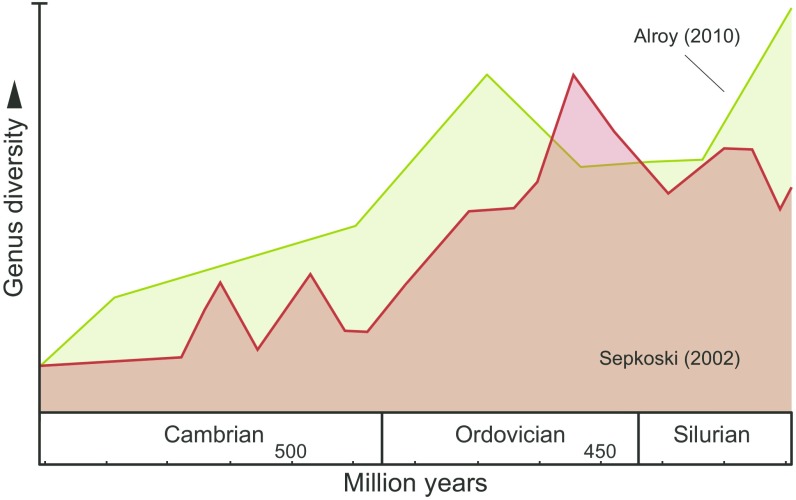
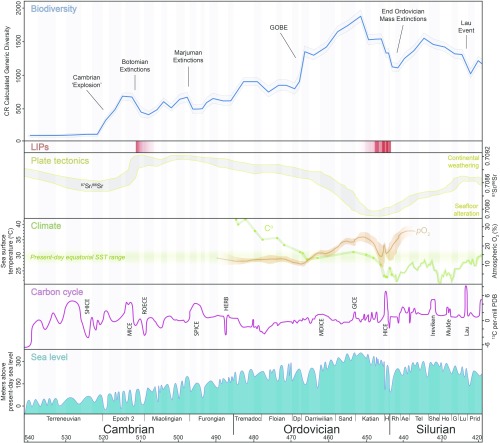
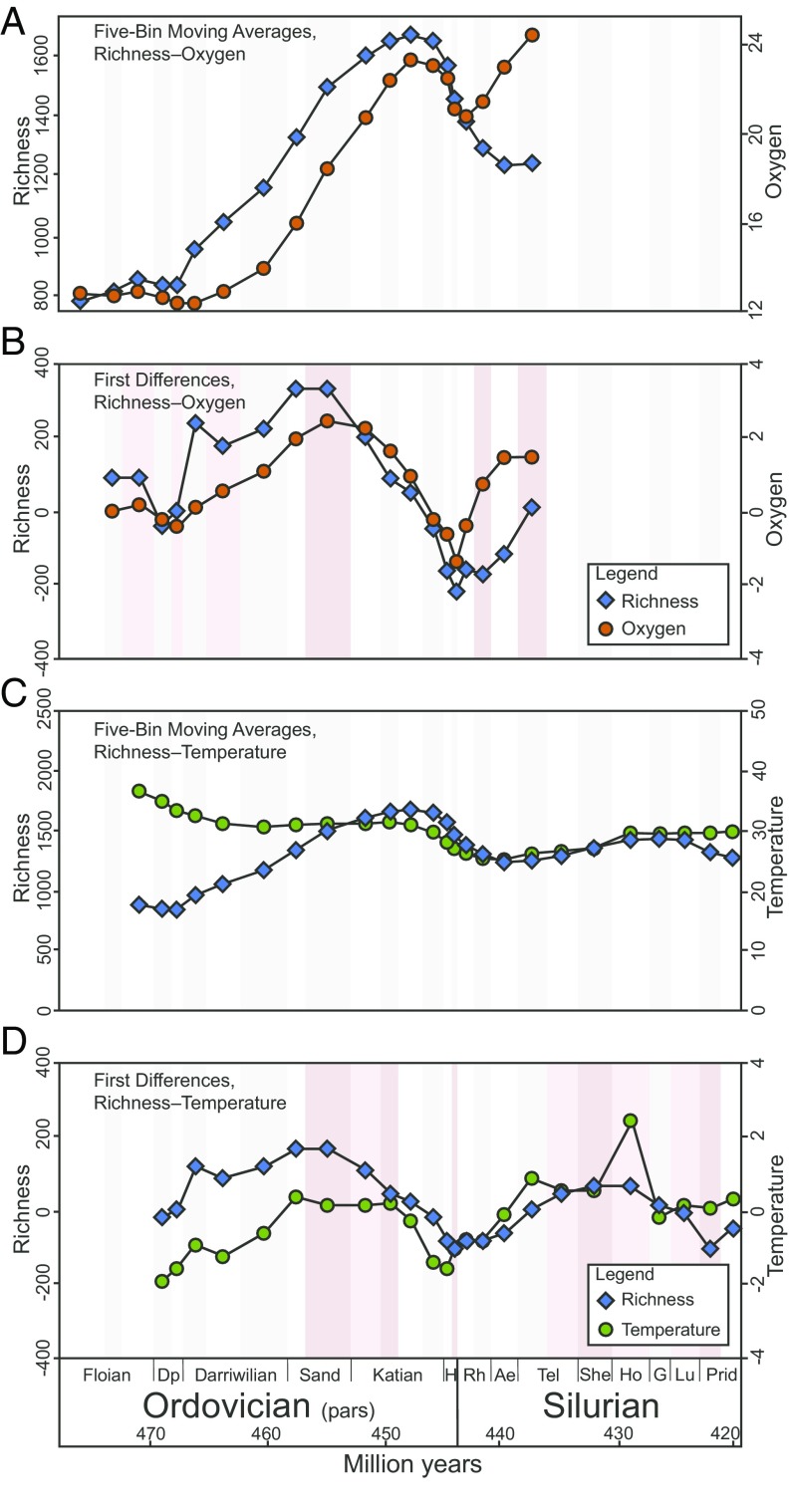
The greatest relative changes in marine biodiversity accumulation occurred during the Early Paleozoic. The precision of temporal constraints on these changes is crude, hampering our understanding of their timing, duration, and links to causal mechanisms. We match fossil occurrence data to their lithostratigraphical ranges in the Paleobiology Database and correlate this inferred taxon range to a constructed set of biostratigraphically defined high-resolution time slices. In addition, we apply capture–recapture modeling approaches to calculate a biodiversity curve that also considers taphonomy and sampling biases with four times better resolution of previous estimates. Our method reveals a stepwise biodiversity increase with distinct Cambrian and Ordovician radiation events that are clearly separated by a 50-million-year-long period of slow biodiversity accumulation. The Ordovician Radiation is confined to a 15-million-year phase after which the Late Ordovician extinctions lowered generic richness and further delayed a biodiversity rebound by at least 35 million years. Based on a first-differences approach on potential abiotic drivers controlling richness, we find an overall correlation with oxygen levels, with temperature also exhibiting a coordinated trend once equatorial sea surface temperatures fell to present-day levels during the Middle Ordovician Darriwilian Age. Contrary to the traditional view of the Late Ordovician extinctions, our study suggests a protracted crisis interval linked to intense volcanism during the middle Late Ordovician Katian Age. As richness levels did not return to prior levels during the Silurian—a time of continental amalgamation—we further argue that plate tectonics exerted an overarching control on biodiversity accumulation.
Overview
The claims and statistics of this paper haven’t been checked yet.
Free: it reads the open-access text and checks the first 5 claims that cite a source we can check. Create a free account to check every claim.
Integrity signals
Registry
Cites
Statistics
Figures
Verification
Claims the paper makes
The claims and statistics of this paper haven’t been checked yet.
Free: it reads the open-access text and checks the first 5 claims that cite a source we can check. Create a free account to check every claim.
Claims other papers make about this one
Each is checked against this paper’s own text: does it say what the citing paper says it does?
The source backs part of the claim, not all of it — or backs it for a different population, condition or comparison.
In the citing paper
“Both the curves (Fig. 2B) of Rasmussen et al. (2019) and Kr ¨ oger et al. (2019) indicated a strong increase of diversity in Cambrian Series 2 (Cambrian Stage 3), already observed by Na and Kiessling (2015), and thus illustrating the presence of taxa in the PBDB, resulting mainly from the numerous descriptions of fossils in the major Lagerst ¨ atten.”
From No (Cambrian) explosion and no (Ordovician) event: A single long-term radiation in the early Palaeozoic (2023) · cites this paper as Rasmussen et al., 2019
Experimental — accuracy not yet measuredThe cited source says what the claim attributes to it.
In the citing paper
“It is interesting to note that the timing of the Cambrian 'Explo sion ' differs slightly in both datasets, but that the definition of the GOBE is totally different: while the GBDB (Fan et al., 2020) indicates a GOBE in the late Cambrian and Early Ordovician, the PBDB related publications by Rasmussen et al. (2019) and Kr ¨ oger et al. (2019) define a rather short GOBE in the Middle Ordovician (”
From No (Cambrian) explosion and no (Ordovician) event: A single long-term radiation in the early Palaeozoic (2023) · cites this paper as Rasmussen et al., 2019
The cited source says what the claim attributes to it.
In the citing paper
“Rasmussen et al. (2019) narrowed the concept of the 'GOBE ' even more, considering a particular diversity increase in the PBDB dataset, taking place during an earlier part of the Darriwilian, as the 'event. '”
From No (Cambrian) explosion and no (Ordovician) event: A single long-term radiation in the early Palaeozoic (2023) · cites this paper as Rasmussen et al. (2019)
In the citing paper
“Meanwhile, persistent and widespread reducing conditions leading into the Silurian are consistent with a protracted and turbulent recovery of marine groups (8, 68).”
From Rapid marine oxygen variability: Driver of the Late Ordovician mass extinction (2022) · cites this paper as [8]
Self-check
Percentages, sums and reported differences re-computed from the paper’s own numbers.
The self-check needs the paper’s full text.
Citations
Cites
Chao, A., Gotelli, N. J., Hsieh, T. C., Sander, E. L., Ma, K. H., Colwell, R. K., & Ellison, A. M. (2014) · Ecological Monographs · doi:10.1890/13-0133.1 · Cited by 4,256 · cited 5×
“We compared the results of the CR-modeling (DCR) approach with results from shareholders quorum subsampling, DSQS (2, 3), and from estimates of the Shannon entropy Hill number, DHill (17, 21).”
MethodResultInfluentialPARTITIONING DIVERSITY INTO INDEPENDENT ALPHA AND BETA COMPONENTS
Jost, L. (2007) · Ecology · doi:10.1890/06-1736.1 · Cited by 2,265
Approaching a state shift in Earth’s biosphere
Barnosky, A. D., Hadly, E. A., Bascompte, J., Berlow, E. L., Brown, J. H., Fortelius, M., Getz, W. M., Harte, J., Hastings, A., Marquet, P. A., et al. (2012) · Nature · doi:10.1038/nature11018 · Cited by 1,966 · cited 1×
“C transitions in the state of the Earth that forced global ecosystems to adjust to changes in the physical environment fundamentally impacted Phanerozoic biodiversity levels (1).”
BackgroundA Chronology of Paleozoic Sea-Level Changes
Haq, B. U., & Schutter, S. R. (2008) · Science · doi:10.1126/science.1161648 · Cited by 1,623 · cited 2×
“Likely the increase in oxygen concentrations benefitted metazoan life and continued to sustain increased biodiversity accumulation as sea levels rose (32), expanding the habitable ecospace on the drowned epicontinental platforms.”
BackgroundMethod(2016) · Elsevier eBooks · doi:10.1016/c2009-0-64442-1 · Cited by 1,476
Phanerozoic polar wander, palaeogeography and dynamics
Torsvik, T. H., Van der Voo, R., Preeden, U., Mac Niocaill, C., Steinberger, B., Doubrovine, P. V., van Hinsbergen, D. J. J., Domeier, M., Gaina, C., Tohver, E., et al. (2012) · Earth-Science Reviews · doi:10.1016/j.earscirev.2012.06.007 · Cited by 1,445 · cited 1×
“Decreasing provincialism and habitat destruction caused by amalgamating continents (70) further hindered a fast rebound of biodiversity accumulation during the earliest Silurian (56).”
BackgroundPhanerozoic Trends in the Global Diversity of Marine Invertebrates
Alroy, J., Aberhan, M., Bottjer, D. J., Foote, M., Fürsich, F. T., Harries, P. J., Hendy, A. J. W., Holland, S. M., Ivany, L. C., Kiessling, W., et al. (2008) · Science · doi:10.1126/science.1156963 · Cited by 778 · cited 17×
“(2, 3) used genus-level occurrences to address sampling and preservation bias in a temporal binning framework of equal duration (Fig.”
BackgroundResultInfluentialA General Methodology for the Analysis of Capture-Recapture Experiments in Open Populations
Schwarz, C. J., & Arnason, A. N. (1996) · Biometrics · doi:10.2307/2533048 · Cited by 747
Falcon, N. L., & Harland, W. B. (1983) · The Geographical Journal · doi:10.2307/634028 · Cited by 689
Did Cooling Oceans Trigger Ordovician Biodiversification? Evidence from Conodont Thermometry
Trotter, J. A., Williams, I. S., Barnes, C. R., Lécuyer, C., & Nicoll, R. S. (2008) · Science · doi:10.1126/science.1155814 · Cited by 669 · cited 5×
“(C and D) Coordinated change between richness and tropical sea surface temperature estimates (33, 63).”
BackgroundInfluential
Research works printed but not linked: 3
- Liow LH Nichols JD 2010 Estimating rates and probabilities of origination and extinction using taxonomic occurrence data: Capture–mark–recapture (CMR) approaches The Paleontological Society Short Course, October 30th, 2010 The Paleontological Society Bethesda 81 94
- Peters SE Foote M 2001 Biodiversity in the Phanerozoic: A reinterpretation Paleobiology 27 583 601 · doi:10.1666/0094-8373(2001)027
- Holland SM 1997 Using time/environment analysis to recognize faunal events in the Upper Ordovician of the Cincinnati Arch Paleontological Event Horizons: Ecological and Evolutionary Implications Brett CE Baird GC Columbia Univ Press New York 309 334
Cited by
Items 201–224 of 224
Mass Extinction Triggered the Early Radiations of Jawed Vertebrates and Relatives (Gnathostomes)Preprint
Hagiwara, W., & Sallan, L. C. (2025) · bioRxiv (Cold Spring Harbor Laboratory) · doi:10.1101/2025.09.11.673971
“This includes the double-pulsed Late Ordovician Mass Extinction (LOME, 445–443 Ma), a “Big Five” event marked by prolonged global fluctuations in temperature, sudden polar glaciation, and sea level changes which drowned or marooned coastal faunas ( 13–15 ).”
InfluentialVilela-Andrade, M., Sproat, C. D., Wright, D. F., & Stigall, A. L. (2025) · Journal of Paleontology · doi:10.1017/jpa.2025.10118 · Cited by 2
“This finding is coordinated with higher speciation rates present at the last peak of diversification of the latest part of the Ordovician Radiation before the diversity decline by the late Katian (Rasmussen et al., 2019).”
Seo, M.-J., Cho, S. H., & Choh, S. (2025) · Palaeogeography Palaeoclimatology Palaeoecology · doi:10.1016/j.palaeo.2025.113339
Isotopic Constraints on End-Ordovician Glacial Dynamics and Climate
Bergmann, K., Zimmt, J. B., Finnegan, S., Swanson‐Hysell, N. L., Macdonald, F. A., Present, T., & Desrochers, A. (2025) · SEPM (Society for Sedimentary Geology) eBooks · doi:10.2110/sepmscn.058.25
SHI, Y. Z., Shi, Y., Yang, A., Huang, H., Deng, Y., Lu, Z., Xiaohong, Z., Cui, Y., Yuan, J., & Fan, J. (2026) · Global and Planetary Change · doi:10.1016/j.gloplacha.2026.105346 · Cited by 1
Sampling biases in the rise and fall of fossil marine animal genera
Chupongstimun, S. (2026) · Paleobiology · doi:10.1017/pab.2025.10090
“Formations were cross-referenced to substage assignments in Rasmussen et al. (2019).”
Time scales and magnitudes of environmental responses to volcanic activity in the deep-time record
Xie, H., Liang, C., Wu, J., Cao, Y., Han, Y., Liu, K., & Hao, F. (2026) · Geological Society of America Bulletin · doi:10.1130/b38369.1 · Cited by 1
Monti, D., & Serra, F. (2026) · Lethaia · doi:10.18261/let.59.4.5
Gougeon, R. C., Vaucher, R., Vidal, M., Birolini, E., Dupichaud, C., Lefèbvre, B., & Saleh, F. (2025) · Lethaia · doi:10.18261/let.59.2.5 · Cited by 9
Zhang, X.-L., Wang, K., & Wang, Y. (2026) · Journal of Palaeogeography · doi:10.1016/j.jop.2026.100366
Jing, Y., Ge, W., Yang, H., & Dong, Y. (2026) · Palaeogeography Palaeoclimatology Palaeoecology · doi:10.1016/j.palaeo.2026.113897
The Great Ordovician Biodiversification Event (GOBE): looking under the curvePreprint
Harper, D. A. T., Du, M., Wang, W., & Servais, T. (2026) · SSRN Electronic Journal · doi:10.2139/ssrn.6817931
Global palaeobiogeography of Upper Ordovician acritarchs
Yan, K., Huang, B., Li, J., Manzano, E. G., Monnet, C., Shan, L., & Servais, T. (2026) · Lethaia · doi:10.18261/let.59.4.4 · Cited by 1
Li, F., Hohl, S. V., Wang, D., Xing, C., & Guangyi, W. (2026) · Palaeogeography Palaeoclimatology Palaeoecology · doi:10.1016/j.palaeo.2026.114065
Esteves, C. J. P., McLaughlin, P. I., Paton, T., Cane, G., Sinnesael, M., Emsbo, P., & Vandenbroucke, T. R. A. (2026) · Geological Magazine · doi:10.1017/s0016756826100788
“Diversity trends shown by chitinozoans of the MY-14-01 core are generally consistent with global marine invertebrate diversity estimates for the same period, with decreasing diversity from the lower Katian (~Chatfieldian-Edenian) onwards (Rasmussen et al .”
Sudakow, I., Myers, C., Spiridonov, A., Stankevič, R., Feulner, G., & Livina, V. (2026) · Nature Communications · doi:10.1038/s41467-026-75655-9 · Cited by 1
“…for some signi fi cant changes in the biosphere, including the Cambrian Explosion (evolutionary origins of most animal phyla around 520 Ma 36 ) and the Great Ordovician Biodiversi fi cation Event (GOBE; ~ 485 – 460 Ma; 37,38 ), in which lower taxonomic-level animal diversity increased substantially.”
Huang, H., Cao, H., Chen, F., Wang, Z., Zhou, F., Chen, Q., Zeng, Y., & Chen, C. (2026) · Geoscience Frontiers · doi:10.1016/j.gsf.2026.102450
Xie, H., Liang, C., Wu, J., Cao, Y., Han, Y., Wang, J., Liu, K., & Hao, F. (2026) · Gondwana Research · doi:10.1016/j.gr.2026.08.005
The Ordovician stratigraphy and paleontology of the Qilian Mountains, Northwest China
Wu, R., & Li, W. (2026) · Palaeoworld · doi:10.1016/j.palwor.2026.201177
Órfão, J., de Celis, A., Dunne, E. M., Ortega, F., & Mocho, P. (2026) · Fossil record · doi:10.3897/fr.29.189225
“Despite being commonly used, considering stage-length time bins at both global and regional scale may obscure events that are registered within a single stage and can introduce bias, as longer bins tend to show higher diversities (Rasmussen et al. 2019).”
Helms, L., Gill, B. C., Tarhan, L. G., & Pruss, S. B. (2026) · Palaios · doi:10.2110/palo.2025.036
Yu, S., Wang, Y., Fang, X., Wang, Y., Wang, S., Mao, Y., Kershaw, S., & Li, Q. (2026) · Facies · doi:10.1007/s10347-026-00749-1
“The Middle to Late Ordovician encompasses the peak of the Great Ordovician Biodiversification Event (GOBE) and the Late Ordovician Mass Extinction (Sepkoski 1995, 2002; Servais et al., 2018, 2021; Kröger et al. 2019; Rasmussen et al. 2019; Fan et al. 2020; Harper et al. 2020).”
Yue, S., Huang, C., Du, X., Zhao, K., & Jia, J. (2026) · Global and Planetary Change · doi:10.1016/j.gloplacha.2026.105754
Levacher, M., Bayon, G., Vidal, M., Babonneau, N., Jang, K., Rouget, M., Trinquier, A., Loi, A., & Ghienne, J. (2026) · SSRN Electronic Journal · doi:10.2139/ssrn.7571389
Metadata
- Authors
- Rasmussen, C. M. Ø., Kröger, B., Nielsen, M. L., & Colmenar, J.
- Affiliations
- University of Copenhagen (DK)
- University of Helsinki (FI)
- Corresponding author
- Rasmussen, Christian M. Ø.
- Venue
- Proceedings of the National Academy of Sciences
- Publisher
- National Academy of Sciences
- Published
- 2019-03-25
- Volume
- 116
- Issue
- 15
- Pages
- 7207-7213
- ISSN
- 0027-8424 (ISSN-L)
- 1091-6490
- PMC
- PMC6462056
- OpenAlex
- W2924932526
- Cited by
- 226
- References
- 84
- Citations by year
- 2026: 27 · 2025: 41 · 2024: 25 · 2023: 39 · 2022: 31 · 2021: 25 · 2020: 26 · 2019: 12
- FWCI
- 17.85
- Type
- journal article
- Language
- en
- Open access
- hybrid
- doi.org
- Licence
- Locations
- Proceedings of the National Academy of Sciences (publishedVersion, cc-by-nc-nd)
- Europe PMC (PubMed Central) (publishedVersion, cc-by-nc-nd)
- PubMed Central (publishedVersion, cc-by-nc-nd)
- PubMed (publishedVersion)
- Research at the University of Copenhagen (University of Copenhagen) (publishedVersion, cc-by-nc-nd)
- Bristol Research (University of Bristol) (publishedVersion, cc-by-nc-nd)
- Työväentutkimus Vuosikirja (submittedVersion)
- Funders
- Villum Fonden (VKR023452)
- Geocenter Danmark (2015-5, 3-2017)
- Topics
- Physical Sciences › Earth and Planetary Sciences › Paleontology › Paleontology and Stratigraphy of Fossils
- Physical Sciences › Earth and Planetary Sciences › Paleontology › Evolution and Paleontology Studies
- Physical Sciences › Earth and Planetary Sciences › Paleontology › Paleontology and Evolutionary Biology
- Keywords
- Cambrian explosion, Ordovician radiation, Paleobiology Database, sea surface temperature, volcanic activity, plate tectonics, Silurian
- MeSH terms
- Paleontology, Databases, Factual, Biodiversity, Extinction, Biological
About these checks
Registry, retraction, Cites and statistics results are computed, not judged, with one exception: a printed reference that no index lists is read once by a model before it counts as a citation error. Claims are extracted by a model and kept only when their quote appears verbatim in the text; each cited source is then checked, with a model’s help, for whether it says what the claim relies on. Those verdicts can be wrong — read the claim’s quote and the cited source before relying on one.
Statistics and arithmetic are recomputed, not judged.
Confidence bands are shown only for fields calibrated on our annotated test set. None is calibrated yet, so no band is shown.
What counts as a claim ›How we measure confidence ›How we check this ›
Are you an author, or do you see a problem with this page? Request a review
Data sources
Bibliographic data: Semantic Scholar, OpenAlex, Crossref.
Contains information from the Semantic Scholar Academic Graph Datasets, made available under the ODC Attribution License (ODC-BY 1.0).
Semantic Scholar’s data is described in: Kinney, R., et al. (2023). The Semantic Scholar Open Data Platform. arXiv:2301.10140.
