

Social media’s enduring effect on adolescent life satisfaction
Open accessThe DOI matches its Crossref record; 10 of the 10 references it cites were found in a registry or an index.
Abstract
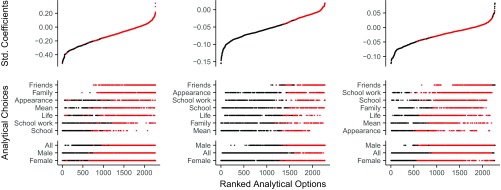
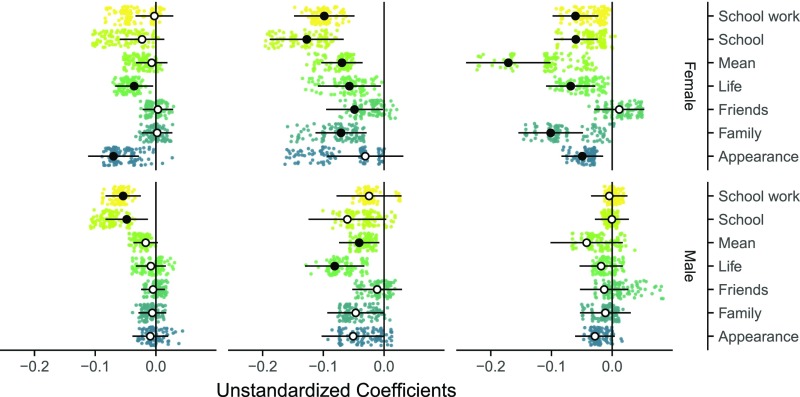
In this study, we used large-scale representative panel data to disentangle the between-person and within-person relations linking adolescent social media use and well-being. We found that social media use is not, in and of itself, a strong predictor of life satisfaction across the adolescent population. Instead, social media effects are nuanced, small at best, reciprocal over time, gender specific, and contingent on analytic methods.
Overview
The claims and statistics of this paper haven’t been checked yet.
Free: it reads the open-access text and checks the first 5 claims that cite a source we can check. Create a free account to check every claim.
Integrity signals
Registry
Cites
Statistics
Figures
Verification
Claims the paper makes
The claims and statistics of this paper haven’t been checked yet.
Free: it reads the open-access text and checks the first 5 claims that cite a source we can check. Create a free account to check every claim.
Claims other papers make about this one
Each is checked against this paper’s own text: does it say what the citing paper says it does?
The source backs part of the claim, not all of it — or backs it for a different population, condition or comparison.
In the citing paper
“Orben and colleagues6 found a small negative reciprocal within-person association between the time spent using social media and life satisfaction.”
From The effect of social media on well-being differs from adolescent to adolescent (2020) · cites this paper as [6]
Experimental — accuracy not yet measuredThe source backs part of the claim, not all of it — or backs it for a different population, condition or comparison.
In the citing paper
“a growing consensus has emerged suggesting that the associations observed between screen time and psychological or health outcomes are very small in size”
From The Conceptual and Methodological Mayhem of “Screen Time” (2020) · cites this paper as [6]
Experimental — accuracy not yet measuredThe source backs part of the claim, not all of it — or backs it for a different population, condition or comparison.
In the citing paper
“while some research has shown no effect of social media on well-being (Orben et al. 2019)”
From The future of social media in marketing (2020) · cites this paper as Orben et al. 2019
Experimental — accuracy not yet measuredThe source backs part of the claim, not all of it — or backs it for a different population, condition or comparison.
In the citing paper
“So far, only a few studies have applied this method and found only minimal within-person associations between social media use and mental health, primarily measured as depressive symptoms [7,20,21].”
From Social Media and Mental Health Among Early Adolescents in Sweden: A Longitudinal Study With 2-Year Follow-Up (KUPOL Study). (2021) · cites this paper as [21]
Experimental — accuracy not yet measuredThe source backs part of the claim, not all of it — or backs it for a different population, condition or comparison.
In the citing paper
“Recent publications that applied more sophisticated statistical methods to study the longitudinal association between social media use and mental health found similar minimal effect sizes [19,20,22], possibly contingent on gender [20,21] or mediated by sleep or physical activity [22,41].”
From Social Media and Mental Health Among Early Adolescents in Sweden: A Longitudinal Study With 2-Year Follow-Up (KUPOL Study). (2021) · cites this paper as [21]
Experimental — accuracy not yet measured
14 more claims about this paper
Create a free account to see every claim other papers make about this one.
Self-check
Percentages, sums and reported differences re-computed from the paper’s own numbers.
The self-check needs the paper’s full text.
Citations
Cites
Cohen, J. (1992) · Psychological Bulletin · doi:10.1037//0033-2909.112.1.155 · Cited by 8,771
A critique of the cross-lagged panel model
Hamaker, E. L., Kuiper, R. M., & Grasman, R. P. P. P. (2015) · Psychological Methods · doi:10.1037/a0038889 · Cited by 4,005
The association between adolescent well-being and digital technology use
Orben, A., & Przybylski, A. K. (2019) · Nature Human Behaviour · doi:10.1038/s41562-018-0506-1 · Cited by 1,500 · cited 4×
“We adopted a specification curve analysis framework (3, 5)—a computational method which minimizes the risk that a specific profile of analytical decisions yields false-positive results.”
BackgroundMethodInfluentialSelf-citationThe Difference Between “Significant” and “Not Significant” is not Itself Statistically Significant
Gelman, A., & Stern, H. (2006) · The American Statistician · doi:10.1198/000313006x152649 · Cited by 1,407
Missing-Data Adjustments in Large Surveys
Little, R. J. A. (1988) · Journal of Business & Economic Statistics · doi:10.1080/07350015.1988.10509663 · Cited by 1,101 · cited 1×
“Each model (i) considered female and male participants separately, (ii) included all relevant covariates, (iii) used weighted least squares mean and variance adjusted estimators to account for ordinal scales, (iv) implemented predictive mean matching to impute missing data (9), and (v) used data from participants who…”
MethodThe Accuracy of Self-Reported Internet Use—A Validation Study Using Client Log Data
Scharkow, M. (2016) · Communication Methods and Measures · doi:10.1080/19312458.2015.1118446 · Cited by 408 · cited 1×
“We also highlight that self-report measures only partially reflect the objective time adolescents spend engaging with social media (11), yet they form the foundation of technological assessments included in the bestquality datasets informing vital research in this area today.”
BackgroundSpecification Curve: Descriptive and Inferential Statistics on All Reasonable Specifications
Simonsohn, U., Simmons, J. P., & Nelson, L. D. (2015) · SSRN Electronic Journal · doi:10.2139/ssrn.2694998 · Cited by 248
The debate over digital technology and young people
Bell, V., Bishop, D. V. M., & Przybylski, A. K. (2015) · BMJ · doi:10.1136/bmj.h3064 · Cited by 143 · cited 1×
“Research, however, has not kept pace (1).”
Self-citationUnderstanding Society: Waves 1-8, 2009-2017 and Harmonised BHPS: Waves 1-18, 1991-2009
University Of Essex, I. F. S. (2019) · UK Data Service · doi:10.5255/ukda-sn-6614-12 · Cited by 26
Social Media’s Enduring Effect on Adolescent Life Satisfaction: CodePreprint
Przybylski, A. K., Orben, A., & Dienlin, T. (2019) · OSF Preprints (OSF Preprints) · doi:10.17605/osf.io/4xp3v
Self-citation
Cited by
Items 301–400 of 486
Editorial: Did Goldilocks Have It Right? How Do We Define Too Little, Too Much, or Just Right?
Belfort, E. L. (2020) · Journal of the American Academy of Child & Adolescent Psychiatry · doi:10.1016/j.jaac.2019.11.023 · Cited by 3
McNamee, P., Mendolia, S., & Yerokhin, O. (2019) · SSRN Electronic Journal · doi:10.2139/ssrn.3510445 · Cited by 3
“…studies in experimental psychology has pointed out the importance of longitudinal data to analyse these issues, and has showed that results change substantially (more specifically, the relationship between technology use and well-being is lower) when longitudinal data are used (Orben et al, 2019).”
BackgroundEffects of restricting social media usagePreprint
Collis, A., & Eggers, F. (2020) · SocArXiv (OSF Preprints) · doi:10.31235/osf.io/udgxt · Cited by 5
Roberts, S. G. B., Malcolm, C., McCarty, K., & Pollet, T. V. (2024) · Cyberpsychology Journal of Psychosocial Research on Cyberspace · doi:10.5817/cp2024-1-3 · Cited by 2
“This study adds to recent research suggesting that the overall effect of Instagram, and SNSs more broadly, on well-being may be small to non-existent (Appel et al., 2020; Coyne et al., 2020; Orben, 2020b; Orben et al., 2019).”
BackgroundResultInfluentialBibian, O. E., & Ma’rof, A. A. (2024) · International Journal of Academic Research in Business and Social Sciences · doi:10.6007/ijarbss/v14-i12/24031 · Cited by 2
“The questionnaires included established and validated scales such as the Social Media Engagement Scale (Przybylski et al., 2020), the Multidimensional Scale of Perceived Social Support (MSPSS) (Zimet et al., 1988), the Peer Influence Scale (Brown et al., 2021), and the Collective Self-Esteem Scale…”
Psycho-physiological impact of virtual non-verbal communication on Gen Z workforce: A study of memes
Lamba, P. S., & Jain, N. (2025) · Acta Psychologica · doi:10.1016/j.actpsy.2025.104848 · Cited by 5
Wang, M., & Lee, Y. R. (2026) · Journal of Adolescent Health · doi:10.1016/j.jadohealth.2026.01.008 · Cited by 2
The Social Construction of Technology
Hall, J. A. (2020) · Cambridge University Press eBooks · doi:10.1017/9781108629935.003 · Cited by 5
Investigating the Relationship Between Disability Status and Grit
Glover, H. L., Robertson, S., & Geye, T. (2021) · Psi Chi Journal of Psychological Research · doi:10.24839/2325-7342.jn26.2.130 · Cited by 2
Vanderheiden, E. (2021) · Springer eBooks · doi:10.1007/978-3-030-59527-2_12 · Cited by 3
Peng, Y., Xing, W., & Wang, Y. (2023) · Current Psychology · doi:10.1007/s12144-023-05238-0 · Cited by 2
“…b; Elhai et al., 2017; Griffiths, 2017; Liu & Wang, 2011; Liu et al., 2020; Volkmer & Lermer, 2019), though some research showed that the association between digital technology such as smartphone use and adolescent well-being is negative but small (Orben & Przybylski, 2019; Orben et al., 2019).”
Şahin, E., & Bekiroğlu, H. A. (2023) · Media Literacy and Academic Research · doi:10.34135/mlar-23-02-10 · Cited by 3
Four reflections on Beast philanthropy: A response to Davies
Dean, J. (2024) · Journal of Philanthropy and Marketing · doi:10.1002/nvsm.1856 · Cited by 2
de Vaate, N. A. J. D. B., Veldhuis, J., & Konijn, E. A. (2024) · Telematics and Informatics · doi:10.1016/j.tele.2024.102160 · Cited by 5
Prospective, Directional Associations Between Social Media Intensity and Loneliness in Adolescence
Sherwin, E. B., Barendse, M. E. A., Dahl, R. E., & Magis‐Weinberg, L. (2025) · Infant and Child Development · doi:10.1002/icd.70000 · Cited by 3
Global Analysis of Perceived Social Media Effects on Well-Being
Dienlin, T., Šmahel, D., & Orben, A. C. (2025) · Cyberpsychology Behavior and Social Networking · doi:10.1177/21522715251359204 · Cited by 5
Self-citationAnshida, M., Murugan, P. P., Senthilkumar, M., Chandrakumar, M., & Vanitha, G. (2025) · Entertainment Computing · doi:10.1016/j.entcom.2025.101012 · Cited by 6
The Relationship Between Technoference, Work-Family Interface, and Telework in the Age of 4IR
Turan, S. G. (2020) · Advances in human resources management and organizational development book series · doi:10.4018/978-1-7998-3347-5.ch019 · Cited by 4
Educating Adolescents about Social Behavior using Information and Communications Technology
Naidu, V. R., Hasan, R., Harrasi, R. A., & Jesrani, K. A. (2021) · Sir Syed University Research Journal of Engineering & Technology · doi:10.33317/ssurj.388 · Cited by 2
“Social media postings have significantly increased linking to person-to-person relationships and personal relationships [9].”
BackgroundExploring Adolescents' Experiences with Personalized Content on Social Media: A Qualitative Study
Bell-Mizori, A. R., Tennfjord, M. K., Tokovská, M., & Eg, R. (2021) · NORA - Norwegian Open Research Archives · Cited by 2
Prediction of attitudes towards infidelity based on identity and life satisfaction
Roshanaei, M. (2022) · Iranian journal of educational research · doi:10.52547/ijer.1.2.38 · Cited by 1
Ma, Y., & Zhou, S. (2024) · Journalism and Media · doi:10.3390/journalmedia5040089 · Cited by 5
Weitzman, E. R., & Wisk, L. E. (2020) · Elsevier eBooks · doi:10.1016/b978-0-12-817485-2.00008-0 · Cited by 2
Personality and Individual Differences
Ellis, D. A. (2020) · Cambridge University Press eBooks · doi:10.1017/9781108671408.006 · Cited by 5
Ellis, D. A. (2020) · Cambridge University Press eBooks · doi:10.1017/9781108671408.003 · Cited by 2
Leveraging Rational Addiction Theory to Reduce Mobile UsagePreprint
Somasundaram, J., Zimmermann, L., & Duc, P. Q. (2020) · SSRN Electronic Journal · doi:10.2139/ssrn.3719413 · Cited by 2
Limiting Social Media Screen-time: Does Voluntary Reduction Impact Mental Health?
Stewart, N. (2020) · Carleton University's Institutional Repository (MacOdrum Library, Carleton University) · doi:10.22215/etd/2020-14424 · Cited by 3
Knowledge and Well-Being in the Digital Society: Towards a Research AgendaPreprint
Büchi, M. (2022) · SocArXiv (OSF Preprints) · doi:10.31235/osf.io/e8hfn · Cited by 2
Social media and adolescent mental health
Charmaraman, L., Delcourt, C. G., Ben-Joseph, E. P., & Smucker, R. (2022) · Elsevier eBooks · doi:10.1016/b978-0-12-818872-9.00171-0 · Cited by 4
Considering Social Media Use and Its Impact on Wellness among Adolescents
Patterson, W. P., & Feather, K. A. (2021) · Journal of Child and Adolescent Counseling · doi:10.1080/23727810.2021.1992591 · Cited by 2
The value of digital technologies in inclusion
Bashkireva, T., Bashkireva, A., Morozov, A. V., Федорчук, Ю. М., & Bakhtina, A. (2022) · SHS Web of Conferences · doi:10.1051/shsconf/202214103015 · Cited by 2
“In the last decade, the influence of social networks on the psychological well-being of a person, both a child and an adult, was actively studying [5; 12; 13; 16 19].”
BackgroundAssociating Depressive Symptoms with Social Media Usage Through Sleep Deprivation in Adolescents
Ni, L., & Whitehouse, P. (2022) · Journal of Student Research · doi:10.47611/jsrhs.v11i1.2360 · Cited by 2
The Role of Moral Panics in Media Transformation: An Examination of the “Techlash”
Hoffmann, C. P. (2023) · Future of business and finance · doi:10.1007/978-3-031-39940-4_4 · Cited by 2
A bibliometric map of research in media psychology
De-Marchis, G. P., Щебетенко, С., Garcia-Nieto, M.-T., & De-la-Vara-López, J. (2025) · Atlantic Journal of Communication · doi:10.1080/15456870.2025.2453740 · Cited by 1
“…Internet usage: Addiction, habit, or deficient self-regulation?,’ LaRose et al., 2003; ‘Social media’s enduring effect on adolescent life satisfaction,’ Orben et al., 2019); and e) engagement and narrative (e.g., ‘Measuring narrative engagement,’ Busselle & Bilandzic, 2009; ‘Transportation and…”
Gugała, O., Nowak, K., Stryczek-Schlusche, A., Paszkiewicz, H., Kowalczyk, P., Trzciński, B., Winogrodzki, I., Furczyńska, A. M., Bracichowicz, F., Gęsińska, A., et al. (2025) · International Journal of Innovative Technologies in Social Science · doi:10.31435/ijitss.3(47).2025.3582 · Cited by 1
“Their primary concerns are appearance on social media [17] and the reception of favourable peer feedback on their online content [18], what makes them more prone to negative consequences associated with utilization of social media [19].”
Jiang, X., Xie, X.-Z., & Han, L. (2025) · Asian Journal of Communication · doi:10.1080/01292986.2025.2602127 · Cited by 3
“…of psychological resilience as a protective factor suggests that therapy should include resilience-building components such as cognitive reframing, mindfulness-based stress reduction, and adaptive coping strategy development speci fi cally tailored to social media stressors (Orben et al., 2019).”
Nennstiel, R., & Ullrich, R. (2026) · Large-scale Assessments in Education · doi:10.1186/s40536-026-00284-z · Cited by 2
“Due to potential gender-specific differences in the hypothesized relationships, we first estimate the models separately for boys and girls (Bertoni et al., 2025; Cosma et al., 2022; Fumagalli et al., 2024; Odgers et al., 2020; Orben et al., 2019).”
Sriyanti, L., Prabawa, A. F., Antika, E. R., & Mahalle, S. (2026) · Multidisciplinary Science Journal · doi:10.31893/multiscience.2026469 · Cited by 1
“Recent research indicates that the combination of low family support and high social media engagement may intensify adolescents’ aggressive behaviors (Kelly et al., 2018; Küçük et al., 2024; Orben et al., 2019; Orben & Przybylski, 2019).”
Einstein, D. A., Marsh, S., Moshel, M. L., Sinani, T., & Burrell, T. (2026) · International Journal of Environmental Research and Public Health · doi:10.3390/ijerph23030364 · Cited by 3
Empowered and aware: adolescent perspectives on technology and well-being in Chile and Colombia
Santana, L. E., Alfaro, A., & López‐Ordosgoitia, R. (2026) · Humanities and Social Sciences Communications · doi:10.1057/s41599-026-06934-5 · Cited by 3
Whelan, E. (2026) · Acta Psychologica · doi:10.1016/j.actpsy.2026.106783 · Cited by 1
Jiankun, L., Taddese, E. T., Gebresilase, B. M., Nair, S. M., Berhanu, K. Z., & Aboudahr, S. M. F. M. (2026) · Discover Sustainability · doi:10.1007/s43621-026-03829-y · Cited by 1
“Self-regulation is embedded within digital well-being [34], information literacy reflects cognitive skills, and screen time is treated as a quantitative measure rather than a proxy for behavioral quality [30].”
Effects of social media on relationships in Lebanon: A study case for Lebanon
Ghaddar, A., Hamadani, M., & Yamout, F. (2019) · Electronic workshops in computing · doi:10.14236/ewic/pom19.8 · Cited by 1
“According to authors in (Constantine & Musingafi, 2013), the parenting styles play a key role in determining how much children use social media.”
BackgroundOf Young People and Internet Cafés
Xiao, Z., & Higgins, S. (2021) · Frontiers in Psychology · doi:10.3389/fpsyg.2021.603992 · Cited by 2
Hall, J. A. (2020) · Cambridge University Press eBooks · doi:10.1017/9781108629935.010 · Cited by 2
Mode Comparison and Coexistence
Hall, J. A. (2020) · Cambridge University Press eBooks · doi:10.1017/9781108629935.006 · Cited by 1
Hall, J. A. (2020) · Cambridge University Press eBooks · doi:10.1017/9781108629935.009 · Cited by 1
Digital Technologies for Health and Well-Being
John, A., & Shibi, B. (2023) · Advances in hospitality, tourism and the services industry (AHTSI) book series · doi:10.4018/979-8-3693-0650-5.ch012 · Cited by 2
The Role of Social Media on Subjective Well-Being of Adolescents: a Systematic Literature Review
Dewi, I., Kasturi, T., & Purwandari, E. (2024) · Journal of Educational Health and Community Psychology · doi:10.12928/jehcp.v13i1.27716 · Cited by 4
Malo, S., Benítez, I., & González‐Carrasco, M. (2024) · Child Indicators Research · doi:10.1007/s12187-024-10153-2 · Cited by 1
“That being said, however, our findings are congruent with those of the study by Orben et al. (2019 ), in that social network consumption did predict overall satisfaction, albeit slightly, and following a gender pattern.”
InfluentialSocial Cognition Is Grounded in Physical Reality
Cecutti, L., & Lee, S. W. S. (2024) · Oxford University Press eBooks · doi:10.1093/oxfordhb/9780197763414.013.10 · Cited by 1
Students’ Social Media Use and Severity of Depression
Tungol, J., & Enad, F. B. (2025) · Psychology and Education A Multidisciplinary Journal · doi:10.70838/pemj.360303 · Cited by 1
Dijitalleşen Dünyada Akıllı Şehirler ve Rekreasyon İle Kentsel Dönüşüm
Yılmaz, O. (2025) · Özgür Yayınları eBooks · doi:10.58830/ozgur.pub796.c3395 · Cited by 1
Techviselkedés a családban a kamaszok szemszögéből
Mikó, F., & Nagy, B. (2021) · Szociológiai szemle · doi:10.51624/szocszemle.2021.2.2 · Cited by 2
Personality Disorders: The History of an Idea
Paris, J. (2020) · Cambridge University Press eBooks · doi:10.1017/9781108867542.004 · Cited by 1
Theorien der sozialen Entwicklung
Siegler, R. S., Saffran, J. R., Gershoff, E. T., & Eisenberg, N. (2021) · Springer eBooks · doi:10.1007/978-3-662-62772-3_9 · Cited by 1
Social media: concerns over effects on teenagers are overblown and lack evidence
Mahase, E. (2019) · BMJ · doi:10.1136/bmj.l2069 · Cited by 1
Association of Media Screen Time Use With Depression in Adolescents
Teh, J. J., Cai, W., & James, N. E. (2019) · Archives of Pediatrics and Adolescent Medicine · doi:10.1001/jamapediatrics.2019.4917 · Cited by 1
Social Interaction and Interpersonal Relationships
Ellis, D. A. (2020) · Cambridge University Press eBooks · doi:10.1017/9781108671408.005 · Cited by 1
Booker, C. L., James‐Hawkins, L., Kennedy, E., & Kelly, Y. J. (2021) · SSRN Electronic Journal · doi:10.2139/ssrn.3911106 · Cited by 1
#ConnectedTeens: Social media use and adolescent wellbeing
Boer, M. (2022) · Utrecht University Repository (Utrecht University) · doi:10.33540/1272 · Cited by 2
Social Media SensitivityPreprint
Vaid, S. S., Kroencke, L., Roshanaei, M., Talaifar, S., Hancock, J. T., Back, M. D., Gosling, S. D., Ram, N., & Harari, G. M. (2023) · doi:10.31234/osf.io/yfp45 · Cited by 1
Schreurs, L., Lee, A. Y., Liu, X., & Hancock, J. T. (2023) · doi:10.31219/osf.io/yznu4 · Cited by 1
A Positive Empathy Intervention to Improve Well-being on InstagramPreprint
Depow, G. J., de Mello, V. O., & Inzlicht, M. (2023) · doi:10.31234/osf.io/8dz3w · Cited by 1
Generative AI Use but not Social Media and Smartphone is Associated with Higher Well-beingPreprint
Lau, G. R., & Hartanto, A. (2025) · SSRN Electronic Journal · doi:10.2139/ssrn.5893625 · Cited by 4
Does Social Media Affects Users’ Well-Being
Mahmoud, W. S., & AbuDaabes, A. (2019) · Automation, Control, and Information Technology · doi:10.1109/acit47987.2019.8991006
“Similar to [10] study, which conducted to analyze data of 12,672 British users over the years 2009-2016.”
ResultPengembangan Multimedia berbasis Libreoffice Impress pada Tema Prasasti – Prasasti Sriwijaya
Wahyuni, F. S., Safitri, S., & Hudaidah, H. (2020) · Historia Jurnal Pendidik dan Peneliti Sejarah · doi:10.17509/historia.v3i2.23313
Phippen, A., & Bond, E. (2020) · Springer eBooks · doi:10.1007/978-3-030-49977-8_1
A Systems Theory of Social Reality
Pond, P. (2020) · Springer eBooks · doi:10.1007/978-3-030-44537-9_3
Why Does Nobody Know Anything Anymore?
Pond, P. (2020) · Springer eBooks · doi:10.1007/978-3-030-44537-9_1
Smith, C. H. (2020) · Philosophical studies series · doi:10.1007/978-3-030-50585-1_13
“23 It is worth noting some of these conclusions have been recently challenged by work testing the link between digital technology and adolescent well-being (Orben et al. 2019; Orben and Przybylski 2019), although this bears no impact on the identity effects that Haferkamp and Krämer researched.”
BackgroundSocial Factors in the Personality Disorders : Finding a Niche
Paris, J. (2020)
Free and Guided Play and Unequal Childhoods
Hartas, D. (2020) · Springer eBooks · doi:10.1007/978-3-030-60001-3_2
Dysphoria as a Moderator of Online Self-Presentation Via Image Selection
Lai, Z.-Y. (2020) · QSpace (Queen's University Library) · Cited by 1
گراوند, ه. (2021) · DOAJ (DOAJ: Directory of Open Access Journals) · doi:10.22059/japr.2021.301863.643509
Theoretical Perspectives on Personal Media and Relationships
Hall, J. A. (2020) · Cambridge University Press eBooks · doi:10.1017/9781108629935.004
Three Ways of Seeing Social Media
Hall, J. A. (2020) · Cambridge University Press eBooks · doi:10.1017/9781108629935.007
Social Ecology and Personal Media
Hall, J. A. (2020) · Cambridge University Press eBooks · doi:10.1017/9781108629935.002
Factors Associated With Owning a Fake ID: Personality Traits and Problematic Alcohol Use
Deegan, K., & Kotchick, B. A. (2021) · Psi Chi Journal of Psychological Research · doi:10.24839/2325-7342.jn26.2.176
Paris, J. (2020) · Cambridge University Press eBooks · doi:10.1017/9781108867542.009
Niche, Media Displacement, and Multimodal Relationships
Hall, J. A. (2020) · Cambridge University Press eBooks · doi:10.1017/9781108629935.005
Acceptance of Transgender Veterans in Social Settings: An Experimental Study
Tremblay, A., Oliveira, J. M., & Pinard, K. (2021) · Psi Chi Journal of Psychological Research · doi:10.24839/2325-7342.jn26.2.113
Five Enduring Tensions in Personal Media
Hall, J. A. (2020) · Cambridge University Press eBooks · doi:10.1017/9781108629935.008
Hall, J. A. (2020) · Cambridge University Press eBooks · doi:10.1017/9781108629935.011
Jaidka, K. (2021) · SSRN Electronic Journal · doi:10.2139/ssrn.3882620
Chawarura, W. I., Zhou, M., Matsika, C., & Zhou, T. G. (2021) · Advances in human and social aspects of technology book series · doi:10.4018/978-1-7998-8318-0.ch014
Supplemental Material for Anxiety Talking: Does Anxiety Predict Sharing Information About COVID-19?
(2021) · Technology Mind and Behavior · doi:10.1037/tmb0000057.supp
Supplemental Material for Active Instagram Use and Its Association With Self-Esteem and Well-Being
Trifiro, B. M., & Prena, K. (2020) · Technology Mind and Behavior · doi:10.1037/tmb0000043.supp · Cited by 1
The Manufacture of Disconnection
Beattie, A. (2020) · doi:10.26686/wgtn.17151578.v1
Antisocial Personality Disorder
Paris, J. (2020) · Cambridge University Press eBooks · doi:10.1017/9781108867542.010
Paris, J. (2020) · Cambridge University Press eBooks · doi:10.1017/9781108867542.013
Modernity and Personality Disorder
Paris, J. (2020) · Cambridge University Press eBooks · doi:10.1017/9781108867542.007
Ellis, D. A. (2020) · Cambridge University Press eBooks · doi:10.1017/9781108671408.008
Hall, J. A. (2020) · Cambridge University Press eBooks · doi:10.1017/9781108629935.001
Paris, J. (2020) · Cambridge University Press eBooks · doi:10.1017/9781108867542.001
Paris, J. (2020) · Cambridge University Press eBooks · doi:10.1017/9781108867542.002
Anderson, R. (2020) · Wiley eBooks · doi:10.1002/9781119644682.biblio
Metadata
- Authors
- Orben, A., Dienlin, T., & Przybylski, A. K.
- Affiliations
- University of Oxford (GB)
- University of Hohenheim (DE)
- Corresponding author
- Orben, Amy
- Venue
- Proceedings of the National Academy of Sciences
- Publisher
- National Academy of Sciences
- Published
- 2019-05-06
- Volume
- 116
- Issue
- 21
- Pages
- 10226-10228
- ISSN
- 0027-8424 (ISSN-L)
- 1091-6490
- PMC
- PMC6534991
- OpenAlex
- W2944221730
- Cited by
- 485
- References
- 9
- Citations by year
- 2026: 42 · 2025: 46 · 2024: 47 · 2023: 54 · 2022: 62 · 2021: 84 · 2020: 125 · 2019: 24
- FWCI
- 148.41
- Type
- journal article
- Language
- en
- Open access
- hybrid
- doi.org
- Licence
- Locations
- Proceedings of the National Academy of Sciences (publishedVersion, cc-by)
- Europe PMC (PubMed Central) (publishedVersion, cc-by)
- PubMed Central (publishedVersion, cc-by)
- PubMed (publishedVersion)
- Funders
- Barnardo's (Research Grant)
- Volkswagen Foundation (Transformations of privacy)
- RCUK | Economic and Social Research Council (Understanding Society Policy Fellowship)
- Topics
- Social Sciences › Sociology and Political Science › Impact of Technology on Adolescents
- Social Sciences › Psychology › Social Psychology › Psychological Well-being and Life Satisfaction
- Social Sciences › Education › Child Development and Digital Technology
- Keywords
- social media use, adolescent life satisfaction, youth welfare, reciprocal effects, gender differences, within-person effects, between-person effects, longitudinal panel data
- MeSH terms
- Adolescent, Adolescent Behavior, Child, Female, Humans, Male, Personal Satisfaction, Surveys and Questionnaires, Social Media
About these checks
Registry, retraction, Cites and statistics results are computed, not judged, with one exception: a printed reference that no index lists is read once by a model before it counts as a citation error. Claims are extracted by a model and kept only when their quote appears verbatim in the text; each cited source is then checked, with a model’s help, for whether it says what the claim relies on. Those verdicts can be wrong — read the claim’s quote and the cited source before relying on one.
Statistics and arithmetic are recomputed, not judged.
Confidence bands are shown only for fields calibrated on our annotated test set. None is calibrated yet, so no band is shown.
What counts as a claim ›How we measure confidence ›How we check this ›
Are you an author, or do you see a problem with this page? Request a review
Data sources
Bibliographic data: Semantic Scholar, OpenAlex, Crossref.
Contains information from the Semantic Scholar Academic Graph Datasets, made available under the ODC Attribution License (ODC-BY 1.0).
Semantic Scholar’s data is described in: Kinney, R., et al. (2023). The Semantic Scholar Open Data Platform. arXiv:2301.10140.
