

Social media’s enduring effect on adolescent life satisfaction
Open accessThe DOI matches its Crossref record; 10 of the 10 references it cites were found in a registry or an index.
Abstract
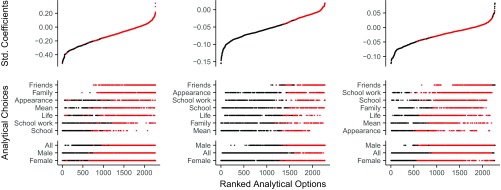
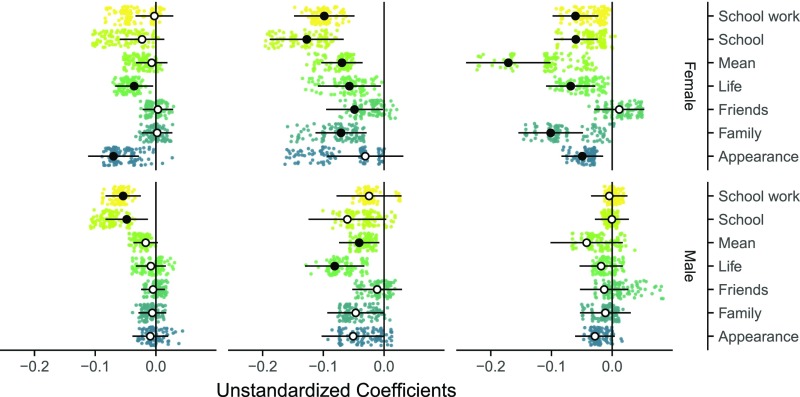
In this study, we used large-scale representative panel data to disentangle the between-person and within-person relations linking adolescent social media use and well-being. We found that social media use is not, in and of itself, a strong predictor of life satisfaction across the adolescent population. Instead, social media effects are nuanced, small at best, reciprocal over time, gender specific, and contingent on analytic methods.
Overview
The claims and statistics of this paper haven’t been checked yet.
Free: it reads the open-access text and checks the first 5 claims that cite a source we can check. Create a free account to check every claim.
Integrity signals
Registry
Cites
Statistics
Figures
Verification
Claims the paper makes
The claims and statistics of this paper haven’t been checked yet.
Free: it reads the open-access text and checks the first 5 claims that cite a source we can check. Create a free account to check every claim.
Claims other papers make about this one
Each is checked against this paper’s own text: does it say what the citing paper says it does?
The source backs part of the claim, not all of it — or backs it for a different population, condition or comparison.
In the citing paper
“Orben and colleagues6 found a small negative reciprocal within-person association between the time spent using social media and life satisfaction.”
From The effect of social media on well-being differs from adolescent to adolescent (2020) · cites this paper as [6]
Experimental — accuracy not yet measuredThe source backs part of the claim, not all of it — or backs it for a different population, condition or comparison.
In the citing paper
“a growing consensus has emerged suggesting that the associations observed between screen time and psychological or health outcomes are very small in size”
From The Conceptual and Methodological Mayhem of “Screen Time” (2020) · cites this paper as [6]
Experimental — accuracy not yet measuredThe source backs part of the claim, not all of it — or backs it for a different population, condition or comparison.
In the citing paper
“while some research has shown no effect of social media on well-being (Orben et al. 2019)”
From The future of social media in marketing (2020) · cites this paper as Orben et al. 2019
Experimental — accuracy not yet measuredThe source backs part of the claim, not all of it — or backs it for a different population, condition or comparison.
In the citing paper
“So far, only a few studies have applied this method and found only minimal within-person associations between social media use and mental health, primarily measured as depressive symptoms [7,20,21].”
From Social Media and Mental Health Among Early Adolescents in Sweden: A Longitudinal Study With 2-Year Follow-Up (KUPOL Study). (2021) · cites this paper as [21]
Experimental — accuracy not yet measuredThe source backs part of the claim, not all of it — or backs it for a different population, condition or comparison.
In the citing paper
“Recent publications that applied more sophisticated statistical methods to study the longitudinal association between social media use and mental health found similar minimal effect sizes [19,20,22], possibly contingent on gender [20,21] or mediated by sleep or physical activity [22,41].”
From Social Media and Mental Health Among Early Adolescents in Sweden: A Longitudinal Study With 2-Year Follow-Up (KUPOL Study). (2021) · cites this paper as [21]
Experimental — accuracy not yet measured
14 more claims about this paper
Create a free account to see every claim other papers make about this one.
Self-check
Percentages, sums and reported differences re-computed from the paper’s own numbers.
The self-check needs the paper’s full text.
Citations
Cites
Cohen, J. (1992) · Psychological Bulletin · doi:10.1037//0033-2909.112.1.155 · Cited by 8,771
A critique of the cross-lagged panel model
Hamaker, E. L., Kuiper, R. M., & Grasman, R. P. P. P. (2015) · Psychological Methods · doi:10.1037/a0038889 · Cited by 4,005
The association between adolescent well-being and digital technology use
Orben, A., & Przybylski, A. K. (2019) · Nature Human Behaviour · doi:10.1038/s41562-018-0506-1 · Cited by 1,500 · cited 4×
“We adopted a specification curve analysis framework (3, 5)—a computational method which minimizes the risk that a specific profile of analytical decisions yields false-positive results.”
BackgroundMethodInfluentialSelf-citationThe Difference Between “Significant” and “Not Significant” is not Itself Statistically Significant
Gelman, A., & Stern, H. (2006) · The American Statistician · doi:10.1198/000313006x152649 · Cited by 1,407
Missing-Data Adjustments in Large Surveys
Little, R. J. A. (1988) · Journal of Business & Economic Statistics · doi:10.1080/07350015.1988.10509663 · Cited by 1,101 · cited 1×
“Each model (i) considered female and male participants separately, (ii) included all relevant covariates, (iii) used weighted least squares mean and variance adjusted estimators to account for ordinal scales, (iv) implemented predictive mean matching to impute missing data (9), and (v) used data from participants who…”
MethodThe Accuracy of Self-Reported Internet Use—A Validation Study Using Client Log Data
Scharkow, M. (2016) · Communication Methods and Measures · doi:10.1080/19312458.2015.1118446 · Cited by 408 · cited 1×
“We also highlight that self-report measures only partially reflect the objective time adolescents spend engaging with social media (11), yet they form the foundation of technological assessments included in the bestquality datasets informing vital research in this area today.”
BackgroundSpecification Curve: Descriptive and Inferential Statistics on All Reasonable Specifications
Simonsohn, U., Simmons, J. P., & Nelson, L. D. (2015) · SSRN Electronic Journal · doi:10.2139/ssrn.2694998 · Cited by 248
The debate over digital technology and young people
Bell, V., Bishop, D. V. M., & Przybylski, A. K. (2015) · BMJ · doi:10.1136/bmj.h3064 · Cited by 143 · cited 1×
“Research, however, has not kept pace (1).”
Self-citationUnderstanding Society: Waves 1-8, 2009-2017 and Harmonised BHPS: Waves 1-18, 1991-2009
University Of Essex, I. F. S. (2019) · UK Data Service · doi:10.5255/ukda-sn-6614-12 · Cited by 26
Social Media’s Enduring Effect on Adolescent Life Satisfaction: CodePreprint
Przybylski, A. K., Orben, A., & Dienlin, T. (2019) · OSF Preprints (OSF Preprints) · doi:10.17605/osf.io/4xp3v
Self-citation
Cited by
Items 401–486 of 486
Paris, J. (2020) · Cambridge University Press eBooks · doi:10.1017/9781108867542.003
Ellis, D. A. (2020) · Cambridge University Press eBooks · doi:10.1017/9781108671408.001
Ellis, D. A. (2020) · Cambridge University Press eBooks · doi:10.1017/9781108671408.004
Ellis, D. A. (2020) · Cambridge University Press eBooks · doi:10.1017/9781108671408.002
A Biopsychosocial Model of Personality Disorders
Paris, J. (2020) · Cambridge University Press eBooks · doi:10.1017/9781108867542.012
Social Context and Personality
Paris, J. (2020) · Cambridge University Press eBooks · doi:10.1017/9781108867542.006
Ellis, D. A. (2020) · Cambridge University Press eBooks · doi:10.1017/9781108671408.009
(2020) · Cambridge University Press eBooks · doi:10.1017/9781108629935.012
Paris, J. (2020) · Cambridge University Press eBooks · doi:10.1017/9781108867542.008
Ellis, D. A. (2020) · Cambridge University Press eBooks · doi:10.1017/9781108671408.007
Paris, J. (2020) · Cambridge University Press eBooks · doi:10.1017/9781108867542.011
Personality Traits and Personality Disorders
Paris, J. (2020) · Cambridge University Press eBooks · doi:10.1017/9781108867542.005
Das Wohlbefinden Jugendlicher auf dem Weg in die digitalisierte Zukunft
Opp, G. (2022) · Psychotherapie: Praxis · doi:10.1007/978-3-662-63821-7_25
Digital Life and Well-BeingPreprint
Cheng, C., & Kushlev, K. (2022) · PsyArXiv (OSF Preprints) · doi:10.31234/osf.io/67scf
The Public and Their Platforms: Public Sociology in an Era of Social Media
Carrigan, M., & Fatsis, L. (2021) · doi:10.2307/j.ctv1pwns4m
Screen Media Use and Academic Performance Among Children and Adolescents
(2020) · AAP Grand Rounds · doi:10.1542/gr.43-1-5
Protecting Vulnerable Groups in Big Data Research (Preprint)Preprint
Shaw, D., Schneble, C. O., Delden, M.-L. V., & Elger, B. S. (2021) · doi:10.2196/preprints.31250
Hall, J. A. (2020) · Cambridge University Press eBooks · doi:10.1017/9781108629935.013
Paris, J. (2020) · Cambridge University Press eBooks · doi:10.1017/9781108867542.014
Ellis, D. A. (2020) · Cambridge University Press eBooks · doi:10.1017/9781108671408.010
Landon, J., Shepherd, D., Goedeke, S., & Li, M. (2021) · Journal of Concurrent Disorders · doi:10.54127/xjel9569
“Given the cohort, we could speculate on activities such as social media use conferring fewer benefits, however research suggests that the effects of social media are similarly contextual and nuanced (Orben et al., 2019).”
BackgroundDigital Media Use, Impact on Well‐Being
Nguyen, M. H., & Büchi, M. (2022) · Wiley eBooks · doi:10.1002/9781119678816.iehc0789
Social Media: Adolescent Health
Buijzen, M., Rozendaal, E., & van Woudenberg, T. J. (2022) · Wiley eBooks · doi:10.1002/9781119678816.iehc0632
de Vaate, N. A. J. D. B. (2023) · doi:10.5463/thesis.113 · Cited by 1
Gugushvili, N. (2023) · Research Publications (Maastricht University) · doi:10.26481/dis.20230320ng · Cited by 7
Dzgezen, V. C., Acarlar, B., & ner, Z. (2020) · Journal of Emerging Investigators · doi:10.59720/19-124
“Finally, the Apple Notes, Notability, Safari, Puffin, PowerPoint, Word, Google Drive, Google Docs, and Google Slides were the most used apps under the category “Creativity and Productivity” (28, 29).”
MethodChopra, R. C., & Chakraborty, S. (2023) · IEEE International Conference on Bioinformatics and Bioengineering (BIBE) · doi:10.1109/bibe60311.2023.00024
“This becomes particularly important in today’s world of social media exposure with varied content that has a large impact on mental health [10, 11].”
BackgroundLeitao, M., Proulx, J. D. E., & Kushlev, K. (2024) · Technology Mind and Behavior · doi:10.1037/tmb0000125.supp
Espinoza, J., & Weekes, A. (2024) · JOURNAL OF SOCIAL SCIENCE RESEARCH · doi:10.24297/jssr.v20i.9621
App use during the sleep period and next day activityPreprint
Lehmann, S., Møllgaard, P., Minor, K., Sapienza, A., & Moro, E. (2024) · Research Square · doi:10.21203/rs.3.rs-4912029/v1
Karagiorgakis, A., & Aaron, K. (2024) · The American Journal of Psychology · doi:10.5406/19398298.137.1.03 · Cited by 1
The Relationship between 8th grade students’ social media use and hope and life satisfaction
Yazıcı, Y., & Atlı, A. (2024) · Education science and sports. · doi:10.70053/esas.1541629
Coaching Generation Z: Necessity, challenges and opportunities
Hulbert‐Williams, L., Wilkinson, D., & Hulbert-Williams, N. (2024) · The Coaching Psychologist · doi:10.53841/bpstcp.2024.20.2.74 · Cited by 1
Ejaz, A., Riaz, S., Shabbir, S., Naseem, F., Khoso, Z. A., & Ain, N. U. (2025) · Journal for social science archives · doi:10.59075/jssa.v3i1.118 · Cited by 1
Despair: Passivity in the Face of Predictive Power
Thiele, L. P. (2025) · Springer eBooks · doi:10.1007/978-3-031-82086-1_6
Curation As Competition, Curation As VicePreprint
Bambauer, J. R. Y., & Adams, G. (2025) · SSRN Electronic Journal · doi:10.2139/ssrn.5148059
Ren, C. S. (2025) · Lecture Notes in Education Psychology and Public Media · doi:10.54254/2753-7048/2025.23015
Long, P. E. (2023) · Scholars Archive - University at Albany (University at Albany, State University of New York) · doi:10.54014/88n8-e5wp · Cited by 2
Early Adopters: Older Teens' Conceptions of Their Significant Social Media Practices
Heaney, A. (2025) · Reading Research Quarterly · doi:10.1002/rrq.70026 · Cited by 2
“Research focusing on promising or positive app effects reveals decreasing isolation, access to resources and social support, development of critical literacies, and increased exchange of ideas and information (Hamilton et al. 2020; Orben et al. 2019; Stern and Odland 2017).”
Laiti, J., Javadpour, S., Mullen, J. M., Byrne, E., & Dunne, P. J. (2025) · doi:10.2196/preprints.79381
Dong, F., & Marquis, W. (2025) · Journal of Strategic Innovation and Sustainability · doi:10.33423/jsis.v20i3.7756
Beyond a straight line: use-disorder and social media-related well-being across regional clustersPreprint
Yankouskaya, A., Almourad, M. B., Liebherr, M., Rashid, M., & Ali, R. (2025) · Research Square · doi:10.21203/rs.3.rs-6890846/v1
Behind the screens: what underlies the experience of social media as a stressor among adolescents
Andersen, A. I. O., Finserås, T. R., Hjetland, G. J., Bøe, T., Sivertsen, B., & Skogen, J. C. (2025) · International Journal of Adolescence and Youth · doi:10.1080/02673843.2025.2559813 · Cited by 1
“This is in line with previous work, where several studies have found a stronger relationship between social media use and adverse mental health outcomes for females than males (Orben et al., 2019; Twenge et al., 2018).”
InfluentialBautista, P., Salinas, A. C., Saso, C. E., & Íñiguez‐Berrozpe, T. (2025) · International Journal of Adolescence and Youth · doi:10.1080/02673843.2025.2574466 · Cited by 3
“However, as they grow older, the pressure to constantly improve and display their image may escalate into a source of dissatisfaction, increasing emotional risks (Orben et al., 2019; Saiphoo & Vahedi, 2019).”
Stokke, S. S., Stenseng, F., Morin, A. H., Hygen, B. W., Wichstrøm, L., Steinsbekk, S., Dybendal, B. H., & Skalická, V. (2025) · Media Psychology · doi:10.1080/15213269.2025.2576017 · Cited by 2
Başal, M., Karalinç, T., & Bekun, F. V. (2025) · Journal of economic and administrative sciences. · doi:10.1108/jeas-03-2025-0129
Li, T., Shan, Y., Sun, Y., & Chen, K. (2025) · Scientific Reports · doi:10.1038/s41598-025-23788-0
“…(e.g., high neuroticism), even when sufficient social support is available and life satisfaction is high, they may be more prone to engaging in negative social media usage behaviors once PWU reaches an extremely high level—without being affected by the mediating role of life satisfaction 42,43 .”
Dijital Çağda Çocuk Psikolojisi
Ersoy, A. (2025) · Özgür Yayınları eBooks · doi:10.58830/ozgur.pub915.c3811
Klinger, D., Plener, P. L., Marboe, G., Karwautz, A., Kothgassner, O. D., & Dienlin, T. (2024) · Figshare · doi:10.6084/m9.figshare.26942628
Self-citationMa, X., Boisen, M. R. M., Dillard, C., Lee, Y., Absalon, E., & Doty, J. L. (2025) · Journal of Adolescence · doi:10.1002/jad.70090 · Cited by 2
“The increasing use of technology among adolescents has significantly impacted their relationships and social behaviors (Orben et al 2019; Zhang 2023).”
Laiti, J., Javadpour, S., Mullen, J. M., Conway, C., Byrne, E., & Dunne, P. J. (2026) · JMIR Human Factors · doi:10.2196/79381 · Cited by 3
“Digital tools present several potential risks, including concerns about data privacy, inappropriate content exposure, overuse or dependence, algorithmic bias, and insufficient safeguarding mechanisms [20,21].”
Der soziale Kitt – Wachstum als Brücke des gesellschaftlichen Zusammenhalts
Pätzold, M., Vesta, F., & Tolkmitt, V. (2026) · Springer eBooks · doi:10.1007/978-3-658-50406-9_9
Connecting internalizing complaints and motivations for Instagram Use: A Bayesian network approach
Maerevoet, M., Hoorelbeke, K., Bosch, R. D., de Putte, E. V., & Koster, E. H. W. (2026) · Computers in Human Behavior Reports · doi:10.1016/j.chbr.2026.101039 · Cited by 1
The Social Media ExternalityPreprint
Markovich, S., & Rayo, L. (2026) · SSRN Electronic Journal · doi:10.2139/ssrn.6670438
Prospective relationships between appearance-based social media use and adolescent mental health
Ragg, C. J., Rapee, R. M., & Fardouly, J. (2026) · New Media & Society · doi:10.1177/14614448261439090
Les jeunes, l'inclusion sociale et le numérique
Street, C., Asam, A. E., & Katz, A. (2025) · Points de vue sur la jeunesse · doi:10.3917/europ.coe.2025.02.0120
Regrets, I’ve Had a Few; But Then Again, Time on Social Media May Not Be One of Them
Whelan, E. (2026) · Cyberpsychology Behavior and Social Networking · doi:10.1177/21522715261449334
“Consistent with the sentiments of some prior studies, 51 but contrary to others, 50 the correlation between social media regret and life satisfaction was weak and not statistically signi fi cant.”
Danielsen, H. E., Finserås, T. R., Bøe, T., Hjetland, G. J., Andersen, A. I. O., Colman, I., & Skogen, J. C. (2026) · BMC Public Health · doi:10.1186/s12889-026-27631-7
“Self-report measures can differ from the observed degree of ADHD symptoms and social media use [43], thus clinical assessment of ADHD symptoms and objective measures for social media use, could have given other results.”
Digital transformation and mental health among young adults
Zhang, Q., Du, C., & Wang, Y. (2026) · Frontiers in Public Health · doi:10.3389/fpubh.2026.1800927
“…waves of Understanding Society (the UK Household Longitudinal Study, UKHLS) data from 2009 to 2016 find that the relationship between social media use and life satisfaction is not statistically significant in more than half of the model specifications, and that this relationship varies by gender (28).”
ElFadl, A. H., Alshakhsi, S. A. A., Ali, R., & Yankouskaya, A. (2026) · PeerJ Computer Science · doi:10.7717/peerj-cs.3547
Problematic Social Media Use and Mental Health: The Mediating Role of Mindfulness
Kruse, F., & Nagel, A. (2026) · Psychiatry International · doi:10.3390/psychiatryint7030134 · Cited by 1
“The broader literature generally shows small-to-modest links between social media variables and adolescent well-being, with substantial heterogeneity across individuals and contexts [5,48,59].”
Adolescents' use of Instagram for coping with stress
Chen, I., & Teoh, Y. (2026) · British Journal of Developmental Psychology · doi:10.1111/bjdp.70058
Yamashita, Y., Kyi, L., He, C., De, A., Antoniak, M., Zou, Y., & Biega, A. J. (2026) · ACM Conference on Fairness, Accountability, and Transparency (FAccT) · doi:10.1145/3805689.3812409
“Despite inconclusive scientific evidence about the effects of platform usage on individual well-being [72, 74, 82], online platforms have begun offering digital well-being tools without explicit regulatory requirements to do so.”
Li, W. O., Fung, C.-M., Chow, T. S., Leung, K. I. D., & Cheung, Y.-W. (2026) · Cyberpsychology Journal of Psychosocial Research on Cyberspace · doi:10.5817/cp2026-3-6
“Aligning with previous studies (for example, Orben et al., 2019), the relationship in this study between SNS usage and life satisfaction was not a simple, direct relationship.”
THE RELATIONSHIP BETWEEN SOCIAL MEDIA ADDICTION, FAMILY LIFE SATISFACTION AND LONELINESS
Öztat, F. (2026) · The Turkish Online Journal of Design Art and Communication · doi:10.7456/tojdac.1929343
The Reinforcement Effect of Social Media Likes in Depression
Mirea, D.-M., Chen, S., Ding, J., Palacio-Soto, K., Mildner, J. N., Kelley, S. W., Gillan, C. M., Nook, E. C., & Niv, Y. (2026) · JAMA Psychiatry · doi:10.1001/jamapsychiatry.2026.1430 · Cited by 1
Digital and Substance Dependence in the Post-Digital Era
Romeo, V. M. (2026) · Encyclopedia · doi:10.3390/encyclopedia6070160
“In a related longitudinal study, Orben, Dienlin, and Przybylski reported limited enduring effects of social media use on adolescent life satisfaction, with substantial variation between individuals and developmental periods [69].”
Toumazou, C. (2026) · IEEE Circuits and Systems Magazine · doi:10.1109/mcas.2026.3674058
“Across developmental psychology, neuroscience and behavioural medicine, social connection consistently predicts resilience, motivation and mental wellbeing [1], [2], [3], [4], [5].”
Hu, J., Liu, L., & Zou, Y. (2026) · Frontiers in Public Health · doi:10.3389/fpubh.2026.1887437
“Moreover, the underlying mechanisms for this age group tend to center on contexts such as peer recognition, identity development, and parental supervision (19, 20).”
Social technology use and life satisfaction in a five-wave panel study of US adults
Kushlev, K., Moon, K., Motyl, M. S., Fast, N. J., & Schroeder, J. (2026) · Nature Human Behaviour · doi:10.1038/s41562-026-02564-8 · Cited by 1
Wang, N.-L., & Lin, Y.-A. (2026) · Child and Adolescent Social Work Journal · doi:10.1007/s10560-026-01167-6
Liu, D., Ta, N., Yu, M., Liu, M., & Fu, Y. (2026) · Clinical Psychology Review · doi:10.1016/j.cpr.2026.102784
Yang, Y., Wang, Y., Zhang, N., Xu, M., Ling, X., Wang, J., & Gao, X. (2026) · Behavioral Sciences · doi:10.3390/bs16091567
“First, existing research has primarily focused on behavioral indicators of social media use, such as duration and frequency, while paying relatively less attention to the psychological connection between individuals and social media (Orben et al., 2019).”
Beyond Text: Embodiment and Robots
Perry, A., & Cameron, C. D. (2026) · Cambridge University Press eBooks · doi:10.1017/9781009639057.016
From Social Media to Empathic Artificial Intelligence: Applying Past Lessons to Future Technologies
Rodriguez, M., Motyl, M., & Schroeder, J. (2026) · Cambridge University Press eBooks · doi:10.1017/9781009639057.023 · Cited by 1
Helvich, J., Novák, L., Jozefiaková, B., Milková, E., & Tavel, P. (2026) · Cyberpsychology Journal of Psychosocial Research on Cyberspace · doi:10.5817/cp2026-4-12 · Cited by 1
“However, directionality remains difficult to establish (Coyne et al., 2020; Orben et al., 2019), with population-level averages often masking individual variation (Beyens et al., 2020).”
Schwertberger, U., & Rieger, D. (2026) · Springer eBooks · doi:10.1007/978-3-658-46851-4_18-1
Impact of Short-Form Videos on Screentime and Sleep: Evidence from TikTok
Agarwal, S., & Ananthakrishnan, U. M. (2026) · Management Science · doi:10.1287/mnsc.2024.08260 · Cited by 4
Teoria wielkiego przeprogramowania dzieciństwa autorstwa Jonathana Haidta – analiza krytyczna
Bajek, W. (2026) · Problemy Opiekuńczo-Wychowawcze · doi:10.71358/pow.3317
Roy, S., & Paty, V. (2025) · PAIN JOINTS SPINE · doi:10.1922/pjs.15.4.2025.1207
Moravec, V., Gavurová, B., Rigelský, M., & Miovský, M. (2026) · Acta Psychologica · doi:10.1016/j.actpsy.2026.107985
Tiernan, P., Donlon, E., & Hamash, M. (2026) · Frontiers in Education · doi:10.3389/feduc.2026.1963041
Metadata
- Authors
- Orben, A., Dienlin, T., & Przybylski, A. K.
- Affiliations
- University of Oxford (GB)
- University of Hohenheim (DE)
- Corresponding author
- Orben, Amy
- Venue
- Proceedings of the National Academy of Sciences
- Publisher
- National Academy of Sciences
- Published
- 2019-05-06
- Volume
- 116
- Issue
- 21
- Pages
- 10226-10228
- ISSN
- 0027-8424 (ISSN-L)
- 1091-6490
- PMC
- PMC6534991
- OpenAlex
- W2944221730
- Cited by
- 485
- References
- 9
- Citations by year
- 2026: 42 · 2025: 46 · 2024: 47 · 2023: 54 · 2022: 62 · 2021: 84 · 2020: 125 · 2019: 24
- FWCI
- 148.41
- Type
- journal article
- Language
- en
- Open access
- hybrid
- doi.org
- Licence
- Locations
- Proceedings of the National Academy of Sciences (publishedVersion, cc-by)
- Europe PMC (PubMed Central) (publishedVersion, cc-by)
- PubMed Central (publishedVersion, cc-by)
- PubMed (publishedVersion)
- Funders
- Barnardo's (Research Grant)
- Volkswagen Foundation (Transformations of privacy)
- RCUK | Economic and Social Research Council (Understanding Society Policy Fellowship)
- Topics
- Social Sciences › Sociology and Political Science › Impact of Technology on Adolescents
- Social Sciences › Psychology › Social Psychology › Psychological Well-being and Life Satisfaction
- Social Sciences › Education › Child Development and Digital Technology
- Keywords
- social media use, adolescent life satisfaction, youth welfare, reciprocal effects, gender differences, within-person effects, between-person effects, longitudinal panel data
- MeSH terms
- Adolescent, Adolescent Behavior, Child, Female, Humans, Male, Personal Satisfaction, Surveys and Questionnaires, Social Media
About these checks
Registry, retraction, Cites and statistics results are computed, not judged, with one exception: a printed reference that no index lists is read once by a model before it counts as a citation error. Claims are extracted by a model and kept only when their quote appears verbatim in the text; each cited source is then checked, with a model’s help, for whether it says what the claim relies on. Those verdicts can be wrong — read the claim’s quote and the cited source before relying on one.
Statistics and arithmetic are recomputed, not judged.
Confidence bands are shown only for fields calibrated on our annotated test set. None is calibrated yet, so no band is shown.
What counts as a claim ›How we measure confidence ›How we check this ›
Are you an author, or do you see a problem with this page? Request a review
Data sources
Bibliographic data: Semantic Scholar, OpenAlex, Crossref.
Contains information from the Semantic Scholar Academic Graph Datasets, made available under the ODC Attribution License (ODC-BY 1.0).
Semantic Scholar’s data is described in: Kinney, R., et al. (2023). The Semantic Scholar Open Data Platform. arXiv:2301.10140.
