

The DOI matches its Crossref record; 35 of the 36 references it cites were found in a registry or an index, and 1 are not checked yet.
Scaling up behavioral science interventions in online education
Open accessAbstract
Significance: Low persistence in educational programs is a major obstacle to social mobility. Scientists have proposed many scalable interventions to support students learning online. In one of the largest international field experiments in education, we iteratively tested established behavioral science interventions and found small benefits depending on individual and contextual characteristics. Forecasting intervention efficacy using state-of-the-art methods yields limited improvements. Online education provides unprecedented access to learning opportunities, as evidenced by its role during the 2020 coronavirus pandemic, but adequately supporting diverse students will require more than a light-touch intervention. Our findings encourage funding agencies and researchers conducting large-scale field trials to consider dynamic investigations to uncover and design for contextual heterogeneity to complement static investigations of overall effects.
Overview
The claims and statistics of this paper haven’t been checked yet.
Run the check — free, no account needed. It reads the open-access text and checks the sources it cites.
Integrity signals
Registry
Cites
Statistics
Figures
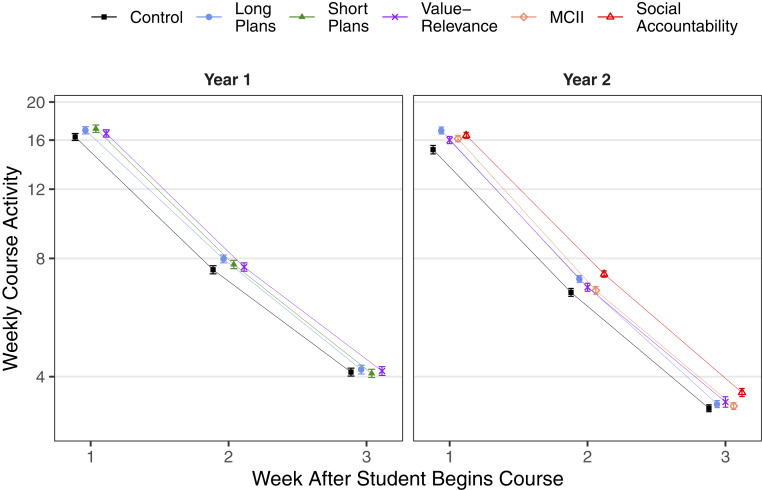
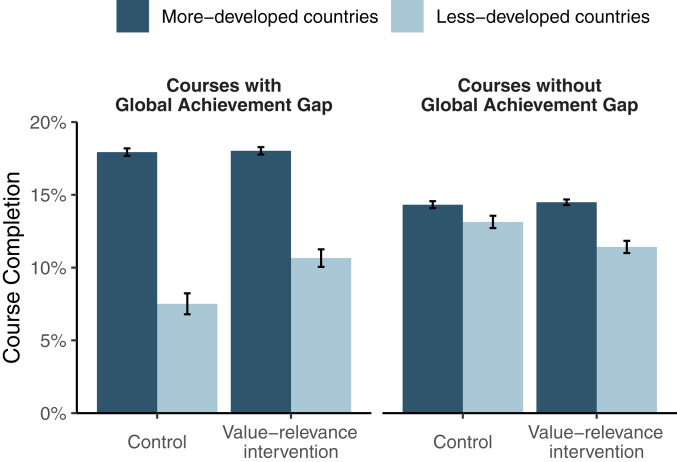
Verification
Claims the paper makes
The claims and statistics of this paper haven’t been checked yet.
Run the check — free, no account needed. It reads the open-access text and checks the sources it cites.
Claims other papers make about this one
Each is checked against this paper’s own text: does it say what the citing paper says it does?
The source backs part of the claim, not all of it — or backs it for a different population, condition or comparison.
In the citing paper
“However, asynchronous courses often rely heavily on self- regulation and intrinsic motivation, which may raise challenges for learners, such as low engagement, high dropout rates, and a lack of immediate feedback (Kizilcec etal.2020).”
From Game‐Based Learning for Asynchronous AI Literacy Course: Approach to Improve Students' Cognitive, Behavioural, Affective, and Ethical Learning of AI (2026) · cites this paper as Kizilcec et al. 2020
Experimental — accuracy not yet measuredThe source backs part of the claim, not all of it — or backs it for a different population, condition or comparison.
In the citing paper
“This intervention increased completion rates only for students in individual countries.”
From Using personalized support & school-based study groups to increase teachers’ participation in MOOCs: Findings from two European pilot projects (2021) · cites this paper as Kizilcec et al., 2020
Experimental — accuracy not yet measuredThe source backs part of the claim, not all of it — or backs it for a different population, condition or comparison.
In the citing paper
“This second intervention was found to increase completion rates only in a subset of courses carried out in developing countries.”
From Using personalized support & school-based study groups to increase teachers’ participation in MOOCs: Findings from two European pilot projects (2021) · cites this paper as Kizilcec et al., 2020
Experimental — accuracy not yet measuredThe cited source says what the claim attributes to it.
In the citing paper
“Overall, the authors conclude that the impacts of such interventions could be highly heterogeneous across contexts, type of participants and that support interventions should be targeted and take those factors in due account.”
From Using personalized support & school-based study groups to increase teachers’ participation in MOOCs: Findings from two European pilot projects (2021) · cites this paper as Kizilcec et al., 2020
The cited source says what the claim attributes to it.
In the citing paper
“While this intervention increased shortterm persistence, it did not increase course completion, which was previously found (Yeomans and Reich, 2017).”
From Using personalized support & school-based study groups to increase teachers’ participation in MOOCs: Findings from two European pilot projects (2021) · cites this paper as Kizilcec et al., 2020
The cited source says what the claim attributes to it.
In the citing paper
“However, robust evidence on what works is limited and is not specifically focused on teachers (Kizilcec et al., 2020).”
From Using personalized support & school-based study groups to increase teachers’ participation in MOOCs: Findings from two European pilot projects (2021) · cites this paper as Kizilcec et al., 2020
Self-check
Percentages, sums and reported differences re-computed from the paper’s own numbers.
The self-check needs the paper’s full text.
Citations
Cites
Implementation intentions and goal achievement: a meta-analysis of effects and processes
Gollwitzer, P. M., & Sheeran, P. (2006) · Advances in Experimental Social Psychology · doi:10.1016/s0065-2601(06)38002-1 · Cited by 3,236 · cited 2×
“The “mental contrasting with implementation intentions” (MCII) intervention prompts students to reflect on the benefits and barriers to achieving their goal (20) and then plan ahead for how to overcome obstacles (15).”
BackgroundSurrogate endpoints in clinical trials: Definition and operational criteria
Prentice, R. L. (1989) · Statistics in Medicine · doi:10.1002/sim.4780080407 · Cited by 2,057
A national experiment reveals where a growth mindset improves achievement
Yeager, D. S., Hanselman, P., Walton, G. M., Murray, J. S., Crosnoe, R., Muller, C., Tipton, E., Schneider, B., Hulleman, C. S., Hinojosa, C. P., et al. (2019) · Nature · doi:10.1038/s41586-019-1466-y · Cited by 1,513
Promoting Interest and Performance in High School Science Classes
Hulleman, C. S., & Harackiewicz, J. M. (2009) · Science · doi:10.1126/science.1177067 · Cited by 1,220
Reducing the racial achievement gap: A social-psychological intervention
Cohen, G. L., Garcia, J., Apfel, N., & Master, A. (2006) · Science · doi:10.1126/science.1128317 · Cited by 1,073
Wise interventions: Psychological remedies for social and personal problems.
Walton, G. M., & Wilson, T. D. (2018) · Psychological Review · doi:10.1037/rev0000115 · Cited by 617
Future thought and behaviour change
Oettingen, G. (2012) · European Review of Social Psychology · doi:10.1080/10463283.2011.643698 · Cited by 504
Site Selection Bias in Program Evaluation *
Allcott, H. (2015) · The Quarterly Journal of Economics · doi:10.1093/qje/qjv015 · Cited by 426
Hall, A. T., Frink, D. D., & Buckley, M. R. (2017) · Journal of Organizational Behavior · doi:10.1002/job.2052 · Cited by 335
Attrition and Achievement Gaps in Online Learning
Kizilcec, R. F., & Halawa, S. (2015) · Proceedings of the Second (2015) ACM Conference on Learning @ Scale · doi:10.1145/2724660.2724680 · Cited by 307
Self-citation
Research works printed but not linked: 3
- C. R. Sunstein, R. H. Thaler, Nudge: Improving Deisions About Health, Wealth, and Happiness, (Yale Univeresity Press, New Haven, 2008).
- C. Zhenghao ., Who’s benefiting from MOOCs, and why. Harv. Bus. Rev. 25, 2–8 (2015).
- 10.1353/bsp.2015.0011 · DOI
Cited by
Sorted by citations
Items 101–200 of 206
Attitudes of intellectual disabled children's teachers towards E-learning during Corona pandemic
Abuzaid, S. (2021) · Revista Amazonia Investiga · doi:10.34069/ai/2021.40.04.3 · Cited by 3
Decrypting the Learners’ Retention Factors in Massive Open Online Courses
Pant, H. V., Lohani, M. C., & Pande, J. (2022) · Journal of Learning for Development · doi:10.56059/jl4d.v9i1.570 · Cited by 3
IMPACT AND VULNERABILITY OF DISTANCE LEARNING ON THE MENTAL HEALTH CONDITIONS OF STUDENTS
Aditya, R. (2021) · Journal of Psychiatry Psychology and Behavioral Research · doi:10.21776/ub.jppbr.2021.002.01.3 · Cited by 3
An Experimental Study of Self-regulated Learning Strategies Application in Moocs
Hsu, S.-Y. (2021) · doi:10.7916/d8-k2g6-5q04 · Cited by 3
Effects of Inductive Learning and Gamification on News Veracity DiscernmentPreprint
Modirrousta-Galian, A., Higham, P. A., & Seabrooke, T. (2022) · doi:10.31234/osf.io/4wfds · Cited by 3
Beetham, H. (2024) · Postdigital Science and Education · doi:10.1007/s42438-024-00511-2 · Cited by 3
Which Planning Tactics Predict Online Course Completion?
Cho, J. Y., Tao, Y., Yeomans, M., Tingley, D. H., & Kizilcec, R. F. (2024) · International Conference on Learning Analytics and Knowledge (LAK) · doi:10.1145/3636555.3636891 · Cited by 2
Self-citationWood, S. Y., & Cross, V. L. (2024) · Scholarship of Teaching and Learning in Psychology · doi:10.1037/stl0000412 · Cited by 2
Pimblett, C., & Rowe, L. (2026) · Education + Training · doi:10.1108/et-05-2025-0311 · Cited by 2
Blikstein, P., & Blikstein, I. (2023) · The MIT Press eBooks · doi:10.7551/mitpress/13654.003.0015 · Cited by 2
Managerial taboos: How the ideal of a manager may harm people and organizations
Háša, S., & Houdek, P. (2024) · The International Journal of Management Education · doi:10.1016/j.ijme.2024.100992 · Cited by 2
The Integration of Artificial Intelligence towards Interactive Based Higher Education System Design
Sulaymanova, S., Boboyeva, Z., & Ozodbek, S. (2024) · International Conference on Advance Computing and Innovative Technologies in Engineering (ICACITE) · doi:10.1109/icacite60783.2024.10617254 · Cited by 2
Personalised Learning Systems and the Human Touch in Society 5.0
Ghosh, U. K., & Jermsittiparsert, K. (2024) · Practice, progress, and proficiency in sustainability · doi:10.4018/979-8-3693-7989-9.ch012 · Cited by 4
Transformation of Quality Education Through E-Learning for Sustainable Development
Pathak, S., & Jain, V. K. (2024) · Advances in educational technologies and instructional design book series · doi:10.4018/979-8-3693-8252-3.ch009 · Cited by 2
Using Social Norms to Promote Actions Beyond the Course
Cho, J. Y., Li, Y., Armstrong, A. K., Russ, A., Krasny, M. E., & Kizilcec, R. F. (2021) · ACM Conference on Learning @ Scale (L@S) · doi:10.1145/3430895.3460144 · Cited by 2
Self-citationExploring Completion in MOOCs for Providing Teacher CPD: Does Grit Matter?
Davies, P. M. (2022) · IEEE Learning With MOOCS (LWMOOCS) · doi:10.1109/lwmoocs53067.2022.9927865 · Cited by 2
Online Instruction and the “Hyflex Teaching ‘Shock Doctrine’”
Vujnović, M., & Foster, J. E. (2022) · Palgrave critical university studies · doi:10.1007/978-3-031-12370-2_7 · Cited by 2
Savi, A. O., van Klaveren, C., & Cornelisz, I. (2023) · Computers & Education · doi:10.1016/j.compedu.2023.104908 · Cited by 2
Navigating student views on online education: Balancing preferences, challenges, and opportunities
Baig, D. (2023) · Education Mind · doi:10.58583/pedapub.em2307 · Cited by 2
Hertz, B., & Engelhardt, K. (2021) · IUL Research · doi:10.57568/iulres.v2i3.123 · Cited by 1
ManyClasses 2: The effects of prequestions on media interactions and learning.
Motz, B. A., Chinni, A., de Leeuw, J. R., Jankowski, H. E., Aggarwal, A., Amato, M., Berlin, K., Britten, K., Brown, A., Cerchiaro, M. L., et al. (2026) · Journal of Educational Psychology · doi:10.1037/edu0000978 · Cited by 1
How do A/B Testing and Secondary Data Analysis on AIED Systems Influence Future Research?
Nasiar, N., Baker, R. S., Li, J., & Gong, W. (2022) · Lecture notes in computer science · doi:10.1007/978-3-031-11644-5_10 · Cited by 1
Christ, A., Birnbaum, L., & Kröner, S. (2025) · Zeitschrift für Erziehungswissenschaft · doi:10.1007/s11618-025-01301-7 · Cited by 1
Artificial Intelligence and Communication in LMS to Enhancing Engagement and Learning
Ouariach, F. Z., Nejjari, A., Ouariach, S., & Khaldi, M. (2025) · Advances in educational technologies and instructional design book series · doi:10.4018/979-8-3373-2262-9.ch012 · Cited by 1
Challenges and Practical Paths of Artificial Intelligence Enabled Educational Evaluation
孙, 佳. (2025) · Advances in Education · doi:10.12677/ae.2025.1571318 · Cited by 1
Kapuza, A., & Andriasian, L. (2025) · Open Learning The Journal of Open Distance and e-Learning · doi:10.1080/02680513.2025.2545925 · Cited by 1
Research on optimization of online education effectiveness system based on Louvain algorithm
Wei, W., Qu, Z., & Jia, P. (2025) · Convergence The International Journal of Research into New Media Technologies · doi:10.1177/13548565251402997 · Cited by 1
Rowing Different Boats in the Same Troubled Sea: A Voyage on Flexible Learning
Borlio, J. G., & Duping, A. M. (2026) · American Journal of Qualitative Research · doi:10.29333/ajqr/17460 · Cited by 1
A Review of the Use of Machine Learning Algorithms in Analyzing Student Performance
Alfarwan, A. M. (2025) · International Conference on Education Technology and Computer · doi:10.1109/icetc66579.2025.11387555 · Cited by 1
Liu, Y., Ji, W., & Zhou, G. (2026) · Journal of King Saud University - Computer and Information Sciences · doi:10.1007/s44443-026-00600-1 · Cited by 1
Casillas-Muñoz, F. A. G., Alvarez-Icaza, I., Tworek, M. T., Escobar-Díaz, C., Sánchez‐Zuno, G. A., Morales-Menéndez, R., & Soledad, M. (2026) · Frontiers in Education · doi:10.3389/feduc.2026.1718468 · Cited by 1
Zhang, L. (2026) · Frontiers in Psychology · doi:10.3389/fpsyg.2026.1831489 · Cited by 1
Sabar, F. C., Taneo, R. F. S., Alemoka, C. K., Mai, A. Y., Walalayo, D. Y., Bumen, S., Jazila, S., Peea, E. E., Nanda, N., Cu'la, H., et al. (2026) · F1000Research · doi:10.12688/f1000research.190540.1
Ackfeld, V., Rohloff, T., & Rzepka, S. (2021) · Behavioural Public Policy · doi:10.1017/bpp.2021.39 · Cited by 1
van de Werfhorst, H. G. (2022) · Socius Sociological Research for a Dynamic World · doi:10.1177/23780231221081703 · Cited by 1
IMPACT AND VULNERABILITY OF DISTANCE LEARNING ON THE MENTAL HEALTH CONDITIONS OF STUDENTS
Aditya, R. (2021) · Journal of Psychiatry Psychology and Behavioral Research · doi:10.21776/ub.jppbr.2021.001.01.3 · Cited by 1
Effects of Framing Professional Development as a Career Growth Opportunity on Course Completion
Kizilcec, R. F., Mimno, J. A., & Karhan, A. J. (2022) · ACM Conference on Learning @ Scale (L@S) · doi:10.1145/3491140.3528304 · Cited by 1
Self-citationChallenges and Prospects of Online Education Due to the Covid-19 Pandemic
Serovaiskaia, E., & Serovaiskii, A. (2022) · Springer eBooks · doi:10.1007/978-3-031-00801-6_10 · Cited by 1
Against Service Innovation: Why Service Innovation Is Not Sustainable
Witell, L., Snyder, H., & Carlborg, P. (2023) · Palgrave debates in business and management · doi:10.1007/978-3-031-16666-2_11 · Cited by 1
Secure Education and Learning Research at Scale with OpenStax Kinetic
Mallick, D. B., Bradford, B. C., & Baraniuk, R. G. (2023) · ACM Conference on Learning @ Scale (L@S) · doi:10.1145/3573051.3596187 · Cited by 1
Better Anticipating Unintended Consequences
Andrews, C. J. (2024) · IEEE Transactions on Technology and Society · doi:10.1109/tts.2024.3403412 · Cited by 1
Ozernov‐Palchik, O., Olson, H. A., Arechiga, X. M., Kentala, H., Solorio-Fielder, J. L., Wang, K. L., Torres, Y. C., Gardino, N. D., Dieffenbach, J. R., & Gabrieli, J. D. E. (2021) · doi:10.31234/osf.io/k9632 · Cited by 1
Kim, J., Yang, G., Chan, W. S., Lin, X., Song, Y., & Li, N. (2026) · European Journal of Education · doi:10.1111/ejed.70658 · Cited by 1
Comrie, A. C. (2021) · Open Book Publishers · doi:10.11647/obp.0240 · Cited by 3
Harrison, N. M. (2019) · Liverpool University Press eBooks · doi:10.3828/liverpool/9781786941763.003.0004
Comrie, A. C. (2021) · Open Book Publishers · doi:10.11647/obp.0240.04
Comrie, A. C. (2021) · Open Book Publishers · doi:10.11647/obp.0240.02
9. Public Service, Cooperative Extension, and Community Engagement
Comrie, A. C. (2021) · Open Book Publishers · doi:10.11647/obp.0240.09
Comrie, A. C. (2021) · Open Book Publishers · doi:10.11647/obp.0240.03
Comrie, A. C. (2021) · Open Book Publishers · doi:10.11647/obp.0240.06
Deliou, C., & Malagkoniari, M. (2023) · International Conference on Business and Economics - Hellenic Open University · doi:10.12681/icbe-hou.5298
Comrie, A. C. (2021) · Open Book Publishers · doi:10.11647/obp.0240.01
Comrie, A. C. (2021) · Open Book Publishers · doi:10.11647/obp.0240.12
Comrie, A. C. (2021) · Open Book Publishers · doi:10.11647/obp.0240.08
Comrie, A. C. (2021) · Open Book Publishers · doi:10.11647/obp.0240.10
Comrie, A. C. (2021) · Open Book Publishers · doi:10.11647/obp.0240.15
Comrie, A. C. (2021) · Open Book Publishers · doi:10.11647/obp.0240.14
11. Health Sciences, Hospitals & Medical Schools
Comrie, A. C. (2021) · Open Book Publishers · doi:10.11647/obp.0240.11
Comrie, A. C. (2021) · Open Book Publishers · doi:10.11647/obp.0240.05
Comrie, A. C. (2021) · Open Book Publishers · doi:10.11647/obp.0240.13
Comrie, A. C. (2021) · Open Book Publishers · doi:10.11647/obp.0240.07
De la collecte des traces d’interaction à la publication scientifique
Cisel, M. (2022) · Distances et médiations des savoirs · doi:10.4000/dms.6953
Bruillard, É. (2022) · Distances et médiations des savoirs · doi:10.4000/dms.7645
Self-Regulation, Motivation, Emotion, and Skill Mastery of Online Learning
Guo, J., & Ding, Q. (2023) · Advances in educational technologies and instructional design book series · doi:10.4018/978-1-6684-6500-4.ch011
Ober, T. M., Johnson, E., Gonsalves, P., Kakodkar, M., & Zdankus, J. (2024) · ASEE Annual Conference & Exposition · doi:10.18260/1-2--41719
Teoh, Y. Y., Cho, H., & Hutcherson, C. A. C. (2024) · doi:10.31234/osf.io/uhgmd
Experimental Impacts of a Virtual Parenting Program with Mothers and FathersPreprint
Lebedinski, L., Carneiro, P., Urzua, T. A., Perng, J., Boudet, A. M., & Herrera-Sosa, K. (2024) · SSRN Electronic Journal · doi:10.2139/ssrn.4849687
Froehlich, L., & Weydner-Volkmann, S. (2024) · Journal of Learning Analytics · doi:10.18608/jla.2023.8301 · Cited by 9
ManyClasses 2: The Effects of Prequestions on Media Interactions and LearningPreprint
Motz, B. A., Chinni, A., de Leeuw, J. R., Jankowski, H. E., Aggarwal, A., Amato, M., Berlin, K. L., Britten, K., Brown, A., Cerchiaro, M. L., et al. (2024) · PsyArXiv (OSF Preprints) · doi:10.31234/osf.io/3xbma · Cited by 1
Petreski, D. (2024) · Proceedings of the International Conference on Networked Learning · doi:10.54337/nlc.v13.8618
You Want to Foster Creative Behavior? Try Behavioral Sciences Models
Bonetto, É., Naczaj, D., & Arciszewski, T. (2024) · Creativity Theories – Research – Applications · doi:10.2478/ctra-2024-0006
Wang, M., Kizilcec, R. F., & Baiocchi, M. (2025) · Journal of Educational and Behavioral Statistics · doi:10.3102/10769986251342292
Self-citationResearch on the Compilation of Mechanical Design Guided Textbooks Based on Chinese University MOOCs
Zhao, X., Liang, R., & Wang, Z. (2024) · SHS Web of Conferences · doi:10.1051/shsconf/202420901008
Khoo, L. J., Yatim, M. H. M., & Seng, W. Y. (2024) · The International journal of Multimedia & Its Applications · doi:10.5121/ijma.2024.16601
Teoh, Y. Y., Cho, H., & Hutcherson, C. A. C. (2025) · Social Psychological and Personality Science · doi:10.1177/19485506251314071
Singh, V. K., Sengar, R. S., & Pandey, N. (2025) · International Conference on Intelligent Control, Computing and Communications (IC3) · doi:10.1109/ic363308.2025.10956321
Saini, R., & Dawra, S. (2023) · Journal of Technology Management for Growing Economies · doi:10.15415/jtmge/2023.142007
Central Banks as EducatorsPreprint
Binder, C. C. (2025) · SSRN Electronic Journal · doi:10.2139/ssrn.5350333
Causal-Driven Neural Cognitive Diagnosis and Learning Attribution for Educational Data Analysis
Li, Y., Yi, B., Zhang, H., & Wang, K. (2025) · International Conference on Computer Science and Technologies in Education (CSTE) · doi:10.1109/cste64638.2025.11091832
He, L., Xia, X., Hu, Y., Zhang, Q., & Guyatt, G. H. (2025) · International Journal of Qualitative Methods · doi:10.1177/16094069251371821
Adaptive Interventions for Learning Engagement
Liu, Z., & Xiao, Y. (2025) · Big data management · doi:10.1007/978-981-96-6894-6_5
Messaging teachers to boost student EdTech use
Araya, R., Cristia, J., Escalante, L., Fabregas, R., Méndez, C., & Ríos, G. (2025) · Economics of Education Review · doi:10.1016/j.econedurev.2025.102706 · Cited by 1
Fisk, S. R., Hudson, T. D., Dobar, E. B., Hunt, C., Dress, C., Akram, B., Price, T., Battestilli, L., & Barnes, T. M. (2025) · Computer Science Education · doi:10.1080/08993408.2025.2551460
Engaging the MOOC Learners to Excel Through Interventions: A Brief Review
Rao, S., & Nishane, I. (2025) · Lecture notes in educational technology · doi:10.1007/978-981-95-1734-3_10
Kuryan, M. L., & Voronina, E. A. (2023) · Вестник Российского университета дружбы народов. Серия: Психология и педагогика · doi:10.22363/2313-1683-2023-20-4-772-790
Zhou, X., Wider, W., & Liao, Y. (2025) · INTI JOURNAL. · doi:10.61453/intij.202544
Jackson, S., & Ng, J. (2024) · Emerald Group Publishing Limited eBooks · doi:10.1108/978-1-80661-993-120251012
Hameed, M. S., Alsultan, Q. H., Rashid, Y. K., Allwan, B. T. H., & Alhayali, O. J. (2025) · IEEE International Conference on Emerging Trends in Engineering and Computing (ETECOM) · doi:10.1109/etecom66111.2025.11319002
Ekstrom, V. S. M. (2026) · JMIR Medical Education · doi:10.2196/86497
Learning Intervention Plan Using Six Thinking Hats Method for Grade 8 Mathematics Learners
Obregon, M., & Uy, S. (2026) · Psychology and Education A Multidisciplinary Journal · doi:10.70838/pemj.520405
Empowering higher education with Extended Reality technology: a bibliometric perspective
Xu, Y., Wang, C., & Mao, D. (2025) · International Conference on Education Technology and Computer · doi:10.1109/icetc66579.2025.11387501
Say, N., Vrbová, L., & HOUDEK, P. (2026) · The International Journal of Management Education · doi:10.1016/j.ijme.2026.101410
Using Social Norms to Promote Actions Beyond the CoursePreprint
Li, Y., Cho, J. Y., Pérez‐Sanagustín, M., & Kizilcec, R. F. (2022) · OSF Preprints (OSF Preprints)
Self-citationArtificial Intelligence in Education
Yemul, R. M., Vyavahare, S. S., Yemul, M. S., & Patil, V. (2026) · Advances in computational intelligence and robotics book series · doi:10.4018/979-8-2600-0467-8.ch001
Evaluating EdTech viability: a consolidated benchmark for implementation
Kucirkova, N. I., Kardiakou, A., Schewe, O., & Pitchford, N. J. (2026) · Smart Learning Environments · doi:10.1186/s40561-026-00457-x
Evangelista-Silva, P. H., Coutinho, C. P., Correia, C. C. M., Moraes, T., Ferreira, A. F. F., Komino, A. C. M., Ramos, J. K. N., Affini, L., Furlan, R. L. A., & Carvalho, C. R. D. O. (2026) · medRxiv · doi:10.64898/2026.06.09.26355322
Chen, E., Chen, W., Tang, X., Wang, Y., Yuan, M., Judicke, S., & Beigh, K. (2026) · ACM Conference on Learning @ Scale (L@S) · doi:10.1145/3774398.3811579
Mahon, S. C. (2026) · Lecture notes in computer science · doi:10.1007/978-3-032-30781-1_7
Metadata
- Authors
- Kizilcec, R. F., Reich, J., Yeomans, M., Dann, C., Brunskill, E., Lopez, G., Turkay, S., Williams, J. J., & Tingley, D.
- Affiliations
- Cornell University (US)
- Massachusetts Institute of Technology (US)
- Harvard University (US)
- Carnegie Mellon University (US)
- Stanford University (US)
- School of Computer Science, Queensland University of Technology, Brisbane City, QLD 4000, Australia;
- University of Toronto (CA)
- Corresponding author
- Kizilcec, René F.
- Reich, Justin
- Yeomans, Michael
- ORCID
- Venue
- Proceedings of the National Academy of Sciences
- Publisher
- National Academy of Sciences
- Published
- 2020-06-15
- Volume
- 117
- Issue
- 26
- Pages
- 14900-14905
- ISSN
- 0027-8424 (ISSN-L)
- 1091-6490
- PMC
- PMC7334459
- OpenAlex
- W3034223452
- Cited by
- 208
- References
- 35
- Citations by year
- 2026: 23 · 2025: 30 · 2024: 28 · 2023: 30 · 2022: 39 · 2021: 49 · 2020: 8
- FWCI
- 28.94
- Type
- journal article
- Language
- en
- Open access
- hybrid
- doi.org
- Licence
- Locations
- Proceedings of the National Academy of Sciences (publishedVersion, cc-by-nc-nd)
- PubMed Central (publishedVersion, cc-by-nc-nd)
- PubMed (publishedVersion)
- QUT ePrints (Queensland University of Technology) (submittedVersion, cc-by-nc-nd)
- DSpace@MIT (Massachusetts Institute of Technology) (submittedVersion)
- Spiral (Imperial College London) (submittedVersion, cc-by-nc-nd)
- Funders
- National Science Foundation (1646978)
- Stanford University (n/a)
- Microsoft (n/a)
- Topics
- Physical Sciences › Computer Science › Computer Science Applications › Online Learning and Analytics
- Social Sciences › Education › Online and Blended Learning
- Social Sciences › Education › Higher Education Research Studies
- Keywords
- online learning, student persistence, course completion, self-regulation interventions, scaling up interventions, preregistration, MOOCs
- MeSH terms
- Behavior, Behavioral Sciences, Goals, Humans, Research, Students, Education, Distance, Internet
About these checks
Registry, retraction, Cites and statistics results are computed, not judged, with one exception: a printed reference that no index lists is read once by a model before it counts as a citation error. Claims are extracted by a model and kept only when their quote appears verbatim in the text; each cited source is then checked, with a model’s help, for whether it says what the claim relies on. Those verdicts can be wrong — read the claim’s quote and the cited source before relying on one.
Statistics and arithmetic are recomputed, not judged.
Confidence bands are shown only for fields calibrated on our annotated test set. None is calibrated yet, so no band is shown.
What counts as a claim ›How we measure confidence ›How we check this ›
Are you an author, or do you see a problem with this page? Request a review
