

A high-coverage Neandertal genome from Chagyrskaya Cave
Open accessPublished version of a preprint
The DOI matches its Crossref record; 41 of the 41 references it cites were found in a registry or an index.
Abstract
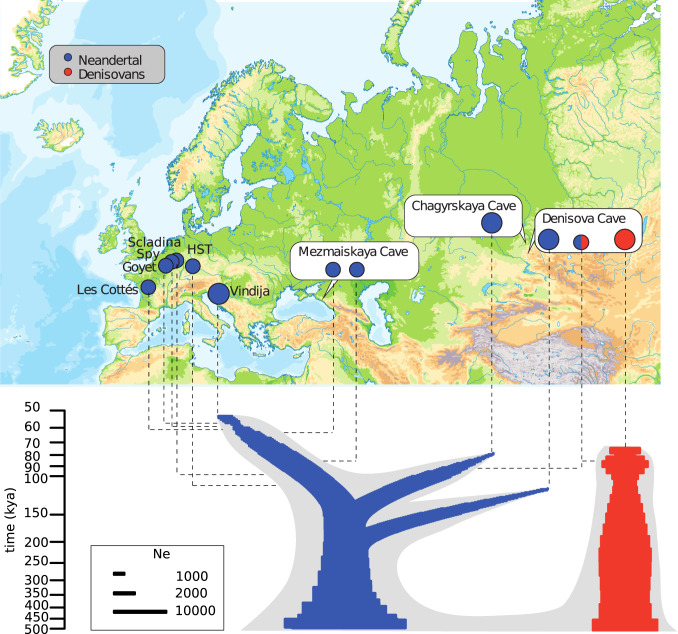
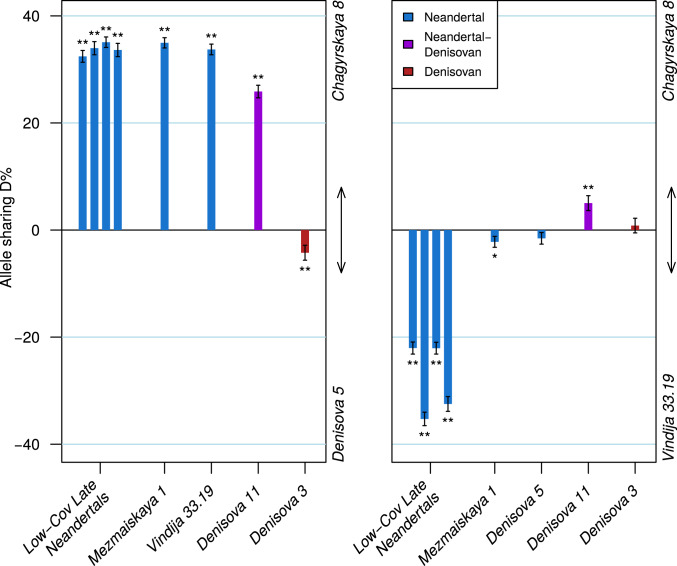
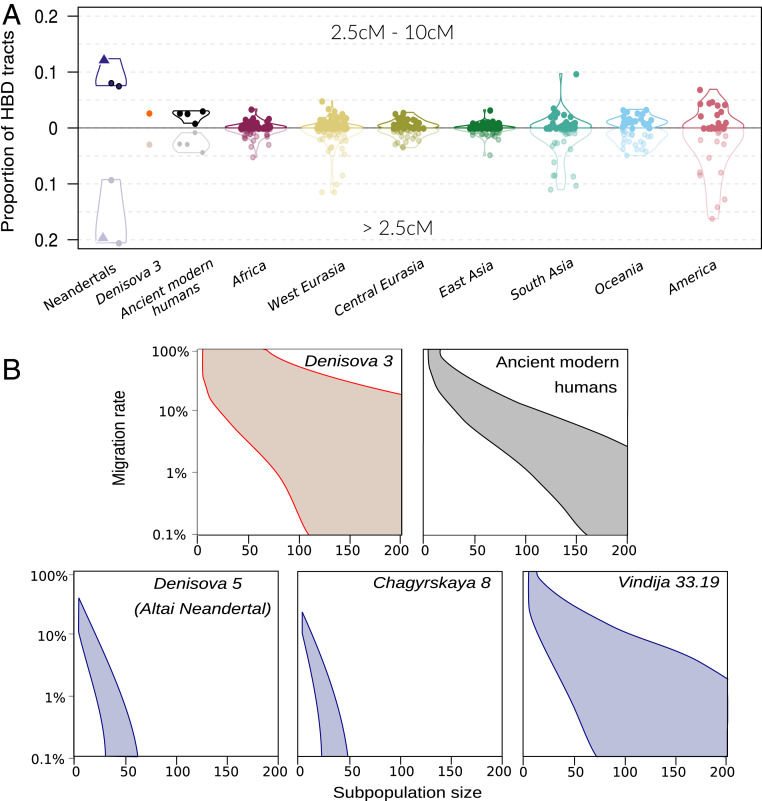
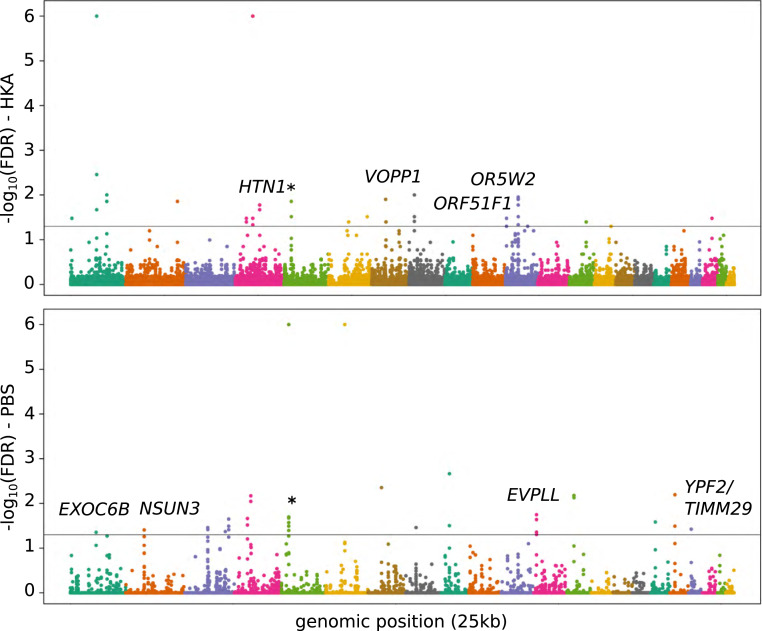
We sequenced the genome of a Neandertal from Chagyrskaya Cave in the Altai Mountains, Russia, to 27-fold genomic coverage. We show that this Neandertal was a female and that she was more related to Neandertals in western Eurasia [Prüfer et al., Science 358, 655–658 (2017); Hajdinjak et al., Nature 555, 652–656 (2018)] than to Neandertals who lived earlier in Denisova Cave [Prüfer et al., Nature 505, 43–49 (2014)], which is located about 100 km away. About 12.9% of the Chagyrskaya genome is spanned by homozygous regions that are between 2.5 and 10 centiMorgans (cM) long. This is consistent with the fact that Siberian Neandertals lived in relatively isolated populations of less than 60 individuals. In contrast, a Neandertal from Europe, a Denisovan from the Altai Mountains, and ancient modern humans seem to have lived in populations of larger sizes. The availability of three Neandertal genomes of high quality allows a view of genetic features that were unique to Neandertals and that are likely to have been at high frequency among them. We find that genes highly expressed in the striatum in the basal ganglia of the brain carry more amino-acid-changing substitutions than genes expressed elsewhere in the brain, suggesting that the striatum may have evolved unique functions in Neandertals.
Overview
The claims and statistics of this paper haven’t been checked yet.
Free: it reads the open-access text and checks the first 5 claims that cite a source we can check. Create a free account to check every claim.
Integrity signals
Registry
Cites
Statistics
Figures
Verification
Claims the paper makes
The claims and statistics of this paper haven’t been checked yet.
Free: it reads the open-access text and checks the first 5 claims that cite a source we can check. Create a free account to check every claim.
Claims other papers make about this one
Each is checked against this paper’s own text: does it say what the citing paper says it does?
The source backs part of the claim, not all of it — or backs it for a different population, condition or comparison.
In the citing paper
“The introgressing Neanderthal population diverged from the Altai Neanderthal population more than 100 kya, while the Vindija was much closer genetically and geographically1,53.”
From Quantifying the contribution of Neanderthal introgression to the heritability of complex traits (2021) · cites this paper as [53]
Experimental — accuracy not yet measuredThe source backs part of the claim, not all of it — or backs it for a different population, condition or comparison.
In the citing paper
“These observations suggest that the population-specific haplotype blocks may be the result of more recent population-specific Neanderthal admixture, as has recently been suggested (26–28, 30).”
From An ancestral recombination graph of human, Neanderthal, and Denisovan genomes (2021) · cites this paper as [28]
Experimental — accuracy not yet measuredThe source backs part of the claim, not all of it — or backs it for a different population, condition or comparison.
In the citing paper
“This value is consistent with published estimates of Neanderthal admixture times and the phylogenetic distance between the Vindija33.19 Neanderthal and the introgressing Neanderthal calculated by a recent study (28).”
From An ancestral recombination graph of human, Neanderthal, and Denisovan genomes (2021) · cites this paper as [28]
Experimental — accuracy not yet measuredThe source backs part of the claim, not all of it — or backs it for a different population, condition or comparison.
In the citing paper
“The Altai-matching set contains alleles that originated in the Neanderthal lineage and were likely common among diverse Neanderthal groups given the substantial genetic, geographical, and temporal divergence of the Altai Neanderthal from the introgressing population1,53.”
From Quantifying the contribution of Neanderthal introgression to the heritability of complex traits (2021) · cites this paper as [53]
Experimental — accuracy not yet measuredThe source backs part of the claim, not all of it — or backs it for a different population, condition or comparison.
In the citing paper
“This approach has revealed that archaic hominin populations survived extinction over long periods of time despite highly reduced effective population sizes [8][9][10] .”
From Ancient DNA analysis (2021) · cites this paper as [10]
Experimental — accuracy not yet measured
2 more claims about this paper
Create a free account to see every claim other papers make about this one.
Self-check
Percentages, sums and reported differences re-computed from the paper’s own numbers.
The self-check needs the paper’s full text.
Citations
Cites
A draft sequence of the Neandertal genome
Green, R. E., Krause, J., Briggs, A. W., Maricic, T., Stenzel, U., Kircher, M., Patterson, N., Li, H., Zhai, W., Fritz, M. H.-Y., et al. (2010) · Science · doi:10.1126/science.1188021 · Cited by 4,318 · cited 1×
“19 ) comes from an individual found in Vindija Cave in Croatia (3), whereas the other Neandertal genome ( Denisova 5 or the “ Altai Neandertal ” ) (4) and the Denisovan genome ( Denisova 3 ) (5) both come from specimens discovered in Denisova Cave, in the Altai mountains in Siberia.”
BackgroundSelf-citationAdaptive protein evolution at the Adh locus in Drosophila
McDonald, J. H., & Kreitman, M. (1991) · Nature · doi:10.1038/351652a0 · Cited by 3,283
An anatomically comprehensive atlas of the adult human brain transcriptome
Hawrylycz, M. J., Lein, E. S., Guillozet-Bongaarts, A. L., Shen, E. H., Ng, L., Miller, J. A., van de Lagemaat, L. N., Smith, K. A., Ebbert, A., Riley, Z. L., et al. (2012) · Nature · doi:10.1038/nature11405 · Cited by 3,083 · cited 1×
“However, when analyzing genes preferentially expressed in different brain regions according to the Allen Brain Atlas (29, 30), we find that genes expressed in the striatum in individuals 12 – 19 y of age show a higher MacDonald-Kreitman ratio (1.02, family-wise error rate = 0.029) than genes…”
BackgroundInfluentialInference of human population history from individual whole-genome sequences
Li, H., & Durbin, R. (2011) · Nature · doi:10.1038/nature10231 · Cited by 2,590
The complete genome sequence of a Neanderthal from the Altai Mountains
Prüfer, K., Racimo, F., Patterson, N., Jay, F., Sankararaman, S., Sawyer, S., Heinze, A., Renaud, G., Sudmant, P. H., de Filippo, C., et al. (2014) · Nature · doi:10.1038/nature12886 · Cited by 2,254 · cited 2×
“In this regard, it is interesting that the Chagyrskaya 8 and Denisova 5 Neandertals lived in smaller populations than the Vindija 33.19 Neandertal in Croatia, the Denisovan Denisova 3, and modern humans (24) (Fig.”
BackgroundInfluentialSelf-citationGenetic history of an archaic hominin group from Denisova Cave in Siberia
Reich, D., Green, R. E., Kircher, M., Krause, J., Patterson, N., Durand, E. Y., Viola, B., Briggs, A. W., Stenzel, U., Johnson, P. L. F., et al. (2010) · Nature · doi:10.1038/nature09710 · Cited by 1,991 · cited 1×
“19 ) comes from an individual found in Vindija Cave in Croatia (3), whereas the other Neandertal genome ( Denisova 5 or the “ Altai Neandertal ” ) (4) and the Denisovan genome ( Denisova 3 ) (5) both come from specimens discovered in Denisova Cave, in the Altai mountains in Siberia.”
BackgroundSelf-citationA high-coverage genome sequence from an archaic denisovan individual
Meyer, M., Kircher, M., Gansauge, M.-T., Li, H., Racimo, F., Mallick, S., Schraiber, J. G., Jay, F., Prüfer, K., de Filippo, C., et al. (2012) · Science · doi:10.1126/science.1224344 · Cited by 1,967 · cited 1×
“For example, genome sequences from five late Neandertals from Europe have shown that they carried little ge-netic variation (6, 7) and were more closely related to the Vindija 33.19 than to the Denisova 5 Neandertal.”
BackgroundInfluentialSelf-citationA Test of Neutral Molecular Evolution Based on Nucleotide Data
Hudson, R. R., Kreitman, M., & Aguadé, M. (1987) · Genetics · doi:10.1093/genetics/116.1.153 · Cited by 1,767
Sequencing of 50 Human Exomes Reveals Adaptation to High Altitude
Yi, X., Liang, Y., Huerta-Sanchez, E., Jin, X., Cuo, Z. X. P., Pool, J. E., Xu, X., Jiang, H., Vinckenbosch, N., Korneliussen, T. S., et al. (2010) · Science · doi:10.1126/science.1190371 · Cited by 1,611
The Simons Genome Diversity Project: 300 genomes from 142 diverse populations
Mallick, S., Li, H., Lipson, M., Mathieson, I., Gymrek, M., Racimo, F., Zhao, M., Chennagiri, N., Nordenfelt, S., Tandon, A., et al. (2016) · Nature · doi:10.1038/nature18964 · Cited by 1,584 · cited 2×
“Among 300 genomes from the Simons Genome Diversity Panel (19) and 89 Papuan genomes (20, 21), the proportions of alleles shared with Chagyrskaya 8 and with Vindija 33.19 are similar ( SI Appendix 7 ), giving no indication that Neandertals closer related to Chagyrskaya 8 than to Vindija 33.19 contributed to the populat…”
BackgroundInfluentialSelf-citation
Research works printed but not linked: 1
- Kolobova K. A.., The significance of bifacial technologies in Altai Middle Paleolithic. Anthropologie 123, 276– 288 (2019).
Cited by
Items 201–300 of 316
Mapping the gene regulatory landscape of archaic hominin introgression in modern Papuans
Comerford, M., Vespasiani, D. M., Shukla, N., Cook, L. E., Yermakovich, D., Dannemann, M., Leavesley, M., Kinipi, C., Ricaut, F., Brucato, N., et al. (2026) · PLoS Genetics · doi:10.1371/journal.pgen.1012067 · Cited by 2
Increased signaling of the Neanderthal growth hormone receptor
Kanis, P., Berreiter, M., Sieme, D., Wootton, O., Ju, X.-C., Holzwart, N. E., Hu, D. Z., Tadaka, S., Taira, M., Kinoshita, K., et al. (2026) · Current Biology · doi:10.1016/j.cub.2026.07.025 · Cited by 3
Self-citationAncient proteins identify various Denisovan remains from Southwest China
Rao, H., Xing, S., Ruan, Q., Bai, F., Zhao, Y., Wu, Z., Tang, S., Bennett, E. A., Feng, X., Lin, S., et al. (2026) · Nature · doi:10.1038/s41586-026-10976-9 · Cited by 2
Pietro, L. D., Boroumand, M., Lattanzi, W., Manconi, B., Salvati, M., Cabras, T., Olianas, A., Flore, L., Serrao, S., Calò, C. M., et al. (2023) · International Journal of Molecular Sciences · doi:10.3390/ijms241915010 · Cited by 2
“…the genomic data of a female Neanderthal (at 52 × coverage) [57] and a juvenile female Denisovan individual (at 30 × coverage) [55] came from the Denisova cave, and another female sample came from the Chagyrskaya cave, located about 100 km westward, and yielded a genome of 27 × coverage [58].”
BackgroundChen, Y., Yu, X., Xu, S., Shi, X., Zhang, X., & Sun, C. (2023) · Annals of Human Genetics · doi:10.1111/ahg.12533 · Cited by 2
“In Chagyrskaya (Mafessoni et al., 2020) and Vindija (Prüfer et al., 2017) sequences, genotype is available for only 47 SNPs.”
BackgroundMethodGlobal Picture of Genetic Relatedness and the Evolution of Humankind
Khvorykh, G. V., Mulyar, O. A., Fedorova, L. V., Владимирович, Х. А., Limborska, S. A., & Fedorov, A. (2020) · Biology · doi:10.3390/biology9110392 · Cited by 3
“neanderthalensis Chagyrskaya Cave Altai mountains 60,000 (80,000) * 27 [54]”
BackgroundMednikova, M. B., & Kazanskiy, P. R. (2021) · Moscow University Anthropology Bulletin (Vestnik Moskovskogo Universiteta Seria XXIII Antropologia) · doi:10.32521/2074-8132.2021.1.093-108 · Cited by 4
Distal manual phalanges of Upper Pleistocene Homo from Altai caves
Mednikova, M. B. (2020) · Moscow University Anthropology Bulletin (Vestnik Moskovskogo Universiteta Seria XXIII Antropologia) · doi:10.32521/2074-8132.2020.2.005-025 · Cited by 4
Saitou, M., Resendez, S. D., Pradhan, A. J., Wu, F., Lie, N. C., Hall, N. J., Zhu, Q., Reinholdt, L. G., Satta, Y., Nakagome, S., et al. (2019) · bioRxiv (Cold Spring Harbor Laboratory) · doi:10.1101/788653 · Cited by 3
The last pieces of a puzzling early meeting
Schierup, M. H. (2020) · Science · doi:10.1126/science.abe2766 · Cited by 2
An extended admixture pulse model reveals the limitations to Human-Neandertal introgression datingPreprint
Iasi, L. N. M., Ringbauer, H., & Peter, B. M. (2021) · bioRxiv (Cold Spring Harbor Laboratory) · doi:10.1101/2021.04.04.438357 · Cited by 2
Self-citationPivirotto, A. M., Platt, A., Patel, R., Kumar, S., & Hey, J. (2024) · eLife · doi:10.7554/elife.93258 · Cited by 4
Regulatory logic of human cortex evolution by combinatorial perturbationsPreprint
Skaros, A., Vitriolo, A., Leonardi, O., Finazzi, V., Pereira, M. F., Prazzoli, F., Trattaro, S., Moriano, J., Capocefalo, D., Villa, C. E., et al. (2025) · bioRxiv (Cold Spring Harbor Laboratory) · doi:10.1101/2025.04.28.651083 · Cited by 2
The Neanderthal population history and the introgression landscape inferred from the UK BiobankPreprint
Morez, A., Soltantouyeh, A., Zeloni, R., Carollo, F., Mezzavilla, M., Marnetto, D., & Pagani, L. (2026) · bioRxiv (Cold Spring Harbor Laboratory) · doi:10.64898/2026.04.03.716297 · Cited by 2
“…= 6,564 ± 1,100, ML ±95% CI), falling on the upper limit of the range estimated for Vindija (N Vindija = 4,168 ± 1,580), and Chagyrskaya (N Chagyrskaya = 2,379 ± 1,845) ( 24 , 25 , 44 ) Our estimate for Altai (N Altai = 12,637 ± 2,265) is slightly higher than previous reports ( 23 , 24 , 44 ).”
<tt>SAFARI</tt> : pangenome alignment of ancient DNA using purine/pyrimidine encodings
Rubin, J., van Waaij, J., Kraft, L., Sirén, J., Sackett, P. W., & Renaud, G. (2025) · NAR Genomics and Bioinformatics · doi:10.1093/nargab/lqaf170 · Cited by 1
“We conducted the experiment using two separate empirically-derived fragment length distributions, the first from Chagyrskaya Cave in Siberia [ 44 ], and the second from Vindija Cave in Croatia [ 45 ].”
Evolutionary and functional analyses of LRP5 in archaic and extant modern humans
Roca‐Ayats, N., Maceda, I., Bruque, C. D., Martínez‐Gil, N., García‐Giralt, N., Cozar, M., Mellibovsky, L., Hul, W. V., Lao, Ó., Grinberg, D., et al. (2024) · Human Genomics · doi:10.1186/s40246-024-00616-6 · Cited by 1
“The Altai Neanderthal [31], Denisovan [32], Vindija Neanderthal [33] and Chagyrskaya 8 Nean-derthal [34] genomes were downloaded in VCF format from the Max Planck Institute for Evolutionary Anthro-pology ftp site (http:// cdna. eva. mpg. de/ neand ertal).”
MethodThe Grotte du Bison Neandertals (Arcy-sur-Cure, France)
Henrion, J., Maureille, B., Beauval, C., Vanderesse, N., Hublin, J., & Hardy, M. (2024) · Journal of Human Evolution · doi:10.1016/j.jhevol.2024.103631 · Cited by 1
Neanderthal and Denisovan Glutamate Dehydrogenase 2 Evolution and Clinical Significance
Aleshina, Y. A., Zavileyskiy, L. G., & Aleshin, V. A. (2025) · International Journal of Molecular Sciences · doi:10.3390/ijms26094322 · Cited by 1
“…four genomes of ancient humans have been sequenced with high coverage: one genome of Denisovan found in Denisova cave in the Altai Mountains in southern Siberia ( Denisova 3 ) [17], and three Neanderthal genomes— Denisova 5 (or Altai Neanderthal) [18], Chagyrskaya 8 [19], and Vindija 33.19 [20].”
InfluentialCrezzini, J., Modi, A., Cannariato, C., Caramelli, D., Ronchitelli, A., Boscato, P., Moroni, A., & Boschin, F. (2025) · Frontiers in Environmental Archaeology · doi:10.3389/fearc.2025.1558698 · Cited by 1
Maida, G. D., Winsemann, J., Hoffmann, M., Lauer, T., Böhner, U., & Terberger, T. (2025) · Boreas · doi:10.1111/bor.70032 · Cited by 1
Rogaev, E. I. (2025) · Russian Journal of Genetics · doi:10.1134/s1022795425700887 · Cited by 1
“…with high coverage from the territory of Eurasia (from the Vin-dija cave, Croatia, and the Chagyrskaya cave, Russia) have been deciphered [1, 2]; a previously unknown fossil form of the “Denisova man” that is a representative of the archaic group of hominids from the Den-isova cave (Altai…”
Adaptive introgression in modern human circadian rhythm genes
Kendall, C., Nooranikhojasteh, A., Debortoli, G., Roberto, V. C. F., de Aquino, M. M., Samson, D. R., Parra, E. J., Viola, B., & Schillaci, M. A. (2025) · npj Biological Timing and Sleep · doi:10.1038/s44323-025-00060-2 · Cited by 1
“This meant that our fi ltering led to the loss from the core haplotype of three variants (0.000153% of the total variants) from the Altai and Chagyrskaya Neanderthals, 10 variants (0.000511% of the total variants) from the Vindija Neanderthal, and no variants lost from the Denisovan.”
InfluentialSelf-citationThe evolution of extended neurodevelopment and increased neuroplasticity in human brains
Drennan, A., Sherwood, C. C., & Gómez‐Robles, A. (2025) · Elsevier eBooks · doi:10.1016/b978-0-443-27380-3.00045-2 · Cited by 2
Zhu, Q., Zhang, J., Zhou, W., Liang, S.-A., Wang, S., Cai, X., Li, F., Li, J., Zhang, G., Feng, H., et al. (2026) · Science Advances · doi:10.1126/sciadv.aea0706 · Cited by 1
“However, recent advancements in sequencing technologies have provided high-quality genomic data from archaic hominins such as Neanderthals and Denisovans ( 24 – 27 ), facilitating more comprehensive investigations in archaic NUMTs.”
Gicqueau, A., Maureille, B., Costamagno, S., Колобова, К. А., Rendu, W., Markin, S. V., & Viola, B. (2026) · Journal of Human Evolution · doi:10.1016/j.jhevol.2026.103808 · Cited by 2
Self-citationAncient DNA and Human Physiology
Bayarsaikhan, M., Boyle, M. J., Demers, P., Habeck, E. W., IV, Bonczarowska, J. H., Silverman, S., & Massilani, D. (2026) · Physiology · doi:10.1152/physiol.00047.2025 · Cited by 1
Zhu, D. Y.-D., Sangesland, M., Okonkwo, V., Zhang, Z., Rosado, V. C., Ronsard, L., McCarthy, C., Alexander, C., Barnes, R. M., Rohrer, D., et al. (2026) · Cell Reports · doi:10.1016/j.celrep.2026.117224 · Cited by 1
Rajpara, R., Polishchuk, S. S., Yermakovich, D., & Dannemann, M. (2026) · Genome Biology and Evolution · doi:10.1093/gbe/evag110 · Cited by 2
The gene-regulatory evolution of the human skeleton
Yan, Y., Mishol, N., Lange, K., Zhang, Z., Bodek, G., Kigel, A., Priel, N., Egyes, N., Ronen, O., Nini, I., et al. (2026) · Nature · doi:10.1038/s41586-026-11053-x · Cited by 1
“4 and Supplementary Table 17).”
InfluentialZabiyako, A. P. (2020) · Study of Religion · doi:10.22250/2072-8662.2020.4.5-27 · Cited by 1
Unsere Vorfahren: Crashkurs und Update
Spitzer, M. (2021) · Nervenheilkunde · doi:10.1055/a-1389-6941 · Cited by 1
“[55] Mafessoni F, Steffi Grote S, de Filippo C, et al.”
BackgroundL’ARNm et ses modifications chez les eucaryotes*
Westhof, É. (2022) · Bulletin de l Académie Nationale de Médecine · doi:10.1016/j.banm.2022.05.007 · Cited by 2
Ancient genomes reveal the origin and evolutionary history of Chinese populations
Gao, S., & Cui, Y. (2023) · Frontiers in Earth Science · doi:10.3389/feart.2022.1059196 · Cited by 1
Analyses of the 2022 Nobel Prize in Physiology or Medicine: Paleogenomics
Sterner, E. A. (2023) · Science & Technology Libraries · doi:10.1080/0194262x.2022.2163451 · Cited by 1
“DNA from a Neandertal woman from Chagyrskaya Cave in the Altai Mountains, Russia suggested that she and her ancestors lived “. . . in isolated populations of less than 60 individuals” (Mafessoni et al. 2020, 15132).”
BackgroundWang, P., Yang, Y., Shi, X., Chen, Y., Liu, S., Wang, H., Peng, T., Shi, Q., Zhang, W., & Sun, C. (2023) · Scientific Reports · doi:10.1038/s41598-023-29682-x · Cited by 1
Toncheva, D. I., Marinova, M., Chobanov, T., & Serbezov, D. (2023) · Genes · doi:10.3390/genes14030727 · Cited by 1
“In 2020, a high-coverage Neanderthal genome (27×) of a female from Chagyrskaya Cave, also in the Altai Mountains, was published, which showed that her ancestors lived in relatively isolated populations of less than 60 individuals [25].”
RetractedEstimates of Effective Population Size in Subdivided Populations
Rogers, A. (2023) · Peer Community In Mathematical and Computational Biology · doi:10.24072/pci.mcb.100150 · Cited by 1
Takakura, J., & Naganuma, M. (2023) · Replacement of neanderthals by modern humans series · doi:10.1007/978-981-99-3712-7_10 · Cited by 1
Xing, L., Pinson, A., Mora‐Bermúdez, F., & Huttner, A. W. B. (2023) · Wiley eBooks · doi:10.1002/9781119860914.ch8 · Cited by 2
Decline in Neanderthal effective population size due to geographic structure and gene flow
Assis, R. (2024) · Peer Community In Mathematical and Computational Biology · doi:10.24072/pci.mcb.100232 · Cited by 1
A Closer Look to the Evolution of Neurons in Humans and Apes Using Stem-Cell-Derived Model Systems
Schörnig, M., & Taverna, E. (2021) · Frontiers in Cell and Developmental Biology · doi:10.3389/fcell.2021.661113 · Cited by 1
Structure-driven effects on genomic DNA damage propensity at G-quadruplex sitesPreprint
Abdullah, A. A., Feng, C., Pflughaupt, P., & Sahakyan, A. B. (2021) · bioRxiv (Cold Spring Harbor Laboratory) · doi:10.1101/2021.12.02.471014 · Cited by 1
“Here, we analysed the fragmentation pattern from the Neanderthal genome (58) from the ~80,000 years old remnant, as mapped on human genome considering their extremely high similarity (96, 97) and the expected lower number of recombination sites across the two species relative to the vast amount of fragmentation sites…”
BackgroundMethodPivirotto, A. M., Platt, A., Patel, R., Kumar, S., & Hey, J. (2023) · bioRxiv (Cold Spring Harbor Laboratory) · doi:10.1101/2023.10.09.561569 · Cited by 1
“2 3 Comparison to Archaic Genomes 4 In order to identify whether a large proportion of our sites of interest arose prior to the speciation 5 between modern humans and archaic humans, we examined for each site whether it was also present in 6 any one of four archaic genomes (73-76).”
BackgroundRubini, M., Rolfo, M. F., Ferracci, A., Zaio, P., & Mario, F. D. (2024) · Research Square · doi:10.21203/rs.3.rs-3869990/v1 · Cited by 1
Upper Pleistocene population dynamics (Neandertals, Denisovans, Homo sapiens)
Crèvecoeur, I. (2024) · Elsevier eBooks · doi:10.1016/b978-0-323-99931-1.00257-9 · Cited by 1
Collier, N. W., Gravel, S., & Ragsdale, A. P. (2026) · bioRxiv (Cold Spring Harbor Laboratory) · doi:10.64898/2026.04.11.717825 · Cited by 2
Ferrando-Bernal, M., & Capra, J. A. (2026) · bioRxiv (Cold Spring Harbor Laboratory) · doi:10.64898/2026.09.06.747930 · Cited by 1
G-ALN: a GPU-accelerated BWA-aln algorithm for palaeogenomicsPreprint
Sharif, M. B., Hedfors, K., van der Valk, T., Heintzman, P. D., & Dalén, L. (2026) · bioRxiv (Cold Spring Harbor Laboratory) · doi:10.64898/2026.10.18.759956 · Cited by 1
“We then sampled 1, 20 and 50 million reads each from the woolly mammoth MD090 (Díez-Del-Molino et al. 2023), the steppe mammoth Adycha (van der Valk et al. 2021), and 1, 2 and 5 million reads from the Neanderthal Chagyrskaya 8 (Mafessoni et al. 2020) sequencing data.”
Illuminating the Function of the Orphan Transporter, SLC22A10 in Humans and Other Primates
Giacomini, K., Yee, S. W., Ferrández-Peral, L., Alentorn, P., Fontsere, C., Ceylan, M., Koleske, M., Handin, N., Artegoitia, V., Lara, G., et al. (2023) · doi:10.21203/rs.3.rs-3263845/v1 · Cited by 1
The Genetic Legacy of Introgression from Two Deeply Divergent Lineages in the Genus Homo
Rogers, A. R., Islam, M. T., Brand, C. M., & Webster, T. H. (2026) · bioRxiv · doi:10.64898/2026.03.22.713509
“The third row adds an additional archaic genome [18].”
Effects of introgressed Neanderthal alleles on present-day brain morphology
Zeloni, R., Amaolo, A., Morez Jacobs, A., Zapparoli, E., Akl, Y., Shafie, M., Huerta-Sanchez, E., Pizzagalli, F., Provero, P., Pagani, L., et al. (2026) · bioRxiv · doi:10.64898/2026.04.14.718380
“In addition, to estimate allele frequencies in Neanderthals and Yoruba we used the variant calls for three high-coverage Neanderthal genomes from Altai 2 , Vindija 68 and Chagyrskaya 69 ; and 108 samples from 1000G phase 3 tagged as YRI.”
Usporedba genetskih i morfoloških dokaza širenja hominina tijekom pleistocena
Krstičević, K. (2021) · ODRAZ (University of Zagreb Faculty of Humanities and SocialSciences)
A review of the spread and habitat of the genus Homo: Focusing on East Asia
Sawafuji, R., Tsutaya, T., & Ishida, H. (2022) · Anthropological Science (Japanese Series) · doi:10.1537/asj.220214
Sun, W., Yang, T., Sun, F., Liu, P., Lan, X., Chen, X., Pang, Y., Ji, X., Gao, R., Li, Y., et al. (2022) · SSRN Electronic Journal · doi:10.2139/ssrn.4102635
Elalouf, J., Utge, J., Lebon, M., Tombret, O., Zazzo, A., & Balzeau, A. (2021) · Paléo · doi:10.4000/paleo.6119 · Cited by 1
“La méthode la plus informative, livrant la séquence de génomes complets, est le séquençage massif (Mafessoni et al. 2020), mais les coûts et l’infrastructure associés la rendent peu envisageable pour l’analyse systématique d’esquilles.”
First known Neanderthal family discovered in Siberian cave
Callaway, E. (2022) · Nature · doi:10.1038/d41586-022-03339-7
Kuzmin, Y. V. (2022) · Известия Иркутского Государственного Университета. Серия «Геоархеология. Этнология. Антропология» · doi:10.26516/2227-2380.2022.41.31 · Cited by 1
Palaeogenomics of Extinct and Archaic Hominins
Gilbert, M. T. P., & Lalueza‐Fox, C. (2023) · Wiley eBooks · doi:10.1002/9781119592112.ch32
Fossil and genetic evidence for Neanderthal introgression
Herrera, R. J., & Garcia‐Bertrand, R. (2023) · Elsevier eBooks · doi:10.1016/b978-0-12-819086-9.00006-3
Panmixis in Middle and Late Pleistocene Human Subspecies
and, F. H. S., & Karriger, W. M. (2023) · Wiley eBooks · doi:10.1002/9781119828075.ch26 · Cited by 1
Sano, K. (2023) · Replacement of neanderthals by modern humans series · doi:10.1007/978-981-99-3712-7_4
Cardoso, F. A. (2023) · Digital Library of Theses and Dissertations (Universidade de São Paulo) · doi:10.11606/d.42.2023.tde-07112023-110521
Pivirotto, A. M., Platt, A., Patel, R., Kumar, S., & Hey, J. (2024) · eLife · doi:10.7554/elife.93258.1
Origin of Neanderthals. Neanderthals of the Altai: Myth or Reality?
Derevianko, A. P. (2024) · Archaeology Ethnology and Anthropology of Eurasia · doi:10.17746/1563-0110.2024.52.1.003-034
Self-citationThe Functional Map of Ultraconserved Regions in Humans, Mice and RatsPreprint
Nichio, B. T. D. L., Oliveira, L. S., Rodrigues, A. C., Mathias, C., Gradia, D. F., Urbanski, A. H., Passetti, F., Camargo, V. L. S., Cury, S. S., Schnepper, A. P., et al. (2024) · Research Square · doi:10.21203/rs.3.rs-4837600/v1
Hubmann, R., Hilgarth, M., Löwenstern, T., Lienhard, A., Sima, F., Reisinger, M., Hobel‐Kleisch, C., Porpaczy, E. A., Haferlach, T., Hoermann, G., et al. (2024) · International Journal of Molecular Sciences · doi:10.3390/ijms252312581
“…46 ethnicities including the oldest contemporary modern humans, the South African San people [26, The available genomes from three Neanderthals [28–30] and one Denisovan [31] from the Max Planck Institute (MPI) for evolutionary anthropology in Leipzig served as the reference for archaic humans…”
Maár, K. (2024) · SZTE Repository of Dissertations (University of Szeged) · doi:10.14232/phd.12139
Sibiryachikha Variant of the Altai Middle Paleolithic: Discussions and Research Perspectives
Маркин, С. В. (2024) · Problems of Archaeology Ethnography Anthropology of Siberia and Neighboring Territories · doi:10.17746/2658-6193.2024.30.0152-0158
GLI3 in Archaic Humans: Possible Contributions to Human Skeletal and Brain Evolution
Nomura, T., Agata, A., & Trinh, N. T. M. (2025) · Development Growth & Differentiation · doi:10.1111/dgd.70015
Role of transketolase-like1 in human cortical neurogenesis
Pinson, A., & Huttner, W. Β. (2025) · Methods in enzymology on CD-ROM/Methods in enzymology · doi:10.1016/bs.mie.2025.06.039
Pflughaupt, P., & Sahakyan, A. B. (2025) · BMC Bioinformatics · doi:10.1186/s12859-025-06267-1
“…particularly when dealing with short sequencing reads or a highly degraded DNA, which is common across research in bacterial and viral genomics [4], forensic testing [5], genetic variation [6], natural decay and fossilisation process leading to DNA fragments preserved to a certain degree [7–11].”
demografr : A toolkit for simulation-based inference in population geneticsPreprint
Petr, M., Pötzsch, I. M., & Racimo, F. (2025) · bioRxiv (Cold Spring Harbor Laboratory) · doi:10.64898/2025.12.18.694482
Roca‐Ayats, N., Maceda, I., Bruque, C. D., Martínez‐Gil, N., García‐Giralt, N., Cozar, M., Mellibovsky, L., Hul, W. V., Lao, Ó., Grinberg, D., et al. (2024) · DIGITAL.CSIC (Spanish National Research Council (CSIC)) · doi:10.6084/m9.figshare.26726201
Srivastava, K., Fratzscher, A.-S., Lan, B., & Flegel, W. A. (2021) · Figshare · doi:10.6084/m9.figshare.14685051
Srivastava, K., Fratzscher, A.-S., Lan, B., & Flegel, W. A. (2021) · Figshare · doi:10.6084/m9.figshare.14685042
Modenini, G. (2024) · AMS Dottorato Institutional Doctoral Theses Repository (University of Bologna) · doi:10.48676/unibo/amsdottorato/11602
Additional file 2 of KIN: a method to infer relatedness from low-coverage ancient DNA
Popli, D., Peyrégne, S., & Peter, B. M. (2024) · Figshare · doi:10.6084/m9.figshare.26562118
Self-citationAdditional file 3 of KIN: a method to infer relatedness from low-coverage ancient DNA
Popli, D., Peyrégne, S., & Peter, B. M. (2024) · Figshare · doi:10.6084/m9.figshare.26562121
Self-citationAdditional file 1 of KIN: a method to infer relatedness from low-coverage ancient DNA
Popli, D., Peyrégne, S., & Peter, B. M. (2024) · Figshare · doi:10.6084/m9.figshare.26562115
Self-citationSrivastava, K., Fratzscher, A.-S., Lan, B., & Flegel, W. A. (2021) · Figshare · doi:10.6084/m9.figshare.14685039
Estimating relatedness with ancient DNA
Popli, D. (2024) · Qucosa (Saxon State and University Library Dresden)
Defining human adaptive immune gene diversity
Narang, S. (2024) · Open Archive (Karolinska Institutet)
Daníelsdóttir, S. P. (2021) · Skemman
Modern brains and bones: genomic analysis of derived Homo sapiens traits
Muñoz Andirkó, A. G. (2021) · Dipòsit Digital de la Universitat de Barcelona (Universitat de Barcelona)
Glantz, M. M., & Radovčić, D. (2025) · American Journal of Biological Anthropology · doi:10.1002/ajpa.70181
“…Europe, rightly cred-ited with important scientific advances in paleogenomics, extracted, analyzed, and interpreted both the Altai and Croatian fossil hominin DNA sequences (e.g., Green et al. 2010; Prüfer et al. 2014; Prüfer et al. 2017; Meyer et al. 2012; Slon et al. 2018; Mafessoni et al. 2020).”
Goldschmidt, A. I., & Guimarães, S. S. M. (2026) · Bio-grafía · doi:10.17227/bio-grafia.vol.19.num36-23341
Evaluating the applicability of kinship analyses for sedimentary ancient DNA datasetsPreprint
Cohen, P., Johnson, S., Zavala, E. I., Moorjani, P., & Slon, V. (2026) · bioRxiv (Cold Spring Harbor Laboratory) · doi:10.64898/2026.02.02.703194
Self-citationARGformer: learning on ancestral recombination graphs with transformers
Bonet, D., Shanks, C., Cara, M. C., Abante, J., & Ioannidis, A. G. (2026) · Bioinformatics · doi:10.1093/bioinformatics/btag438
“…(AmericanAdmixture 4B18) from the stdpopsim catalog (Adrion et al. 2020), we use the default parameters for a single 30 million base pair (bp) chromosome, using a flat recombination rate of 1 × 10 − 8 per bp generation and a mutation rate of 1.25e-8 per bp per generation (Browning et al.…”
The humanity of a new DenisovanPreprint
Hawks, J. D. (2025) · doi:10.32388/substack.c306dh
Tracing Neanderthal ancestry patterns through successive population expansions in Europe
Tsoupas, A., Quilodrán, C. S., Rio, J., & Currat, M. (2026) · Science Advances · doi:10.64898/2026.02.20.706963
“Neanderthal effective sizes are typically estimated around ~3,000-3,500 individuals ( 3 , 52 , 53 ), and may have been up to 20% lower when accounting for reverse introgression from MH, that possibly took place ~250,000-200,000 and ~120,000-100,000 years ago ( 54 ).”
Hybridisation in Primates: Cryptic Admixture and Adaptive Introgression
Kendall, C. J. R. (2025) · TSpace (University of Toronto)
Etude paléogénétique des migrations humaines autour de la mer Caspienne pendant la protohistoire.
Guarino‐Vignon, P. (2021) · theses.fr (ABES) · doi:10.70675/cdc11bb2zce21z4b4cz8a10z4cba8e8f2a5d
Dissecting human population variation in single-cell responses to SARS-CoV-2
Aquino, Y. (2023) · theses.fr (ABES) · doi:10.70675/061da45czf5e5z482dzb71dz92b95c997a05
First multi-individual Neanderthal mitogenomes from north of the Carpathians
Picin, A., Hajdinjak, M., Nowaczewska, W., Blaauw, M., Bayliss, A., Fewlass, H., Heaton, T., Reimer, P. J., Southon, J. R., van der Plicht, J., et al. (2026) · Current Biology · doi:10.1016/j.cub.2026.03.069 · Cited by 1
Self-citationA LINE-1 insertion upstream of FOXP2 promotes neuronal differentiation during primate evolution
Liu, J., Yin, Z., Peng, Y., Cui, S., Shi, B., Jiang, X., Yang, Z., Gu, S., Lin, Y., Lingfeng, X., et al. (2026) · Genome biology · doi:10.1186/s13059-026-04098-8 · Cited by 1
“Through genomic alignments, we detected analogous FOXP2-342L1 sequence in three Neanderthal genomes [52] and one Denisovan genome [51, 53] (Fig.”
Wang, B., Lei, C., Lin, H., 石少康, Ma, X., Zeng, W., Yuan, K., Ni, X., & Xu, S. (2026) · bioRxiv (Cold Spring Harbor Laboratory) · doi:10.64898/2026.05.05.722798
Antoine-Derouet, C., Doucet, J. A., Phoeung, C. L., Михайловна, Д. Ч., Hegay, T., Heyer, É., Chaix, R., Bon, C., Détroit, F., Toupance, B., et al. (2026) · bioRxiv (Cold Spring Harbor Laboratory) · doi:10.64898/2026.05.06.723201
“Central Asia encompasses the Altai Mountains, where both Neanderthal and Denisovan remains were identified ( 8 , 13 , 15 , 30 ) , while Southeast Asia bridges East Asia and Oceania, two regions where Denisovan ancestry has been widely explored and shown to follow complex patterns.”
The reliability of inferred archaic segments
Bird, N., Walker, E., & Hellenthal, G. (2026) · Human Population Genetics and Genomics · doi:10.47248/hpgg2606020007
Recent progress in studies of the last million years of human physical and behavioural evolution
Cole, J., Scerri, E. M. L., Hajdinjak, M., & Stringer, C. B. (2026) · Journal of the Royal Anthropological Institute · doi:10.1111/1467-9655.70141
Revisiting neanderthal ancestry: Evolutionary insights and biomedical relevance
Bu, S., & Zhang, Z. (2026) · The Innovation Life · doi:10.59717/j.xinn-life.2026.100228
Metadata
- Authors
- Mafessoni, F., Grote, S., de Filippo, C., Slon, V., Kolobova, K. A., Viola, B., Markin, S. V., Chintalapati, M., Peyrégne, S., Skov, L., Skoglund, P., Krivoshapkin, A. I., Derevianko, A. P., Meyer, M., Kelso, J., Peter, B., Prüfer, K., & Pääbo, S.
- Affiliations
- Max Planck Institute for Evolutionary Anthropology (DE)
- Department of Evolutionary Genetics, Max Planck Institute for Evolutionary Anthropology, D-04103 Leipzig, Germany;
- Institute of Archaeology and Ethnography, Russian Academy of Sciences, 630090 Novosibirsk, Russia;
- University of Toronto (CA)
- The Francis Crick Institute (GB)
- Russian Academy of Sciences (RU)
- Okinawa Institute of Science and Technology Graduate University (JP)
- Corresponding author
- Pääbo, Svante
- ORCID
- Venue
- Proceedings of the National Academy of Sciences
- Publisher
- National Academy of Sciences
- Published
- 2020-06-16
- Volume
- 117
- Issue
- 26
- Pages
- 15132-15136
- ISSN
- 0027-8424 (ISSN-L)
- 1091-6490
- PMC
- PMC7334501
- OpenAlex
- W3035248535
- Cited by
- 309
- References
- 40
- Citations by year
- 2026: 43 · 2025: 51 · 2024: 56 · 2023: 49 · 2022: 41 · 2021: 49 · 2020: 17
- FWCI
- 147.29
- Type
- journal article
- Language
- en
- Open access
- hybrid
- doi.org
- Licence
- Locations
- Proceedings of the National Academy of Sciences (publishedVersion, cc-by-nc-nd)
- bioRxiv (Cold Spring Harbor Laboratory) (acceptedVersion, cc-by-nc-nd)
- PubMed Central (publishedVersion, cc-by-nc-nd)
- PubMed (publishedVersion)
- ArTS Archivio della ricerca di Trieste (University of Trieste https://www.units.it/) (submittedVersion)
- Institutional Repositories DataBase (IRDB) (submittedVersion, cc-by-nc-nd)
- Digital Commons - University of South Florida (University of South Florida) (submittedVersion)
- Figshare (submittedVersion, cc-by-nc-nd)
- Okinawa Institute of Science and Technology Graduate University (Okinawa Institute of Science and Technology Graduate University) (submittedVersion, cc-by-nc-nd)
- MPG.PuRe (Max Planck Society) (submittedVersion)
- MPG.PuRe (Max Planck Society) (submittedVersion, other-oa)
- Funders
- Francis Crick Institute (10595)
- Max-Planck-Gesellschaft
- Russian Science Foundation (14-50-, 19-48-04107, 14-50-00036)
- H2020 European Research Council (694707)
- Topics
- Social Sciences › Anthropology › Pleistocene-Era Hominins and Archaeology
- Life Sciences › Biochemistry, Genetics and Molecular Biology › Genetics › Forensic and Genetic Research
- Life Sciences › Biochemistry, Genetics and Molecular Biology › Molecular Biology › Genomics and Phylogenetic Studies
- Keywords
- Chagyrskaya Cave, Altai Mountains, Denisovans, homozygosity, population size, brain gene expression, striatum, amino acid substitutions
- MeSH terms
- Animals, Biological Evolution, Female, Fossils, Gene Expression Regulation, Humans, Inbreeding, Population Density, Russia, Genetic Variation, Genome, Neanderthals
About these checks
Registry, retraction, Cites and statistics results are computed, not judged, with one exception: a printed reference that no index lists is read once by a model before it counts as a citation error. Claims are extracted by a model and kept only when their quote appears verbatim in the text; each cited source is then checked, with a model’s help, for whether it says what the claim relies on. Those verdicts can be wrong — read the claim’s quote and the cited source before relying on one.
Statistics and arithmetic are recomputed, not judged.
Confidence bands are shown only for fields calibrated on our annotated test set. None is calibrated yet, so no band is shown.
What counts as a claim ›How we measure confidence ›How we check this ›
Are you an author, or do you see a problem with this page? Request a review
Data sources
Bibliographic data: Semantic Scholar, OpenAlex, Crossref.
Contains information from the Semantic Scholar Academic Graph Datasets, made available under the ODC Attribution License (ODC-BY 1.0).
Semantic Scholar’s data is described in: Kinney, R., et al. (2023). The Semantic Scholar Open Data Platform. arXiv:2301.10140.
