

Timing matters when correcting fake news
Open accessThe DOI matches its Crossref record; 21 of the 21 references it cites were found in a registry or an index.
Abstract
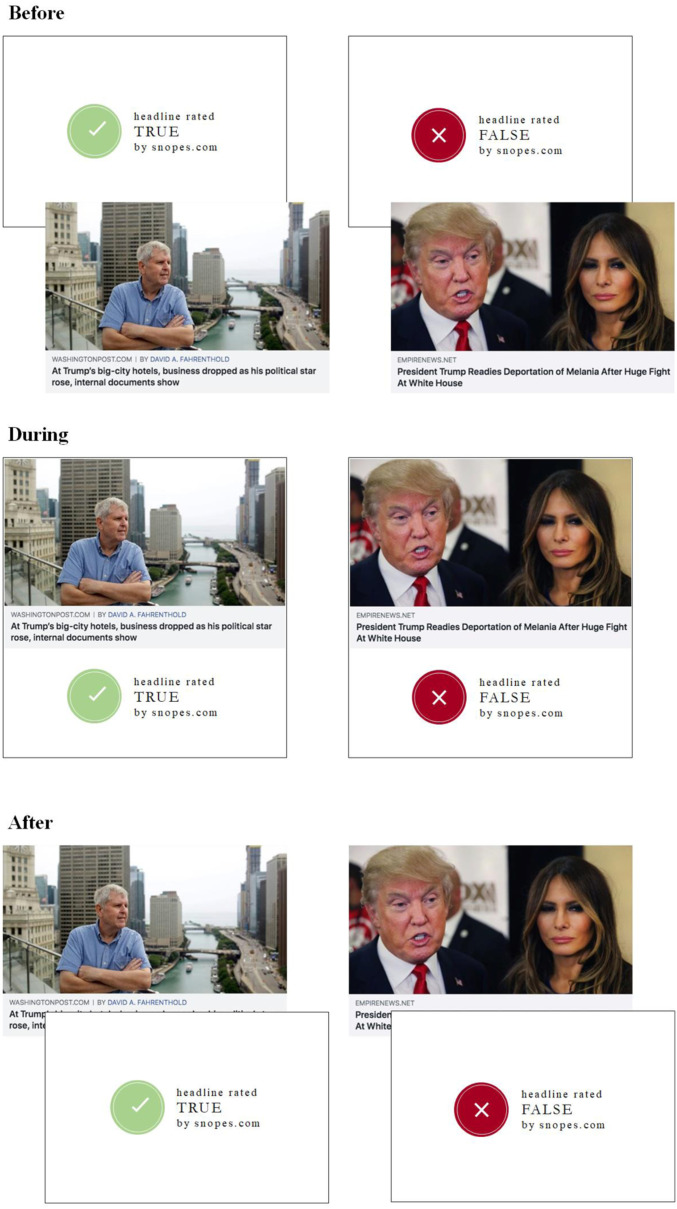
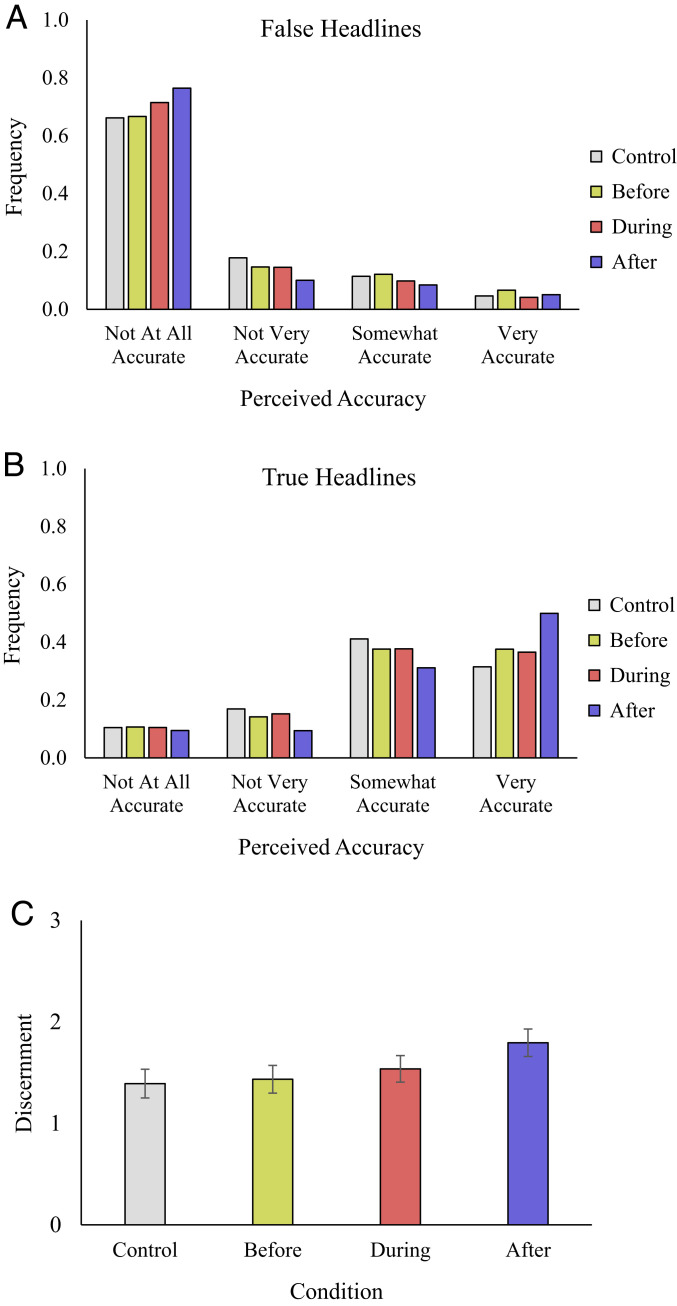
Countering misinformation can reduce belief in the moment, but corrective messages quickly fade from memory. We tested whether the longer-term impact of fact-checks depends on when people receive them. In two experiments (total N = 2,683), participants read true and false headlines taken from social media. In the treatment conditions, “true” and “false” tags appeared before, during, or after participants read each headline. Participants in a control condition received no information about veracity. One week later, participants in all conditions rated the same headlines’ accuracy. Providing fact-checks after headlines ( debunking ) improved subsequent truth discernment more than providing the same information during ( labeling ) or before ( prebunking ) exposure. This finding informs the cognitive science of belief revision and has practical implications for social media platform designers.
Overview
The claims and statistics of this paper haven’t been checked yet.
Free: it reads the open-access text and checks the first 5 claims that cite a source we can check. Create a free account to check every claim.
Integrity signals
Registry
Cites
Statistics
Figures
Verification
Claims the paper makes
The claims and statistics of this paper haven’t been checked yet.
Free: it reads the open-access text and checks the first 5 claims that cite a source we can check. Create a free account to check every claim.
Claims other papers make about this one
Each is checked against this paper’s own text: does it say what the citing paper says it does?
The check wasn’t confident either way, so it gives no verdict — never disputed.
In the citing paper
“A prominent troll farm example is the Russia-based Internet Research Agency (IRA), which disseminated inflammatory content online to influence the outcome of the 2016 U.S. presidential election.33”
From Fake news, disinformation and misinformation in social media: a review (2023) · cites this paper as [33]
Experimental — accuracy not yet measured
Self-check
Percentages, sums and reported differences re-computed from the paper’s own numbers.
The self-check needs the paper’s full text.
Citations
Cites
Hattie, J., & Timperley, H. (2007) · Review of Educational Research · doi:10.3102/003465430298487 · Cited by 12,905
Prior exposure increases perceived accuracy of fake news
Pennycook, G., Cannon, T. D., & Rand, D. G. (2018) · Journal of Experimental Psychology General · doi:10.1037/xge0000465 · Cited by 1,268 · cited 1×
“Ideally, people would not see misinformation in the first place, since even a single exposure to a fake headline makes it seem truer (20).”
BackgroundSelf-citationCook, J., Lewandowsky, S., & Ecker, U. K. H. (2017) · PLOS ONE · doi:10.1371/journal.pone.0175799 · Cited by 971 · cited 1×
“As examples, reading about “fake experts” protects people from climate science myths (5), and playing a game involving common disinformation tactics (e.”
BackgroundThe Elusive Backfire Effect: Mass Attitudes’ Steadfast Factual Adherence
Wood, T., & Porter, E. (2019) · Political Behavior · doi:10.1007/s11109-018-9443-y · Cited by 904
Debunking: A Meta-Analysis of the Psychological Efficacy of Messages Countering Misinformation
Chan, M.-P. S., Jones, C. R., Hall Jamieson, K., & Albarracín, D. (2017) · Psychological Science · doi:10.1177/0956797617714579 · Cited by 898
Pennycook, G., Bear, A., Collins, E. T., & Rand, D. G. (2020) · Management Science · doi:10.1287/mnsc.2019.3478 · Cited by 714
Self-citationExposure to untrustworthy websites in the 2016 US election
Guess, A. M., Nyhan, B., & Reifler, J. (2020) · Nature Human Behaviour · doi:10.1038/s41562-020-0833-x · Cited by 587
A Meta-Analysis of Research on Inoculation Theory
Banas, J. A., & Rains, S. A. (2010) · Communication Monographs · doi:10.1080/03637751003758193 · Cited by 510 · cited 1×
“Inoculating people to weakened arguments makes them less vulnerable to persuasion (4).”
BackgroundThe effect of type and timing of feedback on learning from multiple-choice tests.
Butler, A. C., Karpicke, J. D., & Roediger, H. L. (2007) · Journal of Experimental Psychology: Applied · doi:10.1037/1076-898x.13.4.273 · Cited by 321 · cited 1×
“However, delivering debunks farther in time from exposure may be beneficial, as delayed feedback can be more effective than immediate feedback (19).”
BackgroundThe role of familiarity in correcting inaccurate information.
Swire, B., Ecker, U. K. H., & Lewandowsky, S. (2017) · Journal of Experimental Psychology: Learning, Memory, and Cognition · doi:10.1037/xlm0000422 · Cited by 297
Research works printed but not linked: 1
- 10.1037/h0101809 · doi:10.1037/h0101809 · Paper page
Cited by
Items 101–200 of 216
Understanding Motivational Factors in Social Media News Sharing Decisions
Wang, L., & Rzeszotarski, J. M. (2023) · Proceedings of the ACM on Human-Computer Interaction · doi:10.1145/3579538 · Cited by 14
Pothitou, E., Perifanou, M. A., & Economides, A. A. (2025) · Information · doi:10.3390/info16010041 · Cited by 8
Electoral Crisis Communications: Combatting Disinformation & the Contest for Electoral Legitimacy
Winger, G. H., Calfano, B., Vićić, J., & Harknett, R. J. (2023) · American Politics Research · doi:10.1177/1532673x231184440 · Cited by 25
Horne, B. D. (2025) · Proceedings of the International AAAI Conference on Web and Social Media · doi:10.1609/icwsm.v19i1.35848 · Cited by 15
What’s the News About Bad News? A Review of Bad News Games as a Tool to Teach Media Literacy
Barabas, R. (2023) · Libri · doi:10.1515/libri-2023-0043 · Cited by 10
Johnson, S. S. (2022) · American Journal of Health Promotion · doi:10.1177/08901171211070957a · Cited by 12
Braun, G., Yeshurun, Y., & Shetreet, E. (2025) · Proceedings of the National Academy of Sciences · doi:10.1073/pnas.2422396122 · Cited by 9
“Another critical aspect is actual (dis)belief, involving the ultimate acceptance or rejection of (mis)information - a phenomenon that has gained increasing prominence in a time where misinformation is described as a “global pandemic” ( 1 , 3 , 15 – 18 ).”
Combatting the persuasive effects of misinformation: Forewarning versus debunking revisited
van Huijstee, D., Vermeulen, I., Kerkhof, P., & Droog, E. (2025) · New Media & Society · doi:10.1177/14614448251359988 · Cited by 7
“In addition, since the inclusion of manipulation checks (perceived message veracity and valence) may influence participants’ scores on subsequent dependent measures (e.g. Pennycook et al., 2021), we excluded both checks from the second study.”
Estimating the impact of immediate versus delayed corrections on belief accuracy
Ahn, S., Bergan, D. E., Ma, S., & Carnahan, D. (2023) · Communication Monographs · doi:10.1080/03637751.2023.2202728 · Cited by 6
Tsang, S. J., & Lin, Z. (2025) · Online Information Review · doi:10.1108/oir-07-2024-0454 · Cited by 9
Public sector’s misinformation debunking during the public health campaign: a case of Hong Kong
Zhu, R., & Zhang, X. (2023) · Health Promotion International · doi:10.1093/heapro/daad053 · Cited by 8
Carley, K. M. (2022) · Advanced sciences and technologies for security applications · doi:10.1007/978-3-030-94825-2_1 · Cited by 6
A Bayesian decision-theoretic framework for studying motivated reasoningPreprint
Priniski, J. H., Solanki, P., & Horne, Z. (2022) · PsyArXiv (OSF Preprints) · doi:10.31234/osf.io/ngavz · Cited by 7
Lin, L., Ortega, D. L., & Sun, J. (2024) · Applied Economic Perspectives and Policy · doi:10.1002/aepp.13487 · Cited by 7
“Similarly, Brashier et al. (2021) found that a debunking strategy was more effective and possessed a longer-lasting effect when it comes to identifying the accuracy of news headlines.”
Probing the paradox: are governments fighting or fueling disinformation?
Dragomir, M. (2025) · Frontiers in Communication · doi:10.3389/fcomm.2025.1429741 · Cited by 5
Marcos-Vílchez, J. M., Velázquez, J. A. M., Arraztio-Cordoba, A., & Sánchez-Martín, M. (2025) · Humanities and Social Sciences Communications · doi:10.1057/s41599-025-06143-6 · Cited by 6
“Nevertheless, inoculation strategies also face challenges: their effectiveness remains uncertain and context-dependent (Brashier et al. 2021; Maldita.es 2023; Spampatti et al. 2024), and they risk fostering excessive scepticism that may undermine trust even in legitimate information…”
Scales, D. A., Hurth, L., Xi, W., Gorman, S. E., Radhakrishnan, M., Windham, S., Akunne, A., Florman, J., Leininger, L. J., & Gorman, J. M. (2023) · JMIR Infodemiology · doi:10.2196/50138 · Cited by 6
“I stopped worrying that I’d die if I got COVID” Use personal narratives or anecdotes [61,62] Ensures misinformation does not become entrenched or misinterpreted.”
BackgroundPan, W., & Hu, T.-Y. (2024) · The Journal of Social Psychology · doi:10.1080/00224545.2024.2363366 · Cited by 5
Panizza, F., Ronzani, P., Mattavelli, S., Morisseau, T., Martini, C., & Motterlini, M. (2021) · Research Square · doi:10.21203/rs.3.rs-952649/v1 · Cited by 5
“Debunking has been extensively studied, with several experiments focusing 38 on the source [13–16] and the timing [17] of fact checking.”
BackgroundWhen Fake News Infects Political Networks: Case Study of the Tallano Gold Myth in the Philippines
Mendoza, R. U., Elemia, C. K. S., Recto, J. M. M., & de Castro, B. A. B. (2022) · Media Asia · doi:10.1080/01296612.2023.2217607 · Cited by 7
“In spite of the existence of empirical evidence on the effectiveness of fact-checking as means to correct misperceptions, recent research shows that individuals only tend to recall the false information and often forget the correction in the long run (Brashier et al., 2021).”
BackgroundImproving debriefing practices for participants in social science experiments
Clayton, K., Porter, E. V., Velez, Y. R., & Wood, T. (2024) · PNAS Nexus · doi:10.1093/pnasnexus/pgae502 · Cited by 5
Optimal Selection of Intervention Timing in Opinion Dynamics
Zhang, Q., Wang, L., Wang, X., & Chen, G. (2025) · IEEE Transactions on Automatic Control · doi:10.1109/tac.2025.3528350 · Cited by 4
Aruguete, N., Calvo, E. F., & Ventura, T. (2025) · Research & Politics · doi:10.1177/20531680251323120 · Cited by 7
“…showing that counter-attitudinal fact-checking adjudications of TRUE or FALSE information are often met with disbelief by users, who distrust the accuracy (quality) or intentions (unbiasedness) of the ad-judication (Brandtzaeg et al., 2018; Brashier et al., 2021; Fernandez-Roldan et al., 2023).”
Misinformation as strategy: Epistemic consequences and the undermining of shared truth
Ecker, U. K. H., Spearing, E. R., DiResta, R., & Lewandowsky, S. (2026) · Trends in Cognitive Sciences · doi:10.1016/j.tics.2026.06.009 · Cited by 4
Nudging for Online Misinformation: a Design Inquiry
Konstantinou, L., & Karapanos, E. (2023) · ACM Conference on Computer Supported Cooperative Work (CSCW) · doi:10.1145/3584931.3607015 · Cited by 9
“Empirical research has demonstrated that each strategy - prebunking, labelling, debunking - provides different strengths for prompting behavior change [3].”
Effects of antivaccine tweets on COVID-19 vaccinations, cases, and deaths
Bollenbacher, J., Menczer, F., & Bryden, J. (2026) · EPJ Data Science · doi:10.1140/epjds/s13688-025-00606-1 · Cited by 7
“In general, earlier interventions seem to work better than later ones [27].”
Is trust a zero-sum game? What happens when institutional sources get it wrong
Dawson, A., Bista, A., & Wilson, A. E. (2025) · PLoS ONE · doi:10.1371/journal.pone.0321743 · Cited by 3
“This is accomplished through accuracy prompts, [55,62–66], fact-checks after head-lines [67], and trustworthiness ratings for news sources [68], all of which seem to be at least somewhat effective.”
Meng, M., Namkoong, M., & Park, H. S. (2025) · International Journal of Human-Computer Interaction · doi:10.1080/10447318.2025.2546045 · Cited by 5
“While most studies favor immediate correction over delayed correction (Brashier et al., 2021; Wahlheim et al., 2020), delayed correction has distinct advantages when addressing complex information.”
On the Feasibility of Predicting Volumes of Fake News—The Spanish Case
Ibañez-Lissen, L., González‐Manzano, L., Fuentes, J. M. D., & Goyanes, M. (2023) · IEEE Transactions on Computational Social Systems · doi:10.1109/tcss.2023.3297093 · Cited by 5
“While timing has been shown as a dramatic factor to counter fake news, it is unlikely that they will be immediately discovered [47].”
BackgroundItem-method directed forgetting and perceived truth of news headlines
Abel, M., & Bäuml, K. T. (2023) · Memory · doi:10.1080/09658211.2023.2267191 · Cited by 4
“Such e ff ects are often examined with trivia statements (e.g., Fazio et al., 2019, 2022), but have also been shown with real and fake news headlines (Brashier et al., 2021; Calvillo & Smelter, 2020; Pennycook et al., 2018; Polage, 2012; Smelter & Calvillo, 2020).”
BackgroundParis, B. S., Marcello, G., & Reynolds, R. B. (2022) · Proceedings of the Association for Information Science and Technology · doi:10.1002/pra2.656 · Cited by 3
Fake News Known as Fake Still Changes Beliefs and Leads to Partisan PolarizationPreprint
Bai, H. (2021) · PsyArXiv (OSF Preprints) · doi:10.31234/osf.io/v9gax · Cited by 3
Solutions and Challenges for Addressing Misinformation
Martel, C., & Rand, D. G. (2025) · Journal of Public Policy & Marketing · doi:10.1177/07439156251352415 · Cited by 4
Self-citationNandakumar, A., & Rajivan, P. (2024) · ACM Transactions on Social Computing · doi:10.1145/3688598 · Cited by 3
“However, despite a large body of work that has studied the effectiveness of corrections and rebuttals for promoting accurate beliefs [ 8 , 13 , 15 , 55 , 62 , 69 , 71 , 75 ], there is still much uncertainty around the precise effects of correction messages on users’ behavior in OSN (see Refs.”
The information processing of fake news: How intervention order influences perception over time
Olenberger, C., Schoch, M., & Utz, L. (2025) · Information & Management · doi:10.1016/j.im.2025.104256 · Cited by 4
Gopalan, M., LOPEZ, F., Shalaby, A., Serrano, E., & Delcid, G. (2026) · Evidence & Policy · doi:10.1332/17442648y2025d000000076 · Cited by 3
The Role of Intrusiveness and Color in Content Warning Label Effectiveness
Liban, H. S., & Horne, B. D. (2026) · ACM Transactions on Applied Perception · doi:10.1145/3805797 · Cited by 2
“Broadly, this finding is like the result from Brashier et al. [9], which found that prebunking labels - labels shown before exposure to content - were less effective at reducing belief in false headlines than labels shown during content exposure.”
Applying Misinformation Interventions to Library Instruction and Outreach
Goodsett, M. (2023) · Journal of New Librarianship · doi:10.33011/newlibs/14/9 · Cited by 3
Bypassing as a non-confrontational influence strategy
Samayoa, J. A. G., & Albarracín, D. (2024) · Current Opinion in Psychology · doi:10.1016/j.copsyc.2024.101855 · Cited by 3
“…more or less effective, including the emotional [9], cognitive [10], and social aspects [11], [12], [13] of the correction, as well its optimal timing [14], [15] and structure [16], and how individual differences of the recipients interact with corrections [17]**, but more remains to be known.”
BackgroundXiao, W. (2024) · Telematics and Informatics Reports · doi:10.1016/j.teler.2024.100162 · Cited by 3
Event-Related Potentials in Response to Fake News Correction: Pilot Study
Morozova, A. N., Monahhova, E., Gorodnicheva, J., Zinchenko, O. O., Шестакова, А. Н., & Klucharev, V. A. (2024) · International Conference Neurotechnologies and Neurointerfaces (CNN) · doi:10.1109/cnn63506.2024.10705859 · Cited by 2
“These results are generally consistent with the results of studies of debunking effectiveness [5].”
BackgroundResultLin, H. Y., Lee, J., Wang, Y., & Kim, Y. (2024) · Digital Journalism · doi:10.1080/21670811.2024.2383889 · Cited by 6
“…in addition, regular consumption of fact-checked news could potentially foster a more discerning information processing habit among individuals (Brashier et al. 2021; Kim, cooks, and Kim 2021; Wang, Kim, and lin 2024), aiding them in better recognizing and dismissing misinformation encountered…”
A study of Facebook comments regarding amber teething necklaces: insights into public perception
Jorge, O. S., Leite, J. R. S. A., Lotto, M., & Cruvinel, T. (2024) · European Archives of Paediatric Dentistry · doi:10.1007/s40368-024-00956-w · Cited by 2
“In this context, such organisations can enhance individuals' ability to discern the truth when they encounter mis-information by issuing corrective communications (Brashier et al. 2021).”
The Elephant in the Room: Prior Exposure to Misinformation and Correction Effect
Wang, T., & Yu, W. (2024) · SAGE Open · doi:10.1177/21582440241305654 · Cited by 2
“Brashier et al. (2021) found that knowledge shares similar predictive power for misinformation acceptance with cognitive reflection, another type of abstract cognitive resource.”
Bajpai, S. T., & Sharma, D. K. (2022) · International Conference on Computing for Sustainable Global Development · doi:10.23919/indiacom54597.2022.9763221 · Cited by 2
Can Invalid Information Be Ignored When It Is Detected?
Ramsey, A. T., Liu, Y., & Trueblood, J. S. (2024) · Psychological Science · doi:10.1177/09567976241231571 · Cited by 2
“…information, focusing (a) on whether individuals utilize CIE or believe false factoids (illusory truth), (b) on how misinformation spreads online (Effron & Raj, 2020; Lewandowsky et al., 2012; Vosoughi et al., 2018), and (c) on how to combat it (Brashier et al., 2021; Pennycook et al., 2021).”
BackgroundResultInfluentialWhat do fact checkers fact-check when?Preprint
Ribeiro, M. H., Zannettou, S., Goga, O., Benevenuto, F., & West, R. (2021) · arXiv (Cornell University) · Cited by 2
Misinformation Analysis and Online Quality Theory (A Wittgensteinian Approach)Preprint
Omoregie, U. (2021) · SocArXiv (OSF Preprints) · doi:10.31235/osf.io/82swk · Cited by 4
Lateral reading and monetary incentives to sort out scientific (dis)informationPreprint
Panizza, F., Ronzani, P., Mattavelli, S., Morisseau, T., Martini, C., & Motterlini, M. (2021) · PsyArXiv (OSF Preprints) · doi:10.31234/osf.io/vuqd3 · Cited by 2
Çağdaş Toplumlarda Hakikatin Yeniden Üretimi: Sosyal Medya, Enformasyon ve Bilgi
SELİM, F. (2023) · Elektronik Cumhuriyet İletişim Dergisi · doi:10.54089/ecider.1295929 · Cited by 1
Shoves, nudges and combating misinformation: evidence on a new approach
Porter, E. V., Wood, T., Broniatowski, D. A., & Hosseini, P. (2024) · Behavioural Public Policy · doi:10.1017/bpp.2024.42 · Cited by 2
“…news literacy campaigns (Guess et al ., 2020b), factual corrections produced by journalists and researchers (Porter and Wood, 2024), corrections produced by peers (Bode and Vraga, 2021), inoculation or ‘ pre-bunking ’ (Roozenbeek et al ., 2022) and briefer warning labels (Brashier et al ., 2021).”
Francia, P. L., Morris, D. S. M., & Morris, J. S. (2025) · American Politics Research · doi:10.1177/1532673x251341893 · Cited by 16
“…the National Academy of Sciences of the United States of America , found that, “ Providing fact-checks after headlines ( debunking ) improved subsequent truth dis-cernment more than providing the same information during ( labeling ) or before ( prebunking ) exposure ” (Brashier et al., 2021, p. 1).”
Fujimoto, K., Tanaka, Y., & Inuzuka, M. (2025) · Health Communication · doi:10.1080/10410236.2025.2507676 · Cited by 2
“The effects of warning labels have been examined from various perspectives, including the incorporation of explanatory statements (Kirchner & Reuter, 2020), timing of label presentation (Brashier et al., 2021), and use of corrections provided by other users (Seo et al., 2022).”
Kim, Y., & Lim, H. D. (2025) · Mass Communication & Society · doi:10.1080/15205436.2025.2534979 · Cited by 1
“…and especially for debunking strategies: researchers have found that immediate correction can diminish the continued influence of misinformation (Brashier et al., 2021; Walter & Tukachinsky, 2020), while delayed or reactive correction can create an opportunity for individuals to commit the…”
Mason, C. E., & Rapp, D. N. (2026) · Applied Cognitive Psychology · doi:10.1002/acp.70166 · Cited by 1
Timing Matters: The Effects of Prebunking Versus Debunking on Trust in Disinformation
Lorko, M., Čavojová, V., Šrol, J., Priesol, R., Jalaksova, P., & Tužilová, B. (2026) · Personality and Social Psychology Bulletin · doi:10.1177/01461672251411571 · Cited by 2
The influence and continued influence of misinformation: A review
Rapp, D. N., Holohan, J. A., & Withall, M. M. (2024) · Elsevier eBooks · doi:10.1016/b978-0-443-15754-7.00069-9 · Cited by 1
Wang, M.-H., Sheen, G. C.-H., Chen, P.-Y., & Ho, E. (2025) · Personality and Individual Differences · doi:10.1016/j.paid.2025.113241 · Cited by 2
Community‐Driven Fact‐Checking on WhatsApp : Who Fact‐Checks Whom, Why, and With What Effect?
Garimella, K. (2025) · Proceedings of the Association for Information Science and Technology · doi:10.1002/pra2.1250 · Cited by 1
“…and the significant amount of time users spend consuming information on the platform, developing methods to timely identify and debunk rumors before they spread further can greatly enhance user experiences, considering the crucial role of timing in the fact-checking process Brashier et al. (2021).”
How Good are Older Adults at Detecting Fake News? Analysis of News Credibility among Spaniards
Pont‐Sorribes, C., Martí-Danés, A., & Besalú, R. (2025) · Journalism Practice · doi:10.1080/17512786.2025.2608084 · Cited by 2
Timing Matters: Designing Effective Corrections for Short-Form Video Misinformation
Gunasekara, S., Sew, C., Pareek, S., Kelly, R., Kostakos, V., & Gonçalves, J. (2026) · CHI Conference on Human Factors in Computing Systems · doi:10.1145/3772318.3790560 · Cited by 1
“This could also support knowledge revision [12], as people are more likely to update their understanding when the misinformation and the correction are coactive [61].”
InfluentialScience education’s responses to misinformation: a scoping review
Brown, C. V. (2026) · Studies in Science Education · doi:10.1080/03057267.2026.2654793 · Cited by 4
The influence of fake news on face-trait learning
Eggleston, A., Cook, R., & Over, H. (2022) · PLoS ONE · doi:10.1371/journal.pone.0278671 · Cited by 1
Antes, N., Schwan, S., & Huff, M. (2025) · Cognitive Research Principles and Implications · doi:10.1186/s41235-025-00629-2 · Cited by 3
“In the simplest form, veracity cues can be used where the falseness of a statement is signaled by a graphical making or a flag that serves as a metacognitive veracity warning signal (Brashier et al., 2021; Grady et al., 2021; Kozyreva et al., 2024).”
The Immediate and Delayed Beliefs in Headlines With High-arousal Sentence Starters
Zhou, X., Zhang, T., Wang, D. J., Wang, F., & Peng, K. (2025) · Communication Research · doi:10.1177/00936502251343979 · Cited by 1
Jamieson, K. H., Gibson, L., Jamieson, P. E., & Patterson, S. (2025) · Proceedings of the National Academy of Sciences · doi:10.1073/pnas.2517067122 · Cited by 1
“Adding to prior work, which has produced mixed results ( 64 , 76 ) these studies found evidence that modeled knowledge exposure preceding the Ladapo DNA claims was somewhat more effective than positioning the modeled knowledge in the rebuttal position.”
Understanding the efficacy of provenance interventions for tackling misinformationPreprint
Bereskin, C. (2023) · OSF Preprints (OSF Preprints) · doi:10.31219/osf.io/4a2fw · Cited by 2
Lorko, M., Čavojová, V., Šrol, J., Priesol, R., Jalaksova, P., & Tužilová, B. (2024) · PsyArXiv (OSF Preprints) · doi:10.31234/osf.io/w3mfy · Cited by 1
Some Approaches in Online Misinformation AnalysisPreprint
Omoregie, U. (2021) · doi:10.31235/osf.io/95btr
“…et al. 2022), providing individuals with skills to more easily distinguish between accurate and inaccurate vaccine information (Bowles et al. 2023; Brashier et al. 2021; Cook, Lewandowsky, and Ecker 2017; Guess et al. 2020; Maertens et al. 2021; Roozenbeek et al. 2022; Vraga et al. 2022),…”
BackgroundSelf-Certification: A novel method for increasing sharing discernment on social mediaPreprint
Howe, P. D. L., Perfors, A., Ransom, K., Walker, B., Fay, N., Kashima, Y., Saletta, M., & Dong, S. (2023) · PsyArXiv (OSF Preprints) · doi:10.31234/osf.io/pd2mx
Analysis of Misleading and Authenticity of News Headlines
Li, H. (2024) · Communications in Humanities Research · doi:10.54254/2753-7064/24/20231203
Preempting Polarization: An Experiment on Opinion FormationPreprint
Kashner, D., & Stalinski, M. (2024) · SSRN Electronic Journal · doi:10.2139/ssrn.4817488
Diffusion of fake news on social media: Student’s perceptions and behaviour
Bahige, M. N., & Faloye, S. T. (2024) · South African journal of information management · doi:10.4102/sajim.v26i1.1737
Self-certification: A novel method for increasing sharing discernment on social media
Howe, P. D. L., Perfors, A., Ransom, K., Walker, B., Fay, N., Kashima, Y., Saletta, M., & Dong, S. (2024) · PLoS ONE · doi:10.1371/journal.pone.0303025
“These include media literacy training [11], fact-checking [12], debunking [13], inoculations [14] and source credibility warnings [15].”
BackgroundViacava, J. J. C., Coelho, B. D. S. B., Sabin, G., & Lopes, G. F. (2024) · ReMark - Revista Brasileira de Marketing · doi:10.5585/remark.v23i3.24363
de Brito, A., Nascimento, C. E. S., de Sousa, D. T., & Santana, G. L. (2024) · Revista Sudamericana de Educación Universidad y Sociedad · doi:10.48163/rseus.2024.12151-71
Santos, M. P. F., Andrade, T. A. F., & Jaeger, A. (2025) · Cadernos de Psicologia · doi:10.9788/cp2025.1-03 · Cited by 2
The Impact of the Timing of Advice on Its Utilization
Aiyer, S., & Yeung, N. (2025) · Journal of Behavioral Decision Making · doi:10.1002/bdm.70021 · Cited by 1
Fahey, J. J. (2025) · The Journal of Politics · doi:10.1086/736803
Prescott, W. A., Foltz-Ramos, K., Kruger, J. S., Anadi, I. S., & Fusco, N. M. (2025) · Springer eBooks · doi:10.1007/978-3-031-88668-3_6
Braun, G., & Shetreet, E. (2025) · PsyArXiv (OSF Preprints) · doi:10.31234/osf.io/sbh8z_v1
Kurniawan, W., & Muluk, H. (2025) · SSRN Electronic Journal · doi:10.2139/ssrn.5418399 · Cited by 1
Prevention or Cure? The Joint Effects of Prebunking and Debunking on Electric-Vehicle AdoptionPreprint
Gambin, A., Munzel, A., & Goala, G. N. A. (2025) · SSRN Electronic Journal · doi:10.2139/ssrn.5573992
Linnenluecke, M. K. (2025) · Oxford University Press eBooks · doi:10.1093/9780198953067.003.0008
Invisible Waste: Information Pollution and Circular Economy Policy
Shouman, L. (2025) · IGI Global eBooks · doi:10.4018/979-8-3373-3852-1.ch006
Robinson, D., Agius, S. J., & Warren, A. (2025) · Health Care Analysis · doi:10.1007/s10728-025-00546-x · Cited by 1
李, 星. (2025) · Advances in Psychology · doi:10.12677/ap.2025.1511618
Understanding the mechanisms of infodemics: Equation-based vs. agent-based models
Berceanu, C., Bertolotti, F., Arshad, N., & Pătraşcu, M. (2025) · PLoS ONE · doi:10.1371/journal.pone.0338614
“Fact-based corrections directly address inaccuracies and provide accurate information [103].”
Kemp, P. L., Alexander, T. R., & Wahlheim, C. N. (2022) · Figshare · doi:10.6084/m9.figshare.21152021
Lewandowsky, S., & Yesilada, M. (2021) · Figshare · doi:10.6084/m9.figshare.15568200
Belief: Dumb, Cold, and Cynical
Porot, N., & Mandelbaum, E. (2026) · Oxford University Press eBooks · doi:10.1093/9780197744208.003.0006
A multi-factor intervention model for rumor and refutation dynamics
Yin, F., Yin, Q., Wu, C., Guo, Y., & Wu, Y. (2026) · Journal of Computational Science · doi:10.1016/j.jocs.2026.102889
Chen, W., & Ou, Y. (2026) · Well-Being Sciences Review · doi:10.54844/wsr.2026.1148
“The timing of corrections also influences sustainability of effects (Brashier et al ., 2021).”
Humor as a Tool for Communicating Climate Information and Navigating Misinformation
Yeo, S. K., Cacciatore, M. A., & McKasy, M. (2026) · Palgrave studies in education and the environment · doi:10.1007/978-3-032-14426-3_52
The Cross-Stage Accumulation Mechanism of the Continued Influence of Misinformation
占, 宇. (2026) · Advances in Psychology · doi:10.12677/ap.2026.165263
Terpapar Namun Tidak Percaya: Kesadaran dan Penerimaan Isu dalam Rilis Survei Nasional
Zidan, Z., & Hemay, I. (2026) · JIIP Jurnal Ilmiah Ilmu Pemerintahan · doi:10.14710/jiip.v11i1.30708
Misinformation During Nepal's 2026 Elections
Acharya, U., Kunwar, C., Shrestha, U., & Schäfer, E. M. (2026) · doi:10.62657/cmr26rra
Metadata
- Authors
- Brashier, N. M., Pennycook, G., Berinsky, A. J., & Rand, D. G.
- Affiliations
- Harvard University (US)
- University of Regina (CA)
- Massachusetts Institute of Technology (US)
- Corresponding author
- Brashier, Nadia M.
- Venue
- Proceedings of the National Academy of Sciences
- Publisher
- National Academy of Sciences
- Published
- 2021-01-25
- Volume
- 118
- Issue
- 5
- ISSN
- 0027-8424 (ISSN-L)
- 1091-6490
- PMC
- PMC7865139
- OpenAlex
- W3122113325
- Cited by
- 216
- References
- 21
- Citations by year
- 2026: 27 · 2025: 39 · 2024: 46 · 2023: 49 · 2022: 37 · 2021: 16
- FWCI
- 51.24
- Type
- journal article
- Language
- en
- Open access
- hybrid
- doi.org
- Licence
- Locations
- Proceedings of the National Academy of Sciences (publishedVersion, cc-by)
- PubMed Central (publishedVersion, cc-by)
- PubMed (publishedVersion)
- DSpace@MIT (Massachusetts Institute of Technology) (submittedVersion, cc-by-nc)
- Funders
- National Science Foundation (1808571)
- Ethics and Governance of Artificial Intelligence of the Miami Foundation (N/A)
- Gouvernement du Canada | Social Sciences and Humanities Research Council of Canada (N/A)
- William and Flora Hewlett Foundation (N/A)
- Reset Project of Luminate (N/A)
- Google (N/A)
- Topics
- Social Sciences › Sociology and Political Science › Misinformation and Its Impacts
- Social Sciences › Arts and Humanities › Philosophy › Epistemology, Ethics, and Metaphysics
- Social Sciences › Library and Information Sciences › Academic Publishing and Open Access
- Keywords
- fact-checking, fake news, misinformation, debunking, prebunking, labeling, truth discernment, belief revision, memory retention, social media
- MeSH terms
- Humans, Newspapers as Topic, Time Factors
About these checks
Registry, retraction, Cites and statistics results are computed, not judged, with one exception: a printed reference that no index lists is read once by a model before it counts as a citation error. Claims are extracted by a model and kept only when their quote appears verbatim in the text; each cited source is then checked, with a model’s help, for whether it says what the claim relies on. Those verdicts can be wrong — read the claim’s quote and the cited source before relying on one.
Statistics and arithmetic are recomputed, not judged.
Confidence bands are shown only for fields calibrated on our annotated test set. None is calibrated yet, so no band is shown.
What counts as a claim ›How we measure confidence ›How we check this ›
Are you an author, or do you see a problem with this page? Request a review
Data sources
Bibliographic data: Semantic Scholar, OpenAlex, Crossref.
Contains information from the Semantic Scholar Academic Graph Datasets, made available under the ODC Attribution License (ODC-BY 1.0).
Semantic Scholar’s data is described in: Kinney, R., et al. (2023). The Semantic Scholar Open Data Platform. arXiv:2301.10140.
