

Timing matters when correcting fake news
Open accessThe DOI matches its Crossref record; 21 of the 21 references it cites were found in a registry or an index.
Abstract
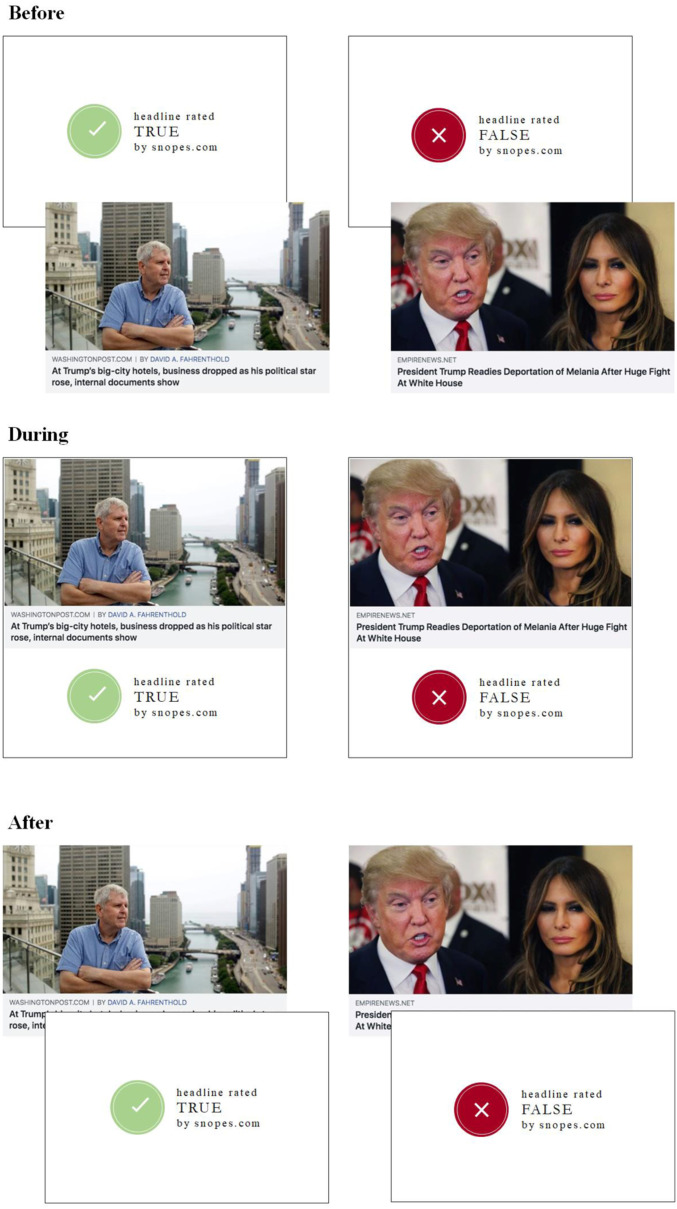
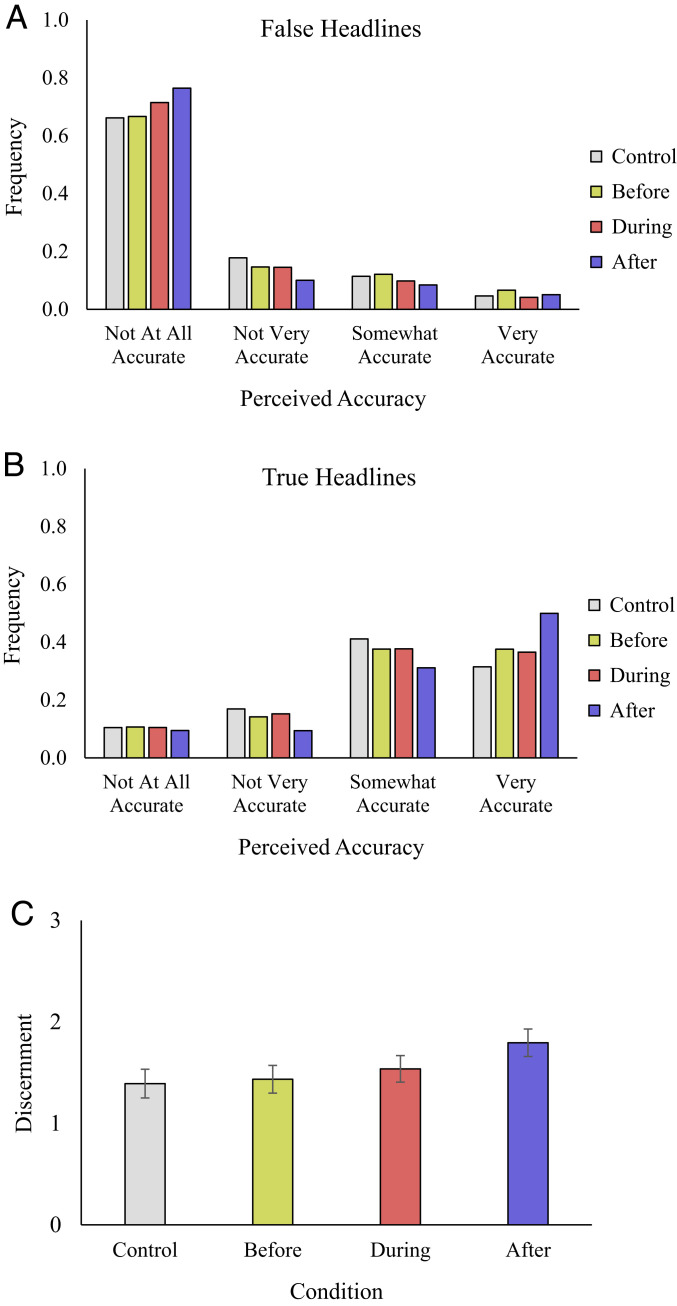
Countering misinformation can reduce belief in the moment, but corrective messages quickly fade from memory. We tested whether the longer-term impact of fact-checks depends on when people receive them. In two experiments (total N = 2,683), participants read true and false headlines taken from social media. In the treatment conditions, “true” and “false” tags appeared before, during, or after participants read each headline. Participants in a control condition received no information about veracity. One week later, participants in all conditions rated the same headlines’ accuracy. Providing fact-checks after headlines ( debunking ) improved subsequent truth discernment more than providing the same information during ( labeling ) or before ( prebunking ) exposure. This finding informs the cognitive science of belief revision and has practical implications for social media platform designers.
Overview
The claims and statistics of this paper haven’t been checked yet.
Free: it reads the open-access text and checks the first 5 claims that cite a source we can check. Create a free account to check every claim.
Integrity signals
Registry
Cites
Statistics
Figures
Verification
Claims the paper makes
The claims and statistics of this paper haven’t been checked yet.
Free: it reads the open-access text and checks the first 5 claims that cite a source we can check. Create a free account to check every claim.
Claims other papers make about this one
Each is checked against this paper’s own text: does it say what the citing paper says it does?
The check wasn’t confident either way, so it gives no verdict — never disputed.
In the citing paper
“A prominent troll farm example is the Russia-based Internet Research Agency (IRA), which disseminated inflammatory content online to influence the outcome of the 2016 U.S. presidential election.33”
From Fake news, disinformation and misinformation in social media: a review (2023) · cites this paper as [33]
Experimental — accuracy not yet measured
Self-check
Percentages, sums and reported differences re-computed from the paper’s own numbers.
The self-check needs the paper’s full text.
Citations
Cites
Hattie, J., & Timperley, H. (2007) · Review of Educational Research · doi:10.3102/003465430298487 · Cited by 12,905
Prior exposure increases perceived accuracy of fake news
Pennycook, G., Cannon, T. D., & Rand, D. G. (2018) · Journal of Experimental Psychology General · doi:10.1037/xge0000465 · Cited by 1,268 · cited 1×
“Ideally, people would not see misinformation in the first place, since even a single exposure to a fake headline makes it seem truer (20).”
BackgroundSelf-citationCook, J., Lewandowsky, S., & Ecker, U. K. H. (2017) · PLOS ONE · doi:10.1371/journal.pone.0175799 · Cited by 971 · cited 1×
“As examples, reading about “fake experts” protects people from climate science myths (5), and playing a game involving common disinformation tactics (e.”
BackgroundThe Elusive Backfire Effect: Mass Attitudes’ Steadfast Factual Adherence
Wood, T., & Porter, E. (2019) · Political Behavior · doi:10.1007/s11109-018-9443-y · Cited by 904
Debunking: A Meta-Analysis of the Psychological Efficacy of Messages Countering Misinformation
Chan, M.-P. S., Jones, C. R., Hall Jamieson, K., & Albarracín, D. (2017) · Psychological Science · doi:10.1177/0956797617714579 · Cited by 898
Pennycook, G., Bear, A., Collins, E. T., & Rand, D. G. (2020) · Management Science · doi:10.1287/mnsc.2019.3478 · Cited by 714
Self-citationExposure to untrustworthy websites in the 2016 US election
Guess, A. M., Nyhan, B., & Reifler, J. (2020) · Nature Human Behaviour · doi:10.1038/s41562-020-0833-x · Cited by 587
A Meta-Analysis of Research on Inoculation Theory
Banas, J. A., & Rains, S. A. (2010) · Communication Monographs · doi:10.1080/03637751003758193 · Cited by 510 · cited 1×
“Inoculating people to weakened arguments makes them less vulnerable to persuasion (4).”
BackgroundThe effect of type and timing of feedback on learning from multiple-choice tests.
Butler, A. C., Karpicke, J. D., & Roediger, H. L. (2007) · Journal of Experimental Psychology: Applied · doi:10.1037/1076-898x.13.4.273 · Cited by 321 · cited 1×
“However, delivering debunks farther in time from exposure may be beneficial, as delayed feedback can be more effective than immediate feedback (19).”
BackgroundThe role of familiarity in correcting inaccurate information.
Swire, B., Ecker, U. K. H., & Lewandowsky, S. (2017) · Journal of Experimental Psychology: Learning, Memory, and Cognition · doi:10.1037/xlm0000422 · Cited by 297
Research works printed but not linked: 1
- 10.1037/h0101809 · doi:10.1037/h0101809 · Paper page
Cited by
Items 201–216 of 216
Laurent, V., Rusinek, S., & Kosinski, T. (2026) · Psychological Reports · doi:10.1177/00332941261464066
Shibuya, Y., & Amichai‐Hamburger, Y. (2026) · Computers in Human Behavior · doi:10.1016/j.chb.2026.109113 · Cited by 1
Misinformation in the Digital Age
Bechler, C. J., & Catapano, R. (2026) · Oxford University Press eBooks · doi:10.1093/9780197859063.003.0065
Asfari, A., Ouassini, N., & Thomsen, E. (2026) · Oxford University Press eBooks · doi:10.1093/9780198945246.003.0137
Krishna, A., Amazeen, M. A., & Wells, C. (2026) · Environmental Communication · doi:10.1080/17524032.2026.2714124
Begum, M. M. R. (2026) · International Journal of Law Politics and Governance · doi:10.64823/ijlpg.2601010
“However, Brashier et al. (2021) argue that this optimistic interpretation has been criticised because it fails to consider the reality of the practical effects of wide-scale digital manipulation.”
Disinformation and epistemic crises
Tvrdý, F. (2026) · E-LOGOS · doi:10.18267/j.e-logos.518
On the Vulnerability of Community Notes to Participation Concentration
Nudo, J., Nemmi, E. N., Loru, E., Mei, A., Quattrociocchi, W., & Cinelli, M. (2026) · Lecture notes in computer science · doi:10.1007/978-3-032-38695-3_24
“While the presence of a CN generally reduces engagement with misleading content, its effectiveness is highly sensitive to publication delays [52, 11, 44].”
Disinformation, Ideology, and Public Opinion in Central Europe
Hlatky, R. (2026) · Cambridge University Press eBooks · doi:10.1017/9781009616935
Moore, R. C., & Hancock, J. T. (2026) · Perspectives on Psychological Science · doi:10.1177/17456916261475589
Gandhi, N., Singh, G., Muhuri, S., & Singh, P. (2026) · doi:10.1145/3841453.3841502
Brouillet, D. (2026) · International Journal of Cognitive Sciences · doi:10.3390/ijcs2040022
Ding, W., Cheng, Z., & Ge, Y. (2026) · Frontiers in Physics · doi:10.3389/fphy.2026.1953841
Kurniawan, W., & Muluk, H. (2026) · Personality and Individual Differences · doi:10.1016/j.paid.2026.114136
Accountable Boundary Work Around Misinformation-Sharing Sources
Hakami, Z., Feng, Y., & Cărbunar, B. (2026) · Proceedings of the ACM on Human-Computer Interaction · doi:10.1145/3858354
Acharya, U., Pathak, T., Bhusal, T. L., & Kunwar, R. (2026) · doi:10.62657/cmr26rrb
Metadata
- Authors
- Brashier, N. M., Pennycook, G., Berinsky, A. J., & Rand, D. G.
- Affiliations
- Harvard University (US)
- University of Regina (CA)
- Massachusetts Institute of Technology (US)
- Corresponding author
- Brashier, Nadia M.
- Venue
- Proceedings of the National Academy of Sciences
- Publisher
- National Academy of Sciences
- Published
- 2021-01-25
- Volume
- 118
- Issue
- 5
- ISSN
- 0027-8424 (ISSN-L)
- 1091-6490
- PMC
- PMC7865139
- OpenAlex
- W3122113325
- Cited by
- 216
- References
- 21
- Citations by year
- 2026: 27 · 2025: 39 · 2024: 46 · 2023: 49 · 2022: 37 · 2021: 16
- FWCI
- 51.24
- Type
- journal article
- Language
- en
- Open access
- hybrid
- doi.org
- Licence
- Locations
- Proceedings of the National Academy of Sciences (publishedVersion, cc-by)
- PubMed Central (publishedVersion, cc-by)
- PubMed (publishedVersion)
- DSpace@MIT (Massachusetts Institute of Technology) (submittedVersion, cc-by-nc)
- Funders
- National Science Foundation (1808571)
- Ethics and Governance of Artificial Intelligence of the Miami Foundation (N/A)
- Gouvernement du Canada | Social Sciences and Humanities Research Council of Canada (N/A)
- William and Flora Hewlett Foundation (N/A)
- Reset Project of Luminate (N/A)
- Google (N/A)
- Topics
- Social Sciences › Sociology and Political Science › Misinformation and Its Impacts
- Social Sciences › Arts and Humanities › Philosophy › Epistemology, Ethics, and Metaphysics
- Social Sciences › Library and Information Sciences › Academic Publishing and Open Access
- Keywords
- fact-checking, fake news, misinformation, debunking, prebunking, labeling, truth discernment, belief revision, memory retention, social media
- MeSH terms
- Humans, Newspapers as Topic, Time Factors
About these checks
Registry, retraction, Cites and statistics results are computed, not judged, with one exception: a printed reference that no index lists is read once by a model before it counts as a citation error. Claims are extracted by a model and kept only when their quote appears verbatim in the text; each cited source is then checked, with a model’s help, for whether it says what the claim relies on. Those verdicts can be wrong — read the claim’s quote and the cited source before relying on one.
Statistics and arithmetic are recomputed, not judged.
Confidence bands are shown only for fields calibrated on our annotated test set. None is calibrated yet, so no band is shown.
What counts as a claim ›How we measure confidence ›How we check this ›
Are you an author, or do you see a problem with this page? Request a review
Data sources
Bibliographic data: Semantic Scholar, OpenAlex, Crossref.
Contains information from the Semantic Scholar Academic Graph Datasets, made available under the ODC Attribution License (ODC-BY 1.0).
Semantic Scholar’s data is described in: Kinney, R., et al. (2023). The Semantic Scholar Open Data Platform. arXiv:2301.10140.
