

Human heuristics for AI-generated language are flawed
Open accessThe DOI matches its Crossref record; 55 of the 55 references it cites were found in a registry or an index.
Abstract
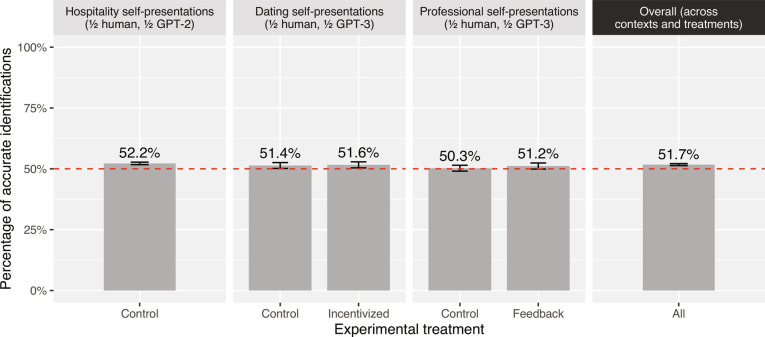
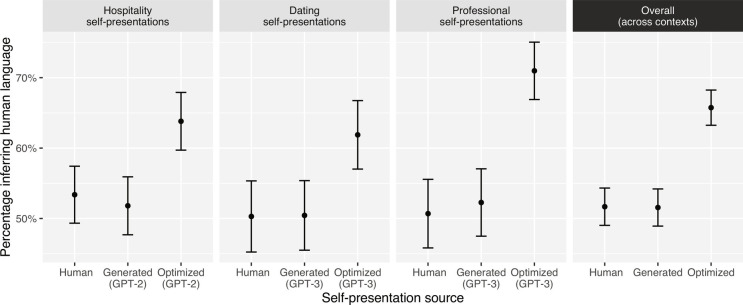
Human communication is increasingly intermixed with language generated by AI. Across chat, email, and social media, AI systems suggest words, complete sentences, or produce entire conversations. AI-generated language is often not identified as such but presented as language written by humans, raising concerns about novel forms of deception and manipulation. Here, we study how humans discern whether verbal self-presentations, one of the most personal and consequential forms of language, were generated by AI. In six experiments, participants (N = 4,600) were unable to detect self-presentations generated by state-of-the-art AI language models in professional, hospitality, and dating contexts. A computational analysis of language features shows that human judgments of AI-generated language are hindered by intuitive but flawed heuristics such as associating first-person pronouns, use of contractions, or family topics with human-written language. We experimentally demonstrate that these heuristics make human judgment of AI-generated language predictable and manipulable, allowing AI systems to produce text perceived as “more human than human.” We discuss solutions, such as AI accents, to reduce the deceptive potential of language generated by AI, limiting the subversion of human intuition.
Overview
The claims and statistics of this paper haven’t been checked yet.
Free: it reads the open-access text and checks the first 5 claims that cite a source we can check. Create a free account to check every claim.
Integrity signals
Registry
Cites
Statistics
Figures
Verification
Claims the paper makes
The claims and statistics of this paper haven’t been checked yet.
Free: it reads the open-access text and checks the first 5 claims that cite a source we can check. Create a free account to check every claim.
Claims other papers make about this one
Each is checked against this paper’s own text: does it say what the citing paper says it does?
The source backs part of the claim, not all of it — or backs it for a different population, condition or comparison.
In the citing paper
“Studies have shown that humans are largely ineffective at discerning AI created from human created content, and thus easily deceived (60).”
From The benefits and dangers of anthropomorphic conversational agents (2025) · cites this paper as [60]
Experimental — accuracy not yet measuredThe source backs part of the claim, not all of it — or backs it for a different population, condition or comparison.
In the citing paper
“Recent studies demonstrate that models like the GPT series are capable of producing news articles indistinguishable from human-generated ones (Kreps et al., 2022;Jakesch et al., 2023)”
From Anatomy of an AI-powered malicious social botnet (2024) · cites this paper as Jakesch et al., 2023
Experimental — accuracy not yet measuredThe source backs part of the claim, not all of it — or backs it for a different population, condition or comparison.
In the citing paper
“First, LLMs beat traditional text generation methods in producing human-like text (Jakesch et al., 2023;Guo et al., 2023;Clark et al., 2021).”
From Anatomy of an AI-powered malicious social botnet (2024) · cites this paper as Jakesch et al., 2023
Experimental — accuracy not yet measuredThe cited source says what the claim attributes to it.
In the citing paper
“We note that recent research has found that people could not reliably distinguish whether a piece of content is generated by people or the latest LLMs [33].”
From 'It was 80% me, 20% AI': Seeking Authenticity in Co-Writing with Large Language Models (2025) · cites this paper as [33]
The cited source says what the claim attributes to it.
In the citing paper
“it can also create realistic disinformation (e.g., fake news, propaganda) that is hard to detect by humans (Kreps et al. 2022; Jakesch et al. 2023)”
From Generative AI (2024) · cites this paper as Jakesch et al. 2023
6 more claims about this paper
Create a free account to see every claim other papers make about this one.
Self-check
Percentages, sums and reported differences re-computed from the paper’s own numbers.
The self-check needs the paper’s full text.
Citations
Cites
Vaswani, A., Shazeer, N., Parmar, N., Uszkoreit, J., Jones, L., Gomez, A. N., Kaiser, L., & Polosukhin, I. (2017) · arXiv · doi:10.48550/arxiv.1706.03762 · Cited by 120,404 · cited 1×
“We trained multiple customized versions of state-of-the-art AI language models (1, 2, 4) to generate self-presentations in three social contexts where trust in a self-presentation is important for decision-making: professional (e.g., job applications) (22), romantic (e.g., online dating) (12), and…”
MethodExploiting Generative AI to Scale up Intelligent Tutoring Systems
Jakubův, J., Chvalovský, K., Goertzel, Z., Kaliszyk, C., Olšák, M., Piotrowski, B., Schulz, S., Suda, M., & Urban, J. (2023) · DROPS (Schloss Dagstuhl – Leibniz Center for Informatics) · doi:10.4230/lipics.itp.2023.19 · Cited by 76,658
Language Models are Few-Shot Learners
Brown, T. B., Mann, B., Ryder, N., Subbiah, M., Kaplan, J., Dhariwal, P., Neelakantan, A., Shyam, P., Sastry, G., Askell, A., et al. (2020) · arXiv · doi:10.48550/arxiv.2005.14165 · Cited by 23,372 · cited 2×
“AI-generated language enables novel interactions that reduce human effort but can facilitate novel forms of plagiarism, manipulation, and deception (1, 3–8) when people mistake AI-generated language for language created by humans.”
BackgroundMethodKaugeranna, R., Kaugeranna, E., & Aion, (. S. 4. 6. (2023) · DROPS (Schloss Dagstuhl – Leibniz Center for Informatics) · doi:10.4230/lipics.giscience.2023.43 · Cited by 13,690
VADER: a parsimonious rule-based model for sentiment analysis of social media text
Hutto, C., & Gilbert, E. (2014) · Proceedings of the International AAAI Conference on Web and Social Media · doi:10.1609/icwsm.v8i1.14550 · Cited by 6,087 · cited 1×
“We computationally created a range of language features present in the self-presentations, including measurements for personality, sentiment, and perspective (28, 29).”
The Psychological Meaning of Words: LIWC and Computerized Text Analysis Methods
Tausczik, Y. R., & Pennebaker, J. W. (2010) · Journal of Language and Social Psychology · doi:10.1177/0261927x09351676 · Cited by 5,774 · cited 2×
“We developed an initial set of language features motivated by participants’ explanations of their judgments, to which we added various statistical metrics and commonly analyzed psychological language features such as LIWC (21).”
MethodProlific.ac—A subject pool for online experiments
Palan, S., & Schitter, C. (2018) · Journal of Behavioral and Experimental Finance · doi:10.1016/j.jbef.2017.12.004 · Cited by 3,450 · cited 2×
“Participants from Prolific had a median age of 37 y, 67% had a college degree, and 27% were at least somewhat familiar with computer programming.”
MethodThielke, S. M. (2004) · Psychiatric Services · doi:10.1176/appi.ps.55.9.1071 · Cited by 3,052
On the Opportunities and Risks of Foundation Models
Bommasani, R., Hudson, D. A., Adeli, E., Altman, R., Arora, S., von Arx, S., Bernstein, M. S., Bohg, J., Bosselut, A., Brunskill, E., et al. (2021) · arXiv · doi:10.48550/arxiv.2108.07258 · Cited by 2,676 · cited 1×
“We trained multiple customized versions of state-of-the-art AI language models (1, 2, 4) to generate self-presentations in three social contexts where trust in a self-presentation is important for decision-making: professional (e.g., job applications) (22), romantic (e.g., online dating) (12), and…”
MethodGPT-3: Its Nature, Scope, Limits, and Consequences
Floridi, L., & Chiriatti, M. (2020) · Minds and Machines · doi:10.1007/s11023-020-09548-1 · Cited by 2,519 · cited 1×
“In addition, human-like AI-generated self-presentations complicate questions about personhood and blur the line between human and machine intelligence (6, 15).”
BackgroundAccuracy of Deception Judgments
Bond, C. F., & DePaulo, B. M. (2006) · Personality and Social Psychology Review · doi:10.1207/s15327957pspr1003_2 · Cited by 1,953
Proceedings of the 2020 CHI Conference on Human Factors in Computing Systems
(2020) · doi:10.1145/3313831 · Cited by 1,951
Comparison of Bayesian and regression approaches to the study of information processing in judgment
Slovic, P., & Lichtenstein, S. (1971) · Organizational Behavior and Human Performance · doi:10.1016/0030-5073(71)90033-x · Cited by 1,819 · cited 1×
“While participants may not always know why they did something (25), a multiparadigm approach (26) based on a statistical analysis of their judgments combined with a computational analysis of language features present in the self-descriptions allows us to independently reconstruct heuristics they…”
BackgroundManaging impressions online: Self-presentation processes in the online dating environment
Ellison, N., Heino, R., & Gibbs, J. (2006) · Journal of Computer-Mediated Communication · doi:10.1111/j.1083-6101.2006.00020.x · Cited by 1,616 · cited 1×
“, online dating) (10), and hospitality (e.”
Lying Words: Predicting Deception from Linguistic Styles
Newman, M. L., Pennebaker, J. W., Berry, D. S., & Richards, J. M. (2003) · Personality and Social Psychology Bulletin · doi:10.1177/0146167203029005010 · Cited by 1,439
The Curious Case of Neural Text Degeneration
Holtzman, A., Buys, J., Du, L., Forbes, M., & Choi, Y. (2019) · arXiv · doi:10.48550/arxiv.1904.09751 · Cited by 1,304 · cited 1×
“We used the fine-tuned model and nucleus sampling (46) at P = 0.”
MethodTrust and reputation in the sharing economy: The role of personal photos in Airbnb
Ert, E., Fleischer, A., & Magen, N. (2016) · Tourism Management · doi:10.1016/j.tourman.2016.01.013 · Cited by 1,295 · cited 1×
“Previous research has extensively studied the importance of self-presentation (9–11), showing that impression formation based on self-descriptions is crucial for establishing the trust required for a wide variety of social interactions (12, 13).”
Coppock, A., & McClellan, O. A. (2019) · Research & Politics · doi:10.1177/2053168018822174 · Cited by 987 · cited 1×
“For the main experiment in the hospitality context, we recruited a US-representative sample of 2,000 participants through Lucid (48).”
MethodPennebaker, J. W. (2011) · New Scientist · doi:10.1016/s0262-4079(11)62167-2 · Cited by 780
Taxonomy of Risks posed by Language Models
Weidinger, L., Uesato, J., Rauh, M., Griffin, C., Huang, P.-S., Mellor, J., Glaese, A., Cheng, M., Balle, B., Kasirzadeh, A., et al. (2022) · 2022 ACM Conference on Fairness Accountability and Transparency · doi:10.1145/3531146.3533088 · Cited by 764 · cited 2×
“AI-generated language enables novel interactions that reduce human effort but can facilitate novel forms of plagiarism, manipulation, and deception (1, 3–8) when people mistake AI-generated language for language created by humans.”
BackgroundUniting the Tribes: Using Text for Marketing Insight
Berger, J., Humphreys, A., Ludwig, S., Moe, W. W., Netzer, O., & Schweidel, D. A. (2020) · Journal of Marketing · doi:10.1177/0022242919873106 · Cited by 742 · cited 1×
“…may not always know why they did something (25), a multiparadigm approach (26) based on a statistical analysis of their judgments combined with a computational analysis of language features present in the self-descriptions allows us to independently reconstruct heuristics they rely on (27).”
BackgroundAI-Mediated Communication: Definition, Research Agenda, and Ethical Considerations
Hancock, J. T., Naaman, M., & Levy, K. (2020) · Journal of Computer-Mediated Communication · doi:10.1093/jcmc/zmz022 · Cited by 658 · cited 3×
“AI systems that generate human-like self-presentations may invalidate signals that people rely on when assessing others (16), such as tone or compositional skill.”
BackgroundSelf-citationWhy do lie-catchers fail? A lens model meta-analysis of human lie judgments.
Hartwig, M., & Bond, C. F. (2011) · Psychological Bulletin · doi:10.1037/a0023589 · Cited by 617 · cited 1×
“Drawing on the extensive literature on deception detection (24, 25), we propose two explanations for human inability to identify generated self-presentation: First, the language generated by state-of-the-art AI systems could be so similar to human language that a lack of reliable cues limits accuracy.”
BackgroundDefending Against Neural Fake News
Zellers, R., Holtzman, A., Rashkin, H., Bisk, Y., Farhadi, A., Roesner, F., & Choi, Y. (2019) · arXiv · doi:10.48550/arxiv.1905.12616 · Cited by 569 · cited 1×
“From automated impersonation (8) to targeted disinformation campaigns (37, 38), AI systems could be optimized to undermine human intuition, exacerbating concerns about novel automatized forms of deception, fraud, and identity theft (3–8).”
BackgroundGLTR: Statistical Detection and Visualization of Generated Text
Gehrmann, S., Strobelt, H., & Rush, A. (2019) · Proceedings of the 57th Annual Meeting of the Association for Computational Linguistics: System Demonstrations · doi:10.18653/v1/p19-3019 · Cited by 470
GLTR: Statistical Detection and Visualization of Generated Text
Gehrmann, S., Strobelt, H., & Rush, A. M. (2019) · arXiv · doi:10.48550/arxiv.1906.04043 · Cited by 460
Köbis, N., & Mossink, L. D. (2021) · Computers in Human Behavior · doi:10.1016/j.chb.2020.106553 · Cited by 406
Pinar Saygin, A., Cicekli, I., & Akman, V. (2000) · Minds and Machines · doi:10.1023/a:1011288000451 · Cited by 383 · cited 2×
“The six experiments combined elements of a simplified Turing test (21) with a data labeling task.”
MethodAll the News That’s Fit to Fabricate: AI-Generated Text as a Tool of Media Misinformation
Kreps, S., McCain, R. M., & Brundage, M. (2022) · Journal of Experimental Political Science · doi:10.1017/xps.2020.37 · Cited by 360
All That’s ‘Human’ Is Not Gold: Evaluating Human Evaluation of Generated Text
Clark, E., August, T., Serrano, S., Haduong, N., Gururangan, S., & Smith, N. A. (2021) · Proceedings of the 59th Annual Meeting of the Association for Computational Linguistics and the 11th International Joint Conference on Natural Language Processing (Volume 1: Long Papers) · doi:10.18653/v1/2021.acl-long.565 · Cited by 290 · cited 1×
“However, the potential for improving human intuition for the detection of generated language is likely limited (16), and future generations of language models may invalidate learned heuristics.”
BackgroundAll That's 'Human' Is Not Gold: Evaluating Human Evaluation of Generated Text
Clark, E., August, T., Serrano, S., Haduong, N., Gururangan, S., & Smith, N. A. (2021) · arXiv · doi:10.48550/arxiv.2107.00061 · Cited by 290 · cited 1×
“However, the potential for improving human intuition for the detection of generated language is likely limited (16), and future generations of language models may invalidate learned heuristics.”
BackgroundAutomatic Detection of Generated Text is Easiest when Humans are Fooled
Ippolito, D., Duckworth, D., Callison-Burch, C., & Eck, D. (2020) · Proceedings of the 58th Annual Meeting of the Association for Computational Linguistics · doi:10.18653/v1/2020.acl-main.164 · Cited by 264 · cited 3×
“Recent work by Ippolito et al. (35) suggests that language model–decoding methods have been optimized for fooling humans at the cost of introducing statistical anomalies easily detected by machines.”
BackgroundInfluentialAutomatic Detection of Generated Text is Easiest when Humans are Fooled
Ippolito, D., Duckworth, D., Callison-Burch, C., & Eck, D. (2019) · arXiv · doi:10.48550/arxiv.1911.00650 · Cited by 264 · cited 3×
“Recent work by Ippolito et al. (35) suggests that language model–decoding methods have been optimized for fooling humans at the cost of introducing statistical anomalies easily detected by machines.”
BackgroundInfluentialMetacognition in computation: A selected research review
Cox, M. T. (2005) · Artificial Intelligence · doi:10.1016/j.artint.2005.10.009 · Cited by 233 · cited 1×
“As self-reports on mental processes can be unreliable and even misleading (24), we conducted additional analyses to evaluate participants’ judgments independently of their self-reported explanations.”
Platforms, People, and Perception: Using Affordances to Understand Self-Presentation on Social Media
DeVito, M. A., Birnholtz, J., & Hancock, J. T. (2017) · Proceedings of the 2017 ACM Conference on Computer Supported Cooperative Work and Social Computing · doi:10.1145/2998181.2998192 · Cited by 227
Self-citationSelf-Disclosure and Perceived Trustworthiness of Airbnb Host Profiles
Ma, X., Hancock, J. T., Lim Mingjie, K., & Naaman, M. (2017) · Proceedings of the 2017 ACM Conference on Computer Supported Cooperative Work and Social Computing · doi:10.1145/2998181.2998269 · Cited by 199 · cited 2×
“…AI language models (1, 2, 4) to generate self-presentations in three social contexts where trust in a self-presentation is important for decision-making: professional (e.g., job applications) (22), romantic (e.g., online dating) (12), and hospitality services (e.g., Airbnb host profiles) (15).”
BackgroundSelf-citationJakesch, M., French, M., Ma, X., Hancock, J. T., & Naaman, M. (2019) · Proceedings of the 2019 CHI Conference on Human Factors in Computing Systems · doi:10.1145/3290605.3300469 · Cited by 190 · cited 2×
“Earlier work on AI-mediated communication (16) has shown that interpersonal trust declines when people suspect that others are using AI systems to generate or optimize their self-presentation (17).”
BackgroundSelf-citationUnifying Human and Statistical Evaluation for Natural Language Generation
Hashimoto, T. B., Zhang, H., & Liang, P. (2019) · Proceedings of the 2019 Conference of the North American Chapter of the Association for Computational Linguistics: Human Language Technologies, Volume 1 (Long and Short Papers) · doi:10.18653/v1/n19-1169 · Cited by 161
The effects of verbal versus photographic self-presentation on impression formation in Facebook
Van Der Heide, B., D’Angelo, J. D., & Schumaker, E. M. (2012) · Journal of Communication · doi:10.1111/j.1460-2466.2011.01617.x · Cited by 152 · cited 1×
“In this work, we operationalize self-presentation as self-descriptions of the type prevalent in online profiles (10), e.g., on professional or dating platforms.”
MethodGoldstein, J. A., Sastry, G., Musser, M., DiResta, R., Gentzel, M., & Sedova, K. (2023) · arXiv · doi:10.48550/arxiv.2301.04246 · Cited by 152 · cited 1×
“From automated impersonation (8) to targeted disinformation campaigns (37, 38), AI systems could be optimized to undermine human intuition, exacerbating concerns about novel automatized forms of deception, fraud, and identity theft (3–8).”
BackgroundPrivacy Concerns in Chatbot Interactions
Ischen, C., Araujo, T., Voorveld, H., van Noort, G., & Smit, E. (2020) · Lecture Notes in Computer Science · doi:10.1007/978-3-030-39540-7_3 · Cited by 152
The Effect of Linkedin on Deception in Resumes
Guillory, J., & Hancock, J. T. (2012) · Cyberpsychology, Behavior, and Social Networking · doi:10.1089/cyber.2011.0389 · Cited by 135 · cited 1×
“…AI language models (1, 2, 4) to generate self-presentations in three social contexts where trust in a self-presentation is important for decision-making: professional (e.g., job applications) (22), romantic (e.g., online dating) (12), and hospitality services (e.g., Airbnb host profiles) (15).”
BackgroundSelf-citationDou, Y., Forbes, M., Koncel-Kedziorski, R., Smith, N., & Choi, Y. (2022) · Proceedings of the 60th Annual Meeting of the Association for Computational Linguistics (Volume 1: Long Papers) · doi:10.18653/v1/2022.acl-long.501 · Cited by 118 · cited 1×
“Future language models should be optimized not to fool humans (28) but to support human communication while accommodating our cognitive limitations.”
BackgroundDuped: Truth-Default Theory and the Social Science of Lying and Deception
Asp, E. W. (2021) · Journal of Communication · doi:10.1093/joc/jqaa026 · Cited by 95
What to Tell About Me? Self-Presentation in Online Communities
Schwämmlein, E., & Wodzicki, K. (2012) · Journal of Computer-Mediated Communication · doi:10.1111/j.1083-6101.2012.01582.x · Cited by 93 · cited 1×
“Researchers have extensively studied the importance of online self-presentation (11– 13), showing that impression formation based on self-descriptions is crucial for establishing the trust required for various social interactions (14, 15).”
BackgroundDou, Y., Forbes, M., Koncel-Kedziorski, R., Smith, N. A., & Choi, Y. (2021) · arXiv · doi:10.48550/arxiv.2107.01294 · Cited by 90 · cited 1×
“Future language models should be optimized not to fool humans (28) but to support human communication while accommodating our cognitive limitations.”
BackgroundFake news and alternative facts: information literacy in a post-truth era
Womack, H. D. (2019) · Technical Services Quarterly · doi:10.1080/07317131.2019.1584985 · Cited by 79
Ethics in cybersecurity research and practice
Macnish, K., & van der Ham, J. (2020) · Technology in Society · doi:10.1016/j.techsoc.2020.101382 · Cited by 73 · cited 1×
“While risky, decisions to share vulnerabilities have led to positive developments in computer safety (50) .”
BackgroundAll the News that’s Fit to Fabricate: AI-Generated Text as a Tool of Media MisinformationPreprint
Kreps, S. E., McCain, R. M., & Brundage, M. (2020) · SSRN Electronic Journal · doi:10.2139/ssrn.3525002 · Cited by 66
The Perils of Using Mechanical Turk to Evaluate Open-Ended Text Generation
Karpinska, M., Akoury, N., & Iyyer, M. (2021) · Proceedings of the 2021 Conference on Empirical Methods in Natural Language Processing · doi:10.18653/v1/2021.emnlp-main.97 · Cited by 56 · cited 3×
“To explore the effect of increased effort (23), we offered half of the participants in the dating context a bonus payment if they rated at least 75% of the self-presentations correctly.”
BackgroundMethodInfluentialHow privacy’s past may shape its future
Acquisti, A., Brandimarte, L., & Hancock, J. (2022) · Science · doi:10.1126/science.abj0826 · Cited by 46 · cited 1×
“Research also shows that typical notice and consent disclosures are largely ignored by users (44).”
BackgroundSelf-citationFooling MOSS Detection with Pretrained Language Models
Biderman, S., & Raff, E. (2022) · arXiv · doi:10.48550/arxiv.2201.07406 · Cited by 37
Fooling MOSS Detection with Pretrained Language Models
Biderman, S., & Raff, E. (2022) · Proceedings of the 31st ACM International Conference on Information & Knowledge Management · doi:10.1145/3511808.3557079 · Cited by 37
OkCupid Data for Introductory Statistics and Data Science Courses
Kim, A. Y., & Escobedo-Land, A. (2015) · Journal of Statistics Education · doi:10.1080/10691898.2015.11889737 · Cited by 34 · cited 2×
“Previously published data were used for this work (47).”
BackgroundMethodUnifying Human and Statistical Evaluation for Natural Language Generation
Hashimoto, T., Zhang, H., & Liang, P. (2019) · arXiv (Cornell University) · doi:10.48550/arxiv.1904.02792 · Cited by 33
Research works printed but not linked: 4
- B. Buchanan, A. Lohn, M. Musser, K. Sedova, Truth, lies, and automation. Cent. Secur. Emerg. Technol. 1, 2 (2021).
- A. Radford, Language models are unsupervised multitask learners. OpenAI Blog 1, 9 (2019).
- A. Nelson, S. Friedler, F. Fields-Meyer, Blueprint for an AI bill of rights: A vision for protecting our civil rights in the algorithmic age. White House Office of Science and Technology Policy (2022). (18 October 2022).
- J. Williams, Should AI always identify itself? It’s more complicated than you might think. Electronic Frontier Foundation (2018). (18 October 2022).
Cited by
Feuerriegel, S., Hartmann, J., Janiesch, C., & Zschech, P. (2024) · Business & Information Systems Engineering · doi:10.1007/s12599-023-00834-7 · Cited by 2,267
“, fake news, propaganda) that is hard to detect by humans (Jakesch et al., 2023; Kreps et al., 2022).”
Generative artificial intelligence
Banh, L., & Strobel, G. (2023) · Electronic Markets · doi:10.1007/s12525-023-00680-1 · Cited by 579
“The promotion of explainable and responsible AI becomes paramount once more (Meske et al., 2022), especially in a technological state where distinguishing between generated and real content by GAI models is becoming increasingly more challenging (Jakesch et al., 2023b; Lehmann & Buschek, 2020).”
BackgroundCan Generative AI Improve Social Science?
Bail, C. A. (2023) · doi:10.31235/osf.io/rwtzs · Cited by 369
Can Generative AI improve social science?
Bail, C. A. (2024) · Proceedings of the National Academy of Sciences · doi:10.1073/pnas.2314021121 · Cited by 369
On the Conversational Persuasiveness of Large Language Models: A Randomized Controlled Trial
Salvi, F., Ribeiro, M. H., Gallotti, R., & West, R. (2024) · doi:10.21203/rs.3.rs-4429707/v1 · Cited by 285
Metadata
- Authors
- Jakesch, M., Hancock, J. T., & Naaman, M.
- Affiliations
- Cornell University (US)
- Stanford University (US)
- Corresponding author
- Jakesch, Maurice
- Venue
- Proceedings of the National Academy of Sciences
- Publisher
- National Academy of Sciences
- Published
- 2023-03-07
- Volume
- 120
- Issue
- 11
- Pages
- e2208839120-e2208839120
- ISSN
- 0027-8424 (ISSN-L)
- 1091-6490
- PMC
- PMC10089155
- OpenAlex
- W4323347737
- Cited by
- 342
- References
- 46
- Citations by year
- 2026: 138 · 2025: 102 · 2024: 69 · 2023: 32
- FWCI
- 32.10
- Type
- journal article
- Language
- en
- Open access
- hybrid
- doi.org
- Licence
- Locations
- Proceedings of the National Academy of Sciences (publishedVersion, cc-by-nc-nd)
- PubMed Central (publishedVersion, cc-by-nc-nd)
- PubMed (publishedVersion)
- arXiv (Cornell University) (submittedVersion)
- arXiv (Cornell University)
- Funders
- National Science Foundation (1901151/1901329)
- Topics
- Physical Sciences › Computer Science › Artificial Intelligence › Authorship Attribution and Profiling
- Physical Sciences › Computer Science › Artificial Intelligence › Ethics and Social Impacts of AI
- Social Sciences › Sociology and Political Science › Misinformation and Its Impacts
- Keywords
- AI-generated text detection, heuristics, intuitive judgment, AI language models, manipulation, first-person pronouns, contractions, human-AI interaction
- MeSH terms
- Heuristics, Artificial Intelligence, Choline O-Acetyltransferase, Communication, Humans, Language
About these checks
Registry, retraction, Cites and statistics results are computed, not judged, with one exception: a printed reference that no index lists is read once by a model before it counts as a citation error. Claims are extracted by a model and kept only when their quote appears verbatim in the text; each cited source is then checked, with a model’s help, for whether it says what the claim relies on. Those verdicts can be wrong — read the claim’s quote and the cited source before relying on one.
Statistics and arithmetic are recomputed, not judged.
Confidence bands are shown only for fields calibrated on our annotated test set. None is calibrated yet, so no band is shown.
What counts as a claim ›How we measure confidence ›How we check this ›
Are you an author, or do you see a problem with this page? Request a review
Data sources
Bibliographic data: Semantic Scholar, OpenAlex, Crossref.
Contains information from the Semantic Scholar Academic Graph Datasets, made available under the ODC Attribution License (ODC-BY 1.0).
Semantic Scholar’s data is described in: Kinney, R., et al. (2023). The Semantic Scholar Open Data Platform. arXiv:2301.10140.
