

Human heuristics for AI-generated language are flawed
Open accessThe DOI matches its Crossref record; 55 of the 55 references it cites were found in a registry or an index.
Abstract
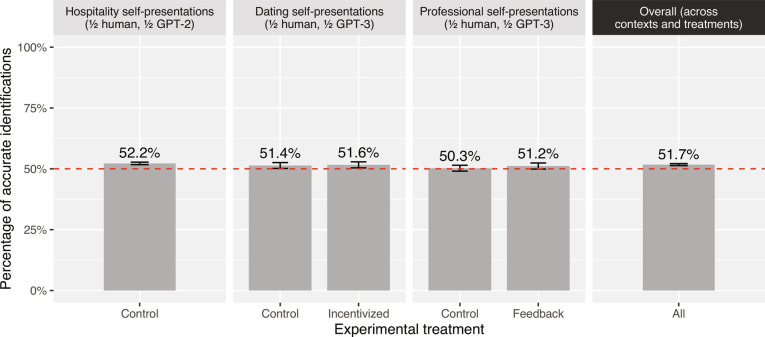
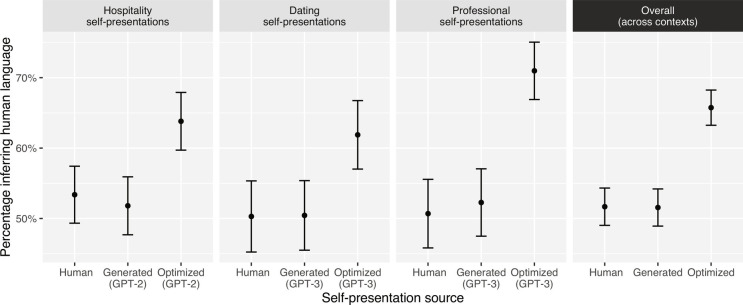
Human communication is increasingly intermixed with language generated by AI. Across chat, email, and social media, AI systems suggest words, complete sentences, or produce entire conversations. AI-generated language is often not identified as such but presented as language written by humans, raising concerns about novel forms of deception and manipulation. Here, we study how humans discern whether verbal self-presentations, one of the most personal and consequential forms of language, were generated by AI. In six experiments, participants (N = 4,600) were unable to detect self-presentations generated by state-of-the-art AI language models in professional, hospitality, and dating contexts. A computational analysis of language features shows that human judgments of AI-generated language are hindered by intuitive but flawed heuristics such as associating first-person pronouns, use of contractions, or family topics with human-written language. We experimentally demonstrate that these heuristics make human judgment of AI-generated language predictable and manipulable, allowing AI systems to produce text perceived as “more human than human.” We discuss solutions, such as AI accents, to reduce the deceptive potential of language generated by AI, limiting the subversion of human intuition.
Overview
The claims and statistics of this paper haven’t been checked yet.
Free: it reads the open-access text and checks the first 5 claims that cite a source we can check. Create a free account to check every claim.
Integrity signals
Registry
Cites
Statistics
Figures
Verification
Claims the paper makes
The claims and statistics of this paper haven’t been checked yet.
Free: it reads the open-access text and checks the first 5 claims that cite a source we can check. Create a free account to check every claim.
Claims other papers make about this one
Each is checked against this paper’s own text: does it say what the citing paper says it does?
The source backs part of the claim, not all of it — or backs it for a different population, condition or comparison.
In the citing paper
“Studies have shown that humans are largely ineffective at discerning AI created from human created content, and thus easily deceived (60).”
From The benefits and dangers of anthropomorphic conversational agents (2025) · cites this paper as [60]
Experimental — accuracy not yet measuredThe source backs part of the claim, not all of it — or backs it for a different population, condition or comparison.
In the citing paper
“Recent studies demonstrate that models like the GPT series are capable of producing news articles indistinguishable from human-generated ones (Kreps et al., 2022;Jakesch et al., 2023)”
From Anatomy of an AI-powered malicious social botnet (2024) · cites this paper as Jakesch et al., 2023
Experimental — accuracy not yet measuredThe source backs part of the claim, not all of it — or backs it for a different population, condition or comparison.
In the citing paper
“First, LLMs beat traditional text generation methods in producing human-like text (Jakesch et al., 2023;Guo et al., 2023;Clark et al., 2021).”
From Anatomy of an AI-powered malicious social botnet (2024) · cites this paper as Jakesch et al., 2023
Experimental — accuracy not yet measuredThe cited source says what the claim attributes to it.
In the citing paper
“We note that recent research has found that people could not reliably distinguish whether a piece of content is generated by people or the latest LLMs [33].”
From 'It was 80% me, 20% AI': Seeking Authenticity in Co-Writing with Large Language Models (2025) · cites this paper as [33]
The cited source says what the claim attributes to it.
In the citing paper
“it can also create realistic disinformation (e.g., fake news, propaganda) that is hard to detect by humans (Kreps et al. 2022; Jakesch et al. 2023)”
From Generative AI (2024) · cites this paper as Jakesch et al. 2023
6 more claims about this paper
Create a free account to see every claim other papers make about this one.
Self-check
Percentages, sums and reported differences re-computed from the paper’s own numbers.
The self-check needs the paper’s full text.
Citations
Cites
Vaswani, A., Shazeer, N., Parmar, N., Uszkoreit, J., Jones, L., Gomez, A. N., Kaiser, L., & Polosukhin, I. (2017) · arXiv · doi:10.48550/arxiv.1706.03762 · Cited by 120,404 · cited 1×
“We trained multiple customized versions of state-of-the-art AI language models (1, 2, 4) to generate self-presentations in three social contexts where trust in a self-presentation is important for decision-making: professional (e.g., job applications) (22), romantic (e.g., online dating) (12), and…”
MethodExploiting Generative AI to Scale up Intelligent Tutoring Systems
Jakubův, J., Chvalovský, K., Goertzel, Z., Kaliszyk, C., Olšák, M., Piotrowski, B., Schulz, S., Suda, M., & Urban, J. (2023) · DROPS (Schloss Dagstuhl – Leibniz Center for Informatics) · doi:10.4230/lipics.itp.2023.19 · Cited by 76,658
Language Models are Few-Shot Learners
Brown, T. B., Mann, B., Ryder, N., Subbiah, M., Kaplan, J., Dhariwal, P., Neelakantan, A., Shyam, P., Sastry, G., Askell, A., et al. (2020) · arXiv · doi:10.48550/arxiv.2005.14165 · Cited by 23,372 · cited 2×
“AI-generated language enables novel interactions that reduce human effort but can facilitate novel forms of plagiarism, manipulation, and deception (1, 3–8) when people mistake AI-generated language for language created by humans.”
BackgroundMethodKaugeranna, R., Kaugeranna, E., & Aion, (. S. 4. 6. (2023) · DROPS (Schloss Dagstuhl – Leibniz Center for Informatics) · doi:10.4230/lipics.giscience.2023.43 · Cited by 13,690
VADER: a parsimonious rule-based model for sentiment analysis of social media text
Hutto, C., & Gilbert, E. (2014) · Proceedings of the International AAAI Conference on Web and Social Media · doi:10.1609/icwsm.v8i1.14550 · Cited by 6,087 · cited 1×
“We computationally created a range of language features present in the self-presentations, including measurements for personality, sentiment, and perspective (28, 29).”
The Psychological Meaning of Words: LIWC and Computerized Text Analysis Methods
Tausczik, Y. R., & Pennebaker, J. W. (2010) · Journal of Language and Social Psychology · doi:10.1177/0261927x09351676 · Cited by 5,774 · cited 2×
“We developed an initial set of language features motivated by participants’ explanations of their judgments, to which we added various statistical metrics and commonly analyzed psychological language features such as LIWC (21).”
MethodProlific.ac—A subject pool for online experiments
Palan, S., & Schitter, C. (2018) · Journal of Behavioral and Experimental Finance · doi:10.1016/j.jbef.2017.12.004 · Cited by 3,450 · cited 2×
“Participants from Prolific had a median age of 37 y, 67% had a college degree, and 27% were at least somewhat familiar with computer programming.”
MethodThielke, S. M. (2004) · Psychiatric Services · doi:10.1176/appi.ps.55.9.1071 · Cited by 3,052
On the Opportunities and Risks of Foundation Models
Bommasani, R., Hudson, D. A., Adeli, E., Altman, R., Arora, S., von Arx, S., Bernstein, M. S., Bohg, J., Bosselut, A., Brunskill, E., et al. (2021) · arXiv · doi:10.48550/arxiv.2108.07258 · Cited by 2,676 · cited 1×
“We trained multiple customized versions of state-of-the-art AI language models (1, 2, 4) to generate self-presentations in three social contexts where trust in a self-presentation is important for decision-making: professional (e.g., job applications) (22), romantic (e.g., online dating) (12), and…”
MethodGPT-3: Its Nature, Scope, Limits, and Consequences
Floridi, L., & Chiriatti, M. (2020) · Minds and Machines · doi:10.1007/s11023-020-09548-1 · Cited by 2,519 · cited 1×
“In addition, human-like AI-generated self-presentations complicate questions about personhood and blur the line between human and machine intelligence (6, 15).”
Background
Research works printed but not linked: 4
- B. Buchanan, A. Lohn, M. Musser, K. Sedova, Truth, lies, and automation. Cent. Secur. Emerg. Technol. 1, 2 (2021).
- A. Radford, Language models are unsupervised multitask learners. OpenAI Blog 1, 9 (2019).
- A. Nelson, S. Friedler, F. Fields-Meyer, Blueprint for an AI bill of rights: A vision for protecting our civil rights in the algorithmic age. White House Office of Science and Technology Policy (2022). (18 October 2022).
- J. Williams, Should AI always identify itself? It’s more complicated than you might think. Electronic Frontier Foundation (2018). (18 October 2022).
Cited by
Feuerriegel, S., Hartmann, J., Janiesch, C., & Zschech, P. (2024) · Business & Information Systems Engineering · doi:10.1007/s12599-023-00834-7 · Cited by 2,267
“, fake news, propaganda) that is hard to detect by humans (Jakesch et al., 2023; Kreps et al., 2022).”
Generative artificial intelligence
Banh, L., & Strobel, G. (2023) · Electronic Markets · doi:10.1007/s12525-023-00680-1 · Cited by 579
“The promotion of explainable and responsible AI becomes paramount once more (Meske et al., 2022), especially in a technological state where distinguishing between generated and real content by GAI models is becoming increasingly more challenging (Jakesch et al., 2023b; Lehmann & Buschek, 2020).”
BackgroundCan Generative AI Improve Social Science?
Bail, C. A. (2023) · doi:10.31235/osf.io/rwtzs · Cited by 369
Can Generative AI improve social science?
Bail, C. A. (2024) · Proceedings of the National Academy of Sciences · doi:10.1073/pnas.2314021121 · Cited by 369
On the Conversational Persuasiveness of Large Language Models: A Randomized Controlled Trial
Salvi, F., Ribeiro, M. H., Gallotti, R., & West, R. (2024) · doi:10.21203/rs.3.rs-4429707/v1 · Cited by 285
Brüns, J. D., & Meißner, M. (2024) · Journal of Retailing and Consumer Services · doi:10.1016/j.jretconser.2024.103790 · Cited by 278
Khraisha, Q., Put, S., Kappenberg, J., Warraitch, A., & Hadfield, K. (2024) · Research Synthesis Methods · doi:10.1002/jrsm.1715 · Cited by 269
“40 Our results for sensitivity and specificity for title and abstract screening were consistent with previous studies.”
Khraisha, Q., Put, S., Kappenberg, J., Warraitch, A., & Hadfield, K. (2023) · arXiv · doi:10.48550/arxiv.2310.17526 · Cited by 268
“40 Our results for sensitivity and specificity for title and abstract screening were consistent with previous studies.”
Co-Writing with Opinionated Language Models Affects Users’ Views
Jakesch, M., Bhat, A., Buschek, D., Zalmanson, L., & Naaman, M. (2023) · Proceedings of the 2023 CHI Conference on Human Factors in Computing Systems · doi:10.1145/3544548.3581196 · Cited by 265
Self-citationOn the conversational persuasiveness of GPT-4
Salvi, F., Horta Ribeiro, M., Gallotti, R., & West, R. (2025) · Nature Human Behaviour · doi:10.1038/s41562-025-02194-6 · Cited by 264
“A particularly menacing aspect of AI-driven persuasion is its possibility to easily and cheaply implement personalization, conditioning the models’ generations on personal attributes and psychological profiles 28 .”
Who is better in project planning?Generative artificial intelligence or project managers?
Barcauí, A., & Monat, A. (2023) · Project Leadership and Society · doi:10.1016/j.plas.2023.100101 · Cited by 255
Artificial intelligence in communication impacts language and social relationships
Hohenstein, J., Kizilcec, R. F., DiFranzo, D., Aghajari, Z., Mieczkowski, H., Levy, K., Naaman, M., Hancock, J., & Jung, M. F. (2023) · Scientific Reports · doi:10.1038/s41598-023-30938-9 · Cited by 243
Self-citationThe power of generative marketing: Can generative AI create superhuman visual marketing content?
Hartmann, J., Exner, Y., & Domdey, S. (2025) · International Journal of Research in Marketing · doi:10.1016/j.ijresmar.2024.09.002 · Cited by 229
AI Transparency in the Age of LLMs: A Human-Centered Research Roadmap
Liao, Q. V., & Wortman Vaughan, J. (2024) · Harvard Data Science Review · doi:10.1162/99608f92.8036d03b · Cited by 210
Generative AI in Higher Education: The ChatGPT Effect
Chan, C. K. Y., & Colloton, T. (2024) · Routledge · doi:10.4324/9781003459026 · Cited by 203
AI vs. Human -- Differentiation Analysis of Scientific Content Generation
Ma, Y., Liu, J., Fan, Y., Cheng, Q., Huang, Y., Lu, W., & Liu, X. (2023) · arXiv (Cornell University) · doi:10.48550/arxiv.2301.10416 · Cited by 68
“[23] found that individuals achieved a low identification accuracy for the AI-generated self presentations in three social contexts (job applications, online dating,and Airbnb host profiles), but heuristics can improve the identification accuracy.”
BackgroundGenerative AI in education and research: A systematic mapping review
Yusuf, A., Pervin, N., Román‐González, M., & Noor, N. M. (2024) · Review of Education · doi:10.1002/rev3.3489 · Cited by 182
Comparing the value of perceived human versus AI-generated empathy
Rubin, M., Li, J. Z., Zimmerman, F., Ong, D. C., Goldenberg, A., & Perry, A. (2025) · Nature Human Behaviour · doi:10.1038/s41562-025-02247-w · Cited by 122
“While we may not always accurately detect when a response is generated by AI 44,61 , it is becoming increasingly evident that a substantial portion of our daily interactions will soon be augmented or reviewed if not entirely generated by AI.”
Generative AI in innovation and marketing processes: A roadmap of research opportunities
Cillo, P., & Rubera, G. (2025) · Journal of the Academy of Marketing Science · doi:10.1007/s11747-024-01044-7 · Cited by 176
“Consumers appear to struggle in distinguishing GenAI-generated content from human-generated content (Jakesch et al., 2023 ).”
All Too Human? Mapping and Mitigating the Risk from Anthropomorphic AI
Akbulut, C., Weidinger, L., Manzini, A., Gabriel, I., & Rieser, V. (2024) · Proceedings of the AAAI/ACM Conference on AI Ethics and Society · doi:10.1609/aies.v7i1.31613 · Cited by 144
A Design Space for Intelligent and Interactive Writing Assistants
Lee, M., Gero, K. I., Chung, J. J. Y., Shum, S. B., Raheja, V., Shen, H., Venugopalan, S., Wambsganss, T., Zhou, D., Alghamdi, E. A., et al. (2024) · Proceedings of the CHI Conference on Human Factors in Computing Systems · doi:10.1145/3613904.3642697 · Cited by 136
“Alternatively, the output may be generated from user input in a deterministic way, in writing systems that do not use AI and/or prefer rule-based automation [12, 138, 216].”
AI-generated poetry is indistinguishable from human-written poetry and is rated more favorably
Porter, B., & Machery, E. (2024) · Scientific Reports · doi:10.1038/s41598-024-76900-1 · Cited by 133
“In fact, the “more human than human” phenomenon discovered in other domains of generative AI 1–5, 10 Furthermore, people prefer AI-generated poetry to human-authored poetry, consistently rating AI-generated poems more highly than the poems of well-known poets across a variety of qualitative factors.”
People Overtrust AI-Generated Medical Advice despite Low Accuracy
Shekar, S., Pataranutaporn, P., Sarabu, C. R., Cecchi, G., & Maes, P. (2025) · NEJM AI · doi:10.1056/aioa2300015 · Cited by 139
“66 This creates a dangerous scenario where inaccurate AI medical advice might be deemed as trustworthy as a doctor’s response.”
Scalable watermarking for identifying large language model outputs
Dathathri, S., See, A., Ghaisas, S., Huang, P.-S., McAdam, R., Welbl, J., Bachani, V., Kaskasoli, A., Stanforth, R., Matejovicova, T., et al. (2024) · Nature · doi:10.1038/s41586-024-08025-4 · Cited by 132
Zhang, R., Li, H., Meng, H., Zhan, J., Gan, H., & Lee, Y.-C. (2025) · Proceedings of the 2025 CHI Conference on Human Factors in Computing Systems · doi:10.1145/3706598.3713429 · Cited by 123
“The rising popularity of AI companions has sparked notable concerns, including emotional dependence [47, 60, 104], privacy risks, [59, 106], and biases in AI-generated content [36, 105].”
Large Language Model Safety: A Holistic SurveyPreprint
Shi, D., Shen, T., Huang, Y., Li, Z., Leng, Y., Jin, R., Liu, C., Wu, X., Guo, Z., Yu, L., et al. (2024) · arXiv (Cornell University) · doi:10.48550/arxiv.2412.17686 · Cited by 120
An Approach to Technical AGI Safety and SecurityPreprint
Shah, R., Irpan, A., Turner, A., Wang, A., Conmy, A., Lindner, D., Brown-Cohen, J., Ho, L., Nanda, N., Popa, R., et al. (2025) · arXiv.org · doi:10.48550/arxiv.2504.01849 · Cited by 58
Evaluating the persuasive influence of political microtargeting with large language models
Hackenburg, K., & Margetts, H. (2024) · Proceedings of the National Academy of Sciences · doi:10.1073/pnas.2403116121 · Cited by 114
“Across these domains, humans are no longer able to consistently distinguish human and LLM - generated texts (8, 10).”
BackgroundThe benefits and dangers of anthropomorphic conversational agents
Peter, S., Riemer, K., & West, J. D. (2025) · Proceedings of the National Academy of Sciences · doi:10.1073/pnas.2415898122 · Cited by 110
LLM-generated messages can persuade humans on policy issues
Bai, H., Voelkel, J. G., Muldowney, S., Eichstaedt, J. C., & Willer, R. (2025) · Nature Communications · doi:10.1038/s41467-025-61345-5 · Cited by 110
Language Model Behavior: A Comprehensive Survey
Chang, T. A., & Bergen, B. K. (2024) · Computational Linguistics · doi:10.1162/coli_a_00492 · Cited by 105
“As an AI language model, I cannot”: Investigating LLM Denials of User Requests
Wester, J., Schrills, T., Pohl, H., & van Berkel, N. (2024) · Proceedings of the CHI Conference on Human Factors in Computing Systems · doi:10.1145/3613904.3642135 · Cited by 36
“This is especially true since LLM-generated text can sometimes appear more human-like than text written by actual people [21].”
BackgroundWhen and How to Use AI in the Design Process? Implications for Human-AI Design Collaboration
Lee, S.-Y., Law, M., & Hoffman, G. (2025) · International Journal of Human–Computer Interaction · doi:10.1080/10447318.2024.2353451 · Cited by 97
“This raises the concerns about new forms of deception and manipulation (Jakesch et al., 2023).”
Sahebi, S., & Formosa, P. (2025) · Synthese · doi:10.1007/s11229-025-04963-2 · Cited by 95
“…more reliant of AI tools to mediate their communications (Mieczkowski & Hancock, 2022 ), AI tools can influence the topics that people write about (Jakesch et al., 2023a, 2023b; Poddar et al., 2023), and that people are more likely to adopt the AI tool’s preferred position in their AI-mediated…”
Markowitz, D. M., Hancock, J. T., & Bailenson, J. N. (2023) · Journal of Language and Social Psychology · doi:10.1177/0261927x231200201 · Cited by 97
“…tasks ef fi - ciently) while receiving a message has presumably become harder (e.g., AI produces language that is largely indistinguishable from human language, making the communicator ’ s identity uncertain; Clark et al., 2021; Jakesch et al., 2023; Köbis & Mossink, 2021; Kreps et al., 2022).”
BackgroundSelf-citationExploring people's perceptions of LLM-generated advice
Wester, J., de Jong, S., Pohl, H., & van Berkel, N. (2024) · Computers in Human Behavior Artificial Humans · doi:10.1016/j.chbah.2024.100072 · Cited by 94
“LLM output can appear ‘more human than human ’ (Jakesch, Hancock, & Naaman, 2023) and presented misinformation may convincingly be presented as fact (Bender et al., 2021), further indicating the need to manage users ’ expectations and tailor messages to their needs.”
Generative AI detection in higher education assessments
Ardito, C. G. (2025) · New Directions for Teaching and Learning · doi:10.1002/tl.20624 · Cited by 86
Unpacking the impact of AI vs. human-generated review summary on hotel booking intentions
Jia, S., Chi, O. H., & Chi, C. G. (2024) · International Journal of Hospitality Management · doi:10.1016/j.ijhm.2024.104030 · Cited by 83
Markowitz, D. M. (2024) · PNAS Nexus · doi:10.1093/pnasnexus/pgae387 · Cited by 81
“Therefore, this article is notable given current challenges of scientific literacy and the disconnect between scien - tific communities and the public — AI is indeed better at communicating like a human (or the intentions of writing simply) than humans (46, 56).”
BackgroundBöhm, R., Jörling, M., Reiter, L., & Fuchs, C. (2023) · Communications Psychology · doi:10.1038/s44271-023-00032-x · Cited by 49
“In this vein, research has demonstrated that people are not able to detect AI-generated self-presentations across different contexts like dating, hospitality, and professional interactions 6 .”
The economics of copyright in the digital age
Peukert, C., & Windisch, M. (2024) · Journal of Economic Surveys · doi:10.1111/joes.12632 · Cited by 82
Position is Power: System Prompts as a Mechanism of Bias in Large Language Models (LLMs)
Neumann, A., Kirsten, E., Zafar, M. B., & Singh, J. (2025) · ACM Conference on Fairness, Accountability, and Transparency (FAccT) · doi:10.1145/3715275.3732038 · Cited by 78
Veselovsky, V., Ribeiro, M. H., & West, R. (2023) · arXiv · doi:10.48550/arxiv.2306.07899 · Cited by 73
“Distinguishing LLM-from human-generated text is difficult for both machine learning models and humans alike (Sadasivan et al., 2023; Jakesch et al., 2023).”
Comparing the Willingness to Share for Human-generated vs. AI-generated Fake News
Bashardoust, A., Feuerriegel, S., & Shrestha, Y. R. (2024) · Proceedings of the ACM on Human-Computer Interaction · doi:10.1145/3687028 · Cited by 33
Anatomy of an AI-powered malicious social botnet
Yang, K., & Menczer, F. (2024) · Journal of Quantitative Description: Digital Media · doi:10.51685/jqd.2024.icwsm.7 · Cited by 71
“First, LLMs beat traditional text generation methods in producing human-like text (Jakesch et al., 2023; Guo et al., 2023; Clark et al., 2021).”
BackgroundMethodGaps in the Safety Evaluation of Generative AI
Rauh, M., Marchal, N., Manzini, A., Hendricks, L. A., Comanescu, R., Akbulut, C., Stepleton, T., Mateos-Garcia, J. C., Bergman, S., Kay, J., et al. (2024) · Proceedings of the AAAI/ACM Conference on AI Ethics and Society · doi:10.1609/aies.v7i1.31717 · Cited by 71
“…is a growing body of work investigating the effect of interactive AI systems, e.g. humans’ ability to distinguish AI-and human-generated content (Jakesch, Hancock, and Naaman 2023; Waltzer et al. 2023) and how users display attachment to AI “compan-ions” (Laestadius et al. 2022; Pentina,…”
Seven HCI Grand Challenges Revisited: Five-Year Progress
Stephanidis, C., Salvendy, G., Antona, M., Duffy, V. G., Gao, Q., Karwowski, W., Konomi, S., Nah, F. F., Ntoa, S., Rau, P. P., et al. (2025) · International Journal of Human-Computer Interaction · doi:10.1080/10447318.2025.2450411 · Cited by 70
“Data to achieve flexible mechanisms for such approaches is likely to be large, while empirical validation remains a challenge (Cuzzolin et al., 2020; Jakesch et al., 2023).”
Cava, L. L., & Tagarelli, A. (2025) · Proceedings of the AAAI Conference on Artificial Intelligence · doi:10.1609/aaai.v39i2.32125 · Cited by 69
Generative propaganda: Evidence of AI’s impact from a state-backed disinformation campaign
Wack, M., Ehrett, C., Linvill, D. L., & Warren, P. L. (2025) · PNAS Nexus · doi:10.1093/pnasnexus/pgaf083 · Cited by 68
“Experimental research has detailed the potential for generative-AI to aid in the production of credible text (8, 9) and in the persuasion of survey respondents (5, 28).”
Fighting Fire with Fire: Can ChatGPT Detect AI-generated Text?
Bhattacharjee, A., & Liu, H. (2024) · ACM SIGKDD Explorations Newsletter · doi:10.1145/3655103.3655106 · Cited by 65
“While several works have shown that humans struggle at identifying AI-generated language [21; 10], a variety of computational methods for detection also exist, including feature-based methods [20; 24], methods exploiting difference in statistical measures across human and AI-generated text [14; 26], more black-box typ…”
MethodAm I Wrong, or Is the Autograder Wrong? Effects of AI Grading Mistakes on Learning
Li, T. W., Hsu, S., Fowler, M., Zhang, Z., Zilles, C. B., & Karahalios, K. G. (2023) · ACM Conference on International Computing Education Research (ICER) · doi:10.1145/3568813.3600124 · Cited by 65
“The fluency of these responses may lead users to think that a human generated the responses [35], masking their inaccuracies.”
BackgroundEmergence of polarization in networks of large language model agents
Piao, J., Lu, Z., Chen, G., Xu, F., Hu, Q., Santos, F. P., Li, Y., & Evans, J. A. (2026) · Nature Communications · doi:10.1038/s41467-026-78228-y · Cited by 67
Human performance in detecting deepfakes: A systematic review and meta-analysis of 56 papers
Diel, A., Lalgi, T., Schröter, I. C., MacDorman, K. F., Teufel, M., & Bäuerle, A. (2024) · Computers in Human Behavior Reports · doi:10.1016/j.chbr.2024.100538 · Cited by 64
Large Language Models Assume People are More Rational than We Really are
Liu, R., Geng, J.-Y., Peterson, J. C., Sucholutsky, I., & Griffiths, T. (2024) · International Conference on Learning Representations · doi:10.48550/arxiv.2406.17055 · Cited by 71
“…existing measures comparing LLM simulations to human behavior use human perception to measure similarity (Park et al., 2023; Jones and Bergen, 2023; Jakesch et al., 2023; Hämäläinen et al., 2023), but existing psychology literature has shown that people’s own perceptions of others may be more…”
BackgroundWaltzer, T., Cox, R. L., & Heyman, G. D. (2023) · Human Behavior and Emerging Technologies · doi:10.1155/2023/1923981 · Cited by 61
“” However, it is important to keep in mind that not all of the heuristics teachers use are necessarily helpful [43].”
BackgroundA Linguistic Comparison Between Human and ChatGPT-Generated Conversations
Sandler, M., Choung, H., Ross, A. A., & David, P. (2025) · Lecture notes in computer science · doi:10.1007/978-981-97-8702-9_25 · Cited by 61
Fiedler, A., & Döpke, J. (2025) · International Review of Economics Education · doi:10.1016/j.iree.2025.100321 · Cited by 61
The Persuasive Power of Large Language Models
Breum, S. M., Egdal, D. V., Gram Mortensen, V., Møller, A. G., & Aiello, L. M. (2024) · Proceedings of the International AAAI Conference on Web and Social Media · doi:10.1609/icwsm.v18i1.31304 · Cited by 57
The Persuasive Power of Large Language Models
Breum, S. M., Egdal, D. V., Mortensen, V. G., Møller, A. G., & Aiello, L. M. (2023) · arXiv · doi:10.48550/arxiv.2312.15523 · Cited by 57
“…that LLM-generated text closely resembles human-written text in terms of style and perceived credibility (Kreps, McCain, and Brundage 2022; Jakesch, Hancock, and Naaman 2023), it is virtually impossible to detect algorithmically (Sadasivan et al. 2023), and it can be inexpensively…”
BackgroundThe Ethics of Advanced AI Assistants
Gabriel, I., Manzini, A., Keeling, G., Hendricks, L. A., Rieser, V., Iqbal, H., Tomašev, N., Ktena, I., Kenton, Z., Rodriguez, M., et al. (2024) · arXiv · doi:10.48550/arxiv.2404.16244 · Cited by 57
Characteristics and prevalence of fake social media profiles with AI-generated faces
Yang, K.-C., Singh, D., & Menczer, F. (2024) · Journal of Online Trust and Safety · doi:10.54501/jots.v2i4.197 · Cited by 40
“Large language models, such as ChatGPT, 1 can understand human language and generate realistic text in different contexts (Jakesch et al., 2023; Ye et al., 2023).”
BackgroundWilliams, A. R., Burke-Moore, L., Chan, R. S.-Y., Enock, F. E., Nanni, F., Sippy, T., Chung, Y.-L., Gabašová, E., Hackenburg, K., & Bright, J. (2025) · PLoS ONE · doi:10.1371/journal.pone.0317421 · Cited by 56
“This mirrors findings from Jakesch et al. [37], in that content produced by frontier AI models appears to be perceived as more human than human-written content.”
Jones, C., & Bergen, B. K. (2026) · Artificial Intelligence Review · doi:10.1007/s10462-026-11517-6 · Cited by 63
Labeling messages as AI-generated does not reduce their persuasive effects
Gallegos, I. O., Shani, C., Shi, W., Bianchi, F., Gainsburg, I., Jurafsky, D., & Willer, R. (2026) · PNAS Nexus · doi:10.1093/pnasnexus/pgag008 · Cited by 58
“Complicating matters, people struggle to distinguish AI from human-written content (6 ).”
Beyond Generating Code: Evaluating GPT on a Data Visualization Course
Chen, Z., Zhang, C., Wang, Q., Troidl, J., Warchol, S., Beyer, J., Gehlenborg, N., & Pfister, H. (2023) · IEEE VIS Workshop on Visualization Education, Literacy, and Activities (EduVis) · doi:10.1109/eduvis60792.2023.00009 · Cited by 54
“In the following section, we will discuss our observations and the feedback we received from the TFs.”
BackgroundYeo, S., Lim, G., Gao, J., Zhang, W., & Perrault, S. T. (2024) · CHI Conference on Human Factors in Computing Systems · doi:10.1145/3613904.3642530 · Cited by 54
“These models are capable of generating human-like language [70] and have been applied in various domains like writing assistance [32, 62, 69], and grammar support [79].”
BackgroundAdvancing communicative competence in the digital age: A case for AI tools in Japanese EFL education
Busso, A., & Sanchez, B. (2024) · Technology in Language Teaching & Learning · doi:10.29140/tltl.v6n3.1211 · Cited by 52
“The authors conclude that since its language closely mirrors human language and people rely on flawed heuristics to detect AI-generated language, the average person cannot distinguish the difference between human and AI-generated content (Jakesch et al., 2023).”
Ali, L., Ali, F., Abdalla, M. J., & Alotaibi, S. (2025) · International Journal of Hospitality Management · doi:10.1016/j.ijhm.2025.104318 · Cited by 56
Shekar, S., Pataranutaporn, P., Sarabu, C. R., Cecchi, G., & Maes, P. (2024) · arXiv (Cornell University) · doi:10.48550/arxiv.2408.15266 · Cited by 54
Revell, T., Yeadon, W., Cahilly-Bretzin, G., Clarke, I., Manning, G., Jones, J., Mulley, C., Pascual, R. J., Bradley, N., Thomas, D., et al. (2024) · International Journal for Educational Integrity · doi:10.1007/s40979-024-00161-8 · Cited by 51
“Compounding the issue, some AI systems are being fine-tuned to produce content intentionally designed to evade human detection, making the distinction even more challenging (Jakesch et al. 2023).”
BackgroundAl-Zahrani, A. M. (2024) · IgMin Research · doi:10.61927/igmin158 · Cited by 51
Generative AI in User-Generated Content
Hua, Y., Niu, S., Cai, J., Chilton, L. B., Heuer, H., & Wohn, D. Y. (2024) · CHI Conference Extended Abstracts on Human Factors in Computing Systems (CHI EA) · doi:10.1145/3613905.3636315 · Cited by 51
“Previous studies suggest that individuals might lack the skills [30] and willingness to identify AI-generated fake content, despite the evident risks and harm to users [51].”
Embarrassingly Simple Text WatermarksPreprint
Sato, R., Takezawa, Y., Bao, H., Niwa, K., & Yamada, M. (2023) · arXiv (Cornell University) · doi:10.48550/arxiv.2310.08920 · Cited by 53
“However, as the LLMs become more sophisticated, the statistical tendency becomes less obvious, and the blackbox detection becomes less reliable (Clark et al., 2021; Jakesch et al., 2023; Schuster et al., 2020).”
BackgroundCan you spot the bot? Identifying AI-generated writing in college essays
Waltzer, T., Pilegard, C., & Heyman, G. D. (2024) · International Journal for Educational Integrity · doi:10.1007/s40979-024-00158-3 · Cited by 49
“One contributing factor may be that people pick up on some false heuristics from reading the text it generates (see Jakesch et al. 2023).”
BackgroundMeasuring the Perceived IQ of Multimodal Large Language Models Using Standardized IQ TestsPreprint
Wasilewski, E., & Jablonski, M. (2024) · doi:10.36227/techrxiv.171560572.29045385/v1 · Cited by 58
Artificial Intelligence (AI) and Workplace Communication: Promises, Perils, and Recommended Policy
Quaquebeke, N. V., & Gerpott, F. H. (2024) · Journal of Leadership & Organizational Studies · doi:10.1177/15480518241289644 · Cited by 50
“A plethora of research shows that, objectively speaking, AI-based chatbots can quite effectively communicate or support human communication (including emotional and complex interpersonal matters; e.g., Jakesch et al., 2023; Yin et al., 2024).”
Mapping the individual, social and biospheric impacts of Foundation Models
Hernández, A. D., Krishna, S., Perini, A., Katell, M. A., Bennett, S., Borda, A., Hashem, Y., Hadjiloizou, S., Mahomed, S., Jayadeva, S., et al. (2024) · ACM Conference on Fairness, Accountability, and Transparency (FAccT) · doi:10.1145/3630106.3658939 · Cited by 48
Purcell, Z. A., Dong, M., Nußberger, A.-M., Köbis, N., & Jakesch, M. (2024) · British Journal of Psychology · doi:10.1111/bjop.12727 · Cited by 48
“However, they also have the potential to increase deception, threaten our perceptions of others' authenticity and promote mistrust (Jago, 2019; Jakesch, Hancock, & Naaman, 2023).”
Self-citationKovács, B. (2024) · Marketing Letters · doi:10.1007/s11002-024-09729-3 · Cited by 44
“Recent studies in professional, hospitality, and dating contexts (Jakesch et al., 2023) and in health, finance, entertainment, technology, and travel contexts (Brandl & Ellis, 2023) demonstrated that humans were not able to tell human-written vs AI-generated content.”
Background'It was 80% me, 20% AI': Seeking Authenticity in Co-Writing with Large Language Models
Hwang, A. H.-C., Liao, Q. V., Blodgett, S. L., Olteanu, A., & Trischler, A. (2025) · Proceedings of the ACM on Human-Computer Interaction · doi:10.1145/3711020 · Cited by 42
AI Rules? Characterizing Reddit Community Policies Towards AI-Generated Content
Lloyd, T., Gosciak, J., Nguyen, T., & Naaman, M. (2025) · CHI Conference on Human Factors in Computing Systems · doi:10.1145/3706598.3713292 · Cited by 42
Self-citationCountering AI-generated misinformation with pre-emptive source discreditation and debunking
Spearing, E. R., Gile, C. I., Fogwill, A. L., Prike, T., Swire‐Thompson, B., Lewandowsky, S., & Ecker, U. K. H. (2025) · Royal Society Open Science · doi:10.1098/rsos.242148 · Cited by 42
'There Has To Be a Lot That We're Missing': Moderating AI-Generated Content on Reddit
Lloyd, T., Reagle, J., & Naaman, M. (2025) · Proceedings of the ACM on Human-Computer Interaction · doi:10.1145/3757445 · Cited by 40
Self-citationShanshan, S., & Sen, G. (2024) · Journal of Computer Assisted Learning · doi:10.1111/jcal.12996 · Cited by 29
Chein, J., Martinez, S., & Barone, A. (2024) · doi:10.21203/rs.3.rs-4277893/v1 · Cited by 38
“This high accuracy rate for comments was obtained without prior training (cf. 25,56 ) or matching of materials to participants’ domain expertise (cf. 37,38 ).”
BackgroundMethodInfluentialChein, J. M., Martinez, S. A., & Barone, A. R. (2024) · Scientific Reports · doi:10.1038/s41598-024-76218-y · Cited by 38
“In further content analyses (see online supplement), we explored the use of first-person pronouns in comments 21 , and the relative congruence of texts with their associated comments, though neither factor had a significant relationship with judgement patterns.”
BackgroundMethodInfluentialShi, Y., Sheng, Q., Cao, J., Mi, H., Hu, B., & Wang, D. (2024) · International Joint Conference on Artificial Intelligence · doi:10.24963/ijcai.2024/55 · Cited by 38
“People can easily instruct LLM-supported services like ChatGPT [OpenAI, 2022] to generate texts that are almost imperceptible to humans [Jakesch et al. , 2023; Uchendu et al. , 2023].”
BackgroundCharacterizing Photorealism and Artifacts in Diffusion Model-Generated Images
Kamali, N., Nakamura, K., Kumar, A., Chatzimparmpas, A., Hullman, J. R., & Groh, M. (2025) · CHI Conference on Human Factors in Computing Systems · doi:10.1145/3706598.3713962 · Cited by 38
The Moral Turing Test: Evaluating Human-LLM Alignment in Moral Decision-MakingPreprint
Palminteri, S., Garcia, B., & Qian, C. (2024) · PsyArXiv (OSF Preprints) · doi:10.31234/osf.io/ct6rx · Cited by 39
AI in the Newsroom: Does the Public Trust Automated Journalism and Will They Pay for It?
Nanz, A., Binder, A., & Matthes, J. (2025) · Journalism Studies · doi:10.1080/1461670x.2025.2547301 · Cited by 36
“For instance, in a chain of experiments, Jakesch, Hancock, and Naaman (2023) showed that people were not able to distinguish between AI-generated and human-written self-presentations in various contexts.”
Linguistic and Embedding-Based Profiling of Texts Generated by Humans and Large Language Models
Zanotto, S. E., & Aroyehun, S. (2025) · Conference on Empirical Methods in Natural Language Processing (EMNLP) · doi:10.18653/v1/2025.emnlp-main.1163 · Cited by 37
Can AI communication tools increase legislative responsiveness and trust in democratic institutions?
Kreps, S., & Jakesch, M. (2023) · Government Information Quarterly · doi:10.1016/j.giq.2023.101829 · Cited by 34
Self-citationGenerative AI models should include detection mechanisms as a condition for public release
Knott, A., Pedreschi, D., Chatila, R., Chakraborti, T., Leavy, S., Baeza-Yates, R., Eyers, D., Trotman, A., Teal, P. D., Biecek, P., et al. (2023) · Ethics and Information Technology · doi:10.1007/s10676-023-09728-4 · Cited by 34
The New Paradigm of Deepfake Detection at the Text Level
Roșca, C.-M., Stancu, A., & Iovanovici, E. M. (2025) · Applied Sciences · doi:10.3390/app15052560 · Cited by 36
AI could create a perfect storm of climate misinformationPreprint
Galaz, V., Metzler, H., Daume, S., Olsson, A., Lindström, B., & Marklund, A. (2023) · arXiv (Cornell University) · doi:10.48550/arxiv.2306.12807 · Cited by 35
Ashkinaze, J., Mendelsohn, J., Qiwei, L., Budak, C., & Gilbert, E. (2025) · Proceedings of the ACM Collective Intelligence Conference · doi:10.1145/3715928.3737481 · Cited by 33
“This exposure likely matters: Ideas we see affect the ideas we create [52].”
InfluentialHow to Detect AI-Generated Texts?
Nguyen, T. T., Hatua, A., & Sung, A. H. (2023) · IEEE Annual Ubiquitous Computing, Electronics & Mobile Communication Conference (UEMCON) · doi:10.1109/uemcon59035.2023.10316132 · Cited by 34
Comparing Sentence-Level Suggestions to Message-Level Suggestions in AI-Mediated Communication
Fu, L., Newman, B., Jakesch, M., & Kreps, S. (2023) · Proceedings of the 2023 CHI Conference on Human Factors in Computing Systems · doi:10.1145/3544548.3581351 · Cited by 31
“Advances language models [6] capable of producing text indistinguishable from human-written content [24, 29].”
BackgroundSelf-citationGenerative AI in Higher Art Education
Chen, X., Liao, Y., & Yu, W. (2024) · International Conference on Computer Science and Technologies in Education (CSTE) · doi:10.1109/cste62025.2024.00032 · Cited by 31
“Turning right”? An experimental study on the political value shift in large language models
Liu, Y., Panwang, Y., & Gu, C. (2025) · Humanities and Social Sciences Communications · doi:10.1057/s41599-025-04465-z · Cited by 31
“In addition, recent research has shown that biased LLMs are able to in fl uence users ’ perspectives (Jakesch et al. 2023), which further highlights the importance of balanced output.”
Metadata
- Authors
- Jakesch, M., Hancock, J. T., & Naaman, M.
- Affiliations
- Cornell University (US)
- Stanford University (US)
- Corresponding author
- Jakesch, Maurice
- Venue
- Proceedings of the National Academy of Sciences
- Publisher
- National Academy of Sciences
- Published
- 2023-03-07
- Volume
- 120
- Issue
- 11
- Pages
- e2208839120-e2208839120
- ISSN
- 0027-8424 (ISSN-L)
- 1091-6490
- PMC
- PMC10089155
- OpenAlex
- W4323347737
- Cited by
- 342
- References
- 46
- Citations by year
- 2026: 138 · 2025: 102 · 2024: 69 · 2023: 32
- FWCI
- 32.10
- Type
- journal article
- Language
- en
- Open access
- hybrid
- doi.org
- Licence
- Locations
- Proceedings of the National Academy of Sciences (publishedVersion, cc-by-nc-nd)
- PubMed Central (publishedVersion, cc-by-nc-nd)
- PubMed (publishedVersion)
- arXiv (Cornell University) (submittedVersion)
- arXiv (Cornell University)
- Funders
- National Science Foundation (1901151/1901329)
- Topics
- Physical Sciences › Computer Science › Artificial Intelligence › Authorship Attribution and Profiling
- Physical Sciences › Computer Science › Artificial Intelligence › Ethics and Social Impacts of AI
- Social Sciences › Sociology and Political Science › Misinformation and Its Impacts
- Keywords
- AI-generated text detection, heuristics, intuitive judgment, AI language models, manipulation, first-person pronouns, contractions, human-AI interaction
- MeSH terms
- Heuristics, Artificial Intelligence, Choline O-Acetyltransferase, Communication, Humans, Language
About these checks
Registry, retraction, Cites and statistics results are computed, not judged, with one exception: a printed reference that no index lists is read once by a model before it counts as a citation error. Claims are extracted by a model and kept only when their quote appears verbatim in the text; each cited source is then checked, with a model’s help, for whether it says what the claim relies on. Those verdicts can be wrong — read the claim’s quote and the cited source before relying on one.
Statistics and arithmetic are recomputed, not judged.
Confidence bands are shown only for fields calibrated on our annotated test set. None is calibrated yet, so no band is shown.
What counts as a claim ›How we measure confidence ›How we check this ›
Are you an author, or do you see a problem with this page? Request a review
Data sources
Bibliographic data: Semantic Scholar, OpenAlex, Crossref.
Contains information from the Semantic Scholar Academic Graph Datasets, made available under the ODC Attribution License (ODC-BY 1.0).
Semantic Scholar’s data is described in: Kinney, R., et al. (2023). The Semantic Scholar Open Data Platform. arXiv:2301.10140.
