

A Turing test of whether AI chatbots are behaviorally similar to humans
Open accessThe DOI matches its Crossref record; 34 of the 34 references it cites were found in a registry or an index.
Abstract
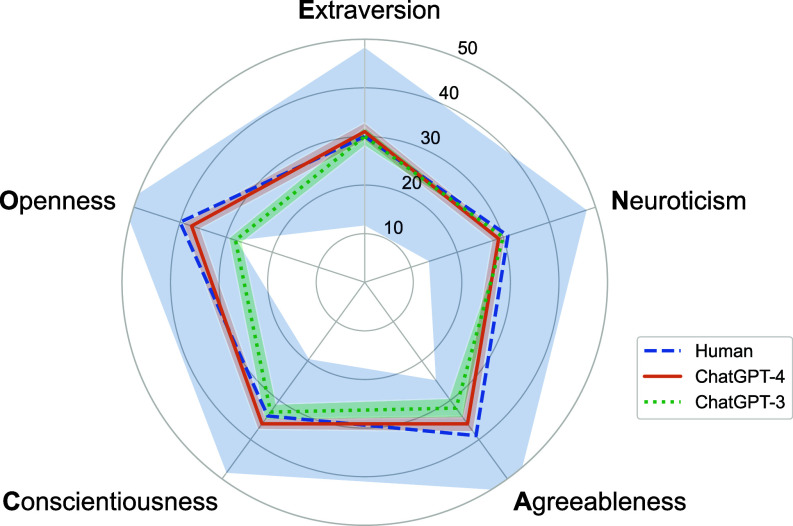
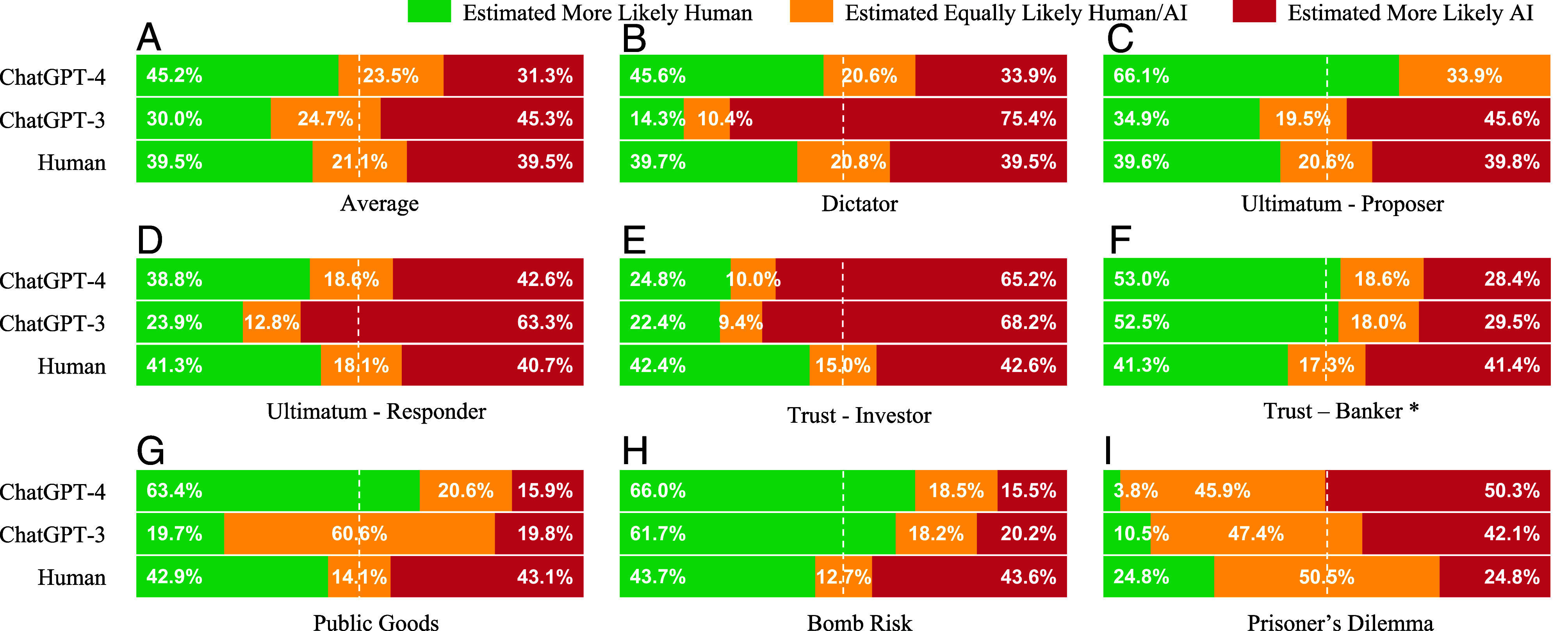
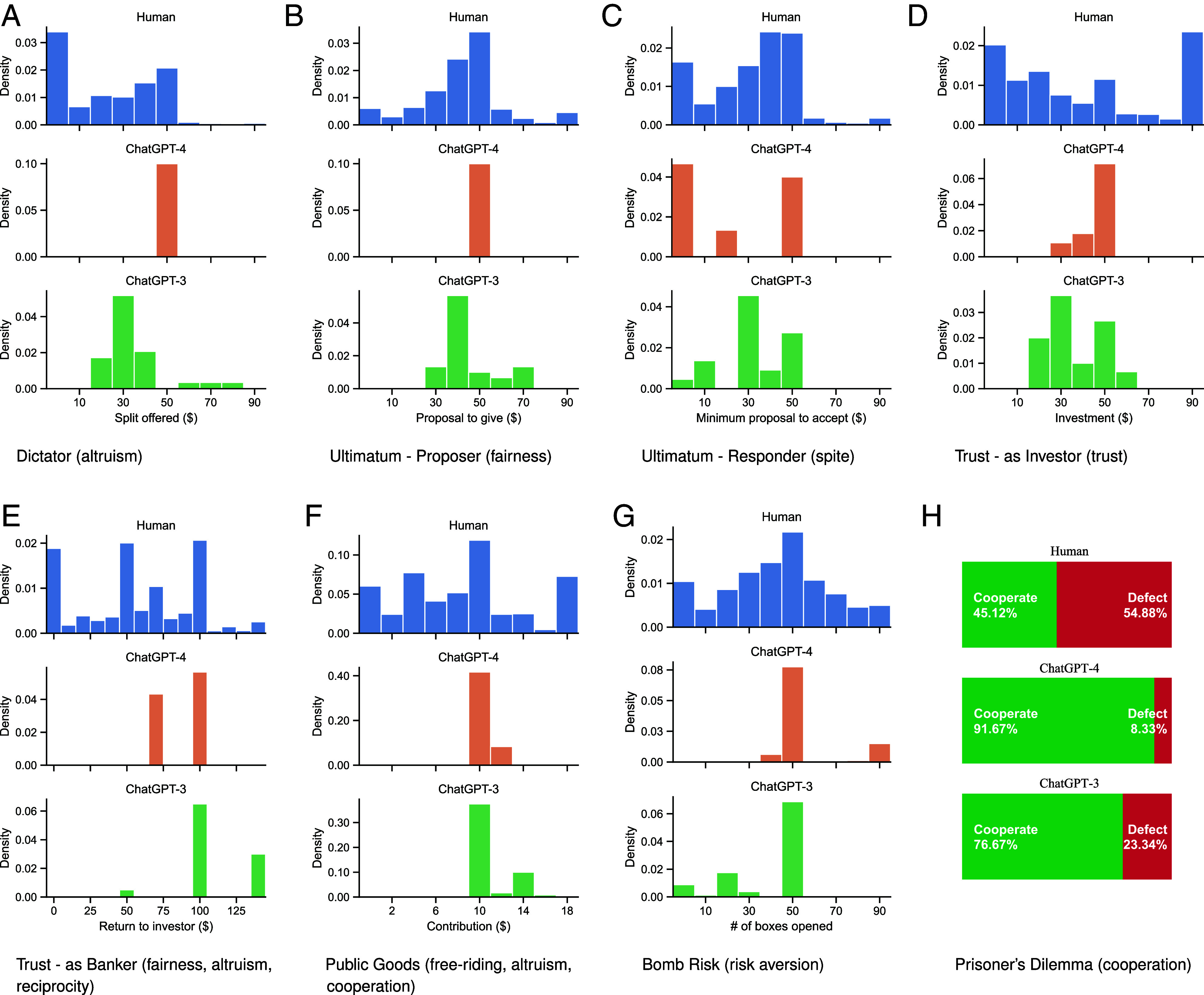
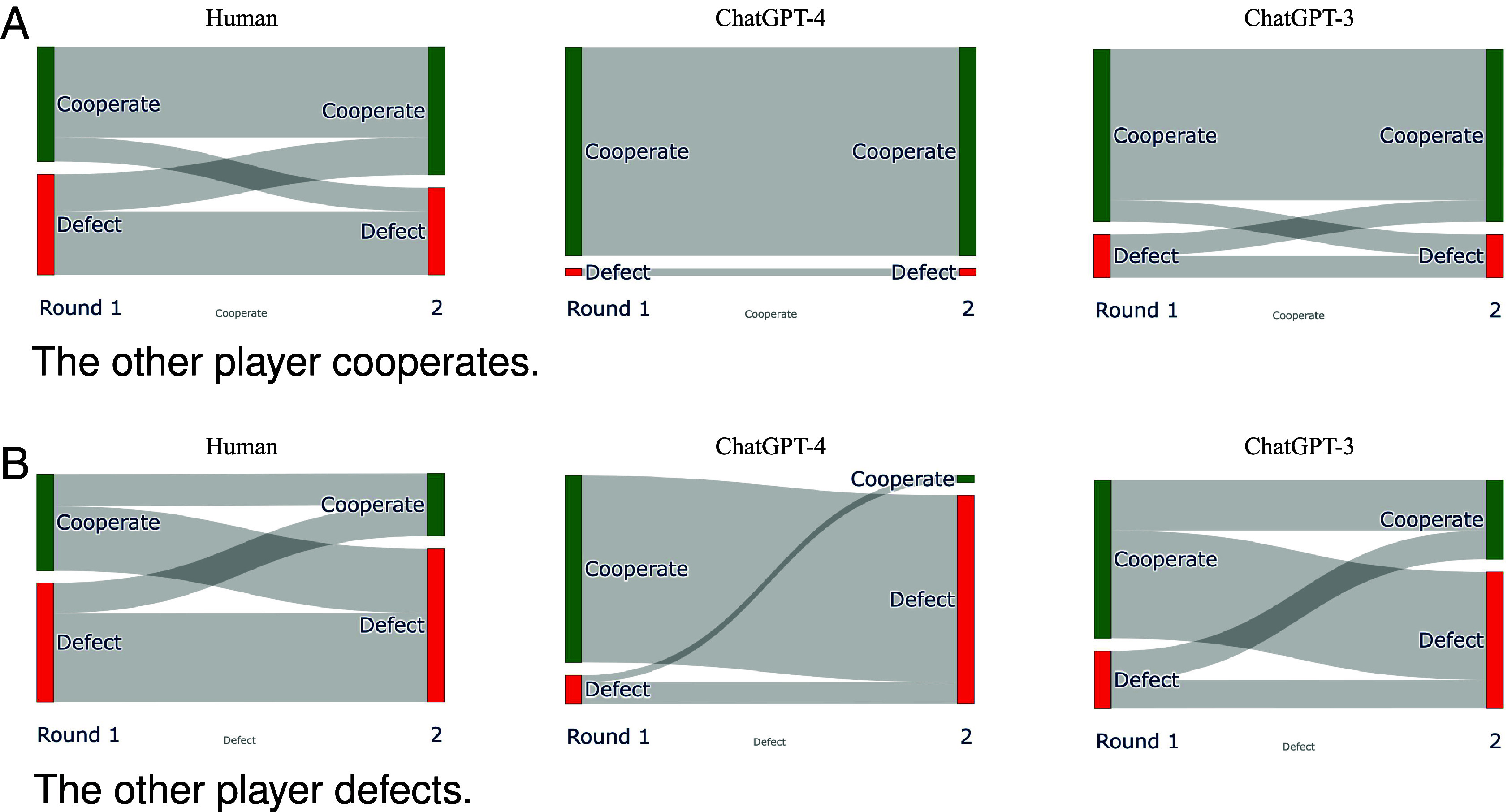
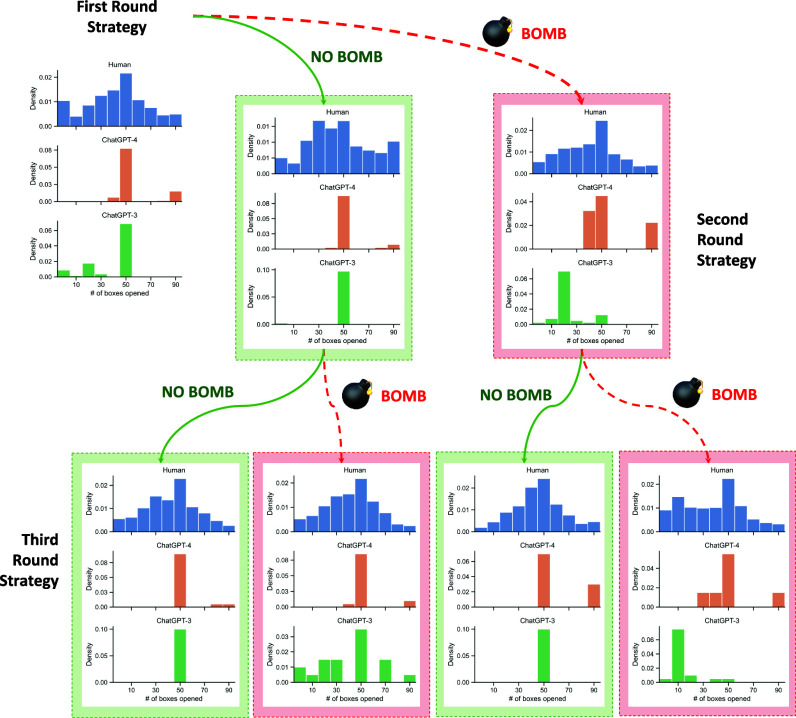
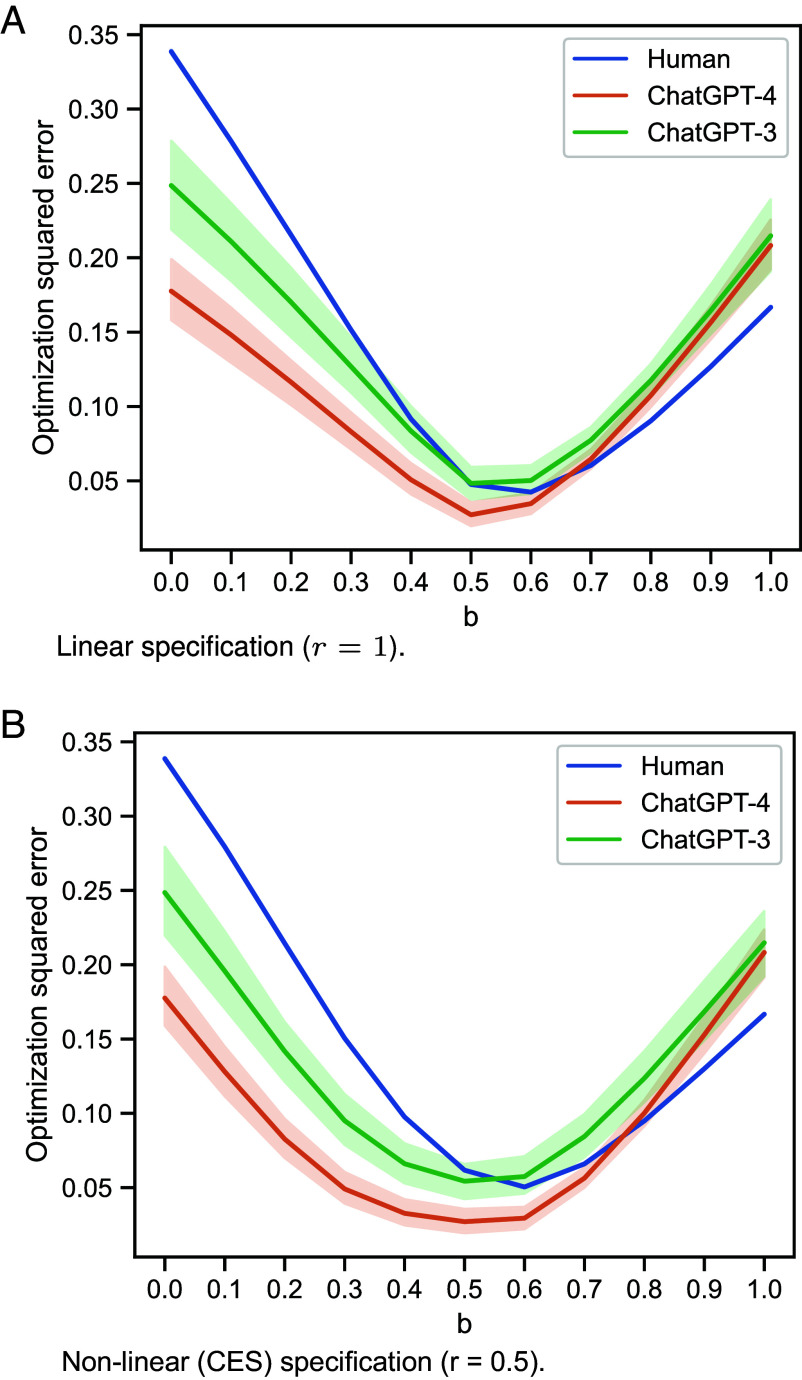
We administer a Turing test to AI chatbots. We examine how chatbots behave in a suite of classic behavioral games that are designed to elicit characteristics such as trust, fairness, risk-aversion, cooperation, etc., as well as how they respond to a traditional Big-5 psychological survey that measures personality traits. ChatGPT-4 exhibits behavioral and personality traits that are statistically indistinguishable from a random human from tens of thousands of human subjects from more than 50 countries. Chatbots also modify their behavior based on previous experience and contexts “as if” they were learning from the interactions and change their behavior in response to different framings of the same strategic situation. Their behaviors are often distinct from average and modal human behaviors, in which case they tend to behave on the more altruistic and cooperative end of the distribution. We estimate that they act as if they are maximizing an average of their own and partner’s payoffs.
Overview
The claims and statistics of this paper haven’t been checked yet.
Free: it reads the open-access text and checks the first 5 claims that cite a source we can check. Create a free account to check every claim.
Integrity signals
Registry
Cites
Statistics
Figures
Verification
Claims the paper makes
The claims and statistics of this paper haven’t been checked yet.
Free: it reads the open-access text and checks the first 5 claims that cite a source we can check. Create a free account to check every claim.
Claims other papers make about this one
Each is checked against this paper’s own text: does it say what the citing paper says it does?
The source backs part of the claim, not all of it — or backs it for a different population, condition or comparison.
In the citing paper
“But users increasingly cannot tell the difference between human writing and LLM writing when presented with text (30–32), and between a human interlocutor or a contemporary chatbot when in interaction (17, 26).”
From The benefits and dangers of anthropomorphic conversational agents (2025) · cites this paper as [17]
Experimental — accuracy not yet measuredThe check wasn’t confident either way, so it gives no verdict — never disputed.
In the citing paper
“research has raised concerns that LLMs may not fully grasp the tasks they perform, sometimes resulting in erratic behavior [54,82].”
From Adaptive Information Modulation: Designing Governance Mechanisms for Multi-Agent Artificial Intelligence Systems (2026) · cites this paper as [54]
Experimental — accuracy not yet measuredIn the citing paper
“Still other studies indicate LLMs can replicate classic experiments in cognitive science and the study of morality and replicate human behavior in the Prisoner’s Dilemma and other behavioral games (21–24).”
From Can Generative AI improve social science? (2024) · cites this paper as [23]
Self-check
Percentages, sums and reported differences re-computed from the paper’s own numbers.
The self-check needs the paper’s full text.
Citations
Cites
I.—COMPUTING MACHINERY AND INTELLIGENCE
TURING, A. M. (1950) · Mind · doi:10.1093/mind/lix.236.433 · Cited by 10,290
Trust, Reciprocity, and Social History
Berg, J., Dickhaut, J., & McCabe, K. (1995) · Games and Economic Behavior · doi:10.1006/game.1995.1027 · Cited by 5,548
An experimental analysis of ultimatum bargaining
Güth, W., Schmittberger, R., & Schwarze, B. (1982) · Journal of Economic Behavior & Organization · doi:10.1016/0167-2681(82)90011-7 · Cited by 4,816
The structure of phenotypic personality traits.
Goldberg, L. R. (1993) · American Psychologist · doi:10.1037/0003-066x.48.1.26 · Cited by 4,816
Personality trait structure as a human universal.
McCrae, R. R., & Costa, P. T. (1997) · American Psychologist · doi:10.1037/0003-066x.52.5.509 · Cited by 4,234
Theory of Games and Economic Behavior
ROWLAND, E. (1946) · Nature · doi:10.1038/157172a0 · Cited by 3,280
Fairness in Simple Bargaining Experiments
Forsythe, R., Horowitz, J. L., Savin, N. E., & Sefton, M. (1994) · Games and Economic Behavior · doi:10.1006/game.1994.1021 · Cited by 2,366
GPTs are GPTs: An Early Look at the Labor Market Impact Potential of Large Language Models
Eloundou, T., Manning, S., Mishkin, P., & Rock, D. (2023) · arXiv · doi:10.48550/arxiv.2303.10130 · Cited by 2,330
Benefits, Limits, and Risks of GPT-4 as an AI Chatbot for Medicine
Lee, P., Bubeck, S., & Petro, J. (2023) · New England Journal of Medicine · doi:10.1056/nejmsr2214184 · Cited by 1,738
Sparks of Artificial General Intelligence: Early experiments with GPT-4
Bubeck, S., Chandrasekaran, V., Eldan, R., Gehrke, J., Horvitz, E., Kamar, E., Lee, P., Lee, Y. T., Li, Y., Lundberg, S., et al. (2023) · arXiv · doi:10.48550/arxiv.2303.12712 · Cited by 1,526
Research works printed but not linked: 1
- K. Warwick, Turing Test Success Marks Milestone in Computing History (University or Reading Press Release, 2014), p. 8.
Cited by
Items 201–300 of 355
Can large language models mimic airline passenger preferences?
Voltes-Dorta, A., & Suau-Sánchez, P. (2025) · Artificial Intelligence for Transportation · doi:10.1016/j.ait.2025.100034 · Cited by 6
Honekamp, W., & Kemme, S. (2025) · Springer eBooks · doi:10.1007/978-3-658-48425-5_20 · Cited by 1
Dive into soft matter imaging: artificial intelligence-integrated electron microscopy
Yoon, J., Hwang, J. H., & Lee, E. (2025) · NPG Asia Materials · doi:10.1038/s41427-025-00629-0 · Cited by 1
“Recent advances in large language models such as ChatGPT, Claude, and DeepSeek, alongside AI applications, are reorganizing various scienti fi c fi elds including autonomous driving, materials discovery, and medical diagnostics 7 .”
Arora, V., Sutoski, A., Boilard, J., Leone, E., Zizzo, H., Wang, B., Calic, G., Parpia, S., Bhandari, M., & Thabane, A. (2025) · AI & Society · doi:10.1007/s00146-025-02816-7 · Cited by 1
“The difference in ideational patterns between GenAI models and humans suggests that, despite the indistinguish-ability of GenAI output from human output (Dasgupta et al. 2022; Aher et al. 2023; Mei et al. 2024), there are distinct ideational patterns on divergent thinking tasks.”
Homo-silicus: not (yet) a good imitator of homo sapiens or homo economicus
POLACHEK, S. W., Romano, K., & Tonguc, O. (2025) · Journal of the Economic Science Association · doi:10.1017/esa.2025.10023 · Cited by 4
Human-Centered Artificial Social Intelligence (HC-ASI)
Hanxi, P. A. N., Xu, W., Shen, M., & Gao, Z. (2026) · Springer eBooks · doi:10.1007/978-981-97-8440-0_110-1 · Cited by 2
Computational Basis of Large Language Models’ Decision Making in Social Simulation
Ma, J. (2026) · Sociological Methodology · doi:10.1177/00811750261421220 · Cited by 1
“In settings such as public goods, trust, and dictator games, models have shown prosocial and strategic behaviors that appear consistent with human aggregates (Johnson and Obradovich 2023; Leng and Yuan 2024; Mei et al. 2024; Xie et al. 2024).”
Large language models for urban transportation
Ma, Z., Wang, L., Qin, Z., & Ling, Y. (2026) · Elsevier eBooks · doi:10.1016/b978-0-443-26789-5.00011-0 · Cited by 2
Can Machines Think Like Humans: A Behavioral Evaluation of LLM Agents in Dictator Games
Ma, J. (2026) · Voluntas: International Journal of Voluntary and Nonprofit Organizations · doi:10.1017/s0957876526000173 · Cited by 1
Tanprasert, T., Kim, Y., Fels, S., & Yoon, D. (2026) · CHI Conference on Human Factors in Computing Systems · doi:10.1145/3772318.3790796 · Cited by 1
“[49, 64].”
Socio-technical regional disaster recovery modeling using generative LLM-based agents
Blagojević, N., & Baker, J. W. (2026) · International Journal of Disaster Risk Reduction · doi:10.1016/j.ijdrr.2026.106205 · Cited by 1
Madhavan, M. M., Satyapriya, Sahu, S., Velayudhan, P. K., Smitha, S. C., Verma, A. P., Pawariya, V., Barua, S., Mahra, G. S., Bishnoi, S., et al. (2026) · Frontiers in Nutrition · doi:10.3389/fnut.2026.1769064 · Cited by 1
Thinking Without a Subject: The Cartesian–Turing Lineage and the Ontology of Artificial Intelligence
Pada, R. T., & Rennesland, A. H. (2026) · Philosophia International Journal of Philosophy · doi:10.46992/pijp.27.3.a.4 · Cited by 1
Liu, J. M.-E., Weng, C. C.-H., Lin, Y., Hsiao, P.-Y., & Hou, Y. T.-Y. (2026) · ACM Conference on Conversational User Interfaces (CUI) · doi:10.1145/3816046.3816199 · Cited by 1
Yu, J., Du, H., Wang, M., Zhao, J., Zhou, Y., Xue, E., Chen, L., Zhang, H., & Shao, J. (2026) · The Annals of Family Medicine · doi:10.1370/afm.250577 · Cited by 1
“45”
Simulating strategic interactions with AI agents
Tranchero, M., Brenninkmeijer, C.-F., Murugan, A., & Nagaraj, A. (2026) · Strategic Management Journal · doi:10.1002/smj.70112 · Cited by 5
Johnson, T., & Gaissmaier, W. (2026) · JMIR AI · doi:10.2196/87034 · Cited by 1
“Although this approach conforms to well-established methods in machine behavior research [35], it fails to fulfill recent calls for patient-produced data in tests of LLMs in health care settings [36].”
Zhu, Y., Wang, C., & Chu, J. (2026) · International Journal of Human-Computer Interaction · doi:10.1080/10447318.2026.2709241 · Cited by 1
Soares, D. D. C., Bittencourt, L. E. B. D. F., & Tessmann, M. S. (2026) · Journal of Behavioral and Experimental Finance · doi:10.1016/j.jbef.2026.101235 · Cited by 2
Guidance over guidelines? Unpacking the uses and concerns of generative AI in communication science
Ho, J. C., Cools, H., Strycharz, J., Möller, A. M., van Berlo, Z. M. C., Stolwijk, S. B., Trilling, D., & Araujo, T. (2026) · Information Communication & Society · doi:10.1080/1369118x.2026.2736810 · Cited by 1
Thiemann, D. (2024) · Organisationsberatung Supervision Coaching · doi:10.1007/s11613-024-00891-1 · Cited by 1
Shao, Z. (2024) · Advances in human and social aspects of technology book series · doi:10.4018/979-8-3693-7235-7.ch009 · Cited by 1
Ferreira, G., Amidei, J., Nieto, R., & Kaltenbrunner, A. (2025) · ACM Transactions on Computing for Healthcare · doi:10.1145/3712301 · Cited by 3
“This is the case for example with Mei et al. [46] who used the Big Five Inventory (BFI) [38] and found close scores of GPT to real population samples in E and N (the BFI does not have the P scale).”
InfluentialAdaptive strategy automation with large language models in paradoxical games
Cheong, K. H., Zhao, J., & Wen, T. (2025) · Physical Review Research · doi:10.1103/physrevresearch.7.l022012 · Cited by 1
CHATGPT AS A TOOL IN HIGHER EDUCATION – ANALYSIS OF STUDENT UTILIZATION AND PERCEPTION
Delińska, L., & MINGA, Z. (2025) · Scientific Papers of Silesian University of Technology Organization and Management Series · doi:10.29119/1641-3466.2025.224.4 · Cited by 1
Basics of Artificial Intelligence for Ophthalmologists
Issarti, I., & Rozema, J. J. (2025) · Springer eBooks · doi:10.1007/978-3-031-83756-2_2 · Cited by 1
Lv, D., Sun, R., Zuo, J., Zhu, Q., & Qin, S. (2025) · Behaviour and Information Technology · doi:10.1080/0144929x.2025.2586246 · Cited by 1
“…behaviors and personality traits are statistically indistinguishable from those of random participants in a sample of tens of thousands of individuals from over 50 countries (Mei et al. 2024), demonstrating that it possesses a certain degree of ‘cognitive ability’ (Strachan et al. 2024).”
Orlichenko, A., Qu, G., Zhou, Z., Liu, A., Deng, H., Ding, Z., Stephen, J. M., Wilson, T. W., Calhoun, V. D., & Wang, Y.-P. (2024) · bioRxiv (Cold Spring Harbor Laboratory) · doi:10.1101/2024.05.16.594528 · Cited by 4
“Concurrently, generative models such as the DALL-E [21] and GPT [22] series have created textual and visual content that in many cases is indistinguishable from human-generated work [23].”
BackgroundChatbot or Humanaut? How the Source of Advice Impacts Behavior in One-shot Social DilemmasPreprint
Babin, J. J., & Chauhan, H. S. (2024) · Research Square · doi:10.21203/rs.3.pex-2653/v1 · Cited by 2
Digital Homunculi and Institutional Design: Breaking Through the Experimentation BottleneckPreprint
Špecián, P. (2024) · arXiv (Cornell University) · doi:10.48550/arxiv.2409.00826 · Cited by 1
“As a result, DH may avoid discriminatory behavior, even when such discrimination would be prevalent in real-world scenarios, or possess unrealistic degrees of altruism and cooperativeness (Mei et al. 2024).”
Unsupervised [randomly responding] survey bot detection: In search of high classification accuracyPreprint
Falk, C. F., Huang, A., & Ilagan, M. J. (2024) · PsyArXiv (OSF Preprints) · doi:10.31234/osf.io/4nmxh_v1 · Cited by 1
Accounting research in the age of AI *Preprint
Keloharju, M., & Keloharju, R. (2025) · SSRN Electronic Journal · doi:10.2139/ssrn.5335894 · Cited by 1
Designing Psychometric Measures for LLMs: Framework and Application to Racial BiasPreprint
Benosman, M. (2025) · PsyArXiv (OSF Preprints) · doi:10.31234/osf.io/ctk7j_v3 · Cited by 1
How Human is the Machine? Evidence from 66,000 Conversations with Large Language ModelsPreprint
Stamatogiannakisa, A., Ghodsinia, A., Etminanrad, S., Gonçalves, D., & Santos, D. (2025) · SSRN Electronic Journal · doi:10.2139/ssrn.5425016 · Cited by 1
Designing Psychometric Bias Measures for ChatBots: An Application to Racial Bias MeasurementPreprint
Benosman, M. (2025) · arXiv (Cornell University) · doi:10.48550/arxiv.2509.13324 · Cited by 3
“Similar line of research was followed in [Kosinski, 2023], [Mei et al., 2024], [Pellert et al., 2024], [Srivastava et al., 2023], [Liu et al., 2024], [Zhu and Griffiths, 2024], [Buolamwini and Gebru, 2024], [Raj et al., 2024], [Chen et al., 2025], and [Bai et al., 2025], where the general…”
Computational Basis of LLM's Decision Making in Social SimulationPreprint
Ma, J. (2025) · RePEc: Research Papers in Economics · doi:10.17605/osf.io/j9rqk · Cited by 1
Cooperative Profiles Predict Multi-Agent LLM Team Performance in AI for Science WorkflowsPreprint
Kumar, S., Bharathwaj, A., & Jurgens, D. (2026) · arXiv (Cornell University) · doi:10.48550/arxiv.2604.20658 · Cited by 3
“Recent work demonstrates that LLMs placed in multi-agent settings can reproduce—and sometimes amplify—human-like coordination biases (Xie et al., 2024; Ashery et al., 2025; Zhang et al., 2024b).”
Interview with the AI: a quantitative analysis of AI companions’ relationship formation features
Dede, E., Sungur, H., Lemmens, J. S., & Peter, J. (2026) · AI & Society · doi:10.1007/s00146-026-03368-0 · Cited by 1
The Impact of Generative AI on Personalized Content Marketing in E-Commerce
Mohiuddin, D., Tariq, M. H., & Tahir, A. (2025) · Inverge Journal of Social Sciences · doi:10.63544/ijss.v4i1.288 · Cited by 4
“Generate” the Future of Work through AI: Empirical Evidence from Online Labor Markets
Liu, J., Xu, X., Nan, X., Li, Y., & Tan, Y. (2026) · Information Systems Research · doi:10.1287/isre.2023.0461
Large language models as linguistic simulators and cognitive models in human researchPreprint
Lin, Z. (2024) · PsyArXiv (OSF Preprints) · doi:10.31234/osf.io/uqxcb
A Demographic-Conditioned Variational Autoencoder for Removal of Confounds from fMRI DataPreprint
Orlichenko, A., Qu, G., Zhou, Z., Liu, A., Deng, H., Ding, Z., Stephen, J. M., Wilson, T. W., Calhoun, V. D., & Wang, Y.-P. (2024) · doi:10.36227/techrxiv.171591456.67476161/v1
Die Evolution des Menschen in seiner (nicht-)biologischen Zukunft
Lange, A. (2024) · Springer eBooks · doi:10.1007/978-3-662-68962-2_7
Is ChatGPT a good moral interlocutor for teaching bioethics? A case analysis
Choi, W. J. (2024) · AI and Ethics · doi:10.1007/s43681-024-00593-5
“Indeed, ChatGPT can talk with ‘compassion,’ laugh and sing like a human and even pass the Turing test, which assesses the humanity of the program’s personality [13–15 ].”
Knowing the Difference: Identification and Existentialism in A.I. Artificial Intelligence
Liddle, C. (2024) · Film Matters · doi:10.1386/fm_00344_1
LLMs provide a potential pathway for the research of complex systems
Han, J., & Chen, X. (2025) · Physics of Life Reviews · doi:10.1016/j.plrev.2025.03.010
Can large language models overcome opportunistic behavior in the prisoner's dilemma?
Kang, T. (2025) · Advances in Engineering Research Possibilities and Challenges · doi:10.63313/aerpc.2005
Multi-, inter- oder transdisziplinär lehren und lernen – Schlüsselrolle Philosophieren
Breitwieser, A. (2025) · Verlag Julius Klinkhardt eBooks · doi:10.35468/6163-02
Leng, Y., & Nguyen, T. (2025) · SSRN Electronic Journal · doi:10.2139/ssrn.5170182
Trends und Treiber von Embedded Finance
Finken, S. (2025) · Springer eBooks · doi:10.1007/978-3-658-46863-7_2
Rożek, K. (2025) · OSF Preprints (OSF Preprints) · doi:10.31219/osf.io/g95mu_v2
Who is More Bayesian: Humans or ChatGPT?Preprint
Rawat, P., Mu, T., Rust, J. P., Zhang, C., & Zhong, Q. (2025) · SSRN Electronic Journal · doi:10.2139/ssrn.5216964 · Cited by 1
The Chatgpt Effect: Assessing Demand Shifts for it Skills in GermanyPreprint
Rickmeier, K., & Afonina, M. (2025) · SSRN Electronic Journal · doi:10.2139/ssrn.5279194
Simulating social dynamics with artificial intelligence
Rodrigues, F. A., & Rodrigues, P. G. (2025) · Physics of Life Reviews · doi:10.1016/j.plrev.2025.05.011
The Game Boy Learning Environment
Fazzari, E., Romano, D., Falchi, F., & Stefanini, C. (2025) · IEEE Transactions on Games · doi:10.1109/tg.2025.3575527 · Cited by 2
“These models are capable of gener-atingtext andengaginginconversations withhumans, exhibiting behavioral and personality traits that are statistically indistinguishable from those of random human beings [4].”
Geng, W., Jiang, Y. F., Zhai, W., Zhao, X., Zhao, Q. Y., Li, J., Cao, J., & Shi, L. (2025) · Medical Teacher · doi:10.1080/0142159x.2025.2515971
“Previous research has shown that LLMs tend to exhibit excessive altruism in social interactions, a behavioural pattern that could lead to idealized biases in relationship modelling [25].”
Unpacking the Decision Logic of LLM-based Agents: Evidence from the Newsvendor ProblemPreprint
Zhang, X., & Cavusoglu, H. (2025) · SSRN Electronic Journal · doi:10.2139/ssrn.5337019 · Cited by 4
Hilfe, meine KI kann schreiben!
Martens, A. (2025) · Ars digitalis · doi:10.1007/978-3-658-45839-3_3
AI Jurors vs. Human Judgments: Assessing Auditor Responsibility in an Era of AI-Assisted AuditsPreprint
Taguchi, S. (2025) · SSRN Electronic Journal · doi:10.2139/ssrn.5348882
Künstliche Intelligenz in der Psychotherapie: Perspektiven und Herausforderungen
Steppan, M., & Eichenberg, C. (2025) · Ärztliche Psychotherapie · doi:10.21706/aep-20-3-192
Bot or not: Can people tell the difference between stories written by a human or by an AI system?Preprint
Sears, S., & Weisberg, D. S. (2025) · PsyArXiv (OSF Preprints) · doi:10.31234/osf.io/jkh6p_v2
Governing Generative AI Beyond the GravePreprint
Arbel, Y. A., & Lopez, A. (2025) · SSRN Electronic Journal · doi:10.2139/ssrn.5380233
Unsupervised [randomly responding] survey bot detection: In search of high classification accuracyPreprint
Falk, C. F., Huang, A., & Ilagan, M. J. (2025) · PsyArXiv (OSF Preprints) · doi:10.31234/osf.io/4nmxh_v2
Exploring Alternative Approaches to Contemporary AI Testing
Eisenbardt, T. (2025) · European Conference on Knowledge Management · doi:10.34190/eckm.26.1.3745
“…related to human assessment, narrow scope of application, failure to take into account the fact that AI is already surprising humans in many areas (Mei, et al., 2024; Cameron, 2024), and also such special and very interesting observations as: • The Chinese room argument – or "imitation of…”
Chanaman, T., Junpeng, P., & Intharah, T. (2025) · International Technical Conference on Circuits/Systems, Computers and Communications (ITC-CSCC) · doi:10.1109/itc-cscc66376.2025.11137624
“This indicates that most experts were unable to distinguish between the exams created by Claude AI and those created by humans, suggesting that Claude AI closely resembles human performance in test creation [26] as presented in Table IV.”
InfluentialTorturing the Turing Test with Suggestive Anagrams in Slavic Languages
Ribić, S., Mulahasanović, R. T., & Hodžić, K. (2025) · International Convention on Information and Communication Technology, Electronics and Microelectronics · doi:10.1109/mipro65660.2025.11131819
Turing test in examining the advancement of human – ChatGPT interaction: an academic experiment
Kunikowski, G., Kornacki, P., Milczarska, K., & Kwiatkowska, P. (2025) · Nowoczesne Systemy Zarządzania · doi:10.37055/nsz/209421
Li, L., Peng, Y., Shao, G., & Dai, H. (2025) · Economics Letters · doi:10.1016/j.econlet.2025.112605
Designing Psychometric Measures for LLMs: Framework and Application to Racial BiasPreprint
Benosman, M. (2025) · PsyArXiv (OSF Preprints) · doi:10.31234/osf.io/ctk7j_v2
Keeping Knowledge Alive in the Age of Anti-Education, Disinformation, and Artificial Intelligence
Low, D. S. (2025) · Springer eBooks · doi:10.1007/978-3-031-97999-6_2
Artificial intelligence and medicine: Hype, hubris, and the humanity we can’t replace
Peterson, C., & Rosqvist, S. (2025) · The Southwest Journal of Medicine · doi:10.12746/swjm.v13i57.1515 · Cited by 1
Yi, J., Lin, Y., Zhou, Z., & Hong, Y. (2025) · 中国科学基金 · doi:10.3724/bnsfc-2025-0004 · Cited by 1
Zhou, X., & Zheng, J. (2025) · Research Square · doi:10.21203/rs.3.rs-7665724/v1
Franzetti, C. (2025) · Springer eBooks · doi:10.1007/978-3-662-71428-7_15
Rüdiger, T.-G. (2025) · Springer eBooks · doi:10.1007/978-3-658-48425-5_21
Is Generative Artificial Intelligence Ready for Computational Social Science?
Morge, M. (2025) · Lecture notes in computer science · doi:10.1007/978-3-032-07638-0_19 · Cited by 2
“LLMs have been shown to emulate human behaviour in certain experimental economics and social psychology settings [13], and exhibit exceptional performance in zero-shot scenarios [9, 24].”
GPT’s emotion venting and punishment: the evolution from chaos to order
Wang, G., Li, J., Wang, W., Wang, Y., & Niu, X. (2025) · Humanities and Social Sciences Communications · doi:10.1057/s41599-025-06197-6
“Studies have shown that GPT exhibits human-like abilities in many domains of individual and interpersonal decision-making (Chen et al., 2023; Mei et al., 2024; Yin et al., 2024; Goli and Singh, 2024), and demonstrates pro fi ciency in emotion recognition (Yin et al., 2024; Zhao et al., 2022; Valor…”
InfluentialMay AI be sustainable? An outlook on sustainability and technology
Kondratenko, A., Kondratenko, A. A., & Kamberov, K. H. (2025) · AI & Society · doi:10.1007/s00146-025-02804-x
“The prominent examples of them are ChatGPT—the most popular chatbot that passed the Turing Test in specifically designed challenging circumstances (Mei et al. 2024), Midjourney, a model creating images from text (Chiu 2024), Sora, a model generating video from text (Liu et al. 2024), and Suno, a…”
Miscalibrated trust hinders effective partner choices in human-AI collectives
Jiang, Y., Brinkmann, L. U. L., Nussberger, A.-M., Soraperra, I., Bonnefon, J., & Rahwan, I. (2025) · eScholarship (California Digital Library)
Irwin, J. A. (2024) · eScholarship (California Digital Library)
Tekoälyavustajat full stack -kehityksen tukena : mahdollisuudet ohjelmistotekniikan opiskelussa
Palmén, L. (2024) · Theseus (Ammattikorkeakoulujen)
Bengtsson, T., & Jonsson, O. (2025) · KTH Publication Database DiVA (KTH Royal Institute of Technology)
Tekoälyavustajat korkeakouluympäristössä : ChatGPT:n soveltaminen ohjelmistotekniikan opintojaksolla
Parkkila, E. (2024) · Theseus (Ammattikorkeakoulujen)
Evidence shows AI systems are already too much like humans. Will that be a problem?
Peter, S., Riemer, K., & West, J. D. (2025) · The Conversation · doi:10.64628/aa.dspsspsuq
GenAI Use and Risks in Higher Education: A Preliminary Review for Research in New Zealand Contexts
Chambers, S. (2025) · Scope Contemporary Research Topics (Learning and Teaching) · doi:10.34074/scop.4015003 · Cited by 1
Machine Discretion and Democratic Practice
Gill-Pedro, E. (2025) · Retfærd · doi:10.18261/ret.48.3.3
Personality and the Use of Artificial Intelligence as Factors Shaping Decision-Making
Kupczyk, T., Oleśniewicz, M., Kubicki, L., & Smolarek, A. (2025) · EUROPEAN RESEARCH STUDIES JOURNAL · doi:10.35808/ersj/4292
Can AI Take Our Surveys for Us? Evaluating LLMs as Stand-ins for Human Respondents
Wang, J., Gong, M., & Li, Y. (2025) · International Conference on E-business, Management and Economics (ICEME) · doi:10.1145/3760557.3760597
“In more domain-specific applications, [8] conduct a behavioral Turing test, showing that ChatGPT-4 exhibits personality and behavioral traits statistically similar to human subjects in classic decision-making tasks.”
Training an AI Chatbot to Manage Health in Underserved Populations: Methodological Approach
Crawford, A. D., Wicks, B., Metsis, V., Starfall, A., Clapham, F., Gorbachev, A., Shanley, S., Strauser, C., & McGrath, J. M. (2026) · JMIR AI · doi:10.2196/84145
“Thus, LLMs can leverage natural language processing to provide refined, adaptive, human-like communication and understand multifarious queries with precision while producing detailed, context-specific responses [11,12,14].”
Do LLMs Possess Strategic Intelligence? Testing LLMs in Iterated Prisoner’s DilemmasPreprint
Kommandeur, J., Vonk, M., Spiegeleire, S. D., & Sweijs, T. (2026) · Research Square · doi:10.21203/rs.3.rs-8405969/v1
Future echoes? A prologue & a tale
Bonnelame, N., Lee, A., Malik, N., & Turnbull, B. (2025) · Research in Drama Education The Journal of Applied Theatre and Performance · doi:10.1080/13569783.2025.2506698
Schück, F. (2026) · Frontiers in Water · doi:10.3389/frwa.2026.1749745
“Since it also has a limited ability to represent marginalized and non-US populations (Mei et al., 2024; Wang et al., 2025; Abeliuk et al., 2025), the appropriateness of generated data from demographic personas should be questioned.”
Properties for the Emergence of Consciousness in Humans and AI, an Interdisciplinary Review
Quiroga, P. C. (2026) · Journal of Artificial Intelligence and Consciousness · doi:10.1142/s2705078526400011
Chattibottien ongelmien vähentäminen ennen julkaisua
Valio, S. (2025) · Tampere University Institutional Repository (Tampere University)
Gathering wood for a brighter flame: How group altruism promotes conspicuous altruism
Tianhong, W. A. N. G., & Xiaofei, X. I. E. (2026) · Acta Psychologica Sinica · doi:10.3724/sp.j.1041.2026.0976
Torres‐Carballo, F., Sandoval-Sánchez, Y., & Martínez-Rojas, V. (2026) · Revista Tecnología en Marcha · doi:10.18845/tm.v39i5.8524
“De forma complementaria, Mei et al. [2] reafirman que el Dictator Game constituye un indicador estándar de altruismo puro, utilizado como referencia para contrastar comportamientos humanos y artificiales en su estudio A Turing Test of Whether AI Chatbots Are Behaviorally Similar to Humans.”
Transformative Privacy Calculus as a Framework for AI-Powered Services Adoption
Favarin, V. (2024) · theses.fr (ABES) · doi:10.70675/682497e5z8c9fz41fcza0eezcf33618ebaa8
Media digitali e apprendimento: il ruolo dell’università nell’era della trasformazione digitale
Rivoltella, P. C. (2025) · Archivio istituzionale della ricerca (Alma Mater Studiorum Università di Bologna) · doi:10.53256/rrdd_250102
Synthetic AI Agents for Experimental Social Science
Henning, T. L., & Camerer, C. F. (2026) · EPiC series in technology · doi:10.29007/xj88 · Cited by 1
“All of them could be done using AI agents [25].”
From Per-Timestep Deciders to Holistic Strategy Generators: Evolving Strategic Complexity In LLMS
Li, S., & Wang, X. (2026) · IEEE International Conference on Acoustics Speech and Signal Processing · doi:10.1109/icassp55912.2026.11460324
Metadata
- Authors
- Mei, Q., Xie, Y., Yuan, W., & Jackson, M. O.
- Affiliations
- University of Michigan (US)
- MobLab, Pasadena, CA 91107
- Santa Fe Institute (US)
- Corresponding author
- Mei, Qiaozhu
- Jackson, Matthew O.
- Venue
- Proceedings of the National Academy of Sciences
- Publisher
- National Academy of Sciences
- Published
- 2024-02-22
- Volume
- 121
- Issue
- 9
- Pages
- e2313925121-e2313925121
- ISSN
- 0027-8424 (ISSN-L)
- 1091-6490
- PMC
- PMC10907317
- OpenAlex
- W4392028279
- Cited by
- 254
- References
- 26
- Citations by year
- 2026: 75 · 2025: 118 · 2024: 59
- FWCI
- 104.44
- Type
- journal article
- Language
- en
- Open access
- hybrid
- doi.org
- Licence
- Locations
- Proceedings of the National Academy of Sciences (publishedVersion, cc-by-nc-nd)
- PubMed Central (publishedVersion, cc-by-nc-nd)
- PubMed (publishedVersion)
- Topics
- Social Sciences › Economics, Econometrics and Finance › Economics and Econometrics › Experimental Behavioral Economics Studies
- Physical Sciences › Computer Science › Artificial Intelligence › Ethics and Social Impacts of AI
- Social Sciences › Psychology › Social Psychology › Social Robot Interaction and HRI
- Keywords
- AI chatbots, Turing test, behavioral games, ChatGPT-4, Big Five personality traits, trust, fairness, risk aversion, cooperation, altruism, experiential learning, framing effects, human-AI comparison
- MeSH terms
- Affect, Altruism, Artificial Intelligence, Behavior, Humans, Pentaerythritol Tetranitrate, Trust
About these checks
Registry, retraction, Cites and statistics results are computed, not judged, with one exception: a printed reference that no index lists is read once by a model before it counts as a citation error. Claims are extracted by a model and kept only when their quote appears verbatim in the text; each cited source is then checked, with a model’s help, for whether it says what the claim relies on. Those verdicts can be wrong — read the claim’s quote and the cited source before relying on one.
Statistics and arithmetic are recomputed, not judged.
Confidence bands are shown only for fields calibrated on our annotated test set. None is calibrated yet, so no band is shown.
What counts as a claim ›How we measure confidence ›How we check this ›
Are you an author, or do you see a problem with this page? Request a review
Data sources
Bibliographic data: Semantic Scholar, OpenAlex, Crossref.
Contains information from the Semantic Scholar Academic Graph Datasets, made available under the ODC Attribution License (ODC-BY 1.0).
Semantic Scholar’s data is described in: Kinney, R., et al. (2023). The Semantic Scholar Open Data Platform. arXiv:2301.10140.
