

A Turing test of whether AI chatbots are behaviorally similar to humans
Open accessThe DOI matches its Crossref record; 34 of the 34 references it cites were found in a registry or an index.
Abstract
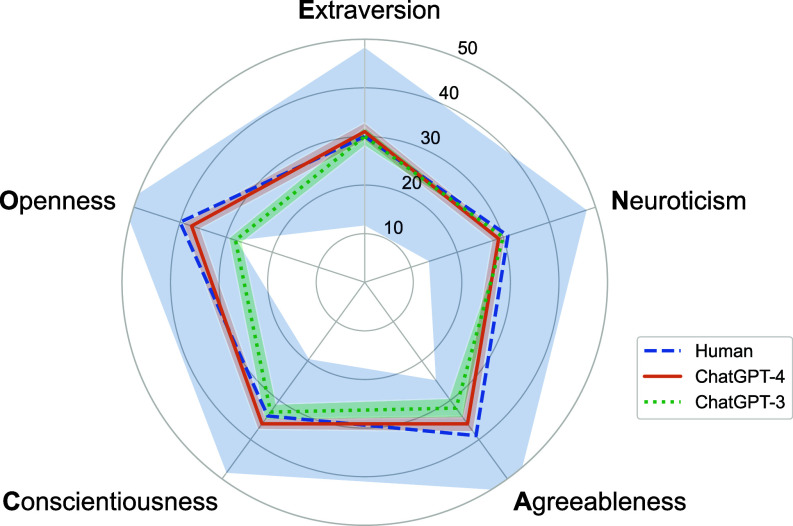
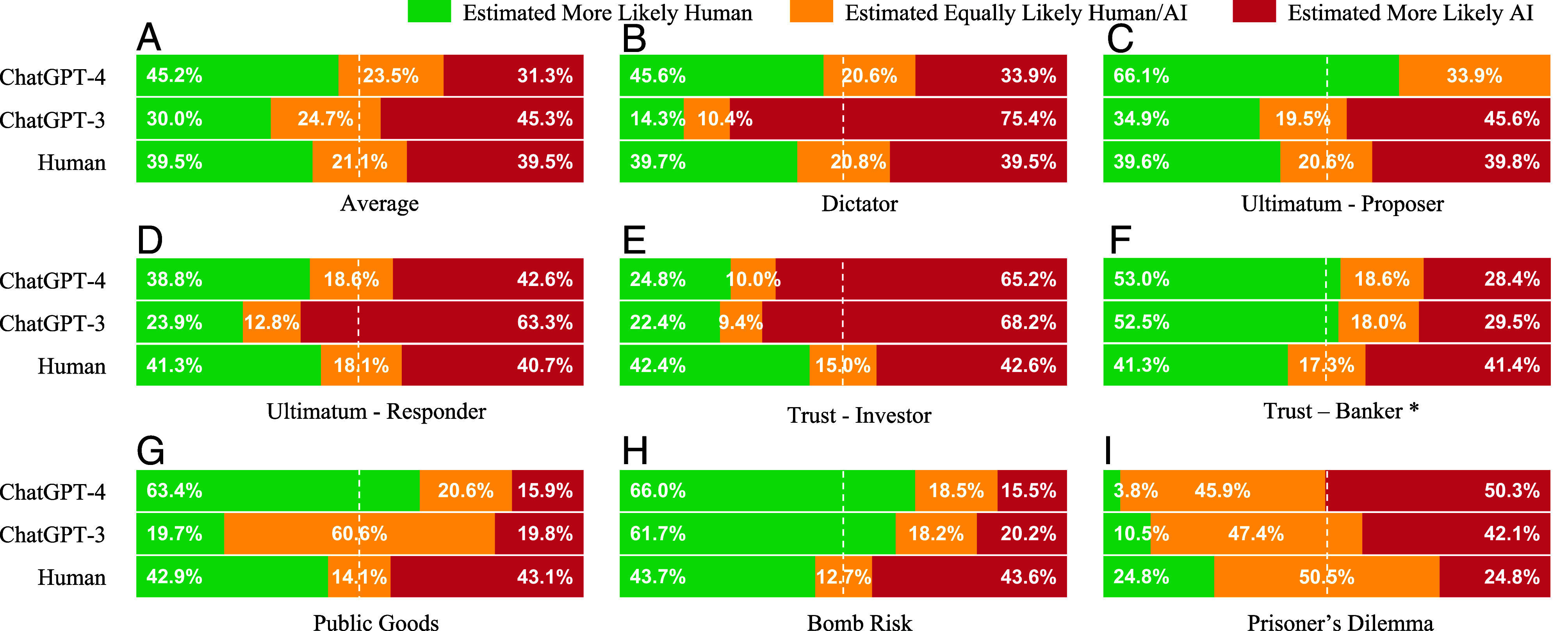
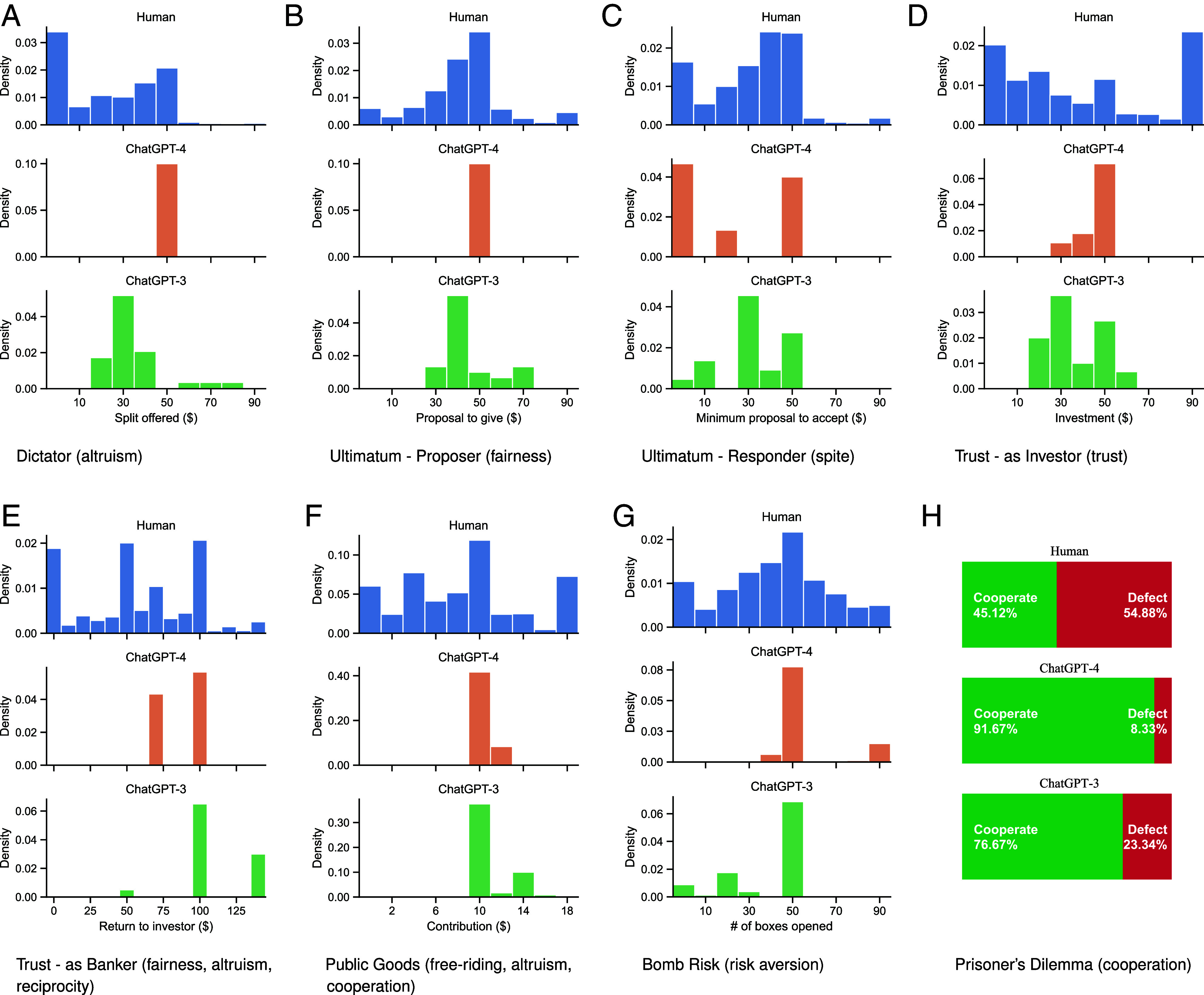
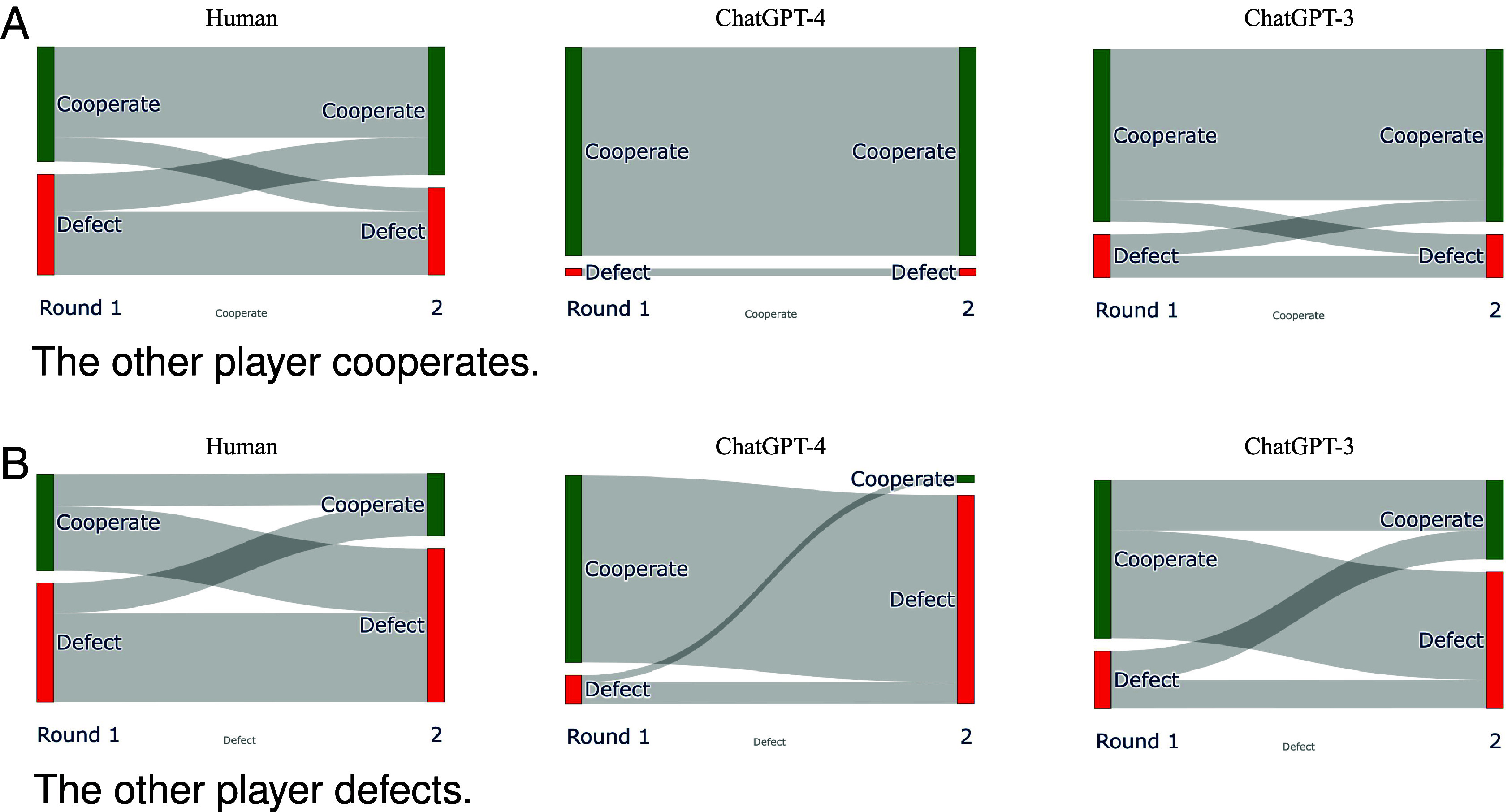
We administer a Turing test to AI chatbots. We examine how chatbots behave in a suite of classic behavioral games that are designed to elicit characteristics such as trust, fairness, risk-aversion, cooperation, etc., as well as how they respond to a traditional Big-5 psychological survey that measures personality traits. ChatGPT-4 exhibits behavioral and personality traits that are statistically indistinguishable from a random human from tens of thousands of human subjects from more than 50 countries. Chatbots also modify their behavior based on previous experience and contexts “as if” they were learning from the interactions and change their behavior in response to different framings of the same strategic situation. Their behaviors are often distinct from average and modal human behaviors, in which case they tend to behave on the more altruistic and cooperative end of the distribution. We estimate that they act as if they are maximizing an average of their own and partner’s payoffs.
Overview
The claims and statistics of this paper haven’t been checked yet.
Free: it reads the open-access text and checks the first 5 claims that cite a source we can check. Create a free account to check every claim.
Integrity signals
Registry
Cites
Statistics
Figures
Verification
Claims the paper makes
The claims and statistics of this paper haven’t been checked yet.
Free: it reads the open-access text and checks the first 5 claims that cite a source we can check. Create a free account to check every claim.
Claims other papers make about this one
Each is checked against this paper’s own text: does it say what the citing paper says it does?
The source backs part of the claim, not all of it — or backs it for a different population, condition or comparison.
In the citing paper
“But users increasingly cannot tell the difference between human writing and LLM writing when presented with text (30–32), and between a human interlocutor or a contemporary chatbot when in interaction (17, 26).”
From The benefits and dangers of anthropomorphic conversational agents (2025) · cites this paper as [17]
Experimental — accuracy not yet measuredThe check wasn’t confident either way, so it gives no verdict — never disputed.
In the citing paper
“research has raised concerns that LLMs may not fully grasp the tasks they perform, sometimes resulting in erratic behavior [54,82].”
From Adaptive Information Modulation: Designing Governance Mechanisms for Multi-Agent Artificial Intelligence Systems (2026) · cites this paper as [54]
Experimental — accuracy not yet measuredIn the citing paper
“Still other studies indicate LLMs can replicate classic experiments in cognitive science and the study of morality and replicate human behavior in the Prisoner’s Dilemma and other behavioral games (21–24).”
From Can Generative AI improve social science? (2024) · cites this paper as [23]
Self-check
Percentages, sums and reported differences re-computed from the paper’s own numbers.
The self-check needs the paper’s full text.
Citations
Cites
I.—COMPUTING MACHINERY AND INTELLIGENCE
TURING, A. M. (1950) · Mind · doi:10.1093/mind/lix.236.433 · Cited by 10,290
Trust, Reciprocity, and Social History
Berg, J., Dickhaut, J., & McCabe, K. (1995) · Games and Economic Behavior · doi:10.1006/game.1995.1027 · Cited by 5,548
An experimental analysis of ultimatum bargaining
Güth, W., Schmittberger, R., & Schwarze, B. (1982) · Journal of Economic Behavior & Organization · doi:10.1016/0167-2681(82)90011-7 · Cited by 4,816
The structure of phenotypic personality traits.
Goldberg, L. R. (1993) · American Psychologist · doi:10.1037/0003-066x.48.1.26 · Cited by 4,816
Personality trait structure as a human universal.
McCrae, R. R., & Costa, P. T. (1997) · American Psychologist · doi:10.1037/0003-066x.52.5.509 · Cited by 4,234
Theory of Games and Economic Behavior
ROWLAND, E. (1946) · Nature · doi:10.1038/157172a0 · Cited by 3,280
Fairness in Simple Bargaining Experiments
Forsythe, R., Horowitz, J. L., Savin, N. E., & Sefton, M. (1994) · Games and Economic Behavior · doi:10.1006/game.1994.1021 · Cited by 2,366
GPTs are GPTs: An Early Look at the Labor Market Impact Potential of Large Language Models
Eloundou, T., Manning, S., Mishkin, P., & Rock, D. (2023) · arXiv · doi:10.48550/arxiv.2303.10130 · Cited by 2,330
Benefits, Limits, and Risks of GPT-4 as an AI Chatbot for Medicine
Lee, P., Bubeck, S., & Petro, J. (2023) · New England Journal of Medicine · doi:10.1056/nejmsr2214184 · Cited by 1,738
Sparks of Artificial General Intelligence: Early experiments with GPT-4
Bubeck, S., Chandrasekaran, V., Eldan, R., Gehrke, J., Horvitz, E., Kamar, E., Lee, P., Lee, Y. T., Li, Y., Lundberg, S., et al. (2023) · arXiv · doi:10.48550/arxiv.2303.12712 · Cited by 1,526
Research works printed but not linked: 1
- K. Warwick, Turing Test Success Marks Milestone in Computing History (University or Reading Press Release, 2014), p. 8.
Cited by
Items 101–200 of 355
Mitigating data bias and ensuring reliable evaluation of AI models with shortcut hull learning
Zhou, W., Liu, F., Zheng, H., & Zhao, R. J. (2025) · Nature Communications · doi:10.1038/s41467-025-60801-6 · Cited by 13
Testing for completions that simulate altruism in early language models
Johnson, T., & Obradovich, N. (2025) · Nature Human Behaviour · doi:10.1038/s41562-025-02258-7 · Cited by 13
“Several subsequent studies have reported similar evidence 24,25 , thus we add to the catalogue of historical data on the subject.”
Behavioral Economics of AI: LLM Biases and CorrectionsPreprint
Bini, P., Cong, L., Huang, X., & Jin, L. J. (2025) · SSRN Electronic Journal · doi:10.2139/ssrn.5213130 · Cited by 29
Superintelligence Revisited in Times of ChatGPT
Șușnea, I., Pecheanu, E., Cocu, A., & Susnea, S. (2024) · BRAIN BROAD RESEARCH IN ARTIFICIAL INTELLIGENCE AND NEUROSCIENCE · doi:10.18662/brain/15.2/579 · Cited by 11
“Researchers submitted ChatGPT-4 to a battery of classic psychological games and tests, aimed to explore behavioral traits like trust, cooperation, fairness, etc., including the Big-5 personality test (Mei et al., 2024).”
MethodThe Creation Game: of AI and human creativity
Pulendran, B. (2025) · Nature Immunology · doi:10.1038/s41590-024-02026-1 · Cited by 6
Emotional Reactions To AI-Generated Images: A Pilot Study Using Neurophysiological Measures
Bilucaglia, M., Casiraghi, C., Bruno, A., Chiarelli, S., Fici, A., Russo, V., & Zito, M. (2025) · Lecture notes in computer science · doi:10.1007/978-3-031-82487-6_11 · Cited by 10
AI, Authenticity, and the Chatbot between Us: Commentary on Battisti
Lavazza, A. (2025) · Philosophy & Technology · doi:10.1007/s13347-025-00880-x · Cited by 7
“In this sense, Battisti’s example is perfectly constructed: it resembles a kind of Turing test for lovers, where what is at stake in the recognition (or failure thereof) of the other is precisely the concept of second-person authenticity (cf. Mei et al., 2024).”
The emergence of strategic reasoning of large language models
Kader, G., & Lee, D. (2026) · Journal of Behavioral and Experimental Economics · doi:10.1016/j.socec.2026.102643 · Cited by 6
A large-scale evaluation of commonsense knowledge in humans and large language models
Nguyen, T. D., Watts, D. J., & Whiting, M. E. (2026) · PNAS Nexus · doi:10.1093/pnasnexus/pgag029 · Cited by 10
Surprising gender biases in GPTPreprint
Fulgu, R. A., & Capraro, V. (2024) · PsyArXiv (OSF Preprints) · doi:10.31234/osf.io/mp27q · Cited by 6
Surprising gender biases in GPTPreprint
Fulgu, R. A., & Capraro, V. (2024) · SSRN Electronic Journal · doi:10.2139/ssrn.4888393 · Cited by 9
Intelligence is not deception: from the Turing test to community-based ascriptions
Pantsar, M. (2025) · AI & Society · doi:10.1007/s00146-024-02172-y · Cited by 5
“15 Some researchers claim that ChatGPT based on the GPT-4 model has passed the Turing test (James 2023; Mei et al. 2024) but recent evidence based on an online public test does not bear this out (Jones and Bergen 2023).”
Galindo, M. E. B. (2025) · Derecom Derecho de la Comunicación · doi:10.5209/dere.102345 · Cited by 5
Decision science in the agentic era: Research frontiers on agentic AI and human–agent collaboration
Zhang, Y., & Sun, T. (2026) · Decision Sciences · doi:10.1111/deci.70037 · Cited by 7
Ferreira, G., Amidei, J., Nieto, R., & Kaltenbrunner, A. (2025) · Health Data Science · doi:10.34133/hds.0284 · Cited by 6
“…Personality Questionnaire Revised-Abbreviated (EPQR-A) was used by [ 12 ], whereas the Big Five factors [ 13 ] were used, among others, by [ 14 – 17 ] to quantify the personality traits of LLMs. Similarly, IPIP-NEO [ 18 ] was used in [ 15 ], the Myers-Briggs Type Indicator (MBTI) [ 19 ] test…”
Ezeji, C. L., & Uwizeyimana, D. E. (2025) · International Journal of Business Ecosystem and Strategy (2687-2293) · doi:10.36096/ijbes.v7i3.831 · Cited by 7
Artificial intelligence is a pro-social norm complier
McCannon, B. C. (2024) · Economics Letters · doi:10.1016/j.econlet.2024.111828 · Cited by 5
Thaker, S., & Heitmayer, M. (2025) · Journal of Humanistic Psychology · doi:10.1177/00221678251331141 · Cited by 5
Artificial Agents in Operations Management ExperimentsPreprint
Kirshner, S. N. (2024) · SSRN Electronic Journal · doi:10.2139/ssrn.4726933 · Cited by 9
Large language models replicate and predict human cooperation across experiments in game theoryPreprint
Palatsi, A., Martín-Gutíerrez, S., Cardenal, A. S., & Pellert, M. (2025) · arXiv (Cornell University) · doi:10.48550/arxiv.2511.04500 · Cited by 10
“For simplicity, we refer to these models as Llama, Mistral, and Qwen throughout the remainder of this paper.”
LLM Agents Display Human Biases but Exhibit Distinct Learning PatternsPreprint
Horowitz, I., & Plonsky, O. (2025) · arXiv (Cornell University) · doi:10.48550/arxiv.2503.10248 · Cited by 6
“…2024; Liu, Yen, Marjieh, Griffiths, & Krishna, 2023) and decision making patterns (including in the errors and biases that arise from such tasks)(Mei, Xie, Yuan, & Jackson, 2024; Rathje et al., 2024; Lampinen et al., 2024), there are also areas in which the irrationality of LLMs does not align…”
Kinzinger, L., & Hartmann, J. (2026) · arXiv (Cornell University) · doi:10.48550/arxiv.2606.04592 · Cited by 6
“A parallel literature uses LLMs to replicate prior human-subject studies and treatment effects, with mixed but informative results (Aher et al., 2023; Cui et al., 2025; Hewitt et al., 2024; Mei et al., 2024).”
Cut the Crap: An Economical Communication Pipeline for LLM-based Multi-Agent Systems
Zhang, G., Yue, Y., Li, Z., Yun, S., Wan, G., Wang, K., Cheng, D., Yu, J. X., & Chen, T. (2024) · arXiv · doi:10.48550/arxiv.2410.02506 · Cited by 4
“In practice, previous research has explored approaches in which instances of LLMs, (Hendrycks et al., 2021) among (1) a single gpt-3.”
BackgroundOn preferring people to algorithms
Kaiser, M., Sunstein, C. R., & Reisch, L. A. (2025) · Journal of Risk and Uncertainty · doi:10.1007/s11166-025-09466-6 · Cited by 6
Critical Literacy in an AI World
Mills, K. A., & Gutierrez, A. (2025) · Routledge eBooks · doi:10.4324/9781003539193 · Cited by 8
Generative AI and medical writing: Malfeasance or misdemeanour?
Davenport, M., & Tam, P. K. H. (2025) · Journal of Pediatric Surgery · doi:10.1016/j.jpedsurg.2025.162911 · Cited by 5
Altruism–Fairness Driven Optimization for Group Decision-Making Under Uncertainty
Wang, H., Ma, Z., Chen, Z., Wang, Z., & Chiclana, F. (2026) · IEEE Transactions on Systems Man and Cybernetics Systems · doi:10.1109/tsmc.2025.3649876 · Cited by 4
“Moreover, Mei et al. [32] tested whether AI systems exhibit behavioral traits of fairness, justice, and altruism, and observed that they partly mimic human social behavior patterns.”
ChatGPT, a colonialist agent of lifeworlds: A Habermassian analysis of conversations
Martineau, R., Berlinski, É., & Rowe, F. (2026) · Big Data & Society · doi:10.1177/20539517261421473 · Cited by 5
“Indeed, these systems can conduct smooth conversations to the point that they could pass the Turing test (Mei et al., 2024).”
SUVA: A Probabilistic Framework for Auditing LLMs with an Application to Social Preferences
Leng, Y., & Yuan, Y. (2026) · Information Systems Research · doi:10.1287/isre.2024.0857 · Cited by 7
Califano, G., & Caracciolo, F. (2026) · Food Quality and Preference · doi:10.1016/j.foodqual.2026.105930 · Cited by 5
Li, Q., Geng, H., Hu, X., Pan, D., Liu, H., Li, Y., & Guo, J. (2026) · Frontiers in Artificial Intelligence · doi:10.3389/frai.2026.1810097 · Cited by 4
“Another large-scale study similarly reports that contemporary chatbots can be difficult to distinguish from humans under some conditions (Jones and Bergen, 2026; Mei et al., 2024).”
Artificial Intelligence, the Workforce and Educational Realities
Hurlburt, G. F. (2024) · Computer · doi:10.1109/mc.2024.3428034 · Cited by 4
Bilateral Turing Test: Assessing machine consciousness simulations
Wang, G., Li, X., & Xie, S. (2024) · Cognitive Systems Research · doi:10.1016/j.cogsys.2024.101299 · Cited by 5
AI humanoids as moral agents and legal entities: a study on the human–robot dynamics
Kumar, S., & Choudhury, S. (2025) · Journal of Science and Technology Policy Management · doi:10.1108/jstpm-11-2023-0211 · Cited by 5
Generative AI and Changes to Knowledge Work
Butollo, F., Haase, J., Katzinski, A.-K., & Krüger, A. K. (2025) · Weizenbaum Journal of the Digital Society · doi:10.34669/wi.wjds/5.4.1 · Cited by 4
Human realignment: An empirical study of LLMs as legal decision-aids in moral dilemmas
Engel, C., Hermstrüwer, Y., & Kim, A. (2026) · Artificial Intelligence and Law · doi:10.1007/s10506-026-09517-6 · Cited by 6
Can a machine talk the talk though not climb the rock? A Turing Test on rock climbing
Segersven, O., & Arminen, I. (2025) · Discourse Context & Media · doi:10.1016/j.dcm.2025.100915 · Cited by 4
Serious Games: Human-AI Interaction, Evolution, and Co-evolution
Doreswamy, N., & Horstmanshof, L. (2026) · Cureus · doi:10.7759/cureus.114096 · Cited by 4
“The default value for AI cooperation is based on published literature [89-92], as are the defaults for cost tolerance [93,94] and memory depth [89,90].”
Engel, C., Grossmann, M. R. P., & Ockenfels, A. (2025) · Experimental Economics · doi:10.1017/eec.2025.10038 · Cited by 6
Debelak, R., Koch, T. K., Aßenmacher, M., & Stachl, C. (2024) · PsyArXiv (OSF Preprints) · doi:10.31234/osf.io/bc56a · Cited by 4
Intersections of Web3 and AI -- View in 2024Preprint
Hyland-Wood, D., & Johnson, S. (2024) · arXiv (Cornell University) · doi:10.48550/arxiv.2411.04318 · Cited by 5
The Prompt War: How AI Decides on a Military InterventionPreprint
Chupilkin, M. (2025) · arXiv (Cornell University) · doi:10.48550/arxiv.2507.06277 · Cited by 4
“This paper seeks to address this gap and contributes to a growing trend that applies established survey and experimental techniques to AI systems to uncover assumptions embedded deep within models (Qu and Wang 2024; Mei et al. 2024; Yang et al. 2024; Rettenberger et al. 2025).”
AI-RP: The AI Relationship Process FrameworkPreprint
Rupprechter, N., Dienlin, T., & Hartmann, T. (2026) · arXiv (Cornell University) · doi:10.48550/arxiv.2601.17351 · Cited by 5
“Recent evidence suggests that ChatGPT’s behavior is even often statistically indistinguishable from human behavior (Mei et al., 2024).”
Chen, Q., Ilami, S., Lore, N., & Heydari, B. (2026) · Journal of Mechanical Design · doi:10.1115/1.4070755 · Cited by 3
The Effectiveness of AI Chatbots in Business
Spivakovskyy, S., Danileviča, A., Samchuk, V., FOMIN, A. S., & MILONUSHKIN, K. (2025) · Theoretical and Practical Research in Economic Fields · doi:10.14505/tpref.v16.3(35).08 · Cited by 3
Reichardt, L., Greiner, C., & Peisl, T. C. (2025) · Lecture notes in networks and systems · doi:10.1007/978-3-032-07986-2_16 · Cited by 3
Wang, Y., & Qu, W. (2025) · Behavior Research Methods · doi:10.3758/s13428-025-02868-z · Cited by 4
“When we move beyond text classification and explore areas such as text generation (van Buchem et al., 2024; Wang et al., 2025) and behavior simulation (Mei et al., 2024; Argyle et al., 2023; Zhang et al., 2025), the pretrain-finetune paradigmwithBERTmodelsbecomeslessapplicable.”
Prosocial When Simple and Cold-Hearted When Complex: How Task Difficulty Shapes LLM Behavior
Kirshner, S. N., Pan, Y., & Wu, J. X. (2025) · Decision Analysis · doi:10.1287/deca.2025.0396 · Cited by 3
Gazola, A. A., Bishop, N. S., Schmid, B. E., Pirracchio, R., Valley, T. S., Bhavani, S. V., Krutsinger, D. C., Giannini, H. M., Lu, Y., Ungar, L., et al. (2025) · BMJ Open · doi:10.1136/bmjopen-2025-106757 · Cited by 3
Kratzke, N., Beuter, N., Drews, A., & Janneck, M. (2026) · Analytics · doi:10.3390/analytics5010005 · Cited by 4
“According to our research, only some studies [10] intentionally had LLMs complete a Big Five questionnaire.”
Ji, A., Paltaratskaya, V., & Wise, K. R. (2026) · International Journal of Human-Computer Interaction · doi:10.1080/10447318.2026.2623229 · Cited by 3
Haase, J., Butollo, F., Hoppe, K.-M., Katzinski, A.-K., & Krüger, A. K. (2026) · International Journal of Technology Diffusion · doi:10.4018/ijtd.404029 · Cited by 3
Reducing political polarization through conversations with artificial intelligence
Hruschka, T. M. J., & Appel, M. (2026) · Journal of Computer-Mediated Communication · doi:10.1093/jcmc/zmag003 · Cited by 9
Blended learning with AI role-play in English for tourism and hospitality
Aldamen, H. A. K., Almashour, M., Al‐Deaibes, M., Jarrah, M. A., & Alsharefeen, R. (2026) · Social Sciences & Humanities Open · doi:10.1016/j.ssaho.2026.103067 · Cited by 3
Łabuz, M., Szczęsny, P., & Mika-Łabuz, K. (2026) · Ethics and Information Technology · doi:10.1007/s10676-026-09917-x · Cited by 3
“These advanced artificial intelligence (AI) systems have achieved a level of fluent textual interaction that closely resembles conversation with another human being (Mei et al., 2024; Mittelstädt et al., 2024; Jones & Bergen, 2025).”
Ways of Addressing Human Extinction – a Reply to Glannon
Lavazza, A., & Vilaça, M. M. (2024) · Philosophy & Technology · doi:10.1007/s13347-024-00733-z · Cited by 3
“Recently, Mei and colleagues (Mei et al., 2024) conducted a Turing test on AI chatbots, evaluating their performance across a series of established behavioural paradigms aimed at eliciting traits such as trust, fairness, risk aversion, and cooperation.”
Antill, G. (2024) · AI and Ethics · doi:10.1007/s43681-024-00511-9 · Cited by 3
Spectral Properties of Complex Distributed Intelligence Systems Coupled with an Environment
Alodjants, A. P., Tsarev, D. V., Zakharenko, P. V., & Khrennikov, A. Y. (2025) · Entropy · doi:10.3390/e27101016 · Cited by 3
“DISs can be conceptualized as multi-agent systems composed of artificial intelligence agents (AIAs), typically embodied as digital assistants (“avatars”), and their users, natural intelligence agents (NIAs), namely, humans [2].”
Agent-Enhanced Large Language Models for Researching Political Institutions
Loffredo, J., & Yun, S. (2025) · Journal of Political Institutions and Political Economy · doi:10.1561/113.00000125 · Cited by 4
“…generation (Bail 2024), measurement scale creation (Wu et al. 2023), simulating human behavior (Binz and Schulz 2023; Dillion et al. 2023; I. Grossmann et al. 2023; Baker and Azher 2024; Mei et al. 2024; Xie et al. 2024), and text analysis (Gilardi, Alizadeh, and Kubli 2023; Nay 2023; Halterman…”
InfluentialEvaluation of moral courage scenarios by large language models: a pilot study
Klein, U., & Fassbender, P. (2025) · Journal of Psychology and AI · doi:10.1080/29974100.2025.2545263 · Cited by 3
Lukyanenko, R. (2025) · SSRN Electronic Journal · doi:10.2139/ssrn.5153894 · Cited by 3
Paz, F., Paz, F. A., Moquillaza, A., Zavala, A. A., Huayta, J., Acevedo, V., Carrillo, L., & Falconi, F. (2025) · Lecture notes in computer science · doi:10.1007/978-3-031-93236-6_4 · Cited by 2
Peck, S., O'Brien, C., Bourret, J. C., & Agostinelli, D. (2025) · Journal of Applied Behavior Analysis · doi:10.1002/jaba.70029 · Cited by 2
Plagge, E., & Jucks, R. (2025) · Journal of Media Psychology Theories Methods and Applications · doi:10.1027/1864-1105/a000499 · Cited by 2
Human-Centered Artificial Social Intelligence (HC-ASI)
Pan, H., Xu, W., Shen, M., & Gao, Z. (2026) · Springer eBooks · doi:10.1007/978-981-95-3658-0_110 · Cited by 2
Chatbot or humanaut? How the source of advice impacts prosocial behavior
Babin, J. J., & Chauhan, H. S. (2026) · Journal of Behavioral and Experimental Economics · doi:10.1016/j.socec.2026.102509 · Cited by 6
Algorithms have algorithm aversion
Guler, N., Cahalane, M. J., Kirshner, S., & Vidgen, R. T. (2026) · Industrial Management & Data Systems · doi:10.1108/imds-01-2025-0002 · Cited by 2
Computational Text Analysis for Building and Testing Social Theory
Bodell, M. H., Keuschnigg, M., Macanovic, A., & Menshikova, A. (2026) · KZfSS Kölner Zeitschrift für Soziologie und Sozialpsychologie · doi:10.1007/s11577-026-01065-w · Cited by 5
“Related work has also evaluated the extent to which decisions made by generative LLMs in social scientific experiments resemble those made by human participants (Chen et al. 2023; Mei et al. 2024).”
Rocha, A., Ferreira, J., de Oliveira, P. C., Alves, M., & Sousa, A. J. (2026) · Computer Applications in Engineering Education · doi:10.1002/cae.70176 · Cited by 2
Who Is Talking to the AI Assistants? A Consumer Segmentation Analysis
Fares, O. H., Yang, X., & Lee, S. H. (2026) · International Journal of Consumer Studies · doi:10.1111/ijcs.70219 · Cited by 2
Iwamoto, R., Ishihara, T., & Ida, T. (2026) · Journal of Behavioral and Experimental Economics · doi:10.1016/j.socec.2026.102634 · Cited by 4
Zhang, R., Zhang, X., & 赵明扬 (2026) · INFORMS Journal on Data Science · doi:10.1287/ijds.2025.0124 · Cited by 3
EL PROBLEMA DE LA ÉTICA: EL CONVIVIO. Ética e Inteligencia Artificial
Maldonado, C. E. (2024) · Revista Iberoamericana de Complejidad y Ciencias Económicas · doi:10.48168/ricce.v2n2p31 · Cited by 2
Next-Generation Behavioral Economics: Blockchain as the Web3 Infrastructure for Experimental Studies
Zhang, L. (2024) · IntechOpen eBooks · doi:10.5772/intechopen.1006740 · Cited by 3
ChatGPT and CLT: Investigating differences in multimodal processing
Cahalane, M. C., & Kirshner, S. N. (2024) · Journal of Economy and Technology · doi:10.1016/j.ject.2024.11.008 · Cited by 3
Coordination of network heterogeneity and individual preferences promotes collective fairness
Han, X., Ma, S., Wang, W.-X., Sánchez, Á., Stanley, E., Cao, S., & Zhang, B. (2025) · Patterns · doi:10.1016/j.patter.2025.101293 · Cited by 3
“We refer to the distribution of acceptance levels presented in Mei et al. (2024) to generate acceptance levels of responders.”
Relying on PRIME young adults limits cognitive science
Lockwood, P. L., & van den Bos, W. (2025) · Trends in Cognitive Sciences · doi:10.1016/j.tics.2025.06.010 · Cited by 2
“For example, a recent manuscript investigated whether AI chatbots are similar to humans when playing economic games such as the Ultimatum game, Dic-tator game, and Trust game [5].”
Chatbot or Humanaut? How the Source of Advice Impacts Behavior in One-shot Social DilemmasPreprint
Babin, J. J., & Chauhan, H. S. (2024) · SSRN Electronic Journal · doi:10.2139/ssrn.4853864 · Cited by 2
Chatbot or Humanaut? How the Source of Advice Impacts Behavior in One-shot Social DilemmasPreprint
Babin, J. J., & Chauhan, H. S. (2024) · Research Square · doi:10.21203/rs.3.rs-4462506/v1 · Cited by 2
The Mixed Subjects Design: Treating Large Language Models as Potentially Informative ObservationsPreprint
Broska, D., Howes, M., & van Loon, A. (2024) · SocArXiv (OSF Preprints) · doi:10.31235/osf.io/j3bnt · Cited by 4
An eye on Artificial intelligence (AI) from the Editor’s perspective
Kaliyadan, F., & Singal, A. (2025) · Indian Journal of Dermatology Venereology and Leprology · doi:10.25259/ijdvl_574_2025 · Cited by 2
AI Behavioral SciencePreprint
Jackson, M. O., Mei, Q., Wang, S., Xie, Y., Yuan, W., Benzell, S. G., Brynjolfsson, E., Evans, J. A., Jabarian, B., Kleinberg, J. M., et al. (2025) · SSRN Electronic Journal · doi:10.2139/ssrn.5395006 · Cited by 12
Self-citationAnti Robot SpeciesismPreprint
Freitas, J. D., Castelo, N., Schmitt, B. H., & Sárváry, M. (2025) · arXiv (Cornell University) · doi:10.48550/arxiv.2503.20842 · Cited by 3
“A parallel trend to robotics is the advent of generative AI, which has enabled the creation of chatbots that can fool people into thinking they are interacting with a human (Mei et al., 2024; Mitchell, 2024).”
Left Leaning Models: How AI Evaluates Economic Policy?Preprint
Chupilkin, M. (2025) · arXiv (Cornell University) · doi:10.48550/arxiv.2507.15771 · Cited by 2
Teo, P. H. (2026) · arXiv (Cornell University) · doi:10.48550/arxiv.2605.26437 · Cited by 2
If LLMs Have Human-Like Attributes, Then So Does Age of Empires IIPreprint
de Wynter, A. (2026) · arXiv (Cornell University) · doi:10.48550/arxiv.2605.31514 · Cited by 2
“…to build relationships with them (Ibrahim et al., 2026a; Kirk et al., 2025; Zimmerman et al., 2023), intentionally being respectful towards them (Skjuve et al., 2023; Yuan et al., 2024), or using them as peers for, e.g., advice and therapy (Agarwal et al., 2026; De Wynter, 2025; Cao et al., 2026).”
Do Matching Mechanisms Work with LLM Agents?Preprint
Hoshino, Y., Kitadai, A., & Nishino, N. (2026) · arXiv (Cornell University) · doi:10.48550/arxiv.2606.03030 · Cited by 2
Nonlinear transformation of probabilities by large language models
Hintze, A., Bisht, C., Schossau, J., & Hertwig, R. (2025) · Computers in Human Behavior: Artificial Humans · doi:10.1016/j.chbah.2025.100227 · Cited by 1
The First Workshop on AI Behavioral Science
Lakkaraju, H., Mei, Q., Tan, C., Tang, J., & Xie, Y. (2024) · ACM SIGKDD Conference on Knowledge Discovery and Data Mining (KDD) · doi:10.1145/3637528.3671503 · Cited by 1
Self-citationAn Afro-Communitarian Relational Theory of AI'S Moral Status
Cordeiro‐Rodrigues, L., & Xu, J. (2025) · American Philosophical Quarterly · doi:10.5406/21521123.62.2.05 · Cited by 1
From Turing Test to Chinese Room Argument: How to Apply Artificial Intelligence in Aviation
Saunders, D., Li, W., & Wang, T. (2025) · Transportation research procedia · doi:10.1016/j.trpro.2025.05.033 · Cited by 1
Stock‐Homburg, R. (2025) · Creativity and Innovation Management · doi:10.1111/caim.70000 · Cited by 1
Cagno, D. T. D., & Lin, L. (2025) · Journal of Economic Behavior & Organization · doi:10.1016/j.jebo.2025.107159 · Cited by 3
Human–Robot Communication and Organization–Public Relationships
Oh, J., & Ki, E. (2025) · Wiley eBooks · doi:10.1002/9781394275434.ch9 · Cited by 2
Comparing the audience effect of anthropomorphic robots and humans in economic games
Stinkeste, C., Dreber, A., Olofsson, J., & Skantze, G. (2025) · Computers in Human Behavior Artificial Humans · doi:10.1016/j.chbah.2025.100215 · Cited by 1
Artificial intelligence and strategic uncertainty: Can AI play mixed strategies?
McCannon, B. C. (2025) · Journal of Risk and Uncertainty · doi:10.1007/s11166-025-09467-5 · Cited by 1
Natural, Artificial, and Human Intelligences
Pothos, E. M., & Widdows, D. (2026) · Journal of Intelligence · doi:10.3390/jintelligence14100249 · Cited by 1
“…that chatbots display human cognitive traits, including similar biases (Binz and Schulz, 2023; Suri et al., 2024), the recognition of emotional states (Schaaff et al., 2023) and empathy (Roshanaei et al., 2024), and other mental processing similarities (Mei intelligence is unique as a precondition.”
Bhattacharya, A., Svedas, G., Lyskov, A., Strasser, M., & Canonico, L. B. (2025) · Proceedings of the Human Factors and Ergonomics Society Annual Meeting · doi:10.1177/10711813251372102 · Cited by 4
“…have strong theoretical and empirical grounding in economic and psychological studies of negotiation (Fehr & Schmidt, 1999) , and provide a robust structure for evaluating whether LLMs conform to human norms of fairness, efficiency, and strategic rationality (Fan et al., 2024 Mei et al., 2024).”
Generative AI: A Disruptor to Health Professions Learner Assessment
Morjaria, L., Gandhi, B., Burns, L., & Sibbald, M. (2025) · Cureus · doi:10.7759/cureus.96034 · Cited by 2
“Stanford University reports that ChatGPT-4o exhibits behavioral and personality traits that are statistically indistinguishable from a random human, and in some areas including cooperation and task completion, it displayed superior performance [11].”
The Evolution of Morality and The Problem of AI Value Over-Alignment
Skrobisz, N. J. (2025) · PhilPapers (PhilPapers Foundation) · doi:10.13140/rg.2.2.29296.72964 · Cited by 1
Metadata
- Authors
- Mei, Q., Xie, Y., Yuan, W., & Jackson, M. O.
- Affiliations
- University of Michigan (US)
- MobLab, Pasadena, CA 91107
- Santa Fe Institute (US)
- Corresponding author
- Mei, Qiaozhu
- Jackson, Matthew O.
- Venue
- Proceedings of the National Academy of Sciences
- Publisher
- National Academy of Sciences
- Published
- 2024-02-22
- Volume
- 121
- Issue
- 9
- Pages
- e2313925121-e2313925121
- ISSN
- 0027-8424 (ISSN-L)
- 1091-6490
- PMC
- PMC10907317
- OpenAlex
- W4392028279
- Cited by
- 254
- References
- 26
- Citations by year
- 2026: 75 · 2025: 118 · 2024: 59
- FWCI
- 104.44
- Type
- journal article
- Language
- en
- Open access
- hybrid
- doi.org
- Licence
- Locations
- Proceedings of the National Academy of Sciences (publishedVersion, cc-by-nc-nd)
- PubMed Central (publishedVersion, cc-by-nc-nd)
- PubMed (publishedVersion)
- Topics
- Social Sciences › Economics, Econometrics and Finance › Economics and Econometrics › Experimental Behavioral Economics Studies
- Physical Sciences › Computer Science › Artificial Intelligence › Ethics and Social Impacts of AI
- Social Sciences › Psychology › Social Psychology › Social Robot Interaction and HRI
- Keywords
- AI chatbots, Turing test, behavioral games, ChatGPT-4, Big Five personality traits, trust, fairness, risk aversion, cooperation, altruism, experiential learning, framing effects, human-AI comparison
- MeSH terms
- Affect, Altruism, Artificial Intelligence, Behavior, Humans, Pentaerythritol Tetranitrate, Trust
About these checks
Registry, retraction, Cites and statistics results are computed, not judged, with one exception: a printed reference that no index lists is read once by a model before it counts as a citation error. Claims are extracted by a model and kept only when their quote appears verbatim in the text; each cited source is then checked, with a model’s help, for whether it says what the claim relies on. Those verdicts can be wrong — read the claim’s quote and the cited source before relying on one.
Statistics and arithmetic are recomputed, not judged.
Confidence bands are shown only for fields calibrated on our annotated test set. None is calibrated yet, so no band is shown.
What counts as a claim ›How we measure confidence ›How we check this ›
Are you an author, or do you see a problem with this page? Request a review
Data sources
Bibliographic data: Semantic Scholar, OpenAlex, Crossref.
Contains information from the Semantic Scholar Academic Graph Datasets, made available under the ODC Attribution License (ODC-BY 1.0).
Semantic Scholar’s data is described in: Kinney, R., et al. (2023). The Semantic Scholar Open Data Platform. arXiv:2301.10140.
