

A Turing test of whether AI chatbots are behaviorally similar to humans
Open accessThe DOI matches its Crossref record; 34 of the 34 references it cites were found in a registry or an index.
Abstract
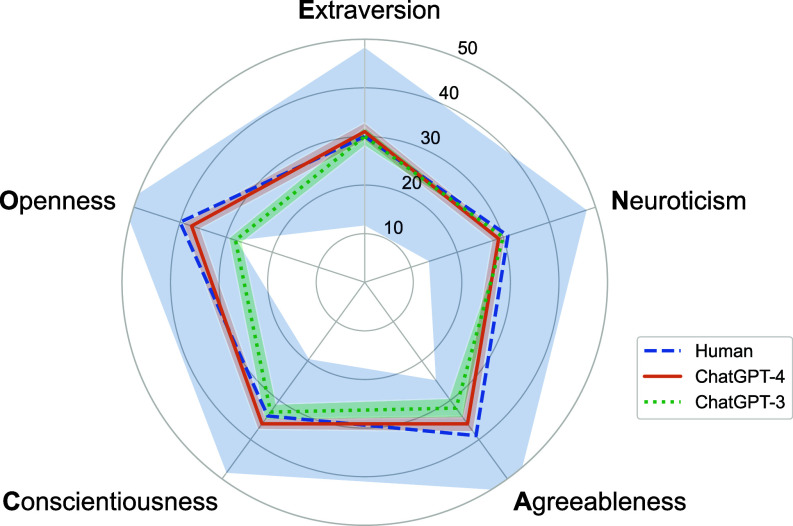
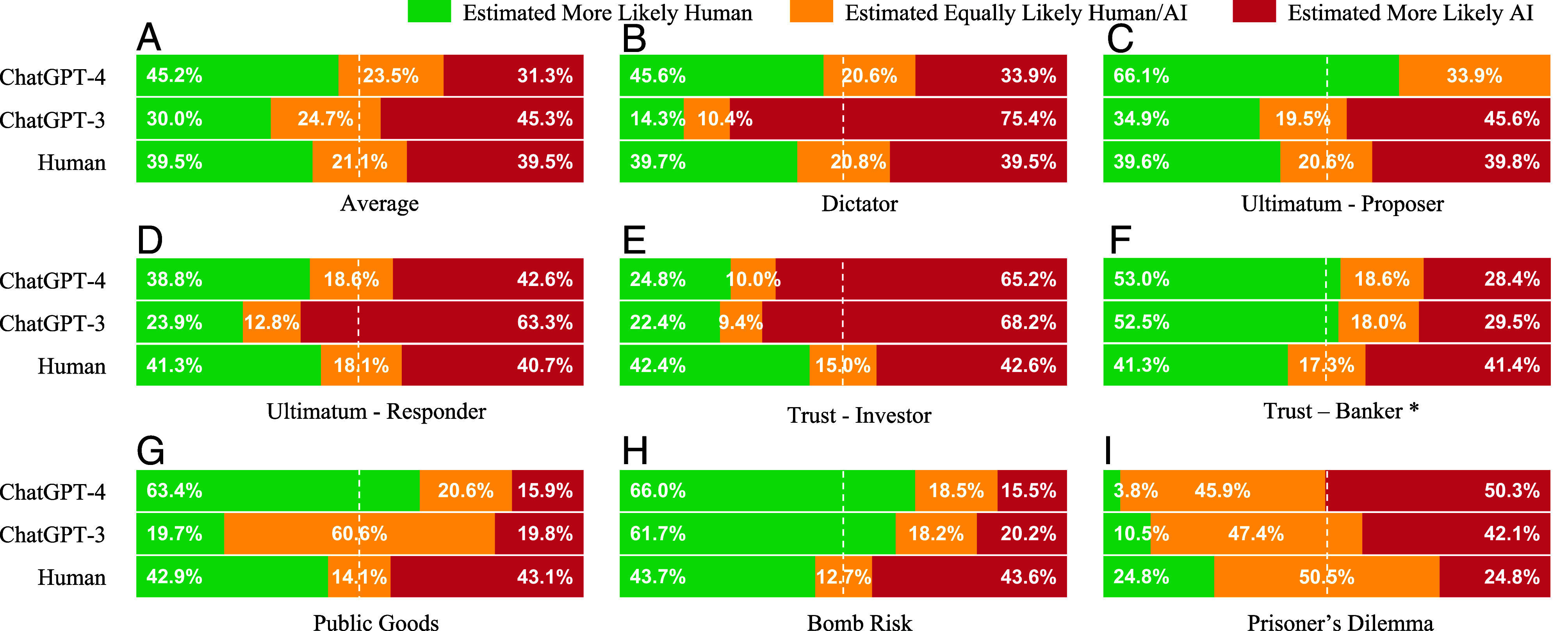
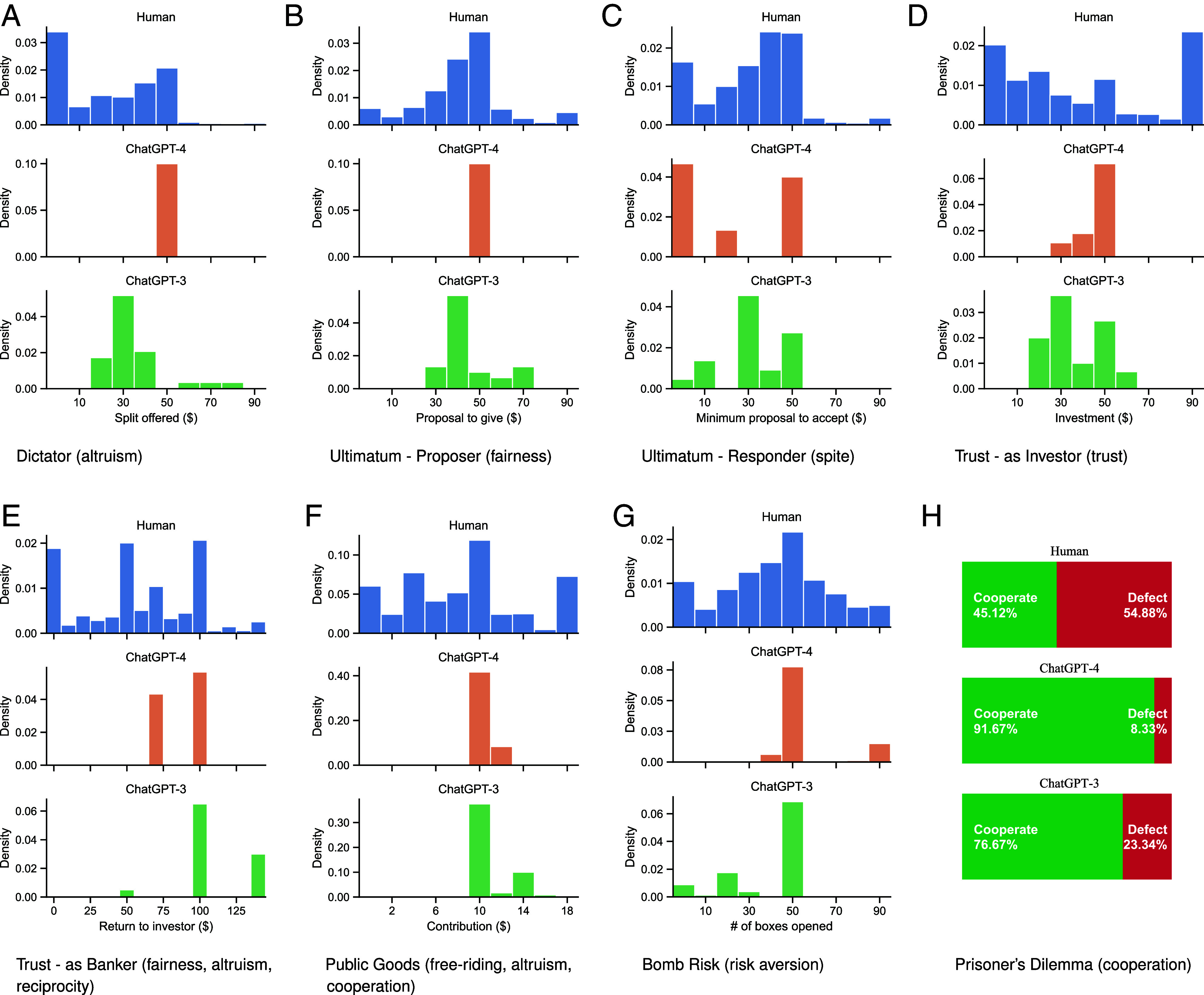
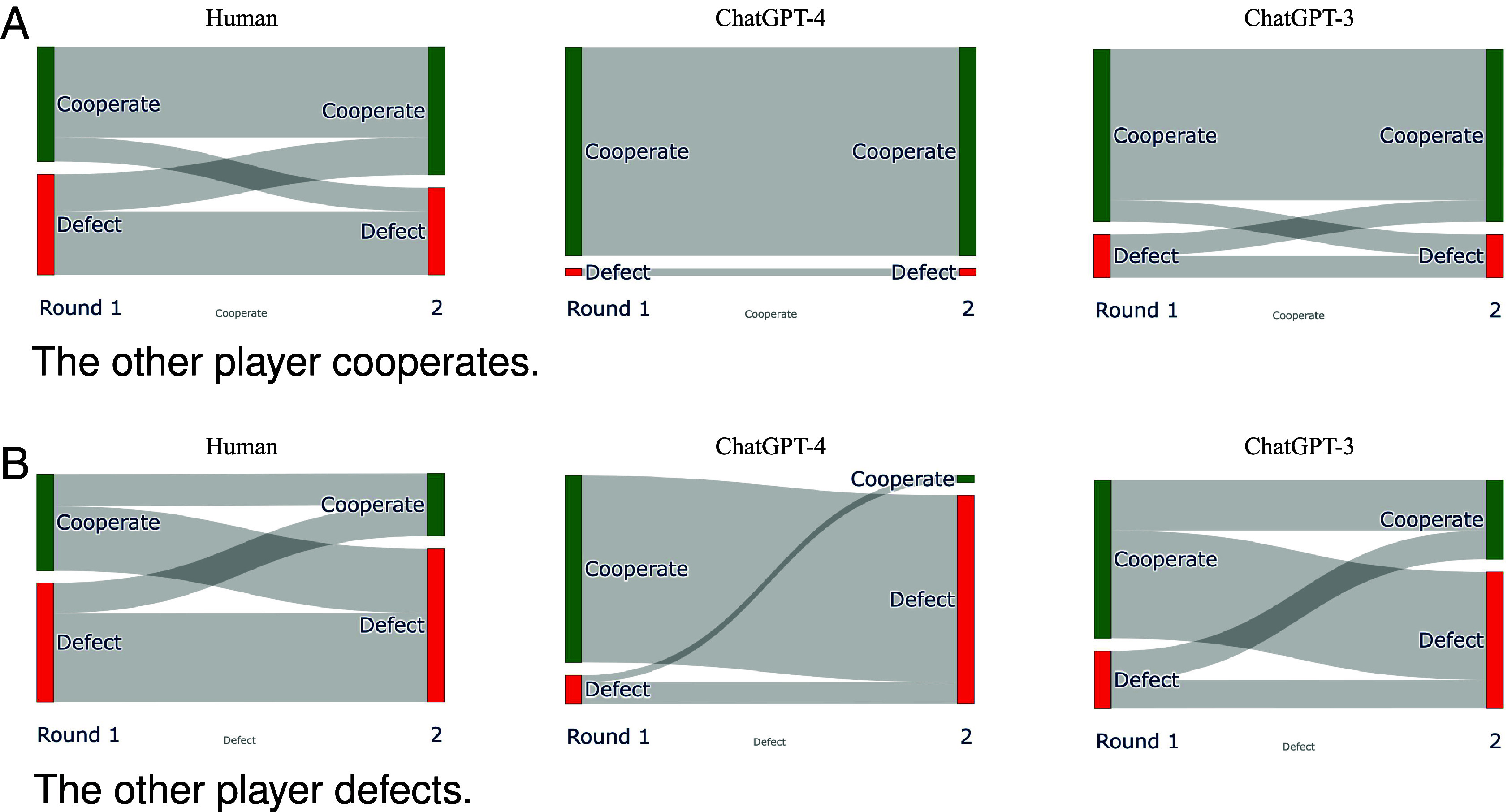
We administer a Turing test to AI chatbots. We examine how chatbots behave in a suite of classic behavioral games that are designed to elicit characteristics such as trust, fairness, risk-aversion, cooperation, etc., as well as how they respond to a traditional Big-5 psychological survey that measures personality traits. ChatGPT-4 exhibits behavioral and personality traits that are statistically indistinguishable from a random human from tens of thousands of human subjects from more than 50 countries. Chatbots also modify their behavior based on previous experience and contexts “as if” they were learning from the interactions and change their behavior in response to different framings of the same strategic situation. Their behaviors are often distinct from average and modal human behaviors, in which case they tend to behave on the more altruistic and cooperative end of the distribution. We estimate that they act as if they are maximizing an average of their own and partner’s payoffs.
Overview
The claims and statistics of this paper haven’t been checked yet.
Free: it reads the open-access text and checks the first 5 claims that cite a source we can check. Create a free account to check every claim.
Integrity signals
Registry
Cites
Statistics
Figures
Verification
Claims the paper makes
The claims and statistics of this paper haven’t been checked yet.
Free: it reads the open-access text and checks the first 5 claims that cite a source we can check. Create a free account to check every claim.
Claims other papers make about this one
Each is checked against this paper’s own text: does it say what the citing paper says it does?
The source backs part of the claim, not all of it — or backs it for a different population, condition or comparison.
In the citing paper
“But users increasingly cannot tell the difference between human writing and LLM writing when presented with text (30–32), and between a human interlocutor or a contemporary chatbot when in interaction (17, 26).”
From The benefits and dangers of anthropomorphic conversational agents (2025) · cites this paper as [17]
Experimental — accuracy not yet measuredThe check wasn’t confident either way, so it gives no verdict — never disputed.
In the citing paper
“research has raised concerns that LLMs may not fully grasp the tasks they perform, sometimes resulting in erratic behavior [54,82].”
From Adaptive Information Modulation: Designing Governance Mechanisms for Multi-Agent Artificial Intelligence Systems (2026) · cites this paper as [54]
Experimental — accuracy not yet measuredIn the citing paper
“Still other studies indicate LLMs can replicate classic experiments in cognitive science and the study of morality and replicate human behavior in the Prisoner’s Dilemma and other behavioral games (21–24).”
From Can Generative AI improve social science? (2024) · cites this paper as [23]
Self-check
Percentages, sums and reported differences re-computed from the paper’s own numbers.
The self-check needs the paper’s full text.
Citations
Cites
I.—COMPUTING MACHINERY AND INTELLIGENCE
TURING, A. M. (1950) · Mind · doi:10.1093/mind/lix.236.433 · Cited by 10,290
Trust, Reciprocity, and Social History
Berg, J., Dickhaut, J., & McCabe, K. (1995) · Games and Economic Behavior · doi:10.1006/game.1995.1027 · Cited by 5,548
An experimental analysis of ultimatum bargaining
Güth, W., Schmittberger, R., & Schwarze, B. (1982) · Journal of Economic Behavior & Organization · doi:10.1016/0167-2681(82)90011-7 · Cited by 4,816
The structure of phenotypic personality traits.
Goldberg, L. R. (1993) · American Psychologist · doi:10.1037/0003-066x.48.1.26 · Cited by 4,816
Personality trait structure as a human universal.
McCrae, R. R., & Costa, P. T. (1997) · American Psychologist · doi:10.1037/0003-066x.52.5.509 · Cited by 4,234
Theory of Games and Economic Behavior
ROWLAND, E. (1946) · Nature · doi:10.1038/157172a0 · Cited by 3,280
Fairness in Simple Bargaining Experiments
Forsythe, R., Horowitz, J. L., Savin, N. E., & Sefton, M. (1994) · Games and Economic Behavior · doi:10.1006/game.1994.1021 · Cited by 2,366
GPTs are GPTs: An Early Look at the Labor Market Impact Potential of Large Language Models
Eloundou, T., Manning, S., Mishkin, P., & Rock, D. (2023) · arXiv · doi:10.48550/arxiv.2303.10130 · Cited by 2,330
Benefits, Limits, and Risks of GPT-4 as an AI Chatbot for Medicine
Lee, P., Bubeck, S., & Petro, J. (2023) · New England Journal of Medicine · doi:10.1056/nejmsr2214184 · Cited by 1,738
Sparks of Artificial General Intelligence: Early experiments with GPT-4
Bubeck, S., Chandrasekaran, V., Eldan, R., Gehrke, J., Horvitz, E., Kamar, E., Lee, P., Lee, Y. T., Li, Y., Lundberg, S., et al. (2023) · arXiv · doi:10.48550/arxiv.2303.12712 · Cited by 1,526
Research works printed but not linked: 1
- K. Warwick, Turing Test Success Marks Milestone in Computing History (University or Reading Press Release, 2014), p. 8.
Cited by
The impact of generative artificial intelligence on socioeconomic inequalities and policy making
Capraro, V., Lentsch, A., Acemoglu, D., Akgun, S., Akhmedova, A., Bilancini, E., Bonnefon, J.-F., Brañas-Garza, P., Butera, L., Douglas, K. M., et al. (2024) · PNAS Nexus · doi:10.1093/pnasnexus/pgae191 · Cited by 371
Can Generative AI improve social science?
Bail, C. A. (2024) · Proceedings of the National Academy of Sciences · doi:10.1073/pnas.2314021121 · Cited by 369
Can Generative AI Improve Social Science?
Bail, C. A. (2023) · doi:10.31235/osf.io/rwtzs · Cited by 369
Storey, V. C., Yue, W. T., Zhao, J. L., & Lukyanenko, R. (2025) · Information Systems Frontiers · doi:10.1007/s10796-025-10581-7 · Cited by 296
“Similarly, human-sounding outputs of ChatGPT are emergent from the specific connectionist and natural language architecture of GenAI, which, if de-coupled and used separately will fail to render similar types of outputs (Mei et al., 2024).”
A Manager and an AI Walk into a Bar: Does ChatGPT Make Biased Decisions Like We Do?
Chen, Y., Kirshner, S. N., Ovchinnikov, A., Andiappan, M., & Jenkin, T. (2025) · Manufacturing & Service Operations Management · doi:10.1287/msom.2023.0279 · Cited by 143
Artificial intelligence in tourism: insights and future research agenda
Tuo, Y., Wu, J., Zhao, J., & Si, X. (2024) · Tourism Review · doi:10.1108/tr-03-2024-0180 · Cited by 146
AI-enhanced collective intelligence
Cui, H., & Yasseri, T. (2024) · Patterns · doi:10.1016/j.patter.2024.101074 · Cited by 145
“113 A study on forbidden triads among jazz groups shows that heavily sided open triangles are associated with lower success (measured by the number of group releases).”
The benefits and dangers of anthropomorphic conversational agents
Peter, S., Riemer, K., & West, J. D. (2025) · Proceedings of the National Academy of Sciences · doi:10.1073/pnas.2415898122 · Cited by 110
Can Generative AI Chatbots Emulate Human Connection? A Relationship Science Perspective
Smith, M. G., Bradbury, T. N., & Karney, B. R. (2025) · Perspectives on Psychological Science · doi:10.1177/17456916251351306 · Cited by 88
“In a battery of behavioral tests including trust, bargaining, and pris-oner’s dilemma games, ChatGPT’s behavior was deemed “statistically indistinguishable” from human subjects (Mei et al., 2024, p. 1).”
Making It Possible for the Auditing of AI: A Systematic Review of AI Audits and AI Auditability
Li, Y., & Goel, S. (2024) · Information Systems Frontiers · doi:10.1007/s10796-024-10508-8 · Cited by 107
“According to a recent study by Mei et al. (2024), ChatGPT-4 exhibits behavioral and personality traits that are statistically indistinguishable from humans chosen randomly from a broad spectrum of subjects.”
LLM-Augmented Agent-Based Modelling for Social Simulations: Challenges and Opportunities
Gürcan, Ö. (2024) · Frontiers in artificial intelligence and applications · doi:10.3233/faia240190 · Cited by 84
Enam, M. A., Murmu, C., & Dixon, E. (2025) · International Journal of Human-Computer Interaction · doi:10.1080/10447318.2025.2476710 · Cited by 80
“Researchers have therefore called for further investigation of how different groups respond to these more advanced AI tools, such as LLM-based generative AI (Mei et al., 2024).”
Conceptualizing generative AI as style engines: Application archetypes and implications
Riemer, K., & Peter, S. (2024) · International Journal of Information Management · doi:10.1016/j.ijinfomgt.2024.102824 · Cited by 63
From robots to chatbots: unveiling the dynamics of human-AI interaction
Łukasik, A., & Gut, A. (2025) · Frontiers in Psychology · doi:10.3389/fpsyg.2025.1569277 · Cited by 74
Pedersen, C. L., & Ritter, T. (2024) · Industrial Marketing Management · doi:10.1016/j.indmarman.2024.10.005 · Cited by 62
Large language models display human-like social desirability biases in Big Five personality surveys
Salecha, A., Ireland, M. E., Subrahmanya, S., Sedoc, J., Ungar, L. H., & Eichstaedt, J. C. (2024) · PNAS Nexus · doi:10.1093/pnasnexus/pgae533 · Cited by 55
“Researchers have assessed LLMs with Big Five surveys and compared trait distribution to human norms (7), in addition to correlating traits with downstream task performance (8).”
Agentic Large Language Models for day-to-day route choices
Wang, L., Duan, P., He, Z., Lyu, C., Chen, X., Zheng, N., Yao, L., & Ma, Z. (2025) · Transportation Research Part C Emerging Technologies · doi:10.1016/j.trc.2025.105307 · Cited by 63
“Notably, [26] shows that GPT-4 has passed a Turing test, demonstrating behavior and personality traits that are statistically indistinguishable from a diverse human sample spanning over 50 countries.”
Challenging the Validity of Personality Tests for Large Language Models
Sühr, T., Dorner, F. E., Samadi, S., & Kelava, A. (2025) · ACM Conference on Equity and Access in Algorithms, Mechanisms, and Optimization (EAAMO) · doi:10.1145/3757887.3763016 · Cited by 61
“As an idea that seems plausible at first glance, psychological tests are now being used in attempts to assess and quantify (potential) personality traits of LLMs [e.g., 8, 20, 21, 23, 24, 27, 30, 31, 34, 38, 39, 43, 44].”
Quaquebeke, N. V., Tonidandel, S., & Banks, G. C. (2025) · The Leadership Quarterly · doi:10.1016/j.leaqua.2025.101895 · Cited by 61
The impact of generative artificial intelligence on socioeconomic inequalities and policy makingPreprint
Capraro, V., Lentsch, A., Acemoğlu, D., Akgün, S., Akhmedova, A., Bilancini, E., Bonnefon, J., Brañas‐Garza, P., Butera, L., Douglas, K. M., et al. (2023) · PsyArXiv (OSF Preprints) · doi:10.31234/osf.io/6fd2y · Cited by 48
Strategic behavior of large language models and the role of game structure versus contextual framing
Lorè, N., & Heydari, B. (2024) · Scientific Reports · doi:10.1038/s41598-024-69032-z · Cited by 117
“Some argue that these models may serve as an intermediate step toward Artificial General Intelligence (AGI) [1].”
Multi-agent, human–agent and beyond: A survey on cooperation in social dilemmas
Mu, C., Guo, H., Chen, Y., Shen, C., Hu, D., Hu, S., & Wang, Z. (2024) · Neurocomputing · doi:10.1016/j.neucom.2024.128514 · Cited by 59
The Threat of Analytic Flexibility in Using Large Language Models to Simulate Human Data
Cummins, J. D. (2026) · Advances in Methods and Practices in Psychological Science · doi:10.1177/25152459261461505 · Cited by 48
“Mei et al. (2024) for instance, found that both ChatGPT-3.”
Game Theory Meets Large Language Models: A Systematic Survey with Taxonomy and New FrontiersPreprint
Sun, H., Wu, Y.-S., Wang, P., Chen, W., Cheng, Y.-K., Deng, X.-T., & Chu, X. (2025) · arXiv.org · doi:10.48550/arxiv.2502.09053 · Cited by 13
“The Turing Test conducted by Mei et al. [56] also confirms that LLMs tend to behave more altruistically and cooperatively, which suggests that LLMs are maximizing the average of their and the partner’s payoff by default.”
Open and closed-ended problem solving in humans and AI: The influence of question asking complexity
Raz, T., Reiter‐Palmon, R., & Kenett, Y. N. (2024) · Thinking Skills and Creativity · doi:10.1016/j.tsc.2024.101598 · Cited by 49
Large Language Models: An Applied Econometric Framework
Ludwig, J., Mullainathan, S., & Rambachan, A. (2026) · Annual Review of Economics · doi:10.1146/annurev-economics-120925-105620 · Cited by 90
Posthuman Cartography? Rethinking Artificial Intelligence, Cartographic Practices, and Reflexivity
Lin, Y., & Zhao, B. (2025) · Annals of the American Association of Geographers · doi:10.1080/24694452.2024.2435920 · Cited by 47
“Recent advancements, such as ChatGPT-4 passing rigorous Turing tests (Turing 1950; Mei et al. 2024), demonstrate AI ’ s capability to match or even exceed the average human ’ s abilities in areas such as altruism and cooperation.”
McLean, A. L., & Hristidis, V. (2025) · Journal of Cancer Education · doi:10.1007/s13187-025-02592-4 · Cited by 44
AI emerges as the frontier in behavioral science
Meng, J. (2024) · Proceedings of the National Academy of Sciences · doi:10.1073/pnas.2401336121 · Cited by 57
The Mixed Subjects Design: Treating Large Language Models as Potentially Informative Observations
Broska, D., Howes, M., & van Loon, A. (2025) · Sociological Methods & Research · doi:10.1177/00491241251326865 · Cited by 64
The cultural stereotype and cultural bias of ChatGPT
Yuan, H., Che, Z., Zhang, Y., Shao, L. H., Yuan, X., Huang, L., Hu, X., Peng, K., & Luo, S. (2025) · Journal of Pacific Rim Psychology · doi:10.1177/18344909251355673 · Cited by 38
“Previous studies have also found that responses from LLMs vary based on how they are prompted (Geng et al., 2024; Mei et al., 2024), high-lighting the critical importance of re fi ning prompt design to achieve more equitable and unbiased AI outputs.”
Six Fallacies in Substituting Large Language Models for Human Participants
Lin, Z. (2025) · Advances in Methods and Practices in Psychological Science · doi:10.1177/25152459251357566 · Cited by 66
Surprising gender biases in GPT
Fulgu, R. A., & Capraro, V. (2024) · Computers in Human Behavior Reports · doi:10.1016/j.chbr.2024.100533 · Cited by 45
Generative AI Solutions to Empower Financial Firms
Dubey, S. S., Astvansh, V., & Kopalle, P. K. (2025) · Journal of Public Policy & Marketing · doi:10.1177/07439156241311300 · Cited by 40
“Contextualized understanding of language enables GenAI to adapt its responses to customers (Huang and Rust 2023; Mei et al. 2024).”
Editorial: The changing landscape of marketing research in the AI era: prospects and challenges
Wang, C. L. (2026) · Journal of Research in Interactive Marketing · doi:10.1108/jrim-02-2026-766 · Cited by 38
Can large language models help predict results from a complex behavioural science study?
Lippert, S., Dreber, A., Johannesson, M., Tierney, W., Cyrus-Lai, W., Uhlmann, E. L., Emotion Expression Collaboration, & Pfeiffer, T. (2024) · Royal Society Open Science · doi:10.1098/rsos.240682 · Cited by 45
AI Surrogates and illusions of generalizability in cognitive science
Crockett, M. J., & Messeri, L. R. (2025) · Trends in Cognitive Sciences · doi:10.1016/j.tics.2025.09.012 · Cited by 36
Strategic Collusion of LLM Agents: Market Division in Multi-Commodity CompetitionsPreprint
Lin, R. Y., Ojha, S., Cai, K., & Chen, M. F. (2024) · RePEc: Research Papers in Economics · doi:10.48550/arxiv.2410.00031 · Cited by 44
“Interestingly, behavioral economics research has shown that human subjects can deviate from these theoretical predictions, sustaining cooperation even in finitely repeated games [28, 29].”
Colour/shape-taste correspondences across three languages in ChatGPT
Motoki, K., Spence, C. J., & Velasco, C. (2024) · Cognition · doi:10.1016/j.cognition.2024.105936 · Cited by 30
“In particular, the responses obtained by ChatGPT are sometimes similar to those given by human respondents (Mei et al., 2024; Suri et al., 2024).”
InfluentialGenerative AI framework for sensory and consumer research
Motoki, K., Low, J. Y. Q., & Velasco, C. (2025) · Food Quality and Preference · doi:10.1016/j.foodqual.2025.105600 · Cited by 32
Towards a mixed human–machine creativity
Farina, M., Pedrycz, W., & Lavazza, A. (2024) · Journal of Cultural Cognitive Science · doi:10.1007/s41809-024-00146-6 · Cited by 30
“This may also happen because certain algorithmic systems can achieve a human-like performative capacity (Mei et al., 2024).”
Li, C., & Qi, Y. (2025) · Computers in Human Behavior · doi:10.1016/j.chb.2025.108687 · Cited by 40
AI ‐Mediated Communication in E‐Commerce: Implications for Customer Trust
Hennighausen, C., Navarro‐Schär, V. G. Y., & Eller, E. (2025) · International Journal of Consumer Studies · doi:10.1111/ijcs.70111 · Cited by 31
Chen, L., Zhang, Y., Feng, J., Chai, H., Zhang, H., Fan, B., Ma, Y., Zhang, S., Li, N., Liu, T., et al. (2026) · Humanities and Social Sciences Communications · doi:10.1057/s41599-026-07316-7 · Cited by 37
“Mei et al. [103] demonstrate how behavioral science tools can be repurposed to assess LLM preferences and traits, drawing comparisons with a global dataset of human behavior.”
Huang, G. I., Zhang, C., Torres, W. C. Z., Xiong, X., & Li, H. (2025) · Tourism Management · doi:10.1016/j.tourman.2025.105315 · Cited by 26
Theorizing with Large Language Models
Tranchero, M., Brenninkmeijer, C.-F., Murugan, A., & Nagaraj, A. (2024) · National Bureau of Economic Research · doi:10.3386/w33033 · Cited by 48
The high-dimensional psychological profile of ChatGPT
Zhang, Y., Shao, L. H., Yuan, X., Yuan, H., Che, Z., & Luo, S. (2025) · Science China Technological Sciences · doi:10.1007/s11431-025-2934-8 · Cited by 23
Can AI with High Reasoning Ability Replicate Human-like Decision Making in Economic Experiments?
Kitadai, A., Lugo, S. D. R., Tsurusaki, Y., Fukasawa, Y., & Nishino, N. (2025) · Group Decision and Negotiation · doi:10.1007/s10726-025-09946-9 · Cited by 29
“Each prompting method (Few-shot, CoT, or Zero-shot) was introduced here”
Are LLMs Socially Adaptive? Contrasting Belief Evolution in Large Language Models and Humans
Yu, L., Liu, H., Xie, C., Liu, S., Yin, Z., Chen, C., Li, G., Torr, P. H. S., & Wu, Z. (2026) · ACM SIGKDD Conference on Knowledge Discovery and Data Mining (KDD) · doi:10.1145/3770855.3818977 · Cited by 23
Wong, S. S. H., & Qiu, S. X. (2026) · Educational Psychology Review · doi:10.1007/s10648-026-10118-7 · Cited by 22
Haupt, M. R., Yang, L., Purnat, T. D., & Mackey, T. K. (2024) · JMIR Infodemiology · doi:10.2196/60678 · Cited by 24
“As output from LLMs is becoming increasingly indistinguishable from human responses [56], chatbots using LLMs raise particular concerns because they can be used to create fake accounts that deceive users by mimicking the language patterns of targeted identities (refer to the studies by De Angelis…”
BackgroundAutomated Social Science: Language Models as Scientist and SubjectsPreprint
Manning, B. S., Zhu, K., & Horton, J. J. (2024) · SSRN Electronic Journal · doi:10.2139/ssrn.4810596 · Cited by 53
A Primer on Large Language Models and their LimitationsPreprint
Johnson, S., & Hyland-Wood, D. (2025) · Qeios · doi:10.32388/nhjyvs · Cited by 21
What makes children perceive or not perceive minds in generative AI?
Xu, Y., Thomas, T., Yu, C., & Pan, Z. (2025) · Computers in Human Behavior Artificial Humans · doi:10.1016/j.chbah.2025.100135 · Cited by 27
Salingaros, N. A. (2024) · New Design Ideas · doi:10.62476/ndi82261 · Cited by 24
Huang, C., Wu, Y., & Wang, K. (2026) · SSRN Electronic Journal · doi:10.2139/ssrn.6131846 · Cited by 21
Recognising and mitigating LLM Pollution in online behavioural research
Rilla, R., Werner, T., Yakura, H., Rahwan, I., & Nußberger, A.-M. (2026) · Nature Communications · doi:10.1038/s41467-026-74621-9 · Cited by 28
DaCosta, B. (2025) · Heritage · doi:10.3390/heritage8090387 · Cited by 19
Large Language Models as Psychological Simulators: A Methodological Guide
Lin, Z. (2026) · Advances in Methods and Practices in Psychological Science · doi:10.1177/25152459251410153 · Cited by 29
“Mei et al. (2024), for example, compared GPT-3.”
From silicon to solutions: AI's impending impact on research and discovery
Markowitz, D. M., Boyd, R. L., & Blackburn, K. G. (2024) · Frontiers in Social Psychology · doi:10.3389/frsps.2024.1392128 · Cited by 19
Wang, Z., Song, R., Shen, C., Yin, S., Song, Z., Battu, B., Shi, L., Jia, D., Rahwan, T., & Hu, S. (2026) · National Science Review · doi:10.1093/nsr/nwag223 · Cited by 17
“Second, their extensive training on human corpora allows them to grasp key concepts such as rationality, risk, trust and fairness, which underpin human cooperative behaviors [27 ,28 ].”
Will our social brain inherently shape and be shaped by interactions with AI?
Becker, B. (2025) · Neuron · doi:10.1016/j.neuron.2025.04.034 · Cited by 17
Social bots spoil activist sentiment without eroding engagement
LI, L. C., Vásárhelyi, O., & Vedres, B. (2024) · Scientific Reports · doi:10.1038/s41598-024-74032-0 · Cited by 22
Ng, S. H. S., & Lai, J. W. (2025) · Higher Education Research & Development · doi:10.1080/07294360.2025.2564977 · Cited by 17
“Modern AI systems are frequently touted for demonstrating capabilities for problem-solving and creative generation that parallel and sometimes surpass human cognitive processes (Mei et al., 2024).”
Social Perception of Faces in a Vision-Language Model
Hausladen, C. I., Knott, M., Camerer, C. F., & Perona, P. (2025) · ACM Conference on Fairness, Accountability, and Transparency (FAccT) · doi:10.1145/3715275.3732041 · Cited by 22
“Our study shows that this is also viable for VLMs. CausalFace does not account for all intersections of protected and non-protected attributes.”
The Impact of Generative Artificial Intelligence on Socioeconomic Inequalities and Policy MakingPreprint
Capraro, V., Lentsch, A., Acemoğlu, D., Akgün, S., Akhmedova, A., Bilancini, E., Bonnefon, J., Brañas‐Garza, P., Butera, L., Douglas, K. M., et al. (2024) · SSRN Electronic Journal · doi:10.2139/ssrn.4666103 · Cited by 18
Ennion, M., & McLellan, R. (2025) · doi:10.21428/8c225f6e.540b41b5 · Cited by 17
Algorithms in the room: AI, representation, and decisions about sustainable futures
Mills, S., & Sætra, H. S. (2025) · Technovation · doi:10.1016/j.technovation.2025.103304 · Cited by 15
Psychomatics—A Multidisciplinary Framework for Understanding Artificial Minds
Riva, G., Mantovani, F., Wiederhold, B. K., Marchetti, A., & Gaggioli, A. (2025) · Cyberpsychology Behavior and Social Networking · doi:10.1089/cyber.2024.0409 · Cited by 15
“For example, Mei et al. 13 used conventional behavioral measures from economics and psychology to evaluate the behavioral and personality traits of large language models (LLMs).”
Artificial intelligence can emulate human normative judgments on emotional visual scenes
Romeo, Z., & Testolin, A. (2025) · Royal Society Open Science · doi:10.1098/rsos.250128 · Cited by 15
“These systems achieve human-like (or even super-human) performance in challenging cognitive tasks such as text annotation [5] and coding [6], and can exhibit behavioral and personality traits that are statistically indistinguishable from those of human subjects [7].”
Xie, Y., Mei, Q., Yuan, W., & Jackson, M. O. (2025) · Proceedings of the National Academy of Sciences · doi:10.1073/pnas.2512075122 · Cited by 26
“For these seven game scenarios, we utilize human game-play data from ( 14 ) to conduct our experiments and analyses.”
Self-citationCan Large Language Models Simulate Spoken Human Conversations?
Mayor, E., Bietti, L. M., & Bangerter, A. (2025) · Cognitive Science · doi:10.1111/cogs.70106 · Cited by 19
“Many Turing test studies of LLMs exist, but are ambiguous about their ability to deceive humans (Mei et al., 2024).”
Rethinking the “A” in STEAM: Insights from and for AI Literacy Education
Mertala, P., Fagerlund, J., & Dufva, T. S. (2026) · Springer eBooks · doi:10.1007/60490_2026_16 · Cited by 12
“For example, pop-ularized AI explanations may enhance anthropomorphic (mis)conceptions by claiming that LLMs can talk and understand "just like humans” with their "big, magical brain,” as stated in a recent blog post aimed at a younger audience [42].”
Tamura, K., & Morita, S. (2024) · Royal Society Open Science · doi:10.1098/rsos.241195 · Cited by 12
Bentzen, S. M. (2025) · Clinical Oncology · doi:10.1016/j.clon.2025.103798 · Cited by 13
Estimation of disciplinary similarity with large language models
Cantone, G. G., Zheng, E.-T., Tomaselli, V., & Nightingale, P. (2025) · Scientometrics · doi:10.1007/s11192-025-05385-0 · Cited by 14
“They are capable of communicating with a human agent, behaving similarly to so‑called chatbots , but being capable of generalising and generating a much wider range of answers (Mei et al., 2024; Noy & Zhang, 2023; Nejjar et al., 2024; Ray, 2023; Shanahan, 2024).”
Artificial intelligence and climate change: the potential roles of foundation models
Filho, W. L., Kovaleva, M., Ng, A. W., Nagy, G. J., Luetz, J. M., & Dinis, M. A. P. (2025) · Environmental Sciences Europe · doi:10.1186/s12302-025-01153-2 · Cited by 14
“Computers and chatbots are programmed to operate similar to humans while learning human behaviour, such as judgment and subsequent decision-making [35, 55].”
Can Machines Think Like Humans? A Behavioral Evaluation of LLM Agents in Dictator GamesPreprint
Ma, J. (2024) · arXiv (Cornell University) · doi:10.48550/arxiv.2410.21359 · Cited by 17
Kleinert, S., & Urbig, D. (2026) · Entrepreneurship Theory and Practice · doi:10.1177/10422587261430320 · Cited by 13
Beyond the snafu: Research directions in customer experience-led business transformation
Keyser, A. D., & Vaerenbergh, Y. V. (2024) · AMS Review · doi:10.1007/s13162-024-00279-5 · Cited by 13
“Finally, recent studies, such as those conducted by Mei et al. (2024), demonstrate that AI-generated data, particularly those from advanced models like ChatGPT-4, exhibit behaviors and personality traits similar to human responses.”
Towards a psychology of machines: large language models predict human memory
Ulakçı, E., Göbel, J. P., & Huff, M. (2025) · PeerJ Computer Science · doi:10.7717/peerj-cs.3324 · Cited by 13
Computational strategic communication in a data-driven world
Zhou, A. Y., & van der Meer, T. G. L. A. (2024) · Public Relations Review · doi:10.1016/j.pubrev.2024.102496 · Cited by 11
Lee, S., Yang, K.-Q., Peng, T., Heo, R., & Liu, H. (2024) · arXiv (Cornell University) · doi:10.48550/arxiv.2410.15442 · Cited by 14
Be.FM: Open Foundation Models for Human BehaviorPreprint
Xie, Y., Li, Z., Wang, X., Pan, Y., Liu, Q., Cui, X., Lo, K.-Y., Gao, R., Zhang, X., Huang, J., et al. (2025) · SSRN Electronic Journal · doi:10.2139/ssrn.5274559 · Cited by 15
Self-citationExamining the Feasibility of Large Language Models as Survey Respondents
Kitadai, A., Ogawa, K., & Nishino, N. (2024) · IEEE International Conference on Big Data (BigData) · doi:10.1109/bigdata62323.2024.10825497 · Cited by 14
Challenges and opportunities in using interpretable AI to develop relationship interventions
Puhlman, D. J., & Chen, C. (2025) · Family Relations · doi:10.1111/fare.13172 · Cited by 10
AI Testing for Intelligent Chatbots—A Case Study
Gao, J. Z., Agarwal, R., & Garsole, P. (2025) · Software · doi:10.3390/software4020012 · Cited by 10
Judgments of learning distinguish humans from large language models in predicting memory
Huff, M., & Ulakci, E. (2025) · Scientific Reports · doi:10.1038/s41598-025-22290-x · Cited by 9
“…collecting data from a model is not the same as obtaining responses from each individual, instead, it involves repeatedly retrieving information from the same integrated model, similar to the situation where one person is questioned recurrently rather than obtaining data from multiple people 10 .”
The collective turing test: large language models can generate realistic multi-user discussions
Bouleimen, A., Marzo, G. D., Kim, T., Pagan, N., Metzler, H., Giordano, S., Hannák, A., & García, D. (2026) · Scientific Reports · doi:10.1038/s41598-026-62286-9 · Cited by 9
Ogg, M., Bose, R., Scharf, J. A., Ratto, C. R., & Wolmetz, M. E. (2026) · iScience · doi:10.1016/j.isci.2026.116400 · Cited by 9
“12,13 In a Turing experiment, an LLM is used to simulate a sample of the human population over repeated runs, 13,14 sometimes using simulated participant identities for each new run, 12,15 and is prompted to engage in classic psychology tasks (e.g., the prisoner’s dilemma, the ulti-matum game, or…”
Distributive Fairness in Large Language Models: Evaluating Alignment with Human Values
Hosseini, H., & Khanna, S. (2025) · neural information processing systems · doi:10.52202/085713-2898 · Cited by 20
A validity-guided workflow for robust large language model research in psychology
Lin, Z. (2026) · Behavior Research Methods · doi:10.3758/s13428-026-03073-2 · Cited by 8
“…just the central tendencies, such as the mean response, but also the deeper structural features of the human data, including its distributional properties like variance, the internal structure of psychometric scales, and the nomological network of correlations among variables (Mei et al., 2024).”
Donner, S. (2025) · Journal of Documentation · doi:10.1108/jd-11-2024-0271 · Cited by 9
Keyßer, G., Pfeil, A., Reuss-Borst, M. A., Frohne, I., Schultz, O., & Sander, O. (2024) · Zeitschrift für Rheumatologie · doi:10.1007/s00393-024-01535-6 · Cited by 8
Game-theory behaviour of large language models: The case of Keynesian beauty contests
Lu, S. E. (2025) · Economics and Business Review/The Poznań University of Economics Review · doi:10.18559/ebr.2025.2.2182 · Cited by 11
LLMs Model Non-WEIRD Populations: Experiments with Synthetic Cultural AgentsPreprint
Gonzalez-Bonorino, A., Capra, M., & Pantoja, E. (2025) · RePEc: Research Papers in Economics · doi:10.48550/arxiv.2501.06834 · Cited by 10
Valuing time in silicon: Can large language models replicate human value of travel time
Yan, Y., Liu, T., & Yin, Y. (2026) · Travel Behaviour and Society · doi:10.1016/j.tbs.2026.101245 · Cited by 15
“Subsequent studies expanded the scope of economic games and investigated newer LLM versions (Akata et al., 2025; Xie et al., 2024; Fan et al., 2024; Aher et al., 2023), similarly finding that LLMs could comprehend game settings and adopt human-like strategies.”
InfluentialStatic network structure cannot stabilize cooperation among large language model agents
Han, J., Battu, B., Romić, I., Rahwan, T., & Holme, P. (2025) · PLoS ONE · doi:10.1371/journal.pone.0320094 · Cited by 12
“Rather than being guided by strategic intentions, LLMs’ behaviors appear largely shaped by underlying “personalities” encoded during training, rather than situational awareness or social intuition 5,11,29,33 .”
InfluentialAutomating chemosensory creativity assessment with large language models
Wang, Q. J., & Pellegrino, R. (2025) · Food Quality and Preference · doi:10.1016/j.foodqual.2025.105599 · Cited by 8
Do Chatbots Exhibit Personality Traits? A Comparison of ChatGPT and Gemini Through Self-Assessment
Jędrzejczak, W. W., & Kobosko, J. (2025) · Information · doi:10.3390/info16070523 · Cited by 7
Metadata
- Authors
- Mei, Q., Xie, Y., Yuan, W., & Jackson, M. O.
- Affiliations
- University of Michigan (US)
- MobLab, Pasadena, CA 91107
- Santa Fe Institute (US)
- Corresponding author
- Mei, Qiaozhu
- Jackson, Matthew O.
- Venue
- Proceedings of the National Academy of Sciences
- Publisher
- National Academy of Sciences
- Published
- 2024-02-22
- Volume
- 121
- Issue
- 9
- Pages
- e2313925121-e2313925121
- ISSN
- 0027-8424 (ISSN-L)
- 1091-6490
- PMC
- PMC10907317
- OpenAlex
- W4392028279
- Cited by
- 254
- References
- 26
- Citations by year
- 2026: 75 · 2025: 118 · 2024: 59
- FWCI
- 104.44
- Type
- journal article
- Language
- en
- Open access
- hybrid
- doi.org
- Licence
- Locations
- Proceedings of the National Academy of Sciences (publishedVersion, cc-by-nc-nd)
- PubMed Central (publishedVersion, cc-by-nc-nd)
- PubMed (publishedVersion)
- Topics
- Social Sciences › Economics, Econometrics and Finance › Economics and Econometrics › Experimental Behavioral Economics Studies
- Physical Sciences › Computer Science › Artificial Intelligence › Ethics and Social Impacts of AI
- Social Sciences › Psychology › Social Psychology › Social Robot Interaction and HRI
- Keywords
- AI chatbots, Turing test, behavioral games, ChatGPT-4, Big Five personality traits, trust, fairness, risk aversion, cooperation, altruism, experiential learning, framing effects, human-AI comparison
- MeSH terms
- Affect, Altruism, Artificial Intelligence, Behavior, Humans, Pentaerythritol Tetranitrate, Trust
About these checks
Registry, retraction, Cites and statistics results are computed, not judged, with one exception: a printed reference that no index lists is read once by a model before it counts as a citation error. Claims are extracted by a model and kept only when their quote appears verbatim in the text; each cited source is then checked, with a model’s help, for whether it says what the claim relies on. Those verdicts can be wrong — read the claim’s quote and the cited source before relying on one.
Statistics and arithmetic are recomputed, not judged.
Confidence bands are shown only for fields calibrated on our annotated test set. None is calibrated yet, so no band is shown.
What counts as a claim ›How we measure confidence ›How we check this ›
Are you an author, or do you see a problem with this page? Request a review
Data sources
Bibliographic data: Semantic Scholar, OpenAlex, Crossref.
Contains information from the Semantic Scholar Academic Graph Datasets, made available under the ODC Attribution License (ODC-BY 1.0).
Semantic Scholar’s data is described in: Kinney, R., et al. (2023). The Semantic Scholar Open Data Platform. arXiv:2301.10140.
