

The DOI matches its Crossref record, with a small difference in title or year; 3 of the 3 references it cites were found in a registry or an index.
Inactivation of Interferon Regulatory Factor-1 Tumor Suppressor Protein by HPV E7 Oncoprotein
Overview
The claims and statistics of this paper haven’t been checked yet.
Run the check — free, no account needed. It reads the open-access text and checks the sources it cites.
Integrity signals
Registry
Cites
Statistics
Figures
Verification
Claims the paper makes
The claims and statistics of this paper haven’t been checked yet.
Run the check — free, no account needed. It reads the open-access text and checks the sources it cites.
Claims other papers make about this one
Each is checked against this paper’s own text: does it say what the citing paper says it does?
In the citing paper
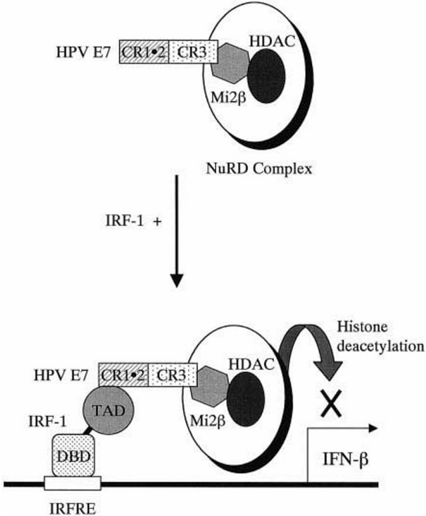
“HPV-16 E7 interacts with interferon regulatory factor-1 (IRF-1), which activates the IFN-β gene; however, by recruiting HDAC to abrogate the transactivation function of IFR-1, E7 has been suggested to suppress a cellular immune response to HPV infection [328]”
From The Not-So-Good, the Bad and the Ugly: HPV E5, E6 and E7 Oncoproteins in the Orchestration of Carcinogenesis (2021) · cites this paper as [328]
In the citing paper
“HPV E7 has also been shown to interact with HDAC1 and HDAC2 through the Mi2β protein [326]: both Mi2β and HDAC1/HDAC2 are components of the NuRD chromatin remodelling complex. This interaction has been demonstrated to modulate histone modification and transcription of cellular genes relevant to cell cycle deregulation [327] or immune evasion [328]”
From The Not-So-Good, the Bad and the Ugly: HPV E5, E6 and E7 Oncoproteins in the Orchestration of Carcinogenesis (2021) · cites this paper as [328]
Self-check
Percentages, sums and reported differences re-computed from the paper’s own numbers.
The self-check needs the paper’s full text.
Citations
Cites
Wathelet, M. G., Lin, C. H., Parekh, B. S., Ronco, L. V., Howley, P. M., & Maniatis, T. (1998) · Molecular Cell · doi:10.1016/s1097-2765(00)80051-9 · Cited by 730
Tanaka, N., Ishihara, M., Kitagawa, M., Harada, H., Kimura, T., Matsuyama, T., Lamphier, M. S., Aizawa, S., Mak, T. W., & Taniguchi, T. (1994) · Cell · doi:10.1016/0092-8674(94)90132-5 · Cited by 491
Durand, B., Saunders, M., Gaudon, C., Roy, B., Losson, R., & Chambon, P. (1994) · The EMBO Journal · doi:10.1002/j.1460-2075.1994.tb06872.x · Cited by 354
Research works printed but not linked: 36
- Pfister, 1987, Adv. Cancer Res., 48, 113, 10.1016/S0065-230X(08)60691-0 · DOI
- zur Hausen, 1996, Biochim. Biophys. Acta, 1288, F55
- Mansur, 1993, Biochim. Biophys. Acta, 1155, 323
- Jensen-Durr, 1996, Trends Genet., 12, 270, 10.1016/0168-9525(96)81455-7 · DOI
- Jewers, 1992, J. Virol., 66, 1329, 10.1128/jvi.66.3.1329-1335.1992 · DOI
- Brokaw, 1994, Virology, 205, 603, 10.1006/viro.1994.1688 · DOI
- Huang, 1993, Mol. Cell. Biol., 13, 953
- Wu, 1993, J. Virol., 67, 2404
- Brehm, 1999, EMBO J., 18, 2449, 10.1093/emboj/18.9.2449 · DOI · Paper page
- Taniguchi, 1997, Biochim. Biophys. Acta, 1333, M9
- Kirchhoff, 1993, Nucleic Acids Res., 21, 2881, 10.1093/nar/21.12.2881 · DOI
- Ploegh, 1998, Science, 280, 248, 10.1126/science.280.5361.248 · DOI
- Timmers, 1989, J. Virol., 63, 1470, 10.1128/jvi.63.3.1470-1473.1989 · DOI
- Proffitt, 1997, FEBS Lett., 400, 141, 10.1016/S0014-5793(96)01375-0 · DOI
- Ronco, 1998, Genes Dev., 12, 2061, 10.1101/gad.12.13.2061 · DOI · Paper page
- Vojtek, 1993, Cell, 74, 205, 10.1016/0092-8674(93)90307-C · DOI
- Le Douarinm, 1995, Nucleic Acids Res., 23, 876, 10.1093/nar/23.5.876 · DOI
- Tora, 1989, Cell, 59, 477, 10.1016/0092-8674(89)90031-7 · DOI
- vom Baur, 1998, Genes Dev., 12, 1278, 10.1101/gad.12.9.1278 · DOI
- Schneider, 1996, BioTechniques, 20, 960, 10.2144/96206bm03 · DOI
- Um, 1998, J. Biol. Chem., 273, 20728, 10.1074/jbc.273.33.20728 · DOI
- Demers, 1996, J. Virol., 70, 6862, 10.1128/jvi.70.10.6862-6869.1996 · DOI
- Germain, 1994, Cell, 76, 287, 10.1016/0092-8674(94)90336-0 · DOI
- Rollins, 1991, Mol. Cell. Biol., 11, 3125
- Cromme, 1993, Br. J. Cancer, 67, 1372, 10.1038/bjc.1993.254 · DOI
- Cromme, 1994, Br. J. Cancer, 69, 1176, 10.1038/bjc.1994.231 · DOI
- Riethdorf, 1996, Am. J. Pathol., 149, 1469
- Kleine-Lowinski, 1999, Int. J. Cancer, 82, 6, 10.1002/(SICI)1097-0215(19990702)82:1<6::AID-IJC2>3.0.CO;2-3 · DOI
- Min, 1996, J. Immunol., 156, 3174, 10.4049/jimmunol.156.9.3174 · DOI
- Hobart, 1997, J. Immunol., 158, 4260, 10.4049/jimmunol.158.9.4260 · DOI
- Chatterjee-Kishore, 1998, J. Biol. Chem., 273, 16177, 10.1074/jbc.273.26.16177 · DOI
- Zhou, 1998, J. Immunol., 160, 3908, 10.4049/jimmunol.160.8.3908 · DOI
- Valente, 1998, J. Immunol., 161, 3719, 10.4049/jimmunol.161.7.3719 · DOI
- Schafer, 1998, J. Biol. Chem., 273, 2714, 10.1074/jbc.273.5.2714 · DOI
- Borchers, 1999, Arch. Virol., 144, 1539, 10.1007/s007050050609 · DOI
- Barnard, 1999, Virology, 259, 305, 10.1006/viro.1999.9771 · DOI
Cited by
IRF Family of Transcription Factors as Regulators of Host Defense
Taniguchi, T., Ogasawara, K., Takaoka, A., & Tanaka, N. (2001) · Annual Review of Immunology · doi:10.1146/annurev.immunol.19.1.623 · Cited by 1,658
The IRF Family Transcription Factors in Immunity and Oncogenesis
Tamura, T., Yanai, H., Savitsky, D., & Taniguchi, T. (2008) · Annual Review of Immunology · doi:10.1146/annurev.immunol.26.021607.090400 · Cited by 1,259
The IRF family of transcription factors: Inception, impact and implications in oncogenesis
Yanai, H., Negishi, H., & Taniguchi, T. (2012) · OncoImmunology · doi:10.4161/onci.22475 · Cited by 261
Basukala, O., & Banks, L. (2021) · Viruses · doi:10.3390/v13101892 · Cited by 137
p130/E2F4 Binds to and Represses the cdc2 Promoter in Response to p53
Taylor, W. R., Schönthal, A. H., Galante, J., & Stark, G. R. (2001) · Journal of Biological Chemistry · doi:10.1074/jbc.m005101200 · Cited by 110
Metadata
- Authors
- Park, J.-S., Kim, E.-J., Kwon, H.-J., Hwang, E.-S., Namkoong, S.-E., & Um, S.-J.
- Venue
- Journal of Biological Chemistry
- Publisher
- Elsevier BV
- Published
- 2000-03
- Volume
- 275
- Issue
- 10
- Pages
- 6764-6769
- ISSN
- 0021-9258
- Cited by
- 285
- References
- 3
- Language
- en
About these checks
Registry, retraction, Cites and statistics results are computed, not judged, with one exception: a printed reference that no index lists is read once by a model before it counts as a citation error. Claims are extracted by a model and kept only when their quote appears verbatim in the text; each cited source is then checked, with a model’s help, for whether it says what the claim relies on. Those verdicts can be wrong — read the claim’s quote and the cited source before relying on one.
Statistics and arithmetic are recomputed, not judged.
Confidence bands are shown only for fields calibrated on our annotated test set. None is calibrated yet, so no band is shown.
What counts as a claim ›How we measure confidence ›How we check this ›
Are you an author, or do you see a problem with this page? Request a review
