

Post-translational Processing of β-Secretase (β-Amyloid-converting Enzyme) and Its Ectodomain Shedding
Open accessThe DOI matches its Crossref record; 49 of the 49 references it cites were found in a registry or an index.
Abstract
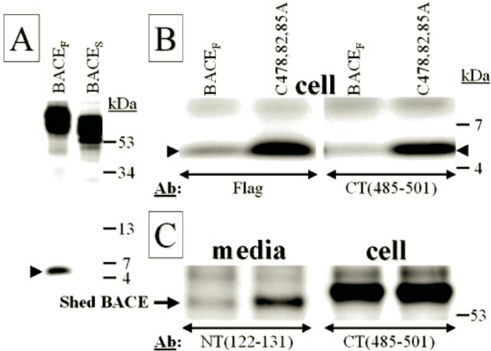
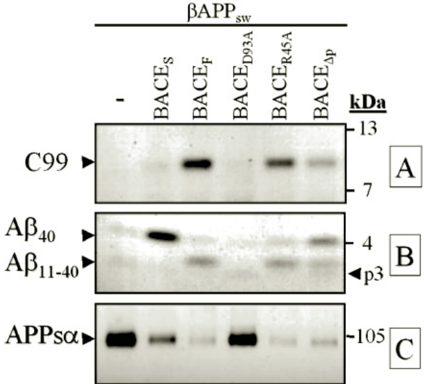
Processing of the beta-amyloid precursor protein (betaAPP) by beta- and gamma-secretases generates the amyloidogenic peptide Abeta, a major factor in the etiology of Alzheimer's disease. Following the recent identification of the beta-secretase beta-amyloid-converting enzyme (BACE), we herein investigate its zymogen processing, molecular properties, and cellular trafficking. Our data show that among the proprotein convertase family members, furin is the major converting enzyme of pro-BACE into BACE within the trans-Golgi network of HK293 cells. While we demonstrate that the 24-amino acid prosegment is required for the efficient exit of pro-BACE from the endoplasmic reticulum, it may not play a strong inhibitory role since we observe that pro-BACE can produce significant quantities of the Swedish mutant betaAPP(sw) beta-secretase product C99. BACE is palmitoylated at three Cys residues within its transmembrane/cytosolic tail and is sulfated at mature N-glycosylated moieties. Data with three different antibodies show that a small fraction of membrane-bound BACE is shed into the medium and that the extent of ectodomain shedding is palmitoylation-dependent. Overexpression of full-length BACE causes a significant increase in the production of C99 and a decrease in the alpha-secretase product APPsalpha. Although there is little increase in the generation of Abeta by full-length BACE, overexpression of either a soluble form of BACE (equivalent to the shed form) or one lacking the prosegment leads to enhanced Abeta levels. These findings suggest that the shedding of BACE may play a role in the amyloidogenic processing of betaAPP.
Overview
The claims and statistics of this paper haven’t been checked yet.
Free: it reads the open-access text and checks the first 5 claims that cite a source we can check. Create a free account to check every claim.
Integrity signals
Registry
Cites
Statistics
Figures
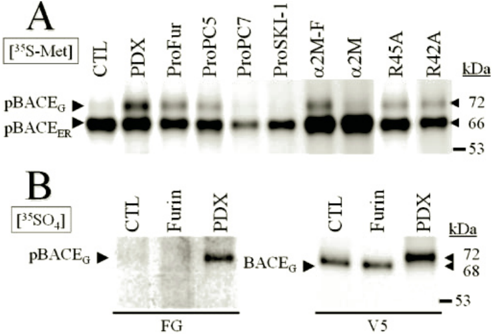
) ( A and C ) or ([BACEF]FG/ V5 1a 1-PDX) ( B and D) cDNAs. Two days post-transfections the cells were pulse-labeled in the absence or presence of 5 mM BFA for 15 min with [ 35 S]Met and then chased for 1 or 2 h. Cell lysates were immunoprecipitated with either the FG or V5 mAbs and analyzed by SDSPAGE on 8% Tricine gels. The migration position of the 53-kDa molecular mass standard and those of pro-BACE (pBACE) and BACE as well as their molecular masses are emphasized.](https://figures.cochat.ai/paper-figures/1364ddaa81664a3dbed628160cd856ec/post-translational-processing-of-secretase-amyloid-converting-enzyme-and-its-figure-1.png)
Verification
Claims the paper makes
The claims and statistics of this paper haven’t been checked yet.
Free: it reads the open-access text and checks the first 5 claims that cite a source we can check. Create a free account to check every claim.
Claims other papers make about this one
Each is checked against this paper’s own text: does it say what the citing paper says it does?
In the citing paper
“In addition, the size of the BACE1 active site is relatively large, including catalytic aspartic acid residues, flap, and 10 S loop.311”
From Amyloid β-based therapy for Alzheimer’s disease: Challenges, successes and future (2023) · cites this paper as [311]
Self-check
Percentages, sums and reported differences re-computed from the paper’s own numbers.
The self-check needs the paper’s full text.
Citations
Cites
Vassar, R., Bennett, B. D., Babu-Khan, S., Kahn, S., Mendiaz, E. A., Denis, P., Teplow, D. B., Ross, S., Amarante, P., Loeloff, R., et al. (1999) · Science · doi:10.1126/science.286.5440.735 · Cited by 3,876
Bowman, E. J., Siebers, A., & Altendorf, K. (1988) · Proceedings of the National Academy of Sciences · doi:10.1073/pnas.85.21.7972 · Cited by 1,784
Purification and cloning of amyloid precursor protein β-secretase from human brain
Sinha, S., Anderson, J. P., Barbour, R., Basi, G. S., Caccavello, R., Davis, D., Doan, M., Dovey, H. F., Frigon, N., Hong, J., et al. (1999) · Nature · doi:10.1038/990114 · Cited by 1,612
Membrane-anchored aspartyl protease with Alzheimer's disease β-secretase activity
Yan, R., Bienkowski, M. J., Shuck, M. E., Miao, H., Tory, M. C., Pauley, A. M., Brashler, J. R., Stratman, N. C., Mathews, W. R., Buhl, A. E., et al. (1999) · Nature · doi:10.1038/990107 · Cited by 1,438
Correlation Between Elevated Levels of Amyloid β-Peptide in the Brain and Cognitive Decline
Näslund, J. (2000) · JAMA · doi:10.1001/jama.283.12.1571 · Cited by 1,268
Resh, M. D. (1999) · Biochimica et Biophysica Acta (BBA) - Molecular Cell Research · doi:10.1016/s0167-4889(99)00075-0 · Cited by 1,250
Identification of a Novel Aspartic Protease (Asp 2) as β-Secretase
Hussain, I., Powell, D., Howlett, D. R., Tew, D. G., Meek, T. D., Chapman, C., Gloger, I. S., Murphy, K. E., Southan, C. D., Ryan, D. M., et al. (1999) · Molecular and Cellular Neuroscience · doi:10.1006/mcne.1999.0811 · Cited by 1,080
Lammich, S., Kojro, E., Postina, R., Gilbert, S., Pfeiffer, R., Jasionowski, M., Haass, C., & Fahrenholz, F. (1999) · Proceedings of the National Academy of Sciences · doi:10.1073/pnas.96.7.3922 · Cited by 975
Buxbaum, J. D., Liu, K.-N., Luo, Y., Slack, J. L., Stocking, K. L., Peschon, J. J., Johnson, R. S., Castner, B. J., Cerretti, D. P., & Black, R. A. (1998) · Journal of Biological Chemistry · doi:10.1074/jbc.273.43.27765 · Cited by 934
Evidence that β-Amyloid Protein in Alzheimer's Disease Is Not Derived by Normal Processing
Sisodia, S. S., Koo, E. H., Beyreuther, K., Unterbeck, A., & Price, D. L. (1990) · Science · doi:10.1126/science.1691865 · Cited by 893
Self-citation
Research works printed but not linked: 1
- Koike, H., Tomioka, S., Sorimachi, H., Saido, T. C., Maruyama, K., Okuyama, A., Fujisawa-Sehara, A., Ohno, S., Suzuki, K., and Ishiura, S. (1999) Bio- chem. J. 343, 371-375 · DOI · Paper page
Cited by
Items 301–354 of 354
Zwei neuartige Aspartylproteasen BACE-1 und BACE-2
Fluhrer, R. (2003) · Electronic Theses of LMU Munich (Ludwig-Maximilians-Universität München) · doi:10.5282/edoc.1442
Funktionelle Charakterisierung von BACE, einer für die Alzheimer Krankheit relevanten Protease
Capell, A. (2005) · edoc Publication server (Humboldt University of Berlin) · doi:10.18452/15321
Adlerz, L. (2007) · DiVA (Stockholm University)
Weber, C. (2010) · University of Vienna · doi:10.25365/thesis.8628
Modulation of BACE1 by a novel sorting nexin in Alzheimer's disease
Okada, H. (n.d.) · ProQuest Demo Repository
BACE1 Inhibitors: Attractive Therapeutics for Alzheimer’s Disease
Decourt, B., Macias, M. P., Sabbagh, M. N., & Adem, A. (2014) · Elsevier eBooks · doi:10.1016/b978-0-12-803959-5.50010-6
Alzheimer-Krankheit : Bindepartner und Prozessierung des Amyloid Precursor Proteins
Stemmer, N. (2008) · PUB – Publications at Bielefeld University (Bielefeld University)
Beta-Secretase Trangenic Mice: Effects of BACE1 and BACE2 on Alzheimer's Disease Pathogenesis
Chiocco, M. J. (2005) · OhioLink ETD Center (Ohio Library and Information Network)
The role of palmitoylation in the pathogenesis of Huntington disease
Sanders, S. S. (2014) · cIRcle (University of British Columbia) · doi:10.14288/1.0167072
The hypothalamic role of BACE1 in energy homeostasis
Jalicy, S. M. (2016) · Discovery Research Portal (University of Dundee)
Regulation of beta-amyloid secretion in vitro through p-glycoprotein
Lam, F. C. (2009) · cIRcle (University of British Columbia) · doi:10.14288/1.0090669
The effect of high glucose on APP metabolism and Abeta production
Yang, Y. (2013) · cIRcle (University of British Columbia) · doi:10.14288/1.0073763
Protein folding in the ER: the fate of β-secretase N-glycosylation mutants
Vanoni, O. (2008) · Repository for Publications and Research Data (ETH Zurich) · doi:10.3929/ethz-a-005701583
Molecular mechanism of Alzheimer's disease pathogenesis in Down syndrome
Sun, X. (2011) · cIRcle (University of British Columbia) · doi:10.14288/1.0100546
How does neuroprotective sAPPα initiate its signalling cascade
Prendergast, J. R. (2016) · Otago University Research Archive (University of Otago)
Untersuchungen zur in vivo Funktion der Aspartylprotease BACE1
Rittger, A. (2008) · MACAU: Open Access Repository of Kiel University
Nakatomi, M., & Neu, H. C. (1986) · PubMed
Seybold, M. (2016) · mediaTUM (Technical University of Munich)
Biological effects of new BACE1 inhibitors for Alzheimer's disease treatment
Figueiredo, V. R. (2019) · Portuguese National Funding Agency for Science, Research and Technology (RCAAP Project by FCT)
Wohlrab, F. W. R. (2018) · mediaTUM (Technical University of Munich)
Genetic and functional studies of genes involved in the pathogenesis of Alzheimer's disease
Natunen, T. (2014) · UEF eRepo (University of Eastern Finland)
Sarajärvi, T. (2011) · UEF eRepo (University of Eastern Finland)
Investigating the role of BACE1 in angiogenesis
Clavane, E. M. (2020) · White Rose eTheses Online (University of Leeds, The University of Sheffield, University of York)
Ex-vivo analysis platforms for amyloid precursor protein cleavagePreprint
Kamikubo, Y., Jin, H., Niisato, K., Hashimoto, Y., Takasugi, N., & Sakurai, T. (2021) · Research Square · doi:10.21203/rs.3.rs-474727/v1
Kreitlow, B. (2018) · University of Minnesota Digital Conservancy (University of Minnesota)
Yukti, Sharma, A., Dhar, S., Ojha, R., & Prajapati, V. K. (2025) · Advances in protein chemistry and structural biology · doi:10.1016/bs.apcsb.2025.11.004
Impact of A β and Tau on Cognition in Mouse Models of Alzheimer’s Disease
Koike, M. A., Myczek, K., Green, K. N., & LaFerla, F. M. (2008) · Humana Press eBooks · doi:10.1007/978-1-59745-422-3_6
Anders, A. (2001) · Gutenberg Open Science · doi:10.25358/openscience-2954
Herrera-Rivero, M. (2013) · LA Referencia (Red Federada de Repositorios Institucionales de Publicaciones Científicas) · doi:10.13140/rg.2.2.15461.24805
Jefferson, T. (2011) · Gutenberg Open Science · doi:10.25358/openscience-2126
Die Prozessierung des humanen Amyloid-Vorläuferproteins im Verlauf der replikativen Seneszenz
Kern, A. (2006) · Gutenberg Open Science · doi:10.25358/openscience-4135
Holler, C. J. (2012) · UKnowledge (University of Kentucky)
A study of PCSK9 in glucose and insulin homeostasis
Cruanès, J. (2021) · eScholarship@McGill (McGill) · doi:10.82308/14400
Function and substrates of the Alzheimer's disease protease BACE1
Rudan Njavro, J. (2019) · mediaTUM (Technical University of Munich)
Fluhrer, R. (2019) · OPUS (Augsburg University)
Efecto del tratamiento con el péptido Beta Amiloide sobre el tráfico intracelular de APP y BACE 1.
Freites, C. L. (2017) · Repositorio Digital de la UNC (National University of Cordoba)
Schieb, H. (2011) · DuEPublico (University of Duisburg-Essen)
Nour, N. (2004) · eScholarship@McGill (McGill) · doi:10.82308/7300
Characterization of the mechanisms underlying Alzheimer's disease and multiple sclerosis
Herculano, B. (2019) · cIRcle (University of British Columbia)
Therapeutics immunotargets for Tauopathy
Chinnathambi, S., & Rangappa, N. (2025) · Advances in protein chemistry and structural biology · doi:10.1016/bs.apcsb.2025.10.015
Action des rétinoïdes et processus neurodégénératifs associés à la maladie d'Alzheimer
Ghenimi, N. (2009) · theses.fr (ABES) · doi:10.70675/346f3088z3847z4c98z86a1z065540a0e093
アルツハイマー病遺伝学的危険因子BIN1によるBACE1およびAβ制御の分子機構
宮川, 統. (2014) · Institutional Repositories DataBase (IRDB) · doi:10.15083/00009144
Hanbouch, L. (2017) · theses.fr (ABES) · doi:10.70675/c4d2c894zf69dz4ae4z9ab1zf4135d0efa12
Castelot, R. (2024) · theses.fr (ABES) · doi:10.70675/c2a7ce1ez8caaz4593zbb3azae8add8055b5
The molecular basis of the interactions of copper metallochaperones
Aggarwal, S. (2011)
Scholz, D. (2011) · KOPS (University of Konstanz)
Investigation of BACE1 as a stress-induced regulator of neuronal metabolism
Findlay, J. A. (2014) · Discovery Research Portal (University of Dundee)
Kalvodova, L. (2006) · Qucosa (Saxon State and University Library Dresden)
Metadata
- Authors
- Benjannet, S., Elagoz, A., Wickham, L., Mamarbachi, M., Munzer, J. S., Basak, A., Lazure, C., Cromlish, J. A., Sisodia, S., Checler, F., Chrétien, M., & Seidah, N. G.
- Affiliations
- Montreal Clinical Research Institute (CA)
- Ottawa Hospital (CA)
- University of Chicago (US)
- Centre National de la Recherche Scientifique (FR)
- Corresponding author
- Seidah, Nabil G.
- Venue
- Journal of Biological Chemistry
- Publisher
- Elsevier BV
- Published
- 2001-04
- Volume
- 276
- Issue
- 14
- Pages
- 10879-10887
- ISSN
- 0021-9258 (ISSN-L)
- OpenAlex
- W2040252771
- Cited by
- 301
- References
- 49
- Citations by year
- 2025: 6 · 2024: 4 · 2023: 5 · 2022: 4 · 2021: 9 · 2020: 6 · 2019: 5 · 2018: 6 · 2017: 8 · 2016: 8 · 2015: 4 · 2014: 11 · 2013: 13 · 2012: 13
- FWCI
- 14.55
- Type
- journal article
- Language
- en
- Open access
- hybrid
- doi.org
- Licence
- cc-by
- www.elsevier.com/tdm/userlicense/1.0/ (tdm)
- creativecommons.org/licenses/by/4.0/ (vor, 7124 d)
- Locations
- Journal of Biological Chemistry (publishedVersion, cc-by)
- PubMed (publishedVersion)
- Funders
- Government of Canada
- Canadian Institutes of Health Research
- Topics
- Life Sciences › Neuroscience › Cellular and Molecular Neuroscience › Alzheimer's disease research and treatments
- Life Sciences › Biochemistry, Genetics and Molecular Biology › Cancer Research › Protease and Inhibitor Mechanisms
- Health Sciences › Medicine › Psychiatry and Mental health › Dementia and Cognitive Impairment Research
- Keywords
- beta-secretase, BACE, amyloid precursor protein, post-translational processing, furin, prosegment, trans-Golgi network, palmitoylation, ectodomain shedding, amyloid-beta, Alzheimer's disease, gamma-secretase, alpha-secretase, C99, endoplasmic reticulum exit
- MeSH terms
- Alzheimer Disease, Animals, Cell Line, Cell Membrane, Cytosol, Humans, Endopeptidases, Protein Processing, Post-Translational, Aspartic Acid Endopeptidases, Mice, Amyloid Precursor Protein Secretases
About these checks
Registry, retraction, Cites and statistics results are computed, not judged, with one exception: a printed reference that no index lists is read once by a model before it counts as a citation error. Claims are extracted by a model and kept only when their quote appears verbatim in the text; each cited source is then checked, with a model’s help, for whether it says what the claim relies on. Those verdicts can be wrong — read the claim’s quote and the cited source before relying on one.
Statistics and arithmetic are recomputed, not judged.
Confidence bands are shown only for fields calibrated on our annotated test set. None is calibrated yet, so no band is shown.
What counts as a claim ›How we measure confidence ›How we check this ›
Are you an author, or do you see a problem with this page? Request a review
Data sources
Bibliographic data: Semantic Scholar, OpenAlex, Crossref.
Contains information from the Semantic Scholar Academic Graph Datasets, made available under the ODC Attribution License (ODC-BY 1.0).
Semantic Scholar’s data is described in: Kinney, R., et al. (2023). The Semantic Scholar Open Data Platform. arXiv:2301.10140.
