

Hsp90-binding Immunophilins Link p53 to Dynein During p53 Transport to the Nucleus
Open accessThe DOI matches its Crossref record; 52 of the 52 references it cites were found in a registry or an index.
Abstract
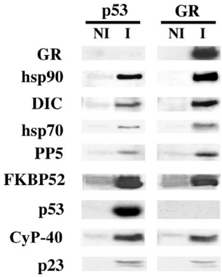
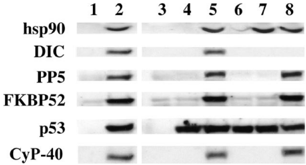
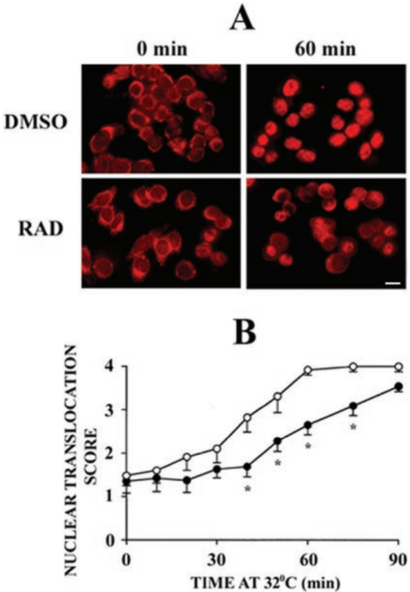
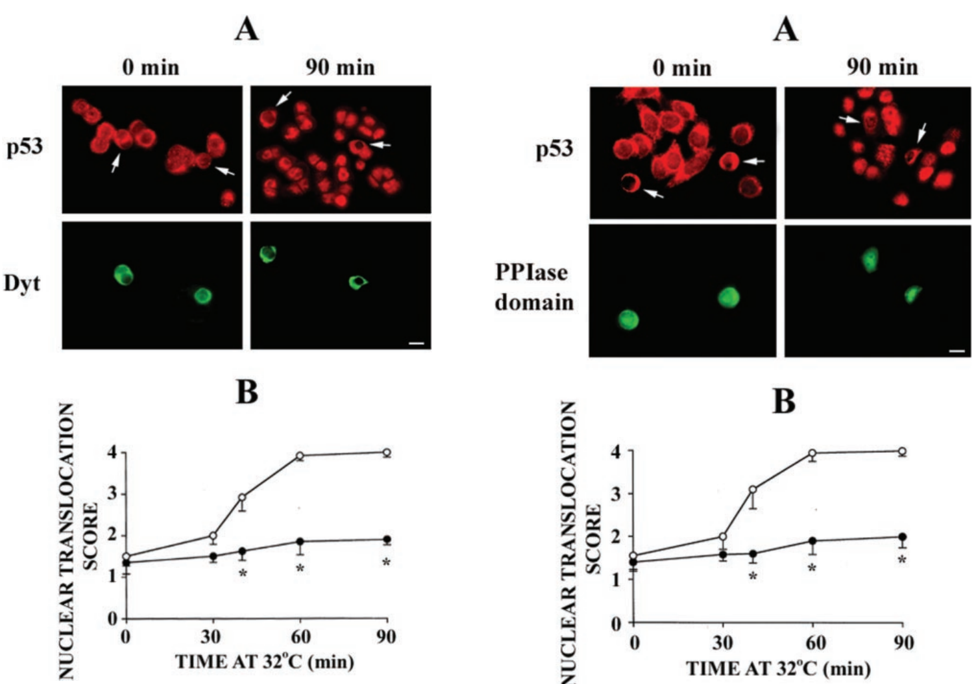
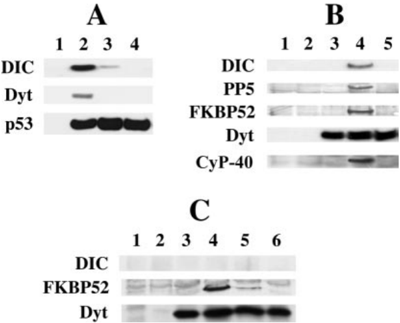
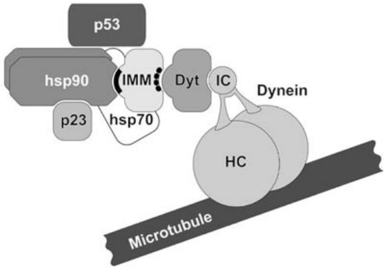
The tumor suppressor protein p53 is known to be transported to the nucleus along microtubular tracks by cytoplasmic dynein. However, the connection between p53 and the dynein motor protein complex has not been established. Here, we show that hsp90.binding immunophilins link p53.hsp90 complexes to dynein and that prevention of that linkage in vivo inhibits the nuclear movement of p53. First, we show that p53.hsp90 heterocomplexes from DLD-1 human colon cancer cells contain an immunophilin (FKBP52, CyP-40, or PP5) as well as dynein. p53.hsp90.immunophilin.dynein complexes can be formed by incubating immunopurified p53 with rabbit reticulocyte lysate, and we show by peptide competition that the immunophilins link via their tetratricopeptide repeat domains to p53-bound hsp90 and by means of their PPIase domains to the dynein complex. The linkage of immunophilins to the dynein motor is indirect by means of the dynamitin component of the dynein-associated dynactin complex, and we show that purified FKBP52 binds directly by means of its PPIase domain to purified dynamitin. By using a temperature-sensitive mutant of p53 where cytoplasmic-nuclear movement occurs by shift to permissive temperature, we show that p53 movement is impeded when p53 binding to hsp90 is inhibited by the hsp90 inhibitor radicicol. Also, nuclear movement of p53 is inhibited when immunophilin binding to dynein is competed for by expression of a PPIase domain fragment in the same manner as when dynein linkage to cargo is dissociated by expression of dynamitin. This is the first demonstration of the linkage between an hsp90-chaperoned transcription factor and the system for its retrograde movement to the nucleus both in vitro and in vivo.
Overview
The claims and statistics of this paper haven’t been checked yet.
Free: it reads the open-access text and checks the first 5 claims that cite a source we can check. Create a free account to check every claim.
Integrity signals
Registry
Cites
Statistics
Figures
Verification
Claims the paper makes
The claims and statistics of this paper haven’t been checked yet.
Free: it reads the open-access text and checks the first 5 claims that cite a source we can check. Create a free account to check every claim.
Claims other papers make about this one
Each is checked against this paper’s own text: does it say what the citing paper says it does?
The cited source says what the claim attributes to it.
In the citing paper
“The same heterocomplex described for steroid receptors is also responsible for the cytoplasmic retrotransport of the proapototic factor p53 [27], suggesting that the hsp90-based complex may play a general role in the retrotransport of a number of hsp90-associated factors towards the nuclear surface.”
From FKBP51 and FKBP52 in signaling and disease (2011) · cites this paper as [27]
Self-check
Percentages, sums and reported differences re-computed from the paper’s own numbers.
The self-check needs the paper’s full text.
Citations
Cites
p53 Mutations in Human Cancers
Hollstein, M., Sidransky, D., Vogelstein, B., & Harris, C. C. (1991) · Science · doi:10.1126/science.1905840 · Cited by 8,018
Vogelstein, B., Lane, D., & Levine, A. J. (2000) · Nature · doi:10.1038/35042675 · Cited by 6,607
The p53 tumour suppressor gene
Levine, A. J., Momand, J., & Finlay, C. A. (1991) · Nature · doi:10.1038/351453a0 · Cited by 3,788
Steroid Receptor Interactions with Heat Shock Protein and Immunophilin Chaperones*
Pratt, W. B., & Toft, D. O. (1997) · Endocrine Reviews · doi:10.1210/edrv.18.3.0303 · Cited by 1,791
Self-citationKinesin and Dynein Superfamily Proteins and the Mechanism of Organelle Transport
Hirokawa, N. (1998) · Science · doi:10.1126/science.279.5350.519 · Cited by 1,686
Pratt, W. B., & Toft, D. O. (2003) · Experimental Biology and Medicine · doi:10.1177/153537020322800201 · Cited by 1,483
Roe, S. M., Prodromou, C., O'Brien, R., Ladbury, J. E., Piper, P. W., & Pearl, L. H. (1999) · Journal of Medicinal Chemistry · doi:10.1021/jm980403y · Cited by 1,004
p53 mutations in colorectal cancer.
Rodrigues, N. R., Rowan, A., Smith, M. E., Kerr, I. B., Bodmer, W. F., Gannon, J. V., & Lane, D. P. (1990) · Proceedings of the National Academy of Sciences · doi:10.1073/pnas.87.19.7555 · Cited by 1,003
Stommel, J. M., Marchenko, N. D., Jimenez, G. S., Moll, U. M., Hope, T. J., & Wahl, G. M. (1999) · The EMBO Journal · doi:10.1093/emboj/18.6.1660 · Cited by 738
Burkhardt, J. K., Echeverri, C. J., Nilsson, T., & Vallee, R. B. (1997) · The Journal of Cell Biology · doi:10.1083/jcb.139.2.469 · Cited by 656
Two distinct mechanisms alter p53 in breast cancer: mutation and nuclear exclusion.
Moll, U. M., Riou, G., & Levine, A. J. (1992) · Proceedings of the National Academy of Sciences · doi:10.1073/pnas.89.15.7262 · Cited by 575
Cellular localization and cell cycle regulation by a temperature-sensitive p53 protein.
Martinez, J., Georgoff, I., Martinez, J., & Levine, A. J. (1991) · Genes & Development · doi:10.1101/gad.5.2.151 · Cited by 527
A New First Step in Activation of Steroid Receptors
Davies, T. H., Ning, Y.-M., & Sánchez, E. R. (2002) · Journal of Biological Chemistry · doi:10.1074/jbc.c100531200 · Cited by 427
Regulation of Hsp90 ATPase activity by tetratricopeptide repeat (TPR)-domain co-chaperones
Prodromou, C. (1999) · The EMBO Journal · doi:10.1093/emboj/18.3.754 · Cited by 425
p53 is associated with cellular microtubules and is transported to the nucleus by dynein
Giannakakou, P., Sackett, D. L., Ward, Y., Webster, K. R., Blagosklonny, M. V., & Fojo, T. (2000) · Nature Cell Biology · doi:10.1038/35036335 · Cited by 373
Peptidylprolyl Cis / Trans Isomerases (Immunophilins): Biological Diversity - Targets - Functions
Galat, A. (2003) · Current Topics in Medicinal Chemistry · doi:10.2174/1568026033451862 · Cited by 360
Nikolaev, A. Y., Li, M., Puskas, N., Qin, J., & Gu, W. (2003) · Cell · doi:10.1016/s0092-8674(02)01255-2 · Cited by 356
The Hsp90‐binding peptidylprolyl isomerase FKBP52 potentiates glucocorticoid signaling in vivo
Riggs, D. L., Roberts, P. J., Chirillo, S. C., Cheung‐Flynn, J., Prapapanich, V., Ratajczak, T., Gaber, R., Picard, D., & Smith, D. F. (2003) · The EMBO Journal · doi:10.1093/emboj/cdg108 · Cited by 353
Mutant conformation of p53 translated in vitro or in vivo requires functional HSP90.
Blagosklonny, M. V., Toretsky, J., Bohen, S., & Neckers, L. (1996) · Proceedings of the National Academy of Sciences · doi:10.1073/pnas.93.16.8379 · Cited by 314
Geldanamycin as a Potential Anti-Cancer Agent: Its Molecular Target and Biochemical Activity
Neckers, L., Schulte, T. W., & Mimnaugh, E. (1999) · Investigational New Drugs · doi:10.1023/a:1006382320697 · Cited by 301
Folding of the Glucocorticoid Receptor by the Heat Shock Protein (hsp) 90-based Chaperone Machinery
Dittmar, K. D., Demady, D. R., Stancato, L. F., Krishna, P., & Pratt, W. B. (1997) · Journal of Biological Chemistry · doi:10.1074/jbc.272.34.21213 · Cited by 268
Silverstein, A. M., Galigniana, M. D., Chen, M.-S., Owens-Grillo, J. K., Chinkers, M., & Pratt, W. B. (1997) · Journal of Biological Chemistry · doi:10.1074/jbc.272.26.16224 · Cited by 257
Sharpless, N. E., & DePinho, R. A. (2002) · Cell · doi:10.1016/s0092-8674(02)00818-8 · Cited by 250
Galigniana, M. D., Radanyi, C., Renoir, J.-M., Housley, P. R., & Pratt, W. B. (2001) · Journal of Biological Chemistry · doi:10.1074/jbc.m010809200 · Cited by 236
Specific Binding of Tetratricopeptide Repeat Proteins to the C-terminal 12-kDa Domain of hsp90
Young, J. C., Obermann, W. M. J., & Hartl, F. U. (1998) · Journal of Biological Chemistry · doi:10.1074/jbc.273.29.18007 · Cited by 227
Chen, M.-S., Silverstein, A. M., Pratt, W. B., & Chinkers, M. (1996) · Journal of Biological Chemistry · doi:10.1074/jbc.271.50.32315 · Cited by 221
Dial 9-1-1 for p53: Mechanisms of p53 Activation by Cellular Stress
Ljungman, M. (2000) · Neoplasia · doi:10.1038/sj.neo.7900073 · Cited by 221
Whitesell, L., Sutphin, P. D., Pulcini, E. J., Martinez, J. D., & Cook, P. H. (1998) · Molecular and Cellular Biology · doi:10.1128/mcb.18.3.1517 · Cited by 206
The hsp90 Chaperone Complex Regulates Intracellular Localization of the Dioxin Receptor
Kazlauskas, A., Sundström, S., Poellinger, L., & Pongratz, I. (2001) · Molecular and Cellular Biology · doi:10.1128/mcb.21.7.2594-2607.2001 · Cited by 204
New approaches to understanding p53 gene tumor mutation spectra
Hollstein, M., Hergenhahn, M., Yang, Q., Bartsch, H., Wang, Z.-Q., & Hainaut, P. (1999) · Mutation Research - Fundamental and Molecular Mechanisms of Mutagenesis · doi:10.1016/s0027-5107(99)00162-1 · Cited by 198
Silverstein, A. M., Galigniana, M. D., Kanelakis, K. C., Radanyi, C., Renoir, J.-M., & Pratt, W. B. (1999) · Journal of Biological Chemistry · doi:10.1074/jbc.274.52.36980 · Cited by 186
Self-citationInhibition of MDM2 by hsp90 Contributes to Mutant p53 Stabilization
Peng, Y., Chen, L., Li, C., Lu, W., & Chen, J. (2001) · Journal of Biological Chemistry · doi:10.1074/jbc.m102817200 · Cited by 183
Pirkl, F., & Buchner, J. (2001) · Journal of Molecular Biology · doi:10.1006/jmbi.2001.4595 · Cited by 179
Galigniana, M. D. (1998) · Molecular Endocrinology · doi:10.1210/me.12.12.1903 · Cited by 175
Cannon, J. V., & Lane, D. P. (1991) · Nature · doi:10.1038/349802a0 · Cited by 173
King, F. W. (2001) · The EMBO Journal · doi:10.1093/emboj/20.22.6297 · Cited by 167
Interaction of Radicicol with Members of the Heat Shock Protein 90 Family of Molecular Chaperones
Schulte, T. W. (1999) · Molecular Endocrinology · doi:10.1210/me.13.9.1435 · Cited by 161
Ginsberg, D., Michael-Michalovitz, D., Ginsberg, D., & Oren, M. (1991) · Molecular and Cellular Biology · doi:10.1128/mcb.11.1.582 · Cited by 142
Geldanamycin-stimulated destabilization of mutated p53 is mediated by the proteasome in vivo
Whitesell, L. J., Sutphin, P. D., An, W. G., Schulte, T. W., Blagosklonny, M. V., & Neckers, L. (1997) · Oncogene · doi:10.1038/sj.onc.1201120 · Cited by 127
Galigniana, M. D., Harrell, J. M., Murphy, P. J. M., Chinkers, M., Radanyi, C., Renoir, J.-M., Zhang, M., & Pratt, W. B. (2002) · Biochemistry · doi:10.1021/bi020399z · Cited by 117
Self-citationSepehrnia, B., Paz, I. B., Dasgupta, G., & Momand, J. (1996) · Journal of Biological Chemistry · doi:10.1074/jbc.271.25.15084 · Cited by 115
Uberti, D. L., Yavin, E., Gil, S., Kameshwar‐Rao, A. S. V. R., Goldfinger, N., & Rotter, V. (1999) · Molecular Brain Research · doi:10.1016/s0169-328x(98)00339-8 · Cited by 95
Owens-Grillo, J. K., Stancato, L. F., Hoffmann, K., Pratt, W. B., & Krishna, P. (1996) · Biochemistry · doi:10.1021/bi9615349 · Cited by 81
hsp90 Is Required for Heme Binding and Activation of Apo-Neuronal Nitric-oxide Synthase
Billecke, S. S., Bender, A. T., Kanelakis, K. C., Murphy, P. J. M., Lowe, E. R., Kamada, Y., Pratt, W. B., & Osawa, Y. (2002) · Journal of Biological Chemistry · doi:10.1074/jbc.m201940200 · Cited by 78
Nuclear Exclusion of Wild-Type p53 in Immortalized Human Retinoblastoma Cells
Schlamp, C. L., Poulsen, G. L., Nork, T. M., & Nickells, R. W. (1997) · JNCI Journal of the National Cancer Institute · doi:10.1093/jnci/89.20.1530 · Cited by 75
Komarova, E. A., Zelnick, C. R., Chin, D., Zeremski, M., Gleiberman, A. S., Bacus, S. S., & Gudkov, A. V. (1997) · PubMed · Cited by 55
Vallee, R. B., & Gee, M. A. (1998) · Trends in Cell Biology · doi:10.1016/s0962-8924(98)01379-8 · Cited by 53
Harrell, J. M., Kurek, I., Breiman, A., Radanyi, C., Renoir, J.-M., Pratt, W. B., & Galigniana, M. D. (2002) · Biochemistry · doi:10.1021/bi020073q · Cited by 53
The Tumor Suppressor p53 Can Both Stimulate and Inhibit Ultraviolet Light–induced Apoptosis
McKay, B. C., Chen, F., Perumalswami, C. R., Zhang, F., & Ljungman, M. (2000) · Molecular Biology of the Cell · doi:10.1091/mbc.11.8.2543 · Cited by 53
Merchant, A. K., Loney, T. L., & Maybaum, J. (1996) · PubMed · Cited by 47
David-Pfeuty, T., Chakrani, F., Ory, K., & Nouvian-Dooghe, Y. (1996) · PubMed · Cited by 41
The Mammalian Heat Shock Protein Binding Immunophilin (p59/HBI) Is an ATP and GTP Binding Protein
Lebihan, S., Renoir, J., Radanyi, C., Chambraud, B., Joulin, V., CATELLI, M. G., & Baulieu, E. E. (1993) · Biochemical and Biophysical Research Communications · doi:10.1006/bbrc.1993.2088 · Cited by 39
Research works printed but not linked: 7
- David-Pfeuty, T., Chakrani, F., Ory, K., and Nouviandooghe, Y. (1996) Cell Growth Differ. 7, 1211-1225
- Komarova, E. A., Zelnick, C. R., Chin, D., Zeremeski, M., Gleiberman, A. S., Bacus, S. S., and Gudkor, A. V. (1997) Cancer Res. 57, 5217-5220
- Galigniana, M. D., Scruggs, J. L., Herrington, J., Welsh, M. J., Carter-Su, C., Housley, P. R., and Pratt, W. B. (1998) Mol. Endocrinol. 12, 1903-1913 · doi:10.1210/mend.12.12.0204 · Paper page
- Merchant, A. K., Loney, T. L., and Maybaum, J. (1996) Oncogene 13, 2631-2637
- Ginsberg, D., Michael-Michalovitz, D., Ginsberg, D., and Oren, M. (1991) Mol. Cell Biol. 11, 582-585
- Schulte, T. W., Akinaga, S., Murakata, T., Agatsuma, T., Sugimoto, S., Na- kano, H., Lee, Y. S., Simen, B. B., Argon, Y., Felts, S., Toft, D. O., Neckers, L. M., and Sharma, S. (1999) Mol. Endocrinol. 13, 1435-1448 · doi:10.1210/mend.13.9.0339 · Paper page
- Pratt, W. B., and Toft, D. O. (1997) Endocr. Rev. 18, 306 -360
Cited by
Wochnik, G. M., Rüegg, J., Abel, G. A., Schmidt, U., Holsboer, F., & Rein, T. (2005) · Journal of Biological Chemistry · doi:10.1074/jbc.m407498200 · Cited by 638
Microtubules and Their Role in Cellular Stress in Cancer
Parker, A. L., Kavallaris, M., & McCarroll, J. A. (2014) · Frontiers in Oncology · doi:10.3389/fonc.2014.00153 · Cited by 440
The glucocorticoid responses are shaped by molecular chaperones
Grad, I., & Picard, D. (2007) · Molecular and Cellular Endocrinology · doi:10.1016/j.mce.2007.05.018 · Cited by 423
Understanding microtubule dynamics for improved cancer therapy
Honore, S., Pasquier, E., & Braguer, D. (2005) · Cellular and Molecular Life Sciences CMLS · doi:10.1007/s00018-005-5330-x · Cited by 319
FKBP51 and FKBP52 in signaling and disease
Storer, C. L., Dickey, C. A., Galigniana, M. D., Rein, T., & Cox, M. B. (2011) · Trends in Endocrinology & Metabolism · doi:10.1016/j.tem.2011.08.001 · Cited by 266
“The same heterocomplex described for steroid receptors is also responsible for cytoplasmic retrotransport of the proapototic factor p53 [27], which suggests that the HSP90-based complex may play a general role in the retrotransport of a number of HSP90-associated factors towards the nuclear surface.”
Metadata
- Authors
- Galigniana, M. D., Harrell, J. M., O'Hagen, H. M., Ljungman, M., & Pratt, W. B.
- Affiliations
- Consejo Nacional de Investigaciones Científicas y Técnicas (AR)
- University of Michigan (US)
- Corresponding author
- Pratt, William B.
- Venue
- Journal of Biological Chemistry
- Publisher
- Elsevier BV
- Published
- 2004-05
- Volume
- 279
- Issue
- 21
- Pages
- 22483-22489
- ISSN
- 0021-9258 (ISSN-L)
- OpenAlex
- W2171230661
- Cited by
- 150
- References
- 52
- Citations by year
- 2026: 1 · 2024: 4 · 2023: 3 · 2022: 5 · 2021: 6 · 2019: 8 · 2018: 5 · 2017: 5 · 2016: 4 · 2015: 8 · 2014: 7 · 2013: 5 · 2012: 10
- FWCI
- 4.63
- Type
- journal article
- Language
- en
- Open access
- hybrid
- doi.org
- Licence
- cc-by
- www.elsevier.com/tdm/userlicense/1.0/ (tdm)
- creativecommons.org/licenses/by/4.0/ (vor, 5988 d)
- Locations
- Journal of Biological Chemistry (publishedVersion, cc-by)
- PubMed (publishedVersion)
- Repositorio Digital Institucional de la Universidad de Buenos Aires (Universidad de Buenos Aires) (publishedVersion, other-oa)
- LA Referencia (Red Federada de Repositorios Institucionales de Publicaciones Científicas) (publishedVersion, other-oa)
- Americanae (AECID Library) (submittedVersion, cc-by-nc-sa)
- Greater South Information System
- Funders
- National Institutes of Health (5r01ca082376-04, P60DK20572, CA28010)
- National Cancer Institute (R01CA028010, CA-82376, CA 28010)
- National Institute of Diabetes and Digestive and Kidney Diseases (P60DK020572, P60 DK 20572)
- Fondo para la Investigación Científica y Tecnológica
- Topics
- Life Sciences › Biochemistry, Genetics and Molecular Biology › Molecular Biology › Heat shock proteins research
- Health Sciences › Medicine › Oncology › Cancer-related Molecular Pathways
- Life Sciences › Biochemistry, Genetics and Molecular Biology › Cell Biology › Microtubule and mitosis dynamics
- Keywords
- p53, HSP90, immunophilins, cytoplasmic dynein, nuclear transport, FKBP52, protein phosphatase 5, dynamitin, dynactin, tetratricopeptide repeat domain, PPIase domain, radicicol, microtubule motor proteins, tumor suppressor proteins
- MeSH terms
- Adsorption, Binding, Competitive, Cell Line, Cell Nucleus, Cells, Cultured, Cytoplasm, Cytosol, Humans, Lactones, Microscopy, Fluorescence, Microtubules, Models, Biological, Mutation, Peptides, Protein Binding, Quinones, Temperature, Time Factors, Transfection, Tumor Suppressor Protein p53, Benzoquinones, Protein Structure, Tertiary, HSP90 Heat-Shock Proteins, Macrolides, Immunophilins, Active Transport, Cell Nucleus, Tacrolimus Binding Proteins, Cell Line, Tumor, Lactams, Macrocyclic
About these checks
Registry, retraction, Cites and statistics results are computed, not judged, with one exception: a printed reference that no index lists is read once by a model before it counts as a citation error. Claims are extracted by a model and kept only when their quote appears verbatim in the text; each cited source is then checked, with a model’s help, for whether it says what the claim relies on. Those verdicts can be wrong — read the claim’s quote and the cited source before relying on one.
Statistics and arithmetic are recomputed, not judged.
Confidence bands are shown only for fields calibrated on our annotated test set. None is calibrated yet, so no band is shown.
What counts as a claim ›How we measure confidence ›How we check this ›
Are you an author, or do you see a problem with this page? Request a review
Data sources
Bibliographic data: Semantic Scholar, OpenAlex, Crossref.
Contains information from the Semantic Scholar Academic Graph Datasets, made available under the ODC Attribution License (ODC-BY 1.0).
Semantic Scholar’s data is described in: Kinney, R., et al. (2023). The Semantic Scholar Open Data Platform. arXiv:2301.10140.
